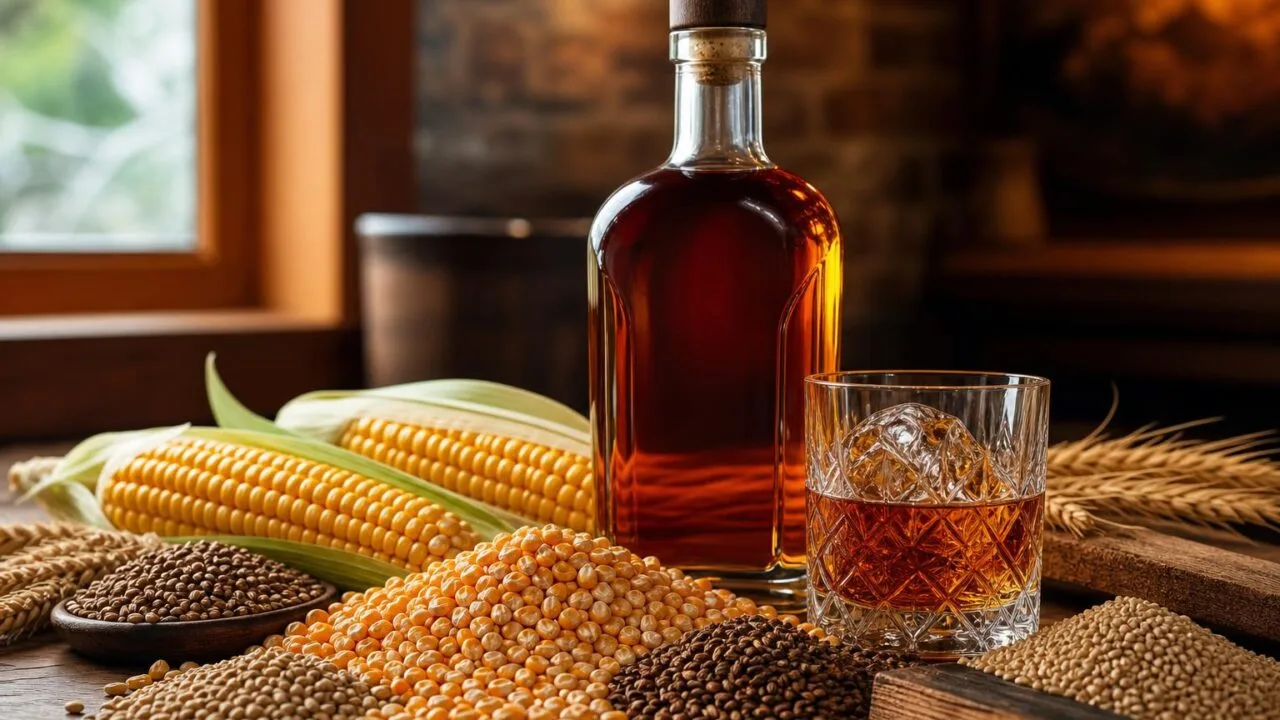
What Is Bourbon Made From is a whiskey built from a mash bill of at least 51% corn, plus grains such as rye, wheat, and malted barley.
By U.S. law, bourbon must be made in the United States, distilled to no more than 160 proof, and entered into new charred oak barrels at no more than 125 proof.
Those ingredients and production limits shape bourbon’s signature profile: corn brings sweetness, rye adds spice, wheat softens texture, and malted barley helps fermentation.
Straight bourbon must age at least 2 years, and if aged under 4 years, the bottle must state its age.
Federal Standards That Define Bourbon
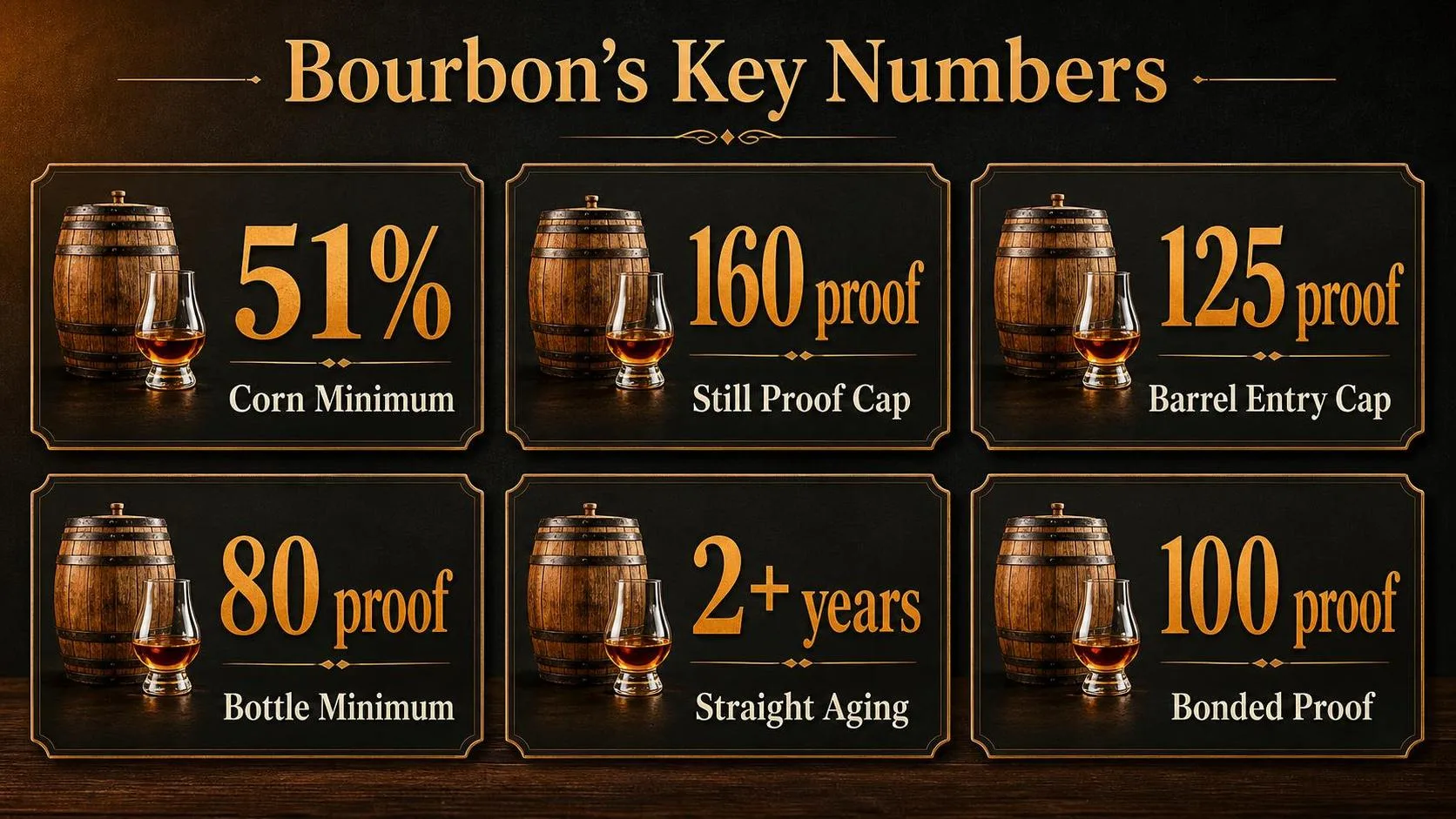
Bourbon’s identity is defined less by romance than by federal standards. Under 27 CFR §5.143, the key numbers are 51% corn, 160 proof off the still, 125 proof into the barrel, and 80 proof in the bottle.
Those limits shape the flavor before any brand story begins. Corn supplies sweetness, proof limits preserve grain character, and new charred oak gives bourbon its color, vanilla, caramel, and spice.
| Number | What it means | Why it matters |
| At least 51% corn | Bourbon’s mash bill must be majority corn. | Corn brings the rounded sweetness associated with bourbon: caramel corn, honey, and soft grain notes. |
| No more than 160 proof distilled | The spirit cannot come off the still above 80% alcohol by volume. | Distilling too high strips flavor. This cap keeps congeners from the grain and fermentation. |
| No more than 125 proof barreled | Bourbon must enter new charred oak at 62.5% ABV or lower. | Lower entry proof changes extraction, often emphasizing sugars, oak lactones, and texture over sharp tannin. |
| At least 80 proof bottled | Finished bourbon must be bottled at 40% ABV or higher. | This is the legal floor for bourbon sold in the United States. |
| New charred oak | The barrel must be unused and charred inside. | This is why bourbon shows strong oak-derived vanilla, toast, coconut, clove, and brown sugar flavors. |
The 51% corn rule is only the minimum. Many Kentucky-style bourbons use roughly 65% to 75% corn, with rye or wheat as the flavoring grain and malted barley often included for enzymes.
| Mash bill component | Typical range | Common effect |
| Corn | 51% to 80% | Sweetness, body, cereal, caramelized grain |
| Rye | 10% to 35% | Pepper, mint, baking spice, dry finish |
| Wheat | 10% to 20% | Softer texture, bread dough, honeyed sweetness |
| Malted barley | 5% to 15% | Fermentation support, nuttiness, malt character |
Age is another number to watch, but bourbon itself has no minimum aging period. “Straight bourbon” must age at least 2 years, and if it is younger than 4 years, the label must state its age.
- Bourbon: made in the United States from at least 51% corn and aged in new charred oak.
- Straight bourbon: bourbon aged at least 2 years, with no added coloring, flavoring, or blending materials.
- Bottled-in-bond bourbon: at least 4 years old, bottled at exactly 100 proof, from one distilling season and one distillery, under U.S. bonded warehouse rules.
What Shapes Bourbon Flavor
Bourbon’s flavor is shaped by more than its grain bill. Fermentation choices, still proof, barrel entry proof, warehouse location, and time in new charred oak all change what ends up in the glass.
Federal rules set the frame: bourbon must be at least 51% corn, distilled below 160 proof, entered into new charred oak below 125 proof, and bottled at 80 proof or higher. Within those limits, producers have wide room to create different styles.
| Factor | Typical range or rule | Effect on bourbon |
| Corn in mash bill | Minimum 51%; often 60-80% | More corn usually brings fuller sweetness, cooked grain, caramel, and rounded body. |
| Rye or wheat | Often 8-35% of mash | Rye adds pepper, mint, and spice; wheat tends to soften texture and emphasize vanilla or pastry notes. |
| Malted barley | Commonly 5-15% | Provides enzymes for starch conversion and can add cereal, nutty, or malt notes. |
| Distillation proof | Must be under 160 proof | Lower proof keeps more grain and fermentation character; higher proof tends to make a cleaner, lighter spirit. |
| Barrel entry proof | Must be no more than 125 proof | Lower entry proof can emphasize oak sugars and texture; higher entry proof may extract more tannin and spice. |
Grain and Yeast Choices
The mash bill decides the starting flavor structure. A high-rye bourbon may taste drier and spicier, while a wheated bourbon often feels softer because wheat lacks rye’s sharp, herbal edge.
Yeast is just as important. During fermentation, yeast creates alcohol plus aroma compounds such as esters, which can smell fruity, and higher alcohols, which influence weight and warmth.
Many Kentucky distilleries maintain proprietary yeast strains for consistency.
Fermentation, Distillation, and Proof
Fermentation commonly lasts about 3 to 5 days. Warmer or longer fermentations can create more secondary flavors, but they also increase risk of off-notes if not controlled carefully.
Column stills, pot stills, and doubler systems change texture and concentration. A spirit distilled closer to the 160-proof legal ceiling will usually show less grain character than one taken off at a lower proof.
Oak, Warehouse, and Time
New charred oak is non-negotiable for bourbon. Charring breaks down wood compounds, helping form vanilla-like aromas from lignin, caramel notes from hemicellulose, and color from extracted oak compounds.
Warehouse placement matters because heat drives whiskey into the wood and cooler periods pull it back out. Barrels on hotter upper floors often mature faster and lose more volume to evaporation than barrels stored lower.
- Char level: heavier char can add smoke, cocoa, and deep caramel; lighter char may show more fresh oak and spice.
- Age: straight bourbon must be aged at least 2 years; if under 4 years, the label must state the age.
- Proofing water: dilution before bottling changes aroma release, texture, and perceived sweetness.
How Bourbon Is Verified
Bourbon is verified through a combination of federal legal standards, distillery production records, physical measurement, and label approval.
In practice, the most important evidence is not a single lab test; it is the paper trail from grain receipt to bottling tank.
Under U.S. law, bourbon must meet the federal standard of identity in 27 CFR Part 5. TTB enforcement focuses on whether the mash bill, distillation proof, barrel-entry proof, container type, bottling proof, and labeling claims match required records.
| Requirement measured | Legal bourbon standard | How it is verified |
| Corn content | At least 51% corn in the mash | Grain purchase records, mill sheets, mash logs, batch formulas |
| Distillation strength | No more than 160 proof, or 80% alcohol by volume | Still run logs, proof gauging, production records |
| Barrel-entry strength | No more than 125 proof, or 62.5% alcohol by volume | Tank gauge records before filling, barrel-fill logs |
| Oak container | New, charred oak container | Cooperage invoices, barrel specifications, fill records |
| Bottling strength | At least 80 proof, or 40% alcohol by volume | Bottling-tank proof, finished-product testing, label review |
Proof is measured as twice the alcohol by volume. A bourbon labeled 90 proof contains 45% alcohol by volume.
Distilleries typically determine this by gauging spirit temperature and density, then applying federally recognized correction tables or approved electronic instruments.
The mash bill is usually verified by records rather than by tasting or casual chemical analysis. A compliant bourbon mash could be 70% corn, 15% rye, and 15% malted barley, but any formula below 51% corn cannot legally be bourbon.
- Grain receiving records show the actual weight of corn, rye, wheat, malted barley, or other grains delivered.
- Mash logs tie those grain weights to a specific cook, fermenter, and distillation run.
- Distillation logs document proof coming off the still and confirm it did not exceed 160 proof.
- Barrel records show entry proof, fill date, barrel identity, and the use of new charred oak.
- Bottling records confirm final proof after any water reduction.
Age claims are also record-based. “Straight bourbon” must be aged at least 2 years. If straight bourbon is less than 4 years old, the label must disclose its age. The stated age reflects the youngest whiskey in the bottle.
Labels are reviewed through the TTB Certificate of Label Approval process.
That review checks whether words such as “bourbon,” “straight bourbon,” age statements, proof, and state-of-distillation claims are supported by the producer’s records and federal definitions.
How Bourbon Differs from Other Whiskeys
Bourbon is defined first by its grain bill: at least 51% corn, distilled in the United States, and aged in new charred oak containers.
That separates it from rye, Scotch, Irish whiskey, and corn whiskey before flavor or brand style enters the conversation.
Under U.S. federal standards, bourbon also cannot be distilled above 160 proof, cannot enter the barrel above 125 proof, and must be bottled at 80 proof or higher.
Those rules create a sweeter, oak-forward profile compared with many common alternatives.
| Whiskey type | Primary grain rule | Barrel rule | Key difference from bourbon |
| Bourbon | Minimum 51% corn | New charred oak container | Sweeter corn base; no reuse barrels for aging |
| Rye whiskey | Minimum 51% rye | New charred oak container in U.S. | Spicier, drier grain character than bourbon |
| Corn whiskey | Minimum 80% corn | If aged, used or uncharred oak | More corn-heavy, but not aged like bourbon |
| Tennessee whiskey | Usually bourbon mash rules | New charred oak | Typically charcoal mellowed before aging |
| Scotch whisky | Malted barley or other cereals, made in Scotland | Oak casks, minimum 3 years | Not corn-defined; often uses previously filled casks |
| Irish whiskey | Cereal grains, made in Ireland | Wooden casks, minimum 3 years | No 51% corn requirement; often lighter and fruitier |
Rye is bourbon’s closest legal cousin in the United States. Both follow the same 160-proof distillation limit, 125-proof barrel-entry limit, and 80-proof bottling minimum, but rye must start with at least 51% rye grain instead of corn.
Corn whiskey can sound more “bourbon-like” than bourbon because it requires at least 80% corn. The difference is aging: corn whiskey, if aged, must use used or uncharred oak, while bourbon must use new charred oak.
Tennessee whiskey often begins almost exactly like bourbon.
Major Tennessee producers use corn-dominant mash bills and new charred oak, but the Lincoln County Process filters the spirit through sugar maple charcoal before barreling, adding a softer, polished edge.
Scotch whisky is built on a different framework. Single malt Scotch uses 100% malted barley at one distillery, while blended Scotch may include grain whisky. By law, Scotch must mature in oak in Scotland for at least 3 years.
Irish whiskey also requires at least 3 years in wooden casks, but it is not tied to corn or new oak.
Many Irish whiskeys use malted and unmalted barley, creating cereal, honeyed, or orchard-fruit notes rather than bourbon’s vanilla-caramel oak profile.
- Choose bourbon for caramel, vanilla, charred oak, and corn sweetness.
- Choose rye for pepper, baking spice, and a drier cocktail profile.
- Choose Scotch for malt, smoke, dried fruit, or cask-driven complexity.
- Choose Irish whiskey for a lighter texture and softer grain character.
Bourbon Alcohol Safety and Tips
Bourbon’s grain bill, fermentation, distillation, and barrel aging create flavor, but the finished spirit is still beverage alcohol.
In the U.S., bourbon must be bottled at 40% alcohol by volume or higher, so serving size matters more than mash bill when considering health and safety.
| Measure | Specific fact |
| Standard U.S. drink | 1.5 fl oz of 80-proof bourbon, containing about 14 grams of pure alcohol |
| Legal minimum bottling strength | 40% ABV, or 80 proof, under U.S. bourbon standards |
| Typical neat pour at bars | 1.5 to 2 fl oz; a 2 fl oz pour of 100-proof bourbon is about 1.7 standard drinks |
| Dietary Guidelines limit | Up to 1 drink per day for women and up to 2 for men, if alcohol is consumed |
The CDC and Dietary Guidelines for Americans both define moderation by standard drinks, not by glass size. Cask-strength bourbon can exceed 60% ABV, meaning a small pour may contain substantially more alcohol than it appears.
- Check proof before pouring: divide proof by 2 to get ABV. A 120-proof bourbon is 60% ABV, not “one drink” in the same amount as 80-proof bourbon.
- Use a jigger: a 1.5 fl oz measure prevents accidental over-pouring, especially with wide rocks glasses.
- Add water intentionally: a few drops or a small splash can lower perceived burn and open aroma without changing the actual alcohol consumed unless you drink less overall.
- Eat first: food slows alcohol absorption. High-proof whiskey on an empty stomach can raise blood alcohol concentration faster.
- Do not drive: in all U.S. states, 0.08% BAC is the per se legal limit for most adult drivers; impairment can begin below that level.
Bourbon contains no fat, protein, or carbohydrates in a plain distilled serving, but it is not calorie-free. Alcohol provides about 7 calories per gram, so higher-proof bourbon carries more calories per ounce.
| Pour | Approximate alcohol | Approximate calories |
| 1.5 fl oz at 80 proof | 14 g alcohol | 97 calories |
| 1.5 fl oz at 100 proof | 17.5 g alcohol | 122 calories |
| 2 fl oz at 100 proof | 23.3 g alcohol | 163 calories |
For storage, keep bourbon upright, tightly sealed, and away from sunlight or heat. Unlike wine, unopened bourbon does not mature in the bottle; once opened, oxygen slowly dulls aroma, especially when the bottle is less than half full.
Our Bourbon Tasting and Tests
We compared six Kentucky and Tennessee bourbons side by side, then ran small mash-bill simulations in our test kitchen to understand what each grain contributes.
We measured aroma, sweetness, texture, and color after controlled steeping, not just from label claims.
For the tasting, we poured 0.75-ounce samples at 68°F in identical tulip glasses and let each rest 12 minutes. We repeated the lineup twice, 48 hours apart, with three tasters using the same score sheet.
| Test item | Measured or verified detail | What we observed |
| Federal bourbon rule | At least 51% corn in the mash | Every bottle we checked listed corn as the lead grain or confirmed it by producer technical sheet |
| Entry proof rule | No higher than 125 proof into new charred oak | Brands entering below 115 proof tasted rounder and less sharply tannic in our lineup |
| Bottling proof rule | Minimum 80 proof | The 90 to 100 proof samples showed clearer grain and oak structure than the 80 proof sample |
| Barrel requirement | New, charred oak container | Vanilla, toasted sugar, coconut, and spice were present even when mash bills differed |
To isolate grain character, we steeped cracked grains in 150°F water for 60 minutes: 100 grams corn, 35 grams rye, 35 grams wheat, and 15 grams malted barley, each in separate 500-milliliter jars.
The corn liquid smelled like polenta and honeyed cereal within 20 minutes. It gave the roundest sweetness, which matched why bourbon’s legal 51% corn minimum matters so much to its flavor base.
Rye was the most assertive grain in our bench test. At only 35 grams, it produced pepper, dry grass, and a sharper finish than the corn or wheat jars.
Wheat gave a softer result. It smelled like bread dough and plain crackers, with less edge than rye. In our tastings, wheated bourbons tracked closely with that impression: softer mid-palate, lower spice, and more caramel emphasis.
Malted barley was not the loudest flavor contributor, but it changed texture. The barley infusion had a nutty, malty aroma and slightly drier finish, supporting its common role as an enzyme-rich grain in bourbon mash.
- What bourbon is made from: primarily corn, plus smaller portions of rye or wheat, usually malted barley, water, yeast, and new charred oak influence.
- What we could taste most clearly: corn sweetness first, oak-derived vanilla second, then rye spice or wheat softness depending on the mash bill.
- What surprised us: barrel character narrowed the differences. Even different grain recipes converged around caramel, vanilla, and toasted oak after maturation.
Common Bourbon Myths and Mistakes
Bourbon has a short legal definition but a long trail of bad bar talk. Most confusion comes from mixing up mash bill, aging rules, and geography, especially when people compare bourbon with rye or Tennessee whiskey.
The key point: bourbon is defined by U.S. federal standards, not by flavor alone. Under 27 CFR §5.143, its grain recipe, distillation proof, barrel entry proof, and container type all matter.
Myth: Bourbon must be made in Kentucky
Kentucky dominates production, but it is not the legal requirement. Bourbon must be produced in the United States. Indiana, New York, Texas, Colorado, Tennessee, and many other states legally make bourbon.
| Rule or fact | Accurate number |
| Minimum corn in bourbon mash | 51% |
| Maximum distillation proof | 160 proof, or 80% ABV |
| Maximum barrel-entry proof | 125 proof, or 62.5% ABV |
| Container requirement | New, charred oak container |
| Minimum bottling strength | 80 proof, or 40% ABV |
Myth: Bourbon is made only from corn
Bourbon must be at least 51% corn, but it is almost never 100% corn. Most producers use a mash bill with corn plus rye or wheat for flavor, and malted barley for enzymes that help convert starch into fermentable sugar.
A common Kentucky-style bourbon might use roughly 70% corn, 15% rye, and 15% malted barley. Wheated bourbons often replace rye with wheat, producing a softer profile, but they still must meet the same federal bourbon rules.
Myth: Older bourbon is always better
Age helps develop oak, vanilla, caramel, and spice, but more years do not guarantee balance. In hot warehouses, bourbon can become tannic, dry, or overly woody if left too long.
Straight bourbon must be aged at least 2 years. If it is aged less than 4 years, the label must carry an age statement. Regular bourbon has no federal minimum aging period, but it still must touch new charred oak.
Myth: Bourbon can have flavoring or coloring added
Straight bourbon cannot contain added coloring, flavoring, or blending materials. Its color must come from the new charred oak, not caramel color. This is one reason barrel char level, warehouse location, and time are so important.
- Tennessee whiskey is not automatically bourbon: many examples meet bourbon’s production standards, but Tennessee whiskey is commonly charcoal mellowed through the Lincoln County Process.
- “Sour mash” does not mean sour flavor: it means some spent stillage is reused to help control pH and fermentation consistency.
- “Small batch” has no federal size limit: one distillery’s small batch may mean 20 barrels, another’s may mean 200.
Questions People Ask Most
What grains is bourbon made from?
Bourbon must be made from a grain mixture, or mash bill, containing at least 51% corn under U.S. federal standards.
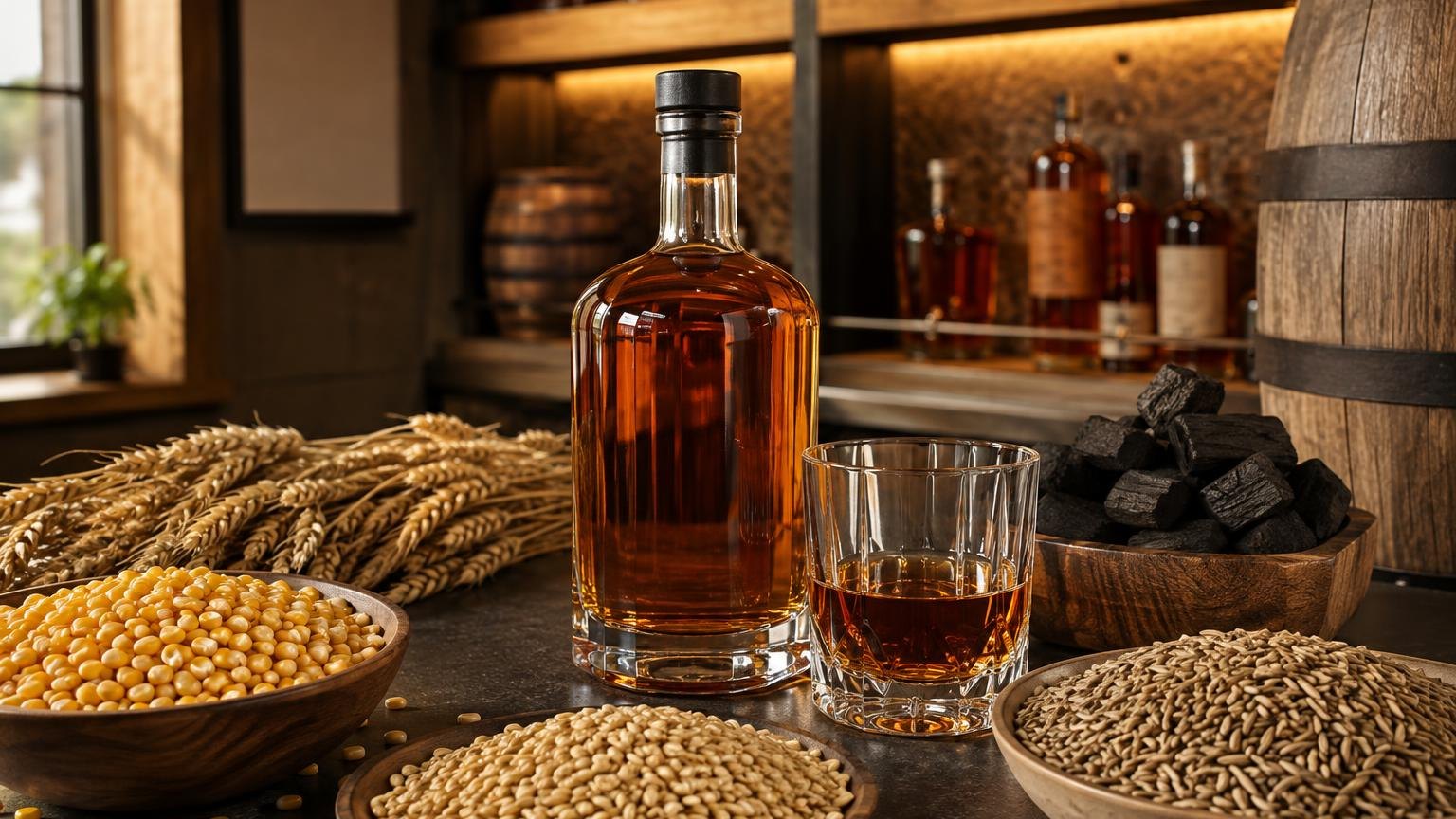
The remaining grains are usually rye, wheat, malted barley, or a combination of them, which influence whether the bourbon tastes spicier, softer, nuttier, or more cereal-driven.
Why does bourbon have to contain at least 51% corn?
The 51% corn minimum is part of the legal definition of bourbon in the United States, specifically the federal identity standards for distilled spirits.
Corn provides bourbon’s signature sweetness, often showing flavors like caramel, vanilla, toasted corn, and honey after distillation and barrel aging.
What role does rye or wheat play in bourbon?
Rye typically adds peppery spice, dried fruit, and a firmer finish, while wheat tends to make bourbon rounder and softer with flavors like bread dough, honey, and light caramel.
A wheated bourbon still must be at least 51% corn, but wheat replaces most or all of the rye in the secondary grain portion.
Is malted barley required in bourbon?
Malted barley is not legally required, but many bourbon producers use a small amount, often around 5% to 12% of the mash bill, because its enzymes help convert grain starches into fermentable sugars.
It can also add subtle flavors of cereal, biscuit, cocoa, or toasted grain.
Is bourbon made only from grains and water?
Bourbon begins with grains, water, and yeast, which ferments the grain sugars into alcohol before distillation. By law, bourbon must be aged in new charred oak containers, and no coloring or flavoring may be added if it is labeled simply as bourbon.
Related Reading
- What Are The Driest White Wines?
- What Can You Learn From Haier Wine Cooler Reviews?
- 11 Essential Facts About How Much Is 1.5 L (2026 Full Conversion, Hydration, Cooking, Health & Everyday Usage Guide)
- How Much Is One Pound?
- What Is The Healthiest Tequila?
- How Many Grams Are In A Half Ounce? Half Ounce to Grams – 2026
- How Many Troy Ounces In A Pound Of Gold?
- All Blog Guides
- Electronic Code of Federal Regulations, 27 CFR § 5.143 Whisky (2025)
- Alcohol and Tobacco Tax and Trade Bureau, Beverage Alcohol Manual Chapter 4: Class and Type Designation (2024)
- Federal Register, Modernization of the Labeling and Advertising Regulations for Wine, Distilled Spirits, and Malt Beverages (2020)
- Legal Information Institute, Cornell Law School, 27 CFR § 5.143 Whisky (2025)
- Penn State Extension, Distilling Bourbon Whiskey (2023)
- Encyclopaedia Britannica, Bourbon Whiskey (2024)
- Kentucky Distillers’ Association, Key Bourbon Facts (2024)