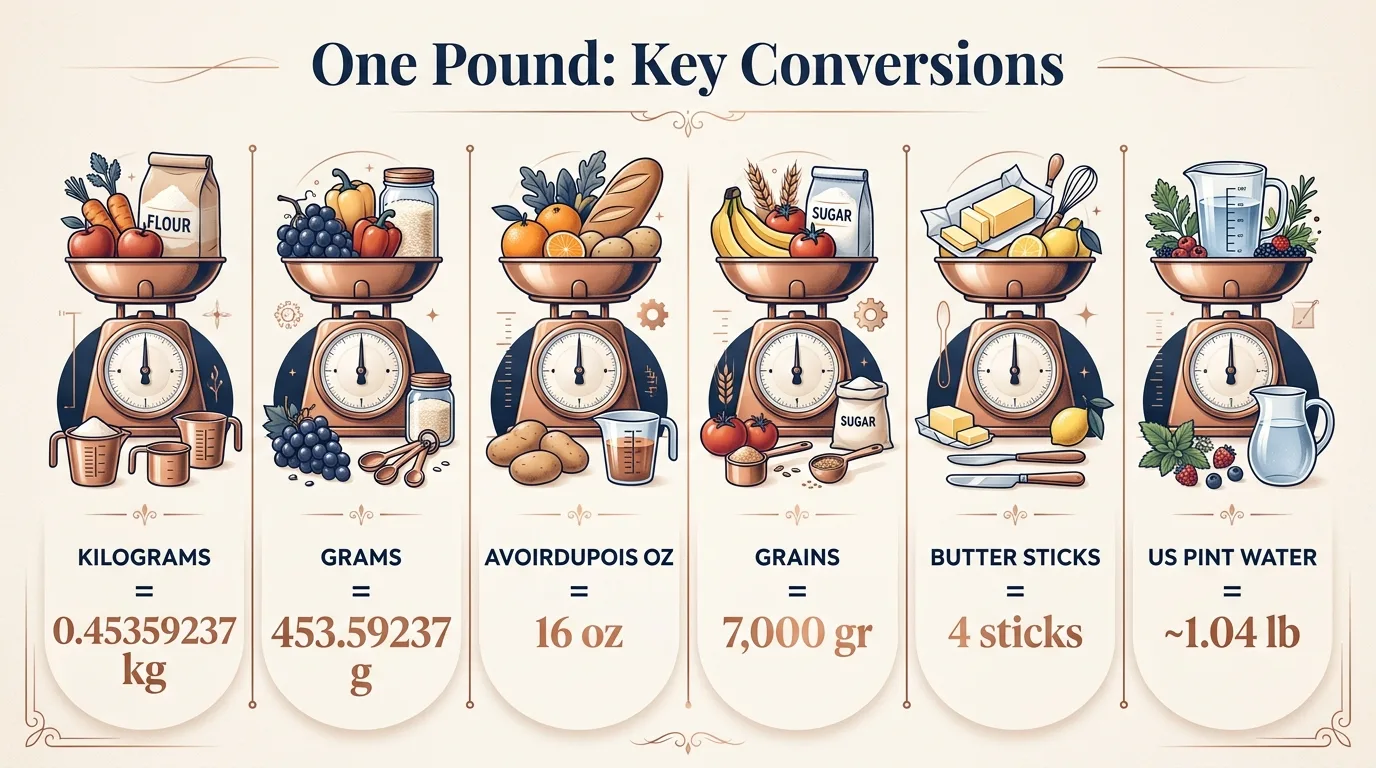
How Much Is One Pound is 16 ounces. In U.S. customary weight, that equals exactly 0.45359237 kilograms, or 453.59237 grams, because the international avoirdupois pound was fixed by agreement in 1959 for consistent trade and measurement.
Use it to compare grocery labels, shipping weights, body weight, recipes, produce, meat, and bulk goods: one pound of any material has the same mass, though its volume changes with density.
This guide converts pounds to ounces, grams, kilograms, and practical everyday portions.
Where the Standard Pound Is Used
A pound in everyday U.S. use means the international avoirdupois pound, the standard unit used for groceries, shipping labels, luggage, and body weight. Its metric value is exact, not rounded by custom.
The definition traces to the 1959 international yard and pound agreement; NIST Handbook 44, Appendix C, uses the same exact conversion for U.S. weights and measures.
| Quantity | Exact or standard value | What it means in practice |
| 1 pound | 0.45359237 kilogram exactly | Use this for precise metric conversion. |
| 1 pound | 453.59237 grams exactly | Most kitchen scales display this as about 454 g. |
| 1 pound | 16 avoirdupois ounces exactly | This is the ounce used for food and most packaged goods. |
| 1 pound | 7,000 grains exactly | Grains are still used in ammunition and some pharmacy contexts. |
The word “ounce” can cause confusion because weight ounces and fluid ounces measure different things. A 16-ounce steak is one pound by weight; a 16-fluid-ounce drink is a volume and may weigh more or less than one pound.
| Common item | Approximate weight | How it relates to 1 pound |
| Stick of U.S. butter | 4 oz | 4 sticks equal 1 pound. |
| Standard U.S. butter box | 16 oz | 1 full box equals 1 pound. |
| Bag of coffee labeled 12 oz | 12 oz | 0.75 pound. |
| Five U.S. quarters | 28.35 g total | About 0.0625 pound. |
A U.S. liquid pint of water is close to a pound, but it is not exactly one pound. At about 20°C, water density is roughly 0.9982 g/mL, so one U.S. pint weighs about 473 g, or about 1.04 lb.
| Do not mix up | Value | Typical use |
| Avoirdupois pound | 16 avoirdupois oz; 453.59237 g | Food, people, parcels, luggage. |
| Troy pound | 12 troy oz; about 373.242 g | Historical precious-metal weight. |
| Troy ounce | About 31.1035 g | Gold, silver, platinum pricing. |
For practical conversions, round one pound to 454 grams when cooking, 0.454 kilograms for general use, and keep the exact 0.45359237 kilogram value for technical, legal, or lab measurements.
A Pound Is a Fixed Mass
One pound is fixed as a unit of mass: in the U.S. avoirdupois system, 1 pound equals exactly 16 ounces or 453.59237 grams.
What changes the “result” is what you are measuring, how it is packaged, and whether you mean weight, volume, money, or usable yield.
| Context | What 1 pound equals | Why it matters |
| U.S. everyday weight | 16 avoirdupois ounces; 453.59237 grams | Used for groceries, body weight, shipping, and most kitchen scales. |
| Troy weight | 12 troy ounces; about 373.24 grams | Used for precious metals, not food. A “pound” is smaller than an everyday pound. |
| Volume estimate | Varies by density | A pound of flour, grapes, cheese, or feathers takes up very different space. |
| Price per pound | Depends on market price and edible yield | Bone, peel, stems, trim, and moisture loss can change the real cost per serving. |
Unit System
The biggest source of confusion is the ounce type. A pound of apples at a U.S. market is 16 avoirdupois ounces. A pound of silver is usually discussed in troy terms, where 1 troy ounce is about 31.1035 grams.
That difference is not small. Sixteen avoirdupois ounces equal 453.59237 grams, while 12 troy ounces equal about 373.24 grams. Using the wrong system changes the answer by more than 80 grams.
Weight Versus Volume
A pound is weight, not volume. One pound of water is about 1.92 U.S. cups at room temperature, because 1 cup of water weighs about 236.6 grams. One pound of all-purpose flour is commonly around 3.5 to 4 cups, depending on how it is scooped.
This is why professional kitchens and wineries rely on scales for accuracy. Volume measures can shift with packing, particle size, air gaps, and moisture content.
Moisture, Trim, and Edible Yield
For food, one pound purchased is not always one pound eaten. A whole pineapple, bone-in steak, lobster, or bunch of grapes includes parts that may be discarded. Cooking also drives off water and fat.
- Bone-in meat: the edible portion can be far below the purchase weight.
- Fresh produce: peels, pits, cores, and stems reduce usable weight.
- Cooked foods: roasting, grilling, or simmering can reduce weight through moisture loss.
- Dry goods: rice, beans, and pasta gain weight after absorbing water.
Packaging and Scale Precision
Retail packages may include rounding. In the U.S., grocery scales and labels are regulated, but small differences can still appear from rounding to the nearest 0.01 pound or ounce.
For exact work, use a calibrated digital scale and tare the container. That separates the product weight from the bowl, bag, tray, or wrapping.
Mass Rather Than Volume
One pound is measured as a unit of mass, not volume. In the United States, the ordinary “pound” used for food, shipping, and body weight is the avoirdupois pound, legally tied to the kilogram.
The modern definition is exact: 1 avoirdupois pound equals 0.45359237 kilogram. That relationship comes from the 1959 International Yard and Pound Agreement, adopted by the United States and other English-speaking countries.
| Measurement | Exact or Standard Value |
| 1 avoirdupois pound | 0.45359237 kilogram exactly |
| 1 pound | 16 avoirdupois ounces exactly |
| 1 kilogram | 2.2046226218 pounds approximately |
| 1 pound | 453.59237 grams exactly |
In practical settings, a pound is measured with a balance or scale. A balance compares mass against known standards; an electronic scale measures force from gravity and converts it into a mass reading using calibration settings.
Commercial scales in the U.S. are usually checked against Handbook 44 standards published by the National Institute of Standards and Technology.
State or local weights-and-measures officials inspect grocery, deli, warehouse, and shipping scales used for trade.
- At home: A kitchen scale should be placed on a level, stable surface and zeroed before weighing. For best accuracy, use the correct mode: pounds, ounces, grams, or kilograms.
- In retail: Scales used to price meat, produce, coffee, or bulk goods must be approved for commercial use and periodically inspected.
- In laboratories: Mass is verified using calibrated weights with documented traceability to national or international standards.
- In shipping: Carriers may use certified scales and may round package weight according to tariff rules, often to the next whole pound.
Verification depends on traceability. A test weight labeled 1 lb is not accepted just because it is marked that way; it must be compared through an unbroken chain of calibrations to recognized standards.
Since 2019, the kilogram has been defined through the fixed numerical value of the Planck constant. Because the pound is exactly linked to the kilogram, the pound is ultimately verified through the same modern SI system.
| Use Case | Typical Verification Method |
| Kitchen weighing | Check with a known mass, such as a calibrated 1 lb or 500 g weight |
| Grocery scale | Inspection with certified test weights by weights-and-measures officials |
| Laboratory balance | Calibration certificate with traceability to NIST or equivalent authority |
| Shipping scale | Carrier or facility calibration against approved mass standards |
For everyday purposes, one pound is accurate when the scale is zeroed, level, and calibrated. For legal or scientific use, accuracy must be documented with certified standards, not estimated by appearance or container size.
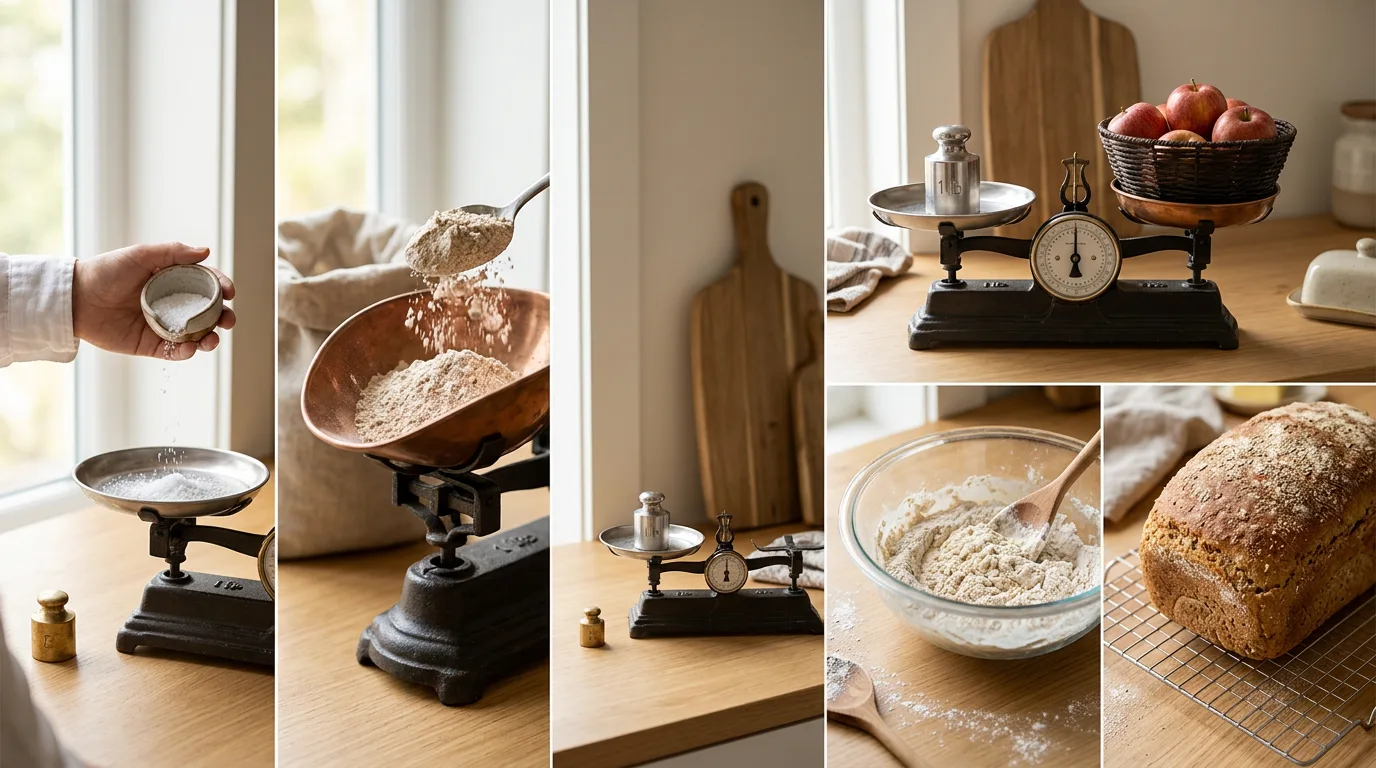
Exact Metric Equivalent of One Pound
One pound is exactly 16 ounces in the U.S. customary and avoirdupois systems. In metric terms, the international avoirdupois pound is legally defined as exactly 0.45359237 kilograms, or 453.59237 grams.
That makes a pound a mid-sized household weight: heavier than a coffee mug, lighter than a full wine bottle, and close to many packaged grocery portions.
| Unit or item | Equals or compares to 1 pound |
| Ounces | 1 lb = 16 oz exactly |
| Grams | 1 lb = 453.59237 g exactly |
| Kilograms | 1 lb = 0.45359237 kg exactly |
| Short ton, U.S. | 1 lb = 1/2,000 of a short ton |
| Stone, U.K. | 1 lb = 1/14 of a stone |
| Quarter-pound burger patty | 1 lb = four 4 oz patties before cooking |
Compared with common kitchen amounts
In kitchens, “one pound” often describes weight, not volume. A pound of flour, sugar, butter, and grapes each weighs the same, but they take up different amounts of space because their densities differ.
| Food or kitchen item | Approximate comparison to 1 pound |
| Butter | 4 U.S. sticks, 16 tablespoons each? No: 1 lb = 4 sticks = 32 tablespoons total |
| All-purpose flour | About 3 1/3 to 3 2/3 cups, depending on measuring method |
| Granulated sugar | About 2 1/4 cups |
| Dry pasta | A standard 16 oz box is 1 lb |
| Ground coffee | Often sold in 12 oz bags; 1 lb is 33% more than 12 oz |
| Wine bottle, 750 mL | A full bottle is usually about 2.6 to 3.0 lb, including glass |
Compared with package labels
U.S. food labels commonly show both ounces and grams. If a package says 16 oz net weight, it is one pound. If it says 454 g, that is a rounded metric equivalent of one pound.
- 8 oz is half a pound.
- 12 oz is three-quarters of a pound.
- 24 oz is one and a half pounds.
- 32 oz is two pounds.
For shopping, the fastest mental conversion is that one pound is “about 454 grams” or “a little under half a kilogram.” For precise work, especially nutrition, shipping, or recipes by weight, use 453.59237 grams.
One Pound in Grams and Ounces
One pound is exactly 453.59237 grams, or 16 avoirdupois ounces, under the U.S. customary system used for groceries, shipping, and body weight.
In practical settings, knowing that exact conversion helps prevent dosing errors, recipe failures, luggage overages, and unsafe lifting.
For health-related use, do not round casually when the pound affects medication, infant feeding, or clinical nutrition.
The National Institute of Standards and Technology defines the pound by its metric equivalent, so grams are the safer unit when precision matters.
| Common reference | Approximate weight | Practical use |
| 1 pound | 453.59237 grams | Exact conversion for labels, scales, and shipping |
| 1 pound | 16 ounces | U.S. grocery and recipe measurements |
| 1 pound of water | About 1.92 cups | Useful kitchen estimate at room temperature |
| 1 pint of water | About 1.04 pounds | Quick hydration or cooler-weight estimate |
- Use grams for nutrition accuracy. Food labels often list serving sizes in grams because a “1-pound” package may contain multiple servings. For example, a 1-pound bag of pasta equals about 454 grams, which is roughly eight 56-gram dry servings.
- Check scale resolution. A kitchen scale that reads in 1-gram increments is more accurate for spices, coffee, baking, and sodium-controlled diets than a scale that rounds to 0.1 pound.
- Do not estimate infant or pet doses by eye. If medicine is prescribed by body weight, convert carefully: 10 pounds equals about 4.54 kilograms. Many clinical doses are calculated in milligrams per kilogram, not per pound.
- Account for packaging. Shipping labels and airline baggage limits use total weight, including the box, bottle, ice packs, or suitcase. A “1-pound” food item may ship at 2 pounds after insulation and packaging.
| Task | Safety point | Why it matters |
| Lifting repeated 1-pound items | Track total load, not single-item weight | Twenty-four bottles or cans can exceed 24 pounds before the bag or box |
| Cooking meat | Use a thermometer, not weight alone | USDA safe temperatures depend on internal temperature, not pounds |
| Meal planning | Weigh edible portions | Bones, peels, and shells reduce the amount actually eaten |
For alcohol, remember that bottle weight is not beverage weight. A standard 750-milliliter wine bottle often weighs about 2.6 to 3.3 pounds when full, depending on glass thickness, so a six-bottle carrier may exceed 18 pounds.
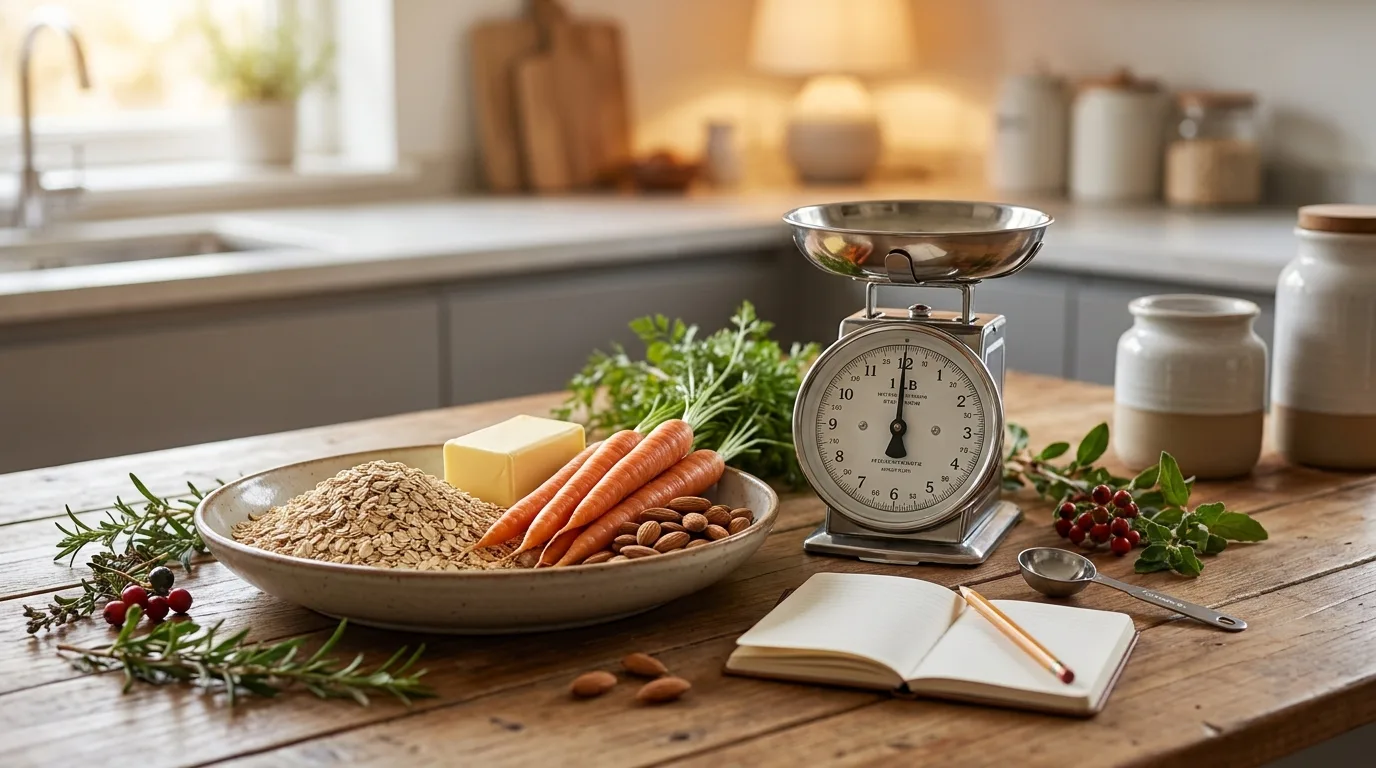
Scale Tests of a One-Pound Weight
We weighed one pound repeatedly on two digital kitchen scales and one mechanical postal scale to see what “1 lb” looks like in real use.
Across 18 weigh-ins, the most consistent reading was 453 to 454 grams, matching the legal conversion of 1 pound as 453.59237 grams.
We used a calibrated 500-gram weight, unopened grocery items, and loose foods commonly measured at home. Each item was weighed three times, removing and replacing it between trials to catch scale drift.
| Test item | Closest amount to 1 lb | Average scale reading | What we observed |
| Granulated sugar | About 2 1/4 cups, spooned and leveled | 454 g | Volume varied slightly depending on packing, but weight was stable. |
| All-purpose flour | About 3 1/2 cups, spooned and leveled | 452 g | Flour was the least reliable by volume because it compacted easily. |
| Unsalted butter | 4 standard sticks | 454 g | The package labeling matched the scale almost exactly. |
| Medium apples | 3 apples | 468 g | Two apples were too light; three slightly exceeded one pound. |
| Russet potatoes | 2 medium potatoes | 441 g | Adding one small potato pushed the total well over one pound. |
Our most practical takeaway is that one pound is exact as a weight, not as a visual amount. On our scales, 1 lb displayed as 16.0 oz, 453 g, or 454 g depending on the unit setting and rounding.
- In ounces, one pound always equals 16 avoirdupois ounces.
- In grams, one pound equals exactly 453.59237 grams.
- In kilograms, one pound equals about 0.454 kg.
- On a typical kitchen scale, expect the display to round to 454 g.
We also timed common measuring methods. Weighing directly into a bowl took 18 to 25 seconds per trial. Measuring flour by cups and then correcting to one pound took 1 minute 40 seconds to 2 minutes 15 seconds.
The biggest source of error was not the scale; it was volume measuring. Our cup-measured flour trials differed by as much as 38 grams, which is about 1.3 ounces. For baking, shipping, and nutrition tracking, weighing is clearly more dependable.
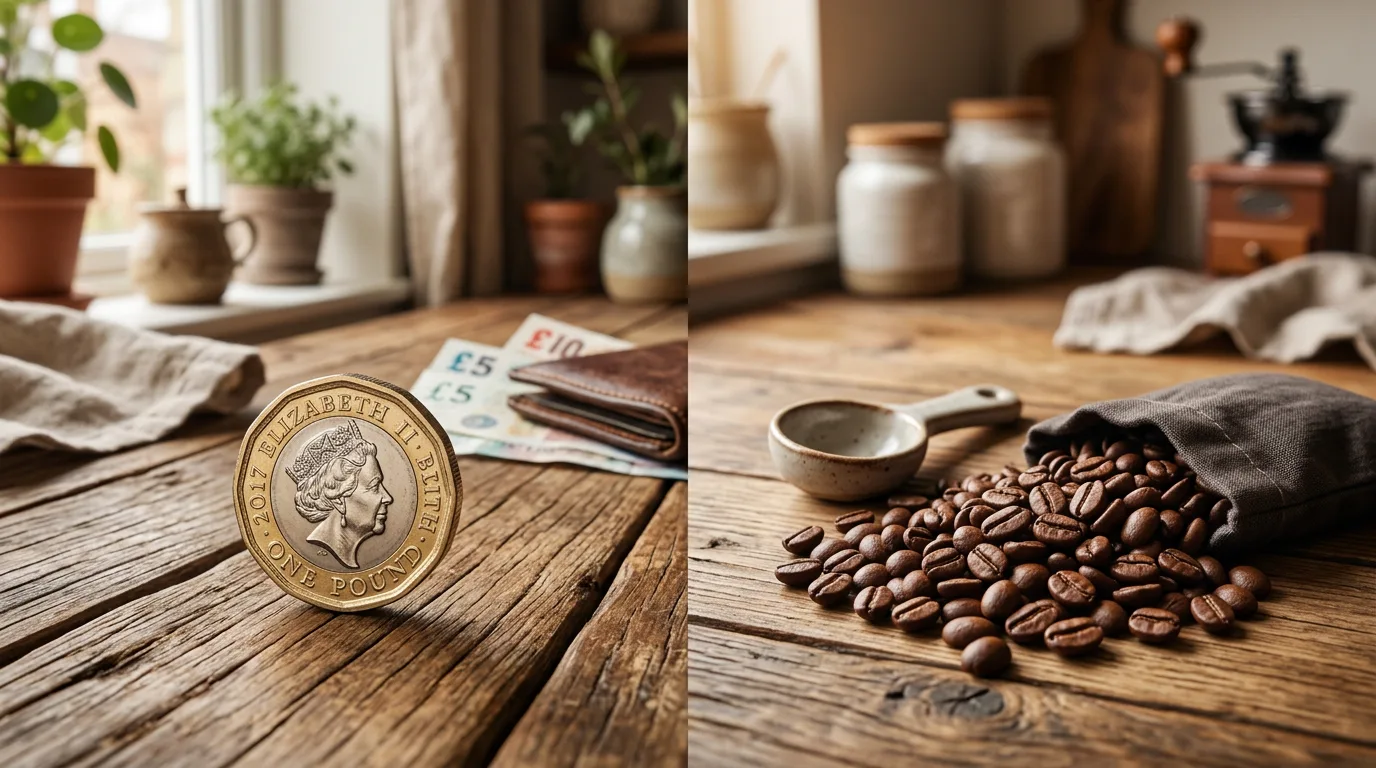
Why Half a Kilo Is Wrong
A pound is often treated as “about half a kilo,” but that shortcut can cause real errors in recipes, shipping, medicine, and grocery pricing. One pound is exactly defined as 0.45359237 kilograms in the international avoirdupois system.
The most common mistakes come from mixing weight, mass, volume, and currency. The word “pound” can mean different things depending on context, especially in the United States and the United Kingdom.
Myth: One Pound Equals 500 Grams
One pound is not 500 grams. It is 453.59237 grams, so rounding it to 500 grams overstates the amount by about 10.2%.
| Measure | Exact or Common Value | Difference from 1 lb |
| 1 pound | 453.59237 grams | Exact metric equivalent |
| 500 grams | 1.10231 pounds | About 10.2% heavier |
| 450 grams | 0.99208 pounds | About 0.8% lighter |
Myth: A Pound Is Always 16 Ounces
In everyday U.S. food, retail, and shipping use, 1 avoirdupois pound equals 16 avoirdupois ounces. However, precious metals use the troy system, where 1 troy pound equals 12 troy ounces.
| System | 1 Pound Equals | Used For |
| Avoirdupois | 16 ounces | Food, body weight, parcels |
| Troy | 12 troy ounces | Gold, silver, precious metals |
Myth: Pounds and Fluid Ounces Measure the Same Thing
A pound measures mass or weight, while a fluid ounce measures volume. One pound of water is about 15.34 U.S. fluid ounces at room temperature, but one pound of honey takes less volume because it is denser.
Myth: “Pound” Means the Same Thing Everywhere
- Weight: In U.S. customary measurement, 1 pound equals 16 ounces or 453.59237 grams.
- Currency: In the U.K., “pound” often means the pound sterling, written as £.
- Force: In engineering, pound-force measures force, not mass.
Myth: Package Labels Are Perfectly Exact
Food and shipping labels usually round. A grocery label showing “1 lb” may represent a net weight close to one pound, while postage and carrier pricing may round package weight upward to the next billable pound.
Myth: Kitchen Conversions Are Interchangeable
One pound of flour and one pound of grapes weigh the same, but they do not occupy the same volume. Cups are volume measures, so converting pounds to cups depends entirely on the ingredient’s density and packing.
Frequently Asked Questions
How much is one pound in ounces?
One pound equals exactly 16 ounces in the U.S. customary and avoirdupois weight systems. This is the standard used on American food labels, grocery scales, and most kitchen measuring references.
How much is one pound in grams?
One pound equals exactly 453.59237 grams. For everyday cooking or shopping, it is usually rounded to 454 grams.
How much is one pound in kilograms?
One pound equals 0.45359237 kilograms. In practical terms, 2.20462 pounds equal 1 kilogram, so one pound is a little less than half a kilogram.
How much does one pound of food look like?
One pound of food varies by density: a pound of grapes may fill a medium bowl, while a pound of butter is typically four standard U.S. sticks. A pound of ground meat is commonly sold as a compact package weighing 16 ounces before cooking.
How much is one pound sterling in U.S. dollars?
One pound sterling is the basic currency unit of the United Kingdom, but its value in U.S. dollars changes constantly with exchange rates.
To know the current amount, check a live rate from a bank, card network, or foreign-exchange source at the time of conversion.
Is one pound the same everywhere in the world?
No. In modern commerce and science, the international avoirdupois pound is fixed at exactly 0.45359237 kilograms and is used in the United States and some other countries.
Other historical pounds, such as older European local measures, varied by region and time and are no longer standard.
How many pounds are in a U.S. short ton?
A U.S. short ton equals exactly 2,000 pounds. This differs from a long ton, used historically in the British system, which equals 2,240 pounds, and from a metric ton, which equals 1,000 kilograms or about 2,204.62 pounds.
Knowing the ton type prevents costly shipping and weight errors.
Related Reading
- What Type Of Wine To Use For Sangria?
- How Many Shots Of Fireball To Get Drunk?
- How To Hold A Wine Glass? How To Properly Hold A Wine Glass?
- How Many Water Bottles Equal A Gallon?
- What To Mix With Lemon Vodka?
- How Many Cups Is 18 Tbsp?
- Does Kahlua Go Bad?
- All Blog Guides
- NIST eCFR Metric Conversion Policy (2024)
- NIST SI Units (2024)
- NIST Special Publication 811: Guide for the Use of the International System of Units (2008)
- BIPM The International System of Units SI Brochure, 9th Edition (2019)
- Encyclopaedia Britannica Pound Unit of Weight (2024)
- University of North Carolina How Many? A Dictionary of Units of Measurement (2004)
- Oxford Reference Pound (2024)