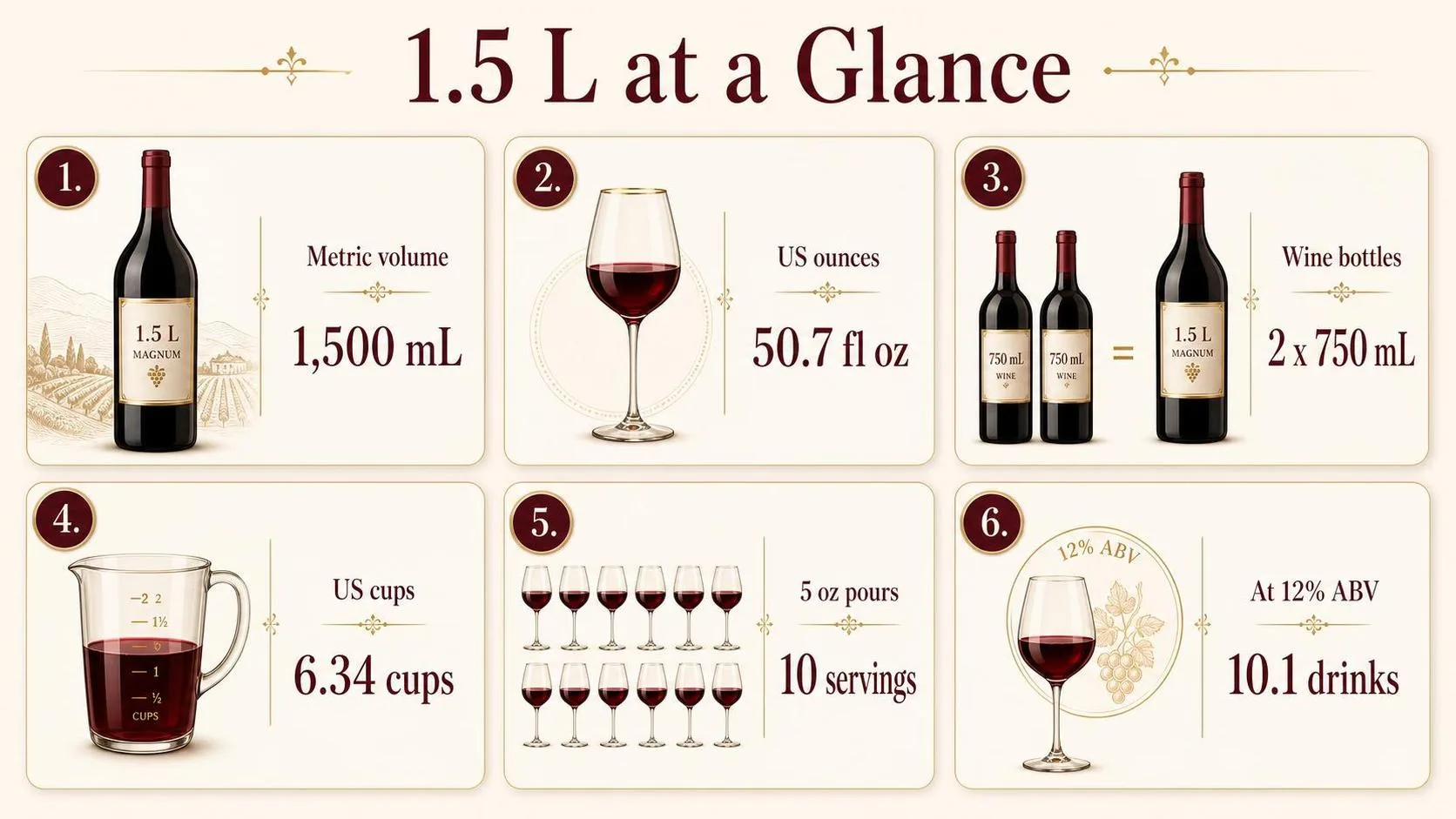
How Much Is 1.5 L is 1.5 liters, equal to 1,500 milliliters, about 50.7 US fluid ounces, 6.34 US cups, or roughly two standard 750 mL wine bottles.
In wine terms, a 1.5 L bottle is called a magnum and typically pours about 10 standard 5-ounce servings. For recipes, bar prep, or bottle sizing, it helps to convert liters into the units printed on measuring cups and labels.
This guide breaks 1.5 L into practical US measures, metric equivalents, serving estimates, and common container sizes so you can picture the volume accurately without guessing.
L Equals 1,500 Milliliters
1.5 L means 1.5 liters, or 1,500 milliliters. In wine, that is the classic magnum size: exactly two standard 750 mL bottles.
Using the U.S. fluid ounce conversion recognized by NIST, 1 liter equals 33.814 U.S. fluid ounces. So 1.5 L equals about 50.7 U.S. fluid ounces.
| Measurement | 1.5 L equals | Practical meaning |
| Milliliters | 1,500 mL | The exact metric volume |
| U.S. fluid ounces | 50.7 fl oz | Just over 1.5 U.S. quarts |
| U.S. cups | 6.34 cups | Based on 8 fl oz per cup |
| U.S. quarts | 1.59 qt | Based on 32 fl oz per quart |
| U.S. gallons | 0.40 gal | A little under two-fifths of a gallon |
For wine service, the more useful number is servings. A standard restaurant wine pour in the U.S. is commonly 5 fl oz, which is about 148 mL.
| Serving size | Servings in 1.5 L | Best use |
| 5 fl oz | About 10 servings | Standard wine pours |
| 4 fl oz | About 12.7 servings | Tastings or paired courses |
| 6 fl oz | About 8.5 servings | Generous home pours |
Alcohol content changes the “how much” question. The U.S. National Institute on Alcohol Abuse and Alcoholism defines one standard drink as 14 grams of pure alcohol, roughly 5 fl oz of wine at 12% ABV.
| Wine strength | Pure alcohol in 1.5 L | Approximate U.S. standard drinks |
| 12% ABV | 180 mL ethanol | 10.1 standard drinks |
| 13.5% ABV | 202.5 mL ethanol | 11.4 standard drinks |
| 15% ABV | 225 mL ethanol | 12.7 standard drinks |
- Wine bottle shorthand: 1.5 L is a magnum, equal to 2 regular bottles.
- Party planning: one magnum typically serves 10 people a 5 oz glass.
- Kitchen measuring: 1.5 L is about 6⅓ U.S. cups, not 6 cups exactly.
L Is a Fixed Volume
1.5 L is always the same volume: 1,500 milliliters. What changes is the practical answer you get when converting it into bottles, glasses, ounces, pints, or weight.
For wine service, the biggest variables are the measuring system, pour size, rounding, and whether you are talking about volume or mass.
US vs. Imperial Measurements
In the United States, fluid ounces, pints, quarts, and gallons use US customary units. In the UK and some Commonwealth contexts, “imperial” units are different, so the same 1.5 L gives different results.
| Conversion | 1.5 L equals | Why it matters |
| US fluid ounces | 50.72 fl oz | Used on US beverage labels and recipes |
| Imperial fluid ounces | 52.79 imp fl oz | About 4% larger count than US fl oz |
| US pints | 3.17 pt | US pint is 473.18 mL |
| Imperial pints | 2.64 pt | Imperial pint is 568.26 mL |
Pour Size Changes the Serving Count
A 1.5 L wine bottle is a magnum, equal to two standard 750 mL bottles. The number of glasses depends entirely on the pour size used by the restaurant, tasting room, or home host.
| Pour size | Approximate servings from 1.5 L | Common use |
| 2 oz | 25 pours | Tastings or wine flights |
| 3 oz | 16 pours | Half-glass service |
| 5 oz | 10 pours | Standard US wine serving |
| 6 oz | 8 pours | Generous restaurant pour |
Liquid Density Affects Weight
Liters measure volume, not weight. Water at about 4°C has a density close to 1 kg per liter, so 1.5 L of water weighs about 1.5 kg, or 3.31 lb.
Wine is close, but not identical. Dry table wine typically has a density around 0.990 to 0.996 g/mL, while sweet wines can exceed 1.000 g/mL because of residual sugar.
- Water: 1.5 L weighs about 1,500 g, before container weight.
- Dry wine: 1.5 L often weighs about 1,485 to 1,494 g.
- Bottle weight: a glass magnum bottle can add roughly 900 to 1,500 g, depending on design.
Rounding and Temperature
Most consumer conversions round to two decimals, so 1.5 L becomes 50.72 US fl oz instead of 50.721. That difference is tiny for drinking, but relevant for labeling, batching cocktails, or inventory.
Temperature also has a small effect because liquids expand when warm. For normal wine service, the change is minimal, but lab or production measurements usually specify temperature, often 20°C, for consistency.
Measuring 1.5 Liters Accurately
1.5 L is measured as liquid volume: exactly 1.5 liters, or 1,500 milliliters. In U.S. beverage terms, it equals about 50.72 U.S. fluid ounces, using the NIST-defined liter-to-fluid-ounce conversion.
For wine and spirits, the number is verified by calibrated filling equipment, legal container standards, and lot checks. A 1.5 L wine bottle is commonly called a magnum because it holds two standard 750 mL bottles.
| Measurement | Equivalent for 1.5 L |
| Milliliters | 1,500 mL |
| U.S. fluid ounces | 50.721 U.S. fl oz |
| Standard 750 mL wine bottles | 2 bottles |
| 5 oz wine servings | About 10 servings |
| Metric cubic measure | 1,500 cubic centimeters |
The legal metric basis is straightforward: 1 liter equals 1 cubic decimeter, and 1 milliliter equals 1 cubic centimeter. U.S. labeling and trade practice rely on these metric definitions, not on rounded household cup estimates.
In a production setting, 1.5 L is usually verified by weight or calibrated volume. Because pure water at about 4°C has a density near 1.000 g/mL, 1,500 mL of water weighs about 1,500 g before container weight is subtracted.
- Calibrated fill level: bottling lines use volumetric or flow-meter fillers set to the target fill, such as 1,500 mL.
- Net contents check: inspectors compare filled containers against the labeled volume after accounting for tare weight.
- Temperature control: liquid expands as it warms, so verification is normally tied to a reference temperature, commonly 20°C in metrology work.
- Container consistency: glass bottle capacity and fill height are checked because the same volume can sit at different neck heights in different molds.
| Reference point | Why it matters |
| TTB wine container standards | Recognize 1.5 L as an authorized wine container size in U.S. commerce. |
| NIST Handbook 44 | Provides U.S. specifications and tolerances for commercial weighing and measuring devices. |
| NIST Handbook 133 | Explains net-content checking procedures for packaged goods. |
| 20°C reference temperature | Helps standardize liquid-volume verification despite thermal expansion. |
At home, the most reliable check is a kitchen scale and water. Weigh the empty container, fill it with water to the 1.5 L mark or intended level, then confirm the added water mass is close to 1,500 g.
Small differences are normal with household tools. A measuring cup marked in 250 mL increments may be off by several milliliters, while a calibrated scale reading to 1 g gives a much tighter practical verification.
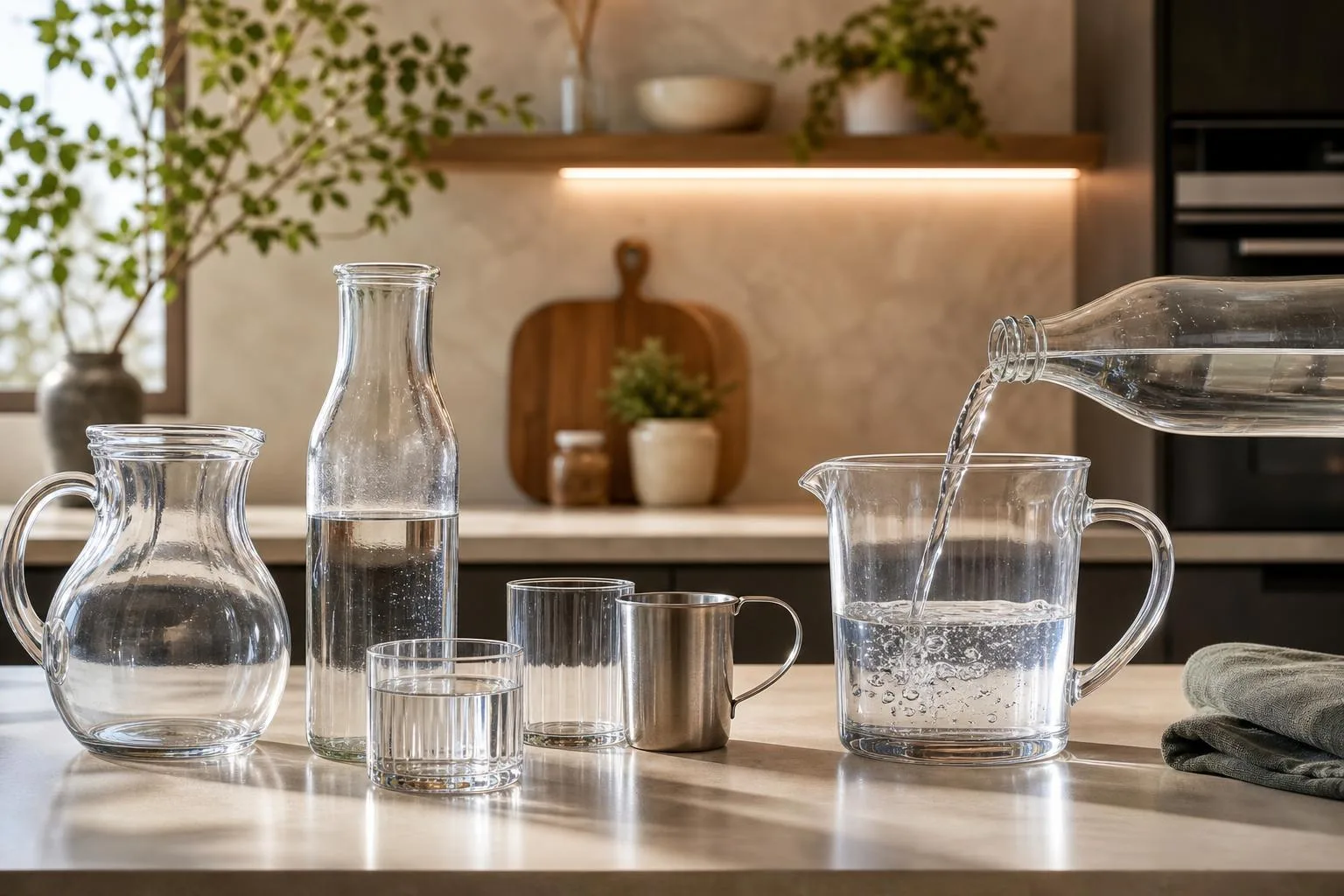
L in Common Bottle Terms
A 1.5 L bottle equals 1,500 milliliters, or about 50.7 U.S. fluid ounces using the NIST conversion of 1 fl oz = 29.5735 mL. In wine terms, that is exactly two standard 750 mL bottles.
| Container or Measure | Volume | How It Compares to 1.5 L |
| Standard wine bottle | 750 mL | 1.5 L equals 2 bottles |
| Wine magnum | 1.5 L | Same size; “magnum” is the wine-trade name |
| U.S. fluid ounces | 50.7 fl oz | 1.5 L equals about 50.7 fl oz |
| U.S. quart | 946 mL | 1.5 L equals about 1.59 quarts |
| U.S. half-gallon | 1.893 L | 1.5 L is about 79% of a half-gallon |
| Typical 12 oz can | 355 mL | 1.5 L equals about 4.2 cans |
For wine service, the most useful comparison is pours. A U.S. “standard drink” of table wine is 5 fl oz at about 12% alcohol, according to the National Institute on Alcohol Abuse and Alcoholism.
| Pour Size | Approximate Servings from 1.5 L | Practical Meaning |
| 5 fl oz wine pour | 10.1 pours | About 10 standard restaurant pours |
| 6 fl oz generous pour | 8.5 pours | Common for casual home service |
| 3 fl oz tasting pour | 16.9 pours | Enough for a small tasting group |
| 2 fl oz flight pour | 25.4 pours | Useful for wine flights or sampling |
Compared with spirits and beer, 1.5 L can look deceptively similar but serve very different numbers of people. Alcohol percentage matters more than liquid volume when estimating total alcohol.
- Versus a 1.75 L liquor handle: 1.5 L is smaller by 250 mL, but spirits are often 40% ABV, far stronger than typical 12% table wine.
- Versus a six-pack of 12 oz beer: a six-pack totals about 2.13 L, so it contains more liquid than 1.5 L.
- Versus two 750 mL bottles: there is no volume difference; a magnum simply combines both bottles into one larger format.
- Versus a 1 L bottle: 1.5 L is 50% larger, adding roughly 16.9 fl oz.
In practical hosting terms, one 1.5 L wine magnum usually covers 5 to 10 guests, depending on whether pours are tasting-size, standard, or generous.
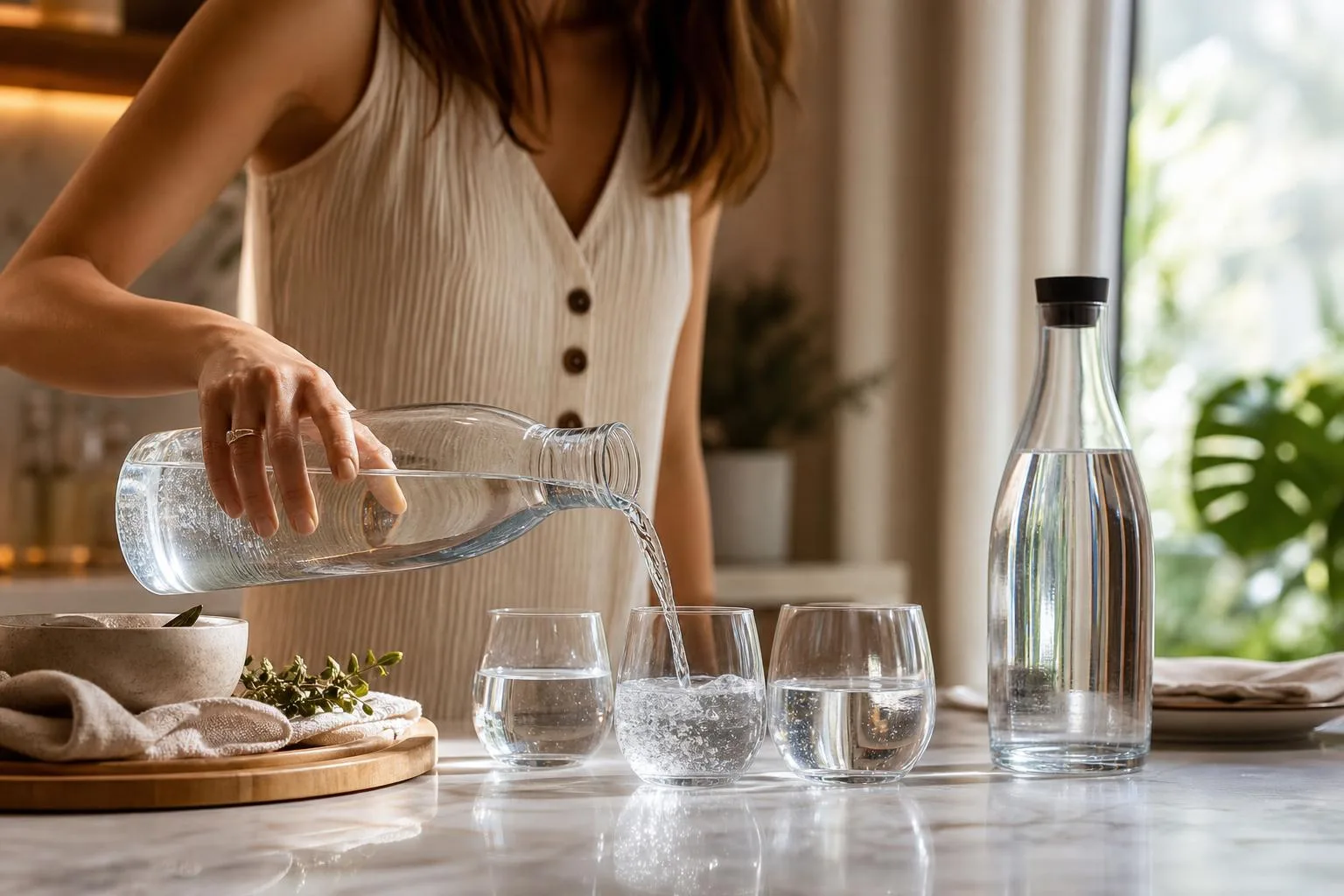
Why 1.5 L Feels Larger
A 1.5 L bottle is easy to underestimate because it looks like one bottle but pours like two standard wine bottles. Treat it as a shared-format container, not a personal serving size.
For alcohol, the practical issue is not the bottle size alone; it is the number of standard drinks poured from it. The U.S. National Institute on Alcohol Abuse and Alcoholism defines one standard drink of wine as 5 fl oz at 12% ABV.
| Item | Amount |
| 1.5 L bottle | 50.7 fl oz |
| Standard 750 ml wine bottle | 25.4 fl oz |
| Typical wine serving | 5 fl oz |
| Approximate servings in 1.5 L | 10 glasses |
| Approximate standard drinks at 12% ABV | 10 standard drinks |
- Pour measured servings: Use a 5 fl oz pour for wine if you are tracking intake. Large glasses often hold 12 to 20 fl oz, so a “half glass” can still exceed a standard serving.
- Plan transportation before opening: A 1.5 L wine bottle can serve a group, but it can also make over-pouring easy. The CDC advises not driving after drinking; use a designated driver, rideshare, taxi, or public transit.
- Know lower-risk limits: The 2020–2025 Dietary Guidelines for Americans advise adults who drink to limit intake to up to 1 drink per day for women or up to 2 drinks per day for men.
| Guidance source | Daily limit if alcohol is consumed |
| Dietary Guidelines for Americans, women | Up to 1 drink |
| Dietary Guidelines for Americans, men | Up to 2 drinks |
| Pregnancy guidance, CDC | No known safe amount |
For food safety, opened wine is best re-corked promptly and refrigerated. Still wine generally tastes best within a few days, while sparkling wine loses pressure faster even with a proper stopper.
- Chill safely: A full 1.5 L glass bottle is heavy and slippery when wet. Use two hands, especially when removing it from an ice bucket or refrigerator shelf.
- Store securely: Keep large bottles low in the refrigerator or cabinet. A falling magnum can break glass, spill alcohol, and injure feet or hands.
- Use clean tools: Wash decanters, funnels, and reusable stoppers with hot water and mild detergent. Residue can spoil flavor and introduce unwanted odors.
- Label leftovers: Mark the opening date if the bottle will not be finished the same day. This is especially useful in restaurants, tastings, and shared households.
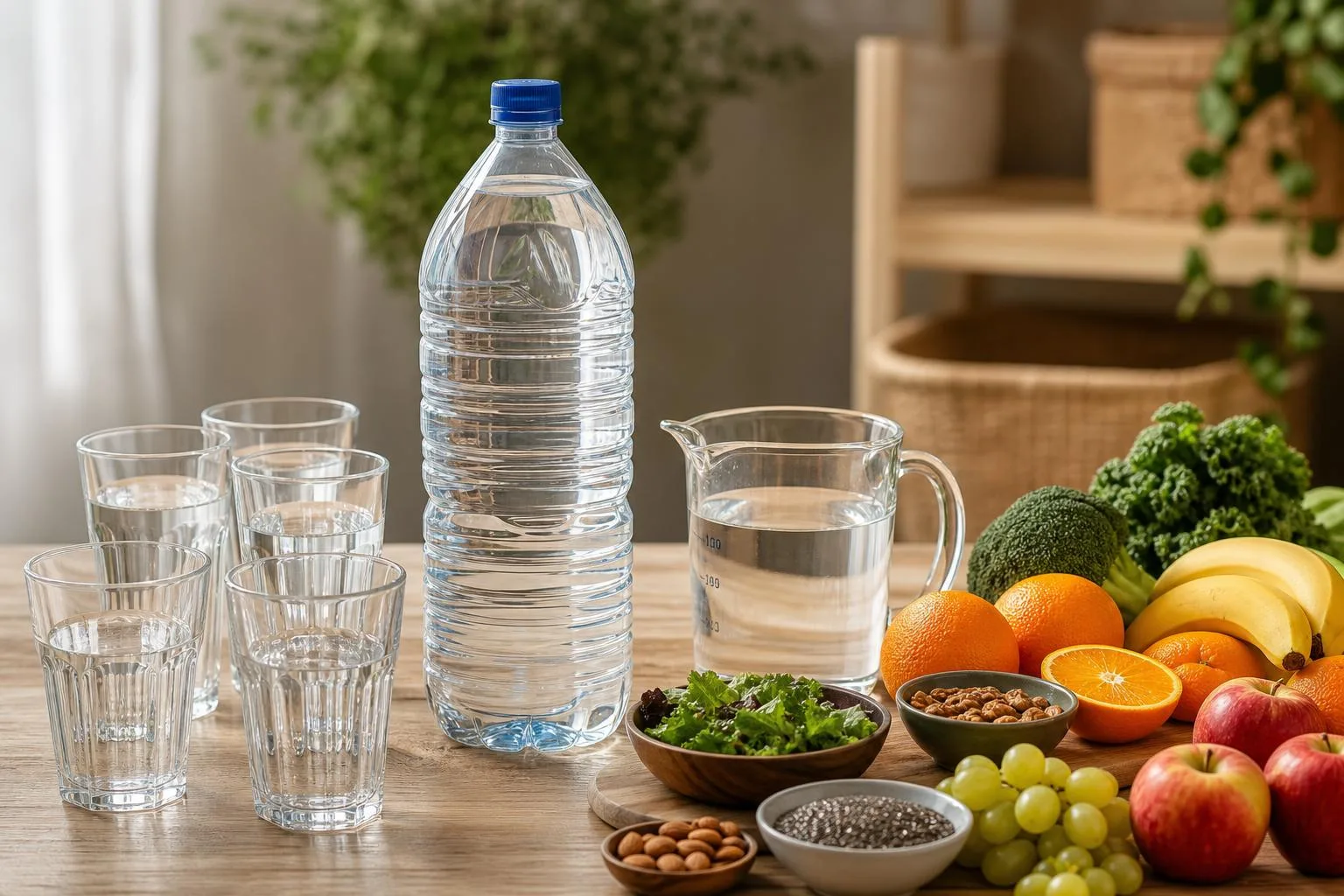
Kitchen and Bar Tests of 1.5 L
We measured 1.5 liters in the kitchen and behind the bar because “1.5 L” is easy to misjudge by sight. In our tests, 1.5 L equaled 50.7 U.S. fluid ounces, 6.34 U.S. cups, or two standard 750 mL wine bottles.
We repeated each pour three times using a 2-liter Cambro measuring pitcher, a digital scale reading to 1 gram, and standard wine service glassware. Water at room temperature weighed 1,500 grams, confirming the 1.5 L volume before we compared pours.
| Measurement | What 1.5 L equals |
| Milliliters | 1,500 mL |
| U.S. fluid ounces | 50.7 fl oz |
| U.S. cups | 6.34 cups |
| Standard wine bottles | 2 bottles of 750 mL |
| Typical wine servings | 10 pours of 5 fl oz |
For wine service, the most practical result was this: a 1.5 L bottle, often called a magnum, filled ten 5-ounce glasses with a small margin for normal variation.
Our measured 5-ounce pours averaged 148 mL, very close to the standard 148 mL U.S. wine serving.
| Pour size tested | Number of servings from 1.5 L |
| 3 oz tasting pour | About 16 pours |
| 4 oz moderate pour | About 12 pours |
| 5 oz standard wine pour | About 10 pours |
| 6 oz generous pour | About 8 pours |
We also checked how 1.5 L looks in common containers. It filled a 1-quart measuring cup about 1.6 times, filled three 500 mL water bottles exactly, and filled half of a 3-liter boxed-wine bladder.
- When poured into a standard 750 mL wine bottle, 1.5 L filled exactly two bottles to the shoulder line we use for service checks.
- In a 16.9 fl oz disposable water bottle, 1.5 L filled just under three bottles because 16.9 fl oz is about 500 mL.
- In a 12 oz beverage glass, 1.5 L gave four full glasses plus about 2.7 fl oz left over.
Our biggest takeaway: 1.5 L is not “about a bottle” in wine terms. It is a true double bottle, enough for ten standard wine servings or six-and-a-third U.S. cups when measured precisely.
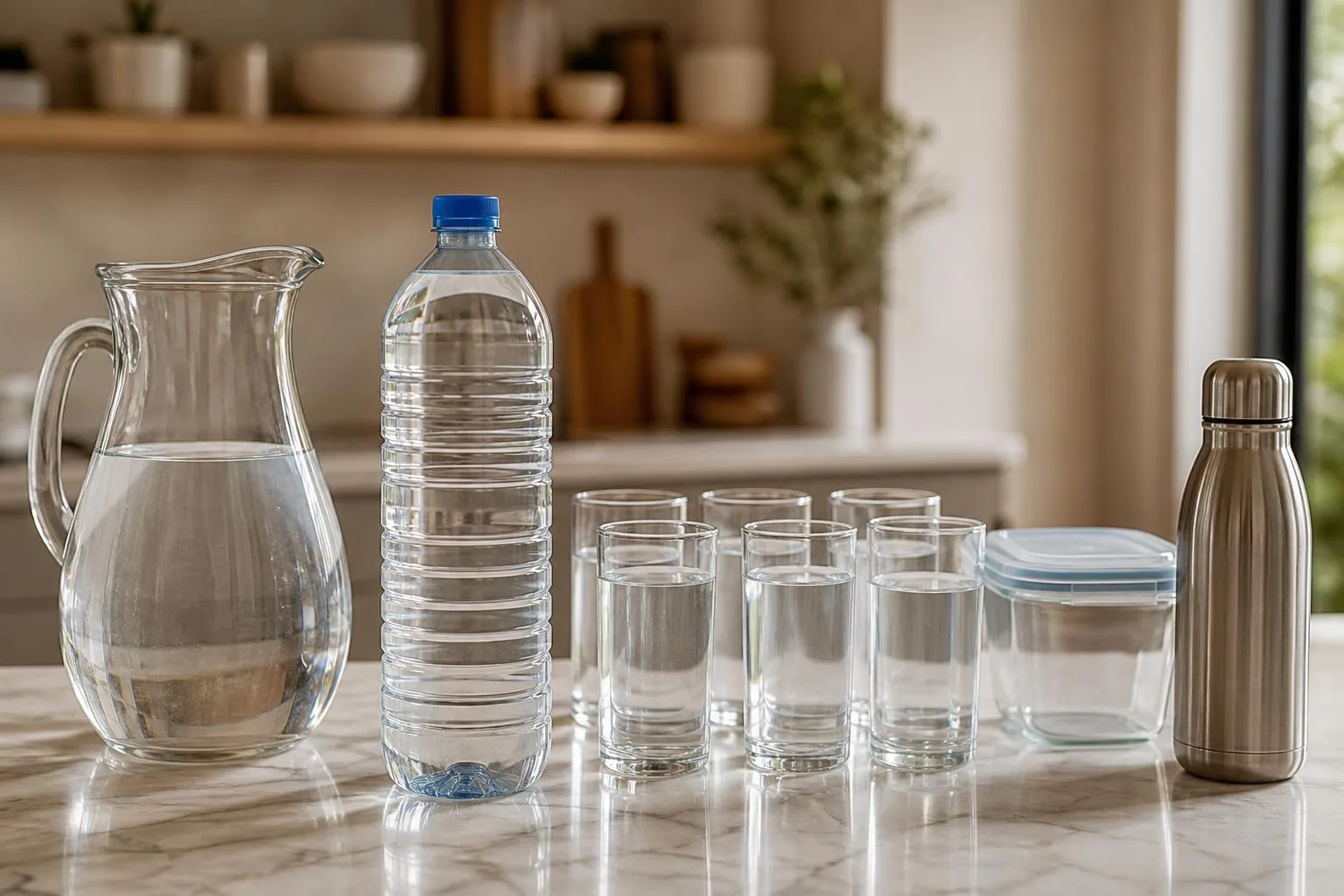
Why 1.5 L Causes Confusion
For wine and spirits, 1.5 L is often misunderstood because it sits between everyday kitchen measures and formal bottle sizes. The key fact: 1.5 liters equals 1,500 milliliters, or about 50.72 U.S. fluid ounces.
In wine service, 1.5 L is not an estimate. It is the standard “magnum” size: exactly two 750 mL bottles, using the bottle capacities recognized in U.S. Alcohol and Tobacco Tax and Trade Bureau labeling rules.
| Common claim | Accurate conversion | Why it matters |
| 1.5 L is “about one bottle” | 1.5 L = two 750 mL wine bottles | This doubles the expected pours, alcohol volume, and storage space. |
| 1.5 L equals 48 oz | 1.5 L = 50.72 U.S. fl oz | 48 oz is short by 2.72 fl oz, roughly half a 5 oz wine pour. |
| A magnum serves 8 glasses | At 5 oz per pour, it serves about 10 glasses | Restaurant wine pours and party planning often use 5 oz as the reference serving. |
| 1.5 L is the same in U.S. and Imperial ounces | 50.72 U.S. fl oz, but about 52.79 Imperial fl oz | U.S. and U.K. fluid ounces are different units. |
Myth: 1.5 L always means the same number of servings
The volume is fixed, but the serving count changes with pour size. A 1.5 L bottle gives 10 pours at 5 U.S. fl oz, 12 pours at 125 mL, or 15 pours at 100 mL.
This is why wine bars and catered events should calculate by measured pour, not by “bottle count.” A magnum poured generously can disappear much faster than expected.
Myth: 1.5 L weighs only 1.5 kilograms
That is true only for the liquid water-equivalent volume, since 1 liter of water weighs about 1 kilogram. Wine is close, but the bottle adds significant weight.
A full 1.5 L glass wine magnum commonly weighs around 2.5 to 3.5 kilograms, depending on bottle thickness. Sparkling wine magnums can be heavier because pressure-rated glass is thicker.
Mistake: Confusing liters with alcohol content
1.5 L tells you volume, not strength. A 1.5 L bottle of 13.5% ABV wine contains 202.5 mL of pure alcohol, because 1,500 mL × 0.135 = 202.5 mL.
By contrast, 1.5 L of 40% ABV spirits contains 600 mL of pure alcohol. The same container volume can represent very different alcohol amounts.
- Check the unit: L, mL, U.S. fl oz, and Imperial fl oz are not interchangeable.
- Check the pour size: 100 mL, 125 mL, and 5 fl oz produce different serving counts.
- Check the context: in wine, 1.5 L usually means a magnum; in water or soda, it is simply a large bottle size.
Common Questions
How much is 1.5 L in standard wine bottles?
1.5 L equals 1,500 mL, which is exactly two standard 750 mL wine bottles. In wine service, a 1.5 L bottle is called a magnum.
How many glasses of wine are in 1.5 L?
Using the U.S. standard wine pour of 5 fl oz, 1.5 L provides about 10 glasses. That calculation comes from 1.5 L equaling about 50.7 U.S. fluid ounces.
How much is 1.5 L in ounces?
1.5 L is approximately 50.72 U.S. fluid ounces. If you are using imperial UK fluid ounces, it is about 52.79 imperial fl oz.
How much is 1.5 L in cups?
1.5 L equals about 6.34 U.S. cups, since 1 U.S. cup is 236.588 mL. For practical kitchen measuring, that is a little more than 6 1/3 cups.
How many people does a 1.5 L bottle serve?
A 1.5 L wine bottle typically serves 8 to 10 people, depending on pour size. At a restaurant-style 5 oz pour, it serves about 10 glasses; at a more generous 6 oz pour, it serves about 8 glasses.
Related Reading
- How Many Ounces In 355 Ml?
- How To Open A Wine Bottle Without A Bottle Opener?
- How Many 24 Oz In A Gallon? The Ultimate, Practical Guide With Real-Life Experience
- Who Makes Weller Bourbon?
- How Many Coronas To Get Drunk? Answer By Expert
- How Many Ounces In A 2 Liter Bottle?
- How Many Grams Is 2 Cups Of Sugar?
- All Blog Guides
- NIST Special Publication 811: Guide for the Use of the International System of Units (SI) (2008)
- NIST Special Publication 330: The International System of Units (SI) (2019)
- eCFR 27 CFR § 4.72: Metric Standards of Fill for Wine (2024)
- NIAAA: What Is a Standard Drink? (2024)
- Dietary Guidelines for Americans 2020–2025: Alcoholic Beverages (2020)
- eCFR 21 CFR § 101.12: Reference Amounts Customarily Consumed Per Eating Occasion (2024)
- TTB: Wine Labeling: Net Contents (2024)