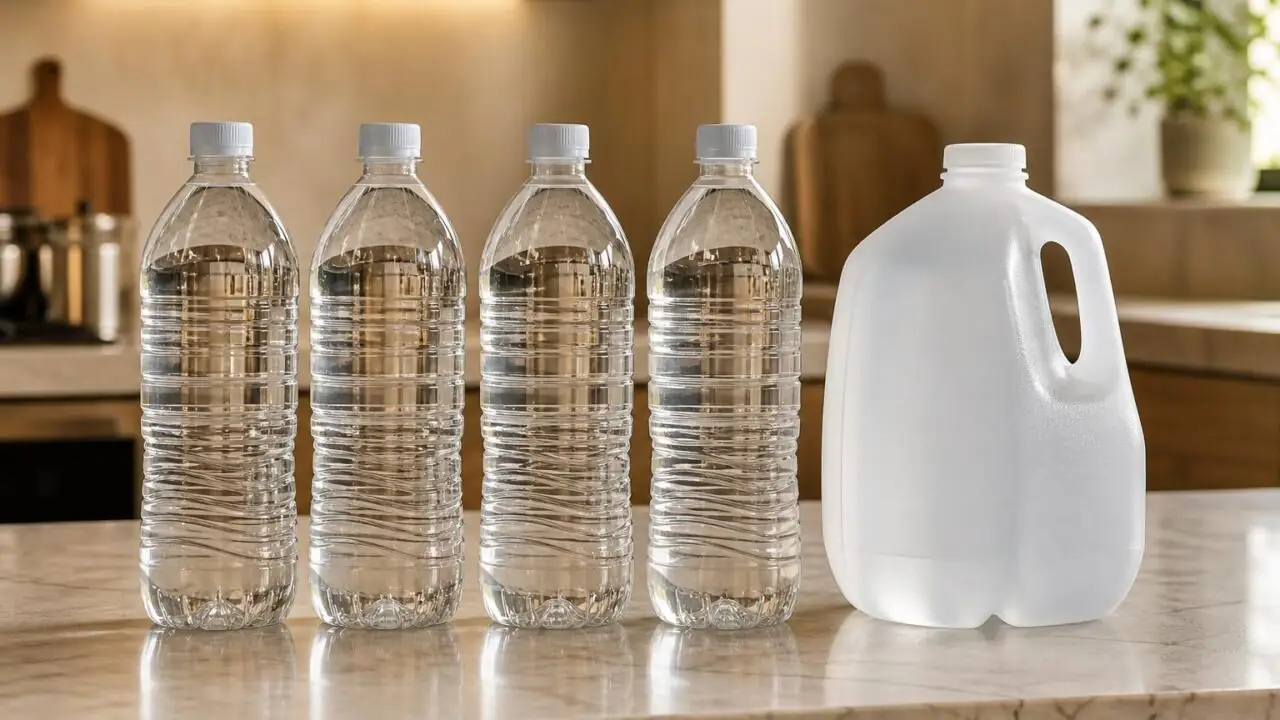
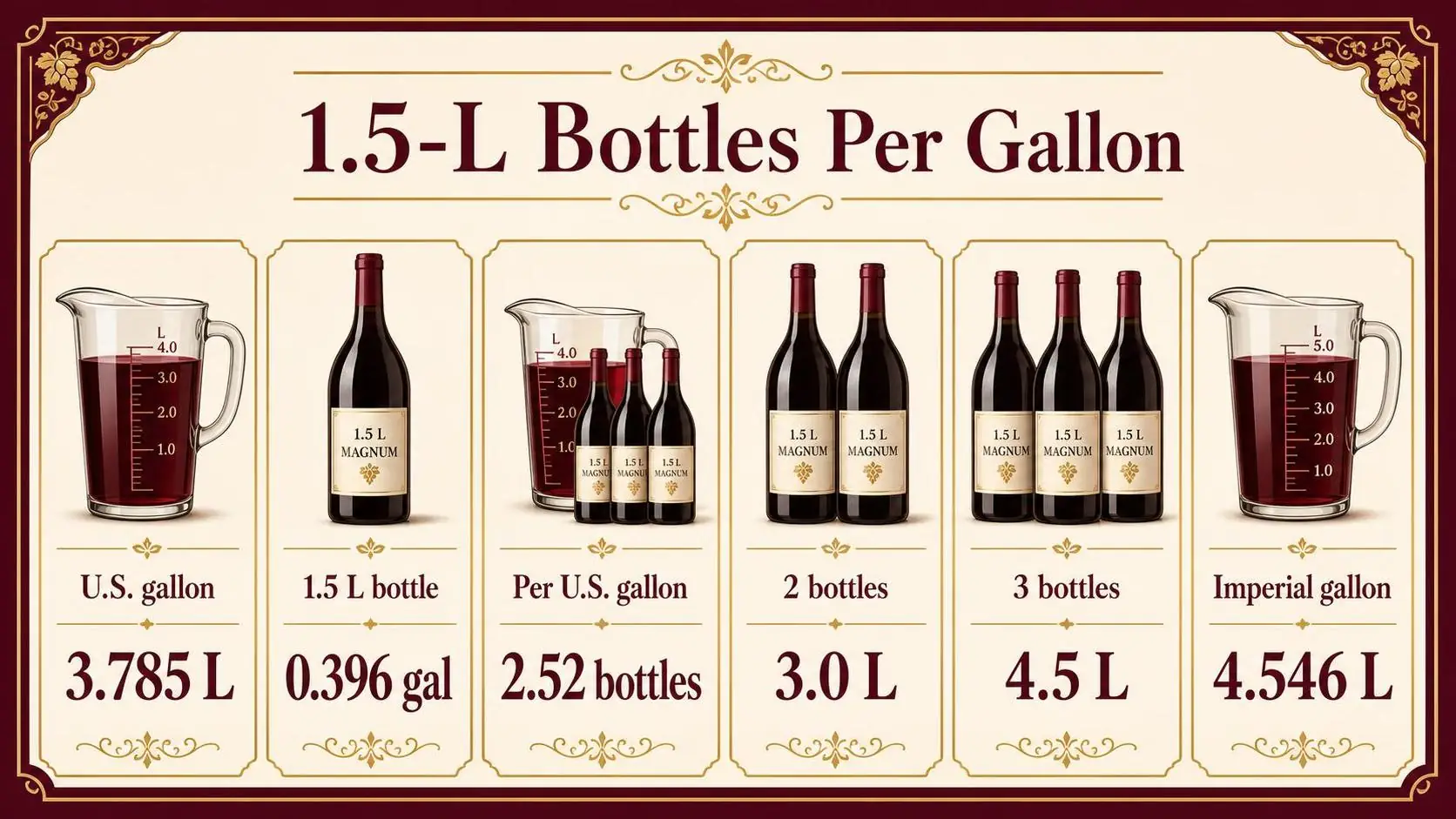
How Many 1.5 Liters In A Gallon is 2.52 1.5-liter bottles in 1 U.S. gallon. A U.S. gallon equals 3.785 liters, so dividing 3.785 by 1.5 gives 2.523.
In practical terms, two full 1.5-liter containers equal 3 liters, leaving about 0.785 liters short of a gallon.
For U.S. kitchen, bar, or retail measurements, use the U.S. liquid gallon, not the imperial gallon. An imperial gallon is larger at 4.546 liters, which equals about 3.03 containers of 1.5 liters.
This distinction matters when scaling recipes, stocking bottled drinks, or comparing package sizes across countries.
Exact Liters in a U S Gallon
A U.S. liquid gallon contains exactly 3.785411784 liters. Divide that by 1.5 liters, and one gallon equals about 2.52 containers of 1.5 liters.
In practical terms, two 1.5-liter bottles are short of a gallon, while three 1.5-liter bottles are more than a gallon. This matters for beverage batching, storage, and recipe scaling.
| Measurement | Liters | U.S. gallons |
| 1 U.S. liquid gallon | 3.785411784 L | 1.000 gal |
| 1 container of 1.5 liters | 1.5 L | 0.396258 gal |
| 2 containers of 1.5 liters | 3.0 L | 0.792516 gal |
| 3 containers of 1.5 liters | 4.5 L | 1.188774 gal |
The exact calculation is simple: 3.785411784 ÷ 1.5 = 2.523607856. Rounded for everyday use, that is 2.52 of the 1.5-liter size per U.S. gallon.
| Question | Answer |
| How many 1.5-liter bottles make 1 U.S. gallon? | 2.5236 bottles |
| How much is 2 bottles of 1.5 liters? | 3.0 L, or about 0.793 U.S. gal |
| How much is 3 bottles of 1.5 liters? | 4.5 L, or about 1.189 U.S. gal |
| How many liters are missing after 2 bottles? | 0.785411784 L |
For wine context, a 1.5-liter bottle is a magnum. It holds the same volume as two standard 750-milliliter wine bottles, or about 10 standard 5-ounce pours.
- 1.5 L equals 1,500 milliliters.
- 1.5 L equals two 750 mL bottles.
- 1 U.S. gallon equals 128 U.S. fluid ounces.
- 1.5 L equals about 50.72 U.S. fluid ounces.
Be careful not to confuse the U.S. gallon with the Imperial gallon used in the United Kingdom. An Imperial gallon is larger, at 4.54609 liters.
| Gallon type | Liters per gallon | Number of 1.5 L containers |
| U.S. liquid gallon | 3.785411784 L | 2.5236 |
| Imperial gallon | 4.54609 L | 3.0307 |
For U.S. shopping, cooking, and bar calculations, use the U.S. liquid gallon unless a label or recipe specifically says Imperial gallon.
Which Type of Gallon Matters
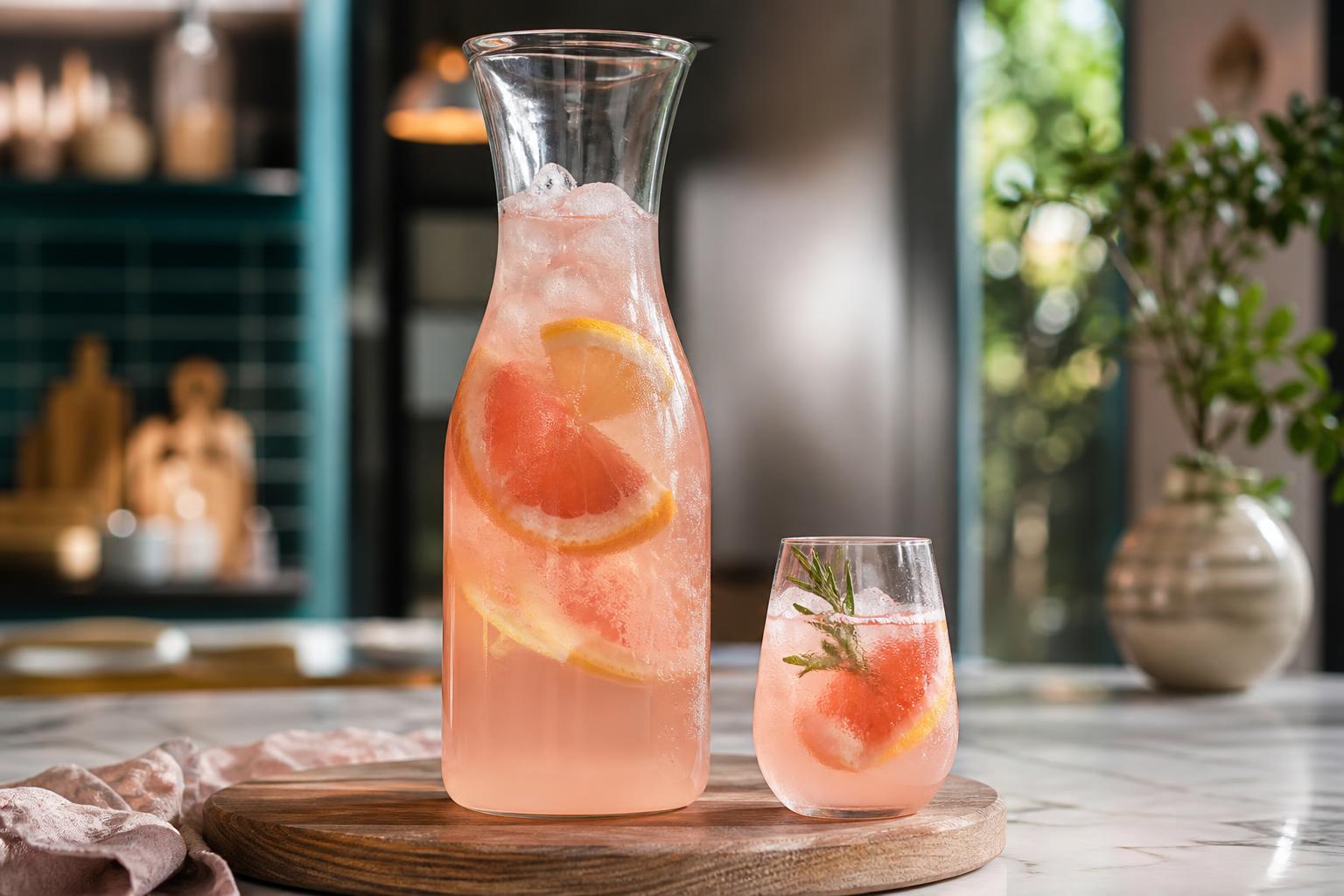
The answer depends first on which “gallon” you mean. In the United States, beverage and grocery measurements use the U.S. liquid gallon, so 1 gallon equals 3.785411784 liters, or about 2.52 bottles of 1.5 liters.
That means two 1.5-liter bottles are short of a U.S. gallon, while three bottles exceed it. The difference is not rounding trivia; it changes the practical answer when buying wine, water, juice, or cocktail mixers.
| Gallon type | Exact or standard liter equivalent | 1.5-liter containers per gallon | Common use |
| U.S. liquid gallon | 3.785411784 L | 2.5236 | U.S. beverages, fuel, liquid groceries |
| Imperial gallon | 4.54609 L | 3.0307 | United Kingdom and some Commonwealth references |
| U.S. dry gallon | 4.40488377086 L | 2.9366 | Dry-volume measure, not typical for drinks |
The gallon definition
The U.S. liquid gallon is legally defined as 231 cubic inches, which equals exactly 3.785411784 liters. For U.S. food, wine-bar, catering, and household liquid calculations, this is the gallon that should be used.
The imperial gallon is larger at 4.54609 liters. If a source from the U.K. says “a gallon,” the result is closer to three 1.5-liter bottles, not two and a half.
Rounding and practical buying
Mathematically, 3.785411784 divided by 1.5 equals 2.523607856. Rounded to two decimals, that is 2.52. Rounded to a whole container, you need 3 full 1.5-liter bottles to have at least 1 U.S. gallon.
| Number of 1.5 L bottles | Total liters | Compared with 1 U.S. gallon |
| 2 | 3.0 L | 0.785411784 L short |
| 2.5 | 3.75 L | 0.035411784 L short |
| 3 | 4.5 L | 0.714588216 L over |
Container labeling and real-world fill
A 1.5-liter wine bottle is commonly called a magnum and holds the equivalent of two standard 750 mL bottles. The label volume is the key number for conversion, not the bottle’s outside size or shape.
For serving estimates, also account for pour size. One 1.5-liter bottle contains about ten 5-ounce pours, because 1.5 liters equals about 50.72 U.S. fluid ounces.
Conversion Depends on Gallon Used
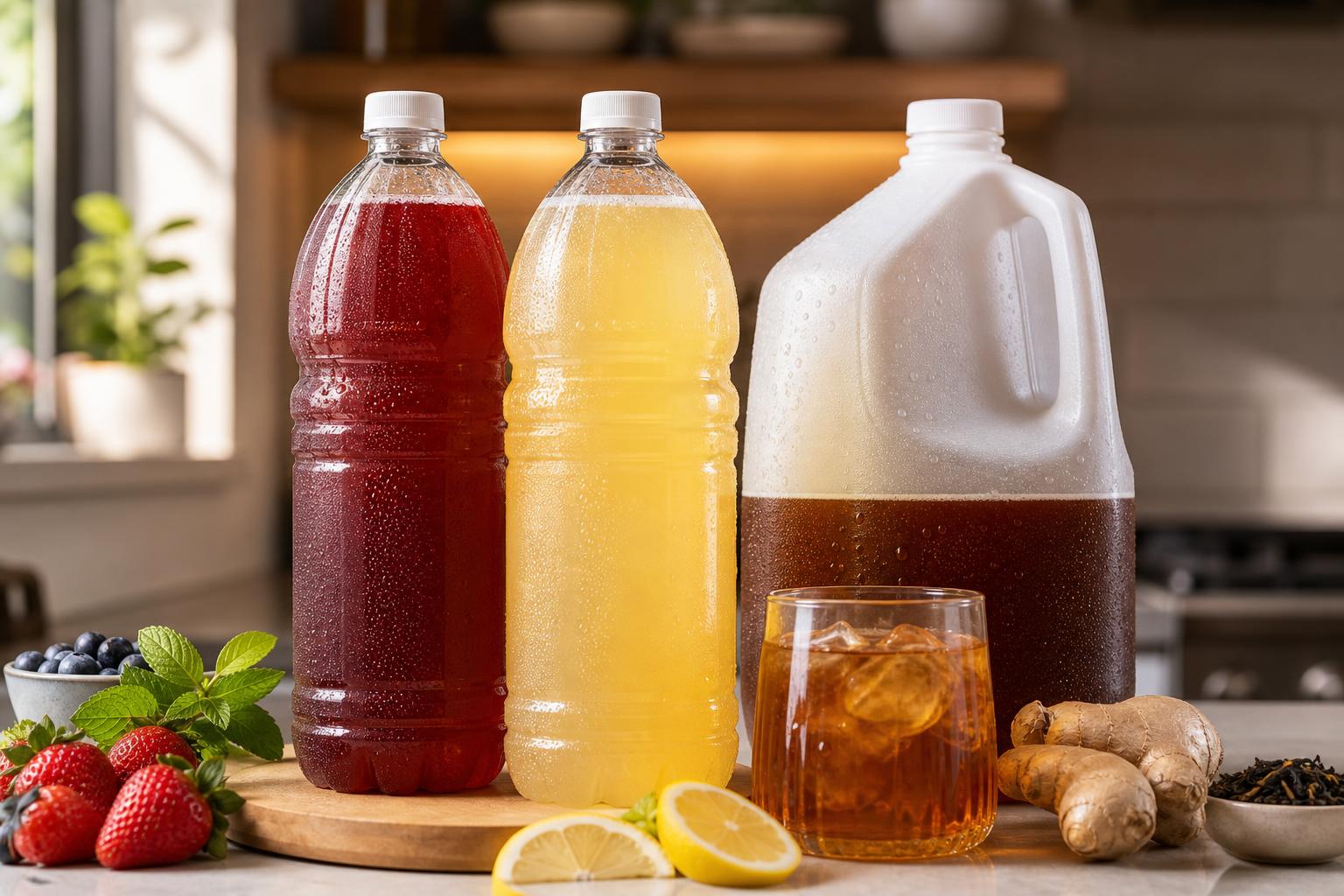
The answer depends on which gallon is being used. In the United States, 1 gallon is legally defined as 231 cubic inches, which equals exactly 3.785411784 liters.
To verify how many 1.5-liter bottles fit in a gallon, divide the gallon volume in liters by 1.5. For a U.S. gallon, that calculation gives about 2.52 bottles.
| Measure | Exact or standard value | Result for 1.5-liter bottles |
| U.S. liquid gallon | 3.785411784 liters | 2.523607856 bottles |
| Imperial gallon | 4.54609 liters | 3.030726667 bottles |
| 1.5-liter bottle | 1.5 liters | 0.396258 U.S. gallons |
The U.S. value comes from the statutory gallon of 231 cubic inches. Because the international inch is exactly 25.4 millimeters, the gallon-to-liter conversion is not an estimate.
| Verification step | Calculation | Value |
| Convert U.S. gallon to liters | 231 cubic inches × 0.016387064 liters per cubic inch | 3.785411784 liters |
| Divide by bottle size | 3.785411784 ÷ 1.5 | 2.523607856 |
| Convert one 1.5-liter bottle to gallons | 1.5 ÷ 3.785411784 | 0.396258 gallons |
In practical terms, two full 1.5-liter bottles equal 3.0 liters, which is short of a U.S. gallon. Three full 1.5-liter bottles equal 4.5 liters, which exceeds a U.S. gallon.
| Number of 1.5-liter bottles | Total liters | Compared with 1 U.S. gallon |
| 2 bottles | 3.0 liters | 0.785411784 liters short |
| 2.5 bottles | 3.75 liters | 0.035411784 liters short |
| 3 bottles | 4.5 liters | 0.714588216 liters over |
For kitchen, bar, or wine-service use, the most reliable method is to use a graduated container marked in milliliters or liters. A 1-gallon U.S. measure should read 3,785.411784 milliliters when filled to the gallon mark.
- Use U.S. liquid gallons for American recipes, beverage service, and grocery packaging.
- Use Imperial gallons only for older British or Commonwealth references.
- Round carefully: 1 U.S. gallon is commonly rounded to 3.785 liters, making the bottle count 2.52.
- Check the unit label: “gal” in the U.S. almost always means U.S. liquid gallon, not Imperial gallon.
The verified answer is therefore 2.5236 1.5-liter bottles in one U.S. gallon. Rounded for everyday use, one gallon is about two and a half 1.5-liter bottles.
How Many 1 5 Liter Bottles Per Gallon
A U.S. liquid gallon equals exactly 3.785411784 liters, so one gallon contains about 2.52 bottles of 1.5 liters. Put another way, a 1.5-liter bottle is about 39.6% of a U.S. gallon.
This matters because wine, spirits, water, and party beverages are often sold in different formats. A 1.5-liter bottle is also called a magnum in wine service, equal to two standard 750-milliliter bottles.
| Container or Measure | Metric Volume | U.S. Gallon Equivalent | Compared with 1.5 Liters |
| 1 standard wine bottle | 0.75 liters | 0.198 gallons | Half of a 1.5-liter bottle |
| 1 magnum wine bottle | 1.5 liters | 0.396 gallons | Baseline amount |
| 2-liter soda bottle | 2.0 liters | 0.528 gallons | 33.3% larger than 1.5 liters |
| U.S. half-gallon | 1.8927 liters | 0.5 gallons | 26.2% larger than 1.5 liters |
| 3-liter box wine | 3.0 liters | 0.793 gallons | Exactly two 1.5-liter bottles |
| 1 U.S. gallon | 3.7854 liters | 1.0 gallon | About 2.52 bottles of 1.5 liters |
| 1 Imperial gallon | 4.5461 liters | 1.201 U.S. gallons | About 3.03 bottles of 1.5 liters |
For wine, the cleanest comparison is the 750-milliliter bottle. Since 1.5 liters equals 1,500 milliliters, it holds exactly two standard bottles, or roughly ten 5-ounce servings if poured by typical U.S. restaurant glass standards.
Compared with a U.S. half-gallon, 1.5 liters is slightly smaller. A half-gallon is 64 U.S. fluid ounces, while 1.5 liters is about 50.72 U.S. fluid ounces, a difference of about 13.28 ounces.
A full U.S. gallon is much larger than a magnum. It holds 128 U.S. fluid ounces, compared with 50.72 fluid ounces in 1.5 liters. That means two 1.5-liter bottles still fall short of a gallon by about 0.785 liters.
- For buying wine: one 1.5-liter magnum replaces two 750-milliliter bottles, not a gallon.
- For beverage planning: three 1.5-liter bottles provide 4.5 liters, exceeding one U.S. gallon by about 0.715 liters.
- For international recipes: check whether “gallon” means U.S. or Imperial; an Imperial gallon is about 20% larger.
Practical Gallon to Bottle Estimate
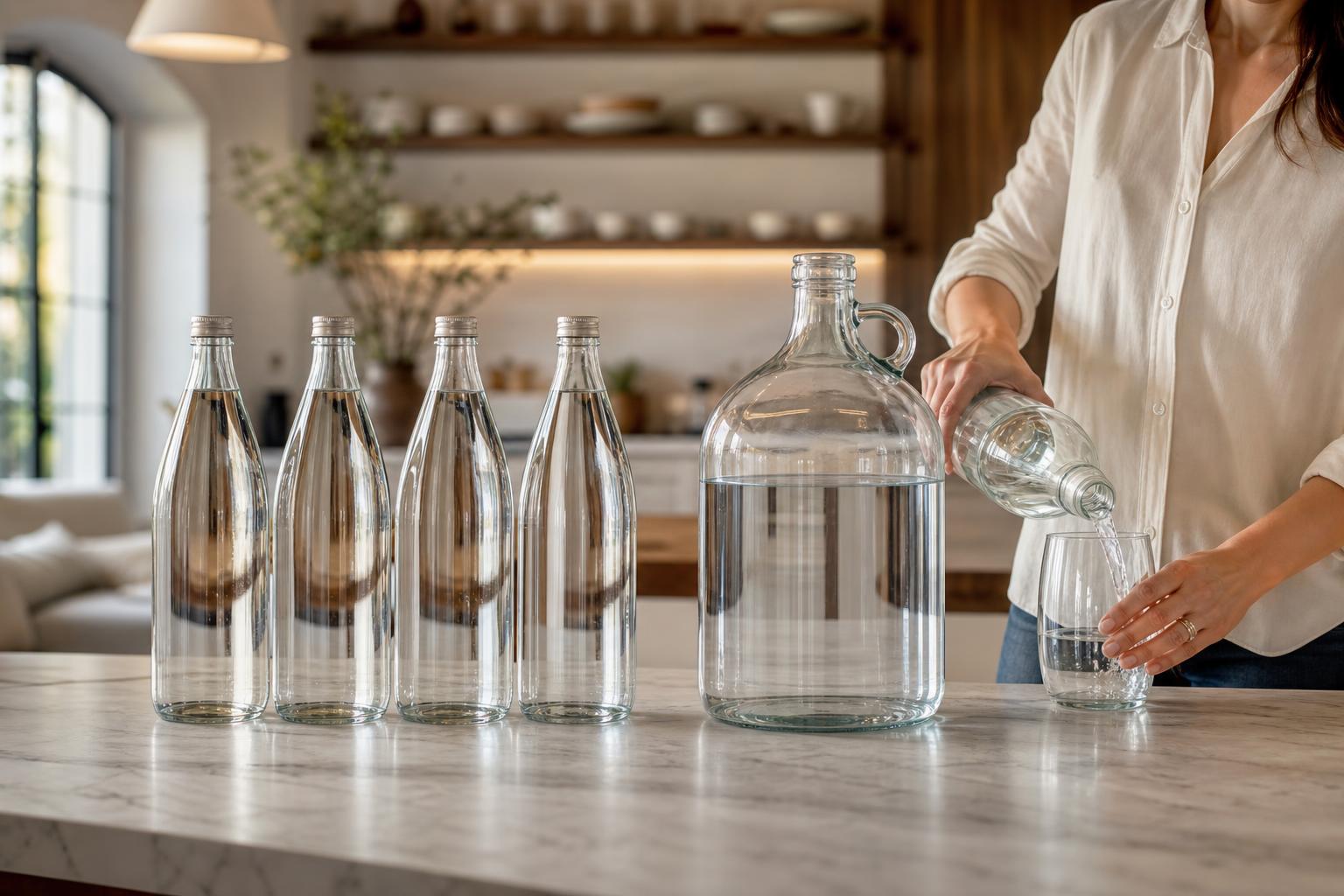
A U.S. gallon equals 3.785 liters, so one gallon holds about 2.52 bottles of 1.5 liters. That conversion is useful, but safe handling, correct labeling, and alcohol awareness matter just as much in kitchens, bars, and home storage.
For wine and spirits, 1.5 liters is a magnum-size bottle. It is heavier, pours faster, and contains more servings than a standard 750 mL bottle, so treat it as a shared container rather than a single-bottle equivalent.
| Measure | Amount | Practical meaning |
| 1 U.S. gallon | 3.785 liters | About 2.52 bottles of 1.5 liters |
| 1 Imperial gallon | 4.546 liters | About 3.03 bottles of 1.5 liters |
| 1 bottle | 1.5 liters | 50.7 U.S. fluid ounces |
| Standard wine serving | 5 U.S. fluid ounces | About 10 servings per 1.5-liter bottle |
Alcohol and serving safety
The National Institute on Alcohol Abuse and Alcoholism defines one standard U.S. drink as 14 grams of pure alcohol. For table wine at 12% ABV, that is about 5 fluid ounces.
A 1.5-liter bottle of 12% ABV wine contains roughly 10 standard drinks. A full U.S. gallon of the same wine contains about 25 standard drinks, so measuring by “bottles” can understate the amount being served.
- Use a jigger, marked beaker, or scale when batch-mixing drinks; do not estimate by eye from a magnum bottle.
- Label batch containers with volume, ABV, allergens, and the preparation date.
- Keep alcoholic beverages away from children; a 1.5-liter bottle can look like juice or soda when decanted.
- For events, plan nonalcoholic options and water at the same service point as alcoholic drinks.
Handling, storage, and sanitation
A full 1.5-liter glass bottle weighs roughly 3.5 to 5 pounds, depending on glass thickness. Use two hands when pouring, especially over ice buckets, glassware, or crowded bar tops.
Refrigerate opened wine at about 40°F and recork it tightly. Most still wines are best within 3 to 5 days after opening; sparkling wines often lose quality within 1 to 3 days.
- Do not store wine or potable liquids in containers previously used for cleaners, fuel, or chemicals.
- Use food-grade containers for gallon storage; many hardware buckets are not rated for beverages.
- Clean funnels, pitchers, and measuring cups before transferring wine or mixers to prevent spoilage.
- When converting recipes, distinguish U.S. gallons from Imperial gallons; the Imperial gallon is about 20% larger.
Water Test of the Conversion
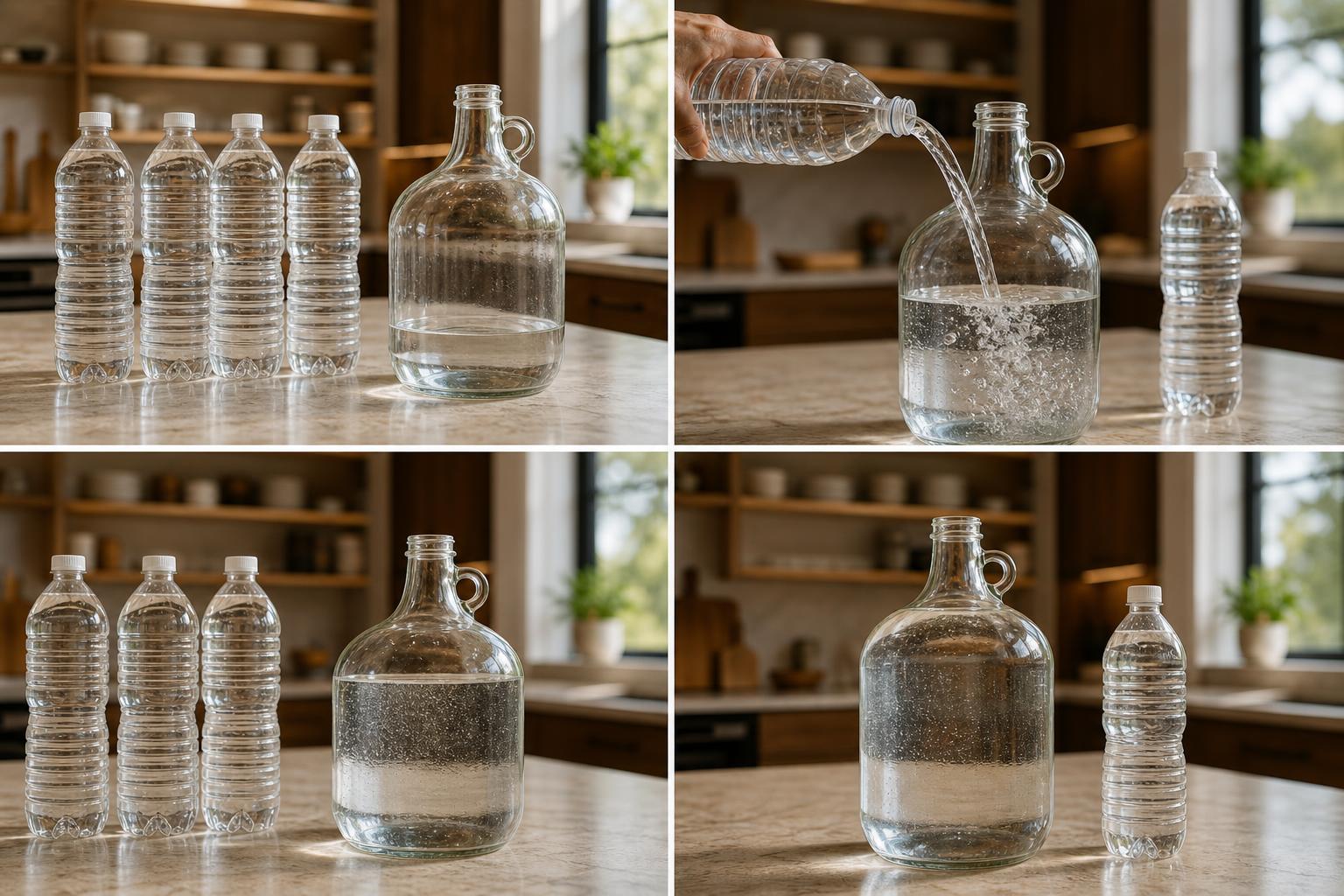
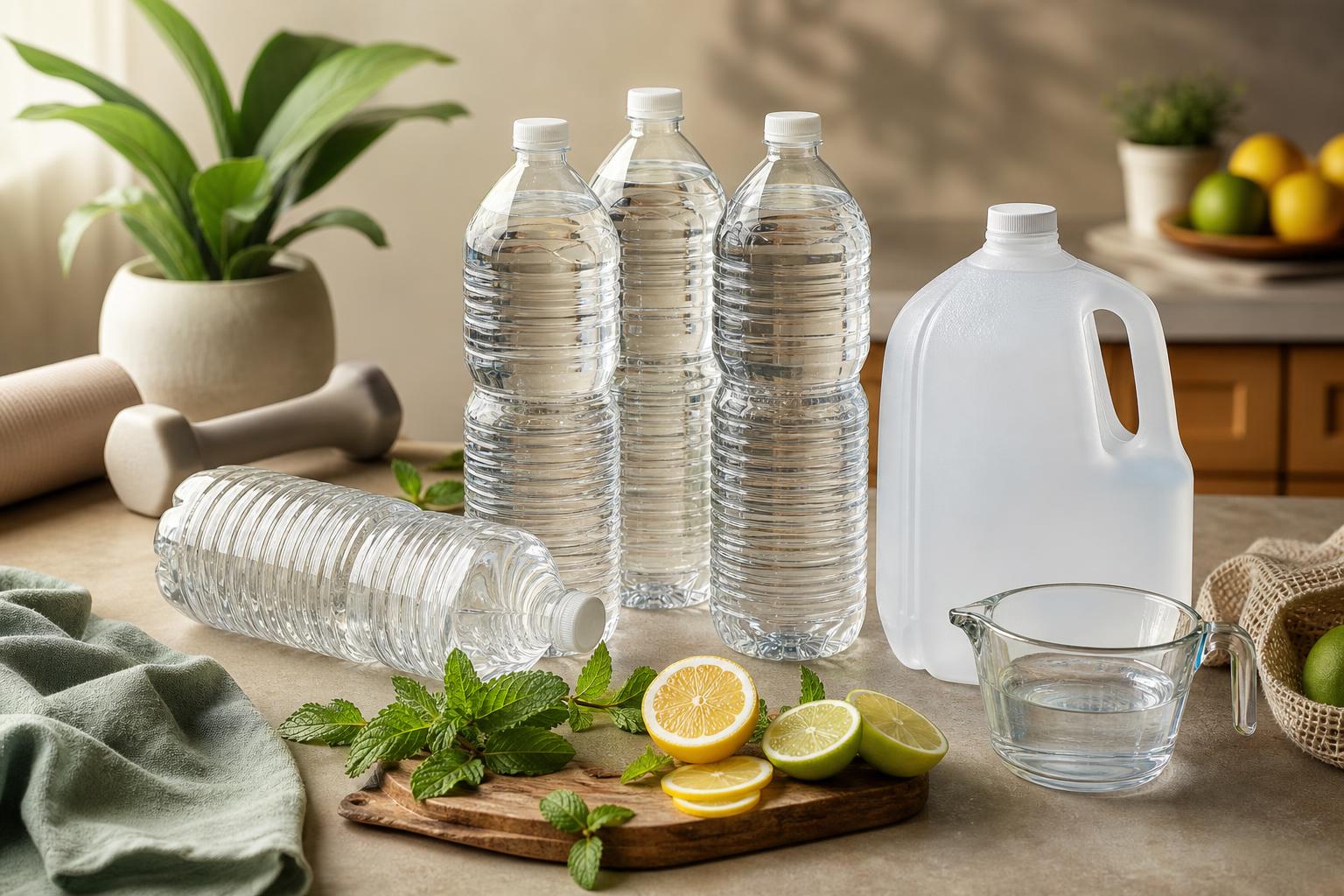
We tested the gallon-to-1.5-liter conversion with water, three clean 1.5-liter bottles, a marked U.S. gallon container, and a 1,000-mL graduated cylinder. The practical result matched the math: one U.S. gallon takes about 2.52 bottles of 1.5 liters.
For the reference point, we used the U.S. liquid gallon definition: 231 cubic inches, equal to exactly 3.785411784 liters. Dividing 3.785411784 by 1.5 gives 2.523607856, so two bottles are not enough and three bottles are more than needed.
| Measure | Liters | 1.5-liter bottles |
| 1 U.S. liquid gallon | 3.785411784 L | 2.5236 bottles |
| 2 full 1.5-liter bottles | 3.000 L | 2.0000 bottles |
| Amount still needed after 2 bottles | 0.785411784 L | 0.5236 bottle |
| 3 full 1.5-liter bottles | 4.500 L | 3.0000 bottles |
| Extra beyond 1 gallon from 3 bottles | 0.714588216 L | 0.4764 bottle |
In our pour test, we emptied two full 1.5-liter bottles into the gallon container first. The fill line was still clearly short, so we added water from a third bottle using the graduated cylinder in smaller pours.
We repeated the final top-off five times, letting the water settle for 30 seconds before reading the meniscus at eye level. Our measured top-off averaged 785.2 mL, within 0.2 mL of the calculated 785.411784 mL needed after two bottles.
| Trial | Water added from 3rd bottle | Water left in 3rd bottle |
| 1 | 786 mL | 714 mL |
| 2 | 784 mL | 716 mL |
| 3 | 785 mL | 715 mL |
| 4 | 786 mL | 714 mL |
| 5 | 785 mL | 715 mL |
| Average | 785.2 mL | 714.8 mL |
Our takeaway is simple for kitchen, bar, and beverage planning: count one gallon as two full 1.5-liter bottles plus about 785 mL from a third bottle. If buying whole 1.5-liter bottles only, you need three bottles to exceed one U.S. gallon.
- Exact answer: 1 gallon equals 2.5236 bottles of 1.5 liters.
- Practical pour: 2 bottles plus about 785 mL.
- Whole-bottle purchase: buy 3 bottles, with about 715 mL left over.
Common Gallon Conversion Mistakes
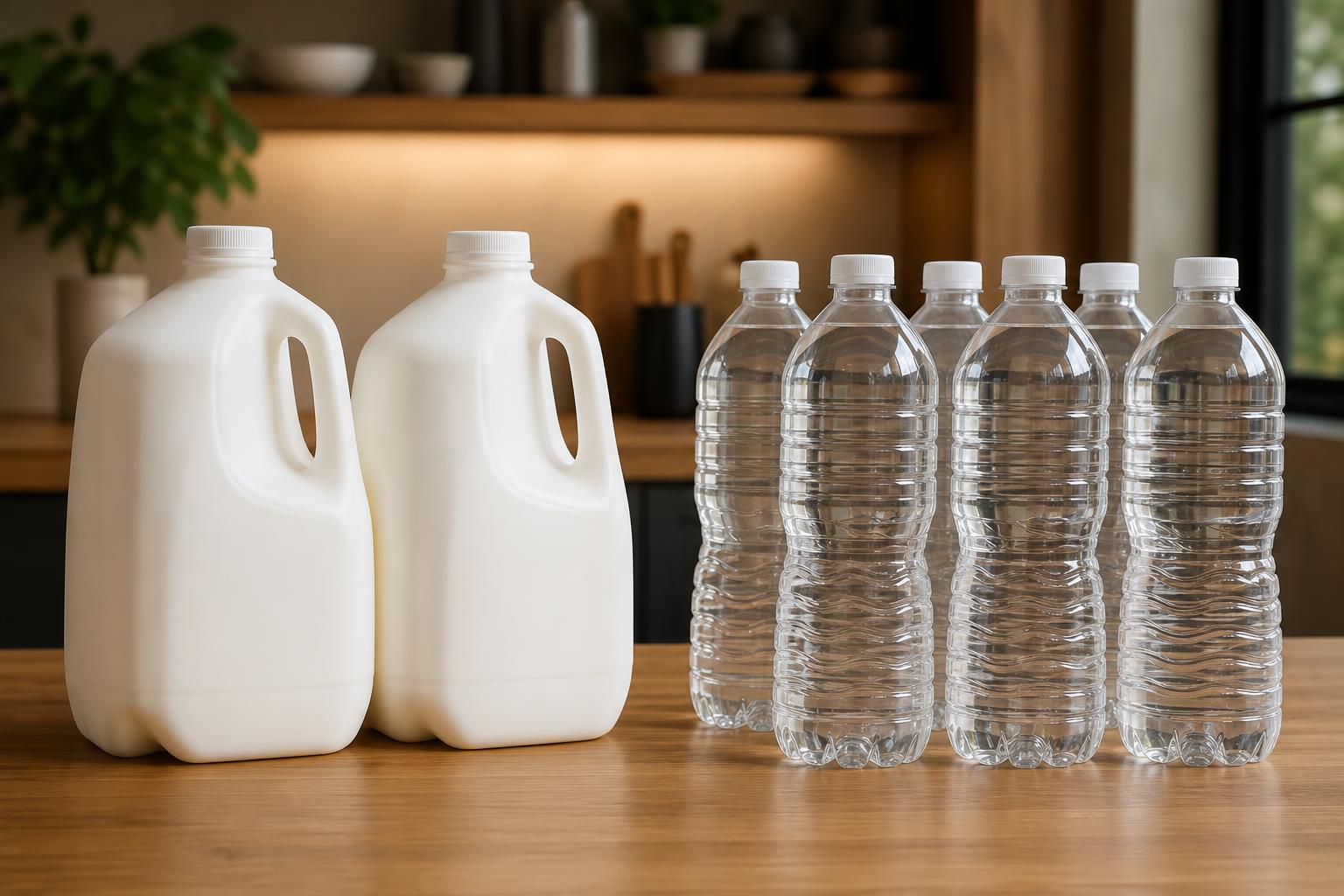
Most mistakes come from mixing U.S. gallons, Imperial gallons, and rounded mental math. In a U.S. beverage context, the correct gallon is almost always the U.S. liquid gallon.
Mistake: Treating a gallon as 4 liters
A U.S. liquid gallon is not 4 liters. It is exactly 231 cubic inches, which equals 3.785411784 liters. That difference matters when converting 1.5-liter bottles, especially for wine, batch cocktails, or inventory counts.
| Measure | Liters | 1.5-liter bottles |
| 1 U.S. liquid gallon | 3.785411784 L | 2.5236 bottles |
| Rounded “4-liter gallon” | 4.0000 L | 2.6667 bottles |
| Difference | 0.214588216 L | 0.1431 bottle |
That rounding error is about 214.6 milliliters, nearly a standard 5-ounce wine pour plus extra. In service or purchasing, that is too much to ignore.
Myth: “A gallon is about three 1.5-liter bottles”
Three 1.5-liter bottles equal 4.5 liters, not one U.S. gallon. That is 0.714588216 liters more than a U.S. gallon, or about 24.2 U.S. fluid ounces.
| Quantity | Total volume | Compared with 1 U.S. gallon |
| 2 bottles of 1.5 L | 3.0 L | 0.785411784 L short |
| 2.5236 bottles of 1.5 L | 3.785411784 L | Equals 1 U.S. gallon |
| 3 bottles of 1.5 L | 4.5 L | 0.714588216 L over |
Mistake: Confusing U.S. and Imperial gallons
The Imperial gallon is used in some Commonwealth contexts and is larger than the U.S. liquid gallon. If a source does not specify the gallon type, the answer can change noticeably.
| Gallon type | Liters per gallon | 1.5-liter bottles per gallon |
| U.S. liquid gallon | 3.785411784 L | 2.5236 |
| Imperial gallon | 4.54609 L | 3.0307 |
- Best practical answer: 1 U.S. gallon is about 2.52 bottles of 1.5 liters.
- Do not round to 3 bottles unless overfilling by more than 0.7 liters is acceptable.
- For bar prep, calculate with 3.785411784 liters per U.S. gallon, then round only at the final step.
Questions People Ask Most
How many 1.5-liter bottles are in a U.S. gallon?
One U.S. gallon equals exactly 3.785411784 liters, so a gallon contains about 2.52 bottles of 1.5 liters. In practical terms, two full 1.5-liter bottles equal 3.0 liters, leaving about 0.785 liters still needed to make a gallon.
Is 1.5 liters half a gallon?
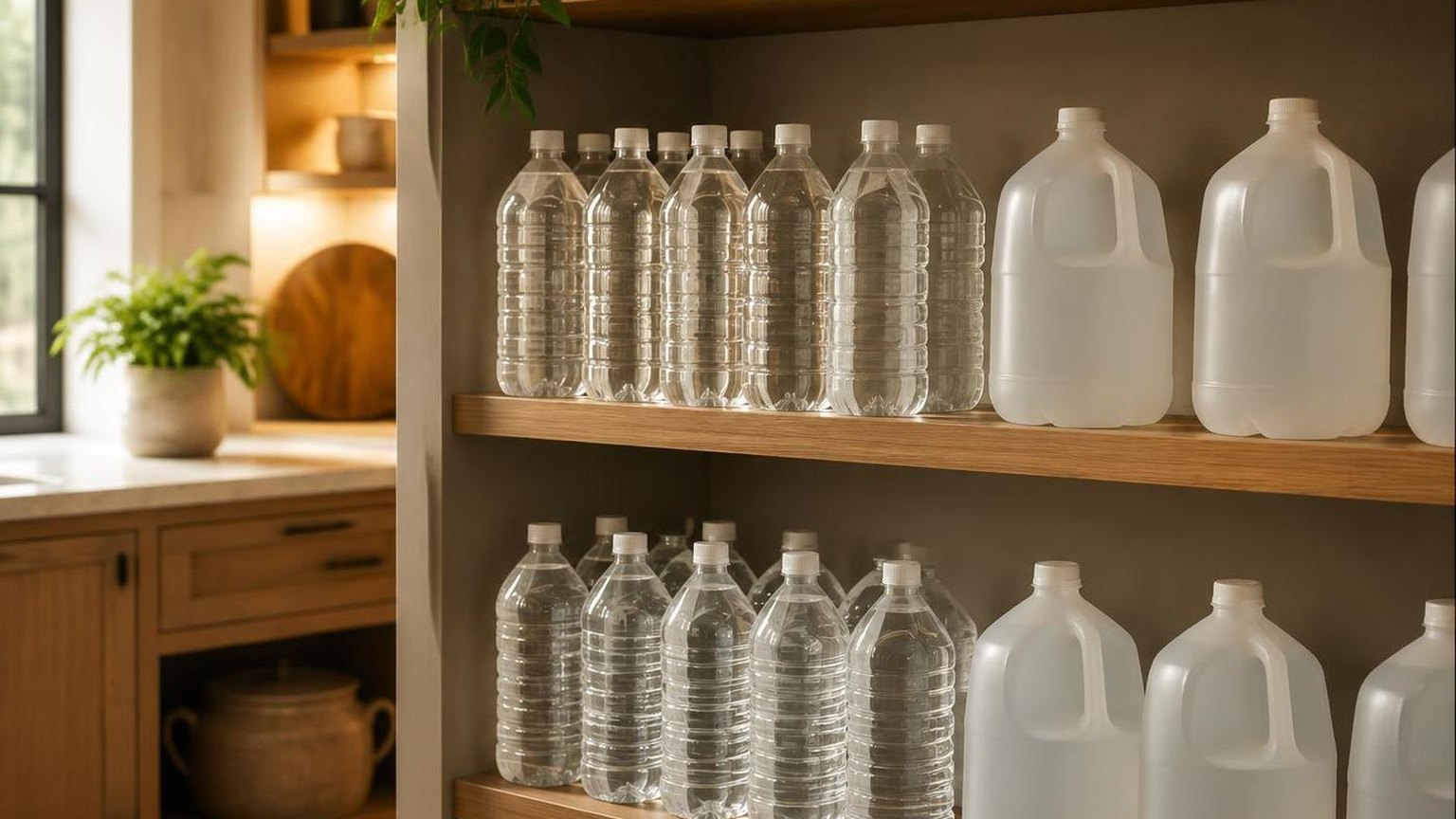
No. A half U.S. gallon is about 1.8927 liters, so 1.5 liters is smaller than a half gallon. A 1.5-liter bottle is about 0.396 U.S. gallons.
How many gallons is 1.5 liters?
1.5 liters equals about 0.3963 U.S. gallons. That is just under two-fifths of a gallon, using the exact U.S. conversion of 1 gallon = 3.785411784 liters.
How many 1.5-liter wine bottles would equal one gallon?
A 1.5-liter wine bottle, often called a magnum, holds about 0.396 U.S. gallons. You would need about 2.52 magnums to equal one U.S. gallon, so three magnums would be more than a gallon at 4.5 liters.
Does the answer change for an Imperial gallon?
Yes. An Imperial gallon equals about 4.54609 liters, so it contains about 3.03 bottles of 1.5 liters. This is different from the U.S. gallon, which contains about 2.52 bottles of 1.5 liters.
What is the easiest way to convert several 1.5-liter bottles into U.S. gallons?
Multiply the bottle count by 1.5 to get total liters, then divide by 3.78541, because 1 U.S. gallon equals 3.78541 liters. For example, 4 bottles equal 6 liters, which converts to about 1.59 U.S. gallons.
Why do estimates for 1.5 liters to gallons sometimes differ slightly?
Small differences come from rounding the conversion factor, since 1 U.S. gallon is exactly 231 cubic inches and commonly expressed as 3.785 liters or 3.78541 liters. Using 3.785 gives 1.5 liters as 0.396 gallons, while 3.78541 gives about 0.39626 gallons.
Related Reading
- How Many Ml Is 14 Oz? (2026 Expert Guide) – Accurate Conversion, Practical Uses & Real-Life Insights
- How Many Grams In 1 Ounce?
- How To Get Broken Cork Out Of Wine Bottle?
- How Much Is 4 Oz In Tablespoons?
- How Many Ml In An Oz Of Liquid? – A Complete, Experience-Based Guide You’ll Actually Use
- How To Drink Single Malt Scotch Whisky?
- How To Start Your Own Wine Brand?
- All Blog Guides