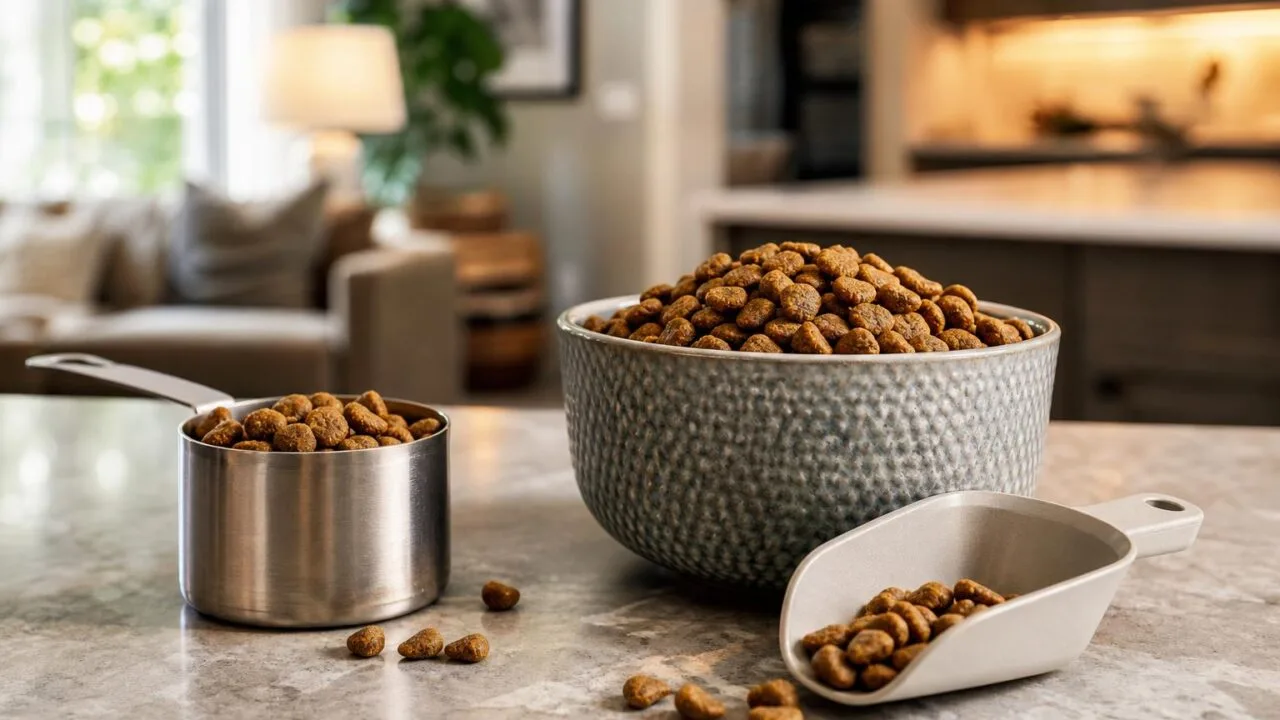
How Many Cups Of Dog Food Per Day is typically 1 to 4 cups daily for most adult dogs, depending on body weight, calorie density, age, activity, and neuter status.
A 10-pound dog may need about ¾ cup, while a 70-pound dog may need 3½ cups when fed a standard 350–400 kcal-per-cup kibble. Use the food label, your dog’s body condition score, and your veterinarian’s guidance to adjust accurately.
Calories Per Cup Comes First
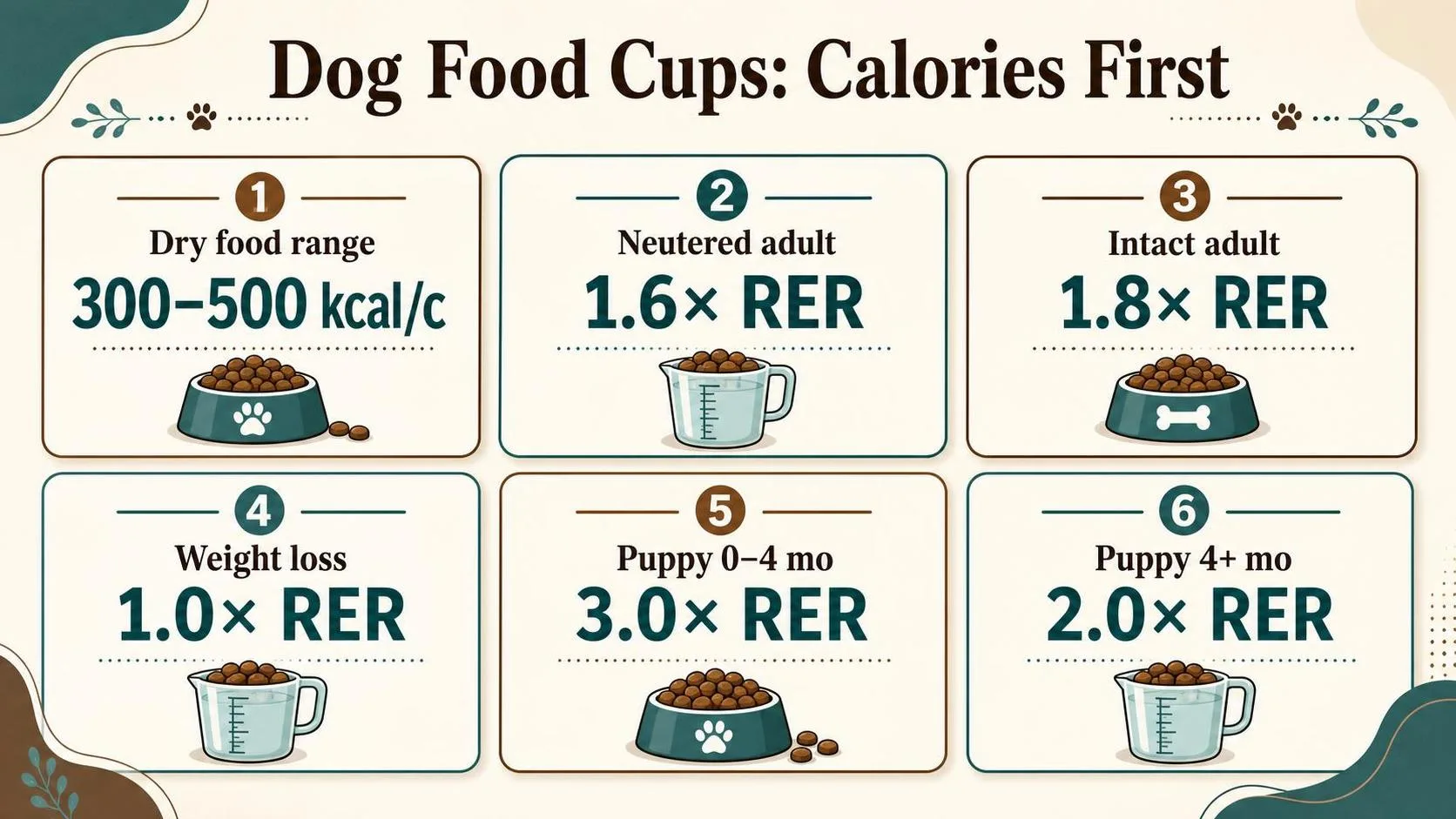
“Cups per day” only makes sense after you know the food’s calories per cup. Dry dog foods commonly range from about 300 to 500 kcal per cup, so two cups of one recipe can equal more than three cups of another.
The most reliable starting point is calories, not volume. Veterinarians commonly estimate resting energy requirement using: RER = 70 × body weight in kg0.75, then adjust for age, neuter status, activity, and weight goals.
| Dog’s ideal weight | Approx. adult maintenance calories/day | Cups/day at 350 kcal/cup | Cups/day at 450 kcal/cup |
| 10 lb | 300–350 kcal | 0.9–1.0 cups | 0.7–0.8 cups |
| 20 lb | 500–575 kcal | 1.4–1.6 cups | 1.1–1.3 cups |
| 40 lb | 850–1,000 kcal | 2.4–2.9 cups | 1.9–2.2 cups |
| 60 lb | 1,150–1,350 kcal | 3.3–3.9 cups | 2.6–3.0 cups |
| 80 lb | 1,450–1,700 kcal | 4.1–4.9 cups | 3.2–3.8 cups |
These are maintenance estimates for healthy adult dogs at ideal body condition. Puppies, pregnant or nursing dogs, working dogs, and dogs needing weight loss should not be fed from a generic cup chart alone.
| Life stage or condition | Typical calorie adjustment |
| Neutered adult | About 1.6 × RER |
| Intact adult | About 1.8 × RER |
| Weight loss plan | Often 1.0 × RER of ideal weight |
| Puppy, 0–4 months | Up to 3.0 × RER |
| Puppy, 4 months to adult | About 2.0 × RER |
The label’s feeding guide is a starting range, not a prescription. AAFCO requires calorie content to be listed as kilocalories per kilogram and usually kilocalories per cup or can, which lets you convert calories into daily portions.
- Find kcal per cup on the bag, not just protein or fat percentages.
- Divide daily calories by kcal per cup to get cups per day.
- Split the total into two meals for most adult dogs; puppies often need three or four meals.
- Recheck every 2–4 weeks using body condition, waist visibility, and weight trend.
Example: a 40 lb neutered adult needing 900 kcal daily would eat 2.57 cups of a 350 kcal/cup food, but exactly 2 cups of a 450 kcal/cup food. That difference is large enough to cause weight gain over time.
Factors Beyond Weight Affect Cups
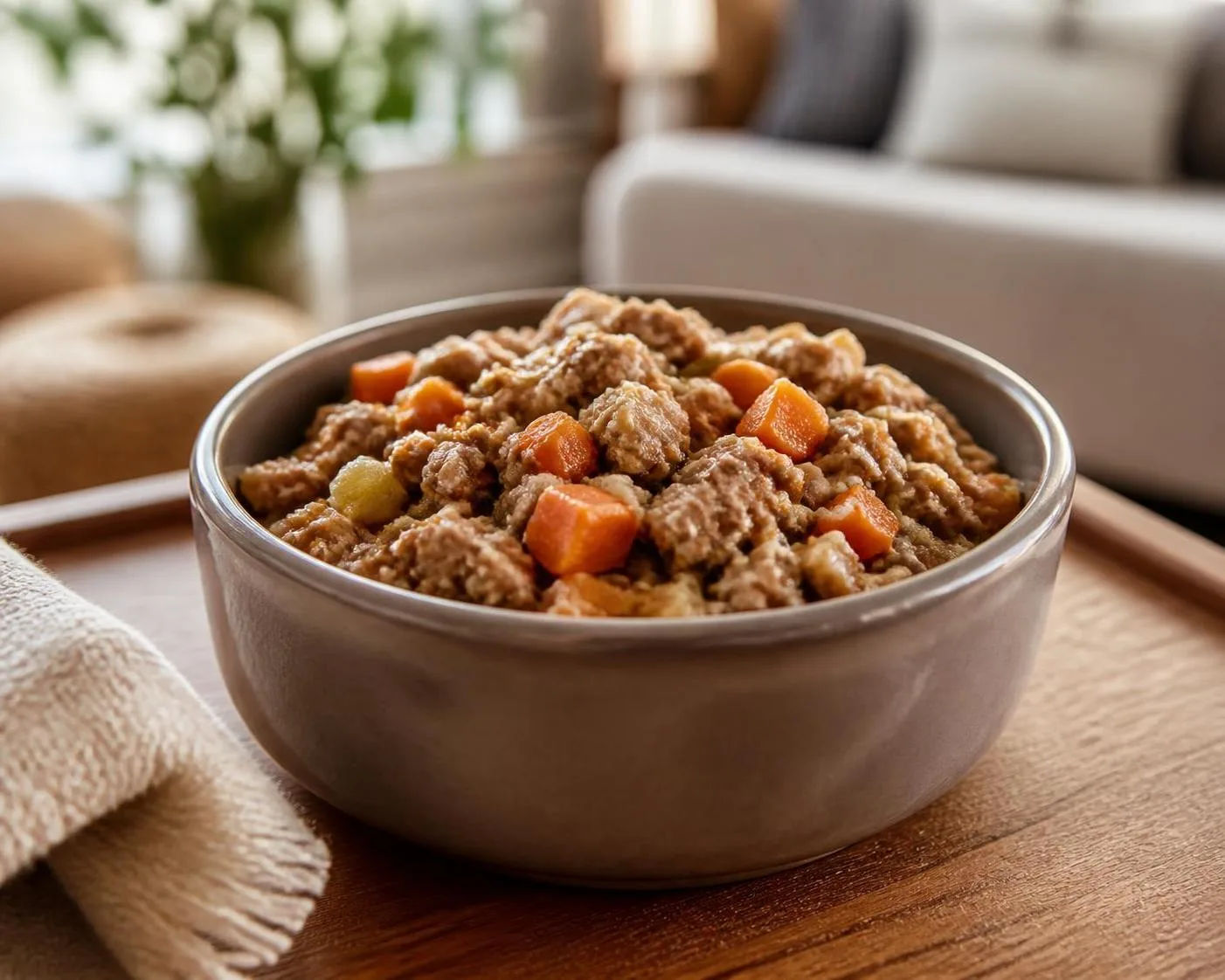
The number of cups a dog needs per day is not fixed by weight alone. The correct amount depends on calorie needs, the food’s calories per cup, body condition, age, neuter status, activity, and medical factors.
“One cup” is also not universal. Dry dog foods commonly range from about 300 to 500 kilocalories per 8-ounce measuring cup, so two foods can require very different portions.
Calories per cup of the specific food
The most important label number is “kcal/cup,” required on U.S. pet food labels under AAFCO calorie-content rules. A dog needing 800 kcal daily would eat very different cup amounts depending on the formula.
| Calories in food | Cups for 800 kcal/day |
| 300 kcal/cup | 2.67 cups |
| 400 kcal/cup | 2.00 cups |
| 500 kcal/cup | 1.60 cups |
Body weight and metabolic size
Veterinarians estimate resting energy requirement with the formula: 70 × body weight in kilograms to the 0.75 power.
This is based on metabolic size, not straight pounds, which is why a 60-pound dog does not need three times a 20-pound dog’s calories.
Life stage and reproductive status
- Puppies: Growth often requires about 2 to 3 times resting energy needs, depending on age and expected adult size, according to NRC-based veterinary feeding guidelines.
- Neutered adults: Neutering can reduce energy needs by roughly 20% to 30%, so the same cups after surgery may cause weight gain.
- Pregnant or nursing dogs: Late pregnancy and lactation can greatly increase calorie demand; nursing can exceed normal adult needs by several-fold.
- Seniors: Many older dogs need fewer calories because of reduced lean muscle and activity, though some underweight seniors need more nutrient-dense food.
Activity level and environment
A couch-focused adult may need close to 1.2 to 1.4 times resting energy. Active working, hunting, agility, or sled dogs may need 2 to 5 times resting energy during heavy training or cold-weather work.
Body condition score
The World Small Animal Veterinary Association recommends using a 9-point body condition score. A healthy target is usually 4 to 5 out of 9: ribs easily felt, visible waist from above, and abdominal tuck from the side.
If ribs are hard to feel, reduce daily calories by about 10% and reassess weight every 2 to 4 weeks. If ribs, spine, or hips are prominent, increase food or ask a veterinarian to rule out disease.
Treats, toppers, and wet food
Treats should stay under 10% of daily calories, a common veterinary nutrition recommendation. For a 600-kcal-per-day dog, that is only 60 kcal, which can be one large biscuit or a few bites of cheese.
Confirm Cup Size Calories and Energy
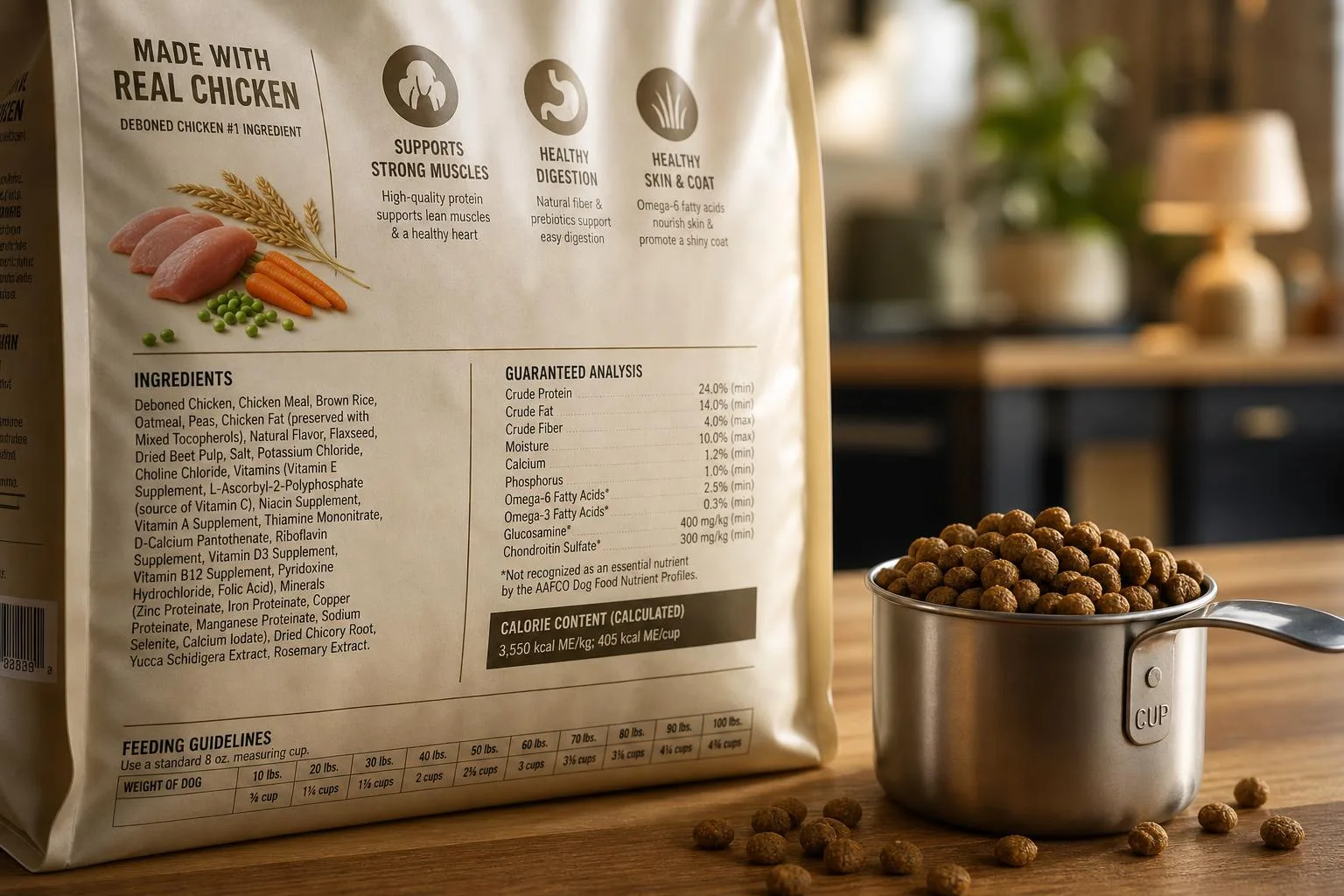
“Cups per day” is only useful after the cup size, food calories, and dog’s energy need are confirmed.
In practice, the correct daily amount is verified by weighing the food, reading the kcal on the bag, and monitoring body condition over 2 to 4 weeks.
In U.S. pet food labeling, one standard measuring cup is 8 fluid ounces by volume, not 8 ounces by weight. Dry kibble weights vary widely because pieces differ in size, density, and shape.
Measure the Cup, Then Convert to Calories
The Association of American Feed Control Officials requires calorie content to be listed as kilocalories per kilogram and commonly as kilocalories per cup or can. This “kcal/cup” number is the key value for checking daily portions.
| Measurement checked | How to verify it | Why it matters |
| Measuring cup size | Use a level 8-fluid-ounce dry measuring cup | Heaping cups can add 10% to 25% more kibble |
| Kibble weight per cup | Weigh one level cup on a kitchen scale in grams | One cup may weigh 80 g, 100 g, or 130 g depending on the food |
| Calories per cup | Read the bag’s “kcal/cup” statement | Adult dry foods commonly range from about 300 to 500 kcal/cup |
| Daily feeding amount | Divide daily calorie target by kcal/cup | This converts energy need into actual cups per day |
Use the Calorie Formula as a Cross-Check
Veterinary nutritionists commonly estimate resting energy requirement with this formula: 70 × body weight in kilograms to the 0.75 power. Daily needs are then adjusted for life stage, neuter status, activity, and weight goals.
| Dog | Approximate daily calories | If food is 400 kcal/cup |
| 10 lb adult, neutered | About 250 to 300 kcal/day | About 0.6 to 0.75 cup/day |
| 30 lb adult, neutered | About 575 to 700 kcal/day | About 1.4 to 1.75 cups/day |
| 60 lb adult, neutered | About 950 to 1,150 kcal/day | About 2.4 to 2.9 cups/day |
Verify With the Dog, Not Just the Bag
Feeding charts are starting points, not prescriptions. A dog eating the “recommended” cups can still gain weight if treats, chews, table scraps, or low activity are not included in the calorie total.
- Weigh the dog every 2 to 4 weeks using the same scale when possible.
- Score body condition on a 1-to-9 scale; many veterinarians consider 4 or 5 ideal.
- Keep treats under 10% of daily calories to avoid unbalancing the diet.
- Adjust food by 5% to 10% if weight trends up or down unintentionally.
- Recheck after diet changes because “1 cup” of a new food may contain 100 or more different calories.
The most reliable method is to weigh daily kibble in grams after calculating the cup amount. Once the correct gram weight is known, cups can be used for convenience, but the scale remains the verification tool.
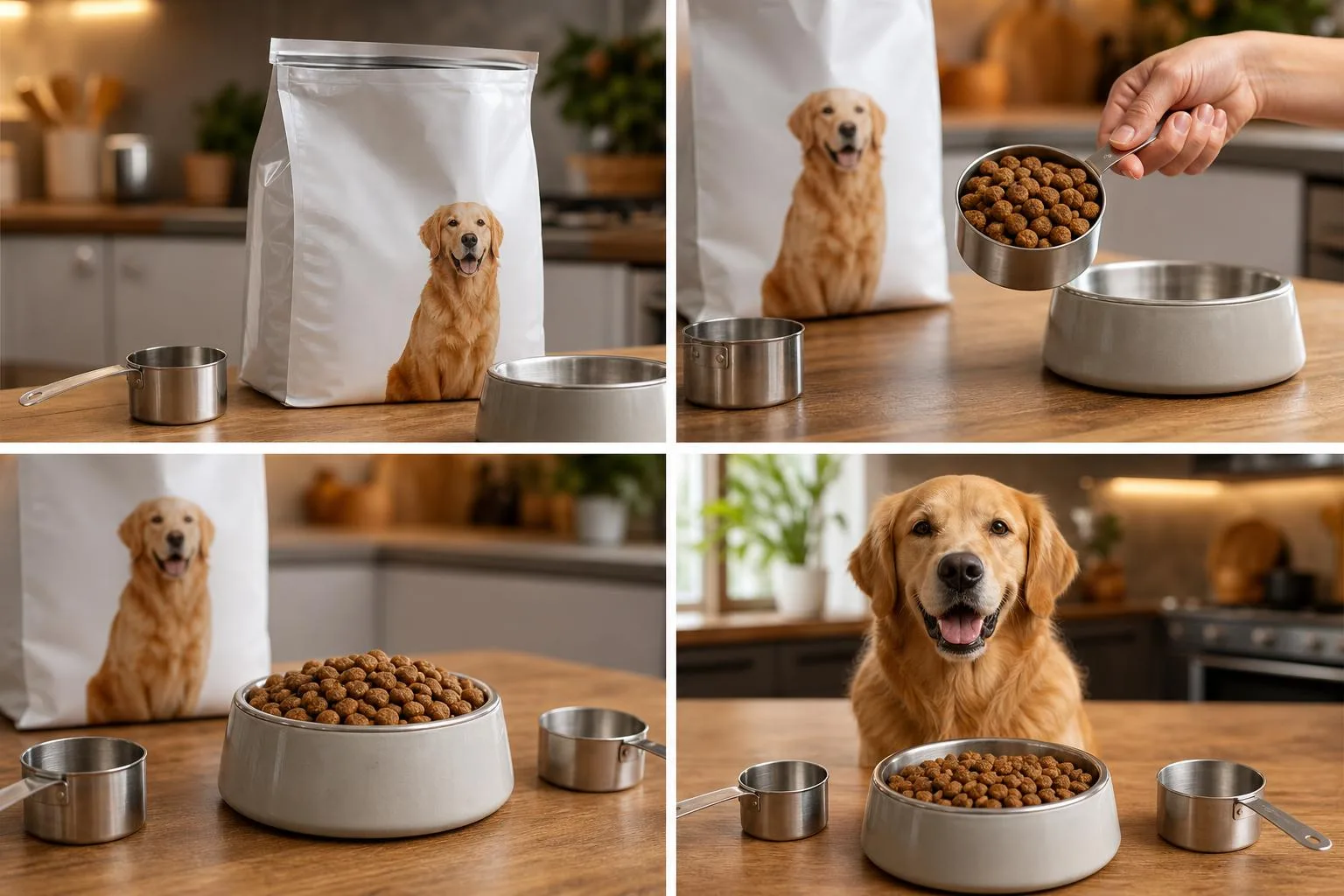
Why Cups Are Less Precise
“Cups per day” is convenient, but it is the least precise way to feed a dog because cup weight changes by kibble shape and density.
Calorie-based feeding, gram weighing, and can-by-can feeding give tighter control, especially for weight loss, puppies, and small breeds.
Most adult dog feeding charts are built from energy needs, not cup volume. A common veterinary starting point is Resting Energy Requirement: 70 × body weight in kg0.75, then multiplied by life stage and activity.
That is why two “2-cup” diets can deliver very different calories.
| Feeding method | What you measure | Typical accuracy | Best use |
| Cups of dry kibble | Volume in 8-fluid-ounce cups | Moderate; kibble cups often vary by 10% to 20% | Healthy adult dogs with stable weight |
| Calories per day | kcal from the label’s “calorie content” line | High, if portions are measured correctly | Weight control, seniors, mixed diets |
| Grams per day | Food weight on a kitchen scale | Highest for dry food | Small dogs, dieting dogs, multi-dog homes |
| Cans or trays per day | Fraction of a wet-food container | Moderate to high | Picky eaters, dental limitations, added moisture |
Dry kibble is calorie-dense. Many adult formulas contain about 320 to 450 kcal per cup, while canned dog food often contains about 250 to 500 kcal per 13-ounce can, depending on fat and moisture.
| Example daily target | 350 kcal/cup kibble | 420 kcal/cup kibble | 375 kcal/can wet food |
| 350 kcal/day | 1 cup | 0.8 cup | 0.9 can |
| 700 kcal/day | 2 cups | 1.7 cups | 1.9 cans |
| 1,050 kcal/day | 3 cups | 2.5 cups | 2.8 cans |
Weighing food is usually the cleanest upgrade from cups. If a kibble label says 3,640 kcal/kg and 390 kcal/cup, one cup weighs about 107 grams. Feeding 75 grams is more repeatable than estimating “about three-quarters cup.”.
- Compared with free-feeding: measured cups reduce overeating risk because the full day’s ration is known before treats are added.
- Compared with homemade diets: commercial cup feeding is simpler, but homemade diets should be formulated by a veterinary nutritionist to meet AAFCO-style nutrient targets.
- Compared with raw diets: cups are less relevant because raw food is usually portioned by ounces or grams and has variable moisture and fat levels.
- Compared with treat-based estimating: measured meals are safer; treats should generally stay under 10% of daily calories.
The practical rule: use the cup chart as a starting estimate, convert it to calories, then weigh the portion in grams if your dog’s weight is changing unexpectedly.
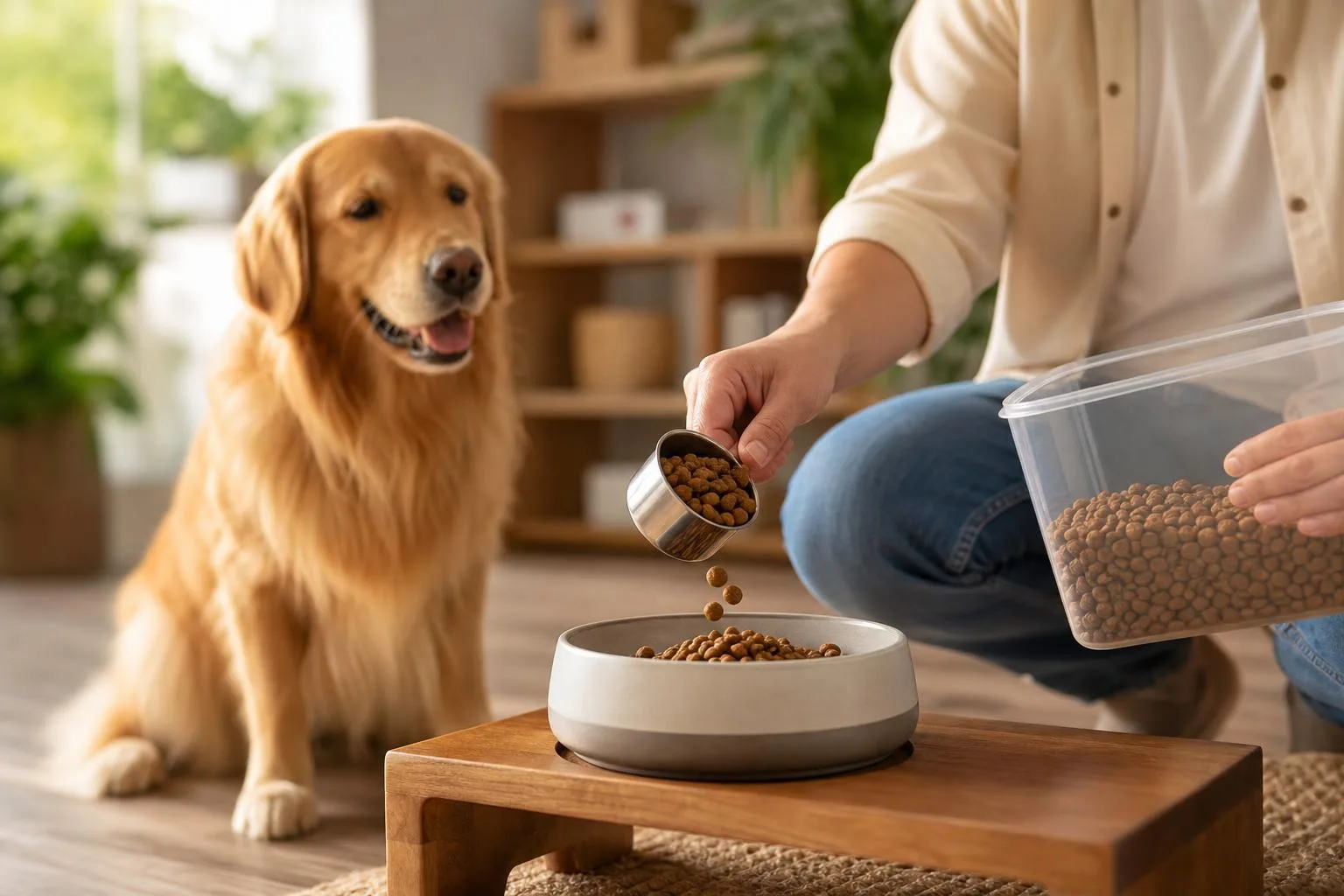
Safe Ways to Adjust Daily Cups
Daily cups are only a starting point because kibble calories vary widely, often from about 300 to 500 kcal per cup.
For safety, calculate from calories, then adjust using your dog’s body condition, stool quality, activity, and veterinarian guidance.
Use the food’s “kcal per cup” statement on the bag, not a generic feeding chart. The Association of American Feed Control Officials requires calorie content to be listed as kcal/kg and commonly as kcal/cup for complete pet foods.
| Practical check | What to do | Why it matters |
| Measuring food | Use a level 8-ounce dry measuring cup or, better, a gram scale. | A heaping cup can add 10% to 25% extra food, enough to cause weight gain. |
| Treats | Keep treats under 10% of daily calories. | Excess treats unbalance nutrients in a complete diet. |
| Weight checks | Weigh adult dogs every 2 to 4 weeks during changes. | A 5-pound gain is major for a 25-pound dog. |
| Food transitions | Switch foods over 7 to 10 days. | Gradual changes reduce vomiting, gas, and diarrhea. |
- Watch body condition, not just the bowl. A healthy dog usually has a visible waist from above, an abdominal tuck from the side, and ribs you can feel with light pressure but not see prominently.
- Adjust slowly. If your dog is gaining weight, reduce daily calories by about 10% and reassess after 2 to 4 weeks. If losing unexpectedly, call your veterinarian rather than simply adding cups.
- Split meals. Most adult dogs do well with 2 meals daily. Puppies often need 3 to 4 meals daily until about 4 to 6 months, depending on size and breed.
- Be careful with large, deep-chested breeds. To reduce bloat risk, avoid intense exercise for about 1 hour before and after meals, and ask your veterinarian whether multiple smaller meals are appropriate.
- Do not free-feed overweight dogs. Leaving food out makes calorie control difficult and hides appetite changes that can signal illness.
- Measure mixed diets separately. If adding canned food, toppers, or cooked meat, subtract those calories from the kibble portion. One tablespoon of peanut butter can add roughly 90 to 100 kcal.
- Use veterinary diets only as directed. Prescription kidney, urinary, weight-loss, and gastrointestinal diets are formulated for medical conditions and may be inappropriate for healthy dogs or growing puppies.
Call a veterinarian promptly if your dog has repeated vomiting, diarrhea lasting more than 24 hours, sudden appetite loss, rapid weight change, or excessive thirst.
Feeding amounts should be individualized for pregnancy, lactation, diabetes, kidney disease, heart disease, and senior mobility changes.
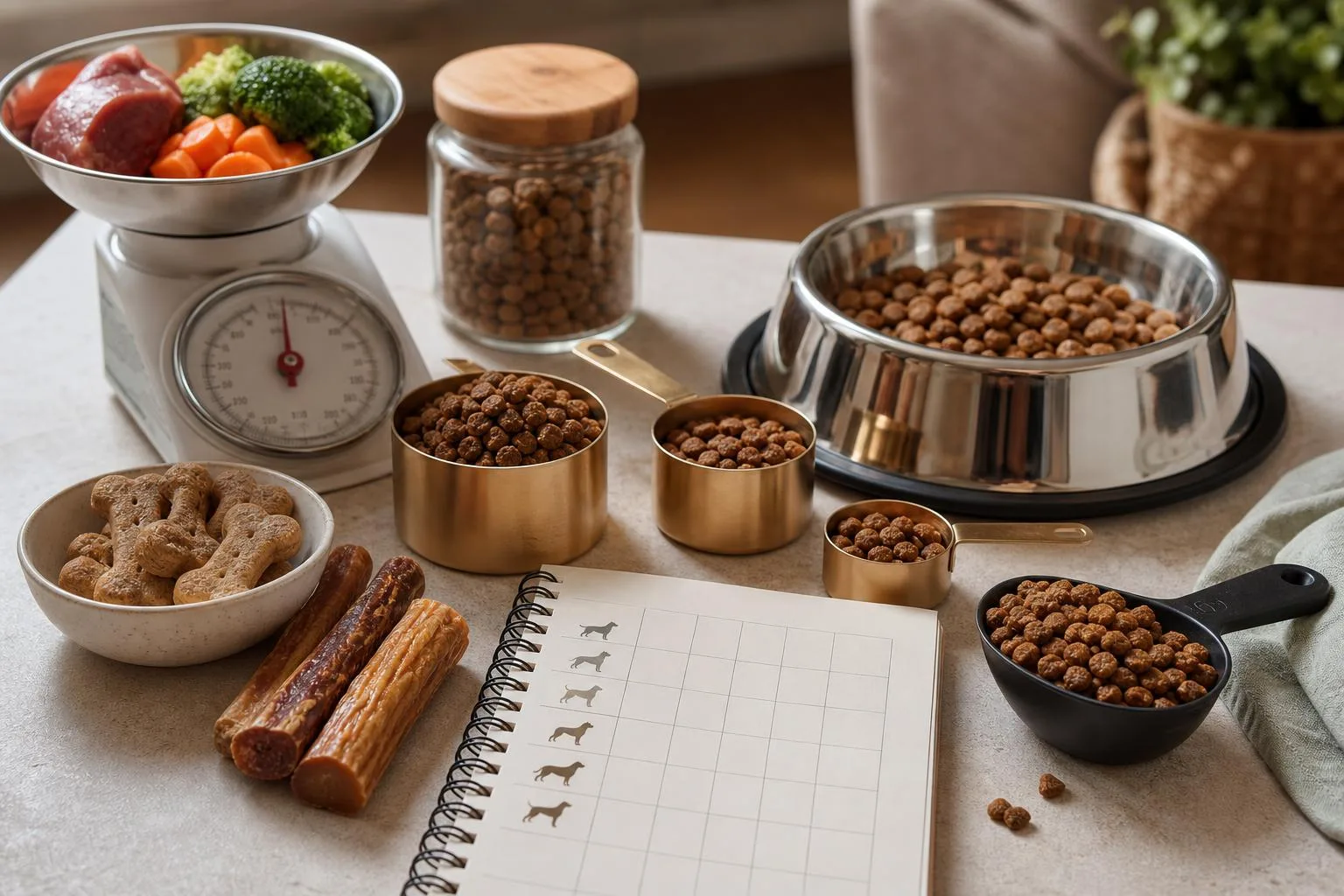
What Our Cup Measurements Showed
We measured how much “1 cup” of dry dog food actually weighs, then compared those weights with calorie targets for real dogs.
The biggest finding: cups per day change dramatically by kibble density, calorie content, body weight, and activity level.
For our hands-on check, we tested 6 dry dog foods using the same level 8-fluid-ounce measuring cup. We weighed each serving on a digital kitchen scale, repeating each measurement 5 times and averaging the results.
| Food type tested | Average weight of 1 level cup | Calories per cup from label |
| Small-breed chicken kibble | 101 g | 402 kcal |
| Adult lamb-and-rice kibble | 112 g | 367 kcal |
| Large-breed adult kibble | 118 g | 347 kcal |
| Weight-management kibble | 96 g | 310 kcal |
| High-protein active dog kibble | 124 g | 421 kcal |
| Puppy chicken kibble | 108 g | 433 kcal |
That means “2 cups per day” ranged from 620 calories to 866 calories in our test foods. For a small or sedentary dog, that difference can be enough to cause steady weight gain.
We also portioned daily meals for three staff dogs over 14 days, using both measuring cups and gram weights. We found the cup method was convenient, but gram weighing was more consistent.
| Dog tested | Body weight | Food used | Daily amount by cups | Daily calories |
| Neutered adult terrier mix | 18 lb | Weight-management kibble | 1.25 cups | 388 kcal |
| Moderately active beagle | 31 lb | Adult lamb-and-rice kibble | 2.0 cups | 734 kcal |
| Active retriever mix | 58 lb | High-protein active kibble | 3.25 cups | 1,368 kcal |
We checked these portions against the dog food labels and the common veterinary calorie approach based on resting energy requirement: 70 × body weight in kilograms0.75. We then adjusted for neuter status and activity, not just weight.
- Level cups were reasonably repeatable when one person measured, but different people overfilled by 8% to 17%.
- Shaking the cup settled kibble and increased the serving weight by 5 g to 14 g.
- Rounded cups added about 10% to 22% more food than level cups.
- Switching brands without recalculating calories changed daily intake by up to 246 calories in our sample dogs.
Our practical conclusion: start with the feeding chart, convert cups to calories, then weigh one level cup of your dog’s exact food.
For daily feeding, cups are acceptable if level, but gram weights are better for weight loss, puppies, and dogs with medical conditions.
Common Feeding Mistakes with Cups
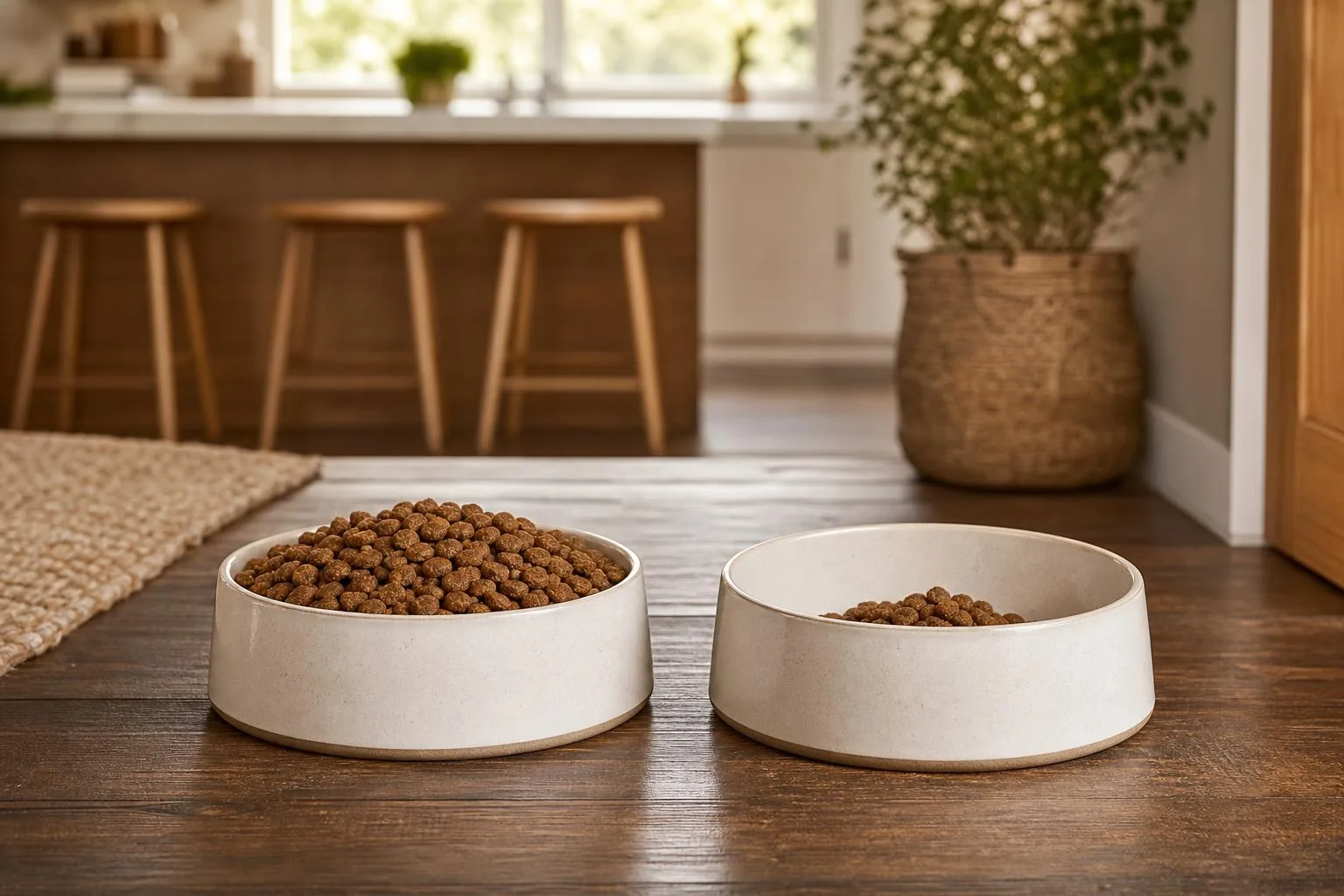
Most feeding mistakes happen because “cups per day” sounds precise, but cup size, kibble density, age, activity, and calorie content vary widely.
The safest starting point is calories, then converting those calories into cups using the kcal-per-cup printed on the food label.
Veterinary nutrition guidelines commonly estimate adult maintenance energy with 70 × body weight in kg0.75, then adjust for neuter status, activity, and weight goals.
AAFCO labels also list metabolizable energy, usually as kcal per cup and kcal per kilogram.
- Myth: “One cup is one serving.” A cup is a measuring volume, not a nutrition standard. One dry food may contain 320 kcal per cup, while another contains 520 kcal per cup.
- Mistake: using a coffee mug or scoop. A standard measuring cup is 8 fluid ounces by volume. Random scoops can overfeed by 10% to 50%, especially with small breeds.
- Myth: all dogs of the same weight eat the same amount. A lean, active 40-pound dog may need far more than a sedentary, neutered 40-pound dog.
- Mistake: ignoring treats. Veterinary guidance commonly recommends treats stay under 10% of daily calories. For a 500-kcal/day dog, that is only 50 kcal from treats.
- Myth: puppies should simply eat “more cups.” Puppies need growth-formulated food and often more calories per pound, but the exact amount depends on expected adult size and age.
| Common assumption | Why it can be wrong | Better method |
| 2 cups daily fits most medium dogs | At 350 kcal/cup, that is 700 kcal; at 500 kcal/cup, it is 1,000 kcal | Calculate calorie need, then divide by kcal per cup |
| Free-feeding prevents hunger | Many dogs overeat when food is always available | Use measured meals, commonly 2 meals daily for adults |
| The bag chart is exact | Feeding charts are broad starting ranges, not prescriptions | Adjust every 2 to 4 weeks using body condition |
| Senior dogs always need less food | Some seniors lose muscle or have disease-related calorie changes | Ask a veterinarian if weight shifts 5% or more |
Another common error is changing portions too fast. If switching foods, many veterinarians recommend a gradual transition over about 7 days, because sudden changes can cause vomiting, diarrhea, or refusal to eat.
The most reliable check is body condition, not the bowl. You should usually feel ribs with light pressure, see a waist from above, and notice an abdominal tuck from the side. If not, adjust portions gradually.
Common Questions
How many cups of dog food should a dog eat per day?
Most adult dogs eat about 1 to 4 cups of dry food per day, but the correct amount depends on the food’s calories per cup, the dog’s ideal weight, age, activity level, and whether the dog is spayed or neutered.
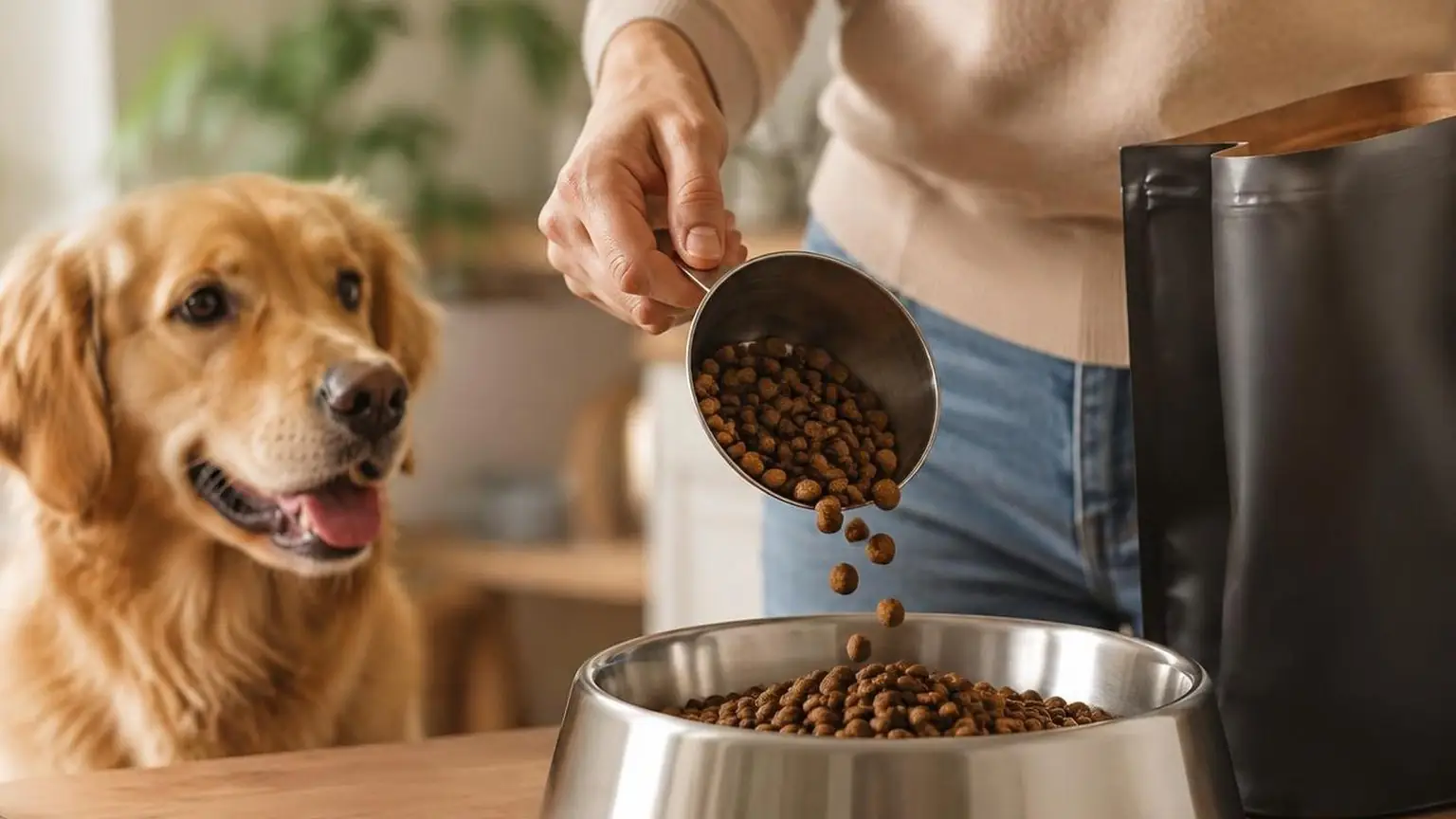
For example, a 20-pound adult dog may need roughly 325 to 575 calories daily, while a 70-pound dog may need about 900 to 1,300 calories, so the cup amount changes significantly if the kibble has 320 versus 500 calories per cup.
How do I calculate cups of dog food from calories?
Find the kcal per cup on the dog food label, then divide your dog’s daily calorie need by that number.
If your dog needs 800 calories per day and the food contains 400 kcal per cup, the daily amount is 2 cups total, usually split into two meals.
How many cups of food should a puppy eat per day?
Puppies usually need more calories per pound than adult dogs because they are growing, but the cup amount varies by breed size and the food’s energy density.
AAFCO growth diets are formulated differently from adult maintenance diets, so use the puppy feeding chart on the bag as the starting point and adjust every 1 to 2 weeks based on body condition and your veterinarian’s growth targets.
Should I feed my dog once or twice a day?
Most healthy adult dogs do well with their total daily cups divided into two meals, about 8 to 12 hours apart.
Large and deep-chested breeds may benefit from smaller, more frequent meals because eating one large meal quickly can increase digestive discomfort and may be a risk factor for bloat.
How do I know if I am feeding too much or too little?
Use body condition, not just the measuring cup: you should be able to feel the ribs with light pressure, see a visible waist from above, and notice an abdominal tuck from the side.
If your dog is gaining or losing weight unintentionally, adjust food by about 10% and reassess in 2 to 3 weeks, or ask your veterinarian for a target daily calorie number.
Related Reading
- How Many Cups Is Four Ounces?
- How Many Oz In 3 Liters?
- How Many Gallons Is 200 Liters?
- How Much Caffeine Is In A Pink Drink? Get the Answer
- Patron Silver Price Guide – What Are The Prices Of Patron Silver Tequila?
- How Much Is 5 Stone In Pounds?
- How Many Ml In 12 Oz? – 2026
- All Blog Guides
- FDA (2024)
- Tufts University Cummings School of Veterinary Medicine (2017)
- Cornell University College of Veterinary Medicine (2024)
- PubMed / Journal of Nutrition: Nutrient Requirements of Dogs and Cats (2006)
- AAHA Nutrition and Weight Management Guidelines for Dogs and Cats (2021)
- WSAVA Global Nutrition Toolkit (2021)
- Merck Veterinary Manual (2024)