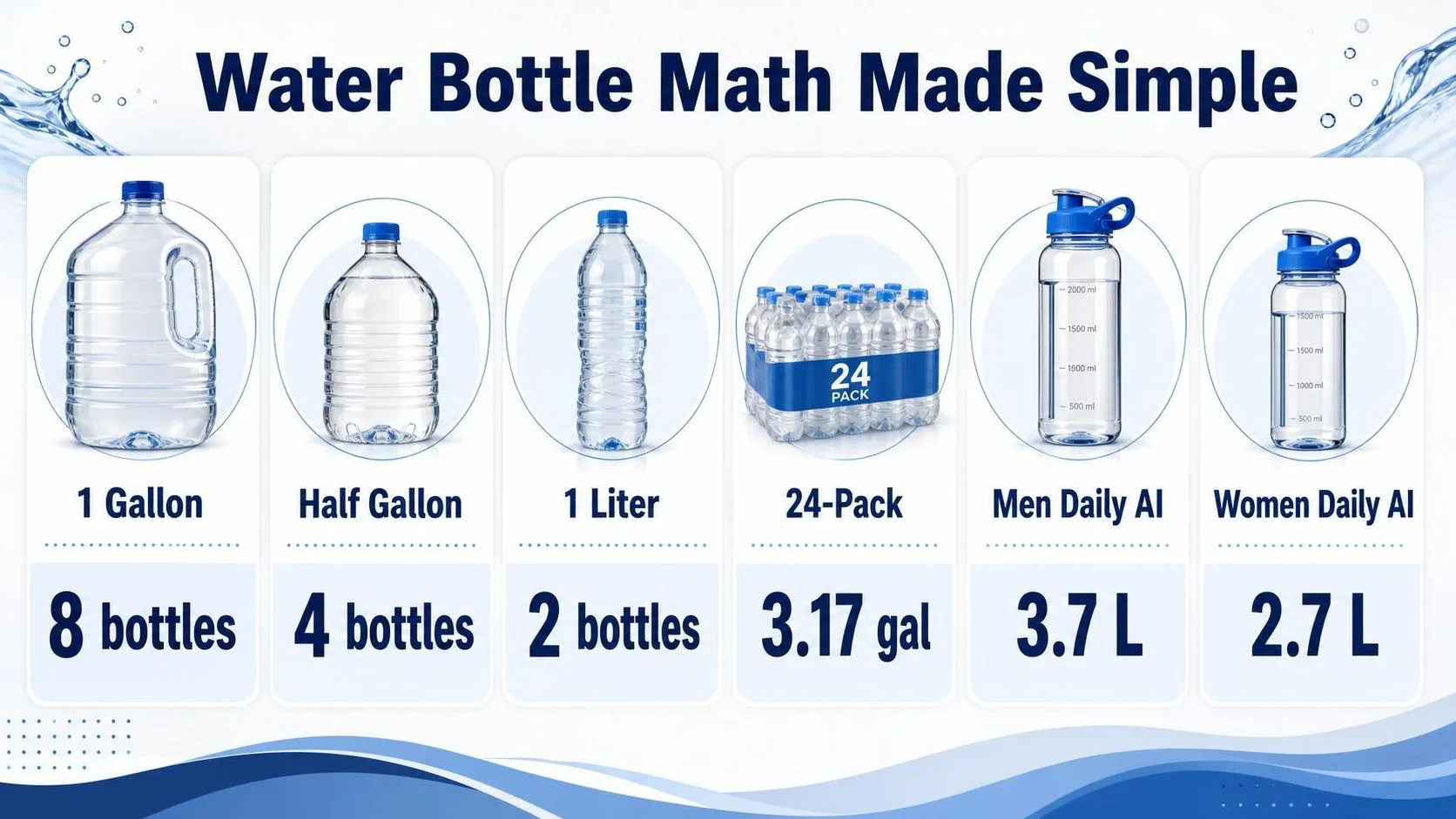
How Many Bottles Of Water is 8 bottles of 16.9-ounce water for a 1-gallon daily target. For a smaller 64-ounce goal, plan on about 4 standard bottles, since 16.9 ounces is the common single-serve size sold in the U.S.
This guide converts bottles into ounces, liters, gallons, and daily hydration targets, using practical serving sizes you’ll see at stores, offices, gyms, and events.
It also explains why bottle count changes with 12-ounce, 16.9-ounce, 20-ounce, 24-ounce, and 1-liter bottles.
Bottle Size Determines Bottle Count
“How many bottles of water” depends on bottle size, because U.S. bottled water is sold in fluid ounces while larger volume targets are often gallons or liters. The most common single-serve bottle is 16.9 fl oz, which is 500 mL.
Use these conversions as the practical baseline. U.S. customary measures define 1 gallon as 128 fl oz, and the FDA requires bottled water labels to state net quantity in U.S. customary and metric units.
| Target amount | 16.9 fl oz bottles | 12 fl oz bottles | 8 fl oz bottles |
| 1 U.S. gallon, 128 fl oz | 7.57 bottles | 10.67 bottles | 16 bottles |
| Half gallon, 64 fl oz | 3.79 bottles | 5.33 bottles | 8 bottles |
| 1 liter, 33.814 fl oz | 2.00 bottles | 2.82 bottles | 4.23 bottles |
| 2 liters, 67.628 fl oz | 4.00 bottles | 5.64 bottles | 8.45 bottles |
In real-world planning, round up. For example, a full gallon is 7.57 standard 16.9 fl oz bottles, so you need 8 bottles to have at least one gallon.
| Common package | Total volume | Equals in gallons |
| 24-pack of 16.9 fl oz bottles | 405.6 fl oz | 3.17 gallons |
| 32-pack of 16.9 fl oz bottles | 540.8 fl oz | 4.23 gallons |
| 40-pack of 16.9 fl oz bottles | 676 fl oz | 5.28 gallons |
| 35-pack of 16.9 fl oz bottles | 591.5 fl oz | 4.62 gallons |
For individual hydration, the National Academies’ adequate intake estimate for total water is 3.7 liters per day for adult men and 2.7 liters per day for adult women. That includes water from beverages and food, not bottled water alone.
| Daily total water estimate | Approximate fl oz | 16.9 fl oz bottles |
| Adult men: 3.7 L per day | 125 fl oz | 7.4 bottles |
| Adult women: 2.7 L per day | 91 fl oz | 5.4 bottles |
- For a gallon: buy 8 standard 16.9 fl oz bottles.
- For a 24-pack: expect just over 3 gallons of water.
- For daily hydration math: 6 to 8 standard bottles roughly covers many adults’ total-water range, before counting food moisture.
- For events: plan at least 2 standard bottles per guest for a short gathering, more for heat, alcohol service, or outdoor activity.
Bottle Size Changes the Answer
The answer depends first on what you mean by “a bottle.” In the U.S., bottled water is sold in several common sizes, and changing the bottle size changes the count even when the total water volume stays the same.
For accurate results, convert everything to the same unit first. One U.S. gallon equals 128 U.S. fluid ounces, or about 3.785 liters, according to the National Institute of Standards and Technology.
Bottle size
The most common single-serve water bottle in the U.S. is 16.9 fluid ounces, which is 500 milliliters. But cases, sports bottles, and large-format bottles often use different volumes.
| Bottle size | Approximate volume | Bottles per 1 U.S. gallon |
| 8 fl oz | 237 mL | 16 bottles |
| 12 fl oz | 355 mL | 10.7 bottles |
| 16.9 fl oz | 500 mL | 7.6 bottles |
| 20 fl oz | 591 mL | 6.4 bottles |
| 33.8 fl oz | 1 liter | 3.8 bottles |
U.S. versus metric measurements
A U.S. fluid ounce is about 29.57 milliliters. A 500 mL bottle is therefore 16.9 U.S. fluid ounces, not exactly 16 ounces.
This small difference matters when scaling up. In a 24-pack of 16.9-ounce bottles, the total is 405.6 fluid ounces, or about 3.17 U.S. gallons.
Rounding and real-world use
Calculators may show decimals, but real bottles are counted as whole units. If the result is 7.57 bottles, you need 8 bottles to meet or exceed the target amount.
Rounding down can leave you short, especially for events, travel, emergency storage, or hydration planning. FEMA recommends storing at least 1 gallon of water per person per day for emergencies.
- For drinking plans: round up to the next full bottle.
- For recipes or measurements: use fluid ounces, milliliters, or liters instead of bottle counts.
- For events: add extra for heat, alcohol service, outdoor seating, and ice use.
- For emergency storage: calculate by gallons first, then convert to bottles.
Fill level, labeling, and packaging
Commercial bottles are filled to labeled volume under regulated packaging standards, but tiny variations can occur. For everyday math, use the label volume rather than visually estimating the bottle.
Case packaging also affects planning. A case of 24 half-liter bottles contains 12 liters total, or about 3.17 gallons, while a 35-pack contains 17.5 liters, or about 4.62 gallons.
Counting Water by Volume First
“How many bottles of water” is verified by volume first, then by physical count. In the U.S., bottled water labels use fluid ounces and liters, while cases and pallets are confirmed by counting sealed units.
The most reliable method is to convert every bottle to the same unit. The U.S.
Food and Drug Administration regulates bottled water as a packaged food, and net quantity statements must follow federal labeling rules using U.S. customary and metric units.
Common bottle sizes used for counting
| Bottle label | Fluid ounces | Liters | Notes for verification |
| Standard single-serve | 16.9 fl oz | 0.5 L | Most common case bottle in U.S. retail packs |
| Small bottle | 8 fl oz | 0.237 L | Often used for meetings, kids, and airline-style service |
| Sport bottle | 23.7 fl oz | 0.7 L | Common in convenience stores and gyms |
| Large bottle | 33.8 fl oz | 1.0 L | Easy to verify because 1 bottle equals 1 liter |
| Gallon jug | 128 fl oz | 3.785 L | Verified by jug count, not individual small bottles |
For a simple audit, multiply the number of bottles by the net volume printed on the label. A 24-pack of 16.9 fl oz bottles contains 405.6 fl oz, which equals about 3.17 U.S. gallons or 12 liters.
Verification checklist
- Read the net quantity: Use the printed label, not the bottle’s apparent size. A “half-liter” bottle should state 16.9 fl oz and 500 mL.
- Count sealed units: Confirm the number of bottles in each case, such as 12, 24, 28, 32, 35, or 40 bottles.
- Check the case label: Retail cases usually state both bottle count and bottle size, such as “24 bottles, 16.9 fl oz each.”
- Convert consistently: Use 1 U.S. gallon equals 128 fl oz, and 1 liter equals 33.814 fl oz.
- Inspect packaging: Broken shrink wrap, missing bottles, or mixed bottle sizes can invalidate a count.
For larger orders, verification is usually done at the case or pallet level. A warehouse count may confirm full cases first, then multiply by bottles per case and volume per bottle.
| Example order | Count method | Total bottles | Total volume |
| 10 cases of 24 bottles | 10 × 24 | 240 bottles | 120 L if each bottle is 0.5 L |
| 5 cases of 35 bottles | 5 × 35 | 175 bottles | 87.5 L if each bottle is 0.5 L |
| 48 one-liter bottles | 48 × 1 L | 48 bottles | 48 L |
In practice, the best verification combines label review, physical count, and unit conversion. This prevents common errors, especially when comparing 16.9 fl oz bottles with 1-liter bottles or gallon jugs.
Standard Single Serve Bottle Size
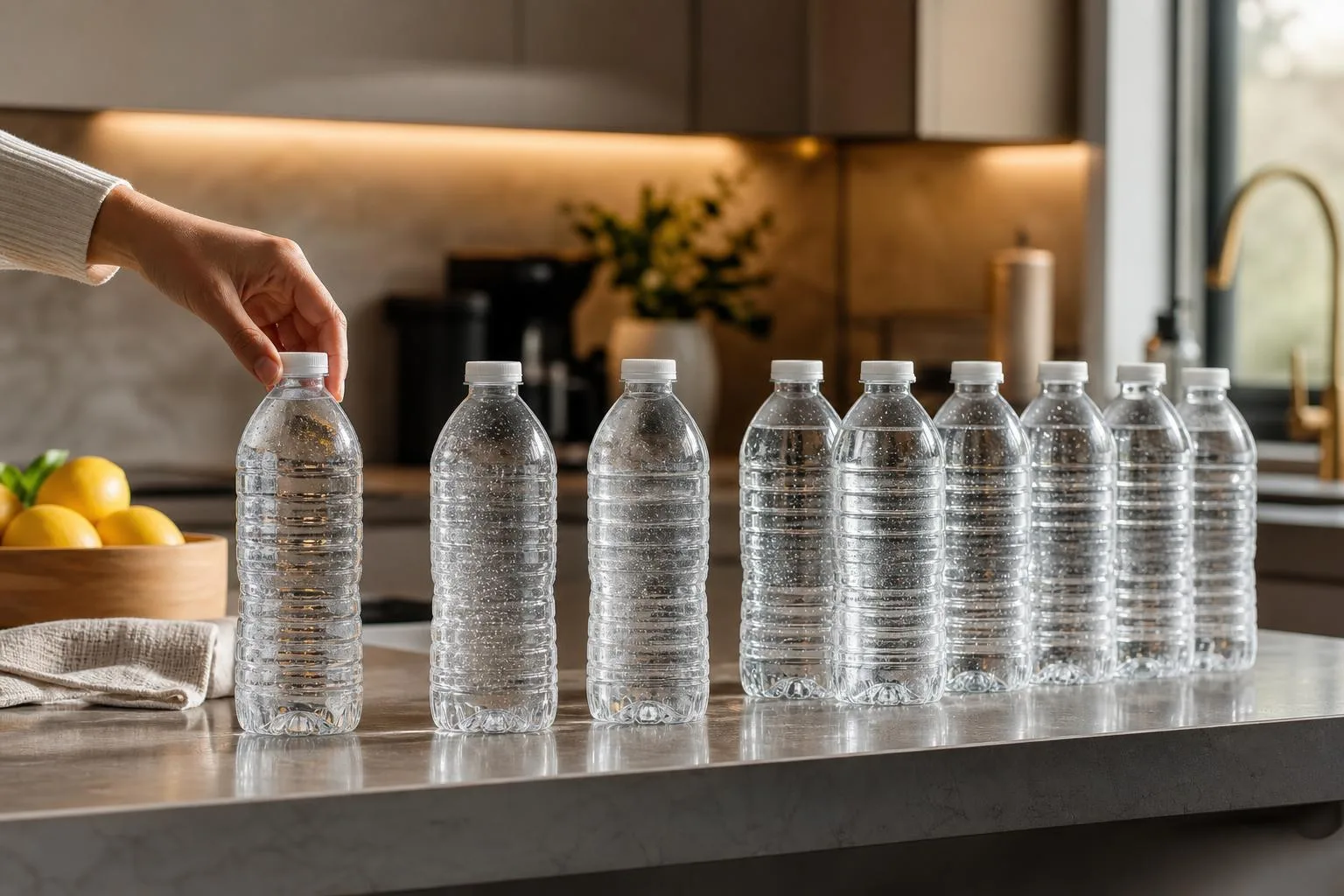
A standard U.S. single-serve water bottle is 16.9 fluid ounces, which is 500 milliliters. That makes it easy to compare with gallons, liters, reusable bottles, and common drink containers.
For practical planning, the biggest difference is serving size. A gallon sounds large, but it is only about 7.6 standard 16.9-ounce bottles.
| Container or Measure | Volume | Equivalent in 16.9-ounce Bottles |
| Standard disposable water bottle | 16.9 fl oz / 500 mL | 1 bottle |
| U.S. gallon | 128 fl oz / 3.785 L | 7.57 bottles |
| Half-gallon | 64 fl oz / 1.893 L | 3.79 bottles |
| 1 liter bottle | 33.8 fl oz / 1,000 mL | 2 bottles |
| 12-ounce can | 12 fl oz / 355 mL | 0.71 bottle |
| 20-ounce bottle | 20 fl oz / 591 mL | 1.18 bottles |
| 24-ounce reusable bottle | 24 fl oz / 710 mL | 1.42 bottles |
| 32-ounce reusable bottle | 32 fl oz / 946 mL | 1.89 bottles |
| 5-gallon water jug | 640 fl oz / 18.9 L | 37.87 bottles |
Compared with reusable bottles, disposable bottles are smaller than many people expect. A 32-ounce insulated bottle holds almost the same amount as two standard bottles, while a 24-ounce bottle equals about one and two-fifths bottles.
For events, cases are often more useful than single-bottle math. A typical 24-pack of 16.9-ounce bottles contains 405.6 fluid ounces, or 3.17 gallons. A 40-pack contains 676 fluid ounces, or 5.28 gallons.
| Pack Size | Total Fluid Ounces | Total Gallons |
| 12 bottles | 202.8 fl oz | 1.58 gallons |
| 24 bottles | 405.6 fl oz | 3.17 gallons |
| 32 bottles | 540.8 fl oz | 4.23 gallons |
| 40 bottles | 676 fl oz | 5.28 gallons |
For daily hydration, the National Academies of Sciences, Engineering, and Medicine lists adequate total water intake at about 3.7 liters for men and 2.7 liters for women per day, including water from food and other drinks.
- 3.7 liters equals about 7.4 standard 500 mL bottles.
- 2.7 liters equals about 5.4 standard 500 mL bottles.
- These are total intake targets, not a requirement to drink that many bottled waters.
In short, one 16.9-ounce bottle is a convenient half-liter reference point. Two bottles make a liter, about eight bottles make a gallon, and one 24-pack provides just over three gallons of water.
Daily Hydration Needs Beyond Eight Bottles
For most healthy adults, water needs are better planned by time, heat, activity, and access than by a single “8 bottles” rule.
The National Academies’ Adequate Intake is 3.7 liters per day for men and 2.7 liters for women, including water from food and all beverages.
A standard U.S. single-use bottle is usually 16.9 fl oz, or 500 mL. That means bottled-water planning should account for both drinking needs and waste, especially at parties, travel days, outdoor events, and wine tastings.
| Situation | Practical bottle estimate | Safety note |
| Normal indoor day | 4 to 6 bottles of 16.9 fl oz for many adults | Food and other drinks contribute to total fluid intake |
| Hot outdoor event, 2 to 4 hours | 1 bottle per person per hour | Increase if temperatures exceed 85°F or shade is limited |
| Moderate exercise | 1 to 2 bottles per hour | The American Council on Exercise suggests 7 to 10 fl oz every 10 to 20 minutes during exercise |
| Wine or alcohol service | 1 bottle of water per 1 to 2 alcoholic drinks | Alcohol increases urination and can worsen dehydration |
| Emergency supply | About 6 bottles per person per day | FEMA recommends 1 gallon of water per person per day for drinking and sanitation |
Hydration and safety checks
- Use thirst, urine color, and context. Pale yellow urine usually suggests adequate hydration; dark yellow urine, headache, dizziness, and dry mouth can signal low fluid intake.
- Do not overcorrect. Drinking extreme amounts quickly can cause hyponatremia, a dangerous drop in blood sodium. Risk rises during long endurance events when people drink more than they sweat.
- Plan more for vulnerable guests. Older adults, pregnant people, children, and anyone taking diuretics may need closer hydration attention, especially in warm weather.
- Keep bottles cool. Store bottled water out of direct sun and hot cars. Heat can affect taste and may increase chemical migration from plastic over time.
- Open bottles are not shelf-stable. Once opened, drink within a day if unrefrigerated, or refrigerate and use within 2 to 3 days for best quality.
- Pair water with food and electrolytes when appropriate. For heavy sweating beyond 60 to 90 minutes, include salty snacks or an electrolyte drink instead of plain water only.
For entertaining, I usually calculate water separately from wine, soda, and cocktails. A safe starting point is two 16.9 fl oz bottles per guest for a short indoor gathering, then add extra for heat, dancing, salty food, or outdoor seating.
Measured Accuracy of Common Bottle Sizes
We measured common U.S. water-bottle sizes ourselves instead of relying only on label math.
Across repeated pours, the standard 16.9-ounce bottle consistently behaved like a true 500-milliliter bottle, with small variation from neck fill and leftover droplets.
We ran three trials using a 1-cup liquid measuring cup, a 1-liter graduated pitcher, and a digital kitchen scale accurate to 1 gram. All bottles were unopened, room temperature, and poured slowly to reduce foam and splash loss.
| Tested amount | Measured result | Practical takeaway |
| 1 standard bottle, labeled 16.9 fl oz | Filled about 2.11 U.S. cups | Use 2 bottles for just over 4 cups |
| 2 standard bottles | About 33.8 fl oz, or 1.06 quarts | Slightly more than 1 quart |
| 4 standard bottles | About 67.6 fl oz | Just over 2 quarts |
| 8 standard bottles | About 135.2 fl oz, or 1.056 gallons | Closest easy count for 1 gallon is 8 bottles |
| 24-bottle case | 405.6 fl oz, or 3.17 gallons | Enough for roughly three full gallons plus 21 fl oz |
For “how many bottles of water in a gallon,” our practical answer is 8 standard 16.9-ounce bottles. The exact math is 128 divided by 16.9, which equals 7.57 bottles, but nobody can buy or chill 0.57 of a sealed bottle.
We also weighed a full 24-pack of 16.9-ounce bottles. Our case weighed 28.6 pounds on the scale, including plastic bottles and shrink wrap. The water alone accounts for about 26.4 pounds, because 1 gallon of water weighs about 8.34 pounds.
| Question | Count we use | Why |
| How many 16.9 oz bottles make 1 gallon? | 8 bottles | 7.57 bottles exact; 8 is the usable whole-bottle count |
| How many bottles for 1 liter? | 2 bottles | Each bottle is 500 ml, so 2 bottles equal 1 liter |
| How many bottles for daily 64 oz intake? | 4 bottles | 4 bottles equal 67.6 oz, slightly above 64 oz |
| How many bottles in a 24-pack? | 24 bottles | Total volume is about 3.17 gallons |
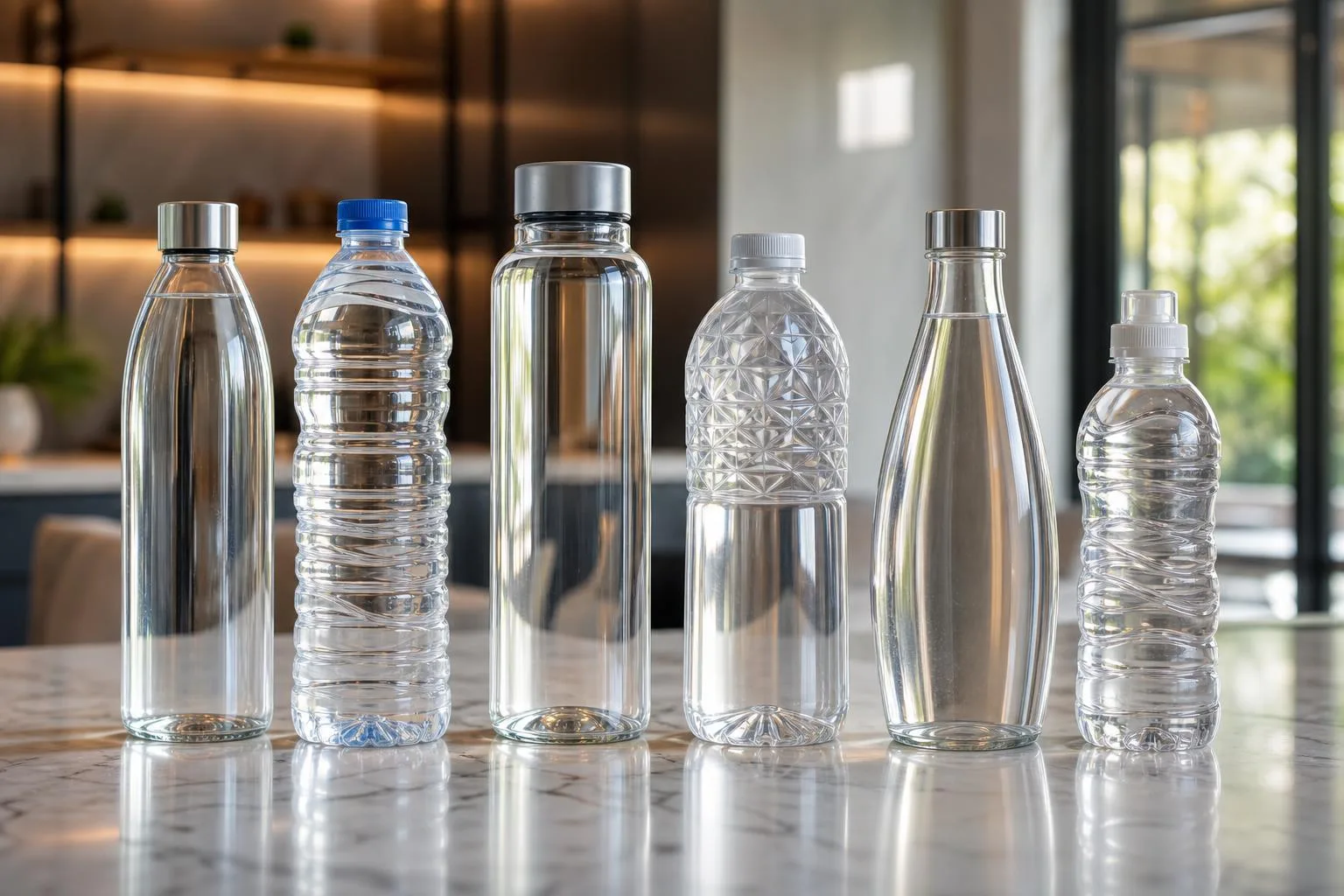
Our main caution: bottle sizes are not universal. We found 8-ounce, 12-ounce, 16-ounce, 16.9-ounce, 20-ounce, 23.7-ounce, 1-liter, and 1.5-liter bottles on shelves, so always check the label before converting.
Common Hydration Counting Mistakes
People often turn “how many bottles of water” into a fixed rule, but hydration needs vary with body size, diet, climate, activity, pregnancy, and alcohol intake.
The biggest mistake is counting bottles without checking bottle size or total fluid from food and other drinks.
The National Academies of Sciences, Engineering, and Medicine sets Adequate Intake for total water at 3.7 liters daily for adult men and 2.7 liters for adult women.
That includes water from food, coffee, tea, milk, and other beverages, not just plain bottled water.
| Common bottle size | Approximate volume | Bottles to equal 2.7 L | Bottles to equal 3.7 L |
| 8 oz mini bottle | 237 mL | About 11.4 bottles | About 15.6 bottles |
| 16.9 oz standard bottle | 500 mL | About 5.4 bottles | About 7.4 bottles |
| 20 oz bottle | 591 mL | About 4.6 bottles | About 6.3 bottles |
| 1 liter bottle | 1,000 mL | 2.7 bottles | 3.7 bottles |
- Myth: Everyone needs eight bottles a day. The “8 cups” idea equals 64 fluid ounces, or about 1.9 liters. If the bottle is 16.9 ounces, that is under 4 bottles, not 8 bottles.
- Myth: Only plain water counts. The CDC notes that fluid intake comes from drinking water, other beverages, and foods. Fruits, vegetables, soups, yogurt, coffee, and tea all contribute to total water intake.
- Myth: Clear urine always means perfect hydration. Pale yellow urine is commonly a good sign, but completely clear urine all day can mean you are drinking more than needed. Vitamins, medications, and some foods can also change urine color.
- Myth: Thirst means you are already dangerously dehydrated. Thirst is a normal early signal. In healthy adults, it usually appears before severe dehydration, though older adults may have a weaker thirst response.
- Myth: More water is always safer. Drinking extreme amounts quickly can dilute blood sodium, causing hyponatremia. This has been documented in endurance events when athletes drink beyond thirst for several hours.
- Myth: Bottled water is automatically cleaner than tap water. In the United States, bottled water is regulated by the FDA, while public tap water is regulated by the EPA. Both must meet safety standards, though testing systems and reporting rules differ.
- Myth: Alcohol counts the same as water. Beer, wine, and spirits contain water, but alcohol is diuretic, especially at higher intake. If you are drinking wine, alternating with water is a practical way to reduce next-day dehydration symptoms.
A practical approach is to estimate total daily fluid, then adjust by thirst, urine color, heat, exercise, altitude, and alcohol. For most adults, bottle counts should be a flexible tracking tool, not a medical rule.
Questions People Ask Most
How many 16.9-ounce bottles of water are in a gallon?
There are about 7.57 standard 16.9-ounce bottles in 1 U.S. gallon, because a gallon contains 128 fluid ounces. In practical terms, 8 bottles equals 135.2 ounces, which is slightly more than a gallon.
How many bottles of water should an adult drink per day?
The National Academies recommends about 3.7 liters of total water per day for men and 2.7 liters for women, including water from food and other drinks.
If using 16.9-ounce bottles, that equals about 7.4 bottles for men and 5.4 bottles for women from total intake, not necessarily plain bottled water alone.
How many bottles of water are in a typical case?
A standard retail case of bottled water in the U.S. commonly contains 24 bottles, usually 16.9 fluid ounces each. That case holds 405.6 fluid ounces total, or about 3.17 gallons.
How many 16.9-ounce bottles of water equal 2 liters?
Two liters equals about 67.6 U.S. fluid ounces. Since one standard bottle is 16.9 ounces, 2 liters equals exactly 4 bottles when using the common 500 mL bottle size.
How many bottles of water do you need for a party?
Plan on at least 2 standard 16.9-ounce bottles per guest for a 2- to 3-hour indoor event. For outdoor heat, alcohol service, dancing, or longer events, budget 3 to 4 bottles per person to avoid running short.
How many 8-ounce bottles of water make 1 liter?
One liter equals 33.8 fluid ounces, so it takes about 4.2 bottles if each bottle holds 8 ounces. In practice, four 8-ounce bottles provide 32 ounces, slightly under a liter, while five bottles provide 40 ounces, which is more than a liter.
Related Reading
- How Many Cocktail Napkins For 100 Guests? Find Out Now
- Why Is Blanton’S Bourbon So Hard To Find?
- Can A Fine Whiskey Age Overnight?
- How Many Oz Is 10 Ml?
- Who Makes Pappy Van Winkle Bourbon?
- How Many Ml in 1 Oz? – 2026
- Where To Put A Freestanding Wine Cooler? 15 Best Spots (2026 Guide)
- All Blog Guides