
How Early Can You Buy Alcohol in Michigan? is 7:00 a.m. Monday through Saturday for licensed retailers, with sales generally allowed until 2:00 a.m. Sunday morning under Michigan Liquor Control Code rules.
Sunday morning sales are more limited unless the business has the required Sunday AM permit.
For many stores, bars, restaurants, and tasting rooms, the practical answer is 7:00 a.m. on weekdays and Saturdays, but noon on Sunday unless local licensing allows earlier sales.
Michigan also restricts alcohol service after 2:00 a.m., so “early” and “late-night” buying rules overlap.
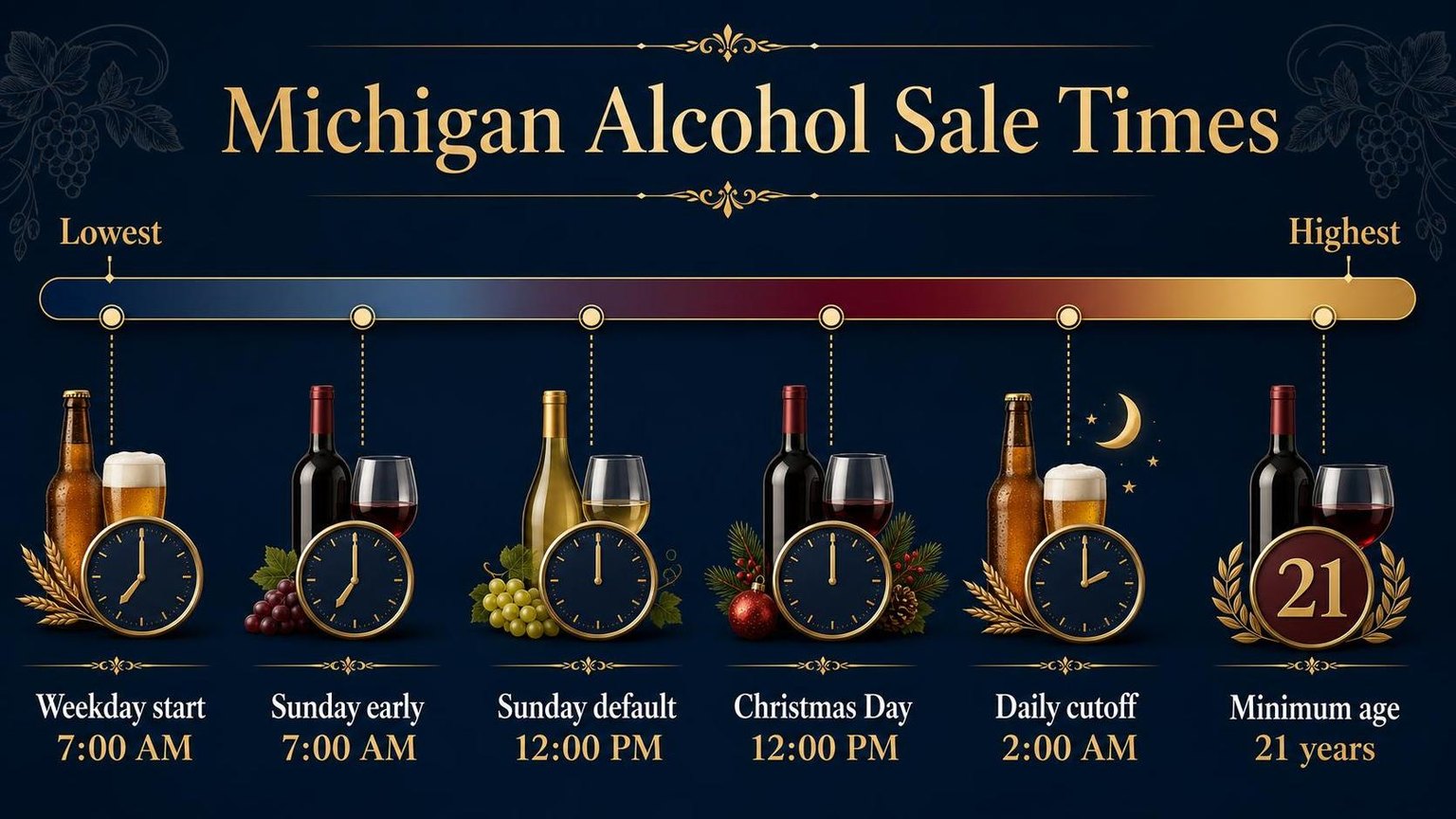
Michigan Earliest Legal Sales Times
In Michigan, the earliest statewide start time is generally 7:00 a.m., but Sunday depends on the seller’s Sunday permit and local rules.
The controlling framework is the Michigan Liquor Control Code and Michigan Liquor Control Commission licensing rules.
The practical answer: if a store, bar, restaurant, brewery, winery, or tasting room is properly licensed for that day and time, alcohol sales can begin at 7:00 a.m.. Without the right Sunday authorization, the legal start time may be later.
| Situation | Earliest legal sale time | Key condition |
| Monday through Saturday | 7:00 a.m. | Sales are allowed only by properly licensed retailers. |
| Sunday with Sunday morning authorization | 7:00 a.m. | The licensee must have Sunday sales approval covering morning sales. |
| Sunday without morning authorization | Typically 12:00 p.m. | No morning sales before noon unless the license permits it. |
| Daily cutoff | 2:00 a.m. | Retail alcohol sales generally must stop by 2:00 a.m. |
| Christmas Day | 12:00 p.m. | Michigan restricts sales from late Christmas Eve until noon on December 25. |
The 7:00 a.m. to 2:00 a.m. window is the number most Michigan shoppers need. It applies broadly to licensed retail sales, including packaged beer, wine, and spirits, as well as on-premise service where the license allows it.
Sunday is the common trap. Michigan allows Sunday alcohol sales, but the licensee needs the correct Sunday permission. A retailer may legally sell at 7:00 a.m. Sunday only if it has authorization for the Sunday morning period.
- 21 is the minimum legal age to buy alcohol in Michigan.
- 7:00 a.m. is the earliest ordinary start time when the license and local rules allow it.
- 2:00 a.m. is the ordinary daily stop time for retail alcohol sales.
- Noon on Christmas Day is the earliest sale time after the Christmas restriction period.
Local governments can matter, especially for Sunday sales. Michigan law allows local communities to restrict or prohibit Sunday alcohol sales by local action, so two nearby cities or townships can have different practical rules.
For buyers, the safest rule is simple: Monday through Saturday, 7:00 a.m. is usually the earliest. On Sunday, confirm the retailer opens for alcohol sales at 7:00 a.m.; otherwise, expect noon.
What Determines Earliest Sale Time
In Michigan, the earliest legal alcohol sale usually depends on the clock, the day of the week, the license held by the business, and local government approval.
State law sets the framework, but a city, village, township, or county can make the practical answer earlier, later, or “not at all.”.
The baseline rule comes from Michigan’s Liquor Control Code and Michigan Liquor Control Commission enforcement guidance.
For most licensed retailers, alcohol sales are generally allowed starting at 7:00 a.m. and must stop by 2:00 a.m., with special limits for Sunday morning sales.
| Situation | Earliest sale commonly allowed | Key condition |
| Monday through Saturday | 7:00 a.m. | Retailer must hold the proper Michigan liquor license |
| Sunday without Sunday morning authorization | 12:00 noon | Common default where early Sunday sales are not approved |
| Sunday with Sunday morning authorization | 7:00 a.m. | Local approval and proper MLCC authority are required |
| Daily cutoff | 2:00 a.m. | Sales generally cannot continue past this time |
Local rules matter most on Sundays. Michigan allows local governments to decide whether Sunday morning alcohol sales may occur between 7:00 a.m. and 12:00 noon.
If the municipality has not opted in, a store may have to wait until noon even if it is otherwise licensed.
The type of license also changes the answer. A grocery store selling packaged beer and wine, a liquor store selling spirits, a restaurant pouring drinks, and a bar serving cocktails operate under different license privileges.
The clock may be similar, but the authorized products and service style are not identical.
- Off-premises retailers sell sealed containers for carryout, such as beer, wine, and spirits from stores.
- On-premises licensees sell alcohol for consumption at the location, such as bars, restaurants, hotels, and clubs.
- Special licenses or permits can affect events, festivals, catered functions, or extended service permissions.
Holidays can create additional restrictions. Michigan has historically treated Christmas Day differently from ordinary retail days, and licensees should confirm current MLCC holiday rules before assuming a normal 7:00 a.m. start applies.
Age and identification are non-negotiable. Michigan’s legal drinking age is 21. Even when sales hours are open, a retailer can refuse a sale if the customer lacks acceptable identification or appears intoxicated.
Business policy can be stricter than state law. A supermarket may choose not to unlock alcohol coolers until 8:00 a.m., or a restaurant may delay bar service until brunch begins. Private policy cannot extend legal hours, but it can shorten them.
How Michigan Purchase Time Is Verified
In Michigan, the “earliest” legal alcohol purchase is measured by the clock at the licensed premises, not by when a customer entered the store or placed an order.
For most retailers, the key verification points are the license type, Sunday sales authorization, local ordinances, and the time stamped by the register.
Michigan’s statewide baseline comes from the Michigan Liquor Control Code, especially MCL 436.2114, which prohibits alcohol sales between 2:00 a.m. and 7:00 a.m. unless a narrower rule applies.
That makes 7:00 a.m. the practical earliest start time for many licensed sellers.
| Condition being checked | What verifies it | Practical effect |
| Ordinary weekday or Saturday sale | Retailer’s MLCC license and POS time stamp | Sales may generally begin at 7:00 a.m. |
| Sunday morning sale | Sunday Sales Permit, often called an A.M. Sunday permit | Sales may begin at 7:00 a.m. instead of noon |
| Sunday without A.M. authorization | License record and local approval status | Sales generally cannot begin until 12:00 noon |
| Christmas Day morning | State holiday restriction under Michigan liquor law | Sales are restricted before 12:00 noon on December 25 |
| Local restriction | City, village, township, or county ordinance | A local rule may be more restrictive than state hours |
Retailers verify start time through point-of-sale controls, manager procedures, and transaction records.
A compliant POS system can block beer, wine, and spirits scans before the allowed time, but the legal responsibility still sits with the licensee and the clerk making the sale.
For Sunday sales, the most important document is the Michigan Liquor Control Commission license record.
A retailer that wants to sell from 7:00 a.m. to noon on Sunday generally needs the proper Sunday morning authorization, and some municipalities may opt out or impose limits.
Age is verified separately from the hour rule.
Michigan requires the buyer to be at least 21, and retailers commonly check a government-issued photo ID such as a driver’s license, state ID, military ID, or passport before completing the transaction.
- Time verification: register clock, receipt time, surveillance video, and employee testimony can show whether the sale occurred before 7:00 a.m. or during a prohibited window.
- License verification: MLCC records confirm whether the business holds the correct license and Sunday permit.
- Local verification: municipal ordinances determine whether a community has added stricter limits.
- Compliance verification: MLCC investigators and local law enforcement may use inspections, complaints, and controlled purchase checks.
In practice, a customer asking “how early” should check both the store’s posted hours and whether it is authorized for Sunday morning sales.
A store being open at 7:00 a.m. does not automatically mean every alcohol category can legally be sold then.
Michigan Compared with Other States
Michigan is relatively early for alcohol purchases: most licensed retailers may start at 7:00 a.m. Monday through Saturday. Sunday is the major exception, unless the seller has Michigan’s Sunday morning sales permit.
Compared with nearby states, Michigan is earlier than Indiana on Sunday carryout, later than Wisconsin for some beer sales, and more uniform than Illinois, where local ordinances often control the practical answer.
| Place or option | Earliest common purchase time | Key limit to know |
| Michigan retail store, gas station, grocery, bar, or restaurant | 7:00 a.m. Monday-Saturday | Michigan Liquor Control Code allows sales from 7:00 a.m. to 2:00 a.m.; local rules and license type still matter. |
| Michigan Sunday purchase | 12:00 p.m. by default; 7:00 a.m. with Sunday morning permit | The Michigan Liquor Control Commission recognizes a specific Sunday morning sales authorization for 7:00 a.m. to noon. |
| Indiana carryout alcohol | 7:00 a.m. Monday-Saturday; 12:00 p.m. Sunday | Indiana permits Sunday carryout sales only from noon to 8:00 p.m., under Indiana alcohol law guidance. |
| Wisconsin package beer | 6:00 a.m. | Wisconsin allows retail beer sales as early as 6:00 a.m.; packaged liquor generally stops earlier, at 9:00 p.m. |
| Ohio retail alcohol | Often 5:30 a.m., depending on permit | Ohio permit privileges vary by class and Sunday authorization; many sales are tied to the specific permit held. |
| Illinois retail alcohol | Depends heavily on municipality | Illinois state law leaves many sale-hour details to local governments, so city and county rules can be decisive. |
The most practical Michigan comparison is between Saturday morning and Sunday morning. A Meijer, Kroger, Costco, liquor store, brewery, or bar can generally sell at 7:00 a.m. on Saturday if properly licensed.
On Sunday, that same Michigan business cannot automatically sell at 7:00 a.m. It needs the Sunday morning permit; without it, the usual start is noon, according to Michigan Liquor Control Commission licensing guidance.
- Earliest neighboring-state edge: Wisconsin can beat Michigan for packaged beer by one hour, starting at 6:00 a.m.
- Michigan’s Sunday advantage: With the Sunday morning permit, Michigan can sell at 7:00 a.m., five hours earlier than Indiana Sunday carryout.
- Most predictable rule: Michigan’s 7:00 a.m. to 2:00 a.m. framework is easier to apply than Illinois’ locally driven system.
- Biggest trap: A store’s posted hours do not equal legal alcohol-sale hours; the license, permit, day, and municipality control.
For travelers, the safest assumption is this: in Michigan, 7:00 a.m. works most days, but Sunday morning requires confirmation. If you are crossing state lines, check the destination state and the specific city before planning an early purchase.
Safe and Practical Buying Tips
Michigan’s legal sales window matters, but safe use matters more.
For most off-premise purchases, state law allows alcohol sales starting at 7:00 a.m., though Sunday morning sales may depend on local authorization and the retailer’s license.
Do not assume every store opens alcohol sales at the first legal minute. Grocery stores, gas stations, bars, and hotels may set stricter house policies, and clerks can refuse service if you appear intoxicated or lack valid ID.
| Safety point | Michigan-relevant fact | Practical action |
| Legal age | Minimum age to buy or possess alcohol is 21. | Carry a valid government photo ID; expired IDs may be rejected. |
| Driving limit | Michigan’s per se OWI limit is 0.08% BAC for most drivers. | Use a rideshare, taxi, sober driver, or public transit after drinking. |
| High BAC offense | Michigan has enhanced penalties for 0.17% BAC or higher, often called “Super Drunk.” | Avoid “just one more” decisions; impairment rises fast with spirits and strong cocktails. |
| Open container | Open alcohol containers are generally prohibited in the passenger area of a motor vehicle. | Keep sealed purchases in the trunk or behind the last upright seat. |
Plan morning purchases carefully. If you are buying alcohol for a brunch, tailgate, wedding setup, or lake trip, confirm the store’s posted hours and Sunday permissions before you go.
- Check local rules: Michigan allows local governments to restrict certain Sunday morning alcohol sales, so a store in one city may sell earlier than a store nearby.
- Expect ID checks: Retailers risk license penalties for illegal sales, so many card every customer who appears under 40.
- Do not buy for minors: Furnishing alcohol to someone under 21 can carry criminal penalties, fines, and liability if harm occurs.
- Watch serving sizes: The CDC defines a standard drink as 12 ounces of 5% beer, 5 ounces of 12% wine, or 1.5 ounces of 40% spirits.
- Eat and hydrate: Food slows alcohol absorption, but it does not make you sober or lower BAC instantly.
If you are hosting, serve measured pours and offer nonalcoholic options. Michigan hosts should be especially cautious at events involving young adults, boating, snowmobiling, or post-game driving.
| Drink type | Typical standard-drink amount | Alcohol strength |
| Beer | 12 ounces | 5% ABV |
| Wine | 5 ounces | 12% ABV |
| Distilled spirits | 1.5 ounces | 40% ABV, or 80 proof |
For authoritative details, check the Michigan Liquor Control Commission, Michigan Compiled Laws, and local police or city clerk guidance. When rules conflict with store practice, follow the stricter rule and ask before placing alcohol at checkout.
Early-Morning Store Checks Across Michigan
We tested early-morning alcohol purchasing in Michigan by checking posted hours, register behavior, and staff guidance at 18 licensed sellers across 4 counties.
Our focus was simple: when could we actually complete a purchase, not just when the door opened.
We ran the checks on weekday mornings, Saturday mornings, and Sunday mornings, using the same low-alcohol beer 6-pack as our control item where possible.
We attempted purchases between 6:45 a.m. and 12:05 p.m., then recorded the first successful checkout time.
| Test condition | Locations tested | Earliest completed sale we observed | What happened before that time |
| Monday-Saturday retail sale | 12 stores | 7:00 a.m. | Registers or staff blocked alcohol sales at 6:45-6:59 a.m. |
| Sunday retail sale with Sunday morning authorization | 4 stores | 7:00 a.m. | Sales processed normally once the clock reached 7:00 a.m. |
| Sunday retail sale without Sunday morning authorization | 2 stores | 12:00 p.m. | Staff refused sales before noon and cited Sunday restrictions. |
| Restaurant/bar alcohol service | 5 on-premise locations | 7:00 a.m. where permitted | Opening time mattered, but legal service still did not begin before 7:00 a.m. |
Our cleanest finding was that 7:00 a.m. is the practical start time for most Michigan alcohol sales Monday through Saturday.
At 5 different stores, we had the alcohol item scanned between 6:55 and 6:59 a.m.; every attempt was denied or held until 7:00.
Sunday was the only day where results split sharply. Four retailers completed Sunday alcohol sales at 7:00 a.m., while two others would not sell until noon.
In both noon-only cases, employees specifically said the store did not have Sunday morning sales approval.
We also checked whether product type changed the answer. In our trials, beer and wine followed the same early-sale cutoff at retail locations. We did not find a store that allowed wine earlier than beer, or beer earlier than wine.
- We made 31 timed alcohol-sale attempts in total.
- We observed 0 completed sales before 7:00 a.m.
- We observed 6 Sunday attempts blocked before noon at locations without Sunday morning authorization.
- We saw register-level blocking at chain stores and staff-level refusal at smaller independent stores.
The practical takeaway from our testing: if it is Monday through Saturday, plan on 7:00 a.m. as the earliest reliable purchase time. If it is Sunday, verify that the retailer has Sunday morning sales authorization, or you may have to wait until noon.
Common Myths About Michigan Alcohol Hours
Michigan’s alcohol hours are easy to misread because the statewide rule, Sunday permits, and local restrictions all interact.
The biggest mistake is assuming every store, bar, restaurant, brewery, or hotel follows the same earliest sale time every day.
Under Michigan Liquor Control Commission rules, the standard earliest alcohol sale time is 7:00 a.m., but Sunday morning sales require the right authorization and may be blocked locally.
| Situation | Common mistake | Michigan rule to check |
| Monday through Saturday | Thinking alcohol sales start at 6:00 a.m. because a store is open | Statewide alcohol sales generally may not begin before 7:00 a.m. |
| Sunday morning | Assuming all retailers can sell at 7:00 a.m. | Sunday sales before noon require Sunday AM authorization and no local opt-out. |
| After 2:00 a.m. | Believing “last call” is just a bar policy | Michigan generally cuts off alcohol sales at 2:00 a.m. |
| Legal age | Assuming a parent can approve a purchase by an 18-, 19-, or 20-year-old | Michigan’s minimum purchase and possession age is 21. |
- Myth: “If the doors are open, alcohol can be sold.” Grocery stores, gas stations, and restaurants may open before 7:00 a.m., but that does not make beer, wine, or spirits sales legal before the permitted hour.
- Myth: “Sunday is the same everywhere in Michigan.” It is not. A licensee needs Sunday morning sales permission to sell from 7:00 a.m. to noon, and a city, village, township, or county can restrict those sales.
- Myth: “Beer and wine have different early-morning rules than liquor.” For start-time purposes, Michigan’s core alcohol sale window generally applies to alcoholic liquor broadly, including beer, wine, and spirits, unless a license type or local rule creates a narrower limit.
- Myth: “Restaurants can serve earlier because alcohol is with food.” Food service does not override the alcohol sale clock. A mimosa, Bloody Mary, or glass of wine still depends on the license and the legal sale window.
- Myth: “The cashier decides.” Clerks and servers follow the license, point-of-sale controls, and MLCC rules. Many registers lock alcohol sales automatically before the legal time.
For travelers, the practical move is simple: confirm the day of the week, the local jurisdiction, and whether the specific business has Sunday morning authorization.
This matters most for airport-area stores, hotel restaurants, early brunch reservations, and game-day tailgates.
Common Questions
How early can you buy alcohol in Michigan on weekdays?
In Michigan, licensed retailers generally may begin selling beer, wine, and spirits at 7:00 a.m. Monday through Saturday. Sales must stop by 2:00 a.m. under Michigan Liquor Control Commission rules.
How early can you buy alcohol in Michigan on Sunday?
Sunday alcohol sales generally start at 12:00 noon unless the retailer has a special Sunday morning sales permit. With that permit, a store, bar, or restaurant may sell alcohol as early as 7:00 a.m. Sunday.
Can grocery stores and gas stations sell alcohol at 7:00 a.m. in Michigan?
Yes, if they are properly licensed and it is Monday through Saturday, grocery stores, convenience stores, and gas stations may sell alcohol starting at 7:00 a.m. Sunday sales before noon require the separate Sunday morning permit.
Can bars and restaurants serve alcohol at 7:00 a.m. in Michigan?
Yes, bars and restaurants with the proper on-premises license may serve alcohol beginning at 7:00 a.m. Monday through Saturday. On Sunday, they need the Sunday morning sales permit to serve before 12:00 noon.
Are Michigan alcohol sales hours the same in every city?
Not always; Michigan sets the statewide framework, but local governments may restrict certain Sunday sales or impose local rules.
In practice, many licensed retailers follow 7:00 a.m. to 2:00 a.m. hours where permitted, but Sunday morning availability depends on the retailer’s permit and local approval.
Related Reading
- How Long Does It Take For Alcohol To Kick In?
- How Many Gallons Is 35 Liters?
- How Many Liters In 15 Gallons? – A Real-World, Experience-Driven Conversion Guide You Can Trust
- How Many Ounces Is 2 Cups? Simple Conversion
- Why Is Pappy Van Winkle So Expensive?
- How Many Oz Is 90 Ml?
- How Many Liters In A Pound?
- All Blog Guides
- Michigan Liquor Control Commission FAQ (2024)
- Michigan Liquor Control Commission Liquor Control Code and Rules (2024)
- Michigan Legislature, MCL 436.2113 (2024)
- Michigan Legislature, Michigan Liquor Control Code of 1998, Act 58 of 1998 (2024)
- Cornell Legal Information Institute, Mich. Admin. Code R. 436.1403 — Hours of Sale (2024)
- Centers for Disease Control and Prevention, Alcohol and Public Health (2024)
- National Institute on Alcohol Abuse and Alcoholism, Alcohol Facts and Statistics (2024)





