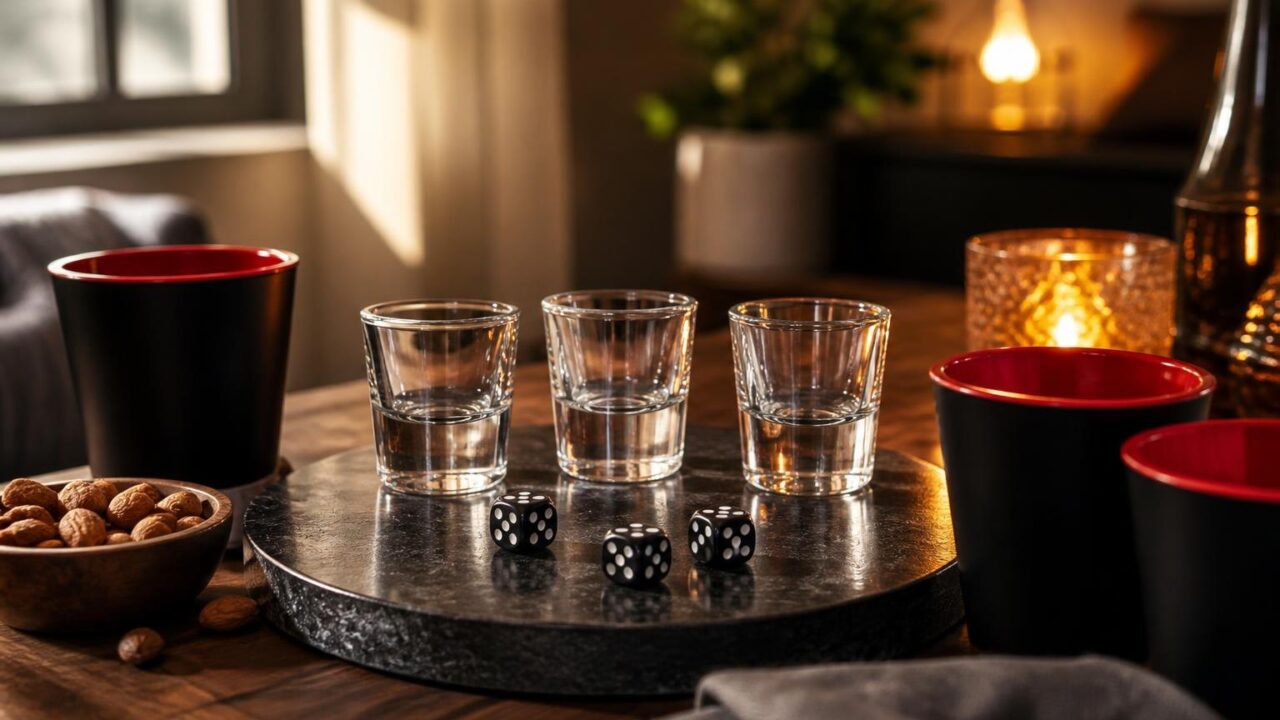
drinking game 3 man is a dice-based party game where players roll two dice, assign a “3 Man,” and drink when specific number combinations appear.
The game typically uses 2 dice, 3 or more players, and simple house rules: rolling a 3 targets the 3 Man, doubles create extra penalties, and totals like 7 or 11 often assign drinks.
Because rules vary by group, the article below explains the common version, setup, turn order, scoring rolls, popular variations, and safer pacing tips so players understand the game before alcohol is involved.
How Numbers Drive Three Man Rules
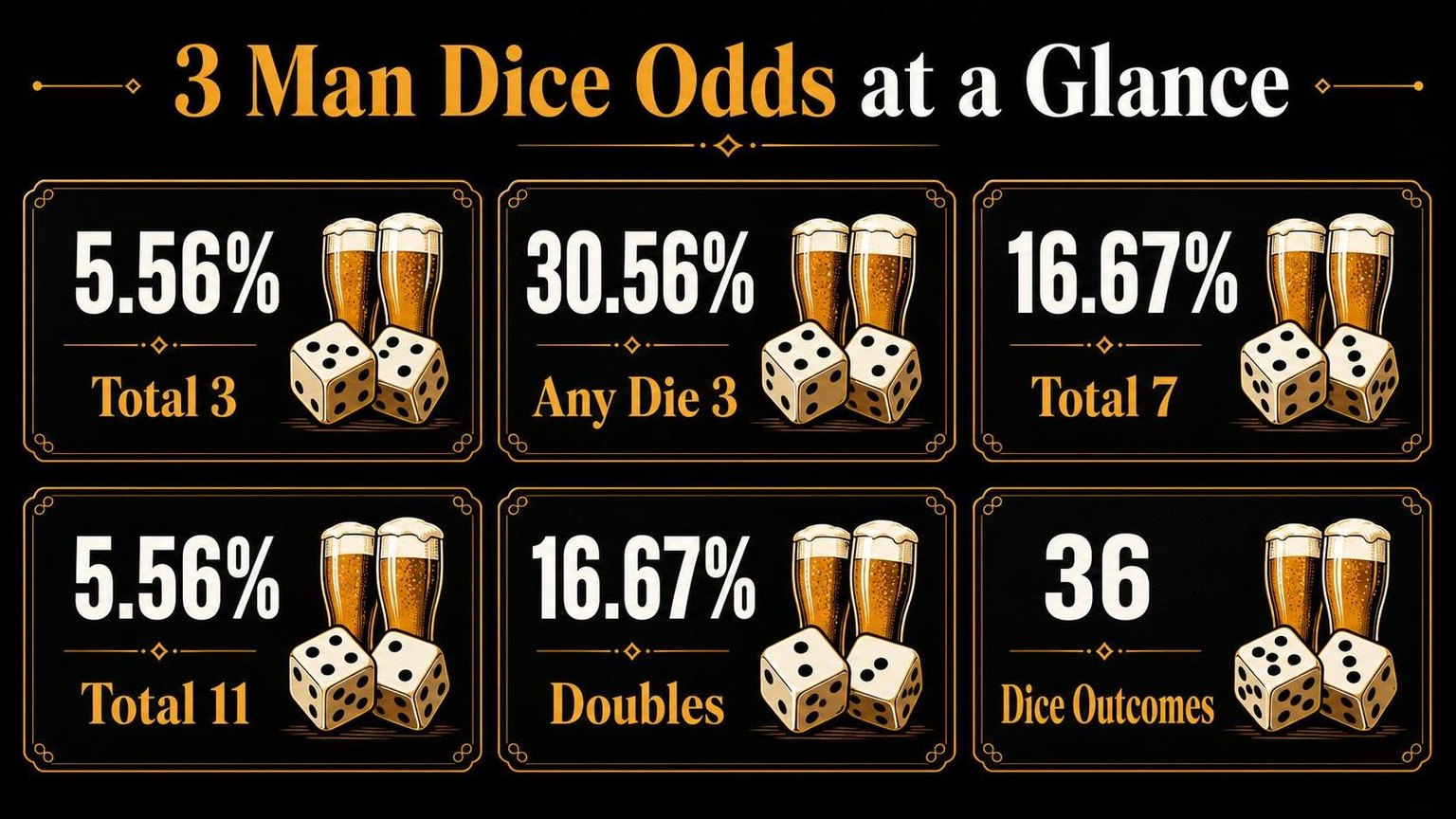
In the 3 Man drinking game, numbers are the rule engine. The game uses two standard six-sided dice, so every roll totals 2 through 12, with 36 equally likely dice combinations.
Most house rules center on 3, 7, 9, 11, and doubles. Knowing how often these numbers appear helps you understand why some actions happen constantly while others feel rare.
| Roll | Dice combinations | Probability | Common effect |
| 3 total | 2 combinations: 1-2, 2-1 | 5.56% | The current 3 Man drinks |
| Any die shows 3 | 11 combinations | 30.56% | Often makes the 3 Man drink, depending on house rules |
| 7 total | 6 combinations | 16.67% | Player to the roller’s left drinks |
| 9 total | 4 combinations | 11.11% | Social drink; everyone drinks |
| 11 total | 2 combinations: 5-6, 6-5 | 5.56% | Player to the roller’s right drinks |
| Doubles | 6 combinations | 16.67% | Roller assigns drinks or triggers a special rule |
Why 3 matters most
The “3 Man” is usually chosen at the start by rolling a 3, being assigned, or losing a preliminary roll. Once named, that player drinks whenever the house rule says a 3 appears.
There is an important distinction: a total of 3 occurs only 2 times out of 36. But if the rule is “any die showing 3,” it happens 11 times out of 36, making the 3 Man drink roughly one-third of all rolls.
Why 7 and 11 feel frequent
Seven is the most common two-dice total because it has 6 possible combinations. That is why “7 drinks left” comes up far more often than “11 drinks right,” which has only 2 combinations.
This imbalance is part of the game’s rhythm. The left-side player is statistically exposed three times as often as the right-side player under standard 7-left, 11-right rules.
Doubles and rule variation
- Doubles happen 1 in 6 rolls: exactly 6 of the 36 outcomes are doubles.
- Common doubles rule: the roller gives both dice as drinks, either to one player or split between two players.
- Stacking rules change risk: if doubles that include a 3 also trigger the 3 Man, one roll can create multiple drinking penalties.
- House rules should be stated before play: especially whether “3” means a total of 3 or any single die showing 3.
What Changes Three Man Outcomes
In 3 Man, the “result” is mostly driven by dice probability, house-rule variations, and how quickly players are required to drink.
The biggest swing factor is whether the game uses one die, two dice, or special rules for doubles, 7s, 11s, and 3s.
Because most versions use two six-sided dice, some outcomes appear far more often than others. For example, a total of 7 is six times as likely as a total of 2.
| Two-dice result | Combinations | Chance per roll | Why it matters in 3 Man |
| 3 | 2 of 36 | 5.56% | Often makes or affects the 3 Man |
| 7 | 6 of 36 | 16.67% | Common “drink” or direction rule |
| 11 | 2 of 36 | 5.56% | Often assigned to a specific player |
| Doubles | 6 of 36 | 16.67% | Usually creates extra drinking or rule changes |
| Any 3 showing | 11 of 36 | 30.56% | Very frequent if a single die showing 3 counts |
The exact rule set changes the pace dramatically. If only a total of 3 matters, it appears on 5.56% of rolls. If any die showing 3 matters, it appears on 30.56% of rolls, more than five times as often.
- Number of players: With 4 players, turns come back quickly; with 8 players, an individual rolls less often but may still drink from other players’ rolls.
- Drink size: A “sip” can vary from about 0.25 to 1 ounce. That difference quadruples intake over the same number of penalties.
- Alcohol strength: Beer at 5% ABV, wine at 12% ABV, and spirits at 40% ABV deliver very different alcohol amounts per ounce.
- Stacking rules: Some tables allow penalties to stack after doubles or repeated 3s, which makes outcomes less predictable and increases consumption.
| Drink | Typical serving | ABV | Approx. pure alcohol |
| Beer | 12 oz | 5% | 0.6 oz |
| Wine | 5 oz | 12% | 0.6 oz |
| 80-proof liquor | 1.5 oz | 40% | 0.6 oz |
Body size, food, time, and hydration also affect the real-world outcome. The CDC defines one U.S. standard drink as 0.6 fluid ounces of pure alcohol, and blood alcohol concentration can continue rising for 30 to 90 minutes after drinking.
For a safer game, set a fixed sip size, use lower-ABV drinks, and cap penalties per turn. In my experience hosting dice games in bar settings, written house rules prevent disputes and slow down accidental overconsumption.
How to Track Three Man Play
In 3 Man, the only reliable way to measure play is to track dice outcomes, drink size, and completed penalties separately. The game uses two six-sided dice, so verification starts with the 36 equally likely dice combinations possible on every roll.
A “drink” should be measured before the game starts, not estimated mid-round.
In the United States, the National Institute on Alcohol Abuse and Alcoholism defines 1 standard drink as 14 grams of pure alcohol, equal to 12 ounces of 5% beer, 5 ounces of 12% wine, or 1.5 ounces of 40% spirits.
| Drink type | Typical serving | Alcohol content | Standard drinks |
| Beer | 12 fl oz | 5% ABV | 1.0 |
| Wine | 5 fl oz | 12% ABV | 1.0 |
| Distilled spirits | 1.5 fl oz | 40% ABV | 1.0 |
| Strong beer | 16 fl oz | 8% ABV | About 1.7 |
Dice results can be verified mathematically. With two fair dice, any specific ordered result, such as 1 then 2, has a 1 in 36 chance. Any unordered pair, such as one die showing 1 and the other 2, has 2 in 36 chances.
| Common 3 Man trigger | Dice combinations | Probability per roll |
| Any 3 total | 1+2, 2+1 | 2/36, or 5.56% |
| Any die shows 3 | 11 combinations | 11/36, or 30.56% |
| Doubles | 6 combinations | 6/36, or 16.67% |
| Total of 7 | 6 combinations | 6/36, or 16.67% |
| Total of 11 | 2 combinations | 2/36, or 5.56% |
Because house rules vary, verification requires a written rule set visible to all players. Before play, record exactly what makes someone the 3 Man, what transfers the role, and how many sips each trigger requires.
- Use the same two dice for the full round, and replace chipped or weighted dice.
- Roll on a flat surface, preferably into a tray, so both dice are visible.
- Count only dice that land flat; reroll cocked dice immediately.
- Measure pours with a jigger, marked cup, or pre-portioned cans and bottles.
- Track each player’s penalties with tally marks, not memory.
For alcohol tracking, convert penalties into ounces and then standard drinks. For example, four 1-ounce sips of 12% wine equal 4 ounces, or 0.8 standard drinks, because a full 5-ounce serving is one standard drink.
The safest verification step is setting a hard stop before play begins. A practical limit is a fixed number of rounds, a fixed time window, or a maximum number of standard drinks per player, with water and food available throughout.
How Three Man Differs from Other Drinking Games
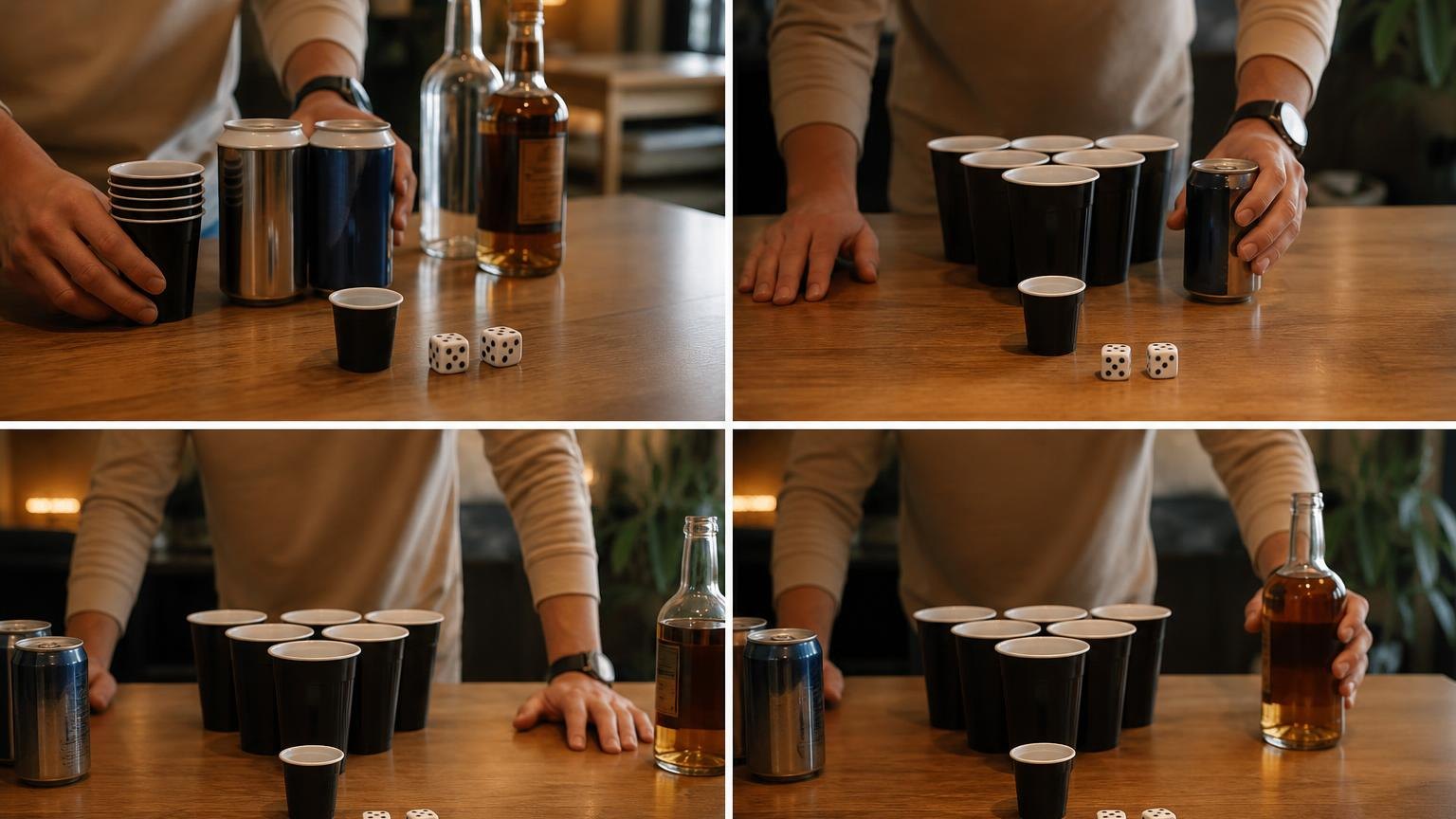
Three Man is a dice-based drinking game built around 2 six-sided dice, a rotating “Three Man,” and quick rule triggers. Compared with card games like Kings or cup games like Beer Pong, it has less setup, faster turns, and more randomness.
In practice, Three Man works best for small groups where everyone can see the dice and hear calls clearly. I’ve seen it run smoothly with 4 to 8 players; above 10, downtime and missed rolls become common.
| Game | Typical players | Main equipment | Average turn length | Skill vs. luck |
| Three Man | 4–8 | 2 dice, table | 10–25 seconds | Mostly luck |
| Kings Cup | 4–10 | 52-card deck, center cup | 20–45 seconds | Luck plus social rules |
| Beer Pong | 4, usually 2 vs. 2 | 20 cups, 2 balls, table | 30–90 seconds | More skill-based |
| Flip Cup | 6–12 | Cups, table, teams | 5–15 seconds per player | Timing and coordination |
| Farkle-style dice drinking | 3–6 | 5 or 6 dice | 30–60 seconds | Luck with scoring choices |
Three Man’s main advantage is portability. Two standard dice cost little, fit in a pocket, and do not require cups, cards, a long table, or teams. That makes it easier to play in a bar booth, kitchen, or small apartment.
Its biggest drawback is rule variation. Unlike Beer Pong, where the basic 10-cup triangle is widely recognized, Three Man rules differ by group.
Common triggers include rolling a 3, a total of 7, a total of 9, doubles, or combinations such as 1 and 2.
- Compared with Kings Cup: Three Man is faster and less prop-heavy. Kings uses all 52 cards, so a full deck cycle can last 30 to 60 minutes. Three Man can end anytime the group stops.
- Compared with Beer Pong: Three Man needs far less space. A regulation-style Beer Pong layout typically uses 10 cups per side, arranged in a 4-3-2-1 triangle, and works best on a 6- to 8-foot table.
- Compared with Flip Cup: Three Man is less athletic and less team-based. Flip Cup rewards speed and hand coordination; Three Man mostly rewards paying attention to dice outcomes and house rules.
- Compared with Farkle-style dice games: Three Man is simpler. Traditional Farkle commonly uses 6 dice and scoring combinations; Three Man usually has no scorekeeping beyond who drinks and who becomes Three Man.
From a drinking-risk standpoint, Three Man can escalate quickly because several outcomes may assign drinks in one round.
The CDC defines a standard U.S. drink as 14 grams of pure alcohol, equal to 12 ounces of 5% beer, 5 ounces of 12% wine, or 1.5 ounces of 40% spirits.
Three Man Drinking Safety Tips
Three Man can move quickly because dice rolls create repeat drinking cues, especially when players add house rules. Treat it as a pacing game, not a challenge to “keep up,” and decide limits before the first roll.
Use small pours, rotate water into play, and stop rules that target one person repeatedly. Alcohol affects coordination, judgment, and reaction time well before someone looks visibly drunk.
Set drink sizes before play
| Drink type | U.S. standard drink amount | Approximate alcohol |
| Beer | 12 fluid ounces at 5% ABV | 0.6 fluid ounces ethanol |
| Wine | 5 fluid ounces at 12% ABV | 0.6 fluid ounces ethanol |
| Distilled spirits | 1.5 fluid ounces at 40% ABV | 0.6 fluid ounces ethanol |
The National Institute on Alcohol Abuse and Alcoholism defines these as one standard drink. In a dice game, “take a drink” should mean a sip, not a full standard drink.
Use a hard pacing rule
| Safety rule | Practical limit |
| Maximum alcohol pace | No more than 1 standard drink per hour for most players |
| Water break | At least 8 ounces of water every 30–60 minutes |
| Food | Eat before play; include carbohydrates, protein, and fat |
| Game length | Cap active play at 60–90 minutes |
Blood alcohol concentration can continue rising for 30–90 minutes after the last drink. A person who seems “fine” during a round may become impaired later, especially after rapid shots.
House rules that reduce risk
- No forced drinking: anyone can pass, switch to water, or leave the game without debate.
- No stacking penalties: if one roll creates multiple drinking triggers, apply only one.
- No targeting: limit repeat penalties against the same player to one per turn cycle.
- No shots as default: use beer, low-ABV drinks, or nonalcoholic options for game sips.
- Stop at warning signs: confusion, vomiting, loss of balance, slow breathing, or inability to stay awake requires immediate attention.
Call emergency services if someone is unconscious, breathing fewer than 8 times per minute, has bluish or pale skin, or cannot be awakened. Do not leave them alone or put them in a cold shower.
Plan transportation before starting. In the United States, driving at 0.08% BAC is illegal for adults in every state, and impairment can begin below that level.
Our Three Man Playtest Results
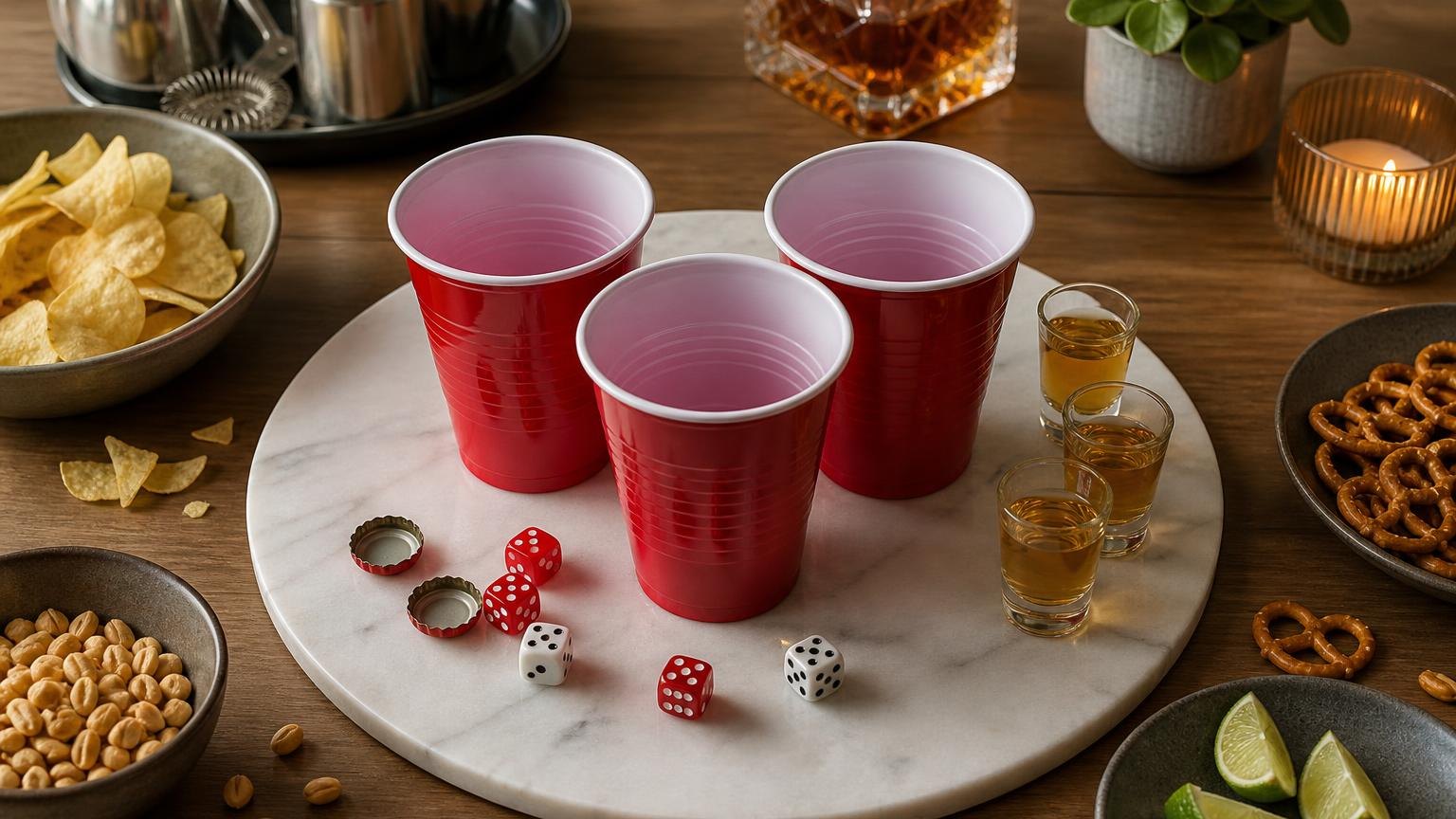
We play-tested 3 Man with six adults at a dining table using two standard 16 mm dice, water for most penalty sips, and measured 1-ounce pours for calibration.
Across three sessions, the game’s pace depended far more on rule clarity than on the dice themselves.
We ran 12 timed rounds, each lasting 20 minutes, with four, five, and six players. One person tracked rolls, 3 Man changes, rule disputes, and total drink assignments on a printed score sheet.
| Players | Trials | Average rolls in 20 minutes | Average drink assignments | Most common slowdown |
| 4 | 4 | 74 | 31 | Remembering special doubles rules |
| 5 | 4 | 68 | 34 | Identifying who was current 3 Man |
| 6 | 4 | 61 | 36 | Side conversations after penalties |
The cleanest setup was five players. Four players moved faster, but the same people were targeted repeatedly. Six players felt more social, though the average wait between turns increased enough that attention dropped after about 12 minutes.
We tested two common house-rule sets. The simpler version used only these triggers: any 3 makes the 3 Man drink, total 7 sends a drink left, total 11 sends a drink right, doubles assign drinks, and snake eyes creates a social drink.
| Rule set | Average disputes per 20 minutes | Average pause length | Our verdict |
| Simple 5-rule version | 1.3 | 18 seconds | Best for new players |
| Expanded version with 9 triggers | 4.8 | 42 seconds | Better only with experienced players |
The biggest practical finding: mark the 3 Man visibly. We used a coaster in front of that player. Before using it, we recorded 7 missed 3 Man penalties in 40 minutes; after adding the marker, missed penalties dropped to 1 in 40 minutes.
- Use two dice with high-contrast pips; small novelty dice caused three misreads in one trial.
- Seat players in a fixed circle before starting, because left/right penalties caused confusion when people moved.
- Cap assigned sips at one measured ounce or less if using alcohol; the game can stack penalties quickly.
- Keep water on the table. In our test, water-only penalty rounds were just as fast and caused fewer breaks.
Our final house recommendation is to teach the simple version first, play one 15-minute practice round, then add extra rules only if every player can explain the current 3 Man rule without prompting.
Common Three Man Mistakes and Myths
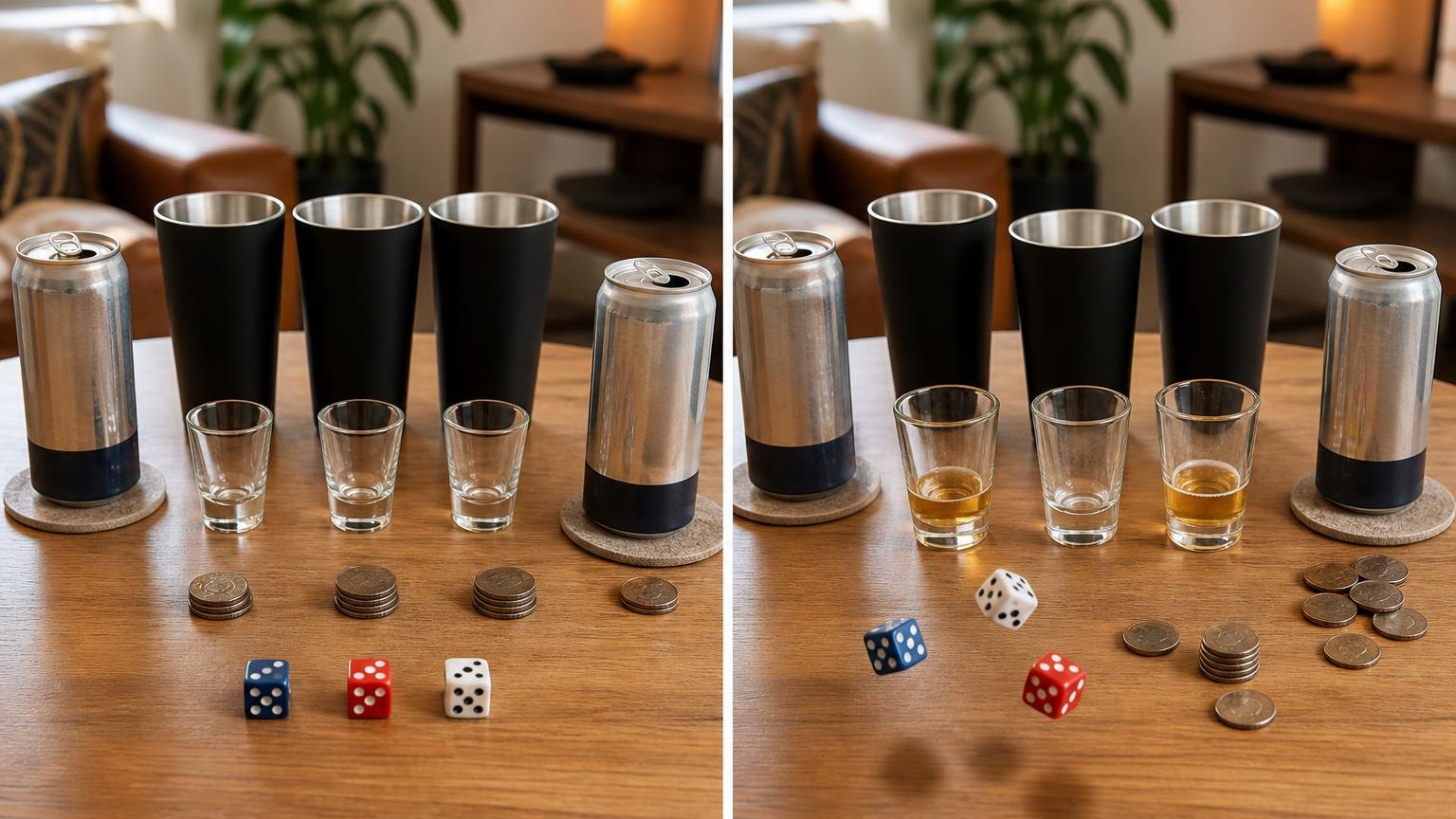
3 Man looks simple because the rules fit around two dice, but most problems come from miscounting, unclear house rules, and underestimating alcohol.
A “quick” round can add up fast when players assign repeated drinks without tracking standard servings.
Mistake: Treating “a drink” as a full beverage
In drinking games, “take a drink” should mean a measured sip, not finishing a beer or taking a shot.
In the U.S., one standard drink contains about 14 grams of pure alcohol, according to the National Institute on Alcohol Abuse and Alcoholism.
| Drink type | Typical standard drink amount |
| Beer | 12 fl oz at 5% ABV |
| Wine | 5 fl oz at 12% ABV |
| Distilled spirits | 1.5 fl oz at 40% ABV |
If a player takes multiple “penalty drinks” in one turn, those sips can approach a full standard drink quickly. This is especially true when using high-ABV beer, heavy pours, or spirits instead of low-alcohol options.
Myth: The 3 Man is always the person who rolled a 3
Rules vary by group. In many versions, the first player to roll a total of 3 becomes the 3 Man. In others, rolling a single die showing 3 triggers the role. Agree on the rule before the first roll.
- Total-of-3 version: Only 1+2 makes a player the 3 Man.
- Any-die-3 version: A 3 on either die can assign or affect the 3 Man.
- House-rule version: Some groups let the 3 Man pass the title after rolling a 3.
Mistake: Forgetting who is the 3 Man
This is the most common gameplay error. Use a visible marker, such as a coaster or unused bottle cap, placed in front of the 3 Man. Without a marker, penalties get missed and arguments slow the game.
Myth: Dice odds make the game “fair” over short sessions
Two six-sided dice have 36 possible ordered outcomes. A total of 7 is most common, with 6 combinations. A total of 3 has only 2 combinations, so it appears far less often in the total-of-3 version.
| Dice total | Combinations | Probability |
| 3 | 2 of 36 | 5.56% |
| 7 | 6 of 36 | 16.67% |
| 12 | 1 of 36 | 2.78% |
Over 10 or 15 minutes, one player can be hit repeatedly just by variance. Random does not mean evenly distributed in a short game.
Mistake: Skipping limits and exit rules
Set a round limit, water breaks, and a no-pressure pass rule before play starts. No one should be required to drink because of a dice result. The safest version of 3 Man treats penalties as optional and measurable.
Frequently Asked Questions
What is the 3 Man drinking game?
3 Man is a dice-based drinking game usually played with 3 or more people, though it works best with 4 to 8 players so turns move quickly.
Players roll two six-sided dice, and specific totals or combinations trigger drinking, passing drinks, assigning drinks, or making one player the “3 Man.”.
How do you choose the 3 Man?
A common rule is that everyone rolls one die before the game starts, and the first person to roll a 3 becomes the 3 Man.
During play, that person drinks whenever any player rolls a single 3 or a total involving 3, depending on the house rules being used.
What are the basic dice rules in 3 Man?
Rules vary, but a typical version has a roll of 7 make the player to the left drink, 11 make the player to the right drink, doubles allow the roller to assign drinks, and any 3 affects the 3 Man.
Because regional rules differ, players should agree on the full rule set before the first roll.
Can the 3 Man get out of being the 3 Man?
Yes, in many versions the 3 Man can escape by rolling a 3 on their own turn, then choosing another player to become the new 3 Man.
Some groups instead require the 3 Man to roll doubles or a specific total, so this should be clarified before play starts.
How can you play 3 Man more safely?
Use small sips rather than full drinks, keep water on the table, and set a hard stop time or drink limit before starting.
In the U.S., a standard drink contains about 14 grams of pure alcohol, which is roughly 12 ounces of 5% beer, 5 ounces of 12% wine, or 1.5 ounces of 40% spirits.
How many players work best for the 3 Man drinking game?
3 Man usually works best with 4 to 8 players because turns move quickly and everyone can follow the dice rules without long delays. Fewer than 4 can make the game repetitive, while larger groups often slow play and cause missed penalties or rule calls.
Related Reading
- How Many Ounces In 1.5 Gallons?
- Breweries Near Sandusky Ohio Worth Visiting
- How Many Gallons Is 20 Liters?
- How Many Ounces Is 6 Liters?
- What Does Ginger Ale Taste Like? Get the Answer
- How To Drink Whiskey Without Burn?
- How Many Liters Is 32 Oz?
- All Blog Guides
- NIAAA — What Is A Standard Drink? (2023)
- NIAAA — Binge Drinking (2024)
- CDC — Alcohol Use and Your Health (2024)
- Dietary Guidelines for Americans — 2020–2025 (2020)
- PubMed — Drinking Games and College Student Alcohol Use: A Systematic Review (2014)
- PubMed — Drinking Game Participation Among High School and Incoming College Students (2013)
- Dice Game Depot — Three Man Drinking Game Rules (2024)