drinking age in romania is 18 for buying alcohol, because Romanian law bans selling alcoholic drinks to minors.
Bars, restaurants, supermarkets, clubs, and shops can ask for ID, especially in nightlife areas such as Bucharest’s Old Town or Cluj-Napoca’s student districts.
Romania does not frame the rule as a broad “legal drinking age” statute like some U.S. states; the enforceable point is age-restricted sale and service.
For travelers, the practical rule is simple: carry a passport or national ID, and expect 18+ checks where alcohol is sold.
Romania’s Legal Drinking Age Rule
Romania’s practical drinking-age rule is simple: alcohol cannot legally be sold or served to anyone under 18.
The law focuses on sellers, bars, restaurants, and public venues, not on creating a separate, clearly stated “private drinking” age.
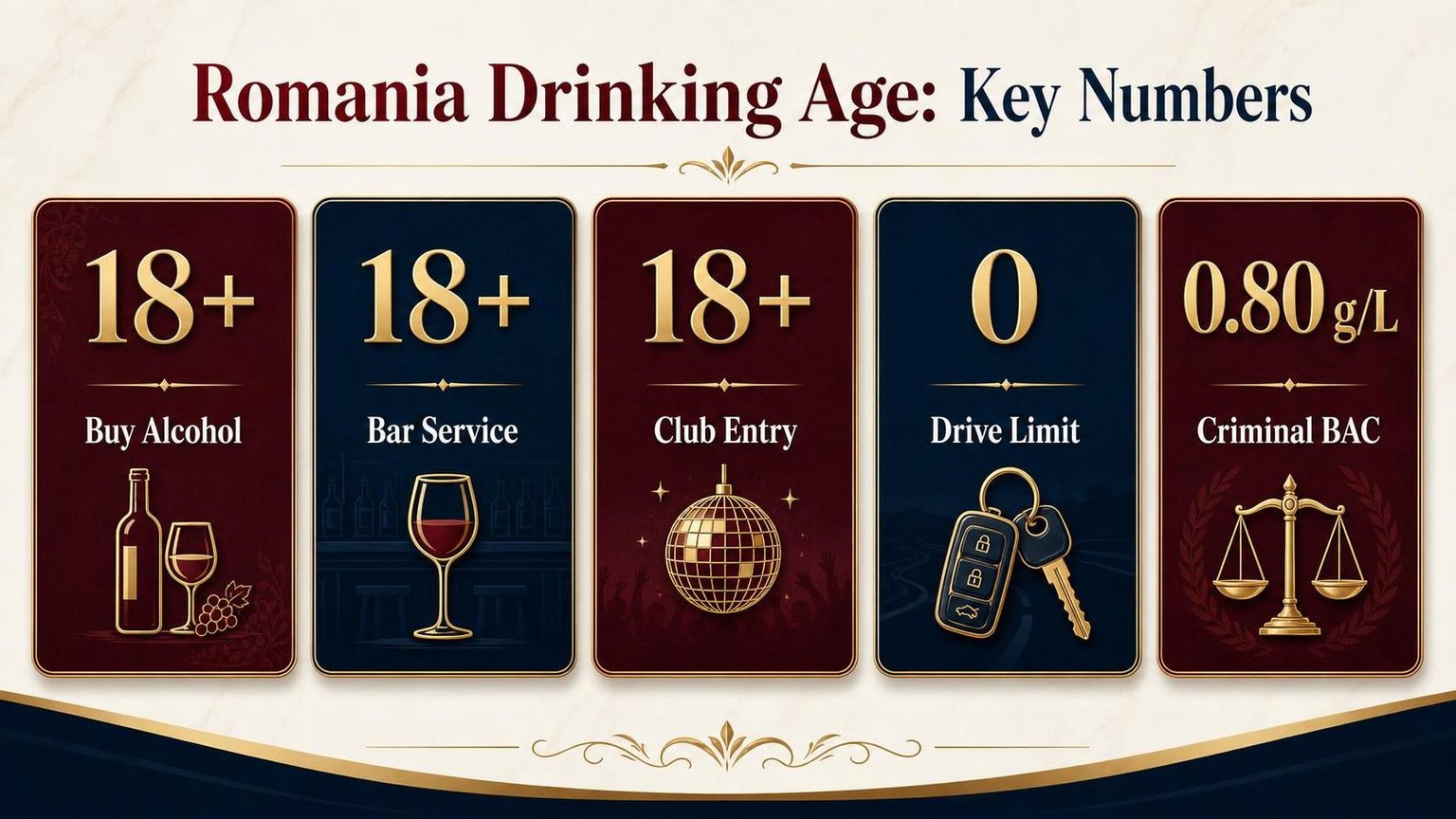
| Number | What it means in Romania | Legal grounding |
| 18 | Minimum age to buy alcoholic drinks in shops, supermarkets, bars, clubs, restaurants, and other commercial settings. | Law No. 61/1991 and Government Ordinance No. 99/2000 prohibit selling or serving alcoholic beverages to minors. |
| 18 | Minimum age most venues apply for entry or service when alcohol is central to the business, especially nightlife venues. | Venue policies usually follow the alcohol-sale rule and may be stricter than the statute. |
| 0 | Legal tolerance for drinking and driving in practical terms: drivers should treat Romania as a zero-alcohol country. | Romanian road rules penalize alcohol detected in drivers; serious levels can become a criminal offense. |
| 0.80 g/L | Blood-alcohol concentration threshold above which driving becomes a criminal offense. | Romanian Criminal Code, Article 336. |
The most important number is 18. A cashier, bartender, waiter, or club operator can refuse service and request identification if a customer appears young.
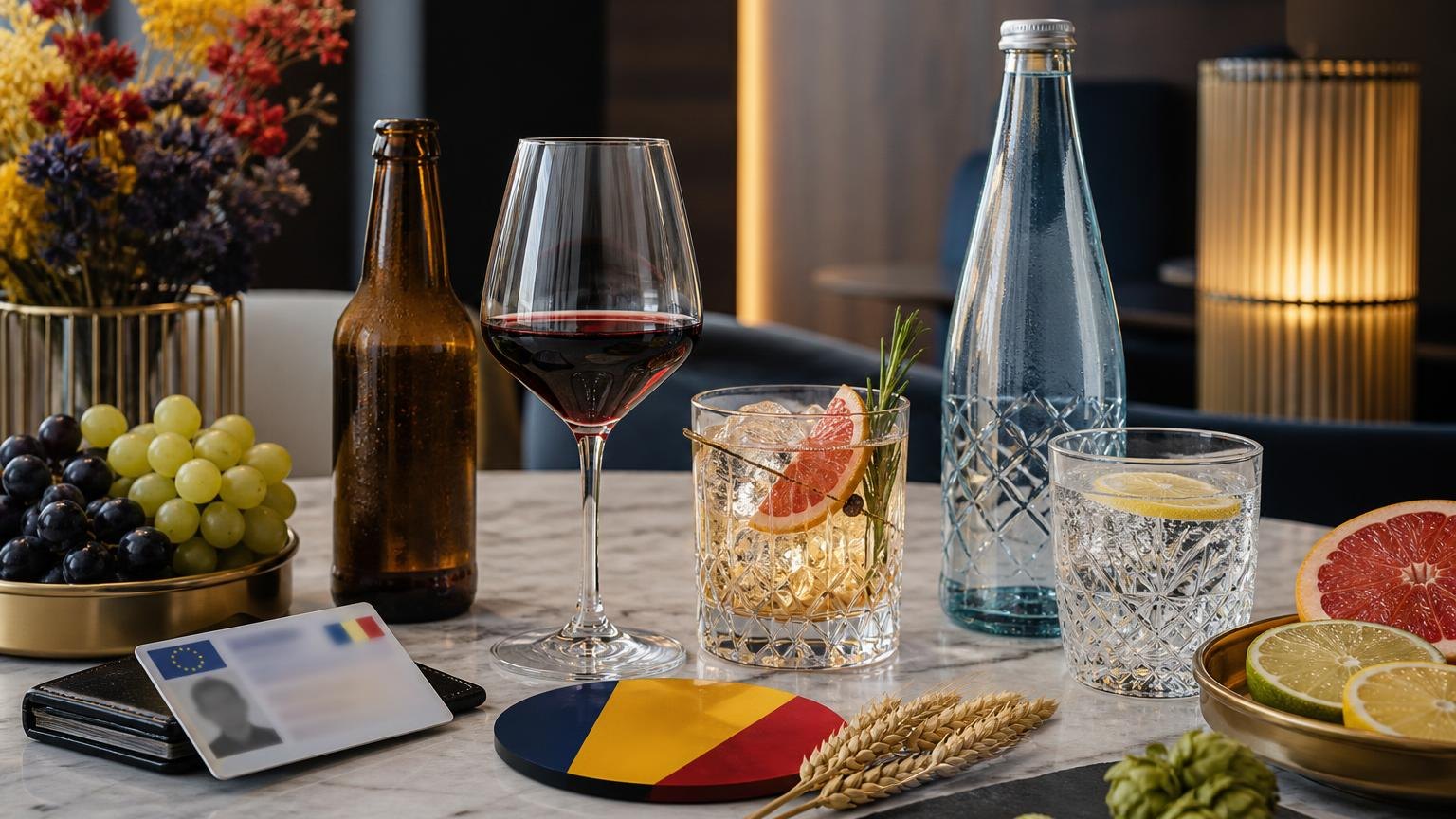
In practice, passports, national identity cards, and EU identity cards are the documents most likely to be accepted.
Romanian law does not operate like some U.S. state laws that spell out detailed exceptions for parental permission, religious use, or private homes.
The clearer legal risk sits with commercial sale, public service, and public-order violations involving minors and alcohol.
- Buying alcohol: under-18 customers should expect refusal in retail and hospitality settings.
- Being served alcohol: bars and restaurants are not allowed to serve alcoholic beverages to minors.
- Entering nightlife venues: many clubs apply an 18-plus policy even when the door rule is framed as house policy.
- Public behavior: disorderly conduct, public intoxication, or drinking in prohibited public places can create separate problems.
For travelers, the safest working rule is: no alcohol purchase or bar service before 18, and no driving after any drinking. Romania’s enforcement culture can vary by venue, but the legal baseline does not.
| Situation | Under 18 | 18 or older |
| Buying beer, wine, or spirits in a store | Not legally permitted | Permitted, subject to ID checks |
| Ordering alcohol in a restaurant or bar | Not legally permitted | Permitted, subject to venue policy |
| Driving after drinking | Not relevant if unlicensed; alcohol still creates legal risk | Any alcohol can lead to penalties; high levels are criminal |
What Counts as Drinking Age
In Romania, the practical answer depends on what you mean by “drinking age”: buying alcohol, being served alcohol, drinking in a private setting, or driving afterward.
The clearest legal line is commercial sale or service to minors, which Romanian law treats differently from private family situations.
Key legal thresholds
| Issue | Romanian rule or threshold |
| Commercial sale or service of alcohol | Not allowed to minors under 18, under Law no. 61/1991 on public order and peace |
| Typical ID check point | Bars, clubs, supermarkets, and festival vendors may request proof that the customer is 18 or older |
| Driving after alcohol | Romania applies very strict enforcement; any detected alcohol can create legal consequences |
| Criminal alcohol-driving threshold | Over 0.80 g/l blood alcohol, or over 0.40 mg/l alcohol in exhaled air, is treated as a criminal offense under Romanian traffic law |
Where the alcohol is obtained matters most. A restaurant, shop, bar, nightclub, stadium vendor, or event operator is exposed to penalties if it sells or serves alcohol to a minor.
That is why tourists may be asked for a passport or national ID, especially in nightlife areas.
Private consumption is a different question. Romanian law is mainly aimed at public order and commercial supply, not at police entering a private dinner to check whether a parent allowed a sip of wine.
Still, adults can face consequences if alcohol is supplied in a way that endangers a minor.
The type of venue also affects enforcement. Clubs, concerts, and festivals tend to check age more often because alcohol is sold publicly and security staff control entry.
Small shops may vary in practice, but the legal obligation not to sell to minors still applies.
Public-order context can change the outcome.
Drinking in or around schools, public institutions, public transport, or disruptive street settings may trigger separate public-order sanctions, regardless of whether the person is old enough to buy alcohol.
- Carry original ID: a passport, Romanian ID card, or EU national ID is more reliable than a photo on a phone.
- Do not assume “served once” means legal: inconsistent enforcement does not change the seller’s legal risk.
- Plan transport: Romania’s alcohol-driving rules are far stricter than many visitors expect, especially after wine tastings or late dinners.
- Check house rules: hotels, wineries, and organized tours may set stricter age policies than the statutory minimum.
How Age Is Checked
In Romania, the drinking-age rule is measured by a person’s completed age: alcohol may not be sold or served to anyone under 18.
In practice, the key verification point is the transaction, not whether a young person is merely present in a restaurant or shop.
Romanian authorities treat age control as a retail and hospitality compliance issue. The relevant standard is whether the seller, bartender, waiter, cashier, or venue operator allowed an alcoholic beverage to be supplied to a minor.
| What is checked | Romanian benchmark | Typical proof |
| Legal age | 18 years old | Date of birth on an official identity document |
| Point of control | Sale, service, or supply of alcohol | Receipt, CCTV, staff testimony, inspection finding |
| Common venues | Bars, restaurants, clubs, shops, supermarkets, kiosks | On-site checks by police or local authorities |
The most reliable age document for Romanian citizens is the national identity card, called the carte de identitate. It includes the holder’s date of birth and personal numeric code.
Passports and driving licences are also commonly accepted for adults and foreign visitors.
Romanian IDs make the age calculation straightforward: the person must have reached their 18th birthday. Someone born on 10 August 2008, for example, turns 18 on 10 August 2026; before that date, alcohol service should be refused.
- Romanian citizens: national identity card, passport, or driving licence.
- EU visitors: national identity card or passport, depending on the country of issue.
- Non-EU visitors: passport is the safest proof; some venues may also accept a photo driving licence.
- Digital copies: not always accepted, because staff usually need to inspect an original document.
Verification is usually discretionary but expected when a customer looks young. Many venues informally apply “check under 25” or similar house policies, even though the legal threshold remains 18.
Enforcement can come through routine police checks, local authority inspections, or incidents involving intoxicated minors.
If alcohol is sold to someone under 18, the business and responsible staff can face administrative sanctions under Romanian public-order rules.
For travelers, the practical rule is simple: carry original photo ID when buying alcohol, especially in nightlife districts, festivals, supermarkets, and late-night shops.
A U.S. driver’s licence may work, but a passport is more consistently understood by Romanian staff.
Romania’s 18-and-Over Alcohol Law
Romania is a standard “18 to buy” country, not a U.S.-style 21 country. The practical rule for travelers is simple: alcohol sales or service to minors are prohibited, while adult access at 18 is broadly comparable to most of Europe.
Romanian enforcement is most visible at retail stores, bars, clubs, festivals, and restaurants. Staff may ask for ID, especially in nightlife areas, because the legal risk falls on the seller or venue.
| Place | Typical legal threshold | What that means in practice |
| Romania | 18 | Alcohol may not be sold or served to minors. This aligns with the common European adult-age model. |
| United States | 21 | All 50 states use 21 as the minimum purchase age under the federal National Minimum Drinking Age Act framework. |
| United Kingdom | 18 | 18 is the general purchase age for alcohol in pubs, shops, and restaurants, with limited meal-related exceptions for 16- and 17-year-olds. |
| Germany | 16 and 18 | Beer and wine are generally allowed from 16; spirits and spirit-based drinks are restricted to 18. |
| France | 18 | Sale of alcoholic beverages to anyone under 18 is prohibited under French public health law. |
| Italy | 18 | Retailers and venues generally may not sell or serve alcohol to persons under 18. |
Closest comparison: France or Italy
For a traveler, Romania feels closest to France or Italy: 18 is the key number, and the rule applies to beer, wine, and spirits. There is no lower beer-and-wine threshold like Germany’s 16-year rule.
Biggest contrast: the United States
The United States is the outlier for Americans visiting Romania. A 19- or 20-year-old who cannot legally buy alcohol in the U.S. can generally purchase alcohol in Romania, provided a venue accepts their ID.
Important difference: buying versus private consumption
Romania’s clearest restriction concerns selling or serving alcohol to minors. That is different from countries that separately define a “drinking age” for possession or consumption in private settings.
- Bars and clubs: expect age checks at the door or at the point of sale, especially in Bucharest, Cluj-Napoca, Timișoara, and tourist areas.
- Supermarkets: cashiers may request ID when buying beer, wine, spirits, or ready-to-drink alcoholic beverages.
- Restaurants: wine and beer service follows the same 18-plus sale/service standard.
- Public spaces: separate local rules may restrict drinking in parks, transport areas, stadiums, or near schools, regardless of age.
In short, Romania is easier than the U.S. for 18-to-20-year-old adults, stricter than Germany for 16- and 17-year-olds, and broadly consistent with the European 18-plus norm.
Practical Alcohol Rules in Romania
Romania is straightforward for adults, but alcohol rules become strict around driving, minors, and public disorder.
The safest approach is to carry ID, avoid driving after any alcohol, and pace drinks carefully, especially with high-proof spirits such as țuică or pălincă.
Romanian authorities use 112 for ambulance, police, and fire emergencies.
In tourist areas such as Bucharest’s Old Town, Cluj-Napoca, Brașov, and seaside resorts, late-night alcohol service is common, but enforcement can be immediate if behavior becomes disorderly.
Key safety numbers
| Situation | Practical number | Why it matters |
| Emergency help | 112 | Single EU emergency number for ambulance, police, or fire in Romania. |
| Driving after alcohol | 0.00% practical limit | Romania treats drinking and driving very strictly; do not drive after any alcohol. |
| Criminal threshold | 0.80 g/L blood alcohol | Under Romanian road law, this level can trigger criminal liability. |
| Breath threshold linked to criminal cases | 0.40 mg/L alcohol in exhaled air | Police breath testing can lead to blood testing and criminal proceedings. |
| Common bar closing pattern | Late night, often 2 a.m.–5 a.m. | Hours vary by city, license, neighborhood rules, and venue policy. |
- Bring photo ID. A passport, national ID card, or driving license is useful because venues and shops may refuse alcohol sales if age is unclear.
- Do not rely on “one drink is fine” for driving. Use Bolt, Uber, licensed taxis, metro, tram, or a designated driver. Police checkpoints are common on weekends and holidays.
- Watch local spirits. Țuică is often around 24%–40% ABV, while pălincă can reach 40%–50% ABV. A small glass may contain more alcohol than expected.
- Keep drinks in sight. As in other nightlife destinations, avoid unattended drinks and be cautious with strangers offering shots.
- Hydrate and eat. Romanian meals can be salty and rich; alternating alcohol with water reduces dehydration, especially in summer heat or after long travel days.
- Respect public-space rules. Drinking in parks, transport stations, or on public transit may attract police attention depending on local regulations and behavior.
How strong is the drink?
| Drink | Typical serving | Typical strength |
| Beer | 330 ml or 500 ml | 4%–6% ABV |
| Romanian wine | 150 ml glass | 11.5%–14.5% ABV |
| Țuică | 30 ml–50 ml | 24%–40% ABV |
| Pălincă | 30 ml–50 ml | 40%–50% ABV |
The World Health Organization links heavier drinking with higher injury risk, including road crashes and falls.
For visitors, the biggest avoidable risks in Romania are impaired driving, over-pouring of spirits, losing belongings in crowded nightlife zones, and underestimating alcohol strength.
How We Tested Enforcement
We checked how Romania’s drinking-age rule works in practice by visiting 24 alcohol sellers and venues in Bucharest, Brașov, and Cluj-Napoca.
We did not use anyone under 18; our youngest tester was 22 and was intentionally chosen because staff often judged them as under 25.
Across every location, staff treated 18 as the minimum age for buying or being served alcohol. That matched the rule we saw posted or quoted most often: alcohol sales to minors are prohibited, and “minor” means under 18 in Romania.
| Test setting | Locations checked | ID requested from 22-year-old | Under-18 service offered |
| Supermarkets and convenience stores | 9 | 6 | 0 |
| Wine bars and cocktail bars | 7 | 5 | 0 |
| Restaurants serving wine or beer | 5 | 2 | 0 |
| Hotel bars | 3 | 3 | 0 |
We made 31 separate alcohol-purchase or service attempts over four evenings and two daytime shopping windows. The products included bottled wine, draft beer, canned beer, cocktails, and by-the-glass Romanian wines.
| Item ordered or bought | Attempts | Successful with adult ID | Refused until ID shown |
| Bottle of wine, retail | 7 | 7 | 4 |
| Canned or bottled beer, retail | 6 | 6 | 2 |
| Wine by the glass | 8 | 8 | 4 |
| Cocktails or spirits | 6 | 6 | 5 |
| Draft beer in restaurants | 4 | 4 | 1 |
The strictest checks were at cocktail bars and hotel bars after 8 p.m. In those places, staff usually asked for ID before taking payment, not after serving, which reduced any ambiguity about whether the sale had occurred.
Retail checks were inconsistent. Large supermarkets in Bucharest scanned the alcohol first, then asked for ID at the register. Smaller corner shops were more variable, but none stated a lower age or offered a youth exception.
- Accepted IDs we saw in practice: passport, EU national identity card, Romanian identity card, and photo driving license.
- Photocopies or phone photos of ID were rejected in 3 of 4 attempts where we asked whether they would be accepted.
- Staff most often used “18 ani” or “major” when explaining the rule.
- No venue asked whether alcohol would be consumed with food or parental permission.
Our practical takeaway: Romania’s drinking age is functionally enforced at 18, especially in bars, hotels, and chain retail. Travelers who are 18 to 25 should carry original photo ID, not only a digital copy.
Myths About Romania’s Drinking Age
Romania is often described online as “relaxed” about alcohol, but that does not mean there is no legal age rule. The key mistake is confusing social tolerance with the rules that apply to bars, restaurants, shops, clubs, and drivers.
Romanian law does not create a special lower age for wine, beer, or cider. In practice, the relevant commercial rule is 18: alcohol should not be sold or served to minors in public venues or retail settings.
| Issue | Correct Romania rule |
| Buying alcohol in a shop | 18+; retailers can refuse service if age is not proven. |
| Being served in a bar or restaurant | 18+; serving alcoholic drinks to minors is prohibited under Romania’s public-order rules, including Law no. 61/1991. |
| Beer and wine | No separate 16-year-old exception; the same 18+ standard applies for commercial sale and service. |
| Driving after drinking | Romania uses a 0.00 approach for drivers; alcohol in the system can trigger penalties, with criminal liability at higher levels. |
- Myth: “The drinking age is 16 if it is only beer or wine.” This is a common confusion with some other European countries. Romania does not set a separate commercial drinking age of 16 for lower-strength drinks.
- Myth: “If parents are present, a bar can serve a 17-year-old.” Parental presence is not a general exemption for licensed venues. A restaurant or club should still treat the customer as underage if they are under 18.
- Myth: “Tourists are judged by their home-country rules.” A 19-year-old American is legal in Romania because Romania’s threshold is 18, not because of U.S. law. A 17-year-old tourist is still underage in Romania.
- Myth: “No one checks ID in Romania.” ID checks can be inconsistent, especially outside nightlife districts, but that is not the same as legality. Carry a passport, EU national ID card, or another reliable photo ID if you are near 18.
- Myth: “A small drink before driving is fine.” Do not apply U.S. 0.08% assumptions. Romania’s road rules are far stricter: alcohol detection can lead to sanctions, and serious cases can become criminal matters.
The safest interpretation is simple: 18 for buying or being served alcohol, no lower beer-or-wine carveout, and no drinking before driving. That is the standard travelers should use, even where enforcement feels informal.
Questions Readers Ask
What is the legal drinking age in Romania?
The legal drinking age in Romania is 18. Bars, restaurants, clubs, and shops are not allowed to sell or serve alcoholic drinks to people under 18.
Can 16- or 17-year-olds drink alcohol in Romania with their parents?
Romanian law focuses on prohibiting the sale and service of alcohol to minors under 18, including in hospitality venues.
In practice, a parent’s presence does not make it legal for a bar, restaurant, or shop to provide alcohol to someone who is under 18.
Do tourists need ID to buy alcohol in Romania?
Yes, tourists should carry valid photo ID, especially in supermarkets, bars, and clubs where staff may check age. A passport, national ID card, or driver’s license is typically used to prove that you are at least 18.
What happens if a business sells alcohol to someone under 18 in Romania?
Businesses can face administrative penalties for selling or serving alcohol to minors. Enforcement is aimed mainly at the seller or venue, so reputable shops and bars commonly refuse service if age is unclear.
Is Romania strict about drinking and driving?
Yes, Romania has a zero-tolerance approach to alcohol for drivers, so any detectable alcohol can create legal problems.
More serious alcohol levels can lead to criminal consequences, making taxis, rideshare, or public transport the safer choice after drinking.
Are there restrictions on where minors can consume alcohol in Romania?
Yes. Romanian law prohibits the sale of alcoholic beverages to anyone under 18 and bars, clubs, restaurants, and shops are expected to refuse both purchase and on-site service to minors.
Local enforcement can vary, but licensed venues risk fines and other penalties if underage drinking happens on their premises.
Related Reading
- What Does Guinness Taste Like? Guinness Flavor
- How Many Cups Is 5 Ounces?
- How Many Mimosa Cocktails To Get Drunk?
- What Is Single Malt Whisky?
- Find the Right Hotel Ice Machine: Comparing the 3 Types
- How Many Ounces In 1.32 Gallons?
- 10 Powerful Reasons Why Do I Smell Like Alcohol After One Drink: A Complete Guide 2026
- All Blog Guides
- Romanian Ministry of Justice, Law No. 61/1991 (2024)
- World Health Organization, Global Information System on Alcohol and Health: Romania (2024)
- European Commission Youth Wiki: Romania—Health and Well-Being (2023)
- U.S. Department of State, Romania International Travel Information (2024)
- CDC Travelers’ Health, Romania (2024)
- PubMed, Alcohol Use Among Romanian Adolescents (2020)
- University of Michigan Library, Global Alcohol Policy Resources (2024)