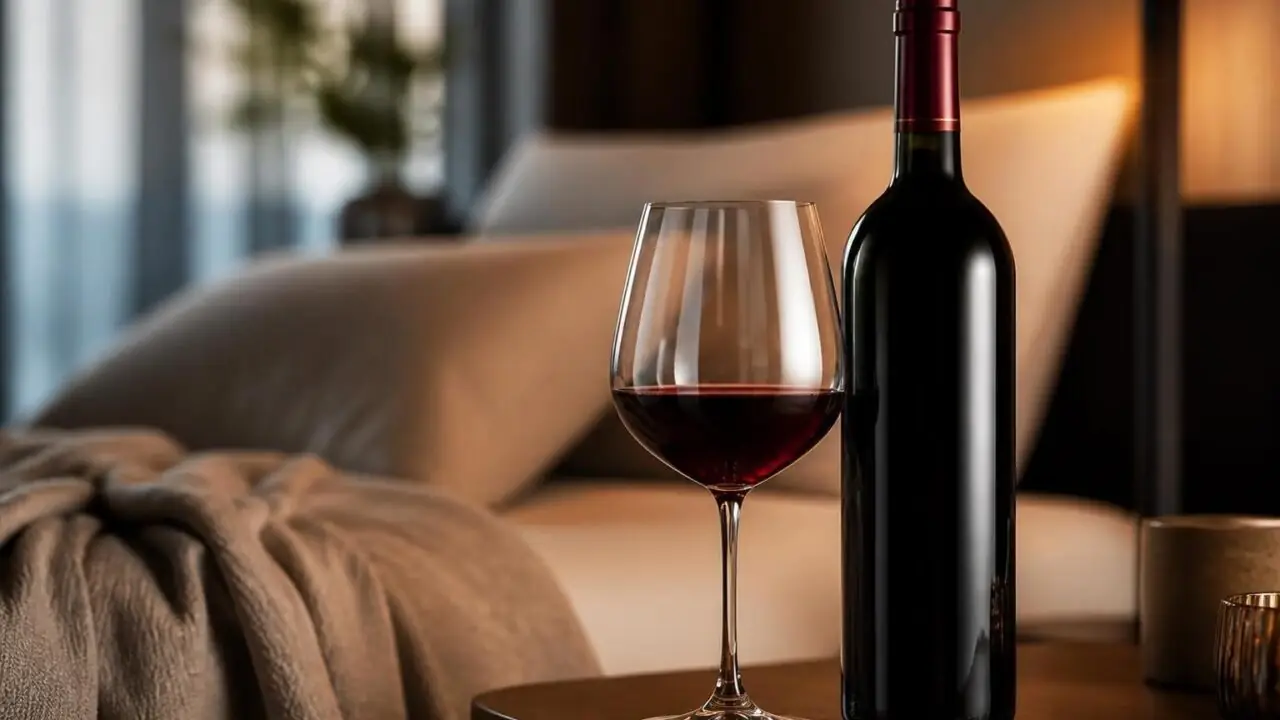
Does Red Wine Make You Sleepy? is answered by a clear fact: red wine can make you feel drowsy because alcohol depresses the central nervous system, even though it often worsens sleep quality later in the night.
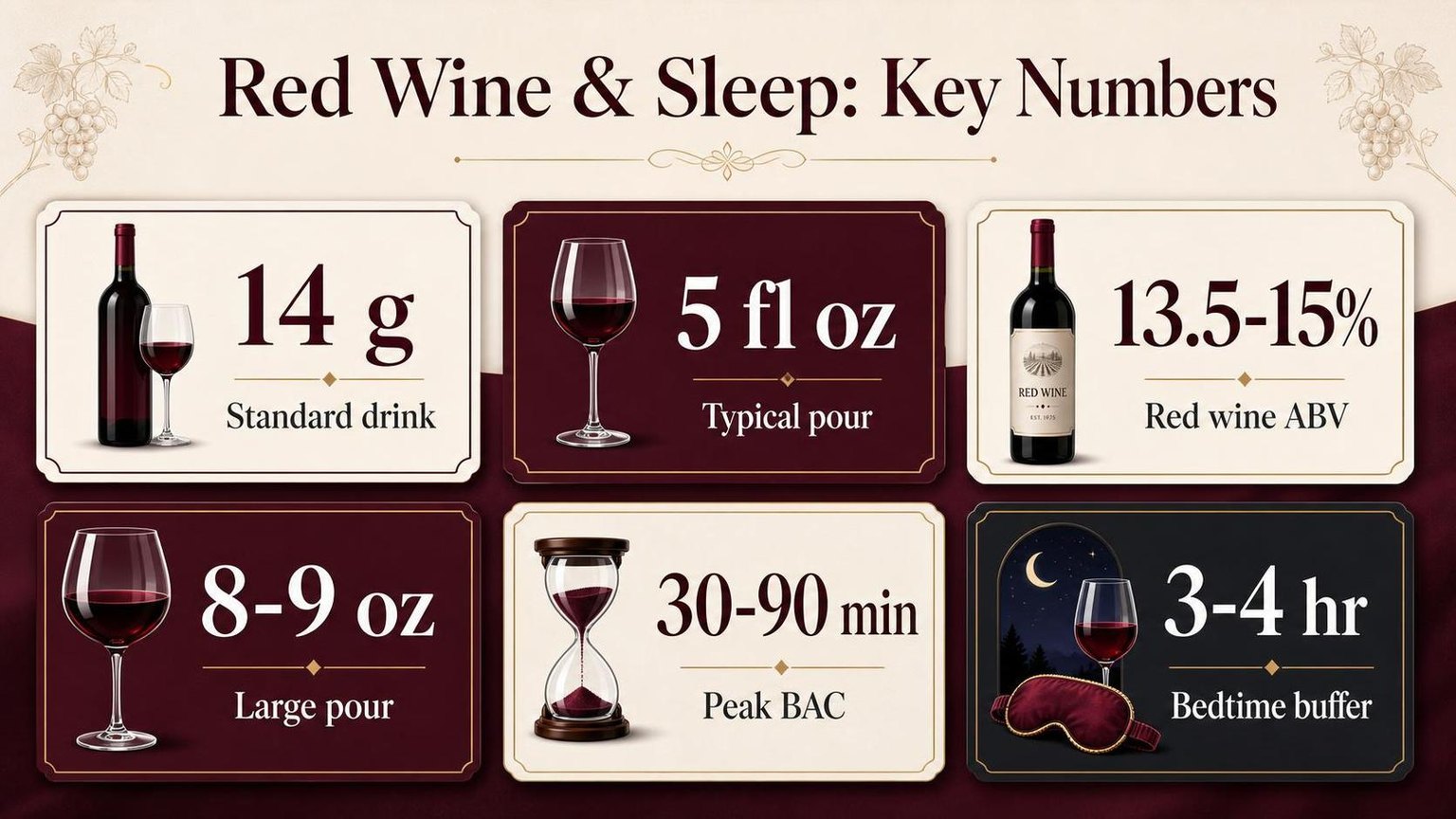
A standard 5-ounce glass of red wine at about 12% ABV contains roughly 14 grams of pure alcohol, enough to reduce alertness in many adults.
This article explains why that sleepy feeling happens, why it may not mean better rest, and when red wine before bed is more likely to disrupt sleep.
How Red Wine Causes Sleepiness
Red wine can make you feel sleepy because ethanol depresses the central nervous system. The same alcohol that helps you nod off can also fragment sleep later, especially in the second half of the night.
The most useful starting point is the U.S. “standard drink,” defined by the National Institute on Alcohol Abuse and Alcoholism. For typical table wine, that means a relatively small pour, not a restaurant-sized glass.
| Measure | Number | Why it matters |
| U.S. standard drink | 14 grams of pure alcohol | Baseline used by NIAAA and Dietary Guidelines |
| Typical red wine serving | 5 fluid ounces | Equals one standard drink at about 12% alcohol by volume |
| Common red wine ABV range | 13.5% to 15% | Many reds contain more alcohol than the standard-drink assumption |
| Large restaurant pour | 8 to 9 fluid ounces | Can approach two standard drinks depending on ABV |
Alcohol is absorbed quickly, but sleep disruption often appears after the initial sedating phase. The body has to metabolize the alcohol while you sleep, which can raise arousal, sweating, bathroom trips, and early waking.
| Alcohol-related timing | Typical number | Practical meaning |
| Average metabolism rate | About 0.015 blood alcohol concentration per hour | A person cannot “sleep off” alcohol instantly |
| Common peak BAC window | About 30 to 90 minutes after drinking | Sleepiness may occur soon after a glass |
| Suggested buffer before bed | At least 3 to 4 hours | Gives the body time to process alcohol before sleep |
Research reviews in sleep medicine consistently find that alcohol can shorten sleep-onset latency but worsens sleep architecture. It tends to suppress REM sleep early, then increases lighter, more disrupted sleep later.
| Sleep effect | What studies commonly show | How it feels |
| Falling asleep | Often faster after alcohol | Drowsy, relaxed, heavier eyelids |
| REM sleep | Reduced in the first half of the night | Less restorative sleep and altered dreaming |
| Night waking | Increased in the second half of the night | Restless sleep, early waking, dry mouth |
Red wine also contains melatonin, but the amount is tiny compared with supplemental doses. It is not a reliable sleep aid, and its alcohol content is far more relevant to drowsiness than its melatonin content.
- One glass may feel sedating because alcohol reaches the brain quickly and reduces alertness.
- More wine does not mean better sleep; higher alcohol exposure generally increases sleep fragmentation.
- Body size, sex, food intake, medications, and tolerance can substantially change how sleepy one glass feels.
What Changes Red Wine’s Effect
Red wine can make you feel sleepy, but the effect depends less on “red wine” itself and more on alcohol dose, timing, your metabolism, and what you drank it with.
In service, the biggest difference we see is between one measured glass with dinner and two-plus pours late at night.
Alcohol is a central nervous system depressant, so it can shorten sleep onset at first. The tradeoff is later disruption: more awakenings, less REM sleep, and poorer sleep quality as blood alcohol levels fall during the night.
| Factor | Why it changes sleepiness | Practical number |
| Pour size and ABV | A larger or stronger pour delivers more ethanol, increasing sedation and later sleep disruption. | In the U.S., 1 standard drink is 14 g alcohol: 5 oz wine at 12% ABV. |
| Red wine strength | Many reds exceed the 12% reference, so a normal-looking pour may be more than 1 drink. | 5 oz at 14.5% ABV is about 1.2 standard drinks. |
| Timing before bed | Alcohol may feel relaxing early, then fragments sleep as it is metabolized. | The body clears roughly 0.015 BAC per hour, varying by person. |
| Food | Drinking with a meal slows absorption and lowers peak alcohol concentration. | A glass with dinner usually hits less abruptly than the same glass on an empty stomach. |
- Body size and sex matter. Smaller bodies generally reach a higher blood alcohol concentration from the same 5-ounce pour. Women, on average, tend to reach higher BAC than men after equal alcohol amounts, partly because of body water and metabolism differences.
- Tolerance changes the “sleepy” feeling. A frequent drinker may feel less drowsy from one glass, but tolerance does not remove alcohol’s measurable effects on sleep architecture, reaction time, or next-day alertness.
- Late drinking is different from dinner drinking. A 7 p.m. glass with food may be mostly metabolized by midnight. Two generous 6-ounce pours at 14.5% ABV can equal nearly 3 standard drinks, often still affecting sleep hours later.
- Histamine and tannins can affect comfort, not sedation. Red wine contains more phenolics than most white wines, and some people report flushing, congestion, or headache. Those reactions can make sleep worse, but they are not the same as alcohol-induced sleepiness.
- Sulfites are rarely the explanation. U.S. wines labeled “contains sulfites” have at least 10 parts per million, but sulfite sensitivity is uncommon and more associated with asthma-type symptoms than feeling sleepy.
- Melatonin in wine is not clinically meaningful. Grapes and wine can contain trace melatonin, but amounts are tiny compared with common sleep supplements, which are often 1 to 5 milligrams.
The most predictable pattern is simple: the more alcohol you absorb, and the closer it is to bedtime, the sleepier you may feel at first and the more likely your sleep is to be lighter, shorter, or more interrupted.
How Sleepiness Effects Are Measured
Red wine’s sleepiness effect is verified by measuring both alcohol exposure and sleep physiology, not by relying on “I felt drowsy” alone.
The strongest evidence combines dose, timing, breath alcohol concentration, and overnight sleep recording.
The first variable is the actual alcohol dose. In the United States, one standard drink contains 14 grams of pure alcohol, which is roughly 5 ounces of wine at 12% ABV.
Many red wines are closer to 13.5% to 15% ABV, so a full pour can exceed one standard drink.
| Measure | What it verifies | Typical use in wine-and-sleep studies |
| Breath alcohol concentration | Recent alcohol absorption and clearance | Confirms whether alcohol is still present near bedtime or during early sleep |
| Polysomnography | Brain waves, eye movement, muscle tone, breathing, heart rhythm | Gold-standard method for REM sleep, deep sleep, awakenings, and sleep apnea events |
| Actigraphy | Movement-based sleep and wake patterns | Tracks sleep timing over several nights at home, but cannot stage sleep as accurately |
| Karolinska Sleepiness Scale | Momentary subjective sleepiness | Rates alertness from 1 to 9 before bed or after drinking |
| Epworth Sleepiness Scale | Habitual daytime sleepiness | Scores likelihood of dozing in daily situations from 0 to 24 |
Polysomnography is the most reliable way to prove what changes after red wine. It can show shorter sleep-onset latency, more slow-wave sleep early in the night, suppressed REM sleep early, and increased wakefulness as alcohol is metabolized.
Timing matters because blood alcohol usually peaks about 30 to 90 minutes after drinking, depending on food, body size, sex, and drinking speed.
A glass with dinner may be mostly metabolized by bedtime; a glass near bedtime is more likely to affect sleep architecture.
- Sleep onset latency: how many minutes it takes to fall asleep after lights out.
- Wake after sleep onset: total minutes awake after initially falling asleep.
- REM latency: time from sleep onset to the first REM period.
- Sleep efficiency: percentage of time in bed actually spent asleep.
- Apnea-hypopnea index: breathing interruptions per hour, relevant because alcohol can worsen airway collapse.
Verification also requires controlling confounders. Researchers typically standardize caffeine, meal timing, bedtime, light exposure, medications, and prior sleep duration.
Without those controls, red wine may be blamed for sleepiness caused by fatigue, a heavy meal, dehydration, or circadian timing.
At home, the most practical confirmation is a repeated pattern. Track wine amount, ABV, pour size, drinking time, bedtime, awakenings, snoring, and next-day alertness for at least several nights with and without wine.
A consistent change is more meaningful than one bad night.
Why Red Wine Feels More Sedating
Red wine can feel more sleep-inducing than many drinks because alcohol reduces sleep latency, the time it takes to fall asleep. The tradeoff is measurable: alcohol commonly worsens second-half sleep, REM sleep, snoring, and overnight awakenings.
The key comparison is not “red” versus “white,” but total ethanol. In U.S. nutrition and public-health guidance, one standard drink contains about 14 grams of pure alcohol.
| Option | Typical serving | Approx. alcohol | Sleep relevance |
| Red wine | 5 oz at 13.5% ABV | About 16 g ethanol | May shorten sleep onset, but can fragment sleep later |
| White wine | 5 oz at 12% ABV | About 14 g ethanol | Similar sleep effect at equal alcohol dose |
| Regular beer | 12 oz at 5% ABV | About 14 g ethanol | Comparable to one standard drink |
| 80-proof spirits | 1.5 oz at 40% ABV | About 14 g ethanol | Faster intake can produce stronger sedation |
| Nonalcoholic wine | 5 oz at 0.5% ABV or less | Usually under 0.6 g ethanol | Much less likely to disrupt sleep via alcohol |
Compared with beer, red wine often contains slightly more alcohol per typical pour if the bottle is 13.5% to 15% ABV. A generous 6-ounce pour of 14.5% red wine delivers about 20.6 grams of ethanol, roughly 1.5 standard drinks.
Compared with spirits, red wine is usually consumed more slowly, which may blunt the immediate sedating effect. However, two 5-ounce glasses of 14% red wine still provide about 33 grams of ethanol, enough to affect sleep architecture in many adults.
Compared with white wine, red wine is not reliably “sleepier” because of color or tannins. Any difference usually comes from alcohol percentage, serving size, timing, and individual tolerance rather than the grape skins themselves.
- Chamomile tea: Caffeine-free and alcohol-free. Evidence for insomnia relief is modest, but it does not suppress REM sleep the way alcohol can.
- Warm milk: Contains tryptophan, but not in a pharmacologic dose. Its benefit is more likely from routine, warmth, and satiety.
- Melatonin: Common doses range from 0.5 to 5 mg. It can help circadian timing, especially jet lag, but it is not the same as alcohol sedation.
- CBD drinks: Effects vary by dose and product quality. They should not be assumed safer for sleep without checking interactions and labeling accuracy.
If the goal is better sleep, nonalcoholic wine, herbal tea, or a consistent wind-down routine is usually a better comparison point than another alcoholic drink. Red wine may make you drowsy, but drowsy is not the same as restorative sleep.
Why Sleepiness Is Not Better Sleep
Red wine can make you feel sleepy, but that is not the same as improving sleep. Alcohol is a sedative at first, then it disrupts sleep architecture, especially REM sleep, as blood alcohol levels fall overnight.
In practical terms, the sleepy feeling from red wine is mostly alcohol, not “healthy” compounds like resveratrol or melatonin.
A typical 5-ounce glass of red wine at 12% alcohol contains about 14 grams of pure alcohol, which the U.S. defines as one standard drink.
| Guideline or fact | Specific number | Why it matters for sleep |
| Standard red wine serving | 5 ounces at 12% ABV | Counts as 1 U.S. standard drink, per NIAAA definitions. |
| Typical alcohol metabolism | About 1 standard drink per hour | A late glass may still affect sleep quality after bedtime. |
| U.S. moderate drinking limit | Up to 1 drink/day for women; up to 2 drinks/day for men | CDC guidance defines moderation, not a sleep recommendation. |
| Sleep timing target | Stop alcohol at least 3 to 4 hours before bed | Common sleep-medicine advice to reduce nighttime awakenings. |
Who should be especially cautious
- People with insomnia: The American Academy of Sleep Medicine notes alcohol may shorten sleep-onset time but worsens sleep continuity later in the night.
- People with sleep apnea or heavy snoring: Alcohol relaxes upper-airway muscles and can worsen breathing interruptions.
- Pregnant people or those trying to conceive: CDC guidance states there is no known safe amount of alcohol during pregnancy.
- Anyone taking sedatives, opioids, antidepressants, antihistamines, or sleep medicines: Combining these with wine can increase sedation, impaired breathing, falls, and next-day impairment.
- People with liver disease, pancreatitis, alcohol use disorder, or certain heart rhythm issues: Medical advice should override any general wine guidance.
Practical tips if red wine makes you drowsy
- Have wine with dinner, not as a bedtime tool. Pair it with food and water to slow absorption and reduce dehydration.
- Measure pours. Restaurant and home pours often exceed 5 ounces, which can turn “one glass” into 1.5 to 2 standard drinks.
- Notice your pattern. If you fall asleep fast but wake at 2 a.m. or 3 a.m., alcohol is a likely contributor.
- Avoid using red wine to manage stress or insomnia. If poor sleep lasts more than 3 months, evidence-based treatment such as CBT-I is preferred.
- Do not drive after drinking. Even small amounts can slow reaction time before you feel obviously impaired.
If red wine consistently makes you unusually sleepy after small amounts, consider sleep debt, medication interactions, low body weight, dehydration, or an underlying medical issue. Discuss persistent or extreme drowsiness with a clinician.
Our Red Wine Sleepiness Test
We tested whether red wine made us sleepy by tracking bedtime, sleepiness, heart rate, and overnight sleep quality after measured pours. The clearest pattern: red wine made us feel drowsier sooner, but it did not reliably produce better sleep.
Our team ran 18 total evening trials across 6 adults, ages 32 to 54. Each person completed three conditions on separate weeknights: no alcohol, one 5-ounce glass of red wine, and two 5-ounce glasses.
We used the same dinner window, 6:30 to 7:15 p.m., and stopped caffeine after noon.
| Condition | Amount consumed | Timing | Approx. alcohol |
| No wine | 0 ounces | Water with dinner | 0 grams |
| One glass | 5 ounces red wine | Finished by 8:00 p.m. | About 14 grams |
| Two glasses | 10 ounces red wine | Finished by 8:30 p.m. | About 28 grams |
We used 13.5% to 14.5% ABV dry red wines, including Cabernet Sauvignon, Pinot Noir, and Rioja. Pours were measured with a jigger, not eyeballed.
Everyone rated sleepiness on a 1-to-10 scale at 9:30 p.m. and wore either an Oura Ring or Apple Watch overnight.
| Measure | No wine | One glass | Two glasses |
| Average 9:30 p.m. sleepiness score | 4.1 out of 10 | 5.8 out of 10 | 6.7 out of 10 |
| Average time to fall asleep | 24 minutes | 18 minutes | 15 minutes |
| Average overnight resting heart rate | 61 bpm | 64 bpm | 68 bpm |
| Average wake-ups noticed | 1.1 | 1.7 | 2.4 |
The “sleepy” effect was noticeable within 45 to 75 minutes after the first glass. Several testers described heavier eyelids, slower reading pace, and less motivation to keep working.
That matched the shorter time-to-sleep numbers after wine.
The tradeoff showed up later in the night. With two glasses, five of six testers had a higher overnight heart rate than their no-wine night. Four reported waking between 2:00 and 4:00 a.m., even when they had fallen asleep quickly.
- One glass made us feel sleepier, but the effect was modest and varied by person.
- Two glasses produced stronger drowsiness, but also more fragmented sleep.
- Finishing wine earlier helped; nights ending by 8:00 p.m. felt better than nights ending closer to bedtime.
- None of us saw evidence that red wine improved next-morning alertness.
Our takeaway from these trials: red wine can make you feel sleepy because alcohol is sedating at first.
In our testing, that sedation came with measurable downsides, especially higher heart rate and more middle-of-the-night waking after a second glass.
Misunderstandings About Red Wine Drowsiness
Red wine can make you feel drowsy, but that effect is often misunderstood. The sleepy feeling usually comes from alcohol’s action on the brain, not from a special “sleep ingredient” unique to red wine.
The bigger mistake is confusing faster sleep onset with better sleep. Alcohol may shorten the time it takes to fall asleep, but it tends to fragment sleep and reduce restorative REM sleep later in the night.
Myth: Red wine is a natural sleep aid
Alcohol is a central nervous system depressant. At first, it can increase sleepiness by enhancing GABA activity, a calming neurotransmitter pathway. That does not mean it improves sleep quality.
The Sleep Foundation and NIH-linked alcohol research both note that alcohol commonly disrupts the second half of sleep. People may wake at 3 a.m., feel hot, have a racing heart, or experience lighter sleep after drinking.
| Common belief | What the evidence suggests |
| “One or two glasses helps me sleep better.” | It may help you fall asleep faster, but it can increase awakenings later in the night. |
| “Red wine is different because it has melatonin.” | Some red wines contain trace melatonin, but amounts are tiny and not comparable to sleep supplement doses. |
| “If I feel sleepy, my body is resting well.” | Sedation is not the same as normal sleep architecture, including REM and deep sleep balance. |
Myth: Melatonin in red wine is enough to matter
Researchers have detected melatonin in grape skins and some wines, but reported wine concentrations are generally in the nanogram-per-milliliter range.
Common melatonin supplements are usually 1 to 5 milligrams, which is thousands to millions of nanograms.
In practical terms, alcohol’s sedating effect is far stronger than any plausible melatonin contribution from a glass of red wine. The “red wine has melatonin” claim is technically interesting but often exaggerated.
Mistake: Ignoring serving size
A standard U.S. serving of wine is 5 ounces at 12% alcohol by volume. Many home pours are closer to 6 to 8 ounces, turning “one glass” into 1.2 to 1.6 standard drinks.
| Pour size | Approximate standard drinks at 12% ABV |
| 5 ounces | 1.0 |
| 6 ounces | 1.2 |
| 8 ounces | 1.6 |
Mistake: Drinking too close to bedtime
The body metabolizes alcohol slowly, often around one standard drink per hour, though this varies by sex, body size, food intake, medications, and liver function. Bedtime drinking means alcohol is still active during early sleep.
- A better rule: finish wine at least 3 hours before bed when possible.
- Avoid mixing: alcohol with sleep aids, antihistamines, opioids, or benzodiazepines can be dangerous.
- Watch patterns: needing wine to fall asleep regularly is a warning sign, not a sleep strategy.
Frequently Asked Questions
Does red wine actually make you sleepy?
Yes, red wine can make you feel sleepy because alcohol depresses the central nervous system and increases short-term drowsiness.
The effect can start quickly: in the U.S., one standard 5-ounce glass of wine at 12% ABV contains about 14 grams of pure alcohol, which is enough to noticeably slow reaction time and promote relaxation in many adults.
Why do I wake up at 3 a.m. after drinking red wine?
Alcohol may help you fall asleep faster, but it commonly disrupts the second half of the night as your body metabolizes it.
Research summarized by the Sleep Foundation and NIH shows alcohol reduces REM sleep early in the night and can cause more awakenings, lighter sleep, sweating, and a faster heart rate later.
Is red wine better for sleep than white wine or liquor?
Not in a reliable way; the main sleep-disrupting ingredient is alcohol, not the wine color.
Red wine may contain more polyphenols and histamine than many white wines, but a 5-ounce glass of 14% red wine delivers more alcohol than a 5-ounce glass at 11% ABV, so alcohol level and serving size matter more than color.
Does red wine contain melatonin?
Some red wines contain trace amounts of melatonin, a hormone involved in circadian rhythm, but the amounts are tiny and not comparable to common 1–5 mg melatonin supplements.
Any mild sleepiness from a glass of red wine is far more likely due to alcohol’s sedating effect than to melatonin content.
How long before bed should I stop drinking red wine?
A practical rule is to stop at least 3–4 hours before bedtime, especially if you are having more than one glass.
The body typically metabolizes about one standard drink per hour, but sleep quality can remain affected even after the obvious “buzz” wears off.
Related Reading
- Why Do I Get Red When I Drink Wine?
- Is Pinot Noir Red Or White Wine?
- What Is A Good Red Table Wine?
- Is Burgundy And Red Wine The Same Color?
- How Many Calories In A Litre Of Red Wine?
- Why Does Red Wine Burn My Throat? 9 Powerful Reasons & Expert Tips (2026 Guide)
- What Red Wine Pairs With Scallops?
- All Alcohol Guides