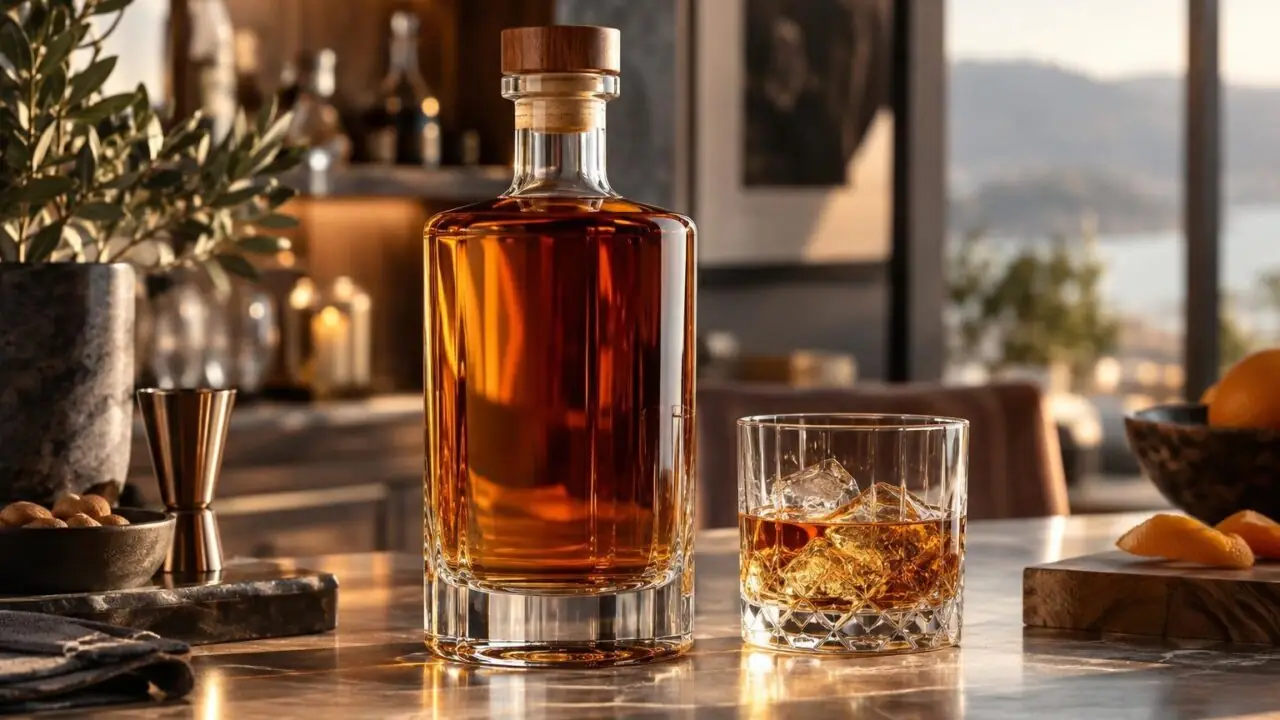
How Many Calories in a Bottle of Whiskey? is answered by about 1,650 calories in a standard 750 mL bottle of 80-proof whiskey.
That estimate comes from ethanol’s 7 calories per gram and the bottle’s roughly 237 mL of pure alcohol, before counting mixers, flavored additives, or larger pours.
Whiskey has no meaningful fat, protein, or carbohydrate in its straight distilled form, so nearly all calories come from alcohol.
Proof, bottle size, and serving habits change the final number: a 1.5 oz shot of 80-proof whiskey has about 97 calories, while higher-proof bottles climb quickly.
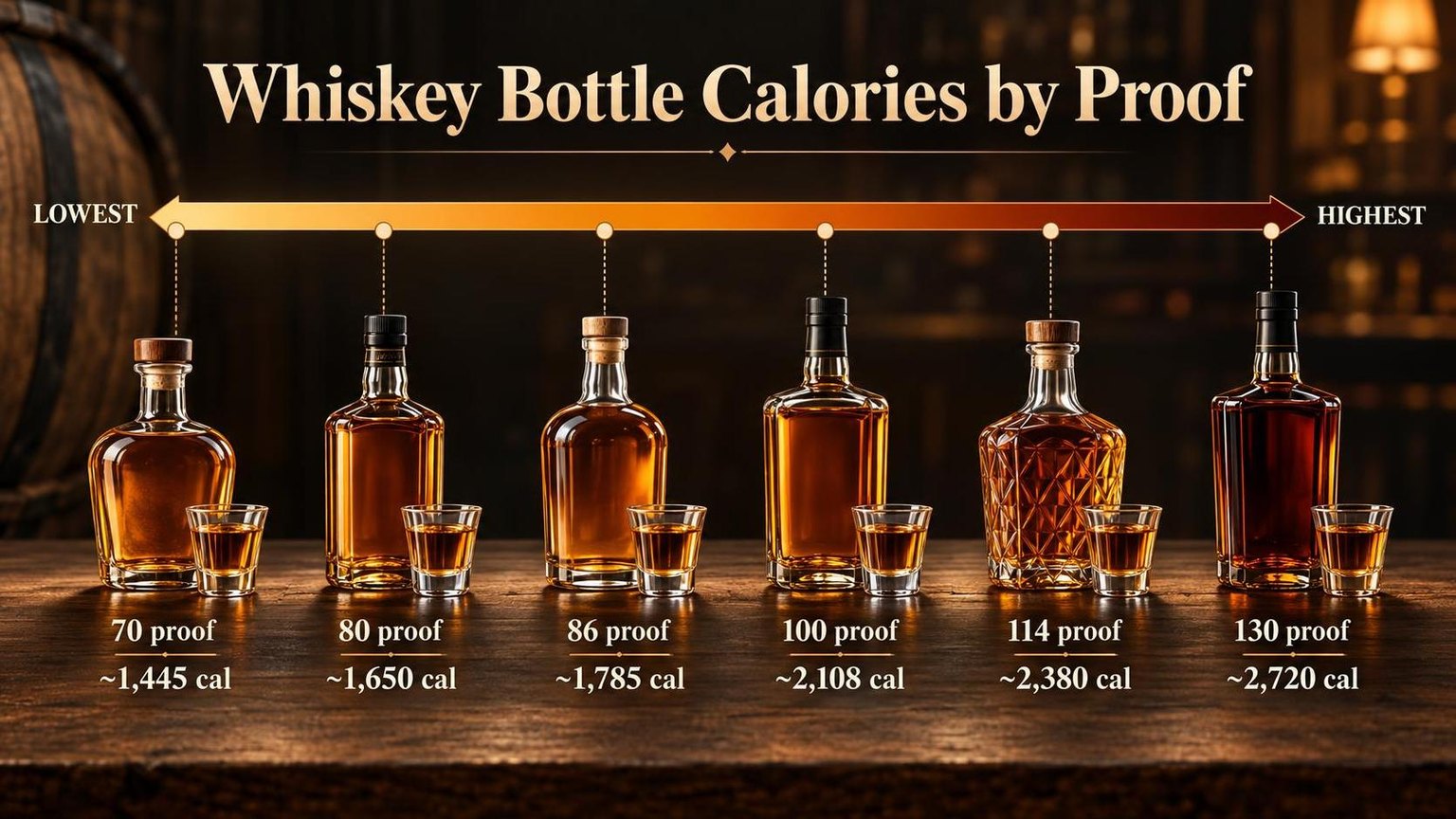
Calories in a 750 ml Whiskey Bottle
A 750 ml bottle of whiskey at 40% alcohol by volume contains approximately 1,650 calories. Nearly all come from ethanol because straight whiskey generally contains negligible carbohydrate, protein, and fat.
Alcohol supplies 7 calories per gram, according to the USDA.
To estimate bottle calories, multiply bottle volume by ABV, convert the resulting pure-alcohol volume to grams using ethanol’s density of approximately 0.789 grams per milliliter, then multiply by 7.
| Calculation for a 750 ml bottle at 40% ABV | Result |
| Pure ethanol volume | 300 ml |
| Ethanol weight | 236.7 g |
| Estimated energy | 1,657 calories |
Published nutrition databases may show a slightly lower total. USDA-derived listings commonly assign about 97 calories to a 1.5 fl oz serving of 80-proof distilled spirits, producing roughly 1,640 calories per bottle after unit conversion.
Rounding, pour size, and analytical methodology explain the small difference.
| Whiskey strength | US proof | Estimated calories per 750 ml bottle |
| 40% ABV | 80 proof | 1,657 |
| 43% ABV | 86 proof | 1,782 |
| 46% ABV | 92 proof | 1,906 |
| 50% ABV | 100 proof | 2,071 |
| 57% ABV | 114 proof | 2,361 |
Higher-proof whiskey contains more calories because the bottle holds more ethanol. Diluting whiskey with water changes calories per sip but not the bottle’s total energy; the same alcohol remains present.
A standard 750 ml bottle provides about 16.9 pours when each pour is 1.5 fl oz. The National Institute on Alcohol Abuse and Alcoholism defines 1.5 fl oz of 40% spirits as one U.S. standard drink containing approximately 14 grams of pure alcohol.
| Measure at 40% ABV | Approximate amount |
| One 1.5 fl oz pour | 97–98 calories |
| Number of 1.5 fl oz pours | 16.9 |
| Entire 750 ml bottle | 1,640–1,657 calories |
Flavored whiskey can contain additional calories from sugar. Cocktail ingredients also change the total substantially: regular soda, juice, syrups, cream, and liqueurs add energy beyond the whiskey itself.
- Check the label for ABV before estimating calories.
- Use the producer’s nutrition disclosure for sweetened or flavored products.
- Count mixers separately when calculating a drink’s full calorie content.
The bottle total is nutritional information, not a safe-consumption target. Consuming an entire bottle represents far more alcohol than U.S. public-health guidance permits and creates a serious risk of alcohol poisoning.
Calories by Whiskey Proof and ABV
Alcohol itself contains 7 calories per gram—nearly double the 4 calories per gram in protein or carbohydrates.
Because whiskey carries virtually zero sugar, fat, or protein, its calorie count is driven almost entirely by its ABV (alcohol by volume).
Proof is simply double the ABV. An 80-proof whiskey is 40% ABV; a 100-proof whiskey is 50% ABV. Higher proof means more ethanol per pour, which means more calories per ounce.
Calorie Comparison by Proof (Per 1.5 oz / 44 ml Shot)
| Proof | ABV | Calories per 1.5 oz Shot | Calories per 750 ml Bottle |
| 70 | 35% | ~85 | ~1,445 |
| 80 | 40% | ~97 | ~1,650 |
| 86 | 43% | ~105 | ~1,785 |
| 90 | 45% | ~110 | ~1,870 |
| 100 | 50% | ~124 | ~2,108 |
| 114 | 57% | ~140 | ~2,380 |
| 120 | 60% | ~148 | ~2,516 |
| 130 | 65% | ~160 | ~2,720 |
The USDA lists a standard 1.5 oz serving of 80-proof distilled spirits at 97 calories. That figure serves as the baseline for all extrapolations above.
How the Math Works
One milliliter of pure ethanol weighs approximately 0.789 grams. Multiply that by ABV to get grams of alcohol, then multiply by 7 cal/g. A 750 ml bottle at 40% ABV contains about 236.7 grams of ethanol—yielding roughly 1,657 calories.
Real-World Examples
- Jameson Irish Whiskey (80 proof / 40% ABV): ~97 calories per shot, ~1,650 per bottle
- Wild Turkey 101 (101 proof / 50.5% ABV): ~125 calories per shot, ~2,125 per bottle
- Booker’s Bourbon (~125 proof / 62.5% ABV): ~153 calories per shot, ~2,600 per bottle
- George T. Stagg (~130 proof / 65% ABV): ~160 calories per shot, ~2,720 per bottle
Every 10-proof increase adds roughly 13–15 calories per 1.5 oz shot. Choosing an 80-proof bottle over a barrel-proof 130-proof bottle saves approximately 1,070 calories across a full 750 ml.
Cask-strength and barrel-proof releases routinely exceed 2,500 calories per bottle. Diluting with water before drinking lowers the ABV per sip but does not change the total caloric content of the bottle.
Calories per Shot from the Bottle
A standard 1.5-fluid-ounce shot of 80-proof whiskey contains about 97 calories. A 750-milliliter bottle provides approximately 16.9 standard shots, so each accurately measured pour represents about 5.9% of the bottle’s calories.
The estimate aligns with USDA FoodData Central data for distilled spirits at 40% alcohol by volume.
Unflavored whiskey contains negligible carbohydrate, fat, and protein; nearly all its calories come from ethanol, which supplies approximately 7 calories per gram.
| Pour size | 80-proof calories | Pours per 750 mL bottle |
| 1 fluid ounce | 65 | 25.4 |
| 1.5 fluid ounces | 97 | 16.9 |
| 2 fluid ounces | 129 | 12.7 |
| 3 fluid ounces | 194 | 8.5 |
Proof directly affects calories because U.S. proof equals twice the alcohol-by-volume percentage. Higher-proof whiskey delivers more ethanol—and therefore more calories—in the same measured shot, even when it contains no added sugar.
| Whiskey strength | Alcohol by volume | Calories per 1.5-ounce shot | Approximate calories per 750 mL bottle |
| 80 proof | 40% | 97 | 1,640 |
| 86 proof | 43% | 104 | 1,760 |
| 90 proof | 45% | 109 | 1,840 |
| 100 proof | 50% | 121 | 2,050 |
These figures are estimates because databases and producers may use different rounding methods. Ethanol concentration can also vary slightly from the stated label strength, while bar pours often exceed the assumed shot size.
Why the Actual Pour Matters
A free-poured serving can look like a shot while containing substantially more whiskey. Measuring with a jigger exposes the difference: a 2-ounce pour of 80-proof whiskey has roughly one-third more calories than a 1.5-ounce serving.
- Use the labeled ABV: Calculate from the whiskey’s actual strength rather than assuming every bottle is 80 proof.
- Measure the serving: A marked jigger gives a more dependable estimate than counting seconds during a free pour.
- Include mixers: Soda, juice, syrups, liqueurs, and sweet vermouth add calories beyond those in the whiskey.
- Check flavored products: Flavored whiskey may contain added sweeteners, so its calorie content may exceed an unflavored spirit at the same proof.
For bottle planning, divide the bottle’s estimated calorie total by the number of equal pours. For consumption tracking, calculate the poured whiskey first, then add every mixer and garnish separately.
Why Whiskey Has Calories Without Carbs
Distilled whiskey contains zero carbohydrates, zero sugar, and zero fat—yet a standard 750 ml bottle packs roughly 1,640 calories.
Every single calorie comes from one source: ethanol, which the body metabolizes differently from any macronutrient.
Ethanol delivers 7 calories per gram. That places it between fat (9 cal/g) and carbohydrates or protein (4 cal/g each). The distillation process strips away all fermentable sugars, leaving pure alcohol and water as the primary components.
| Macronutrient | Calories per Gram |
| Fat | 9 |
| Ethanol (alcohol) | 7 |
| Carbohydrate | 4 |
| Protein | 4 |
The confusion arises because the USDA does not classify ethanol as a macronutrient. Nutrition labels on food products track fat, carbs, and protein—but alcohol falls outside that framework entirely.
How the Body Processes Ethanol
Your liver prioritizes ethanol above all other fuel sources. The enzyme alcohol dehydrogenase converts ethanol into acetaldehyde, then aldehyde dehydrogenase breaks it down into acetate. Acetate enters general circulation as usable energy.
This metabolic priority means the body pauses fat oxidation while processing alcohol. A 2004 study in the American Journal of Clinical Nutrition found that fat oxidation dropped by approximately 73% after ethanol consumption.
The practical consequence: those 1,640 calories per bottle aren’t “empty” in a metabolic sense. They actively redirect how your body handles other calories you’ve consumed.
What About Flavored or Barrel-Aged Whiskeys?
Standard straight whiskey—bourbon, scotch, rye—registers 0 g carbs per 1.5 oz serving according to USDA FoodData Central. Barrel aging adds trace compounds like vanillin and tannins but no measurable carbohydrates.
Flavored whiskeys are the exception. Products like Fireball (33% ABV) contain added sugar, contributing roughly 11 g of carbs per 1.5 oz pour—adding approximately 44 calories beyond the alcohol itself.
- 80-proof straight whiskey (1.5 oz): ~97 calories, 0 g carbs
- Fireball Cinnamon Whisky (1.5 oz): ~108 calories, ~11 g carbs
- Honey-flavored whiskey (1.5 oz): ~106 calories, ~6 g carbs
For anyone counting carbs—whether on keto or simply tracking macros—unflavored whiskey remains technically carb-free.
The caloric load, however, is substantial and entirely attributable to ethanol’s 7-calorie-per-gram energy density.
Bottle Calories for Popular Whiskey Sizes
Whiskey bottle sizes directly determine total calorie count. A standard 750 ml bottle of 80-proof whiskey contains approximately 1,640 calories, while a full liter pushes past 2,100 calories.
Calorie counts scale linearly with volume, assuming consistent proof. The following table covers the most common bottle formats sold in the United States.
| Bottle Size | Volume (oz) | Standard Drinks (1.5 oz) | Total Calories (80 proof) |
| Miniature (Nip) | 1.7 oz (50 ml) | ~1 | ~110 |
| Half Pint | 6.8 oz (200 ml) | ~4.5 | ~440 |
| Pint | 12.7 oz (375 ml) | ~8.5 | ~820 |
| Fifth (Standard) | 25.4 oz (750 ml) | ~17 | ~1,640 |
| Liter | 33.8 oz (1 L) | ~22.5 | ~2,190 |
| Handle | 59.2 oz (1.75 L) | ~39.5 | ~3,830 |
These figures use the USDA value of roughly 97 calories per 1.5-oz serving of 80-proof (40% ABV) distilled spirits, which contain zero carbohydrates, fat, or protein.
How Proof Changes the Math
Higher-proof whiskeys pack significantly more calories per bottle. Alcohol itself delivers 7 calories per gram — nearly double the 4 calories per gram in protein or carbohydrates.
| Proof | ABV | Calories per 1.5 oz | Calories per 750 ml Bottle |
| 80 | 40% | ~97 | ~1,640 |
| 86 | 43% | ~105 | ~1,775 |
| 90 | 45% | ~110 | ~1,860 |
| 100 | 50% | ~124 | ~2,100 |
| 114 (Cask Strength) | 57% | ~140 | ~2,370 |
A single 750 ml bottle of cask-strength bourbon like Booker’s (125.8 proof) can exceed 2,500 calories — more than an average adult’s entire daily recommended intake.
Practical Size Comparisons
Context helps put these numbers in perspective. Consider what common bottle sizes equate to in everyday food terms:
- Miniature (50 ml): 110 calories — roughly one medium banana.
- Half pint (200 ml): 440 calories — equivalent to a McDonald’s Big Mac (550 cal minus the bun).
- Fifth (750 ml): 1,640 calories — comparable to eating 3.5 Snickers bars (459 cal each).
- Handle (1.75 L): 3,830 calories — nearly two full days of caloric intake for a sedentary adult woman (2,000 cal/day recommended by the FDA).
Flavored whiskeys often add 10–30% more calories per serving due to added sugars. Fireball, for example, contains approximately 108 calories per 1.5-oz pour at just 66 proof.
How Mixers Change Total Whiskey Calories
A 1.5 oz shot of 80-proof whiskey contains approximately 97 calories from alcohol alone. The moment you add a mixer, that number can double, triple, or even quadruple depending on your choice.
Most whiskey calories come from ethanol at 7 calories per gram. Mixers introduce additional calories from sugar, high-fructose corn syrup, or fruit juice concentrates that stack directly on top.
Calorie Count: Whiskey With Common Mixers
The following table shows approximate calories for a standard drink made with 1.5 oz of 80-proof whiskey plus a typical 6 oz mixer serving.
| Mixer (6 oz) | Mixer Calories | Total Drink Calories |
| Club soda | 0 | 97 |
| Diet cola | 0–2 | 97–99 |
| Water (on the rocks) | 0 | 97 |
| Regular Coca-Cola | 78 | 175 |
| Ginger ale | 62 | 159 |
| Ginger beer | 84 | 181 |
| Sweet & sour mix | 100 | 197 |
| Orange juice | 84 | 181 |
| Cranberry juice cocktail | 82 | 179 |
| Red Bull (8.4 oz can) | 112 | 209 |
Low-Calorie Mixer Strategies
Zero-calorie mixers keep total intake at 97 calories per drink. Club soda with a lemon wedge adds less than 1 calorie and enhances aroma without sugar.
- Club soda or sparkling water — 0 calories, preserves whiskey flavor
- Diet ginger ale — 0–5 calories per 6 oz, mimics a highball
- Black coffee — roughly 2 calories per 6 oz, pairs well with bourbon
- Unsweetened iced tea — about 2 calories per 6 oz
The Sugar Multiplier Effect
Ordering a double whiskey and Coke at a bar typically means 3 oz of whiskey plus 8 oz of cola. That single cocktail reaches approximately 298 calories — equivalent to a full slice of pepperoni pizza.
Frozen whiskey cocktails present the steepest calorie climb. A 12 oz whiskey sour slushie from a bar machine can contain 350–450 calories due to added simple syrup and commercial sour mix.
Tracking mixer calories matters more than most drinkers realize.
USDA nutrient data confirms that regular soft drinks contribute 39 grams of sugar per 12 oz serving — roughly 9.5 teaspoons — turning a moderate-calorie spirit into a high-calorie indulgence.
Questions Readers Ask
How many calories are in a standard 750 ml bottle of whiskey?
A standard 750 ml bottle of 80-proof (40% ABV) whiskey contains approximately 1,640 calories. This figure comes from the roughly 97 calories per 1.5 oz (44 ml) serving, with about 17 servings per bottle.
All of these calories derive from alcohol itself, as straight whiskey contains zero carbohydrates, fat, or protein.
Does higher-proof whiskey have more calories per bottle?
Yes — alcohol contributes 7 calories per gram, so higher-proof expressions pack significantly more energy.
A 750 ml bottle of cask-strength bourbon at 120 proof (60% ABV) contains roughly 2,460 calories, about 50% more than an equivalent bottle at 80 proof.
Choosing a lower-proof whiskey is the most direct way to reduce caloric intake without reducing volume.
How do whiskey calories compare to a bottle of wine or vodka?
A 750 ml bottle of dry red wine (13.5% ABV) averages around 625 calories, while a 750 ml bottle of 80-proof vodka matches whiskey at approximately 1,640 calories since both spirits derive calories solely from ethanol at the same proof.
The key difference with wine is the much lower alcohol concentration — whiskey delivers roughly 2.6 times the calories of a same-sized wine bottle.
Are there fewer calories in whiskey than in flavored or sweetened spirits?
Straight whiskey contains no sugar, so its calorie count comes entirely from alcohol.
Flavored whiskeys — such as honey or cinnamon variants — often add 20–60 extra calories per serving from sugar, pushing a 750 ml bottle toward 1,980–2,660 total calories.
Reading the label for added sugars is essential, as U.S. TTB regulations do not yet require spirits to display a Nutrition Facts panel.
How many calories does a single whiskey drink add when mixed?
A neat 1.5 oz pour of 80-proof whiskey adds about 97 calories, but common mixers escalate that sharply.
A whiskey and regular cola (with 8 oz of cola) totals roughly 194 calories, while a Whiskey Sour made with fresh lemon juice and simple syrup lands around 165–180 calories per cocktail.
Substituting soda water or a zero-calorie mixer keeps the drink closest to its base spirit calorie count.
Related Guides
- What To Mix With Irish Whiskey?
- How To Store Whiskey At Home?
- Eagle Rare Vs Buffalo Trace: Which Is Best?
- What Do You Mix Jameson With?
- Does Whiskey Get Better With Age?
- Tennessee Whiskey Vs Bourbon: Which Is Best?
- What To Mix With Fireball Whiskey?
- What Percent Alcohol Is Moonshine?
- All Alcohol Guides
- USDA FoodData Central – Whiskey Nutrient Data (2025)
- National Institute on Alcohol Abuse and Alcoholism – What Is a Standard Drink? (2025)
- NIAAA Rethinking Drinking – Alcohol Calorie Calculator (2025)
- Centers for Disease Control and Prevention – About Standard Drink Sizes (2025)
- Dietary Guidelines for Americans, 2020–2025 (2020)
- Electronic Code of Federal Regulations – 27 CFR § 5.65 Alcohol Content Statements (2025)
- National Center for Biotechnology Information – Alcohol Consumption and Obesity: An Update (2015)
- NHS – Calories in Alcohol (2023)