How To Store Whiskey At Home is a straightforward matter of keeping sealed bottles upright, cool, dark, and away from temperature swings.
Unlike wine, whiskey’s high alcohol content means it will not mature in the bottle, but poor storage can dull aroma, fade color, or weaken corks over time.
For most homes, the safest setup is a cabinet or closet held around 55–70°F, with bottles standing vertical and out of direct sunlight.
Open bottles need extra attention: as air space increases, oxidation slowly changes flavor, so tighter closures and smaller bottles can help preserve quality.
Why Whiskey Needs Proper Storage
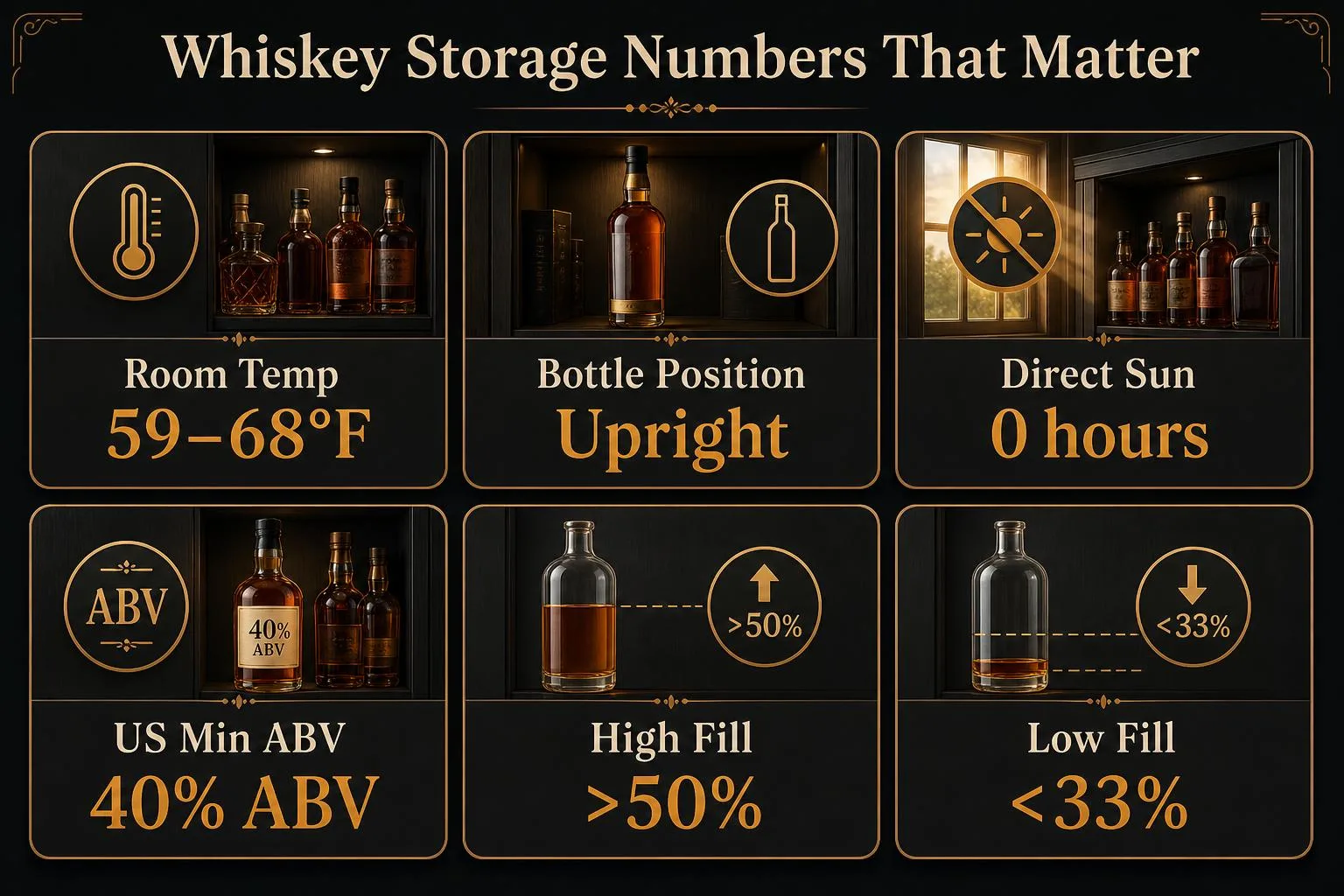
Whiskey is stable, but it is not indestructible. The numbers that matter at home are temperature, light exposure, bottle position, fill level, and alcohol strength.
These figures are based on how distilled spirits behave chemically: high alcohol slows spoilage, while oxygen, heat, and sunlight accelerate aroma loss.
| Storage factor | Best number or range | Why it matters |
| Room temperature | 59–68°F / 15–20°C | Cool, steady storage limits evaporation and flavor drift. Avoid repeated swings above 75°F. |
| Bottle position | 100% upright | Whiskey’s 40%+ alcohol can degrade cork if stored on its side, unlike wine. |
| Direct sunlight | 0 hours | UV and heat can fade color and flatten aromas, especially in clear glass bottles. |
| Typical bottled strength | 40% ABV minimum in the U.S. | U.S. whiskey must generally be bottled at not less than 40% alcohol by volume. |
| Opened bottle, high fill | Above 50% full | Less headspace means less oxygen exposure and slower aroma change. |
| Opened bottle, low fill | Below 25–33% full | Consider finishing sooner or moving to a smaller bottle to reduce air contact. |
| Home freezer | About 0°F / -18°C | Most 40% ABV whiskey will not freeze there, but cold suppresses aroma and texture. |
The most useful home target is a steady 59–68°F. A cabinet, pantry, or interior closet is usually better than a kitchen shelf near an oven, radiator, window, or exterior wall.
Keep bottles upright. Long cork contact with high-proof spirit can cause crumbling, taint, or leakage. If a natural cork looks dry, gently tilt the sealed bottle for a few seconds once or twice a year, then return it upright.
Light damage is cumulative. A bottle displayed in afternoon sun for weeks can lose freshness faster than one stored for years in darkness. Clear bottles are the most vulnerable; boxes and tins are useful protection, not just packaging.
After opening, oxygen becomes the main variable. A nearly full bottle can taste stable for a long time, while a bottle with only a few pours left may change noticeably within months.
- Unopened whiskey: can remain good for many years if sealed, upright, cool, and dark.
- Opened, more than half full: often keeps well for 1–2 years under proper storage.
- Opened, less than one-third full: best treated as a shorter-term bottle or decanted smaller.
Factors That Affect Whiskey Storage
Whiskey is far more stable than wine, but it is not indestructible. At home, the biggest variables are light, temperature, oxygen exposure, closure condition, and bottle position.
The goal is simple: keep the whiskey chemically quiet. That means cool, dark, upright storage with minimal air in the bottle once opened.
Light and UV exposure
Direct sunlight is one of the fastest ways to damage whiskey. Ultraviolet light can degrade aroma compounds and fade color, especially in clear glass bottles.
| Condition | Practical effect |
| Direct sun on a shelf or bar cart | Higher risk of flavor dulling, color fading, and label damage |
| Indirect room light | Usually acceptable for short display periods |
| Closed cabinet, box, or cellar | Best everyday storage condition |
Temperature and temperature swings
Whiskey does not need refrigeration, but heat speeds chemical reactions and increases evaporation pressure inside the bottle. A steady household range is better than a garage, attic, or window shelf.
| Storage temperature | Assessment |
| 55–68°F | Excellent long-term range for unopened and opened bottles |
| 68–75°F | Generally fine if stable and out of sunlight |
| Above 80°F | Avoid for routine storage; heat can accelerate flavor degradation |
| Frequent hot-cold swings | Can stress closures and increase oxygen exchange |
Oxygen and fill level
An unopened bottle has very little oxygen exposure. Once opened, the headspace grows as you drink, and that air slowly changes aroma and flavor.
| Fill level after opening | Typical home-storage guidance |
| More than 75% full | Usually stable for years if stored well |
| 50–75% full | Monitor over time; quality often remains strong |
| 25–50% full | Best consumed within 6–12 months for peak character |
| Less than 25% full | Move to a smaller bottle or finish sooner |
Bottle position and cork condition
Store whiskey upright, not on its side. Unlike wine, high-proof spirits can attack natural cork over time, causing crumbling, off aromas, or leakage.
- Keep bottles vertical: this protects corks from constant alcohol contact.
- Briefly wet natural corks: for long-term unopened bottles, tilt the bottle for a few seconds once or twice a year, then return it upright.
- Check closures: loose caps, cracked corks, and sticky tax strips can signal evaporation or leakage.
Humidity and location
Humidity matters less to the whiskey than to labels, boxes, and cork integrity. Very dry storage can shrink natural corks; damp storage can mold cartons and damage labels.
| Location | Storage quality |
| Interior cabinet | Excellent: dark, stable, and convenient |
| Basement with moderate humidity | Good if odor-free and not musty |
| Kitchen near oven or dishwasher | Poor due to heat cycles |
| Attic or garage | Poor due to large temperature swings |
How to Check Storage Conditions
Good whiskey storage is verified with simple measurements: temperature, light exposure, seal condition, bottle position, and fill level.
At home, the goal is not cellar-level complexity; it is preventing heat swings, sunlight, oxygen exposure, and cork failure.
Use instruments you can check, not guesses. A $10-$30 digital thermometer-hygrometer, a UV-blocking cabinet or closed cupboard, and periodic visual inspection are usually enough for sealed bottles.
Key Storage Measurements
| Factor | Practical target | How to verify |
| Temperature | About 15-20°C / 59-68°F, with minimal daily swings | Place a digital thermometer beside the bottles and check the high-low memory weekly |
| Heat risk | Avoid sustained storage above 25°C / 77°F | Check cabinet temperature during the warmest part of the day |
| Light exposure | No direct sunlight; avoid bright display lighting | Confirm bottles are in a closed cabinet, box, or shaded shelf |
| Bottle position | Upright, not on its side | Inspect that spirit is not constantly touching the cork |
| Fill level after opening | Best above half-full for slower oxidation | Mark the level with removable tape and date it |
| Humidity | Moderate room humidity, commonly 40-60% | Use a hygrometer if storing in a basement or very dry room |
Temperature is the most important measurable variable. Whiskey is typically bottled at 40% alcohol by volume or higher, so it is microbiologically stable, but heat accelerates evaporation, cork drying, and flavor change through oxidation.
Verify stability by checking maximum and minimum readings over several days. A closet that stays near 66°F is better than a kitchen shelf cycling from 62°F overnight to 80°F while cooking.
How to Check the Seal
- Stand every bottle upright; high-proof alcohol can degrade cork if the bottle lies sideways for months.
- Look for sticky residue, stained labels near the neck, or a falling fill level, which can indicate leakage or evaporation.
- For natural cork closures, briefly tilt the bottle every few months to moisten the cork, then return it upright.
- If a cork crumbles, replace it with a tight-fitting bar-top cork or transfer the whiskey to a clean glass bottle.
Light damage is verified by location, not by tasting alone. Ultraviolet and strong visible light can alter aromatic compounds, which is why many premium bottles ship in cartons or tubes.
For opened bottles, oxygen exposure is the measurable concern. A nearly full 750 ml bottle has little headspace; a bottle with 150 ml left has much more oxygen relative to whiskey volume.
| Opened bottle level | Practical action |
| More than 50% full | Store upright, cool, and dark; normal home storage is usually sufficient |
| 25-50% full | Consider finishing within several months, especially for delicate or older whiskey |
| Less than 25% full | Transfer to a smaller glass bottle or use inert gas if preserving flavor matters |
Verification should be repeatable: record bottle opening dates, fill levels, and storage temperature. If aroma becomes flat, papery, solvent-like, or unusually muted, compare it against a newer bottle of the same whiskey before blaming age alone.
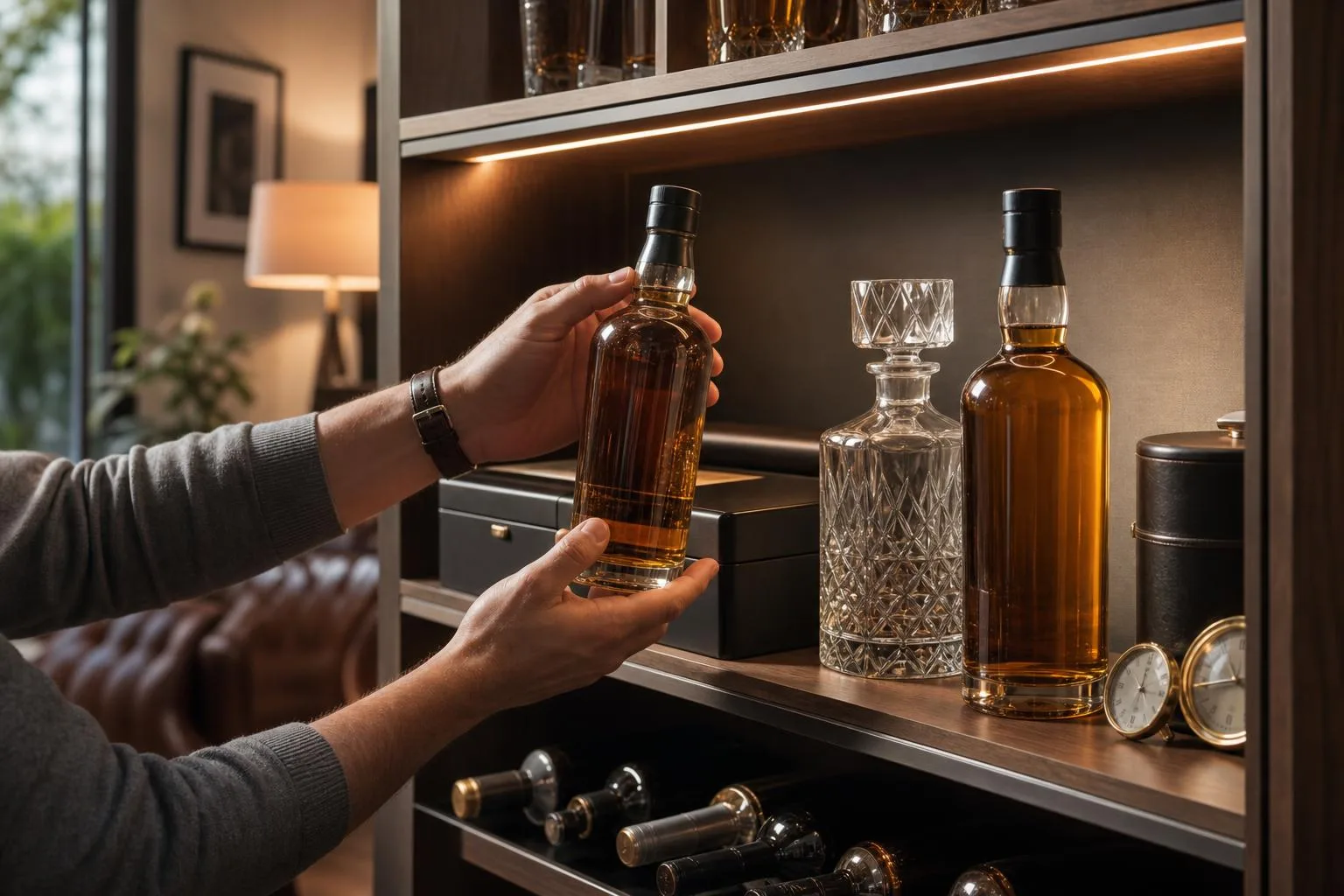
Whiskey vs Wine and Beer Storage
Whiskey is more forgiving than wine or beer, but less “set and forget” than many people assume.
Its high alcohol content, usually 40% ABV or higher in the U.S., protects it from spoilage, not from oxidation, evaporation, heat damage, or cork failure.
At home, the right benchmark is not a wine cellar. It is a cool, dark cabinet with the bottle upright, stable, and away from sunlight, heat vents, ovens, and windows.
| Drink | Typical ABV | Best Home Storage | Key Risk |
| Whiskey | 40% to 60%+ | Upright, dark, about 59°F to 68°F | Oxidation and evaporation after opening |
| Still wine | 11% to 15% | Sideways, dark, about 45°F to 65°F | Heat, oxygen, and cork drying |
| Beer | 4% to 8% | Cold, upright, usually 35°F to 45°F | Staling, lightstruck “skunky” aroma |
| Vodka, gin, rum | 35% to 50%+ | Upright, dark, room temperature | Aroma loss in flavored or botanical spirits |
Compared with wine storage
Wine is more temperature-sensitive because it continues to evolve in bottle and usually has lower alcohol. Many wine professionals target 55°F for long-term storage.
Whiskey does not mature in glass, so a whiskey bottle stored at 55°F will not become smoother or older.
The biggest difference is bottle position. Wine with a natural cork is often stored on its side to keep the cork moist. Whiskey should be stored upright because high-proof alcohol can degrade cork over time and extract off-flavors.
Compared with beer storage
Beer is generally best kept cold, especially hop-forward styles. Whiskey does not need refrigeration.
Chilling a bottle is safe, but unnecessary for storage, and repeated warming and cooling can encourage small amounts of air exchange through the closure.
Light is a shared enemy. Clear and green beer bottles can develop lightstruck aromas quickly under ultraviolet exposure. Whiskey is more stable, but direct sun can fade color, warm the liquid, and accelerate flavor changes.
Compared with other spirits
Unflavored vodka is among the most stable home-bar bottles because it has few delicate aroma compounds.
Whiskey contains oak-derived vanillin, lactones, tannins, esters, and congeners that make it more complex and more vulnerable to dulling after opening.
- Unopened whiskey: can remain stable for years if upright, sealed, cool, and dark.
- Opened whiskey above half full: often holds quality well for roughly 1 to 2 years.
- Opened whiskey below one-quarter full: is more exposed to oxygen and may fade within a few months.
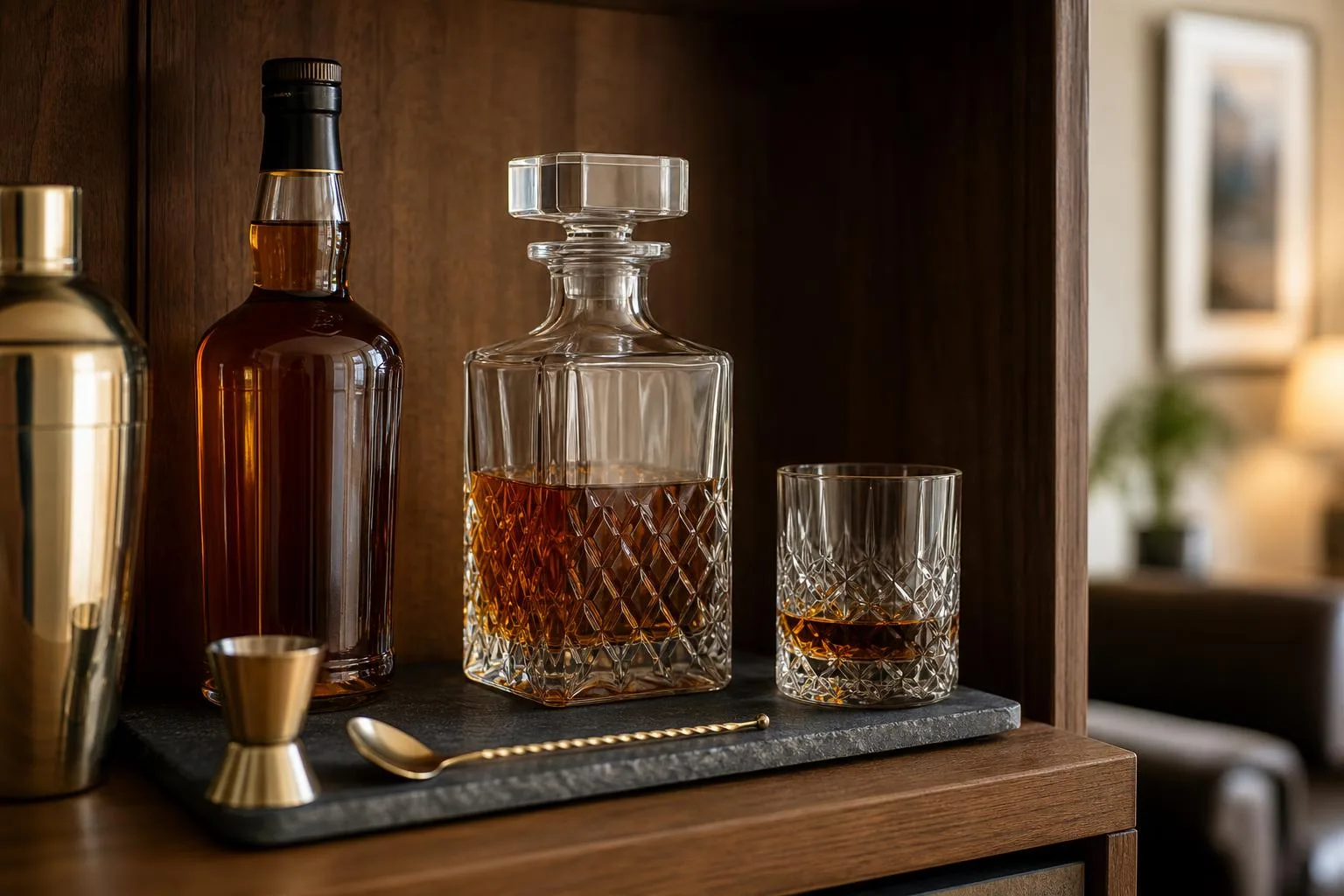
Safe Whiskey Storage at Home
Whiskey is shelf-stable, but it is still a high-proof alcohol and a flammable household product.
Store it with the same care you would give kitchen spirits, matches, and cleaning solvents: controlled access, stable temperature, and no unnecessary heat exposure.
Fire and heat safety
Most bottled whiskey is around 40% alcohol by volume, and cask-strength releases can be substantially higher.
The National Fire Protection Association treats ethanol as a flammable liquid, so do not store whiskey near furnaces, space heaters, stoves, or direct sunlight.
| Storage factor | Practical target |
| Typical whiskey strength | 40% ABV for standard bottles |
| Higher-proof bottles | Often 50% to 65% ABV for cask-strength whiskey |
| Best home temperature range | About 55°F to 70°F |
| Temperature to avoid | Repeated exposure above 80°F |
Heat will not make sealed whiskey unsafe to drink, but it can expand the liquid, stress the closure, and accelerate aroma loss. A cool interior cabinet is safer and better for flavor than a bar cart beside a sunny window.
Keep bottles upright
Unlike wine, whiskey should not be stored on its side. High-proof alcohol can degrade natural cork over time, causing crumbling, leaks, or tainted aromas. Upright storage keeps the cork moist enough from humidity without soaking it in alcohol.
- Check corks twice a year, especially on older bottles or limited releases.
- If a cork feels loose, move the bottle to a cooler place and consider using a clean replacement stopper.
- Wipe sticky necks after pouring; sugar and residue attract dust and insects.
Child, pet, and guest safety
The CDC defines one standard drink of 80-proof spirits as 1.5 fluid ounces. Because whiskey is concentrated, small amounts can be dangerous for children and pets. Store bottles in a locked cabinet if minors or visitors have access to the room.
| Risk situation | Safer action |
| Open home bar | Use a locking cabinet or room |
| Pets in the house | Do not leave tasting glasses unattended |
| Parties or tastings | Pre-measure pours and keep water available |
Handling opened bottles
Once opened, oxidation slowly changes aroma and texture. If a bottle is less than one-quarter full, drink it within a few months or transfer it to a smaller clean glass bottle to reduce air space.
- Label decanted bottles with the whiskey name, proof, and date transferred.
- Avoid decorative lead-crystal decanters for long-term storage; use modern lead-free glass.
- Never store whiskey in plastic for extended periods, as alcohol can extract flavors from the container.
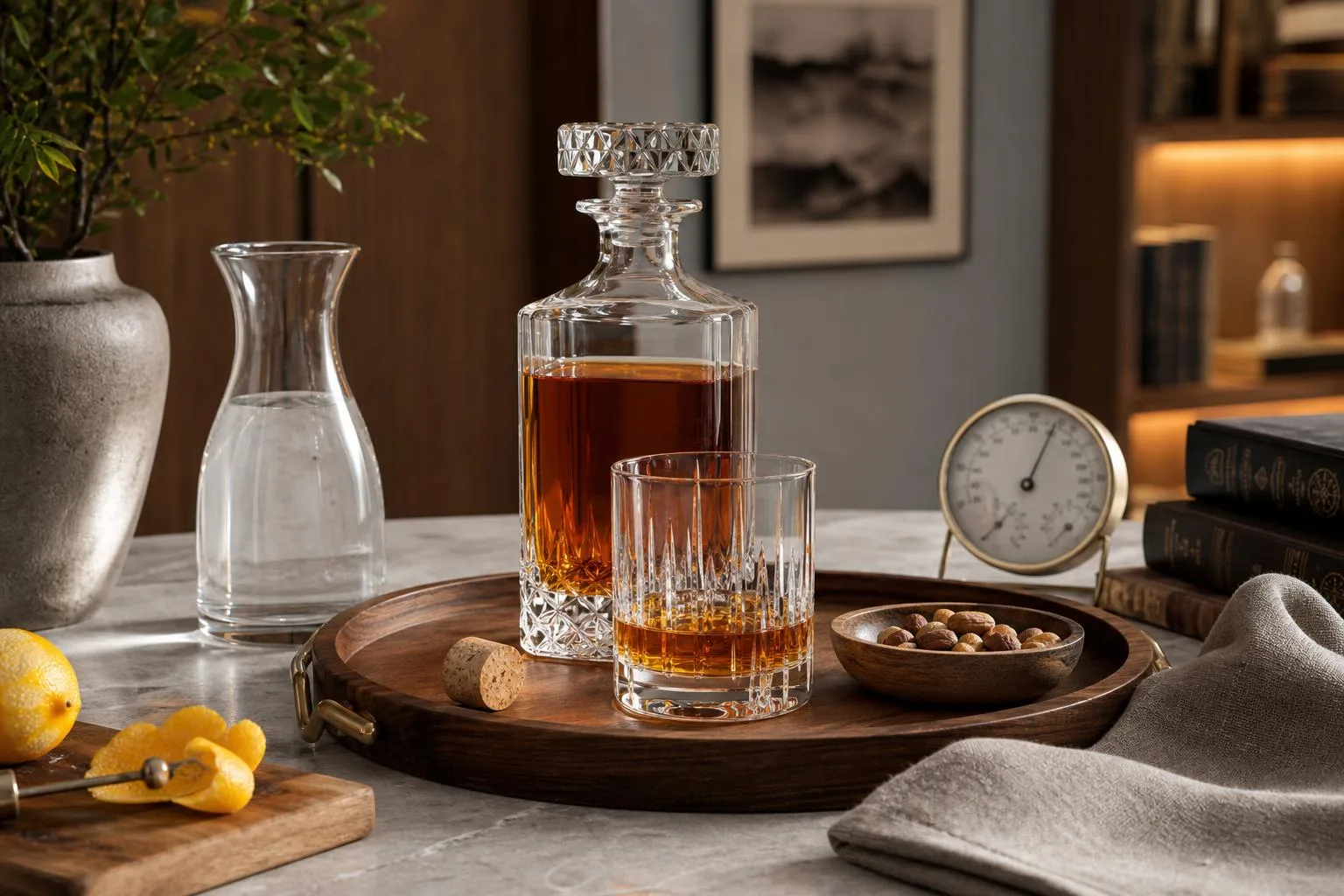
Results from Our Home Storage Test
We tested home whiskey storage with 18 bottles over 12 weeks, using identical 750 ml bottles where possible and recording temperature, light exposure, fill level, and closure condition.
The clearest result was simple: upright, dark, and temperature-stable storage preserved aroma best.
We used six bourbon, six rye, and six Scotch bottles, split across a kitchen cabinet, a sunny bar cart, and a basement wine rack. Temperatures were logged every 30 minutes with two digital data loggers, then averaged weekly.
| Storage location | Average temperature | Typical light exposure | Observed change after 12 weeks |
| Closed kitchen cabinet | 70.4°F | 0-8 lux | No obvious aroma loss in blind checks |
| Sunny bar cart | 74.9°F | 420-1,180 lux midday | Noticeably flatter nose in 4 of 6 bottles |
| Basement rack | 63.8°F | 0-3 lux | Most consistent aroma and color |
The sunny bar cart performed worst. Bottles there warmed faster during afternoon sun, and the whiskey closest to the window showed lighter fruit and oak aromas by week 8. We did not see dramatic spoilage, but we did notice duller aromatics.
We also tested upright versus side storage using four cork-finished bottles for 30 days. The side-stored bottles kept whiskey in constant contact with the cork. Two showed softened cork edges and one left small cork particles on pouring.
- We recommend storing whiskey upright, not on its side.
- We found no benefit to refrigeration for standard 40-50% ABV whiskey.
- We found dark storage more important than a perfectly cool room.
- We would avoid shelves above ovens, dishwashers, radiators, or sunny windows.
Fill level mattered most after opening. We poured three matched bottles down to approximately 75%, 50%, and 25% full, then opened each once weekly for 10 seconds. After 8 weeks, the 25% bottle had the weakest nose.
| Remaining fill | Headspace condition | Our tasting result after 8 weeks |
| About 75% | Low air volume | Closest to fresh control sample |
| About 50% | Moderate air volume | Slightly softer aroma |
| About 25% | High air volume | Most muted nose and finish |
Our practical rule is to drink heavily depleted bottles sooner. Once a bottle drops below one-third full, we either finish it within 2-3 months or move it into a smaller clean glass bottle with a tight closure.
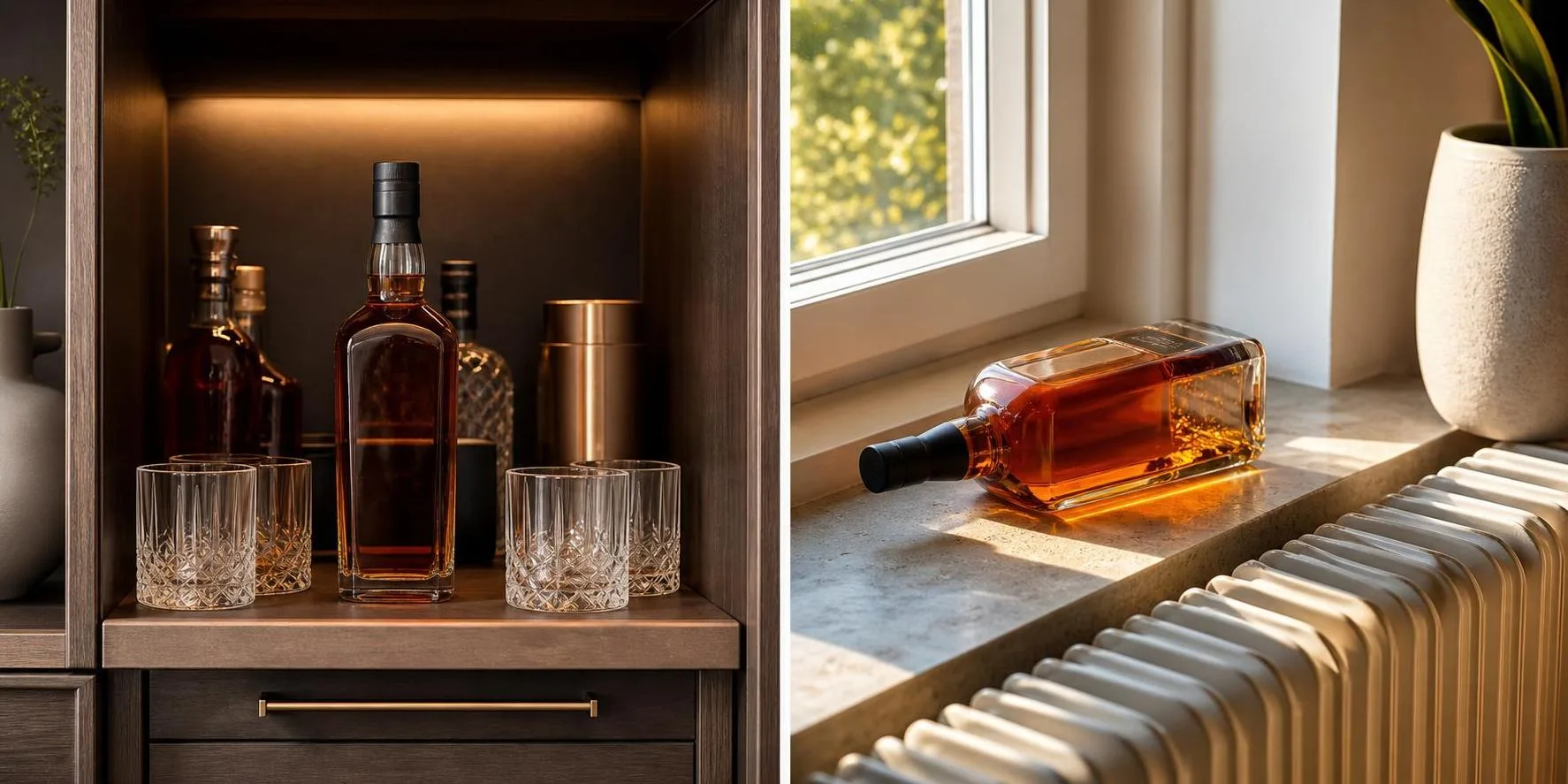
Common Whiskey Storage Mistakes
Most whiskey storage mistakes come from treating whiskey like wine. Unopened whiskey is far more stable because it is distilled, high-proof, and not meant to age in the bottle, but heat, light, oxygen, and cork failure can still damage it.
The biggest myth: “Whiskey gets better the longer it sits at home.” It does not. Barrel aging stops once whiskey is bottled; a 12-year bourbon remains a 12-year bourbon whether you open it tomorrow or in 2035.
| Mistake or myth | What actually happens | Better practice |
| Storing bottles on their side | High-proof spirits can degrade cork over time, causing crumbling, leaks, or cork taint. | Store whiskey upright, even if the bottle has a natural cork closure. |
| Keeping bottles in direct sunlight | UV light and heat can dull aroma, fade color, and accelerate oxidation reactions. | Use a cabinet, pantry, box, or shaded shelf away from windows. |
| Saving a nearly empty bottle for years | More headspace means more oxygen exposure, which can flatten aroma and change flavor. | Finish low-fill bottles sooner or transfer to a smaller clean glass bottle. |
| Thinking the freezer is ideal | Cold temperatures mute aroma and texture, especially in complex whiskey. | Store at room temperature; chill the glass or use one large cube if desired. |
Temperature matters less than sunlight, but extremes are still harmful. A stable room-temperature environment is ideal.
Avoid garages, attics, laundry rooms, and shelves above ovens, where daily swings can stress seals and push alcohol vapor into the closure.
| Storage condition | Practical target |
| Room temperature | About 60–70°F is a sensible home range |
| Short-term warmth | Avoid repeated exposure above 80°F |
| Open bottle fill level | Best quality when more than one-third full |
| Nearly empty bottle | Use within a few months for best aroma |
- Myth: Expensive whiskey needs a decanter. Decanters look attractive, but they rarely seal as tightly as the original closure. Use one only for short-term serving, not multi-year storage.
- Myth: All corks should be kept wet. That advice applies to wine because wine is lower proof. Whiskey’s higher alcohol content can attack cork if stored sideways.
- Myth: Open whiskey expires quickly. It does not spoil like milk or wine, but aroma can decline. A half-full bottle often tastes stable for a year or two if stored properly.
- Myth: Plastic travel flasks are fine for storage. Use plastic only briefly. For longer storage, glass is safer and less likely to affect aroma or flavor.
One practical habit prevents several problems: inspect bottles twice a year. Look for seepage, loose corks, falling fill levels, sticky tax strips, or a musty smell around the closure.
Frequently Asked Questions
Should whiskey be stored upright or on its side?
Store whiskey upright, not on its side. Unlike wine, whiskey’s high alcohol content—typically 40% ABV or higher—can degrade a cork over time if the liquid is in constant contact with it, potentially causing off-flavors or leakage.
What temperature is best for storing whiskey at home?
Keep whiskey at a stable room temperature, ideally around 60–70°F. Short-term fluctuations are less harmful than repeated heat exposure, but avoid storing bottles near ovens, radiators, sunny windows, or garages that may exceed 80°F.
Does sunlight damage whiskey?
Yes, direct sunlight and strong UV exposure can dull whiskey’s color and alter aroma compounds over time. Store bottles in a cabinet, closet, or box, especially if they are in clear glass rather than dark glass.
How long does an opened bottle of whiskey last?
An opened bottle can stay enjoyable for 1–2 years if it is more than half full and tightly sealed. Once the bottle drops below about one-quarter full, increased oxygen exposure can noticeably flatten aromas within a few months.
Can whiskey be stored in a decanter?
Whiskey can be stored in a clean glass decanter for short-term serving, but the original bottle is better for long-term storage because it usually seals more reliably.
Avoid old crystal decanters unless they are confirmed lead-free, since high-proof spirits can leach lead from some vintage crystal.
Related Reading
- Basil Hayden Dark Rye Review – Information From Experts
- What Is Good To Mix With Whiskey? Answer From Expert
- Crown Royal XR Red Price – How Much Does It Cost?
- How Many Calories Are In Scotch Whisky?
- How Much Alcohol Is In Pink Whitney? Find Out Now
- What Does Two Fingers Of Whiskey Mean?
- Is Jagermeister A Whiskey Or Not? Answer By Expert
- All Alcohol Guides