Does Whiskey Help a Toothache? Whiskey is not a reliable or safe treatment; its alcohol may briefly numb irritated tissue, but it cannot remove decay, drain an abscess, or repair a cracked tooth.
Holding whiskey against the gum can also irritate damaged tissue and delay effective care.
Toothache pain often signals decay, infection, gum disease, or trauma. Use a cold compress outside the cheek, rinse gently with warm salt water, and follow the label directions for an appropriate over-the-counter pain reliever if safe for you.
Do not place aspirin or concentrated alcohol directly on the gum. Seek dental care promptly, especially for swelling, fever, facial tenderness, foul drainage, trouble swallowing, or breathing.
These symptoms can indicate an infection requiring professional treatment, not a home remedy.
Can Whiskey Numb Toothache Pain
Whiskey contains ethanol, a compound with documented local anesthetic properties. At concentrations found in most whiskeys (40–50% ABV), ethanol can temporarily desensitize nerve endings in oral tissue.
The effect is measurable but limited in both strength and duration.
How Ethanol Acts on Nerve Tissue
Ethanol inhibits voltage-gated sodium channels in peripheral nerves. A 1999 study in The Journal of Pharmacology and Experimental Therapeutics confirmed ethanol suppresses neuronal excitability at concentrations above 6% by volume.
Whiskey applied topically to a tooth delivers roughly 40% ethanol directly to inflamed gingival tissue. That concentration exceeds the threshold needed to partially block pain signal transmission along the trigeminal nerve.
Whiskey vs. Clinical Anesthetics
The numbing effect of whiskey is significantly weaker and shorter-lived than pharmaceutical-grade local anesthetics used in dentistry.
| Property | Whiskey (40% ABV) | Lidocaine 2% | Benzocaine 20% |
| Onset of numbness | 30–60 seconds | 2–4 minutes | 15–30 seconds |
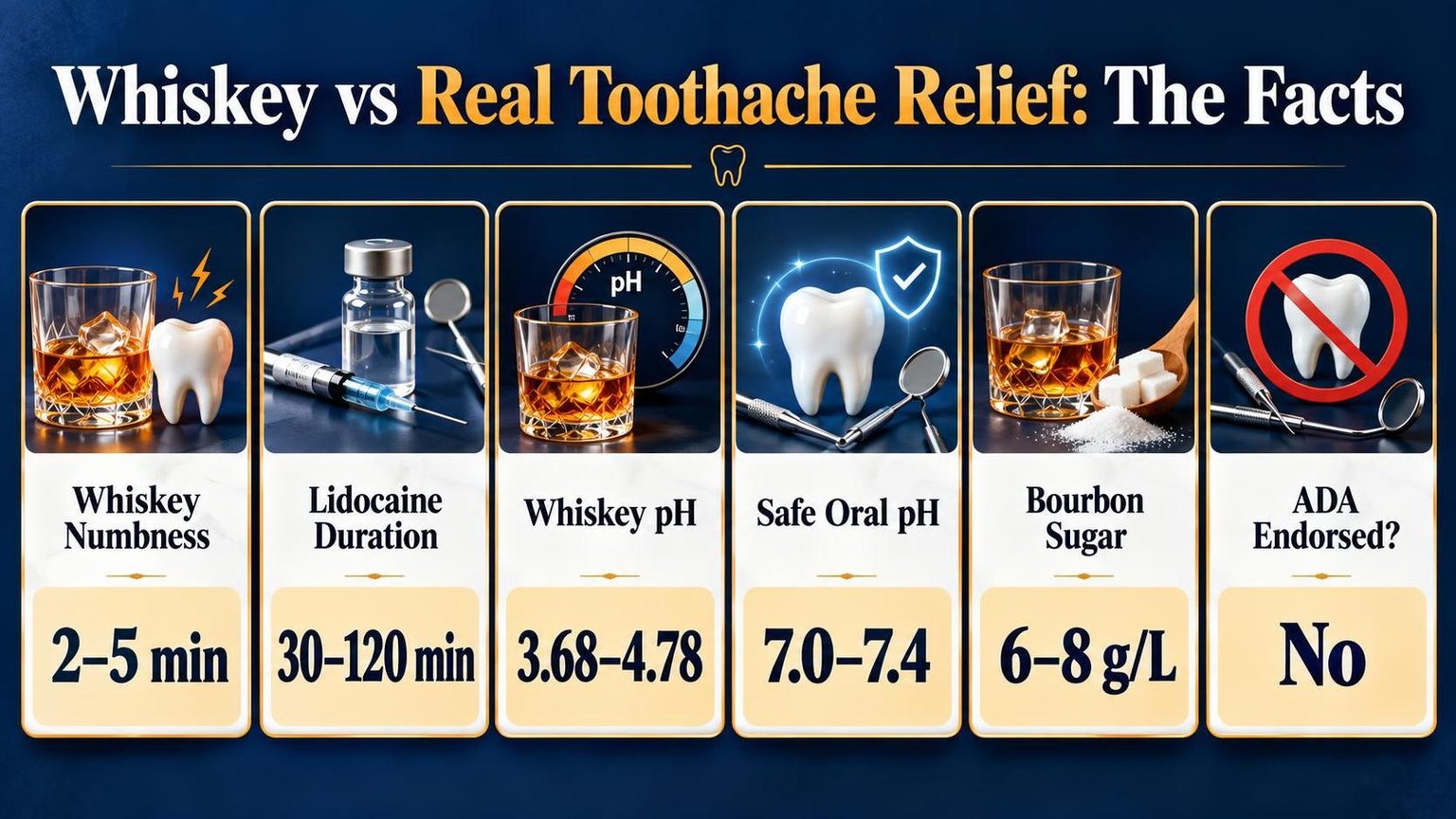
| Duration of relief | 2–5 minutes | 30–120 minutes | 15–20 minutes |
| Depth of anesthesia | Surface only | Deep tissue | Surface only |
| FDA-approved for oral pain | No | Yes | Yes |
Key Limitations
- Ethanol evaporates quickly from mucosal surfaces, reducing contact time below what sustained anesthesia requires.
- Alcohol at 40% concentration irritates open wounds, inflamed pulp, or exposed dentin — potentially worsening pain after the brief numbing fades.
- Repeated application dries oral tissue and disrupts the protective mucosal barrier, increasing infection risk.
- Swallowing whiskey provides zero topical benefit; systemic blood-alcohol levels needed to blunt pain perception (~0.08% BAC or higher) impair judgment and carry health risks.
Whiskey produces a real but fleeting surface numbness lasting no more than a few minutes. It cannot reach the dental pulp where most toothache pain originates.
The American Dental Association does not endorse alcohol as a pain management strategy.
Over-the-counter benzocaine gels or ibuprofen (200–400 mg every 4–6 hours) provide stronger, longer, and safer relief until a dentist addresses the underlying cause.
Why Whiskey Does Not Treat Decay
Tooth decay is a structural disease caused by bacterial acid dissolving enamel and dentin. Whiskey cannot reverse mineral loss, fill a cavity, or eliminate the biofilm responsible for decay. Temporary numbing masks damage that continues unchecked.
What Actually Causes Decay
Streptococcus mutans and related bacteria metabolize sugars into lactic acid. This acid drops oral pH below the critical threshold of 5.5, demineralizing hydroxyapatite crystals in enamel.
Once a cavity forms, the lost tooth structure cannot regenerate. Only a dentist can remove infected dentin and restore the tooth with filling material, an inlay, or a crown.
Why Whiskey Fails at Every Stage
| Factor | What’s Needed | What Whiskey Provides |
| Antibacterial strength | Chlorhexidine 0.12% kills S. mutans within 30 seconds | 40% ABV ethanol reduces bacteria temporarily but does not penetrate biofilm effectively |
| pH environment | Neutral or slightly alkaline (pH 7.0–7.4) to promote remineralization | Whiskey pH ranges from 3.68 to 4.78, adding acid to an already acidic environment |
| Sugar content | Zero fermentable sugars at the tooth surface | Bourbon contains roughly 6–8 g of residual sugar per liter, feeding cariogenic bacteria |
| Structural repair | Dental composite, amalgam, or ceramic restoration | No restorative capacity whatsoever |
Alcohol Can Worsen Oral Health
- Ethanol reduces salivary flow rate by approximately 20–30% with regular use, weakening the mouth’s primary defense against acid.
- The American Dental Association identifies alcohol as a risk factor for oral cancer, with risk increasing 5-fold in heavy drinkers.
- Chronic alcohol use is linked to higher DMFT (Decayed, Missing, Filled Teeth) scores in clinical studies.
- Swishing spirits over an exposed nerve can cause intense pain once the brief numbing effect fades.
Applying whiskey to a decayed tooth treats neither the bacterial infection nor the structural damage. It introduces acid and sugar to a site already under microbial attack.
A dental visit remains the only evidence-based path to treating decay. Delaying professional care while relying on whiskey allows the cavity to deepen toward the pulp, risking abscess and potential tooth loss.
Risks of Applying Whiskey Directly
Applying whiskey directly to a toothache carries measurable risks that outweigh any brief numbing effect. Alcohol at concentrations found in whiskey (40–60% ABV) damages soft oral tissue and can worsen the underlying dental condition.
Tissue Damage and Irritation
Ethanol above 25% concentration causes chemical burns to oral mucosa. A 2017 study in the Journal of Oral Pathology & Medicine confirmed that repeated alcohol exposure degrades the epithelial barrier of gum tissue.
Whiskey held against an open cavity or exposed nerve intensifies inflammation rather than reducing it. The dehydrating effect of alcohol pulls moisture from cells, delaying healing.
Oral Cancer Risk
The International Agency for Research on Cancer (IARC) classifies ethanol in alcoholic beverages as a Group 1 carcinogen. Direct mucosal contact increases acetaldehyde exposure in the mouth.
Research published in The Lancet Oncology found that people consuming more than 4 drinks daily had a 5-fold increased risk of oral cavity cancers compared to non-drinkers.
Comparison: Whiskey vs. Proven OTC Remedies
| Factor | Whiskey (40% ABV) | Benzocaine Gel (20%) | Clove Oil (Eugenol) |
| Numbing duration | 1–2 minutes | 15–20 minutes | 10–30 minutes |
| FDA-approved for oral pain | No | Yes | Yes (as dental analgesic) |
| Tissue irritation risk | High | Low | Moderate if undiluted |
| Carcinogen classification | Group 1 (IARC) | None | None |
Additional Risks
- Masking symptoms: Temporary numbness delays diagnosis of abscesses, which affect roughly 13% of adults seeking emergency dental care annually in the U.S.
- Sugar content: Many whiskeys contain residual sugars that feed Streptococcus mutans, the primary bacterium responsible for tooth decay.
- Drug interactions: Ethanol potentiates common pain relievers like acetaminophen, increasing hepatotoxicity risk at doses above 3,000 mg/day combined with alcohol.
- Children: The American Academy of Pediatrics explicitly warns against rubbing whiskey on infants’ gums, citing alcohol poisoning risk even in small amounts.
A dentist visit remains the only reliable solution. Over-the-counter options like benzocaine or eugenol-based products provide safer, longer-lasting relief while you schedule an appointment.
Whiskey and Toothache in Children
Rubbing whiskey on a teething baby’s gums is a persistent folk remedy that every major pediatric health authority explicitly condemns. The practice carries measurable risks, and no clinical evidence supports any benefit.
Why Alcohol Is Dangerous for Infants and Children
A child’s liver metabolizes ethanol far less efficiently than an adult’s. Even small amounts can cause harm rapidly.
| Factor | Adult | Child (under 2 years) |
| Liver enzyme (ADH) maturity | Fully developed | Approximately 20–25% of adult activity |
| Blood volume | ~5 liters | ~0.8 liters (infant) |
| Toxic dose threshold | ~1 g/kg body weight | As low as 0.3 g/kg |
| Hypoglycemia risk from ethanol | Low | High — limited glycogen stores |
A single teaspoon (5 mL) of 40% ABV whiskey contains roughly 1.6 g of pure ethanol. For a 5 kg infant, that equates to 0.32 g/kg — already at the toxic threshold.
Documented Risks
- Hypoglycemia: Ethanol suppresses gluconeogenesis. Infants have limited glycogen reserves, making seizures from low blood sugar a real danger.
- Central nervous system depression: Doses that seem negligible to adults can cause drowsiness, respiratory depression, or loss of consciousness in children.
- Mucosal irritation: Alcohol at 40% concentration damages delicate oral tissue rather than soothing it.
- Aspiration risk: A sedated infant is more likely to choke on saliva or liquids.
What the Authorities Say
The American Academy of Pediatrics (AAP) states no amount of alcohol is safe for children. The FDA issued a 2018 warning against homeopathic teething products containing belladonna and alcohol-based remedies alike.
The AAP recommends chilled (not frozen) teething rings, gentle gum massage with a clean finger, or age-appropriate doses of acetaminophen or ibuprofen for infants over 6 months.
Bottom Line
Whiskey on a child’s gums is not a mild home remedy — it is a genuine poisoning risk. Parents should discard this outdated practice entirely and consult a pediatric dentist for persistent teething pain.
Safer Temporary Toothache Relief
Evidence-based alternatives outperform whiskey for temporary toothache pain without the risks of alcohol on open tissue. These methods buy time until a dentist appointment, which remains the only real solution.
Over-the-Counter Pain Relievers
NSAIDs are the first-line recommendation from the American Dental Association for dental pain. Ibuprofen combined with acetaminophen rivals opioid-level relief in clinical trials.
| Medication | Adult Dose | Onset | Duration |
| Ibuprofen (Advil) | 400–600 mg every 6 hours | 20–30 minutes | 4–6 hours |
| Acetaminophen (Tylenol) | 500–1,000 mg every 6 hours | 30–45 minutes | 4–6 hours |
| Ibuprofen + Acetaminophen (combo) | 400 mg + 500 mg together | 20–30 minutes | 6–8 hours |
A 2020 Journal of the American Dental Association study confirmed the ibuprofen-acetaminophen combination provided superior analgesia to opioid prescriptions for acute dental pain.
Topical Numbing Agents
Benzocaine gels (Orajel) at 20% concentration numb tissue within 30 seconds. Apply directly to the affected area up to 4 times daily. Avoid use in children under 2 due to methemoglobinemia risk per FDA warnings.
Home Remedies With Actual Evidence
- Saltwater rinse: Dissolve ½ teaspoon of salt in 8 ounces of warm water. Reduces bacterial load and draws fluid from inflamed tissue through osmosis.
- Cold compress: Apply ice wrapped in cloth to the outer cheek for 15–20 minutes. Constricts blood vessels, reducing swelling and slowing nerve signals.
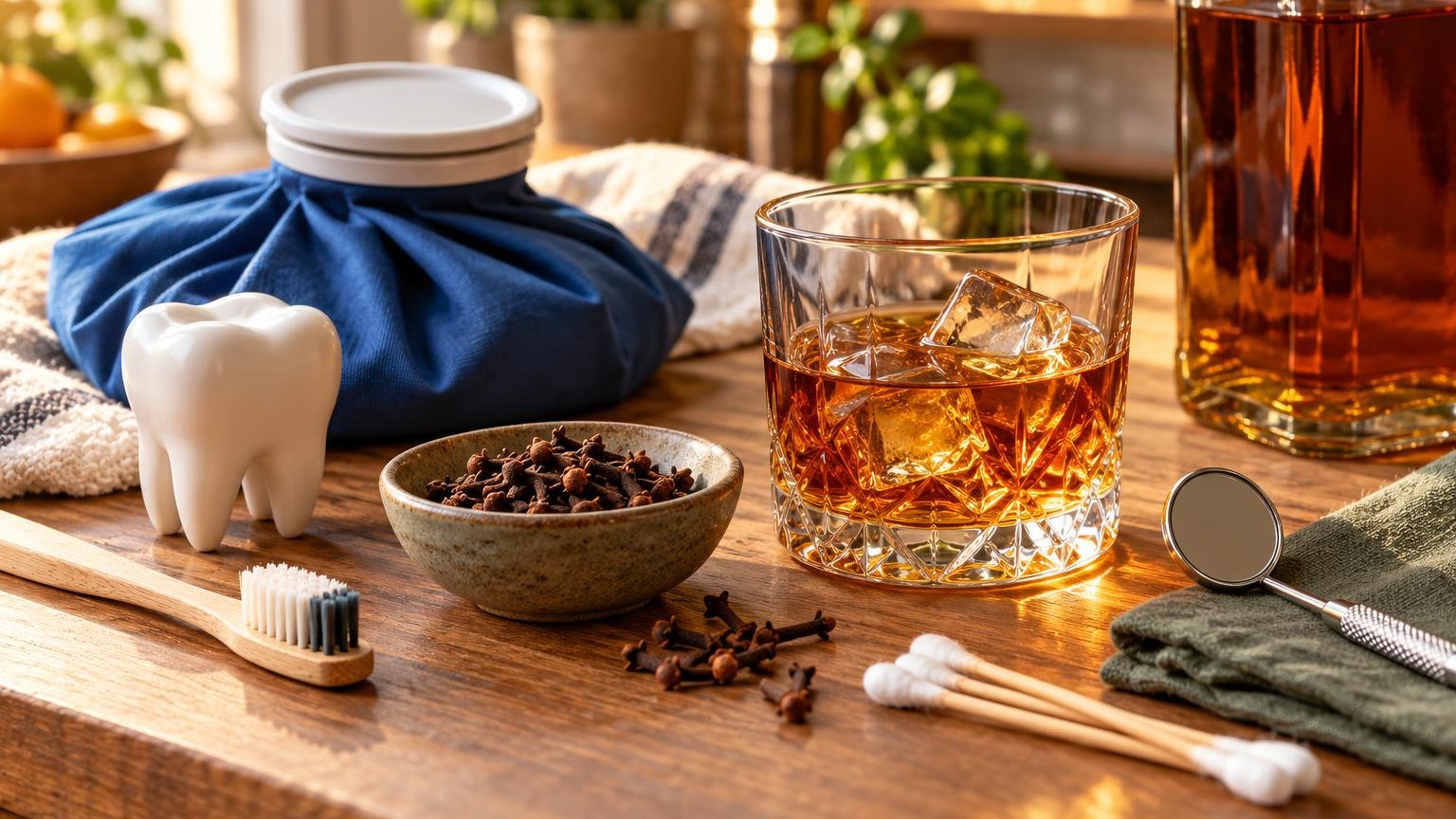
- Clove oil (eugenol): Contains 72–90% eugenol, a natural anesthetic recognized by the FDA as effective for dental pain. Dab a small amount on cotton and apply to the tooth.
What Not to Do
Never place aspirin directly on gum tissue. The acidity (pH ~3.5) causes chemical burns and tissue necrosis. Swallow aspirin normally instead.
These methods manage symptoms for 24–48 hours at most. Untreated dental infections can spread to the jaw, neck, or bloodstream. Schedule a dental visit at the first sign of persistent tooth pain.
When Tooth Pain Needs Urgent Care
Swishing whiskey on a sore tooth delays real treatment. The American Dental Association warns that untreated dental infections can spread to the jaw, neck, or brain within days. Recognizing urgent symptoms prevents life-threatening complications.
Red-Flag Symptoms Requiring Immediate Attention
- Fever above 101°F (38.3°C) alongside tooth pain — signals systemic infection
- Facial swelling spreading to the eye, neck, or floor of the mouth
- Difficulty swallowing or breathing — indicates a potential Ludwig’s angina, which carries a 50% mortality rate if untreated
- Pus or foul-tasting drainage near the affected tooth
- Pain lasting longer than 48 hours without improvement
- Trauma resulting in a knocked-out or cracked tooth — reimplantation success drops significantly after 60 minutes
Dental Emergency Timeline
Response time directly affects outcomes. The following table outlines critical windows for common dental emergencies.
| Condition | Optimal Treatment Window | Risk If Delayed |
| Knocked-out permanent tooth | Within 30 minutes | Reimplantation success falls below 5% after 60 min |
| Dental abscess | Within 24–48 hours | Sepsis; spread to mediastinum |
| Cracked tooth exposing pulp | Within 24 hours | Irreversible pulpitis, extraction |
| Post-extraction hemorrhage | Immediate | Significant blood loss, shock |
What the Data Shows
A 2019 study in the Journal of Endodontics found that roughly 1 in 2,600 dental infections led to hospitalization in the United States.
Emergency department visits for dental conditions exceeded 2 million annually as of 2018, per the ADA Health Policy Institute.
Patients over age 65 and those with diabetes or immunosuppression face the highest risk of rapid infection spread.
Alcohol applied topically provides zero antibacterial benefit at beverage-strength concentrations (typically 40% ABV), which fall well below the 60–90% needed to kill oral pathogens.
Contact your dentist immediately or visit an emergency room if any red-flag symptoms appear. No home remedy — whiskey included — substitutes for professional drainage, antibiotics, or surgical intervention.
What Your Dentist Will Treat
Whiskey numbs surface tissue temporarily but treats zero underlying dental conditions. A dentist identifies and resolves the actual source of pain, which typically falls into a handful of common diagnoses.
The most frequent causes of tooth pain and their standard treatments differ significantly in complexity, cost, and recovery time.
| Condition | Prevalence | Standard Treatment | Typical Cost (US) |
| Dental caries (cavities) | Affects 90% of adults over 20 | Composite filling | $150–$400 per tooth |
| Pulpitis (inflamed pulp) | Develops in 10–15% of untreated cavities | Root canal therapy | $700–$1,500 |
| Periapical abscess | Accounts for 25% of dental emergencies | Incision, drainage, antibiotics | $200–$800 |
| Cracked tooth syndrome | Third most common dental diagnosis | Crown or extraction | $800–$3,000 |
| Periodontal disease | Affects 47.2% of adults over 30 (CDC data) | Scaling and root planing | $200–$500 per quadrant |
Dentists use periapical and bitewing X-rays to pinpoint decay, fractures, or bone loss invisible to the naked eye. Digital X-rays expose patients to roughly 80% less radiation than traditional film.
What Happens at an Emergency Dental Visit
The dentist performs a clinical exam, takes targeted radiographs, and applies cold or electric pulp testing to assess nerve vitality. This process typically takes 15–30 minutes.
Treatment depends on diagnosis. A straightforward filling requires about 45 minutes. A root canal on a molar averages 90 minutes and removes infected pulp tissue from 3–4 canals.
- Reversible pulpitis: Pain responds to stimulus removal; treated with a filling or crown. Success rate exceeds 95%.
- Irreversible pulpitis: Pain persists after stimulus removal; requires root canal or extraction.
- Abscess with systemic symptoms: Fever above 100.4°F, facial swelling, or difficulty swallowing demands same-day treatment and possibly IV antibiotics.
Delaying professional care while relying on whiskey allows bacteria to spread. A localized infection can progress to cellulitis or Ludwig’s angina within 24–48 hours—a life-threatening emergency requiring hospitalization.
Dental insurance typically covers 80% of basic procedures like fillings and 50% of major work such as crowns. Even without coverage, treating early-stage decay costs a fraction of managing advanced infection.
Questions Readers Ask
Does whiskey actually numb toothache pain?
Whiskey contains 40–50% ethanol by volume, which acts as a mild topical analgesic when applied directly to gum tissue.
The numbing effect is temporary—lasting roughly 5–10 minutes—because saliva rapidly dilutes the alcohol concentration below the threshold needed to desensitize nerve endings.
It masks pain without addressing the underlying cause, such as decay, abscess, or cracked enamel.
What is the historical basis for using whiskey on toothaches?
Before modern dentistry, alcohol was one of the few accessible analgesics; 18th- and 19th-century American frontier medicine routinely recommended rubbing whiskey on sore gums.
The practice carried into the 20th century, with parents applying bourbon to teething infants’ gums—a method the American Academy of Pediatrics now explicitly warns against.
Its persistence reflects tradition rather than clinical evidence.
Is it safe to rub whiskey on an infant’s gums for teething?
No. The American Academy of Pediatrics and the FDA both advise against applying any alcohol to a child’s gums.
Even small amounts of ethanol can be toxic to infants, whose livers metabolize alcohol at a fraction of an adult’s capacity. Safer alternatives include chilled teething rings and FDA-approved acetaminophen dosed by weight.
Can swishing whiskey kill bacteria causing a tooth infection?
Ethanol requires a concentration of at least 60–70% to reliably kill bacteria on contact, according to CDC disinfection guidelines.
Standard whiskey at 40% ABV falls well below that threshold and cannot sterilize an infected tooth or abscess. Swishing may also irritate open sores or damaged gum tissue, potentially worsening inflammation.
How does whiskey compare to over-the-counter dental pain relievers?
Ibuprofen (200–400 mg) provides systemic anti-inflammatory relief lasting 4–6 hours, while whiskey’s topical numbing fades in minutes.
Benzocaine-based gels (Orajel, Anbesol) deliver targeted numbing at 10–20% concentration for up to 60 minutes, far outperforming whiskey’s diluted ethanol effect. OTC options carry FDA-reviewed dosing guidance; whiskey does not.
Does drinking whiskey for toothache pain carry additional risks?
Consuming alcohol while experiencing dental pain can increase bleeding if the tooth or gum is compromised, because ethanol inhibits platelet aggregation.
Alcohol also interacts dangerously with common pain medications: combining it with acetaminophen raises the risk of liver damage, and mixing it with ibuprofen elevates the chance of gastrointestinal bleeding.
Dehydration from alcohol consumption can further exacerbate oral inflammation.
What home remedies have more evidence than whiskey for temporary toothache relief?
A warm saltwater rinse (½ teaspoon of salt in 8 oz of water) reduces bacterial load and draws fluid from swollen tissue through osmosis.
Clove oil contains 60–90% eugenol, a compound the FDA has recognized as effective for temporary dental pain relief when applied topically.
Cold compresses applied externally for 15–20 minutes constrict blood vessels and reduce swelling around the affected area.
When should you see a dentist instead of relying on whiskey or any home remedy?
Any toothache lasting more than 1–2 days, accompanied by fever above 101°F (38.3°C), facial swelling, or pus discharge signals a possible abscess requiring professional treatment—typically antibiotics and drainage or root canal therapy.
Untreated dental infections can spread to the jaw, neck, or brain; a 2019 study in the Journal of Endodontics found that emergency hospitalizations for dental abscesses increased 40% between 2000 and 2014 in the U.S.
No home remedy substitutes for definitive dental care.
Related Reading
- What Is Whiskey and Orange Juice Called?
- Is Whiskey Gluten Free? Answer By Expert
- Who Makes Kirkland Canadian Whiskey?
- Is Jack Daniel’S Whiskey Or Bourbon?
- Should Whiskey Be Chilled Or Drunk Straight?
- Is Jagermeister A Whiskey Or Not? Answer By Expert
- How Many Calories In A Shot Of Whiskey? – Get Answered
- How Many Shots of Whiskey to Get Drunk?
- All Alcohol Guides
- National Institute of Dental and Craniofacial Research (2018)
- U.S. Food and Drug Administration (2018)
- Centers for Disease Control and Prevention (2023)
- American Dental Association (2023)
- PubMed – Alcohol and Oral Health Review (2017)
- Mayo Clinic – Toothache First Aid (2022)
- Cleveland Clinic – Toothache (2023)
- MedlinePlus – U.S. National Library of Medicine (2022)
- American Academy of Pediatrics (2019)