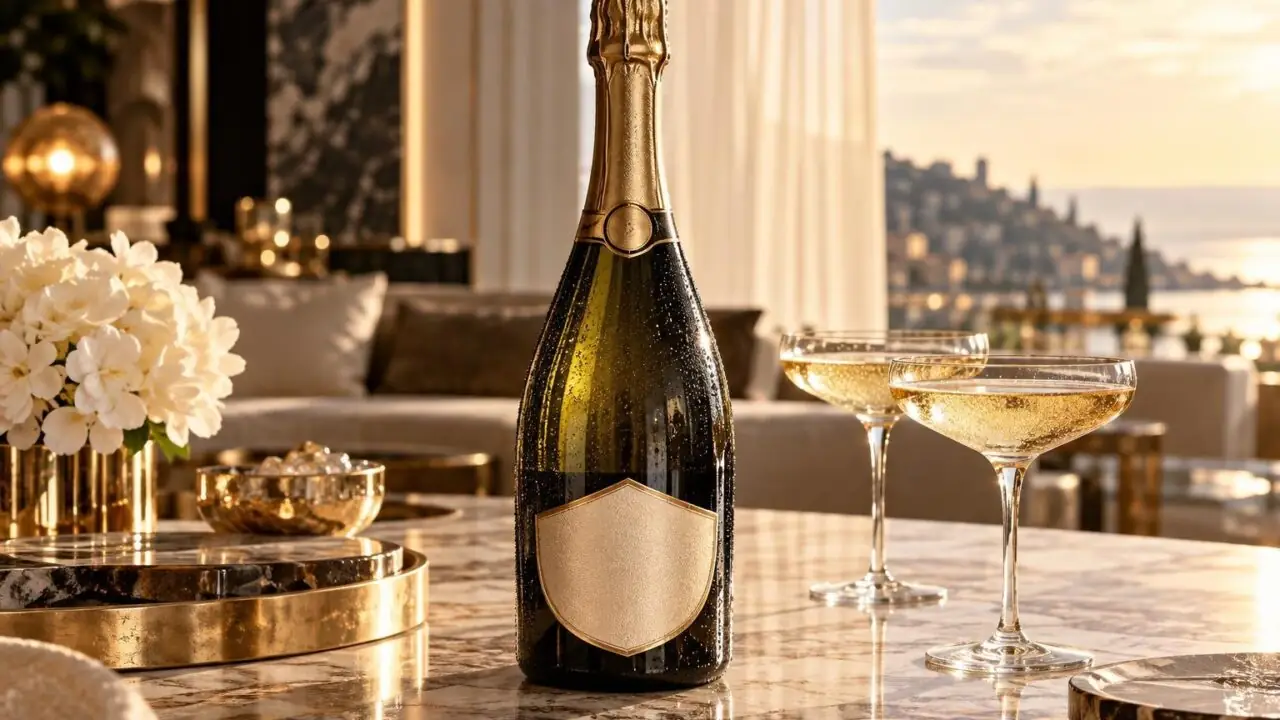
What’s the Most Expensive Champagne? is a prestige bottling associated with a $2.07 million price tag: Champagne Armand de Brignac’s Ace of Spades Gold Brut, presented in a one-of-a-kind bottle decorated with a 19-carat white-gold diamond.
The figure reflects craftsmanship, precious materials, rarity, and celebrity-driven luxury as much as the wine itself.
Unlike ordinary retail releases, this bottle was created as an extravagant collector’s object, making direct comparisons difficult.
Understanding its price requires separating the cost of the Champagne from the value of its packaging, provenance, and limited availability.
This article examines the bottles most often identified as the world’s costliest, including rare vintage cuvées, auction records, and jeweled editions.
It also explains why prestige Champagne commands such premiums, how auction prices differ from listed retail prices, and which expensive bottles offer genuine drinking interest rather than display value.
The result is a practical guide to luxury Champagne pricing, famous records, and the difference between a costly wine and a valuable collectible.
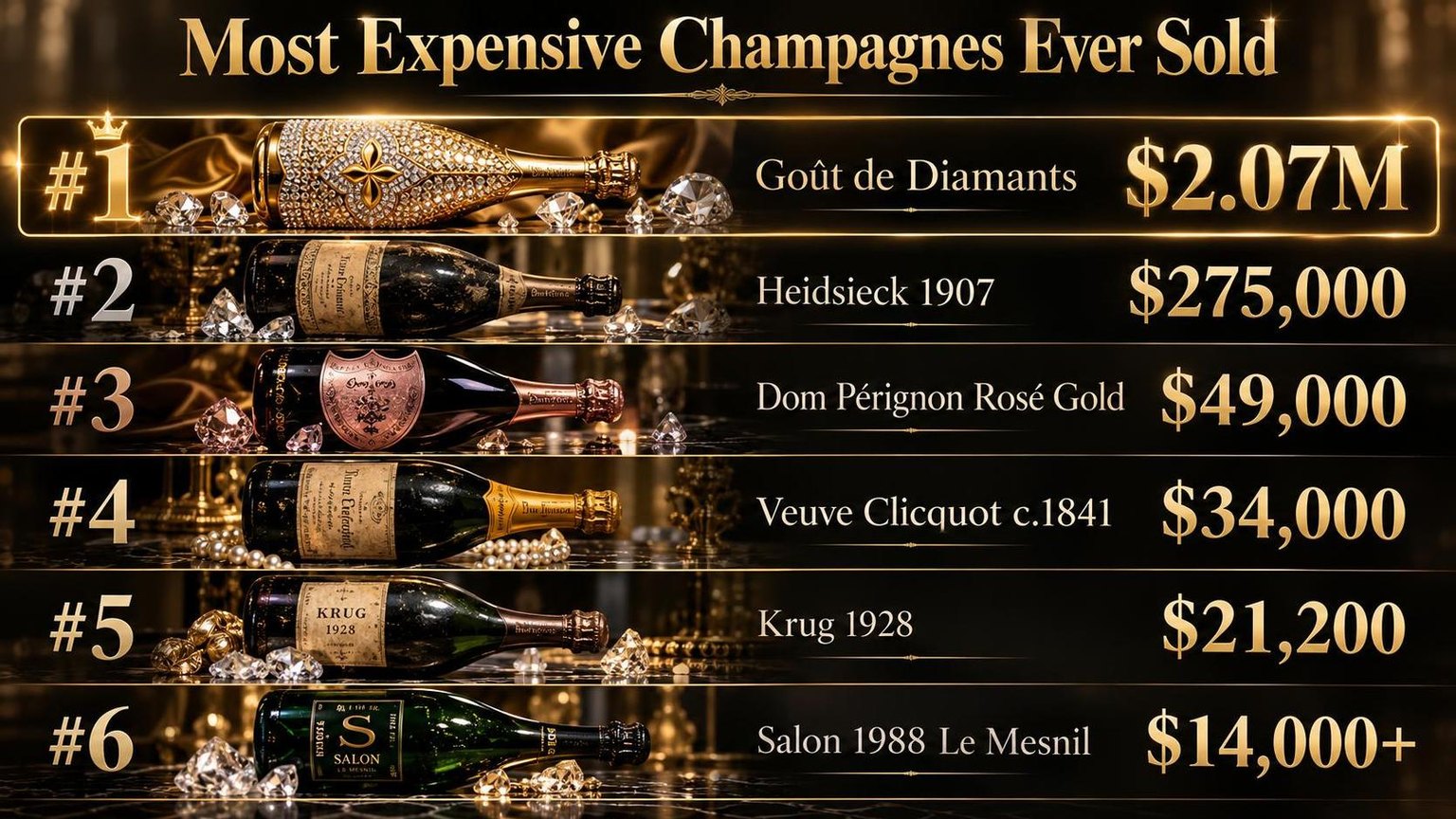
The Most Expensive Champagne Ever Sold
Record-breaking Champagne prices reflect extreme rarity, historical provenance, and collector obsession. A single bottle has fetched over $2.5 million at auction, dwarfing even the most prestigious wines from Bordeaux or Burgundy.
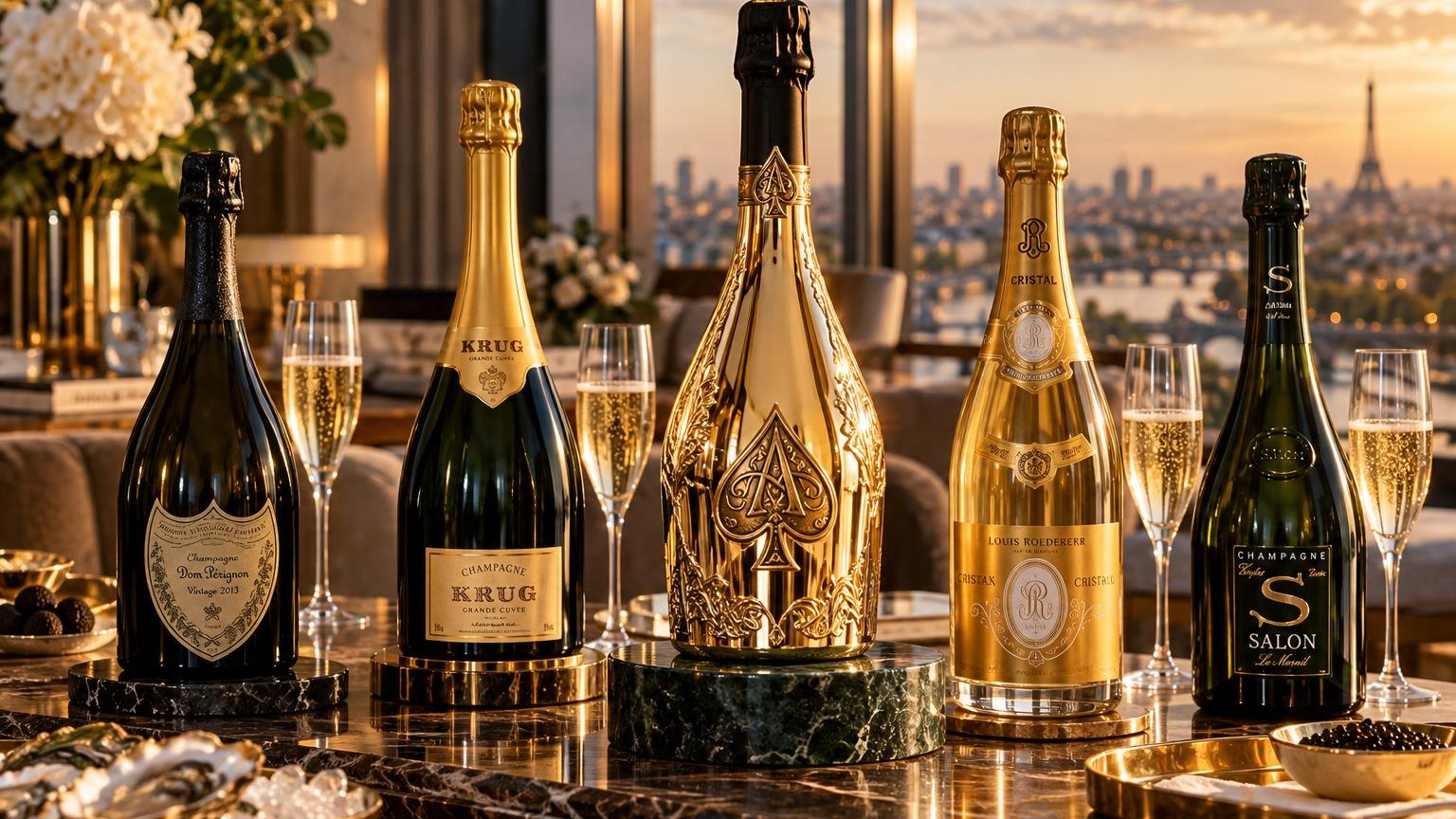
All-Time Auction Records
The most expensive Champagne ever sold is a 2013 bottle of Goût de Diamants (Taste of Diamonds), which commanded $2.07 million in June 2013.
The price reflected its 18.5-carat diamond-adorned label designed by Alexander Amosu rather than the liquid alone.
Excluding novelty bottles, the auction record belongs to a collection of 2000 Dom Pérignon Rosé Gold Methuselahs. A single Methuselah (6 liters) sold for $49,000 at a 2008 Acker Merrall & Condit auction in New York.
Top Record-Setting Champagne Sales
| Champagne | Year/Vintage | Price | Notable Detail |
| Goût de Diamants | 2013 | $2.07 million | 18.5-carat diamond on label |
| Shipwrecked Heidsieck 1907 | 1907 vintage | $275,000 per bottle | Recovered from a Baltic Sea shipwreck in 1998 |
| Shipwrecked Veuve Clicquot | c. 1839–1841 | $34,000 per bottle | Recovered near Finland’s Åland Islands in 2010 |
| Dom Pérignon Rosé Gold Methuselah | 2000 vintage | $49,000 | 6-liter format, Acker Merrall & Condit auction |
| Krug 1928 | 1928 vintage | $21,200 | Standard 750 ml; considered one of the greatest vintages |
| Salon 1988 Le Mesnil | 1988 vintage | $14,000+ | Single-vineyard blanc de blancs rarity |
Shipwreck Champagnes: A Category Apart
In 1998, divers recovered approximately 2,000 bottles of 1907 Heidsieck from the Swedish schooner Jönköping, torpedoed in 1916 while en route to the Russian Imperial Court. Cold, dark Baltic conditions preserved the wine remarkably well.
A second Baltic discovery in 2010 near Finland’s Åland Islands yielded 168 bottles of Veuve Clicquot and Juglar dating to approximately 1839–1841. These are among the oldest drinkable Champagnes ever found.
Tasters described the Veuve Clicquot 1841 as having notes of honey, wet wool, and smoked cheese—still effervescent after 170 years on the seabed at a constant 4°C.
What Drives These Extreme Prices
- Provenance: Documented history—especially shipwreck recovery or royal cellars—multiplies value exponentially.
- Scarcity: Fewer than 10 known bottles of a vintage can push prices past five figures for a standard 750 ml.
- Condition: Fill level, label integrity, and storage temperature records all affect final hammer price at auction.
- Vintage reputation: Legendary years like 1928, 1959, and 1996 carry inherent premiums regardless of house.
Collectors should note that auction estimates and final prices diverge significantly. Buyer’s premiums at major houses like Christie’s and Sotheby’s add 20–25% on top of the hammer price.
Why These Bottles Command Record Prices
Record-setting Champagne prices reflect a convergence of extreme scarcity, historical provenance, and collector psychology.
A bottle’s liquid value accounts for a fraction of its auction price—the rest is narrative, rarity, and verification of authenticity.
Scarcity Drives the Market
Dom Pérignon produces roughly 5 million bottles per vintage. Salon, by contrast, releases only about 60,000 bottles and declares a vintage just 37 times since 1905. Krug Clos du Mesnil comes from a single 1.84-hectare walled vineyard.
When bottles from already-limited runs survive decades or centuries, supply compresses further. Attrition from breakage, consumption, and improper storage eliminates most production within years of release.
| Champagne | Approx. Annual Production | Vintages Declared (Since Founding) |
| Moët & Chandon (total) | ~28 million bottles | Most years |
| Dom Pérignon | ~5 million bottles | ~70% of years |
| Krug Grande Cuvée | ~600,000 bottles | Multi-vintage blend |
| Salon Le Mesnil | ~60,000 bottles | ~37 vintages in 120 years |
| Krug Clos du Mesnil | ~10,000–12,000 bottles | Select years only |
Provenance and History
The 2010 discovery of Champagne from the shipwreck of a Baltic Sea vessel, dated to approximately 1840, yielded bottles of Veuve Clicquot and Juglar. One Veuve Clicquot from that cache sold for €30,000 at auction in Finland.
Shipwreck Champagnes benefit from near-perfect cellar conditions: constant temperature around 4°C, total darkness, minimal vibration, and consistent pressure. These factors preserved drinkability across 170 years.
The Collector Premium
Wealthy collectors treat trophy Champagnes as alternative assets. The Liv-ex Champagne 50 index rose 48% between 2019 and 2022, outperforming many traditional investments during that period.
- Large formats command exponential premiums. A Methuselah (6L) of Dom Pérignon Rosé Gold can reach 10–15× the price of a standard 750ml bottle, not the expected 8× based on volume alone.
- Original wooden cases (OWC) add 10–20% to auction value by confirming unbroken chain of custody.
- Artist collaborations inflate prices further. The Jeff Koons–designed Dom Pérignon Balloon Venus rosé 2003 sold for $20,237 in a Christie’s lot.
- Perfect provenance documentation—verified storage history, temperature logs, fill level—separates five-figure bottles from six-figure bottles at auction houses like Christie’s, Sotheby’s, and Acker Merrall & Condit.
Diminishing Supply, Growing Demand
Every bottle opened permanently reduces global supply. Aged Champagne cannot be reproduced. A 1928 Krug Collection exists in perhaps dozens of bottles worldwide—each one consumed makes the remainder more valuable.
Asian markets, particularly Hong Kong, mainland China, and Singapore, have expanded the buyer pool significantly since 2005. More bidders competing for fewer surviving bottles creates a reliable upward price spiral at auction.
Rare Vintage Champagne Behind the Auction
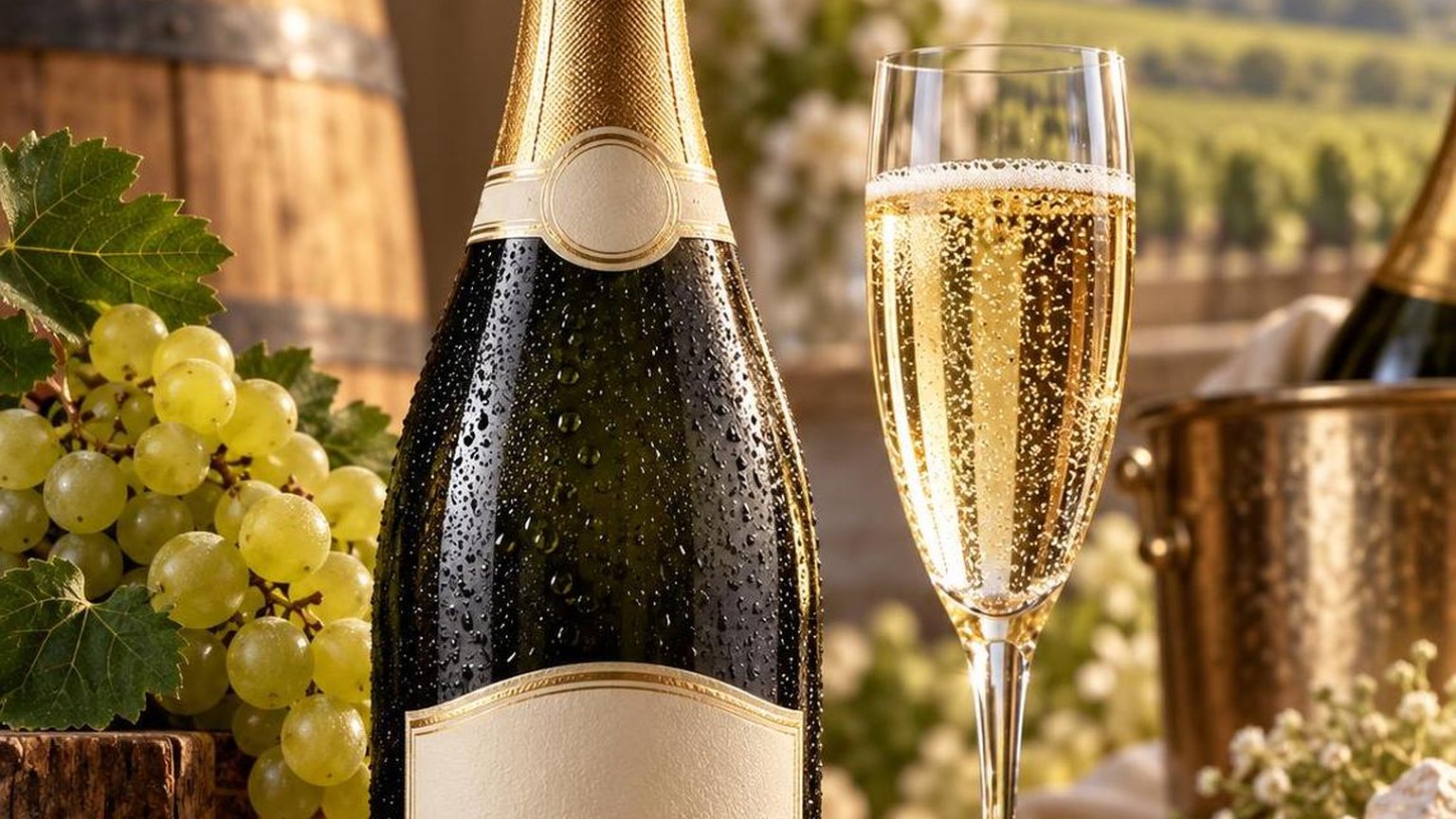
Auction houses have become the proving ground for Champagne’s rarest bottles. Provenance, vintage scarcity, and historical significance drive prices far beyond retail, transforming certain cuvées into liquid collectibles that rival fine art.
Record-Breaking Auction Sales
A handful of bottles have shattered expectations at major auction houses worldwide. These sales establish benchmarks for the entire luxury Champagne market.
| Champagne | Vintage | Auction Price | Year Sold | Auction House |
| Shipwrecked Heidsieck & Co Monopole | 1907 | $275,000 | 1998 | Ritz-Carlton Moscow |
| Shipwrecked Veuve Clicquot | 1841 | €30,000 per bottle | 2011 | Acker Merrall & Condit |
| Dom Pérignon Rosé Gold Methuselah | 1996 | $49,000 | 2008 | Acker Merrall & Condit |
| Krug Collection | 1928 | $21,200 | 2009 | Christie’s |
| Salon Le Mesnil Blanc de Blancs | 1982 | $14,000+ (magnum) | Various | Multiple houses |
Why Shipwrecked Champagne Commands Premiums
In 2010, divers recovered 168 bottles from an 1840s shipwreck near Finland’s Åland Islands. The Baltic Sea’s near-freezing temperatures, darkness, and constant pressure created ideal cellaring conditions for over 170 years.
The haul included bottles of Veuve Clicquot, Heidsieck, and Juglar. Tasters described the Veuve Clicquot 1841 as still vibrant with notes of honey, lime, and wet hair. Individual bottles sold for up to €30,000.
What Drives Extreme Auction Prices
- Provenance documentation: Verified cellar history or dramatic recovery stories add substantial premiums, sometimes doubling estimated values
- Vintage scarcity: Champagne houses declared only 39 vintages between 1900 and 1960, making surviving bottles exceptionally rare
- Bottle format: Large formats like Methuselahs (6L) and Jeroboams (3L) age more gracefully and appear at auction far less frequently
- Label condition: Original labels, foils, and corks in intact condition can increase hammer prices by 20–40% over damaged examples
- Historical association: The 1907 Heidsieck bottles were originally destined for the Russian Imperial Court, adding narrative value
Auction Market Trends
Champagne represents roughly 5–7% of fine wine auction turnover globally, according to Wine Lister data. Prestige cuvées from Dom Pérignon, Krug, and Salon dominate secondary-market trading.
Vintages from the 1980s and 1990s are entering peak collectibility. The 1988, 1990, and 1996 vintages are considered three of the 20th century’s finest, with auction prices climbing 10–15% annually since 2018.
Buyers should verify provenance through auction house guarantees and examine ullage levels carefully.
Reputable houses like Christie’s, Sotheby’s, and Acker provide condition reports detailing fill levels, label integrity, and storage history before bidding opens.
Most Expensive Champagne Brands Compared
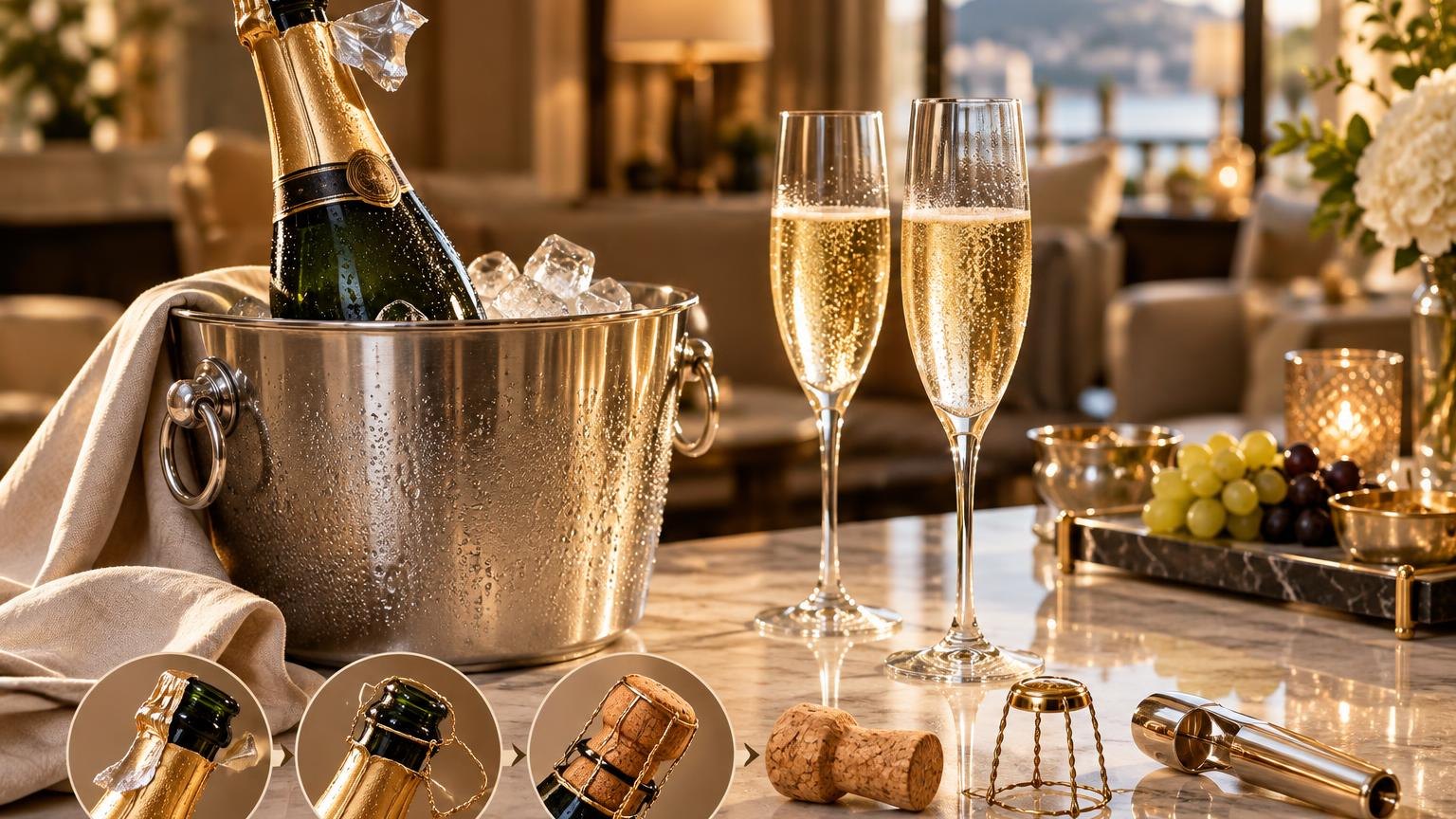
Comparing ultra-premium champagne brands reveals dramatic price differences driven by production methods, aging duration, and brand prestige.
These bottles represent the pinnacle of winemaking, where scarcity and craftsmanship justify five- and six-figure price tags.
| Brand & Cuvée | Typical Price (USD) | Style | Notable Detail |
| Salon Le Mesnil Blanc de Blancs | $500–$900 | Blanc de Blancs | Single vineyard, only ~37 vintages declared since 1905 |
| Krug Clos du Mesnil | $800–$1,200 | Blanc de Blancs | 1.85-hectare walled vineyard; ~10,000 bottles per vintage |
| Krug Clos d’Ambonnay | $2,500–$3,500 | Blanc de Noirs | 0.68-hectare plot; fewer than 5,000 bottles produced |
| Dom Pérignon Plénitude P3 | $1,500–$3,000 | Prestige Cuvée | Aged 25+ years on lees before disgorgement |
| Louis Roederer Cristal Vinotheque | $1,000–$2,000 | Prestige Cuvée | Extended cellar aging, late-disgorged library edition |
| Armand de Brignac Midas (30L) | $50,000–$100,000 | Prestige Cuvée | Largest format champagne bottle commercially available |
| Perrier-Jouët Belle Epoque (standard) | $180–$250 | Prestige Cuvée | Hand-painted anemone bottle, predominantly Chardonnay |
| Bollinger Vieilles Vignes Françaises | $400–$600 | Blanc de Noirs | Pre-phylloxera ungrafted Pinot Noir vines |
Format size dramatically affects price. A standard 750ml Armand de Brignac Brut Gold retails around $300, while the 30-liter Midas format commands $50,000 or more due to extreme production difficulty.
What Drives the Price Gap
Vineyard exclusivity is the primary factor. Krug Clos d’Ambonnay draws from a single 0.68-hectare parcel of Grand Cru Pinot Noir in Ambonnay, limiting annual production to roughly 3,000–5,000 bottles.
Aging duration adds significant cost. Dom Pérignon P3 spends over 25 years on its lees before release. That timeline ties up capital, cellar space, and inventory for decades before generating any revenue.
Salon declares a vintage only in exceptional years—roughly three times per decade on average. This selective approach creates built-in scarcity that sustains high secondary-market demand.
Value Considerations at the Top
- Krug Clos du Mesnil — Regularly scores 96–99 points from major critics; considered among the greatest white wines produced anywhere
- Bollinger VVF — Irreplaceable ungrafted vines make this a living museum piece; production may eventually cease entirely
- Salon — Secondary-market prices for older vintages (1982, 1988) frequently exceed $2,000 per bottle at auction
- Dom Pérignon P3 — The 1990 vintage has sold for over $2,500, reflecting both quality and collector demand
Auction results from Christie’s and Sotheby’s consistently show Salon, Krug single-vineyard bottlings, and aged Dom Pérignon appreciating faster than most prestige cuvées over 10-year horizons.
Price alone does not determine quality. Bollinger VVF at $500 often matches or exceeds wines costing five times more in blind tastings, demonstrating that terroir and vine age can outweigh brand positioning.
How to Buy Luxury Champagne Safely
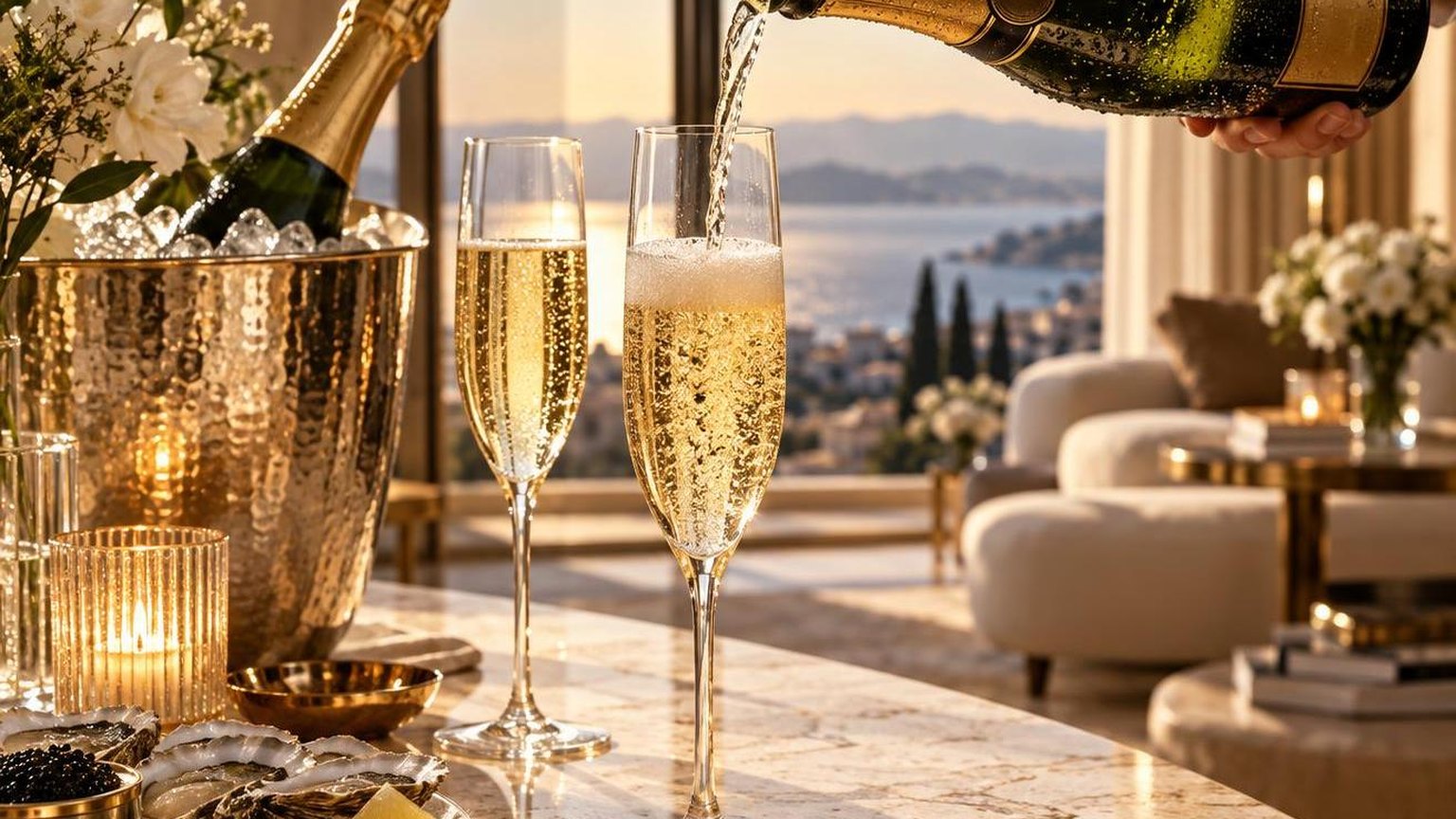
Luxury Champagne bottles routinely sell for $500 to $500,000+, making them prime targets for counterfeiters. The French wine fraud investigation unit (DGCCRF) reported over 2,000 cases of wine and spirits fraud in 2022 alone.
Protecting your investment requires verified sourcing, proper authentication, and correct storage.
Authorized Purchase Channels
Where you buy matters as much as what you buy. Each channel carries different risk levels and price premiums.
| Channel | Typical Premium Over Release Price | Counterfeit Risk | Provenance Guarantee |
| Maison Direct (e.g., Krug, Dom Pérignon) | 0% | None | Full |
| Major Auction Houses (Christie’s, Sotheby’s) | 20–300% | Low | Verified |
| Licensed Merchants (Berry Bros., Millesima) | 10–50% | Low | Strong |
| Secondary Market / Private Sellers | Varies widely | High | Unverified |
Authentication Checks Before Purchase
- Label details: Genuine Champagne carries an RM, NM, or CM code on the label. Verify the registration number against CIVC (Comité Interprofessionnel du Vin de Champagne) records.
- Capsule de surtaxe: Every bottle sold in France bears a fiscal stamp (CRD) with a unique serial number. Missing or poorly printed stamps signal fraud.
- Glass quality: Prestige cuvées like Cristal use proprietary bottle molds. Irregular seams, light weight, or wrong punt depth indicate fakes.
- Lot codes: Houses such as Krug embed a unique Krug iD on every back label since 2011, scannable for disgorgement date and cellar aging duration.
Storage and Provenance Requirements
Champagne degrades faster than still wine. Ideal cellar conditions are 10–12°C (50–54°F) with 70% relative humidity and zero UV exposure.
Temperature excursions above 25°C accelerate oxidation dramatically. Studies from the University of Reims show that bottles stored at 25°C age roughly three times faster than those kept at 12°C.
Ask sellers for provenance documentation: purchase receipts, storage facility records, and temperature logs. Reputable merchants like Farr Vintners and Lay & Wheeler maintain bonded warehouse records for every consignment.
Insurance and Appraisal
Bottles valued above $1,000 warrant dedicated fine wine insurance. Specialist underwriters such as Chubb and Hiscox offer policies covering breakage, theft, and spoilage, typically charging 0.5–1.0% of appraised value annually.
For collections exceeding $50,000, obtain an independent appraisal from a certified wine appraiser accredited through the American Society of Appraisers or similar body.
Reappraise every two to three years as vintage market values shift substantially.
Document every bottle with photographs of the label, capsule, cork condition, and fill level. Store records digitally using platforms like CellarTracker or InVintory for insurance claims and future resale verification.
Questions People Ask Most
What is the most expensive bottle of Champagne ever sold?
The most expensive Champagne ever sold is a 2013 Goût de Diamants (Taste of Diamonds), which fetched $2.07 million in June 2013.
The bottle was designed by luxury designer Alexander Amosu and features a 19-carat white diamond, a deep-cut Swarovski crystal, and an 18-carat gold label engraved by hand.
The liquid inside is a Brut Grand Cru sourced from vineyards in Oger, Cramant, and Mesnil-sur-Oger on the Côte des Blancs.
A current-release Dom Pérignon Vintage typically retails between $200 and $280, while Krug Grande Cuvée sits around $250–$300.
These prices are modest compared to prestige bottlings like Krug Clos d’Ambonnay (approximately $2,500–$3,000) or Dom Pérignon P3 Plénitude ($700–$1,500), which command premiums for extended lees aging of 25+ years.
Why do certain Champagnes from Salon and Jacques Selosse command such high prices?
Salon produces only a single-vineyard, single-vintage Blanc de Blancs from Le Mesnil-sur-Oger and releases roughly 60,000 bottles in exceptional years only—just 37 vintages since 1905—making supply extremely scarce.
Jacques Selosse, farmed biodynamically by Anselme Selosse, produces around 4,500 cases annually across multiple cuvées, with bottles like Substance and the Lieux-Dits series selling for $500–$1,200 due to cult-level demand and tiny allocations.
Does the packaging or bottle design significantly inflate the price of luxury Champagne?
In several record-setting cases, packaging accounts for most of the price. The $2.07 million Goût de Diamants derived its value primarily from a Superman-sized diamond and gold ornamentation, not the wine itself.
Similarly, Armand de Brignac’s Midas bottle (30 liters) sells for roughly $50,000–$100,000 largely because of its hand-finished gold pewter casing and the sheer volume of 40 standard bottles.
While the base Brut Gold in a 750 ml format retails at around $300.
What are the most expensive Champagnes valued purely for their wine quality and vintage rarity?
Excluding novelty packaging, the highest-valued Champagnes are typically old-vintage bottles prized for provenance. A collection of 1907 Heidsieck & Co. Monopole, salvaged from a shipwreck in 1997, has sold for up to $275,000 per bottle.
Collectors also pay $20,000–$40,000 for verified bottles of 1928 Krug and 1959 Dom Pérignon Rosé, where value is driven by near-perfect cellar conditions, historical significance, and the fact that virtually no comparable bottles remain in circulation.
Related Reading
- How Many Servings in a Bottle of Champagne?
- How Champagne Is Made? The Most Understandable Information
- How Many Mimosas in a Bottle of Champagne?
- How To Bottle Elderflower Champagne? — A Complete Professional Guide to Safe Bottling, Fermentation Control, and Long-Term Storage
- How Long Does Moet Champagne Last Unopened? – A Real-World, Experience-Based Guide to Shelf Life, Storage, and Quality (2026 Update)
- 9 Must-Know Facts About How Many Glasses Of Champagne To A Bottle (2026 Expert Serving Guide)
- Cava Vs Champagne: The Easiest Way to Distinguish
- All Alcohol Guides
- U.S. Food & Drug Administration — Caffeine and Your Health (FDA)
- National Institutes of Health — Office of Dietary Supplements (NIH)
- Christie's Wine Department — Auction Records (2024)
- Sotheby's Wine — Champagne Auction Results (2024)
- Wine-Searcher — Most Expensive Champagnes (2024)
- Decanter — Luxury Champagne Coverage (2024)
- Comité Champagne (CIVC) — Official Champagne Appellation Body (2024)
- Wine Spectator — Champagne Reviews and Pricing (2024)
- Liv-ex — Fine Wine Market Data and Indices (2024)