
Whiskey is not compatible with a strict fast; “Does Whiskey Break a Fast?” Yes, because whiskey contains ethanol and calories, even when served neat.
A standard 1.5-ounce (44-milliliter) pour of 80-proof whiskey provides roughly 97 calories, primarily from alcohol. Those calories can interrupt fasting goals centered on zero energy intake, metabolic rest, or religious abstinence.
The effect depends on the fast’s purpose. Someone avoiding food for weight management may still preserve a calorie deficit, but alcohol can increase appetite, impair judgment, disrupt sleep, and affect blood-glucose regulation.
Whiskey also does not provide meaningful protein, fiber, vitamins, or minerals. Water remains the appropriate choice during a strict fast.
People fasting before blood tests, surgery, or medication-related procedures should follow their clinician’s instructions and avoid alcohol for the specified period.
Does Whiskey Break a Fast
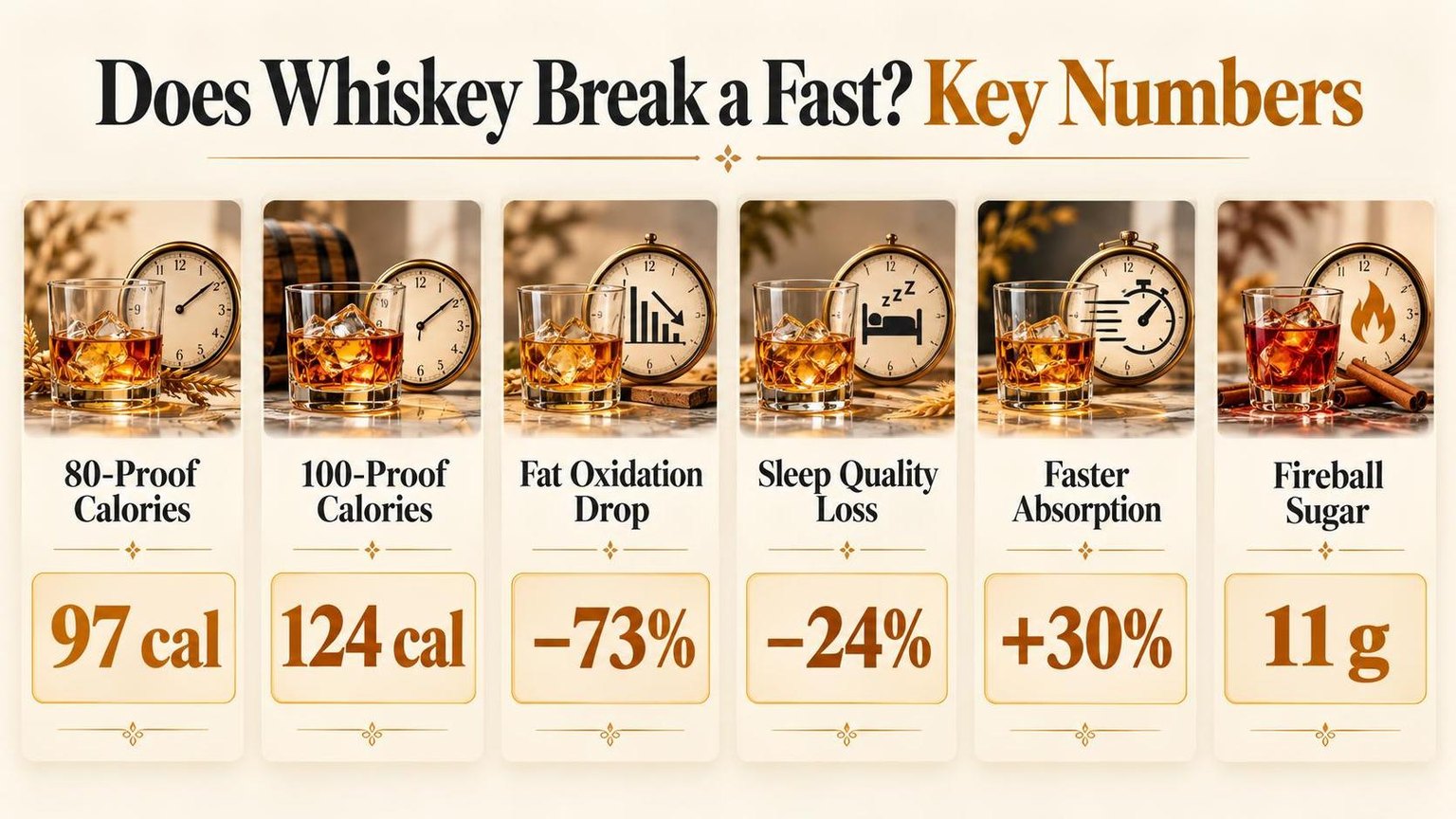
Whiskey contains calories, so it technically breaks a metabolic fast. A standard 1.5-oz pour of 80-proof whiskey delivers approximately 97 calories entirely from alcohol — zero carbs, zero protein, zero fat.
The answer depends on which type of fasting you practice.
Caloric Content of Common Whiskey Pours
| Whiskey Type | Serving Size | Calories | Carbs (g) | Sugar (g) |
| 80-proof bourbon | 1.5 oz (44 ml) | 97 | 0 | 0 |
| 86-proof rye | 1.5 oz (44 ml) | 105 | 0 | 0 |
| 94-proof single malt Scotch | 1.5 oz (44 ml) | 116 | 0 | 0 |
| 100-proof bourbon | 1.5 oz (44 ml) | 124 | 0 | 0 |
| Fireball (66-proof, flavored) | 1.5 oz (44 ml) | 108 | 11 | 11 |
Pure whiskey has no carbohydrates or sugar. Flavored whiskeys like Fireball add significant sugar — up to 11 grams per shot — making them far more disruptive to any fasting protocol.
Impact on Different Fasting Types
Strict/metabolic fast: Any caloric intake above zero breaks this fast. Whiskey’s 97+ calories per serving end the fasted state immediately. Your body shifts to metabolizing ethanol first.
Intermittent fasting (16:8 or 18:6): Whiskey breaks these fasts. The liver prioritizes alcohol metabolism over fat oxidation, directly counteracting the fat-burning goal of time-restricted eating.
Insulin-response fast: Pure whiskey triggers minimal insulin response due to zero carbs. A 2010 study in Diabetes Care found moderate alcohol consumption did not significantly spike insulin in fasting subjects.
However, alcohol still halts fat oxidation.
Religious fasts: Most religious traditions — including Ramadan, Lent, and Yom Kippur — prohibit all alcohol during fasting periods regardless of caloric content.
How Alcohol Disrupts Fasting Benefits
- Halts autophagy: Research published in Hepatology (2012) showed alcohol suppresses autophagy in liver cells, eliminating a primary benefit of extended fasting.
- Stops fat burning: The liver converts ethanol to acetate, which becomes the body’s preferred fuel source. Fat oxidation drops by approximately 73%, according to research in the American Journal of Clinical Nutrition (1999).
- Impairs sleep quality: A 2018 JMIR Mental Health study found even moderate alcohol reduced restorative sleep quality by 24%, undermining recovery benefits associated with fasting.
- Increases hunger hormones: Alcohol stimulates ghrelin production, making adherence to fasting windows significantly harder.
The Bottom Line
Whiskey breaks every meaningful definition of a fast. Despite containing zero carbs and zero sugar, its 97–124 calories per standard pour end the fasted metabolic state.
Drinking whiskey on an empty stomach also accelerates alcohol absorption by up to 30%, increasing intoxication risk. If you practice intermittent fasting, consume whiskey only during your eating window and pair it with food.
Whiskey Calories and Fasting Metabolism
A standard 1.5-oz shot of 80-proof whiskey contains approximately 97 calories, all derived from ethanol rather than carbohydrates, protein, or fat.
These calories absolutely break a metabolic fast, triggering hepatic processing that halts fat oxidation within minutes.
Calorie Content by Whiskey Proof
Whiskey’s caloric load scales directly with its alcohol by volume (ABV). Higher-proof expressions deliver significantly more calories per serving.
| Whiskey Type | Proof | ABV | Calories per 1.5 oz |
| Standard Bourbon/Scotch | 80 | 40% | 97 |
| Bottled-in-Bond Bourbon | 100 | 50% | 124 |
| Cask-Strength Bourbon | 120 | 60% | 148 |
| Barrel-Proof Scotch | 130 | 65% | 161 |
| Navy-Strength Whiskey | 114 | 57% | 141 |
Pure ethanol yields 7.1 calories per gram—nearly double the 4 calories per gram from carbohydrates or protein, and just under fat’s 9 calories per gram.
How Ethanol Disrupts Fasting Metabolism
During a true fast, the body shifts to fat oxidation and eventually ketogenesis after glycogen depletion, typically within 12–36 hours. Ethanol consumption reverses this process rapidly.
The liver prioritizes ethanol metabolism above all other substrates. Alcohol dehydrogenase converts ethanol to acetaldehyde, then aldehyde dehydrogenase converts it to acetate.
This cascade suppresses fat oxidation by up to 73%, according to research published in the American Journal of Clinical Nutrition.
Key metabolic disruptions from whiskey during a fast include:
- Halted lipolysis: Insulin is not significantly spiked, but acetate flooding the bloodstream signals cells to stop breaking down stored fat for energy.
- Suppressed autophagy: mTOR pathway activation from ethanol metabolites inhibits the cellular recycling process many people fast specifically to promote.
- Reduced ketone production: Hepatic acetate production competes directly with ketogenesis, lowering blood beta-hydroxybutyrate levels measurably within 30 minutes of consumption.
- Increased NADH-to-NAD+ ratio: Ethanol metabolism floods the liver with NADH, shifting redox balance and impairing gluconeogenesis and fatty acid oxidation simultaneously.
Zero Carbs Does Not Mean Fast-Friendly
Whiskey contains 0 grams of carbohydrates, 0 grams of sugar, and 0 grams of fat. This leads many to assume it is metabolically inert during a fast. That assumption is incorrect.
The 97 calories in a single shot require roughly 60–90 minutes of hepatic processing. During that window, the liver is functionally occupied with ethanol clearance at a rate of approximately 0.015 g/dL per hour.
Even a single shot measurably breaks a metabolic fast. The absence of macronutrients is irrelevant because ethanol itself functions as a caloric substrate that the liver must process before resuming fat metabolism.
For fasting purists targeting autophagy or ketosis, whiskey is incompatible with the fasted state regardless of its zero-carb profile.
How Alcohol Affects Ketosis
Alcohol and ketosis share an unexpected metabolic relationship. Your liver prioritizes ethanol metabolism over all other substrates, including fat oxidation—effectively pausing the very process that sustains nutritional ketosis.
When you consume alcohol, your liver converts ethanol into acetaldehyde via alcohol dehydrogenase, then into acetate. This process generates excess NADH, shifting your liver’s redox state.
The elevated NADH-to-NAD⁺ ratio suppresses the citric acid cycle and beta-oxidation of fatty acids. Fat burning doesn’t stop permanently—it stalls until alcohol clearance completes.
Alcohol Metabolism Timeline and Ketone Impact
The average human liver processes approximately 7 grams of ethanol per hour, equivalent to roughly one standard drink every 60–90 minutes. During this window, hepatic fat oxidation drops significantly.
| Drink | Ethanol (g) | Approx. Processing Time | Estimated Fat Oxidation Suppression |
| 1 oz whiskey (40% ABV) | 11.2 g | ~1.6 hours | Up to 73% |
| 2 oz whiskey | 22.4 g | ~3.2 hours | Up to 73% |
| 3 oz whiskey | 33.6 g | ~4.8 hours | Up to 73% |
Research published in the American Journal of Clinical Nutrition (1999) found that whole-body lipid oxidation decreased by 73% after subjects consumed 24 g of ethanol—roughly two standard shots of whiskey.
Does Alcohol Knock You Out of Ketosis?
Technically, no. Acetate—the end product of ethanol metabolism—is itself a ketone-adjacent short-chain fatty acid. Some studies show blood ketone levels may actually rise temporarily after moderate alcohol intake.
However, this is misleading. The ketones measured post-alcohol consumption often reflect impaired hepatic clearance rather than increased ketogenesis from body fat stores.
- Fat-derived ketogenesis pauses while your liver processes ethanol as a priority fuel
- Blood ketone readings may appear stable or elevated due to reduced peripheral ketone uptake
- Glycogen synthesis slows, which can mask the metabolic disruption on a glucose monitor
- Fatty acid re-esterification increases, meaning more dietary and stored fat gets redirected to triglyceride formation rather than oxidation
The Practical Takeaway for Fasters in Ketosis
A single 1.5 oz pour of whiskey delivers approximately 14 grams of ethanol. Your liver will spend roughly 2 hours processing it, during which fat oxidation is substantially suppressed.
For anyone relying on fasting-induced ketosis for metabolic benefits—such as enhanced autophagy or insulin sensitization—this 2-hour metabolic detour is not trivial.
Repeated doses compound the effect. Three whiskeys deliver 42 g of ethanol, potentially suppressing fat oxidation for nearly 6 hours. That erases a significant portion of a 16:8 intermittent fasting window.
Whiskey won’t spike insulin or raise blood glucose, but its liver-dominant metabolism directly competes with the fat-burning pathway that defines nutritional ketosis.
Whiskey During Intermittent Fasting
Intermittent fasting (IF) restricts eating to specific windows—commonly 16:8 or 18:6 protocols. Whiskey contains calories but zero carbohydrates, placing it in a gray zone that depends on your fasting goals.
The answer hinges on what “breaking a fast” means to you physiologically.
Caloric Reality of Whiskey
A standard 1.5-oz (44 ml) pour of 80-proof whiskey delivers approximately 97 calories. Those calories come entirely from ethanol, not from protein, fat, or carbohydrates. Any caloric intake technically ends a metabolic fast.
| Whiskey Type | Proof | Calories per 1.5 oz | Carbs (g) | Sugar (g) |
| Bourbon (80-proof) | 80 | 97 | 0 | 0 |
| Scotch (80-proof) | 80 | 97 | 0 | 0 |
| Rye (80-proof) | 80 | 97 | 0 | 0 |
| Cask-strength bourbon | 120 | 146 | 0 | 0 |
| Flavored whiskey | 60–70 | 100–110 | 3–8 | 2–6 |
Flavored whiskeys are the outlier. Brands like Fireball (66 proof) contain roughly 108 calories and 11 g of sugar per 1.5-oz serving, which triggers a significant insulin response.
Impact on Autophagy and Ketosis
Autophagy—cellular self-cleaning—requires near-zero caloric intake. Research published in Molecular Biology of the Cell (2010) shows ethanol suppresses autophagy in hepatocytes. Even one shot likely disrupts this process.
Ketosis may initially persist because ethanol produces acetate, which the liver metabolizes similarly to ketone bodies. However, the body prioritizes alcohol oxidation, pausing fat burning for 4–8 hours depending on the amount consumed.
Insulin and Blood Sugar Response
Straight whiskey does not spike blood glucose. A 2014 study in Diabetes Care found moderate alcohol consumption (1–2 drinks) in fasting adults actually lowered blood glucose by 16–37 mg/dL.
The concern is reactive hypoglycemia, not hyperglycemia.
This glucose-lowering effect makes drinking whiskey on a truly empty stomach potentially dangerous. Symptoms include dizziness, confusion, and accelerated intoxication—approximately 30% faster absorption versus drinking with food.
Practical Guidelines for IF Practitioners
- Strict metabolic fast: Any whiskey breaks it. The 97 calories per shot halt autophagy and redirect liver metabolism toward alcohol clearance.
- Weight-loss fast: A single neat pour is unlikely to derail caloric goals, but alcohol weakens inhibition, increasing the chance of breaking the fast with food by an estimated 20–30%.
- Blood-sugar fast: Straight whiskey won’t spike insulin, but flavored varieties with added sugars will.
- Gut-rest fast: Ethanol irritates the gastric lining regardless of carb content, undermining digestive recovery.
The Verdict
Straight whiskey technically breaks a caloric fast but not an insulin-based fast. If autophagy or maximum fat oxidation is your goal, save the pour for your eating window.
If you’re tracking calories and can absorb the 97-calorie hit, a single neat whiskey causes minimal metabolic disruption—skip the mixers, avoid flavored bottles.
And never drink on a completely empty stomach without understanding the hypoglycemia risk.
When Whiskey Ends a Fast
Whiskey contains calories and triggers metabolic responses that terminate a fasted state. Whether you’re fasting for autophagy, insulin sensitivity, or weight loss, even a single shot disrupts the biological processes that fasting activates.
Caloric Content Breaks the Fast
A standard 1.5-oz (44 ml) shot of 80-proof whiskey delivers approximately 97 calories, all from ethanol. Most fasting protocols define the fasted state as consuming zero or near-zero calories.
| Whiskey Type | Proof | Calories per 1.5 oz | Carbohydrates |
| 80-proof bourbon | 80 | 97 | 0 g |
| 86-proof rye | 86 | 105 | 0 g |
| 90-proof scotch | 90 | 110 | 0 g |
| 100-proof bourbon | 100 | 124 | 0 g |
| Cask-strength whiskey | 120 | 148 | 0 g |
Higher proof means more ethanol per volume, which means more calories. Each gram of pure alcohol provides 7 calories—nearly double the 4 calories per gram from protein or carbohydrates.
Metabolic Disruption
The liver prioritizes alcohol metabolism above all other substrates. When ethanol enters the bloodstream, fat oxidation drops by approximately 73%, according to research published in the American Journal of Clinical Nutrition.
This shift halts ketosis. The liver converts ethanol into acetate, which the body burns as its primary fuel source, displacing fatty acids and ketone bodies that define the fasted metabolic state.
Insulin and Autophagy Effects
Whiskey alone causes minimal insulin secretion because it contains zero sugar and zero carbohydrates. However, alcohol still interrupts autophagy—the cellular cleanup process many people fast to promote.
- mTOR activation: Ethanol metabolism stimulates mTOR signaling, which directly suppresses autophagy pathways
- Liver stress: Processing alcohol generates acetaldehyde, a toxic byproduct that diverts cellular resources away from autophagic recycling
- AMPK suppression: Alcohol reduces AMPK enzyme activity, a key driver of autophagy that fasting normally elevates
Fasting Goal Determines the Impact
The degree to which whiskey “breaks” your fast depends on your specific objective. Not all fasting goals are equally disrupted.
| Fasting Goal | Does Whiskey Break It? | Reason |
| Caloric restriction | Yes | 97+ calories per shot consumed |
| Ketosis maintenance | Yes | Fat oxidation drops ~73%; acetate replaces ketones |
| Autophagy promotion | Yes | mTOR activation and AMPK suppression halt cellular cleanup |
| Insulin control | Partially | Minimal insulin spike, but hepatic glucose output is altered |
| Gut rest | Yes | Ethanol irritates gastric lining and stimulates gastric acid secretion |
Whiskey ends a fast under every mainstream fasting definition. Zero carbohydrates does not mean zero metabolic impact.
The 97 calories per shot and the liver’s forced shift to ethanol metabolism override any fasted-state benefits within minutes of consumption.
Common Questions
Does whiskey break a fast during intermittent fasting?
Yes. A standard 1.5 oz pour of 80-proof whiskey contains roughly 97 calories, virtually all from ethanol (about 14 grams of alcohol × 7 calories per gram).
Any caloric intake above zero ends a metabolic fast, so whiskey unambiguously breaks it even though it contains no carbohydrates, fat, or protein.
Will whiskey spike insulin even though it has zero sugar?
Alcohol itself does not trigger a significant insulin spike the way glucose does, but it halts fat oxidation almost immediately.
The liver prioritizes metabolizing ethanol over burning stored fat, which directly undermines the lipolytic state that fasting is designed to maintain. This metabolic disruption effectively negates fasting’s fat-burning benefits.
Can you drink whiskey during a water fast or extended fast?
No. Water fasts permit only zero-calorie fluids—water, plain black coffee, and unsweetened tea. Whiskey delivers approximately 64 calories per ounce and places substantial metabolic demand on the liver.
Consuming it during an extended fast also increases the risk of hypoglycemia because glycogen stores are already depleted.
Does whiskey break an autophagy fast?
It likely does. Research published in Hepatology (2012) shows that ethanol activates mTOR signaling in liver cells, and mTOR activation is a primary pathway that suppresses autophagy.
Even a single 1.5 oz serving introduces enough ethanol to trigger this response, counteracting one of the key cellular-repair benefits of prolonged fasting.
Is whiskey better or worse than beer or wine for breaking a fast?
Whiskey contains fewer total calories per standard serving (about 97 kcal) compared to a 12 oz beer (approximately 150 kcal) or a 5 oz glass of red wine (about 125 kcal), and it has zero carbohydrates.
However, all three break a fast equally in metabolic terms because the ethanol itself halts fat oxidation and forces the liver into alcohol metabolism mode regardless of the carbohydrate content.
How long after drinking whiskey can you return to a fasted state?
The liver metabolizes alcohol at a relatively fixed rate of roughly 0.015 g/dL blood alcohol concentration per hour, meaning a single standard drink takes about 1–1.5 hours to clear.
Full restoration of ketosis and fat oxidation typically requires an additional 4–8 hours beyond alcohol clearance, depending on individual metabolism and liver health.
Resuming your fast immediately after your last sip still means several hours of disrupted fasting physiology.
Can you drink whiskey during your eating window without affecting your next fast?
You can, but moderation matters. A 2019 study in The American Journal of Clinical Nutrition found that alcohol consumption suppresses fat oxidation by up to 73%, and this effect can persist well beyond the eating window.
Limiting intake to one standard drink and finishing at least 3–4 hours before the fasting window begins gives the liver enough time to clear the ethanol and minimizes carryover metabolic disruption.
Further Reading
- What Is a Good Whiskey to Drink Straight?
- Whiskey Smoker Kit – Comprehensive Guide From Expert
- Is Jagermeister A Whiskey Or Not? Answer By Expert
- What's the Difference Between Whiskey and Cognac?
- What Is Elijah Craig 18 Msrp? Answer From Expert
- What Is Peated Whisky?
- All Alcohol Guides
- USDA FoodData Central – Distilled Spirits, Whiskey (2024)
- National Institute on Alcohol Abuse and Alcoholism – What Is a Standard Drink? (2023)
- Harvard T.H. Chan School of Public Health – Alcohol: Balancing Risks and Benefits (2024)
- Anton SD et al. – Flipping the Metabolic Switch: Understanding and Applying the Health Benefits of Fasting, Obesity (2018)
- de Cabo R, Mattson MP – Effects of Intermittent Fasting on Health, Aging, and Disease, New England Journal of Medicine (2019)
- National Institute on Alcohol Abuse and Alcoholism – Alcohol Metabolism (2024)
- Cedars-Sinai – What Does Alcohol Do to Your Body? (2023)
- Mayo Clinic – Alcohol Use: Weighing Risks and Benefits (2023)
- Patterson RE et al. – Intermittent Fasting and Human Metabolic Health, Journal of the Academy of Nutrition and Dietetics (2015)