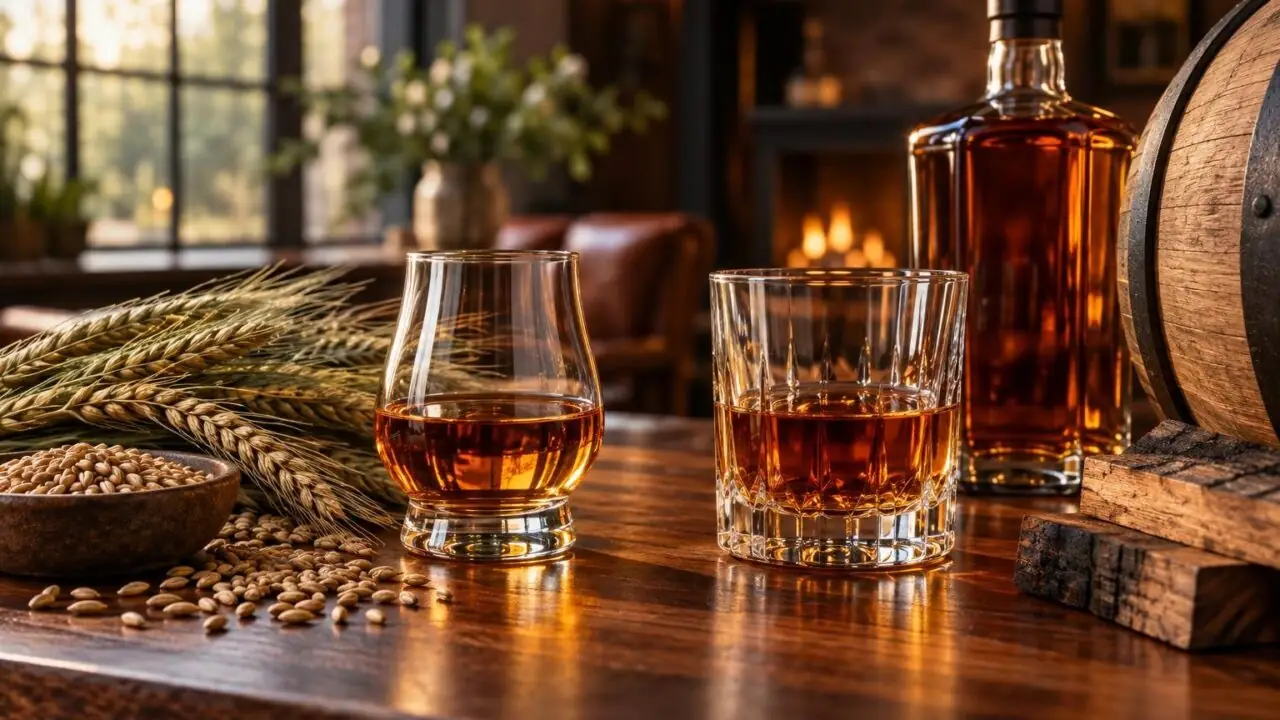
The difference between rye and whiskey is that rye is a whiskey type defined by a rye-heavy grain mash, while whiskey is the wider family of spirits distilled from fermented grain and aged in wood.
In the United States, rye whiskey must use at least 51% rye grain, giving it a drier, spicier profile.
American bourbon, Scotch, Irish whiskey, Canadian whisky, and rye all sit under the whiskey umbrella, but their grains, aging rules, production regions, and flavors differ.
Rye commonly tastes peppery, herbal, and lean; many other whiskeys taste sweeter, maltier, smokier, or softer depending on the base grain and maturation method.
Whiskey as the larger category
Whiskey is the broad family; rye whiskey is one member of it. The category also includes bourbon, Scotch whisky, Irish whiskey, Canadian whisky, and other grain spirits.
Each style is defined by its production location, grain recipe, distillation method, maturation rules, or a combination of these factors.
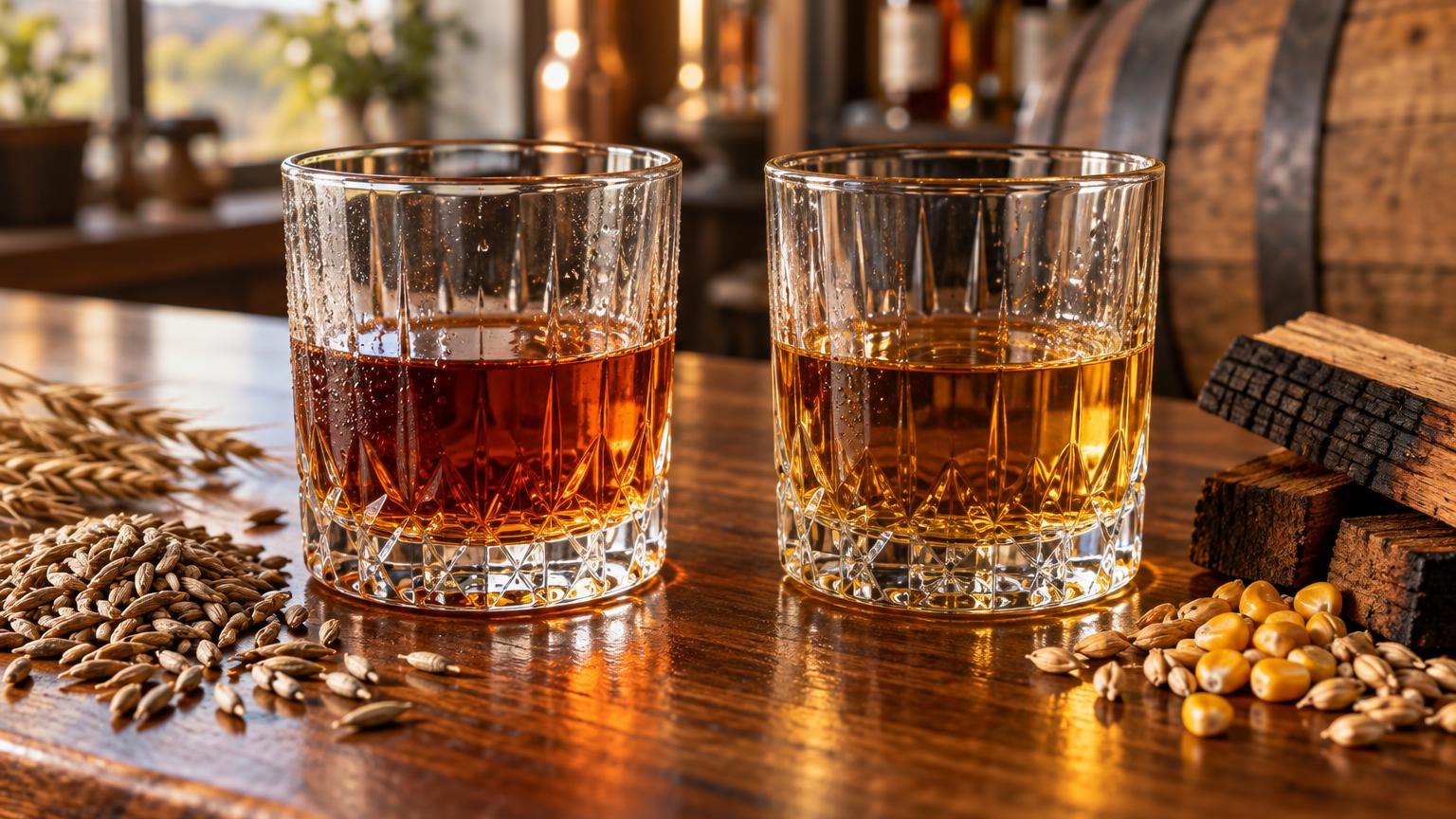
What makes a spirit whiskey?
Whiskey begins with grain that is mashed, fermented, distilled, and usually matured in wood. Producers commonly use corn, rye, wheat, barley, or blends of these grains.
Distillation concentrates the fermented liquid, while barrel aging can add color and flavors such as vanilla, spice, caramel, smoke, and toasted oak.
The spelling does not establish a universal legal category. “Whiskey” is standard in the United States and Ireland, while “whisky” is customary in Scotland, Canada, and Japan.
A producer’s regional convention generally determines the spelling.
How major whiskey styles differ
| Style | Key grain or origin rule | Selected production requirement |
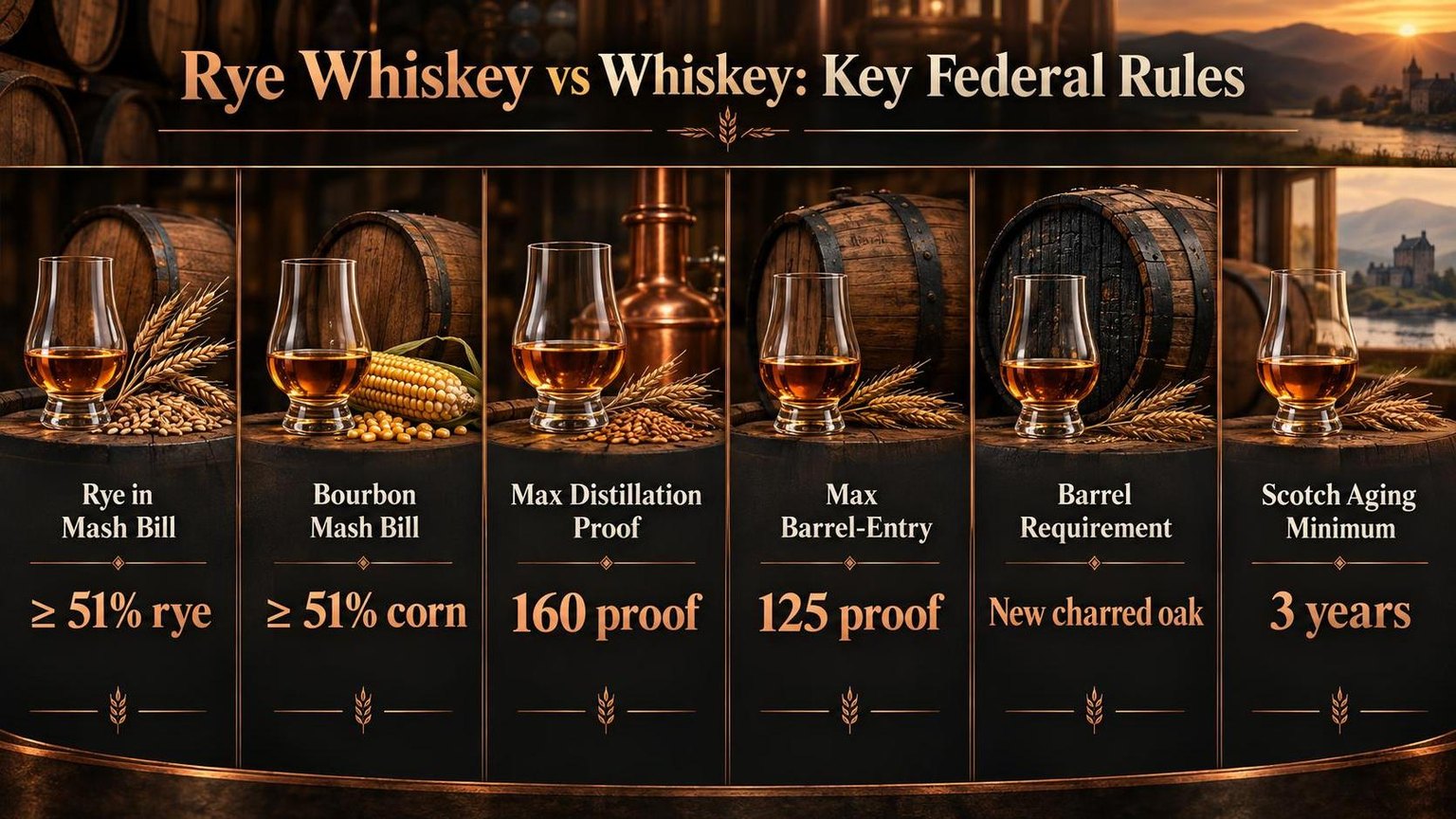
| American rye whiskey | At least 51% rye | Distilled at no more than 160 proof and entered into new charred oak containers at no more than 125 proof |
| Bourbon whiskey | At least 51% corn; produced in the United States | Uses the same maximum distillation and barrel-entry proofs as American rye |
| Scotch whisky | Produced entirely in Scotland | Matured in oak casks in Scotland for at least three years |
| Irish whiskey | Produced on the island of Ireland | Matured in wooden casks for at least three years |
| Canadian whisky | Mashed, distilled, and aged in Canada | Aged in small wood vessels for at least three years |
These rules show why “rye” and “whiskey” are not interchangeable. Every legally labeled American rye whiskey is whiskey, but bourbon and Scotch are not rye whiskey merely because their mash bills may contain some rye.
Why the distinction matters in the glass
Grain composition influences flavor, but it does not act alone. Yeast, fermentation, still design, barrel char, warehouse conditions, maturation time, and blending decisions can substantially change the finished spirit.
- Rye often contributes pepper, herbs, dry spice, or grain-driven intensity.
- Corn commonly supplies sweetness and a rounder texture.
- Malted barley can provide cereal, fruit, nut, or malt flavors.
- Peat smoke in some Scotch comes from drying malt over peat, not from the definition of whiskey itself.
For American definitions, the controlling source is the Alcohol and Tobacco Tax and Trade Bureau’s standards of identity in the Code of Federal Regulations.
Scotch, Irish, and Canadian requirements come from their respective national laws and technical regulations.

Rye whiskey mash bill rules
In the United States, rye whiskey is a legally defined whiskey style, not merely whiskey that tastes spicy. Its mash must contain a majority of rye grain, while federal rules also control distillation strength, barrel type, and barrel-entry proof.
Federal production requirements
The Alcohol and Tobacco Tax and Trade Bureau applies the standards in Title 27 of the Code of Federal Regulations. The mash bill is calculated from the cereal grains used to create the fermentable mash.
| Requirement | Federal standard for rye whiskey |
| Rye in mash bill | At least 51% |
| Maximum distillation proof | 160 proof, equivalent to 80% alcohol by volume |
| Maximum barrel-entry proof | 125 proof, equivalent to 62.5% alcohol by volume |
| Required vessel | Charred new oak container |
| Minimum aging for “rye whiskey” | No stated minimum duration, but the spirit must be stored in the required oak |
| Minimum aging for “straight rye whiskey” | 2 years |
| Mandatory age statement | Required when the whiskey is under 4 years old, subject to federal labeling rules |
| Primary authority | 27 CFR §§ 5.143 and 5.74 |
The remainder of the mash bill may contain other cereal grains. Corn commonly adds sweetness and yield, while malted barley supplies enzymes that convert grain starches into fermentable sugars.
Some distillers instead use commercial enzymes or malted rye.
A mash containing less than the federal rye threshold cannot be labeled simply “rye whiskey,” even when rye dominates its aroma.
It may qualify under another whiskey classification, depending on its grains, proof, maturation, and labeling.
Rye whiskey versus rye malt whiskey
Federal standards distinguish ordinary rye whiskey from rye malt whiskey. Both require rye as the majority grain, but rye malt whiskey requires that majority component to be malted rye rather than unmalted rye.
| Label | Required majority grain |
| Rye whiskey | At least 51% rye |
| Rye malt whiskey | At least 51% malted rye |
Why mash bills taste different
During side-by-side tasting, a higher rye percentage often presents drier grain, herbal, pepper, or baking-spice notes.
That pattern is useful, not absolute: yeast strain, fermentation, distillation cuts, barrel char, warehouse conditions, age, dilution, and blending can outweigh the mash bill.
“Rye” also changes meaning outside the United States. Canadian whisky may be called rye because of historical style and flavor conventions; Canadian law does not impose the American majority-rye mash requirement.
Check the country of origin before interpreting the label.
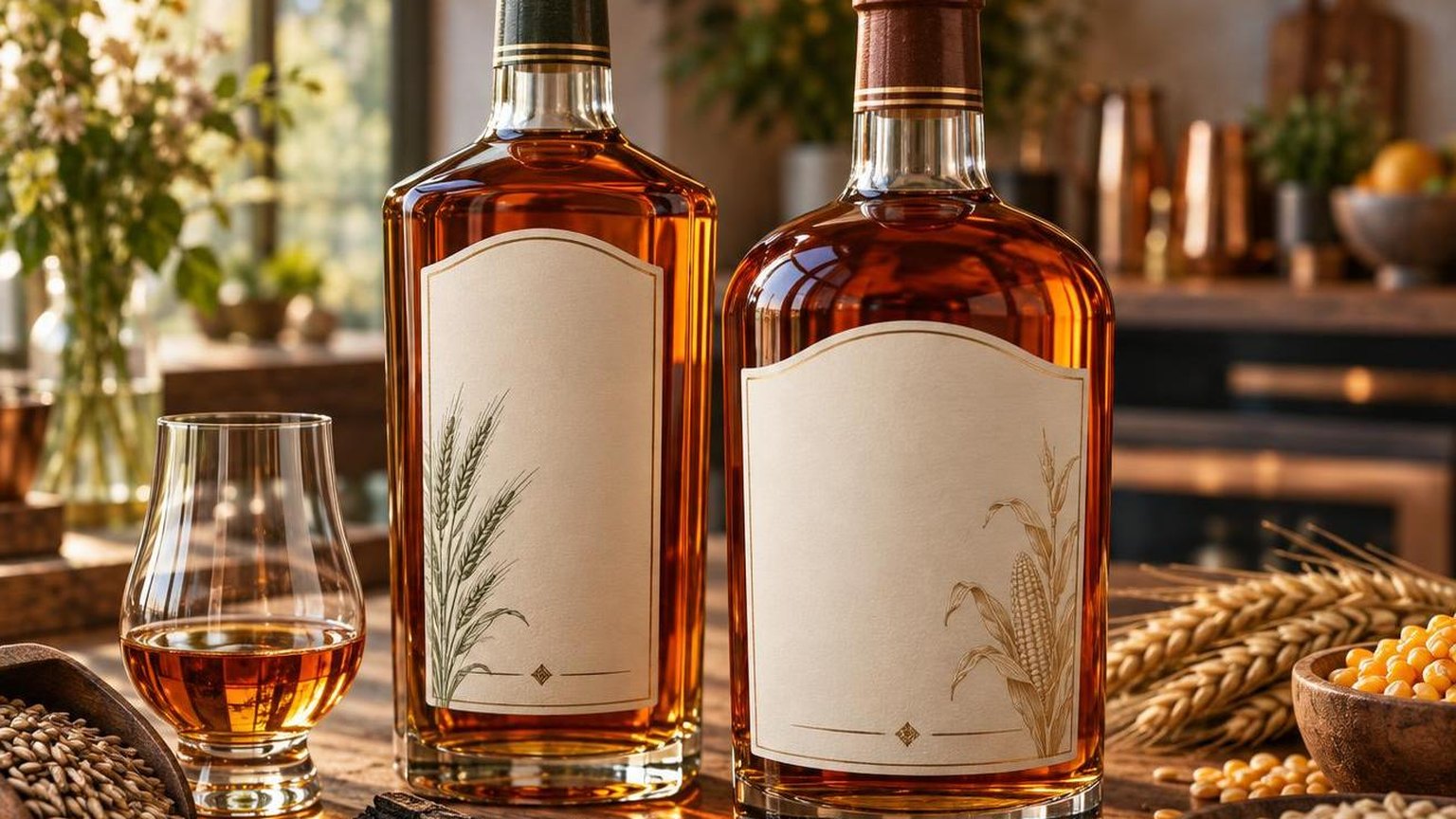
Flavor differences in the glass
Rye is not separate from whiskey; it is a whiskey category defined largely by its grain recipe. In the glass, American rye commonly tastes drier, spicier, and more herbal than corn-led bourbon.
Production choices, age, barrel entry proof, and dilution can outweigh the grain difference.
Typical sensory profile
| Characteristic | American rye whiskey | Bourbon whiskey |
| Required dominant grain | At least 51% rye | At least 51% corn |
| Common opening aromas | Black pepper, mint, dill, anise, citrus peel | Caramel, vanilla, sweet corn, coconut, baked fruit |
| Mid-palate impression | Lean, grainy, herbal, sharply spiced | Round, sweet-seeming, creamy, confectionary |
| Typical finish | Drying spice, toasted grain, herbs | Caramelized sugar, oak, vanilla, gentle spice |
Rye’s “spice” is an aroma-and-texture impression, not capsaicin heat. Tasters may perceive cracked pepper, clove, cinnamon, menthol, grass, or licorice.
Rye can also create a firm, angular palate that makes sweetness seem lower even when the whiskey contains comparable residual compounds.
Corn contributes a softer, sweeter-seeming grain character. Bourbon therefore provides the most useful contrast, although bourbon can contain substantial rye in its remaining mash bill.
A high-rye bourbon may taste peppery, while a rye made with abundant corn can taste unusually rounded and caramel-rich.
What the barrel adds
Both American rye and bourbon must enter new charred oak containers. Heat breaks down oak compounds, producing vanilla-like vanillin, toasted coconut aromas from oak lactones, caramelized notes, tannin, and color.
Consequently, mature examples of both categories can share vanilla, toffee, smoke, leather, and char.
| U.S. production limit | Rye whiskey | Bourbon whiskey |
| Distillation proof maximum | 160 proof | 160 proof |
| New charred container entry maximum | 125 proof | 125 proof |
| Minimum age for “straight” labeling | 2 years | 2 years |
Longer aging generally increases oak influence, but climate and warehouse position change extraction rates. Heavy oak can obscure rye’s herbal grain signature, while youth may expose cereal, grassy, or solvent-like notes.
Lower bottling proof can soften alcohol and spice but may also suppress aroma intensity.
How to compare them
- Use similarly aged, similarly proofed American rye and bourbon to reduce variables unrelated to grain.
- Taste neat first, then add equal small amounts of water; dilution can reveal mint, fruit, vanilla, and oak beneath ethanol.
- Revisit after several minutes. Rye often becomes more herbal, while bourbon commonly emphasizes caramel, vanilla, and cooked fruit.
Canadian “rye” requires separate expectations: the term may describe traditional flavor rather than a majority-rye mash. Read the country, mash information, age statement, and proof before treating the label as a flavor guarantee.
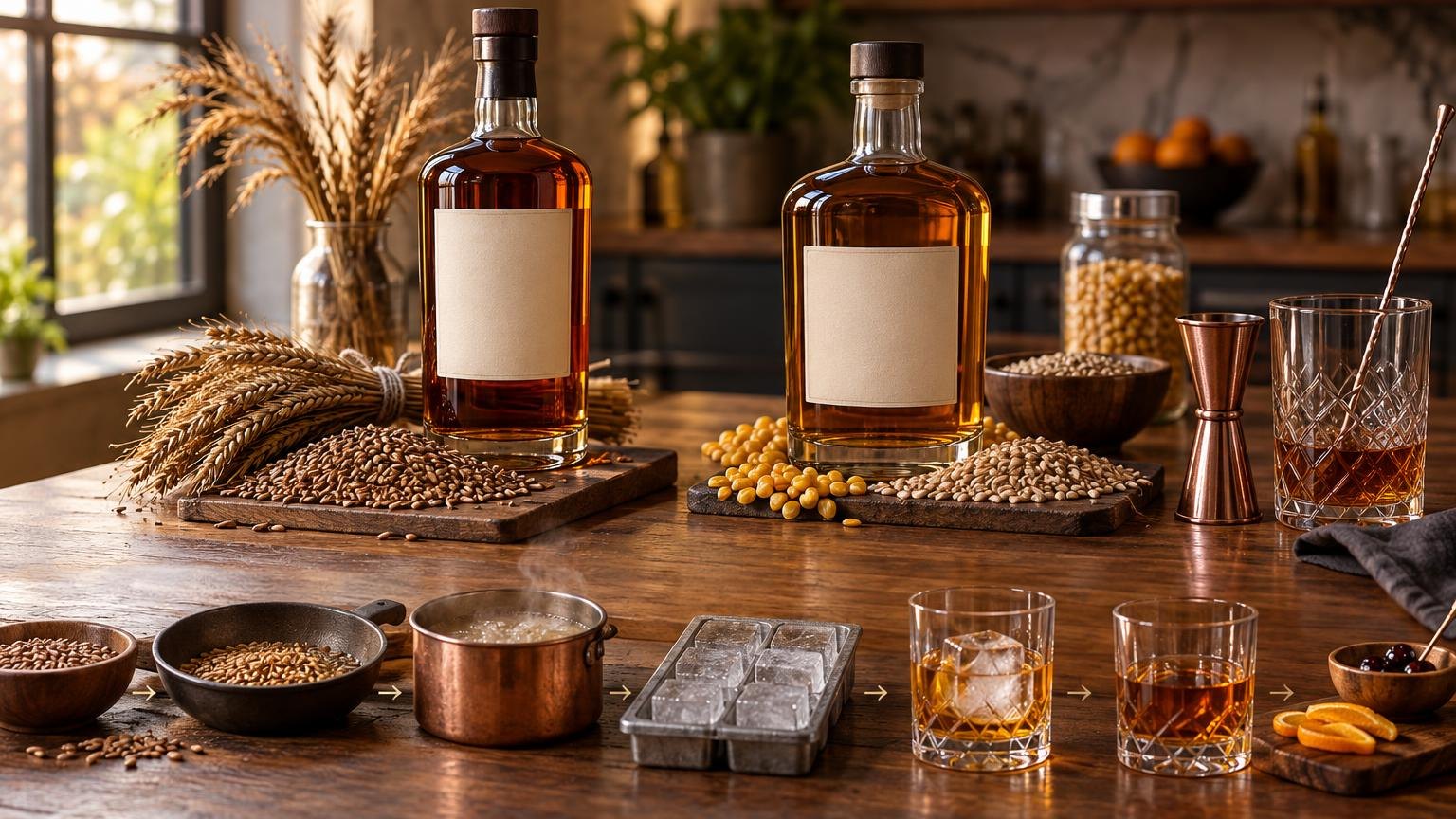
Canadian rye versus American rye
American rye is a legally defined whiskey based on mash composition. Canadian rye is a broader identity tied to Canadian production standards and a historic flavor style, not a mandatory rye-grain percentage.
That distinction explains why two bottles labeled “rye” can differ substantially. An American rye must begin with a rye-majority mash, while a Canadian rye may blend whiskies distilled from rye, corn, wheat, or barley.
| Requirement | American rye whiskey | Canadian rye whisky |
| Rye in mash | At least 51% | No statutory minimum |
| Maximum distillation strength | 80% alcohol by volume | Not defined by a rye-specific mash standard |
| Barrel entry strength | No more than 62.5% alcohol by volume | No equivalent rye-specific limit |
| Wood | New, charred oak containers | Small wood vessels with a maximum capacity of 700 liters |
| Minimum aging | None for standard rye; 2 years for straight rye | At least 3 years |
| Bottling strength | At least 40% alcohol by volume | At least 40% alcohol by volume |
Under U.S. federal standards, “straight rye whiskey” must satisfy the rye rules and mature for at least two years. If it is younger than four years, its label must carry an age statement.
Straight rye cannot contain added coloring, flavoring, or blending materials.
Canadian law instead requires Canadian whisky, Canadian rye whisky, or rye whisky to be mashed, distilled, and aged in Canada. It must possess the aroma, taste, and character generally attributed to Canadian whisky.
Caramel and permitted flavoring may be used within federal compositional rules.
The Canadian terminology developed because rye grain was historically added to otherwise corn-heavy whisky to supply spice and aroma.
Consumers began calling the resulting style “rye,” and Canadian regulations preserve that customary usage. The word therefore does not prove that rye supplied most of the fermentable grain.
How the styles usually taste
American rye commonly emphasizes pepper, clove, mint, dry grain, citrus peel, and assertive new-oak notes.
Its mandatory rye majority creates a recognizable grain-driven profile, although yeast, distillation, maturation climate, barrel char, and remaining mash grains still cause major variation.
Canadian rye often tastes lighter, smoother, or more blend-driven, with caramel, vanilla, baking spice, fruit, and restrained oak. Some producers distill rye separately as a flavorful component, then combine it with a softer base whisky.
Others release genuinely rye-heavy or entirely rye-based bottlings.
Read the country of origin and technical label language before inferring composition.
Choose American straight rye for a regulated rye-majority mash and additive-free profile; choose Canadian rye by producer and product specifications, because “rye” alone does not disclose the grain recipe.
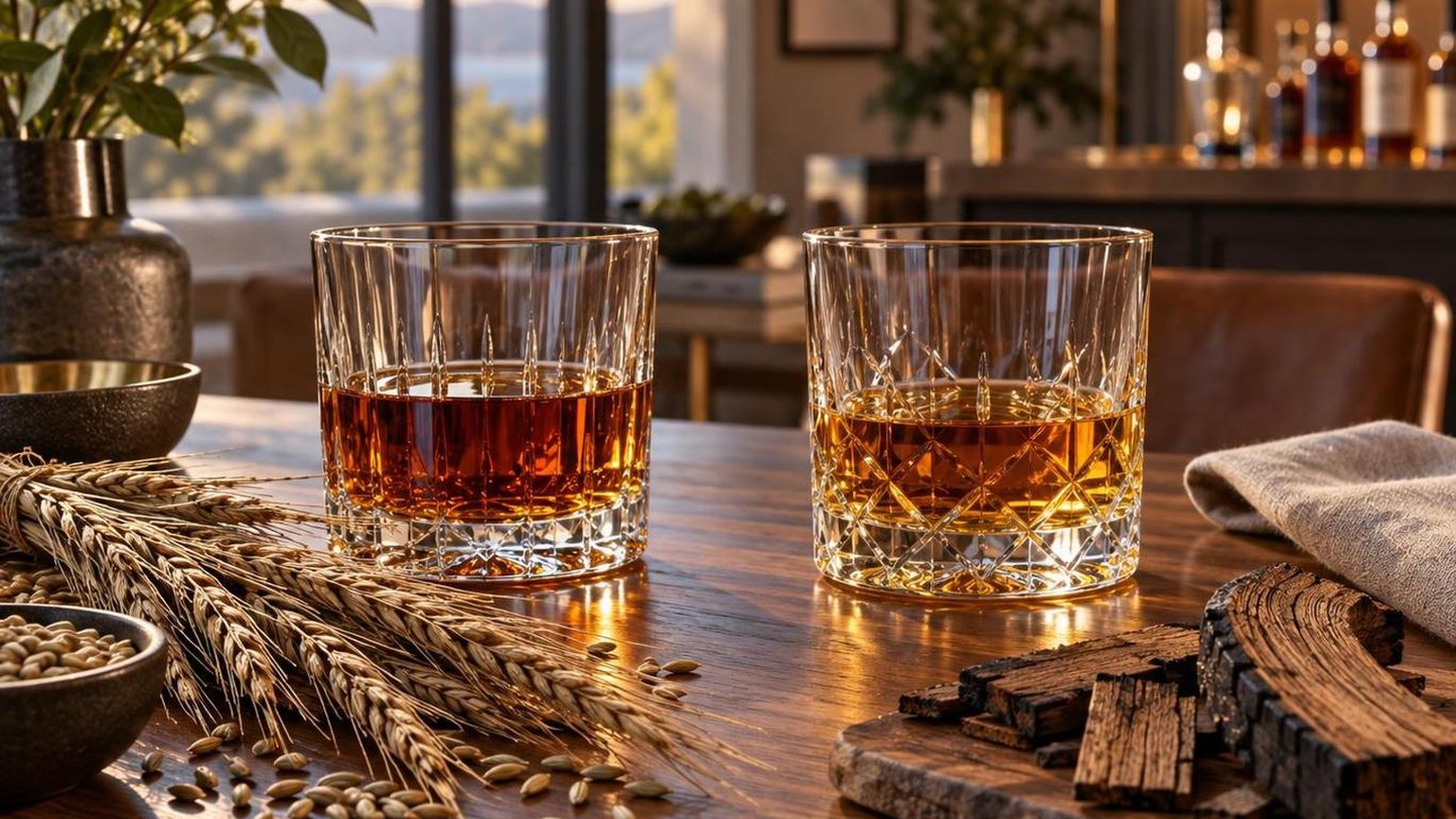
Cocktail uses for each style
Rye is whiskey, not a separate spirit category. In cocktails, American rye contributes pepper, dry grain, and herbal spice, while bourbon, Scotch, Irish whiskey, and Canadian whisky offer different balances of sweetness, smoke, fruit, and body.
Choose by structure: rye sharpens drinks containing sugar or sweet vermouth; softer or maltier whiskeys suit citrus, soda, coffee, honey, and smoke-forward recipes.
Where rye works best
American rye is the classic choice for a Manhattan because its spice resists sweet vermouth and keeps the finish defined. The International Bartenders Association formula illustrates that spirit-forward balance.
| Cocktail | Whiskey | Core formula | Why it works |
| Manhattan | Rye | 50 ml rye, 20 ml sweet vermouth, 1 dash Angostura bitters | Pepper and grain offset the vermouth’s sugar and herbs. |
| Old Fashioned | Rye or bourbon | 45 ml whiskey, 1 sugar cube, bitters, water | Rye produces a drier, spicier drink; bourbon emphasizes caramel. |
| Whiskey Sour | Bourbon | 45 ml bourbon, 25 ml lemon juice, 20 ml sugar syrup | Corn sweetness rounds the lemon’s acidity. |
Rye also excels in a Boulevardier, where it cuts through sweet vermouth and bitter red aperitivo. In a rye Sazerac, an absinthe rinse and aromatic bitters amplify anise, clove, and pepper rather than masking the grain.
When another whiskey is better
- Bourbon: Use it for Whiskey Sours, Mint Juleps, and fruit-led drinks. Its legally required majority-corn mash and new charred-oak maturation commonly produce vanilla, caramel, and baking-spice flavors.
- Scotch: Use blended Scotch in a highball or Rob Roy. Peated malt works as a rinse, float, or split base in drinks such as the Penicillin because a modest portion can provide conspicuous smoke.
- Irish whiskey: Use it in Irish Coffee, highballs, and approachable sours. Many bottlings emphasize orchard fruit, cereal, and a relatively light texture that integrates cleanly with coffee or ginger ale.
- Canadian whisky: Use it when a recipe requests “rye” but a gentler profile is preferred. In Canada, “Canadian whisky” and “Canadian rye whisky” are legally interchangeable style designations; the bottle need not contain a majority-rye mash.
Do not substitute by label alone.
American rye must derive most of its mash from rye under federal standards, whereas bourbon centers corn; that grain shift can noticeably change sweetness, spice, and perceived dryness even when the cocktail recipe remains unchanged.
Buying labels without confusion
U.S. federal regulations (27 CFR § 5.22) define whiskey categories by mash bill, proof, and barrel requirements. Reading a label correctly prevents paying $45 for a product you assumed was straight rye when it is actually a blended whiskey.
The TTB (Alcohol and Tobacco Tax and Trade Bureau) mandates specific terms on every American whiskey label. Each term carries a legal definition.
Key label terms decoded
| Label Term | Legal Meaning |
| Rye Whiskey | Mash bill ≥ 51% rye grain, distilled at ≤ 160 proof, entered barrel at ≤ 125 proof |
| Straight Rye Whiskey | Meets rye whiskey rules + aged ≥ 2 years in new charred oak barrels, no added coloring or flavoring |
| Bourbon Whiskey | Mash bill ≥ 51% corn, same proof limits as rye, new charred oak barrels required |
| Blended Whiskey | Contains ≥ 20% straight whiskey blended with neutral spirits or other whiskey |
| Whiskey (no modifier) | Distilled from grain at ≤ 190 proof, stored in oak, no minimum mash bill specified |
Age statements
Any whiskey aged less than 4 years must display an age statement on the label. If a bottle shows no age statement, the youngest whiskey inside is at least 4 years old.
When a label reads “aged 7 years,” that number refers to the youngest component in the bottle, not the average age.
What to check before purchasing
- State of distillation vs. bottling: “Distilled in Kentucky” and “Bottled in Indiana” means the liquid was sourced, not produced in-house.
- DSP number: The Distilled Spirits Plant number on the back label identifies the actual producer. DSP-KY-354, for example, is Four Roses.
- “Bottled in Bond”: Guarantees single distillery, single distilling season, aged ≥ 4 years, bottled at exactly 100 proof under government oversight per the Bottled-in-Bond Act of 1897.
- “Kentucky Straight Rye”: Must be distilled and aged in Kentucky for a minimum of 1 year (plus the 2-year straight requirement).
- Proof vs. ABV: U.S. proof = 2 × ABV. A bottle labeled 90 proof contains 45% alcohol by volume.
Price does not guarantee category. Sourced rye whiskeys from MGP in Lawrenceburg, Indiana (DSP-IN-1) appear under dozens of brand names, ranging from $25 to over $100 per 750 ml bottle.
Match the label language to federal definitions before spending. The terminology is precise for a reason — it protects the buyer.
Common Questions
Is rye a type of whiskey or a completely separate spirit?
Rye is a subcategory of whiskey, not a separate spirit.
In the United States, the TTB (Alcohol and Tobacco Tax and Trade Bureau) requires “rye whiskey” to be distilled from a mash containing at least 51% rye grain, aged in new charred oak barrels, and distilled to no more than 160 proof.
The term “whiskey” is the broader umbrella covering bourbon, rye, scotch, Irish whiskey, and other grain-based spirits.
How does the 51% rye grain requirement change the flavor compared to bourbon?
The high rye content produces a distinctly spicy, peppery, and herbaceous profile with notes of caraway, dill, and baking spice. Bourbon, which requires at least 51% corn, tastes noticeably sweeter with caramel, vanilla, and brown sugar notes.
A side-by-side tasting of Rittenhouse Rye against Evan Williams Bourbon illustrates this contrast immediately on the palate.
What is the difference between American rye whiskey and Canadian rye whisky?
American rye whiskey must contain at least 51% rye grain in its mash bill by federal law.
Canadian “rye whisky” has no minimum rye grain requirement—it is a historical term applied to Canadian whisky broadly, and many Canadian rye whiskies use predominantly corn with only a small fraction of rye as a flavoring grain.
Crown Royal, for example, is labeled “Canadian rye” but uses a corn-dominant base.
Does rye whiskey age differently than other whiskeys?
Both American rye whiskey and bourbon must be aged in new charred American oak barrels, so the vessel is identical.
However, rye’s lower sugar content compared to corn means it extracts and integrates oak tannins differently, often retaining a drier, more structured character even after extended aging.
Scotch and Irish whiskey, by contrast, typically use previously used barrels, yielding softer wood influence over their minimum 3-year maturation.
Why did rye whiskey nearly disappear and what drove its comeback?
Prohibition (1920–1933) devastated American rye production, particularly in Pennsylvania and Maryland where it had dominated; post-repeal consumer tastes shifted toward lighter spirits and bourbon.
By 2003, fewer than a dozen rye brands remained on the U.S. market.
The cocktail revival of the mid-2000s—bartenders insisting on rye for authentic Manhattans and Sazeracs—drove demand back up.
And by 2023 the American rye whiskey category had grown to over $1 billion in annual U.S. sales according to the Distilled Spirits Council (DISCUS).
Related Guides
- Crown Royal Pineapple Flavor – Find Out Now
- Jack Daniels Alcohol Percentage – Deepest Knowledge
- What Whiskey Does Joe Rogan Drink on the JRE Podcast?
- Is Whiskey Gluten Free? Answer By Expert
- What Is the Difference Between Vodka and Whiskey?
- Should Whiskey Be Chilled Or Drunk Straight?
- Who Taught Jack Daniel’S To Make Whiskey?
- All Alcohol Guides
- Electronic Code of Federal Regulations, 27 CFR § 5.143—Whisky (2026)
- Alcohol and Tobacco Tax and Trade Bureau, Beverage Alcohol Manual—Chapter 4: Distilled Spirits Class and Type Designation (2012)
- Cornell Law School Legal Information Institute, 27 CFR § 5.143—Whisky (2026)
- Government Publishing Office, Electronic Code of Federal Regulations—Title 27, Part 5 (2026)
- Canadian Food Inspection Agency, Canadian Grade Compendium: Volume 7—Canadian Whisky, Canadian Rye Whisky or Rye Whisky (2024)
- Government of Canada, Food and Drug Regulations—B.02.020 Canadian Whisky, Canadian Rye Whisky or Rye Whisky (2026)
- Scotch Whisky Association, Scotch Whisky Categories (2024)
- Encyclopaedia Britannica, Whiskey (2024)