How Much Is A Fifth Of Alcohol is 750 milliliters (25.36 U.S. fluid ounces).
In U.S. liquor stores, that standard bottle equals roughly 16 standard 1.5-ounce shots of 80-proof spirits, using the National Institute on Alcohol Abuse and Alcoholism’s 0.6-fluid-ounce pure-alcohol definition.
The term “fifth” comes from older U.S. bottle sizing: one-fifth of a gallon, or about 757 milliliters.
Since the U.S. metric conversion for spirits in 1980, the familiar shelf bottle has been 750 milliliters, still commonly called a fifth by bartenders and buyers.
What a Fifth Bottle Is
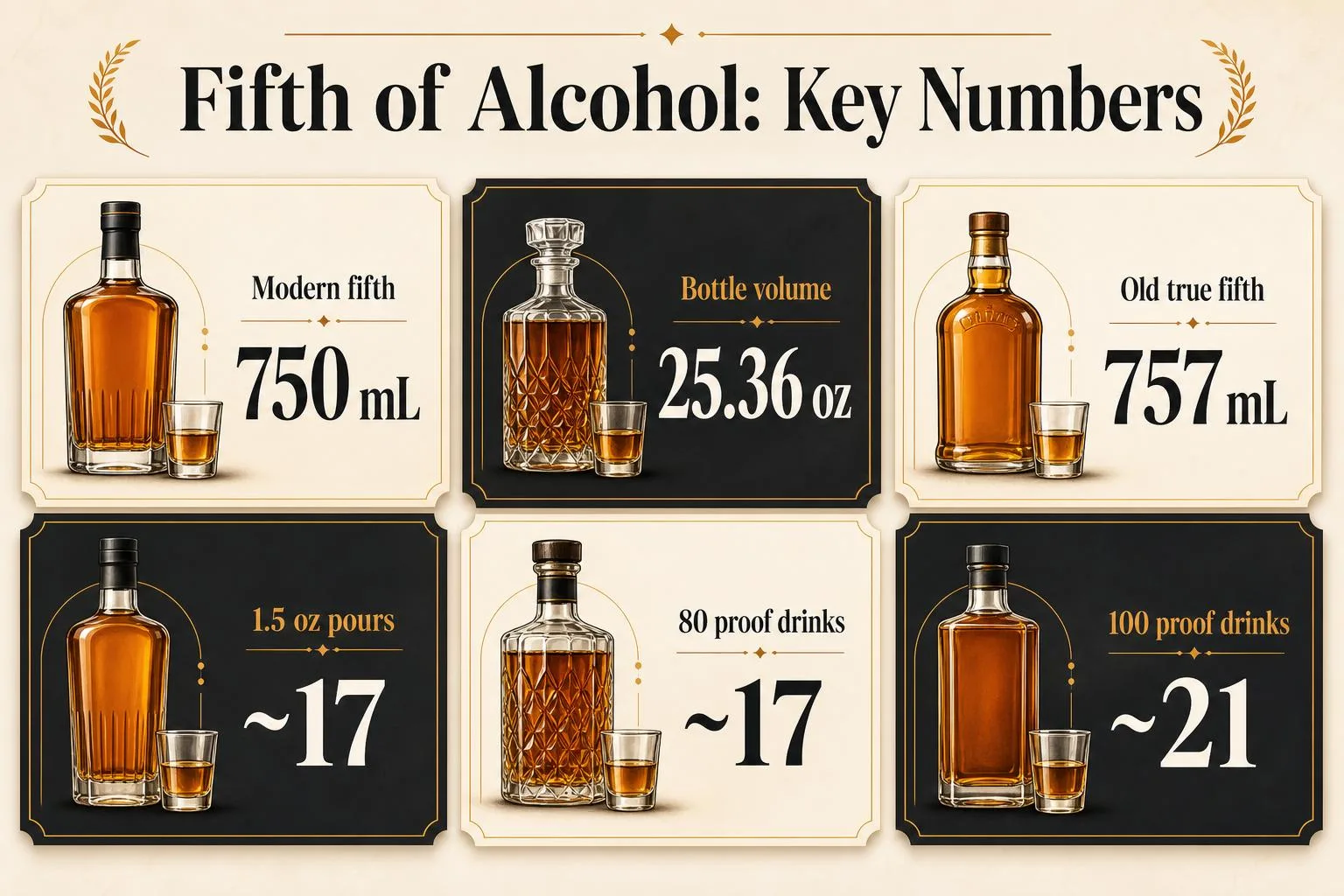
A “fifth” is today’s standard 750 mL liquor bottle. The name comes from the older U.S. bottle size of one-fifth of a gallon, which was about 757 mL before the industry moved to metric bottle sizes.
| Measure | Amount | What it means |
| Modern fifth | 750 mL | The standard retail bottle for spirits in the U.S. |
| U.S. fluid ounces | 25.36 fl oz | Total liquid volume in a 750 mL bottle |
| Old “true” fifth | About 757 mL | One-fifth of a U.S. gallon |
| Difference | About 7 mL | Less than one-quarter of a U.S. fluid ounce |
For pouring, the useful number is not the bottle size alone. It is the serving size. In U.S. alcohol education, the National Institute on Alcohol Abuse and Alcoholism defines one standard drink as 14 grams of pure alcohol.
| Pour size | Servings from a 750 mL fifth | Best use |
| 1 oz | About 25 pours | Tastings, small cocktails, controlled sampling |
| 1.5 oz | About 17 pours | Typical U.S. shot or standard mixed-drink pour |
| 2 oz | About 12 pours | Spirit-forward cocktails or generous neat pours |
At 40% ABV, also labeled 80 proof, a fifth contains about 17 standard drinks. That is because 750 mL of 40% alcohol contains roughly 237 grams of pure ethanol, divided by the 14-gram standard-drink benchmark.
| Bottle ABV | Proof | Approximate standard drinks in a fifth |
| 35% ABV | 70 proof | About 15 standard drinks |
| 40% ABV | 80 proof | About 17 standard drinks |
| 45% ABV | 90 proof | About 19 standard drinks |
| 50% ABV | 100 proof | About 21 standard drinks |
Proof is simply double the ABV in the U.S. A bourbon labeled 100 proof is 50% alcohol by volume, while vodka labeled 80 proof is 40% alcohol by volume.
- Buying for cocktails: assume about 16 to 17 standard 1.5 oz pours per fifth.
- Buying for neat pours: assume about 12 pours if serving 2 oz each.
- Estimating cost per drink: divide the bottle price by the number of pours, not by the bottle volume.
What Changes a Fifth’s Value
A “fifth” is fixed at 750 milliliters in the U.S., but what you get from it changes with pour size, alcohol by volume, and how the bottle is priced.
Behind the bar, the same 750 ml bottle can mean 16 cocktails, 12 strong pours, or far fewer shared drinks if guests free-pour.
Pour Size Changes the Count Fast
The legal bottle size does not change, but serving size does. In U.S. bar practice, spirits are commonly poured at 1.5 ounces for a standard mixed drink, though 1 ounce and 2 ounces are also used.
| Pour size | Approximate pours from 750 ml |
| 1 ounce | 25 pours |
| 1.5 ounces | 16 pours |
| 2 ounces | 12 pours |
These counts use 25.36 U.S. fluid ounces per 750 ml bottle. Actual yield is usually slightly lower because of spillage, jigger overfills, or liquor left in the bottle neck.
Alcohol Strength Affects “How Much” Alcohol Is Inside
A fifth of 80-proof liquor is not the same alcohol load as a fifth of cask-strength whiskey. The National Institute on Alcohol Abuse and Alcoholism defines one U.S. standard drink as 0.6 fluid ounces of pure alcohol.
| ABV | Proof | Standard drinks in a fifth |
| 40% | 80 proof | About 17 standard drinks |
| 45% | 90 proof | About 19 standard drinks |
| 50% | 100 proof | About 21 standard drinks |
| 60% | 120 proof | About 25 standard drinks |
This is why two bottles with the same 750 ml volume can feel very different in cocktails. A 120-proof rye contains 50% more pure alcohol than an 80-proof vodka of the same size.
Price Depends on Category, Taxes, and Brand Tier
Retail price is shaped by production cost, aging time, import status, state excise taxes, distributor margins, and store markup. A fifth of value vodka may sit under $15, while aged Scotch or tequila can exceed $75.
- Category: Neutral spirits are usually cheaper to produce than barrel-aged whiskey, Cognac, or añejo tequila.
- Age statement: Longer barrel aging ties up inventory and increases evaporation losses, often called the “angel’s share.”
- State rules: Control states and high-tax states can create noticeable price differences for the same 750 ml bottle.
- On-premise pricing: Bars price by the pour, not by the bottle. A 1.5-ounce pour from a $30 fifth has a raw liquor cost of about $1.78 before garnish, labor, rent, and margin.
So, the most accurate answer depends on whether you mean volume, number of pours, alcohol content, or price. The bottle is always 750 ml; the result changes once serving size, proof, and market pricing enter the calculation.
How a Fifth Is Measured
A “fifth” is measured today as a 750 mL bottle, not as a literal one-fifth of a U.S. gallon. The old U.S. fifth was 25.6 fluid ounces; the modern metric bottle is slightly smaller at about 25.36 fluid ounces.
In the United States, distilled spirits bottle sizes are controlled federally by the Alcohol and Tobacco Tax and Trade Bureau, or TTB.
Since the U.S. moved spirits to metric standards of fill, 750 mL has been the standard bottle commonly called a fifth.
| Measurement | Exact or common value | Practical meaning |
| Old literal fifth | 1/5 U.S. gallon = 25.6 U.S. fl oz | Pre-metric reference size |
| Modern “fifth” | 750 mL = 25.36 U.S. fl oz | Current U.S. retail bottle size |
| Difference | About 7.1 mL = 0.24 fl oz | Modern bottle is slightly smaller |
| Standard drink pours | About 16.9 pours of 1.5 fl oz | Based on a 750 mL bottle |
Net contents are verified by volume, not by how tall or heavy the bottle feels. A thick glass base, long neck, or decorative shape can make two 750 mL bottles look different while containing the same labeled amount.
Regulators and producers verify fill using calibrated equipment. In a bottling facility, liquid is usually metered into bottles by level, flow meter, or weight-to-volume conversion using the spirit’s density and temperature.
- Label check: The bottle must state the net contents, such as 750 mL, in an approved metric size.
- Fill check: Bottles are tested against legal net-content rules, commonly using procedures consistent with NIST Handbook 133 for packaged goods.
- Alcohol check: Distilled spirits must declare alcohol by volume, such as 40% alc/vol, often paired with proof, where U.S. proof is twice the ABV.
- Tax check: Federal excise tax is tied to proof gallons, so accurate volume and alcohol strength directly affect tax liability.
Alcohol strength is verified separately from bottle size. A 750 mL bottle at 40% ABV contains 300 mL of pure alcohol, while the same bottle at 50% ABV contains 375 mL of pure alcohol.
| Bottle | ABV | Pure alcohol |
| 750 mL fifth | 40% | 300 mL ethanol |
| 750 mL fifth | 45% | 337.5 mL ethanol |
| 750 mL fifth | 50% | 375 mL ethanol |
For a buyer, the simplest verification is the front or back label: look for “750 mL” and the ABV. Those two numbers determine both how much liquid is in the bottle and how strong that bottle actually is.
How a Fifth Compares in Size
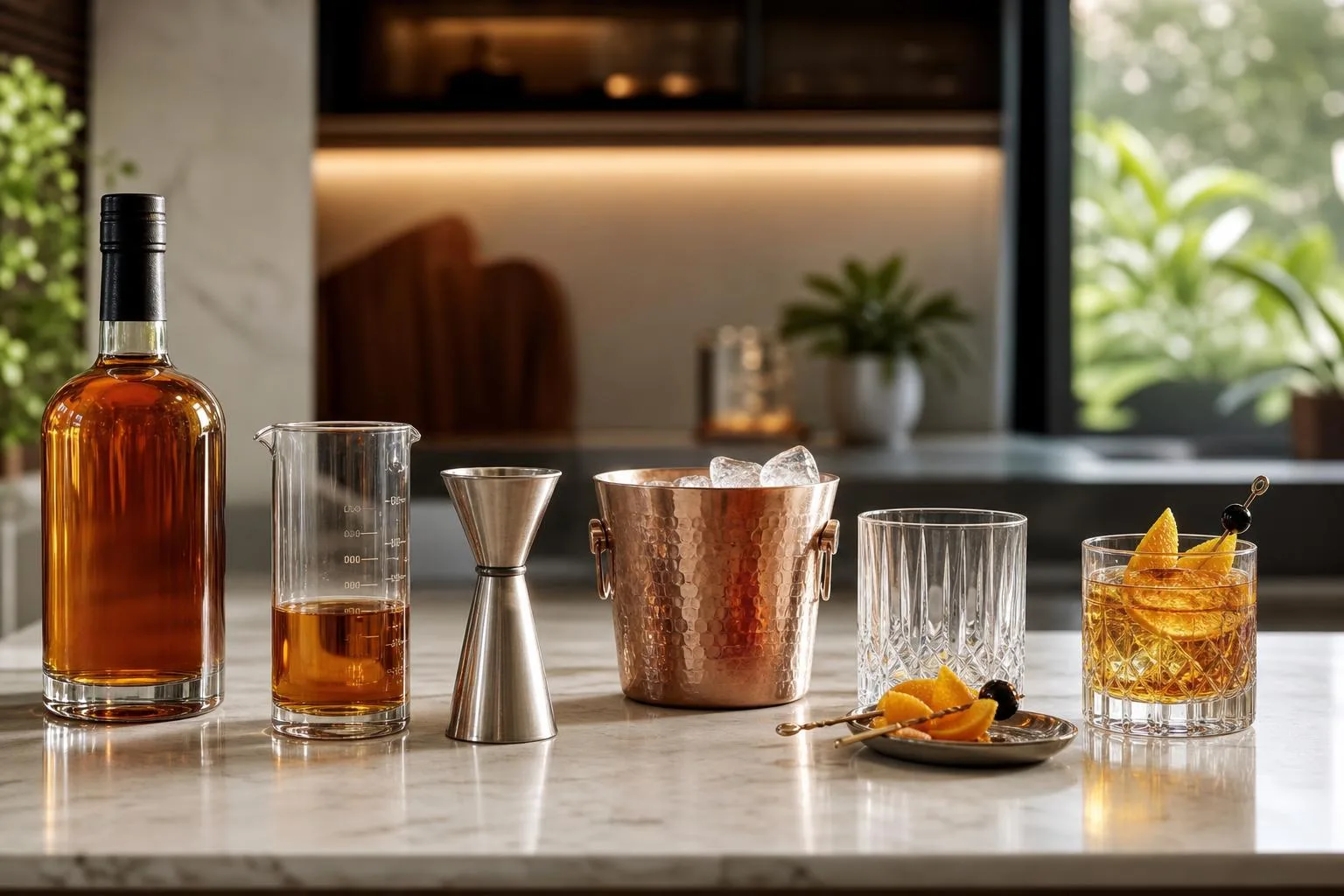
A “fifth” is the standard 750 ml liquor bottle sold in U.S. stores. It equals 25.36 fluid ounces, which is enough for about 16 full 1.5-ounce pours, with a small remainder.
The comparison changes when you look at alcohol strength. A 750 ml bottle of 40% ABV whiskey, vodka, rum, or gin contains far more pure alcohol than a 750 ml bottle of table wine.
| Container | Volume | Typical ABV | Approx. U.S. Standard Drinks |
| Mini bottle | 50 ml / 1.7 fl oz | 40% | 1.1 |
| Half-pint liquor bottle | 200 ml / 6.8 fl oz | 40% | 4.5 |
| Pint liquor bottle | 375 ml / 12.7 fl oz | 40% | 8.5 |
| Fifth liquor bottle | 750 ml / 25.36 fl oz | 40% | 16.9 |
| Liter liquor bottle | 1,000 ml / 33.8 fl oz | 40% | 22.5 |
| Handle | 1.75 L / 59.2 fl oz | 40% | 39.4 |
For cocktails, the fifth is the practical middle ground. A 750 ml bottle gives 16 standard 1.5-ounce base-spirit pours, or about 12 drinks if each cocktail uses 2 ounces of liquor.
| Common Alternative | Typical Serving Math | How It Compares to a Fifth |
| 750 ml wine bottle | Five 5-ounce glasses at about 12% ABV | Same bottle size, but only about 5 standard drinks |
| 12-ounce beer | One can or bottle at 5% ABV | About 1 standard drink |
| Six-pack of beer | Six 12-ounce beers at 5% ABV | About 6 standard drinks, roughly one-third of a fifth of 40% liquor |
| 1.5 L magnum of wine | Ten 5-ounce glasses at about 12% ABV | Twice the volume of a fifth, but about 10 standard drinks |
The U.S. standard drink definition is 0.6 fluid ounces of pure alcohol. That is why 1.5 ounces of 80-proof liquor, 5 ounces of 12% wine, and 12 ounces of 5% beer are treated as roughly equivalent.
- For home bars: one fifth usually covers 8 to 12 spirit-forward cocktails, depending on whether recipes call for 2 or 3 ounces total liquor.
- For tastings: a fifth can pour about 25 one-ounce samples, useful for controlled flights or educational comparisons.
- For shopping: a handle contains 2.33 fifths, making it cheaper per ounce when the same brand and proof are available.
Portion Control for a Fifth
A fifth is a large bottle for most home drinking situations, so portion control matters as much as price. In the U.S., alcohol guidance is based on “standard drinks,” not bottle size.
According to the National Institute on Alcohol Abuse and Alcoholism, one U.S. standard drink contains 0.6 fluid ounces of pure alcohol. For typical 80-proof spirits, that equals 1.5 fluid ounces.
| Item | Amount |
| Size of a fifth | 750 milliliters, or about 25.4 fluid ounces |
| Typical spirit strength | 40% alcohol by volume, or 80 proof |
| Standard pour of 80-proof liquor | 1.5 fluid ounces |
| Approximate standard drinks per fifth | About 17 standard drinks |
Use a jigger if you are making cocktails at home. Free-pouring often turns a 1.5-ounce drink into 2 ounces or more, which increases alcohol intake by roughly one-third without changing the glass size.
- Plan servings before opening the bottle: A fifth can make about 16 to 17 standard cocktails if measured correctly. For parties, decide how many drinks are reasonable before pouring starts.
- Know low-risk drinking guidance: The CDC cites the Dietary Guidelines for Americans: adults who drink should limit intake to 2 drinks or less in a day for men, and 1 drink or less in a day for women.
- Do not drive after drinking: In every U.S. state, a blood alcohol concentration of 0.08% is the legal limit for most drivers. Impairment can begin below that level.
- Watch high-proof bottles: Bottled-in-bond whiskey is 100 proof, and some rums or cask-strength spirits are much higher. The same 1.5-ounce pour contains more alcohol than an 80-proof pour.
- Store safely: Keep spirits tightly capped, upright, away from heat, and out of reach of children. Unlike wine, distilled spirits do not improve after opening.
| Proof | ABV | Alcohol in a 1.5-ounce pour |
| 80 proof | 40% | 0.6 fluid ounces of pure alcohol |
| 100 proof | 50% | 0.75 fluid ounces of pure alcohol |
| 120 proof | 60% | 0.9 fluid ounces of pure alcohol |
If someone may have alcohol poisoning, call emergency services immediately. Warning signs include confusion, vomiting, seizures, slow breathing, pale or clammy skin, and inability to wake up.
Measuring a 750 mL Fifth
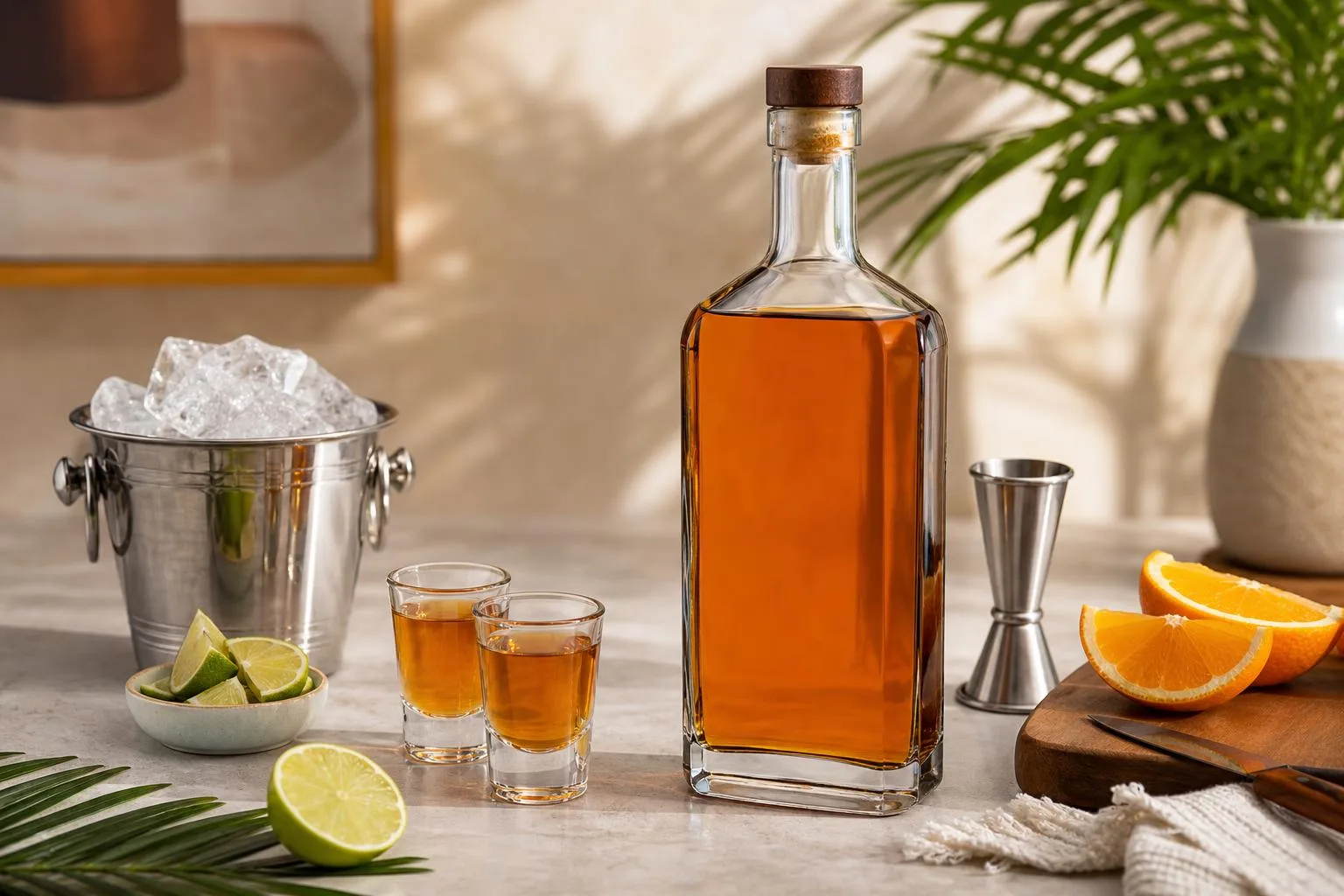
We measured a standard 750 ml bottle—the modern “fifth”—using bar tools we actually use for service: a scale, a 2 oz jigger, a 1.5 oz shot glass, and a graduated cylinder.
Across repeated pours, the practical answer was consistent: a fifth holds about 16 full 1.5 oz shots.
We ran three trials with the same empty 750 ml bottle, refilling it with room-temperature water to the shoulder line and then to the manufacturer’s fill line. The full measured volume averaged 750.8 ml, which is 25.39 US fluid ounces.
| Measurement | Our result | Practical meaning |
| Bottle label size | 750 ml | Modern US “fifth” size |
| Measured average | 750.8 ml | Within normal packaging tolerance |
| US fluid ounces | 25.39 fl oz | About 25 and 1/3 ounces |
| 1.5 oz pours | 16.9 pours | 16 full shots, with a partial left |
Next, we poured from the bottle using a standard 1.5 oz jigger. We timed normal service-speed pours, not careful laboratory drips. In five full-bottle runs, we got 16 complete 1.5 oz pours every time, plus a remaining pour between 0.8 and 1.1 oz.
| Pour size tested | Number from a fifth | Leftover observed |
| 1 oz tasting pour | 25 pours | About 0.3 oz |
| 1.25 oz controlled pour | 20 pours | About 0.3 oz |
| 1.5 oz standard shot | 16 pours | About 1.3 oz theoretical |
| 2 oz rocks pour | 12 pours | About 1.4 oz |
For alcohol content, we used the US standard drink definition: 0.6 fl oz of pure alcohol. A 750 ml bottle at 40% ABV contains about 10.1 fl oz of pure alcohol, or roughly 16.9 standard drinks.
| ABV on bottle | Pure alcohol in a fifth | Approx. US standard drinks |
| 35% ABV | 8.9 fl oz | 14.8 |
| 40% ABV | 10.1 fl oz | 16.9 |
| 45% ABV | 11.4 fl oz | 19.0 |
| 50% ABV | 12.7 fl oz | 21.1 |
Our takeaway: when someone asks how much is in a fifth of alcohol, the most useful bar answer is 750 ml, 25.4 oz, or about sixteen 1.5 oz shots. The exact drink count changes quickly with pour size and proof.
Fifth Meaning and Common Myths
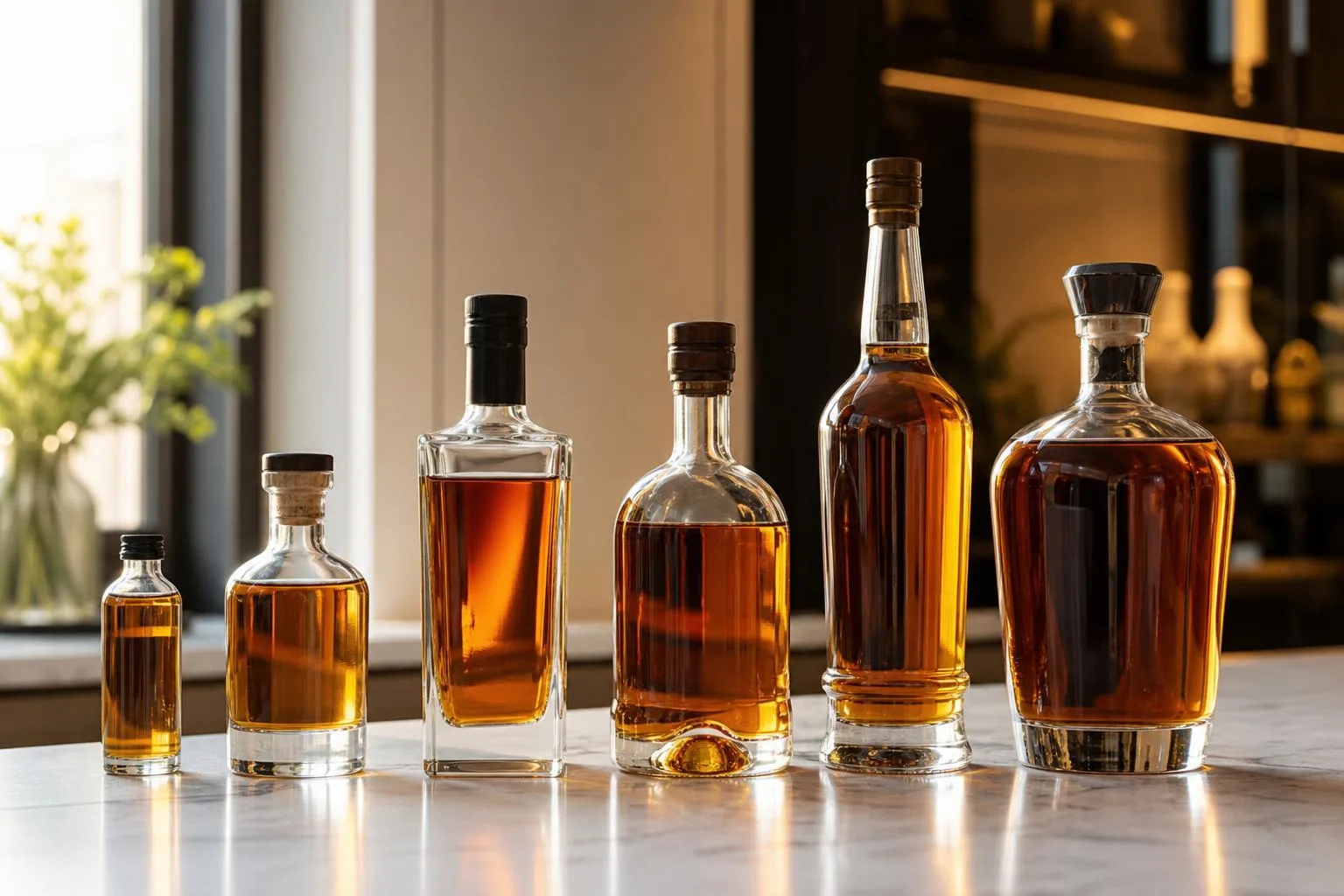
A “fifth” is often used casually, but it has a precise history and a slightly different modern meaning. In U.S. stores today, a fifth usually means a 750 ml bottle of spirits, not an exact one-fifth gallon.
Most confusion comes from mixing bottle size, alcohol strength, pours, and serving counts. Here are the mistakes I see most often when people compare whiskey, vodka, rum, tequila, and liqueurs.
Myth: A fifth is exactly one-fifth of a gallon today
Historically, a fifth referred to one-fifth of a U.S. gallon, about 25.6 fluid ounces. Since U.S. liquor bottles were metricated in 1980, the standard “fifth” became 750 ml, or about 25.36 fluid ounces.
| Term | Volume | Approx. U.S. fluid ounces |
| Old one-fifth gallon | 757 ml | 25.6 fl oz |
| Modern fifth | 750 ml | 25.36 fl oz |
| Standard shot | 44 ml | 1.5 fl oz |
Myth: Every fifth contains the same number of drinks
A 750 ml bottle of 80-proof liquor contains about 17 standard U.S. drinks. That assumes 1.5-ounce pours and 40% alcohol by volume, which matches the National Institute on Alcohol Abuse and Alcoholism definition of one standard drink.
| Bottle / pour | Approximate servings |
| 750 ml bottle, 1.5 oz pours | 16.9 pours |
| 750 ml bottle, 2 oz pours | 12.7 pours |
| 750 ml bottle, 1 oz pours | 25.4 pours |
Myth: A bigger pour is just “one drink”
In bars and home pours, 2 ounces of 80-proof liquor is not one standard drink. It is about 1.3 standard drinks because it contains more pure alcohol than the 1.5-ounce benchmark.
Myth: Proof does not change the math
Proof matters. A fifth of 100-proof bourbon has more alcohol than a fifth of 80-proof vodka, even though the bottles are the same size. Proof is double the alcohol by volume, so 100 proof equals 50% ABV.
- 80 proof: 40% ABV, about 17 standard drinks per 750 ml bottle.
- 100 proof: 50% ABV, about 21 standard drinks per 750 ml bottle.
- 60 proof liqueur: 30% ABV, about 13 standard drinks per 750 ml bottle.
Myth: “Fifth” tells you the price
“Fifth” describes bottle size, not quality or cost. A 750 ml bottle can be a $12 vodka, a $45 single malt, or a $150 limited-release bourbon. The size is the same; the spirit, age, brand, and market demand drive price.
Questions Readers Ask
How much is a fifth of alcohol in ounces?
A fifth of alcohol is 750 milliliters, which equals about 25.36 U.S. fluid ounces. The name comes from the older U.S. bottle size of one-fifth of a gallon, but today the standard “fifth” is legally represented by the 750 mL bottle.
How many shots are in a fifth of liquor?
A 750 mL fifth contains about 16.9 standard 1.5-ounce shots. In practical bar service, that is usually counted as 16 full shots, with a small amount left over depending on how accurately each pour is measured.
How many standard drinks are in a fifth of 80-proof alcohol?
A fifth of 80-proof liquor contains about 17 standard U.S. drinks, because one standard drink is defined as 0.6 fluid ounces of pure alcohol.
Since 80-proof spirits are 40% alcohol by volume, a 750 mL bottle contains roughly 10.1 fluid ounces of pure alcohol.
Is a fifth the same size as a handle?
No, a fifth is 750 mL, while a handle is 1.75 liters, or 1,750 mL. A handle is more than twice the size of a fifth and contains about 39 standard 1.5-ounce shots.
How much does a fifth of alcohol usually cost?
In the U.S., a fifth of mainstream vodka, rum, gin, or whiskey often costs about $10 to $30, while premium bottles commonly run $30 to $80 or more.
Final price depends heavily on the spirit type, brand, age statement, state taxes, and whether it is bought at a liquor store, bar, or restaurant.
Why is a bottle called a fifth if it holds 750 milliliters?
The term “fifth” comes from the older U.S. bottle size of one-fifth of a gallon, which was about 25.6 fluid ounces or roughly 757 milliliters. After metric standardization in 1980, the legal size became 750 milliliters, but the name stayed in common use.
How many 1.5-ounce cocktails can you make from a fifth?
A 750-milliliter fifth contains about 25.36 fluid ounces of liquor. Dividing that by a 1.5-ounce pour yields about 16 full cocktails, with a small remainder of roughly 1.36 ounces, enough for a short extra pour but not another full drink.
How does a fifth compare with other common liquor bottle sizes?
A fifth is 750 milliliters, which places it between a 375-milliliter half bottle and a 1-liter bottle. It is also smaller than a 1.75-liter handle and larger than a 200-milliliter flask, making it the standard full-size bottle in most U.S. retail stores.
Related Reading
- What Soda Goes Good With Malibu Coconut Rum?
- What Rum Does Julian Drink?
- What To Mix With Jack Daniels Honey?
- How Much Sugar In Apothic Red Wine: Essential Guide to Facts, Nutrition & Surprising Details (2026 Edition)
- How To Use Red Wine Vinegar In Cooking?
- How Do You Drink Rum Cream?
- Can Red Wine Give You Diarrhea?
- All Alcohol Guides
- Electronic Code of Federal Regulations, 27 CFR § 5.203 Standards of Fill for Distilled Spirits (2025)
- Alcohol and Tobacco Tax and Trade Bureau, Distilled Spirits Labeling: Net Contents (2024)
- National Institute on Alcohol Abuse and Alcoholism, What Is a Standard Drink? (2024)
- Centers for Disease Control and Prevention, About Moderate Alcohol Use (2024)
- National Institute of Standards and Technology, Appendix B: Conversion Factors (2024)
- Alcohol and Tobacco Tax and Trade Bureau, Beverage Alcohol Manual: Distilled Spirits, Chapter 1 (2020)
- Merriam-Webster Dictionary, Definition of Fifth (2025)