Cognac does contain sugar, though the amount is strictly regulated by the Bureau National Interprofessionnel du Cognac (BNIC) — most VS and VSOP expressions permit up to 1.5 grams per liter, while XO may contain up to 1 gram per liter.
These additions, called dosage, smooth rough edges and harmonize flavors. Many premium producers add zero sugar, relying entirely on barrel aging for sweetness.
Understanding how sugar functions in Cognac production helps drinkers make informed choices about what they pour.
How Sugar Enters Cognac Production
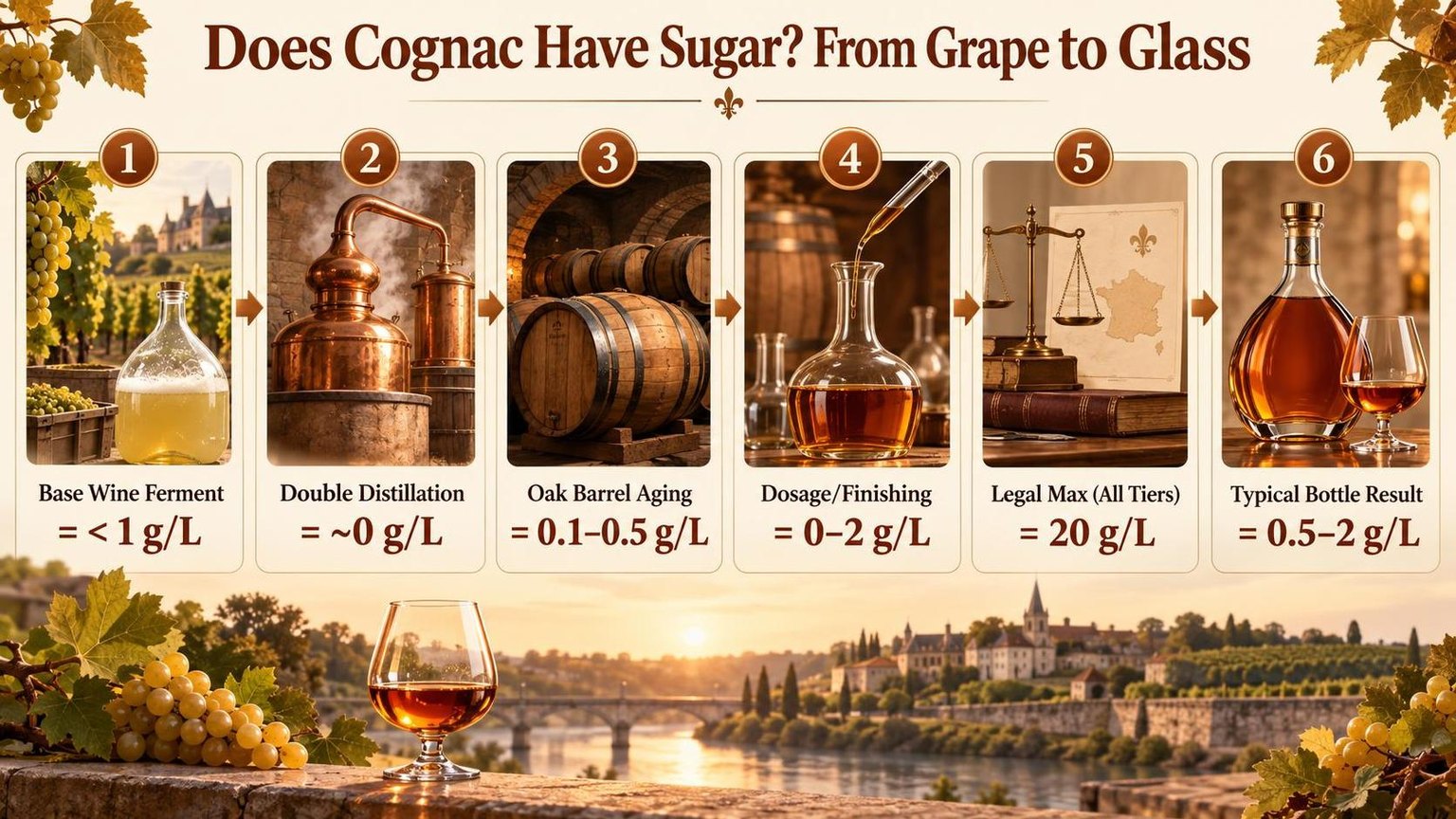
Cognac begins as a bone-dry white wine with zero added sugar, but sweetness can legally enter at multiple stages. Understanding these entry points clarifies why residual sugar levels vary between houses and quality tiers.
Stage 1: Base Wine Fermentation
Ugni Blanc grapes fermented for Cognac production yield a thin, highly acidic wine of 7–9% ABV. Yeast converts virtually all grape sugar into alcohol, leaving a base wine with less than 1 g/L residual sugar.
Stage 2: Double Distillation
The Charentais copper pot still distillation process concentrates alcohol while leaving sugars behind in the spent wash. The resulting eau-de-vie exits the still at 68–72% ABV with effectively 0 g/L sugar.
Stage 3: Oak Barrel Aging
During maturation in Limousin or Tronçais oak, wood compounds including cellulose-derived sugars leach into the spirit.
Extended aging extracts trace amounts—typically under 0.5 g/L—of naturally occurring wood sugars like xylose and arabinose.
Stage 4: Dosage — The Primary Sugar Source
The Bureau National Interprofessionnel du Cognac (BNIC) permits addition of boisé (oak-chip syrup), caramel coloring (E150a), and sugar syrup during finishing. This dosage step accounts for the vast majority of sugar found in bottled Cognac.
EU Regulation (EC) No 110/2008, Annex I, allows Cognac producers to add up to 2 grams of sugar per liter of finished product without disclosure. Most commercial VS and VSOP bottlings use this allowance fully.
| Production Stage | Sugar Contribution (g/L) | Source |
| Base wine post-fermentation | < 1.0 | Residual grape sugar |
| Post-distillation eau-de-vie | ~0 | None (sugar doesn’t distill) |
| Oak barrel extraction | 0.1–0.5 | Wood-derived sugars |
| Dosage/finishing | 0–2.0 | Added cane/beet sugar syrup |
| Typical finished Cognac | 0.5–2.0 | Combined sources |
Houses That Skip Dosage
- Ragnaud-Sabourin — no sugar, no caramel, no chill filtration across all expressions
- Dudognon — zero-dosage Grande Champagne Cognacs aged 10–50+ years
- Jean-Luc Pasquet — certified organic with no additives
These producers bottle at natural sugar levels below 0.5 g/L, derived solely from barrel extraction. Their growing popularity reflects increasing consumer demand for transparency in spirits production.
Legal Sugar Limits in Cognac Categories
EU Regulation 2019/787 and the Bureau National Interprofessionnel du Cognac (BNIC) set precise maximum sugar levels for each Cognac age category.
These limits allow producers to add small amounts of sugar syrup—called liqueur de dosage—for flavor smoothing, but cap the total permitted dosage.
The legal maximum is expressed in grams of sugar per liter, measured as sucrose equivalent. Younger categories receive higher allowances; older expressions get less.
| Cognac Category | Minimum Age | Max Sugar (g/L) | Max Sugar (g/bottle, 700 mL) |
| VS (Very Special) | 2 years | 20 g/L | 14 g |
| VSOP (Very Superior Old Pale) | 4 years | 20 g/L | 14 g |
| Napoléon | 6 years | 20 g/L | 14 g |
| XO (Extra Old) | 10 years | 20 g/L | 14 g |
| XXO (Extra Extra Old) | 14 years | 20 g/L | 14 g |
All categories share the same 20 g/L ceiling. That equals roughly two teaspoons of sugar per standard 700 mL bottle—far less than most liqueurs, which can exceed 100 g/L.
What Counts Toward the Limit
The regulation covers all added sugars, including beet sugar, cane sugar, and caramel (E150a). Caramel is primarily used for color standardization, but its sugar content counts toward the 20 g/L cap.
- Sugar syrup (liqueur de dosage): dissolved sucrose added before bottling to soften harshness in younger eaux-de-vie
- Caramel coloring (E150a): contributes trace sugar, typically 0.5–2 g/L
- Boisé: oak chip infusion occasionally used, adds negligible sugar
Industry Practice vs. Legal Maximum
Most major Cognac houses add well below the 20 g/L limit. Independent analyses by Cognac Expert and spirit reviewers have found typical dosages between 5–12 g/L for VS and VSOP expressions.
Premium XO bottlings frequently contain under 5 g/L, as extended barrel aging develops natural sweetness from wood sugars and oxidative reactions, reducing the need for added dosage.
Some producers now market “brut” or “zero dosage” Cognacs with no added sugar.
These remain niche—representing under 5% of total Cognac production—but reflect growing consumer demand for transparency about sugar content.
Notably, Cognac’s 20 g/L maximum is far stricter than Armagnac’s identical 20 g/L cap but dramatically lower than rum or whisky liqueurs, which face no EU-mandated upper limit below the 100 g/L liqueur threshold.
VS VSOP XO Sugar Content Compared
Cognac’s sugar content varies by age classification, though not always in the direction consumers expect.
EU regulations permit up to 20 grams of sugar per liter for standard Cognac, and producers add different amounts depending on the category and house style.
The three main Cognac age designations—VS, VSOP, and XO—carry distinct flavor profiles that influence how much dosage producers typically add.
| Category | Minimum Aging | Typical Sugar Added (g/L) | Calories per 1.5 oz Pour |
| VS (Very Special) | 2 years | 8–15 | ~98–105 |
| VSOP (Very Superior Old Pale) | 4 years | 5–12 | ~96–102 |
| XO (Extra Old) | 10 years | 0–8 | ~96–100 |
VS Cognacs generally receive the highest sugar dosage. Younger eaux-de-vie have sharper, more aggressive alcohol notes that producers smooth out with added sucrose or beet sugar.
VSOP expressions sit in the middle range. Four or more years in Limousin or Tronçais oak barrels extract natural vanillin and tannins that provide perceived sweetness, reducing the need for added sugar.
XO Cognacs often contain the least added sugar. A decade or more of barrel aging develops complex caramel, dried fruit, and rancio notes that deliver inherent sweetness without dosage. Some premium XO bottlings add zero sugar.
Key Factors Beyond Age Category
- House style: Hennessy VS contains approximately 11 g/L of sugar, while Rémy Martin VSOP typically contains around 8–10 g/L. Each maison sets its own dosage within legal limits.
- Caramel coloring (E150a): Permitted in all categories, this adds negligible sugar but contributes to perceived sweetness through color psychology and trace flavor compounds.
- Brut de fût bottlings: Cask-strength Cognacs labeled “brut de fût” or “brut absolu” typically contain zero added sugar and no coloring, regardless of age category.
- Legal ceiling: The Bureau National Interprofessionnel du Cognac (BNIC) enforces the EU maximum of 20 g/L, though most producers stay well below this threshold.
For context, 15 g/L of sugar in a VS Cognac translates to roughly 0.7 grams per standard 1.5 oz (44 mL) pour—far less than a 5 oz glass of off-dry Riesling at approximately 7–10 grams.
Consumers tracking sugar intake should check individual producer disclosures. French labeling law does not require sugar content on Cognac bottles, making independent lab analyses the most reliable data source.
Why Cognac Tastes Sweet Without Sugar
Cognac can taste distinctly sweet even when it contains zero added sugar.
This perceived sweetness comes from a combination of volatile aromatic compounds, oak-derived molecules, and ethanol itself—all of which trick your palate into registering sweetness without any sucrose present.
Ethanol’s Direct Sweet Taste
Ethanol activates the T1R3 sweet taste receptor on the tongue. At 40% ABV—Cognac’s minimum bottling strength—this activation is significant enough to create a measurable sweet sensation independent of any sugar content.
Oak-Derived Compounds
During aging in Limousin or Tronçais oak barrels, Cognac extracts specific compounds that contribute perceived sweetness. The longer the aging, the more concentrated these molecules become.
| Compound | Source | Flavor Contribution |
| Vanillin | Oak lignin breakdown | Vanilla sweetness |
| Eugenol | Oak extractives | Spicy-sweet warmth |
| Furfural | Hemicellulose thermal degradation | Caramel, butterscotch |
| Lactones (cis/trans) | Oak lipid oxidation | Coconut-like sweetness |
| Syringaldehyde | Lignin decomposition | Toasty, sweet-woody |
Vanillin concentrations in aged Cognac can reach 3–10 mg/L, according to published spirit chemistry analyses. This single compound accounts for much of the “dessert-like” character tasters describe in XO expressions.
Ester Formation During Aging
Over decades in barrel, slow esterification reactions produce fruity esters.
Ethyl acetate, ethyl octanoate, and ethyl decanoate generate aromas of ripe stone fruit, dried apricot, and candied citrus—all coded as “sweet” by the brain.
A 2019 study in Food Chemistry identified over 280 volatile compounds in aged Cognac. Many fall into ester and aldehyde families that trigger cross-modal sweetness perception through aroma alone.
Cross-Modal Perception
Neuroscience confirms that smell and taste interact.
Fruity or vanilla aromas delivered retronasally—from the back of the throat to the olfactory bulb—enhance perceived sweetness by 10–40%, even in solutions containing no sugar whatsoever.
- Retronasal aroma: fruit esters signal sweetness to the brain before taste receptors engage
- Color cue: Cognac’s deep amber hue primes the drinker to expect sweetness
- Mouthfeel: glycerol (0.5–1.5 g/L in Cognac) adds viscosity, mimicking the texture of sugared liquids
Together, these mechanisms explain why a VS with legally zero dosage can taste sweeter than a dry white wine containing 2 g/L residual sugar. Cognac’s sweetness is largely an elegant sensory illusion built by chemistry and time.
Reading Sugar Levels on Cognac Labels
Cognac labels rarely display sugar content directly, but EU regulations and the Bureau National Interprofessionnel du Cognac (BNIC) govern how much sugar each designation may contain.
Understanding these rules lets you decode sweetness from the label alone.
EU-Regulated Sugar Limits by Designation
European Regulation (EC) No 110/2008 sets maximum dosage (liqueur d’expédition) levels for Cognac based on its labeled category. These limits refer to added sugar, measured in grams per liter.
| Label Designation | Maximum Added Sugar (g/L) | Approximate Sugar per 1.5 oz Pour |
| VS (Very Special) | 20 g/L | ≤ 0.89 g |
| VSOP (Very Superior Old Pale) | 20 g/L | ≤ 0.89 g |
| XO (Extra Old) | 20 g/L | ≤ 0.89 g |
| Napoléon | 20 g/L | ≤ 0.89 g |
| Extra / Hors d’âge | 20 g/L | ≤ 0.89 g |
The uniform 20 g/L cap applies across all Cognac age statements. In practice, most premium producers add far less — typically between 1.5 g/L and 8 g/L.
What You Won’t Find on the Label
Unlike wine, Cognac labels are not required to list exact sugar content, calorie counts, or nutritional information under current EU or US (TTB) labeling laws. Consumers must rely on other cues.
- “Brut” or “Brut de Fût” — indicates zero added sugar, bottled at cask strength without dosage
- “Non Dosé” or “Sans Sucre Ajouté” — explicitly signals no sugar addition; used by producers like Dudognon and Ragnaud-Sabourin
- “Dry” or “Extra Dry” — not officially regulated terms in Cognac but occasionally appear, suggesting minimal sweetness
How Producers Disclose Voluntarily
Some houses now publish sugar levels on their websites or technical data sheets. Rémy Martin states its VSOP contains approximately 8 g/L of added sugar. Hennessy’s VS reportedly uses around 6–9 g/L.
Independent bottlers like Jean-Luc Pasquet and Fanny Fougerat often market zero-dosage Cognacs, labeling them explicitly to attract sugar-conscious consumers.
When a Cognac label lacks sugar terminology entirely, assume the producer has added some dosage — likely between 3 g/L and 15 g/L. Contacting the producer directly or checking importer tech sheets remains the most reliable verification method.
Low-Sugar Cognac Brands Worth Trying
Cognac regulations allow producers to add up to 1.5 grams of sugar per liter for VS and VSOP, and up to 2 grams per liter for XO expressions. Some houses add the maximum; others add none. Choosing wisely means fewer hidden sugars in your glass.
Sugar Content Across Major Cognac Houses
Independent laboratory analyses and producer disclosures reveal significant variation in dosage practices among well-known brands.
| Brand & Expression | Estimated Sugar (g/L) | Age Category |
| Delamain Pale & Dry XO | ~2.0 | XO |
| Rémy Martin VSOP | ~1.5 | VSOP |
| Hennessy VS | ~1.5 | VS |
| Pierre Ferrand 1840 | ~1.0 | VS equivalent |
| Dudognon Réserve | 0 | VSOP equivalent |
| Paul Beau Hors d’Âge | 0 | Hors d’Âge |
| Jean-Luc Pasquet L’Organic | 0 | Various |
Why Some Producers Skip Sugar Entirely
Small estate producers like Dudognon, Paul Beau, and Jean-Luc Pasquet rely on extended barrel aging rather than dosage to achieve smoothness. Longer maturation develops natural sweetness from oak vanillins and tannin polymerization.
These artisan houses often distill on their own estates in Grande Champagne or Petite Champagne, the two premier crus. Their spirits typically rest 10–50 years before bottling.
What to Look For on Labels
- “Brut de fût” or “cask strength” — almost always zero dosage, bottled without dilution or additives
- “Sans sucre ajouté” — explicitly states no added sugar, though rarely printed
- Single-estate or “propriétaire” — smaller producers are more likely to skip sugar and caramel additions
- Higher age statements — XO and Hors d’Âge expressions need less sugar because extended aging naturally rounds harsh edges
Practical Considerations
Even at the legal maximum of 2 g/L, a standard 40 mL pour of cognac contains under 0.08 grams of added sugar. That is negligible compared to a 150 mL glass of off-dry Riesling at roughly 9 grams.
For diabetics or strict keto dieters tracking every fraction, zero-dosage estate cognacs from producers like Dudognon or Pasquet eliminate the variable entirely. These bottles typically retail between $50 and $120.
The naturally occurring residual sugars in any distilled spirit are effectively zero. Distillation separates alcohol from sugar, so only post-distillation additions contribute to the final count.
Questions People Ask Most
Does Cognac Have Sugar?
Straight Cognac contains virtually no residual sugar from fermentation, but producers are legally permitted to add a small dosage of sugar called “liqueur d’expédition” before bottling.
The Bureau National Interprofessionnel du Cognac (BNIC) allows up to 1.5 grams of sugar per liter for VS, VSOP, and XO designations.
This means a standard 750 ml bottle may contain just over 1 gram of added sugar — negligible compared to most spirits-based liqueurs.
How Many Calories Come From Sugar in a Glass of Cognac?
A 40 ml pour of Cognac contains roughly 95–100 calories, nearly all derived from its 40% ABV ethanol content rather than sugar.
At the maximum permitted 1.5 g/L dosage, that same pour contributes only about 0.06 grams of sugar — less than 0.25 calories from sugar. Alcohol itself provides 7 calories per gram, making ethanol the dominant caloric source.
Is Cognac a Good Low-Sugar Spirit Option for Diabetics?
Cognac ranks among the lowest-sugar spirits available, with 0–1.5 grams of sugar per liter, comparable to unsweetened whisky or dry gin.
The American Diabetes Association notes that moderate alcohol consumption (one drink per day for women, two for men) can be part of a managed diet.
However, Cognac cocktails mixed with juice, tonic, or liqueurs can add 15–30 grams of sugar per serving, negating this advantage entirely.
Do Older Cognacs Like XO Contain More Sugar Than VS?
All Cognac age categories — VS (minimum 2 years), VSOP (minimum 4 years), and XO (minimum 10 years) — fall under the same 1.5 g/L maximum sugar addition limit set by the Appellation d’Origine Contrôlée regulations.
In practice, many premium XO producers add zero dosage to preserve the complex flavors developed during extended oak aging. Some VS Cognacs actually receive more dosage to smooth out their younger, harsher character.
What Is the Difference Between Cognac and Cognac-Based Liqueurs in Sugar Content?
Cognac-based liqueurs such as Grand Marnier (which blends Cognac with bitter orange essence) contain approximately 274 grams of sugar per liter — over 180 times the maximum permitted in straight Cognac.
Similarly, Alizé VS Cognac liqueur contains around 280 g/L of sugar.
This distinction matters: EU regulations require any product labeled “liqueur” to contain at least 100 g/L of sugar, while products labeled simply “Cognac” must stay at or below 1.5 g/L.
Does the Distillation Process Remove All Natural Grape Sugar From Cognac?
Yes. Cognac begins as a fully fermented, bone-dry white wine (typically 7–9% ABV) made from Ugni Blanc grapes, meaning yeast has already converted nearly all grape sugar into alcohol before distillation begins.
The double distillation in copper pot stills (Charentais alembics) then separates volatile compounds by boiling point, leaving any trace residual sugar behind in the still.
The resulting eau-de-vie exits the still with effectively zero sugar content.
How Can You Tell If a Cognac Has Added Sugar?
Cognac producers are not required to list sugar additions on the label, making detection difficult for consumers.
The term “Brut de Fût” (cask strength) or “Sans Sucre Ajouté” (no added sugar) on a label guarantees zero dosage — brands like Grosperrin and Jean-Luc Pasquet use these designations.
Without such labeling, tasting for a faintly sweet, rounded finish versus a drier, more austere profile can indicate whether dosage was applied, though barrel tannins can mimic sweetness.
Related Guides
- How To Make Cognac At Home?
- What Goes Good With Cognac?
- What To Mix With Cognac?
- How Much Is A 5Th Of Hennessy?
- What Is Hennessy Made From?
- Cavasia Cognac Review – Basic Information You Must Know
- What To Mix Remy Martin With?
- Is Hennessy Brandy?
- Is Cognac An After-Dinner Drink?
- All Alcohol Guides
- USDA FoodData Central – Distilled Spirits, Brandy (2024)
- TTB – Alcohol and Tobacco Tax and Trade Bureau: Spirits Labeling Regulations (2023)
- FDA – CFR Title 21: Labeling of Alcoholic Beverages (2024)
- National Center for Biotechnology Information – Sugar Content of Popular Sweetened Beverages and Alcoholic Drinks (2016)
- Bureau National Interprofessionnel du Cognac (BNIC) – Cognac Specifications and Production Standards (2024)
- Harvard T.H. Chan School of Public Health – Alcohol: Balancing Risks and Benefits (2023)
- MasterClass – What Is Cognac? A Guide to French Brandy (2023)