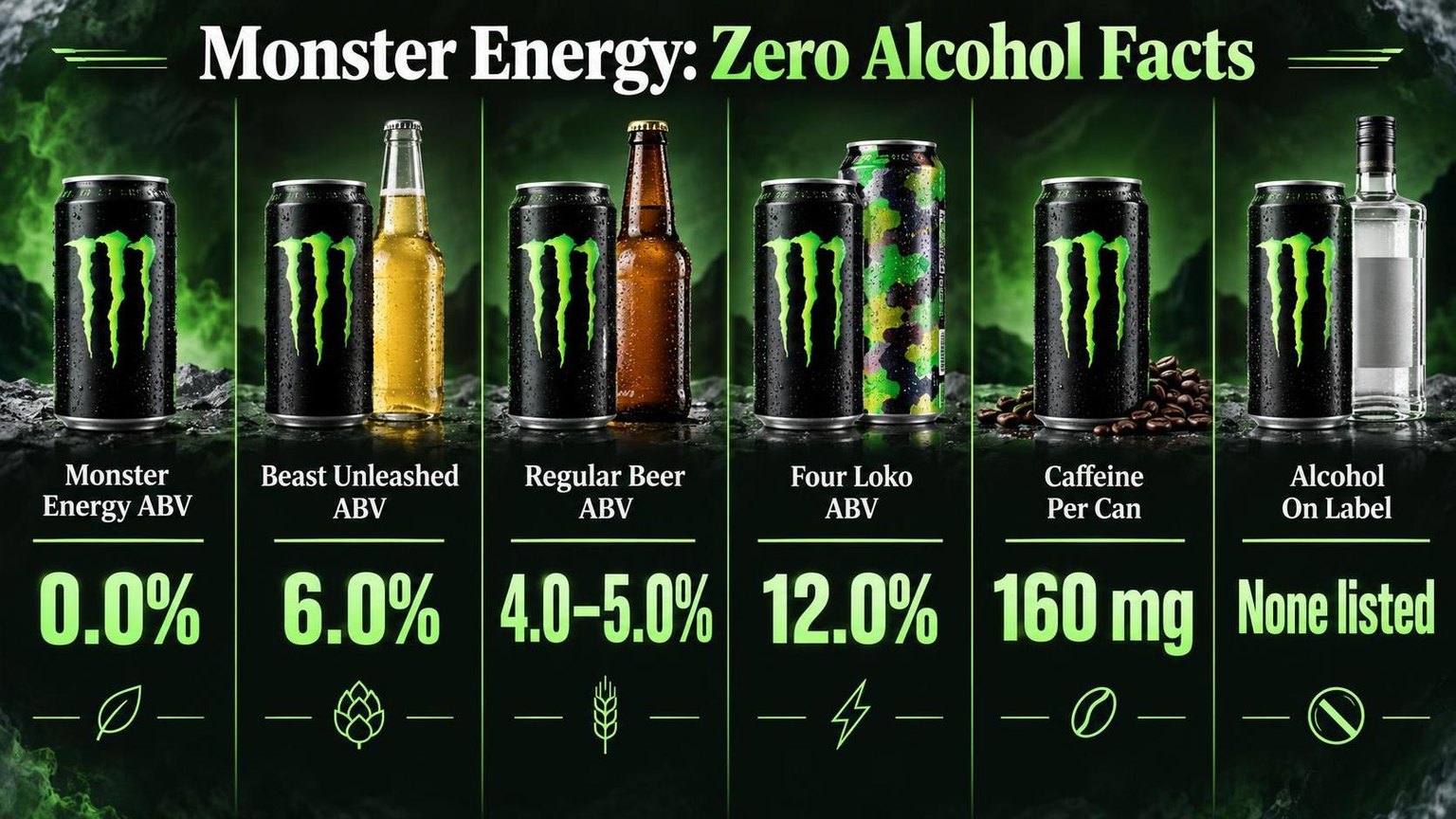
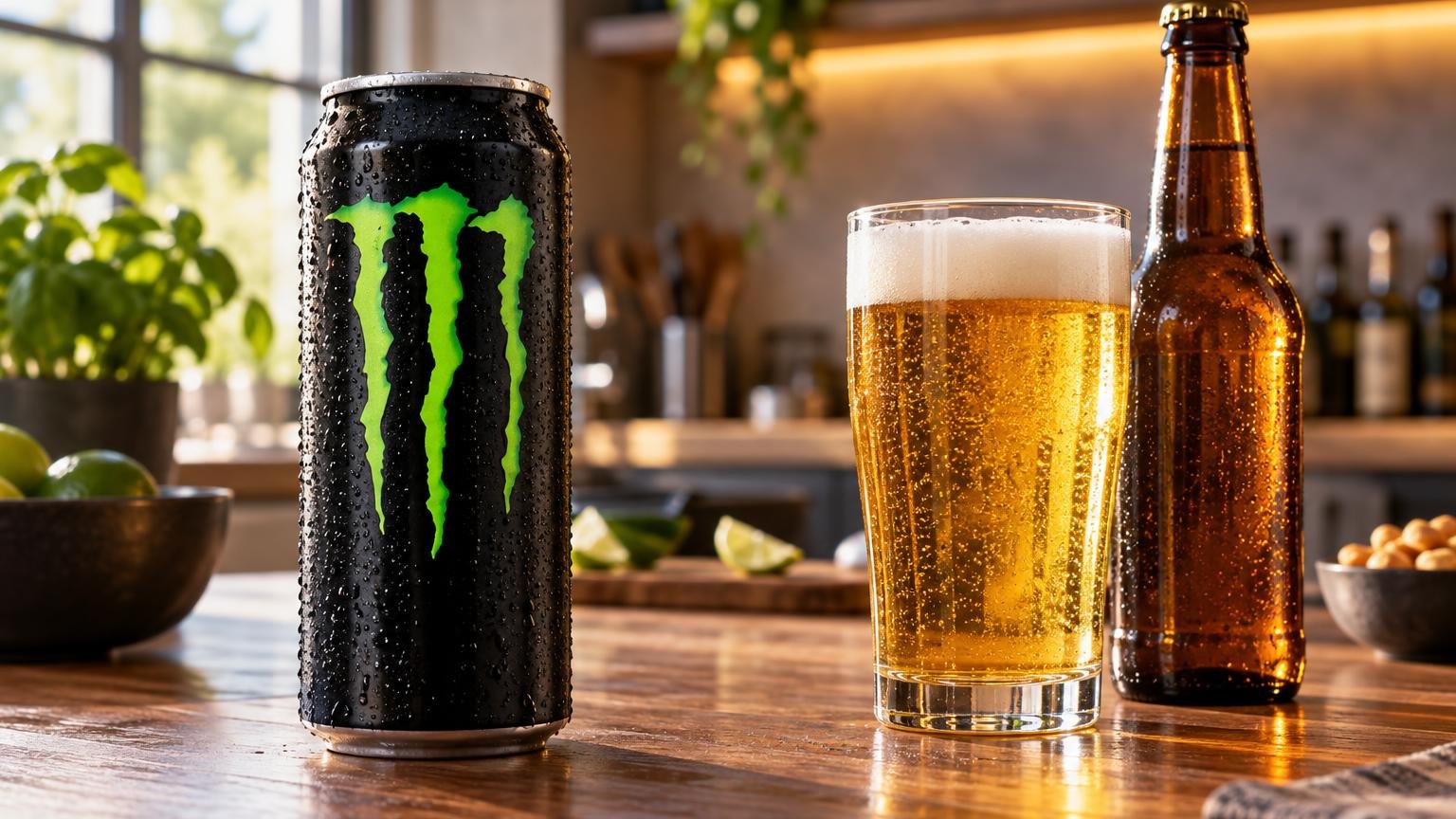
Does Monster Energy Drink Have Alcohol? is answered no: standard Monster Energy cans are non-alcoholic beverages sold as energy drinks, not beer, wine, spirits, or ready-to-drink cocktails.
In the United States, the regular product label does not list alcohol as an ingredient.
The confusion usually comes from the brand name, nightlife marketing, and mixed-drink habits, not the can itself. A sealed Monster Energy drink from a normal retail shelf is not regulated or sold as an alcoholic beverage.
This article explains what “non-alcoholic” means on U.S. labels, how to read Monster ingredients, and when alcohol may enter the picture through separate mixing after purchase.
Does Monster Contain Alcohol
Standard Monster Energy drinks contain zero alcohol. They are classified as non-alcoholic beverages by the FDA and are sold alongside soft drinks, not in liquor aisles.
Monster Beverage Corporation produces no alcoholic products under the Monster Energy line.
Monster Energy’s ingredient list includes carbonated water, sucrose, glucose, citric acid, taurine, sodium citrate, natural flavors, panax ginseng extract, L-carnitine, caffeine, sorbic acid, benzoic acid, niacinamide, sucralose.
Riboflavin, guarana extract, pyridoxine hydrochloride, and cyanocobalamin.
Alcohol is absent from this formulation.
Monster Energy Alcohol Content vs. Common Beverages
| Beverage | Alcohol by Volume (ABV) | Category |
| Monster Energy (16 oz) | 0.0% | Energy drink |
| Monster Reserve (16 oz) | 0.0% | Energy drink |
| Monster Ultra (16 oz) | 0.0% | Energy drink |
| Regular beer | 4.0–5.0% | Alcoholic |
| Four Loko | 12.0% | Flavored malt beverage |
| Hard seltzer (typical) | 4.5–5.0% | Alcoholic |
Why the Confusion Exists
Several factors fuel the misconception that Monster contains alcohol:
- Mixing culture: Monster is frequently combined with vodka, rum, or Jägermeister in bars and at parties, blurring its identity as a standalone non-alcoholic product.
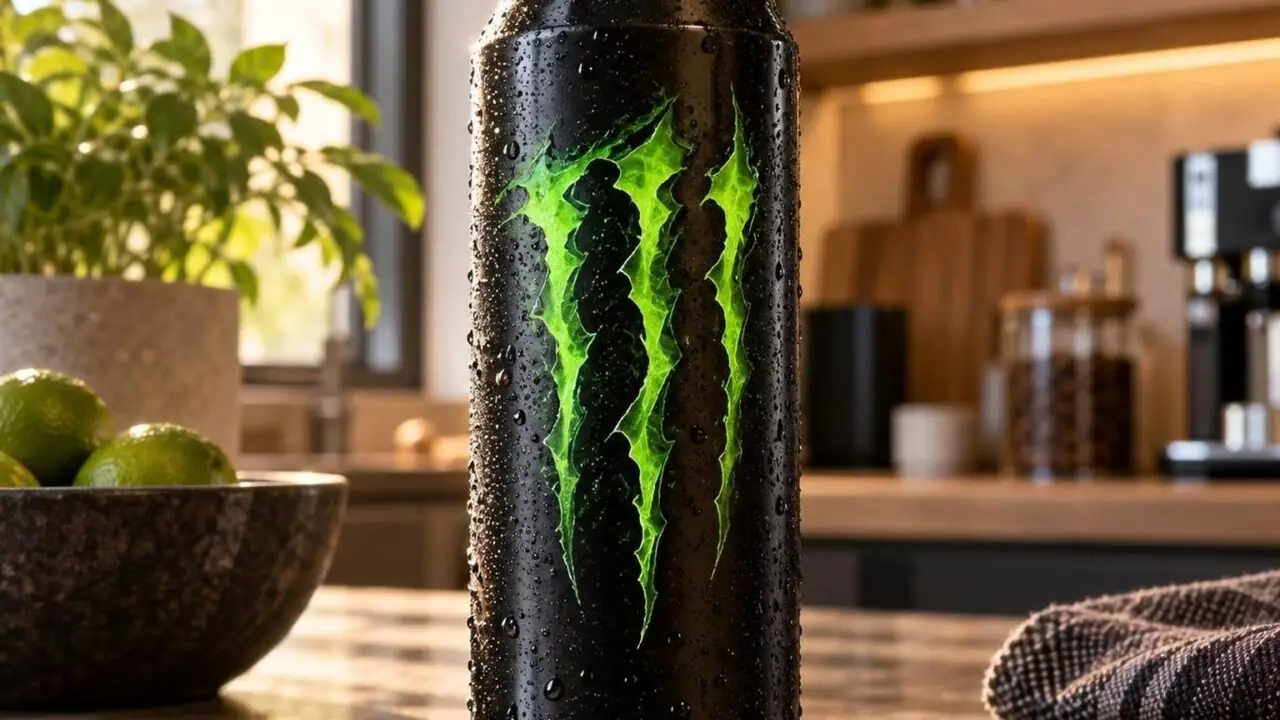
- Aggressive branding: The claw-mark logo, dark can design, and names like “Assault” and “Chaos” project an edgy image some associate with adult beverages.
- The “Beast Unleashed” line: In 2023, Monster Beverage Corporation launched “The Beast Unleashed,” a separate flavored malt beverage containing 6.0% ABV. This product is sold exclusively in liquor stores and alcohol sections—not under the Monster Energy label.
- Caffeine-alcohol drink bans: The FDA’s 2010 warning letters to brands like Four Loko, which combined caffeine with alcohol, created lasting public conflation between energy drinks and alcoholic beverages.
Key Distinction: Monster Energy vs. The Beast Unleashed
The Beast Unleashed is brewed by Monster Brewing Company, a subsidiary.
It carries mandatory alcohol labeling, requires age verification for purchase, and has 6.0% ABV across its flavors including Mean Green, White Haze, Peach Perfect, and Scary Berries.
No Monster Energy drink—Original, Ultra, Java, Juice, or Rehab—contains any measurable alcohol. Consumers can verify this on every can’s Supplement Facts panel, which lists no ethanol content.
What Monster Labels Actually Say
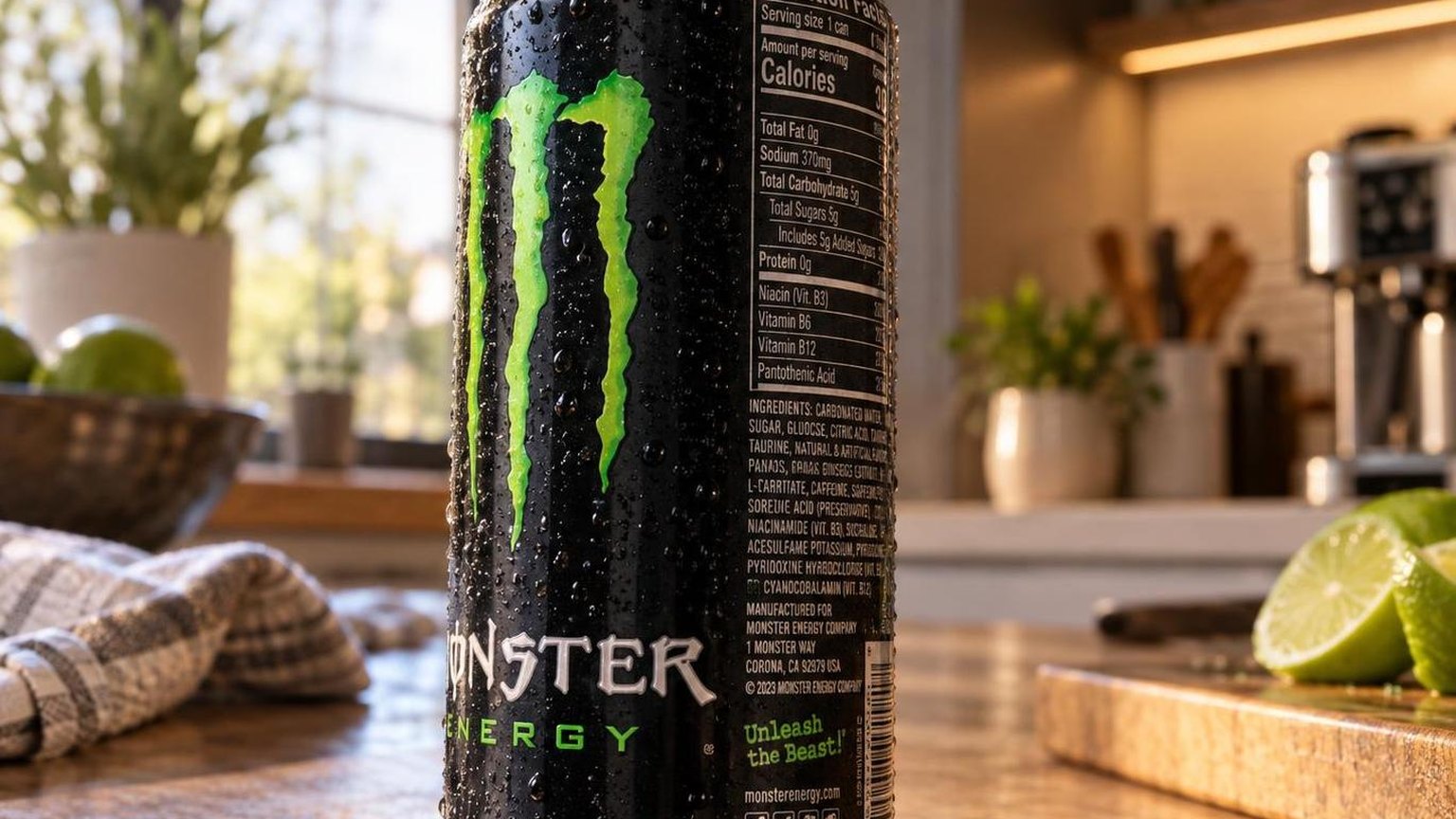
Every standard Monster Energy can sold in the United States carries a Supplement Facts panel—not a Nutrition Facts panel.
This distinction matters because Monster classifies its products as dietary supplements, which follow different FDA labeling rules than conventional beverages.
The standard 16 fl oz Monster Energy contains no alcohol declaration anywhere on its label. FDA regulations require any beverage containing 0.5% ABV or more to disclose alcohol content.
Monster’s absence of such disclosure confirms its non-alcoholic status.
Key Label Declarations on a Standard 16 fl oz Monster Energy
| Label Element | What It States |
| Serving Size | 1 can (16 fl oz / 473 mL) |
| Calories | 210 |
| Total Sugars | 54 g |
| Caffeine | 160 mg per can |
| Alcohol Declaration | None listed |
| Panel Type | Supplement Facts |
| Energy Blend | 5,000 mg (taurine, panax ginseng, L-carnitine, caffeine, glucuronolactone, guarana) |
Monster’s ingredient list includes carbonated water, sugar, glucose, citric acid, natural flavors, taurine, sodium citrate, color added, panax ginseng extract, L-carnitine, caffeine, sorbic acid, benzoic acid, niacinamide, sucralose, salt.
D-glucuronolactone, inositol, guarana extract, pyridoxine hydrochloride, and riboflavin.
No ethanol or alcohol-derived ingredients appear.
Warnings Printed on the Can
- “Not recommended for children, people sensitive to caffeine, pregnant women, or women who are nursing.”
- “Consume responsibly — limit 3 cans per day.”
- “Do not mix with alcohol.” — This warning explicitly treats alcohol as a separate, external substance.
The “do not mix with alcohol” advisory is particularly telling. Monster’s own labeling treats alcohol as something consumers might add—not something already present in the can.
Monster Beverage Corporation shifted some products from Supplement Facts to Nutrition Facts panels starting in 2013 following FDA scrutiny.
Regardless of which panel format a specific SKU uses, no Monster Energy product lists ethanol, alcohol content, or any ABV percentage.
For comparison, products like Four Loko or hard seltzers that actually contain alcohol must display ABV prominently and carry TTB (Alcohol and Tobacco Tax and Trade Bureau) approval—requirements Monster products do not meet and do not need.
Monster Energy Versus Alcoholic Drinks
Monster Energy and alcoholic beverages serve fundamentally different purposes and carry distinct health risks.
Comparing their nutritional profiles reveals why mixing them—a practice the FDA has scrutinized since 2010—remains controversial and potentially dangerous.
Nutritional and Chemical Comparison
The following table compares a standard 16 fl oz Monster Energy Original with common alcoholic drinks per typical serving size.
| Attribute | Monster Energy (16 fl oz) | Regular Beer (12 fl oz) | Red Wine (5 fl oz) | Vodka Shot (1.5 fl oz) |
| Calories | 210 | 153 | 125 | 97 |
| Sugar | 54 g | 0–2 g | 1 g | 0 g |
| Alcohol by Volume | 0% | 4–5% | 12–15% | 40% |
| Caffeine | 160 mg | 0 mg | 0 mg | 0 mg |
| Sodium | 370 mg | 14 mg | 5 mg | 0 mg |
Why the Combination Is Risky
Caffeine masks alcohol’s sedative effects, creating what researchers call “wide-awake drunk.” A 2013 study in Alcoholism:
Clinical & Experimental Research found that people who mixed energy drinks with alcohol consumed 36% more alcohol per session.
The CDC has stated that drinkers aged 15–23 who mix energy drinks with alcohol are four times more likely to binge drink than those who consume alcohol alone.
Key Physiological Differences
- Metabolism: Alcohol is processed by the liver at roughly one standard drink per hour. Caffeine’s half-life is 5–6 hours, meaning stimulant effects persist long after alcohol impairment begins.
- Dehydration: Both alcohol and caffeine act as diuretics. Combined consumption accelerates fluid loss, increasing hangover severity and cardiac strain.
- Heart rate: Monster’s 160 mg caffeine can raise heart rate by 5–10 bpm. Alcohol initially dilates blood vessels, then triggers compensatory tachycardia—compounding cardiovascular stress when combined.
Regulatory Actions
In 2010, the FDA issued warning letters to four companies selling pre-mixed caffeinated alcoholic beverages, declaring added caffeine an “unsafe food additive.” Products like Four Loko subsequently removed caffeine from their formulas.
Monster Energy itself contains zero alcohol and is classified as a conventional beverage, not a dietary supplement, since 2013. Its label carries no alcohol warnings because none is required.
Why Monster Gets Linked With Alcohol
Monster Energy contains zero alcohol, yet persistent consumer confusion ties the brand to alcoholic beverages.
This association stems from specific marketing choices, product naming conventions, and the widespread practice of mixing energy drinks with spirits.
The “Monster + Vodka” Cocktail Culture
Mixing energy drinks with alcohol became a mainstream bar trend in the early 2000s. A 2017 study in the Journal of Clinical Medicine found that 25–33% of young adults aged 18–35 reported combining energy drinks with alcohol.
Monster’s strong, sweet flavor profiles—especially flavors like Mango Loco and Pipeline Punch—make them popular mixers. Bartenders and consumers frequently pair them with vodka, Jägermeister, and rum.
Brand Positioning That Blurs Lines
Monster sponsors UFC fights, motocross events, and music festivals where alcohol flows freely. The brand’s black-and-neon aesthetic mirrors craft beer and hard seltzer packaging more than typical soft drink design.
Monster Beverage Corporation acquired a 5.36% stake in Constellation Brands (a major beer and spirits company) through a brand swap deal in 2015. Constellation simultaneously invested in Monster.
This corporate overlap reinforces perceived connections.
Products Commonly Confused With Alcoholic Drinks
Several Monster product lines have names and packaging that contribute to confusion:
| Product | ABV | Category | Source of Confusion |
| Monster Energy (Original) | 0.0% | Energy drink | Tall can resembles malt liquor format |
| The Beast Unleashed | 6.0% | Flavored malt beverage | Uses Monster branding, actually alcoholic |
| Monster Reserve | 0.0% | Energy drink | Name echoes wine/whiskey terminology |
| Nasty Beast Hard Tea | 6.0% | Hard tea | Monster sub-brand, sold near energy drinks |
The Beast Unleashed: Monster’s Actual Alcohol Line
In 2023, Monster officially entered the alcohol market with “The Beast Unleashed,” a 6% ABV flavored malt beverage sold in four flavors. This launch cemented the brand crossover that consumers had long assumed existed.
Nasty Beast Hard Tea followed in 2024 at the same 6% ABV. Both products use Monster’s distribution network but carry distinct labeling per TTB (Alcohol and Tobacco Tax and Trade Bureau) requirements.
- Standard Monster cans carry Supplement Facts or Nutrition Facts labels regulated by the FDA.
- Beast Unleashed and Nasty Beast carry government warning statements required on all alcoholic beverages.
- Retailers must stock the alcoholic versions in beer and spirits sections, not alongside energy drinks.
The confusion is understandable—Monster now operates in both categories. Checking the label for an ABV percentage or a government warning remains the fastest way to distinguish the two.
Caffeine Sugar And Alcohol Confusion
Monster Energy’s ingredient label lists no ethanol, yet persistent myths link the drink to alcohol.
The confusion stems from its high caffeine and sugar content, its marketing aesthetic, and its history of being mixed with spirits at bars and parties.
A standard 16 fl oz (473 mL) Monster Energy contains 160 mg of caffeine — roughly equivalent to two 8 oz cups of brewed coffee. It also packs 54 g of sugar across that same can.
Neither ingredient is alcohol, but both produce noticeable physiological effects that some consumers misattribute.
Monster Energy vs. Alcoholic Beverages: Key Numbers
| Beverage (Serving Size) | Alcohol by Volume | Caffeine | Sugar |
| Monster Energy (16 fl oz) | 0% | 160 mg | 54 g |
| Budweiser Beer (12 fl oz) | 5% | 0 mg | ~3.2 g |
| Four Loko (23.5 fl oz) | 12% | 0 mg (post-2010 reformulation) | ~60 g |
| Monster The Beast Unleashed (12 fl oz) | 6% | 0 mg | ~34 g |
Monster Hansen Beverage Company launched “The Beast Unleashed” in 2023 — a flavored malt beverage at 6% ABV. This separate product line contains zero caffeine and is sold exclusively in liquor stores or alcohol sections.
The original Monster Energy line and The Beast Unleashed share branding elements like the claw logo. Shelf proximity in some retail locations amplifies consumer confusion between the two distinct product categories.
Why the Myth Persists
- Mixer culture: Vodka-Monster and Jägerbomb cocktails became mainstream in the mid-2000s, fusing the brand’s identity with nightlife drinking.
- Stimulant effects: Caffeine at 160 mg triggers elevated heart rate and alertness, sensations some associate with an alcohol “buzz.”
- Sugar crash: Consuming 54 g of sugar in minutes can cause a rapid energy spike followed by fatigue, mimicking post-drinking symptoms.
- Black-can branding: The dark, edgy packaging resembles craft beer or stout cans more than typical soft drinks.
The FDA classifies Monster Energy as a conventional food, not an alcoholic beverage. Its Supplement Facts panel is required to disclose all active ingredients. Ethanol has never appeared on that panel for the core energy drink line.
Checking the label remains the fastest way to verify. If the can states 0% ABV and carries no government alcohol warning, it contains no alcohol. The Beast Unleashed, by contrast, carries mandatory TTB alcohol labeling.
Safe Mixing With Alcohol Considerations
Monster Energy contains zero alcohol, but millions of consumers deliberately mix it with spirits.
The CDC has explicitly warned against combining energy drinks with alcohol, citing increased risk of binge drinking and impaired judgment of intoxication levels.
Caffeine masks the depressant effects of alcohol. Drinkers feel more alert than they actually are, which researchers at Wake Forest University found leads to consuming 36% more alcohol per session compared to alcohol-only drinkers.
Caffeine and Alcohol Interaction Facts
| Factor | Alcohol Only | Alcohol + Energy Drink |
| Perceived intoxication | Matches actual BAC | Significantly underestimated |
| Average drinks per session | 4.7 | 6.4 |
| Risk of riding with impaired driver | Baseline | 4× more likely (CDC data) |
| Likelihood of binge drinking | Baseline | 2× more likely |
| Caffeine per 16 oz Monster | N/A | 160 mg |
Specific Health Risks
- Cardiac stress: Alcohol dilates blood vessels while caffeine constricts them, creating competing cardiovascular demands. A 2017 Journal of the American Heart Association study found energy drinks raised blood pressure by 5 mmHg and delayed QTc intervals by 10 milliseconds.
- Dehydration: Both caffeine and alcohol are diuretics. Combined consumption accelerates fluid loss, increasing hangover severity and kidney strain.
- Overconsumption: The stimulant effect of 160 mg caffeine in one Monster can delay fatigue signals, allowing drinkers to consume well past their normal tolerance threshold.
- Sugar load: A standard 16 oz Monster adds 54 grams of sugar per cocktail, compounding the caloric impact of alcoholic mixers.
Harm Reduction Guidelines
The FDA has not approved caffeine as a safe additive to alcoholic beverages. In 2010, the agency banned pre-mixed caffeinated alcoholic drinks like Four Loko’s original formula.
If consumers choose to mix Monster with alcohol, medical professionals recommend limiting intake to one caffeinated drink per occasion and staying below 200 mg total caffeine.
Tracking actual drink count rather than perceived sobriety is critical. Setting a firm limit before drinking begins reduces the masking effect that caffeine creates over alcohol impairment.
Hydrating with water between each combined drink helps offset dual diuretic effects. A 1:1 ratio of water to caffeinated-alcohol drinks is a commonly cited minimum by emergency physicians.
Common Questions
Does Monster Energy Drink contain alcohol?
No. Standard Monster Energy drinks contain zero alcohol. They are classified as non-alcoholic beverages by the FDA and contain caffeine (140–160 mg per 16 fl oz can), taurine, B-vitamins, and sugar or artificial sweeteners—but no ethanol.
What about Monster-branded beverages like “The Beast Unleashed”?
Monster Brewing Company launched “The Beast Unleashed” in 2023, a flavored malt beverage line containing 6% ABV.
These are produced separately from the energy drink line, sold in alcohol retail sections, and subject to alcohol purchase age laws. They should not be confused with the core energy drink products.
Can Monster Energy trigger a false positive on a breathalyzer or alcohol test?
Extremely unlikely. Standard Monster Energy contains no ethanol.
Some anecdotal reports involve residual mouth sugars fermenting briefly, but peer-reviewed research (e.g., Logan & Distefano.
1998 in the Journal of Analytical Toxicology) shows energy drinks alone do not produce meaningful blood-alcohol readings on evidential breath testing devices.
Is it safe to mix Monster Energy with alcohol?
The CDC and the American College of Emergency Physicians advise against mixing energy drinks with alcohol. Caffeine masks the depressant effects of alcohol, leading drinkers to underestimate their impairment.
A 2014 study in Alcoholism: Clinical and Experimental Research found that people who combined the two consumed roughly 36% more alcohol per session than those drinking alcohol alone.
Does Monster Energy contain any ingredients derived from alcohol fermentation?
Taurine and certain B-vitamins in Monster can be produced via fermentation processes industrially, but the final ingredients contain no residual ethanol.
The finished product consistently tests at 0.0% ABV, meeting halal and non-alcoholic certification standards in markets that require them.
Are any Monster Energy flavors higher-risk for trace alcohol content?
No standard Monster Energy SKU—including Monster Ultra, Java Monster, Juice Monster, or Rehab—contains alcohol. Java Monster uses coffee extract, not a fermented base.
All varieties are sold alongside soft drinks in grocery and convenience stores without age-restricted purchase requirements.
Can minors legally purchase Monster Energy since it has no alcohol?
In the United States, there is no federal law prohibiting the sale of energy drinks to minors. However, some state and local jurisdictions have proposed or enacted restrictions.
Monster’s own labeling states “Not recommended for children” due to the high caffeine content (160 mg in the original 16 oz can), but the absence of alcohol means it is not regulated under alcohol beverage control laws.
How does Monster Energy compare to an alcoholic drink in calorie and sugar content?
A 16 fl oz original Monster Energy contains 210 calories and 54 g of sugar. By comparison, a 12 oz regular beer averages about 150 calories and 0–2 g of sugar, while a 5 oz glass of red wine contains roughly 125 calories.
Monster’s caloric load comes entirely from added sugars, not from ethanol metabolism, which accounts for 7 calories per gram in alcoholic beverages.
Keep Exploring
- How Much Caffeine In 8.4 Oz Red Bull? Get the Answer
- How Many Energy Drinks Is Too Many?
- How Much Caffeine In Red Bull? The Truth You Didn't Know
- What Is in a Trash Can Drink with Red Bull?
- How Much Caffeine In Red Bull Sugar Free? Find Out Now
- What Drinks Taste Like Red Bull Energy Drink?
- All Non-Alcoholic Beverages Guides
- U.S. Food & Drug Administration – Caffeinated Beverages Guidance (2018)
- National Center for Biotechnology Information / PubMed – Health Effects of Energy Drinks on Children, Adolescents, and Young Adults (2011)
- Centers for Disease Control and Prevention – The Buzz on Energy Drinks (2022)
- National Institute on Alcohol Abuse and Alcoholism – Mixing Alcohol With Energy Drinks (2020)
- Harvard T.H. Chan School of Public Health – Energy Drinks (2023)
- Monster Beverage Corporation – Product FAQ / Ingredient Information (2024)
- Substance Abuse and Mental Health Services Administration – The DAWN Report: Energy Drink-Related Emergency Department Visits (2014)
- American Academy of Pediatrics – Sports Drinks and Energy Drinks for Children and Adolescents: Are They Appropriate? (2011)