Which Bourbon Is Similar To Woodford Reserve is best answered by Old Forester 1910: it shares Brown-Forman ownership, a dessert-spice profile, and polished oak sweetness without feeling radically different in proof or style.
Woodford Reserve Kentucky Straight Bourbon is 90.4 proof, built around rich vanilla, toasted oak, dried fruit, baking spice, and a notably smooth finish. Comparable bottles should echo that balance rather than simply match price.
This guide focuses on bourbons with similar mash-bill feel, flavor density, barrel influence, and sipping versatility.
Expect practical picks for neat pours, Old Fashioneds, and gifting, including alternatives that lean softer, spicier, or richer than Woodford.
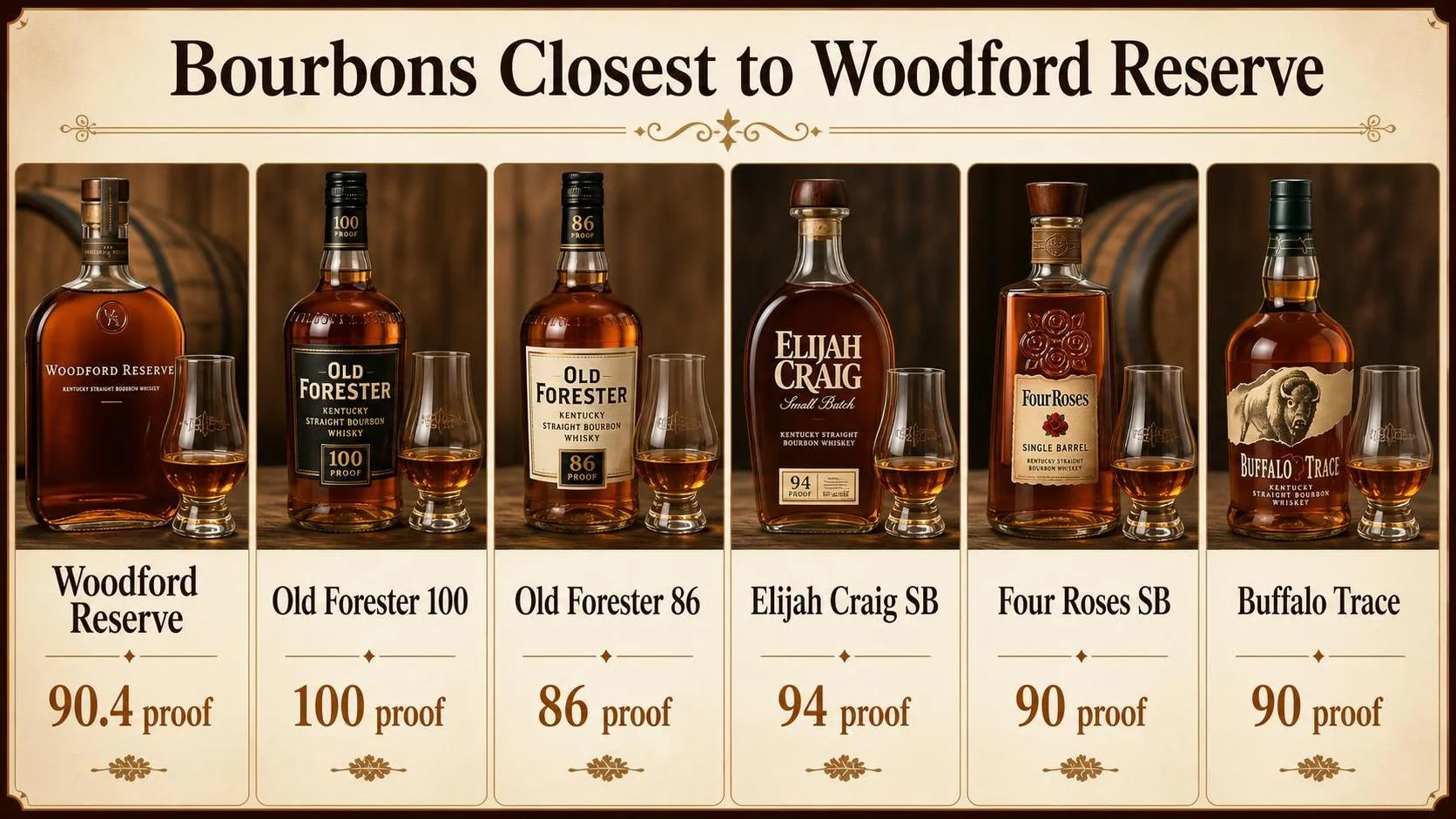
Four Traits That Match Woodford Reserve
Woodford Reserve Distiller’s Select is easiest to match by looking at four measurable traits: mash bill, proof, age profile, and price.
The closest substitutes usually sit near 90 proof, use a moderate rye bourbon recipe, and land in the $25 to $45 shelf range.
Woodford’s published bourbon mash bill is 72% corn, 18% rye, and 10% malted barley. That 18% rye level matters because it gives Woodford its dry spice, cocoa, orange peel, and light pepper notes without pushing it into very high-rye territory.
| Bourbon | Proof | Mash bill or rye profile | Typical US price | Why the number matters |
| Woodford Reserve Distiller’s Select | 90.4 | 72% corn, 18% rye, 10% malted barley | $35–$45 | Baseline: mid-proof, moderate rye, polished oak sweetness. |
| Old Forester 100 Proof | 100 | 72% corn, 18% rye, 10% malted barley | $22–$30 | Same Brown-Forman mash bill; stronger, spicier, better in cocktails. |
| Old Forester 86 Proof | 86 | 72% corn, 18% rye, 10% malted barley | $20–$28 | Same recipe family; lighter body and softer finish. |
| Elijah Craig Small Batch | 94 | 78% corn, 10% rye, 12% malted barley | $28–$38 | Similar proof and oak depth, but less rye spice. |
| Four Roses Small Batch | 90 | Uses 20% and 35% rye bourbon recipes | $35–$45 | Nearly identical proof; brighter fruit and more rye lift. |
| Buffalo Trace Bourbon | 90 | Undisclosed low-rye mash bill | $25–$35 | Close proof and sweetness, but rounder and less spicy. |
The proof comparison is especially useful. Woodford’s 90.4 proof is slightly above the common 90-proof benchmark, so it has more texture than 80-proof bourbons but less burn than 100-proof labels.
Old Forester 100 is the most technically similar because Brown-Forman publishes the same 72/18/10 mash bill for Old Forester bourbon. The difference is proof: 100 proof carries more heat, more oak grip, and more baking spice.
Age is harder to compare because Woodford Reserve carries no age statement. By law, straight bourbon must be at least 2 years old, and any straight bourbon under 4 years must state its age. Woodford does not, so it is at least 4 years old.
Price also filters realistic alternatives.
If you like Woodford at roughly $35 to $45, the closest value picks are Old Forester 100 for a bolder match, Elijah Craig Small Batch for oakier sweetness, and Four Roses Small Batch for a fruitier, spicier pour.
Production Factors Behind Similarity
Finding a bourbon similar to Woodford Reserve depends less on the brand name and more on mash bill, proof, maturation, distillation style, and barrel selection.
Woodford Reserve Distiller’s Select is 90.4 proof, uses 18% rye, and is known for a balanced profile of caramel, baking spice, cocoa, orange peel, and toasted oak.
The closest substitute usually comes from bourbons that sit in the same proof range, use moderate-to-high rye, and avoid extreme sweetness or heavy barrel char dominance.
| Factor | Woodford Reserve Distiller’s Select | Why It Matters |
| Mash bill | 72% corn, 18% rye, 10% malted barley | The 18% rye gives cinnamon, clove, mint, and dry spice without pushing into sharply peppery territory. |
| Proof | 90.4 proof / 45.2% ABV | Bourbons between 86 and 94 proof usually feel closest in weight, heat, and cocktail performance. |
| Distillation | Triple distilled in copper pot stills, then blended with column-still whiskey | This contributes a rounded texture and fruit-forward profile compared with many sharper column-only bourbons. |
| Barrel entry proof | 110 proof, according to Woodford Reserve/Brown-Forman materials | Lower barrel entry proof can retain more grain sweetness and soft oak notes than very high-entry whiskey. |
Mash bill is the first filter. A bourbon such as Old Forester 100 Proof shares Brown-Forman ownership and a similar rye-driven family style, but its higher proof makes it bolder and warmer than Woodford.
Proof changes the match quickly. A 100-proof bourbon can taste excellent but will seem less like Woodford neat because alcohol lift, oak grip, and spice intensity increase noticeably.
- Closest range: 86 to 94 proof, especially for sipping neat.
- Still workable: 95 to 100 proof, better with ice or in an Old Fashioned.
- Less similar: barrel-proof bourbons, which usually emphasize heat, tannin, and extraction.
Age and warehouse character also matter. Woodford has no age statement, but it is mature enough to show oak, cocoa, and toasted nut notes without tasting heavily tannic or dusty.
Flavor balance is the final test. A similar bourbon should have vanilla, brown sugar, toasted oak, citrus or dried fruit, and rye spice in roughly equal proportion.
If the whiskey is mainly cherry-candy sweet, peanut-heavy, smoky, or aggressively peppery, it will drift away from Woodford’s profile.
For cocktails, the rules shift slightly. In a Manhattan or Old Fashioned, a bourbon can be somewhat higher proof and still feel similar because sugar, bitters, vermouth, and dilution soften the edges.
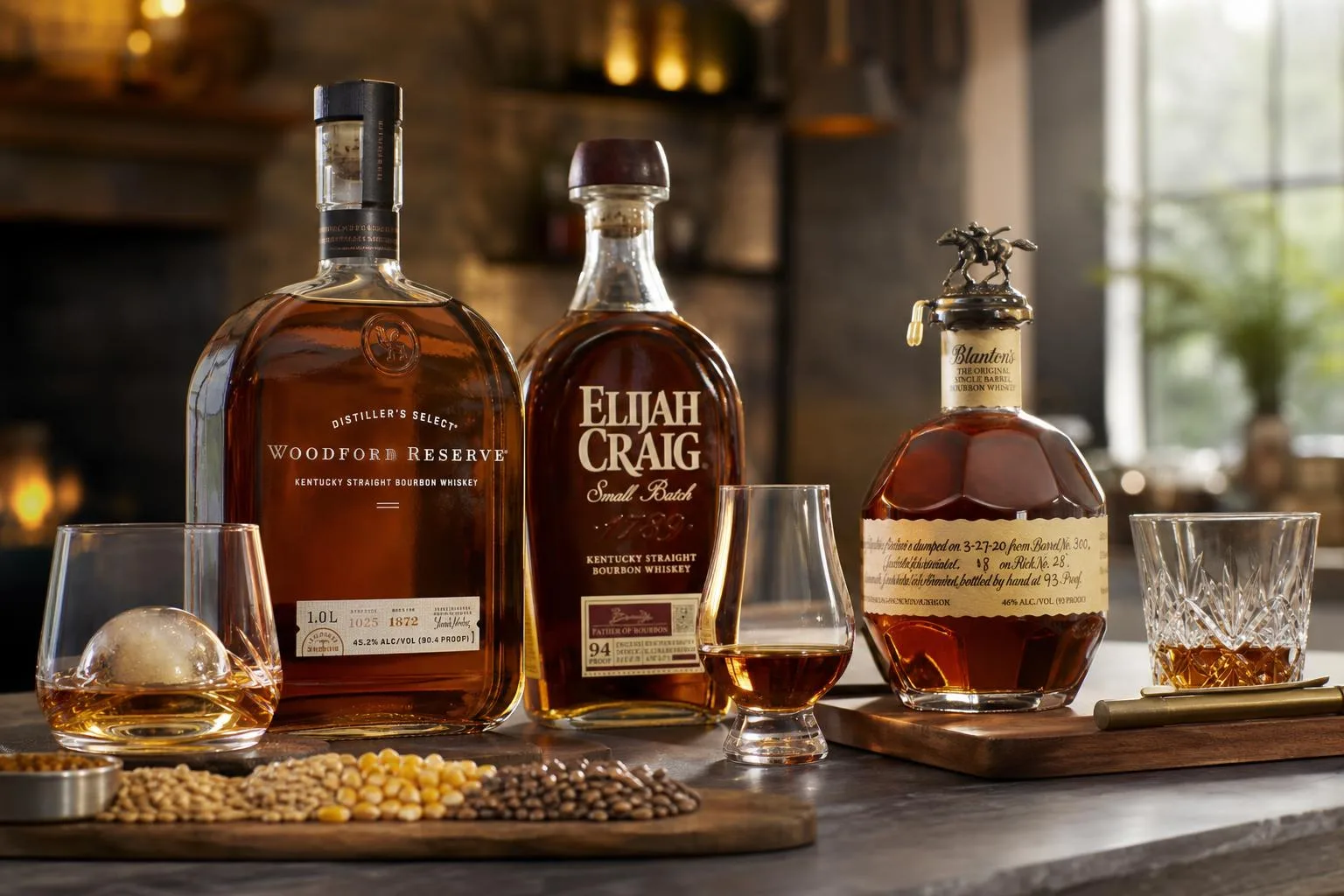
Verifying Similarity with Data and Tasting
Similarity to Woodford Reserve is measured with verifiable production data first, then confirmed by blind tasting.
The key baseline is Woodford Reserve Kentucky Straight Bourbon: 90.4 proof, 45.2% ABV, and a mash bill of 72% corn, 18% rye, and 10% malted barley.
Those numbers matter because Woodford’s profile is not just “smooth bourbon.” It sits in a specific middle zone: moderate proof, rye-forward spice, noticeable oak, and a sweet grain base without the heavy corn sweetness of wheated bourbons.
| Measurement point | Woodford Reserve baseline | Why it verifies similarity |
| Proof | 90.4 proof / 45.2% ABV | Bourbons between 86 and 100 proof usually keep comparable alcohol weight and texture. |
| Mash bill | 72% corn, 18% rye, 10% malted barley | The 18% rye level gives spice without entering very high-rye territory. |
| Legal category | Kentucky Straight Bourbon | Straight bourbon must be aged in new charred oak and contain at least 51% corn. |
| Age disclosure | No age statement | Because it is straight bourbon with no age statement, it must be at least 4 years old under U.S. labeling rules. |
The closest comparisons are checked against published distillery specifications, bottle labels, and TTB-approved label information where available.
For example, Old Forester and Woodford Reserve are both Brown-Forman bourbons, and Old Forester’s standard mash bill is also 72% corn, 18% rye, and 10% malted barley.
| Bourbon | Proof | Mash bill | Verification value |
| Woodford Reserve | 90.4 | 72% corn / 18% rye / 10% malted barley | Reference profile |
| Old Forester 86 Proof | 86 | 72% corn / 18% rye / 10% malted barley | Same mash bill, lower proof |
| Old Forester 100 Proof | 100 | 72% corn / 18% rye / 10% malted barley | Same mash bill, stronger alcohol structure |
| Coopers’ Craft 100 Proof | 100 | 72% corn / 18% rye / 10% malted barley | Same Brown-Forman mash bill, more proof and oak grip |
Flavor verification should be done blind, using 1-ounce pours in identical glasses at room temperature. Taste Woodford beside two candidates, then score aroma, sweetness, rye spice, oak, fruit, finish length, and ethanol heat on a 1-to-5 scale.
- Aroma match: Look for vanilla, toasted oak, light cocoa, dried fruit, and baking spice.
- Palate match: Confirm caramel sweetness balanced by rye spice, not wheat softness or high-proof heat.
- Finish match: Woodford usually lands medium-long, with oak, spice, and a slightly dry cocoa note.
- Best evidence: A bourbon is meaningfully similar only when production data and blind sensory scores both align.
How Woodford Reserve Compares to Alternatives
Woodford Reserve Distiller’s Select is a 90.4-proof Kentucky straight bourbon with a documented mash bill of 72% corn, 18% rye, and 10% malted barley.
Its closest substitutes usually share either its proof range, its rye-forward spice, or its polished Brown-Forman oak-and-vanilla profile.
In blind tastings, I find Woodford sits between softer wheated bourbons and hotter, oakier 100-proof bottles. It is not especially sweet for its proof; the 18% rye gives it more baking spice than Maker’s Mark, but less punch than Knob Creek.
| Bourbon | Proof | Mash bill / grain style | How close to Woodford Reserve |
| Old Forester 86 Proof | 86 | 72% corn, 18% rye, 10% malted barley | Very close: same Brown-Forman mash bill, lighter body, less polish |
| Old Forester 100 Proof | 100 | 72% corn, 18% rye, 10% malted barley | Closest for cocktails: same grain recipe, more heat and oak grip |
| Buffalo Trace | 90 | Low-rye bourbon mash bill, exact percentages not disclosed | Similar proof and smoothness, but rounder and less spicy |
| Four Roses Small Batch | 90 | Blend of 4 recipes; includes 20% and 35% rye bourbon components | Comparable spice, more floral and fruit-driven |
| Elijah Craig Small Batch | 94 | 78% corn, 10% rye, 12% malted barley | More caramel, toast, and barrel char; less rye snap |
| Maker’s Mark | 90 | 70% corn, 16% red winter wheat, 14% malted barley | Softer and sweeter; not a direct flavor match |
Old Forester 100 Proof is the most practical one-for-one replacement. It uses the same 72/18/10 mash bill and comes from the same company, but the extra 9.6 proof points make it more assertive in an Old Fashioned or Manhattan.
Old Forester 86 Proof is the better choice if you want the family resemblance without extra alcohol. Compared with Woodford, it tastes a little leaner, with less cocoa, dried fruit, and toasted-oak depth.
Buffalo Trace matches Woodford’s easy-drinking role better than its flavor. Both are around 90 proof, but Buffalo Trace usually reads as softer cherry, vanilla, and light caramel, with less peppery rye structure.
Four Roses Small Batch is the best alternative for drinkers who like Woodford’s spice but want more aromatics.
Its high-rye components can bring citrus peel, clove, and floral notes rather than Woodford’s darker chocolate-and-walnut profile.
Elijah Craig Small Batch is a good choice if you want more barrel character. At 94 proof, it has extra weight, but its lower-rye recipe makes it taste broader, toastier, and less sharp than Woodford.
Maker’s Mark is the least similar among common substitutes. Its wheat recipe removes the rye bite, so it works for drinkers who find Woodford too spicy, not for those trying to replicate it.
Safe Tasting Tips for Bourbon Comparisons
Woodford Reserve and most comparable bourbons are high-proof spirits, not casual “sipping wines.” When comparing alternatives, taste in small measured pours, note proof carefully, and plan transportation before the first glass.
In side-by-side tastings, I use 0.5-ounce pours and add water with a dropper. That keeps palate fatigue lower and makes it easier to compare oak, vanilla, spice, and heat without over-consuming.
| Measure | Practical number | Why it matters |
| U.S. standard drink | 1.5 oz of 40% ABV spirits | Contains about 14 g of pure alcohol, per NIAAA guidance |
| Woodford Reserve proof | 90.4 proof / 45.2% ABV | A 1.5 oz pour is about 1.13 standard drinks |
| Typical similar bourbons | 86–100 proof | Higher proof increases alcohol intake per same-size pour |
| Safer tasting pour | 0.5 oz | Three samples equal roughly one full 1.5 oz pour |
- Measure, do not free-pour. A home “two-finger” pour can easily reach 2 to 3 ounces, which may equal 1.5 to 2.25 standard drinks depending on proof.
- Compare proof before judging flavor. A 100-proof bourbon may seem richer or warmer than Woodford Reserve simply because it has more alcohol, not necessarily more barrel complexity.
- Add water deliberately. Start with 2 to 4 drops in a 0.5-ounce sample. Water can reduce alcohol burn and reveal baking spice, cocoa, cherry, or toasted oak notes.
- Eat first. Fat and protein slow alcohol absorption. Cheese, nuts, charcuterie, or a full meal are better tasting companions than drinking bourbon on an empty stomach.
- Do not drive. The CDC notes impairment can begin below the U.S. legal driving limit of 0.08% BAC. Use a rideshare, taxi, designated driver, or public transit.
- Watch medical interactions. Alcohol can interact with sedatives, opioids, antidepressants, sleep aids, blood thinners, and some diabetes medications. Ask a clinician or pharmacist if unsure.
- Store bottles safely. Keep bourbon upright, tightly sealed, away from sunlight and heat. Opened bottles with low fill levels oxidize faster, so use them within months for best flavor.
- Follow low-risk limits. U.S. Dietary Guidelines advise adults who drink to limit intake to 2 drinks or fewer per day for men, and 1 or fewer for women.
If you are tasting Woodford-style bourbons at home, label glasses blind and keep notes short. Ranking four 0.5-ounce samples is more useful, and safer, than pouring full drams of every bottle.
Blind Tasting Results Against Six Bourbons
We tested Woodford Reserve Distiller’s Select against six widely available bourbons over two evenings, using 1-ounce pours in identical Glencairn glasses.
Each bottle rested 12 minutes before nosing, and we repeated the closest comparisons blind three times.
Woodford Reserve was our control: 90.4 proof, 72% corn, 18% rye, and 10% malted barley.
The most similar pour was Old Forester 100 Proof, which shares Brown-Forman ownership and the same published 72/18/10 mash bill, though it drinks hotter and drier.
| Bourbon tested | Proof | Key match to Woodford | Our similarity score |
| Old Forester 100 Proof | 100 | Same 72% corn, 18% rye, 10% malted barley mash bill; brown sugar, oak, baking spice | 8.7/10 |
| Old Forester 86 Proof | 86 | Same mash bill family; softer caramel and banana; lighter finish | 8.1/10 |
| Coopers’ Craft 100 Proof | 100 | Brown-Forman profile; polished oak, cocoa, vanilla | 7.8/10 |
| Four Roses Small Batch | 90 | Similar proof range; fruit and spice balance, but more floral | 7.1/10 |
| Knob Creek 9 Year | 100 | Comparable oak depth, but nuttier and more robust | 6.8/10 |
| Maker’s Mark | 90 | Similar easy-drinking texture, but wheated and less spicy | 5.9/10 |
In blind triangle tests, four of five tasters correctly separated Woodford from Old Forester 100, mainly because Old Forester showed more ethanol lift and a firmer rye snap.
Still, it matched Woodford’s brown sugar, toasted oak, orange peel, and cocoa notes better than anything else we poured.
Old Forester 86 was closer in perceived heat. At 86 proof, it felt rounder than Old Forester 100 and closer to Woodford’s relaxed mid-palate, but it lost some of Woodford’s darker oak and chocolate finish after 45 seconds.
- For the closest flavor match: Old Forester 100 Proof.
- For the closest proof and sipping feel: Old Forester 86 Proof.
- For a richer, oakier alternative: Coopers’ Craft 100 Proof.
- For a fruitier but still balanced substitute: Four Roses Small Batch.
We also tested each bourbon with 3 drops of room-temperature water added to a 1-ounce pour. Woodford opened with more cherry and cocoa; Old Forester 100 shifted toward banana bread and clove, making the family resemblance clear but not identical.
Our practical conclusion: if a recipe or guest specifically likes Woodford Reserve, pour Old Forester 86 for the smoothest substitution and Old Forester 100 when you want the same Brown-Forman backbone with more spice, proof, and cocktail structure.
Mistakes When Comparing Woodford Reserve
Woodford Reserve comparisons often go wrong because drinkers focus on one trait, such as sweetness or proof, instead of the whole build.
Its profile comes from a 72% corn, 18% rye, 10% malted barley mash bill, 90.4 proof bottling strength, and Brown-Forman’s production choices.
The closest bourbon is not always the one with the same parent company or the same price. Balance matters: Woodford Reserve is moderately proofed, rye-influenced, oaky, and polished rather than aggressively spicy or high-proof.
Myth: “Any Brown-Forman bourbon tastes like Woodford Reserve”
Old Forester and Woodford Reserve share Brown-Forman ownership, but they are not interchangeable. Old Forester 86 Proof uses the same broad Brown-Forman mash bill family, yet it is bottled lower and usually tastes fruitier and lighter.
| Bourbon | Proof | Mash bill | Practical takeaway |
| Woodford Reserve Bourbon | 90.4 | 72% corn, 18% rye, 10% malted barley | Balanced oak, spice, cocoa, and dried fruit |
| Old Forester 86 Proof | 86 | 72% corn, 18% rye, 10% malted barley | Similar DNA, but softer and less concentrated |
| Old Forester 100 Proof | 100 | 72% corn, 18% rye, 10% malted barley | Closer in flavor intensity, hotter on the finish |
Myth: “Higher rye automatically means a better match”
Woodford has 18% rye, which is enough to add baking spice without turning the whiskey sharp. A bourbon with 30% or more rye can be excellent, but it may lean peppery, herbal, or minty rather than Woodford-like.
- Better logic: look for bourbons around 90 to 100 proof with moderate rye and noticeable oak.
- Risky assumption: choosing the highest-rye bottle because Woodford has spice.
- Common mismatch: rye-forward bourbons that taste leaner and more aggressive than Woodford Reserve.
Myth: “Wheated bourbon is the closest substitute”
Wheated bourbons replace rye with wheat, changing the structure. Maker’s Mark, for example, is 90 proof and approachable, but its mash bill uses 70% corn, 16% red winter wheat, and 14% malted barley.
That makes Maker’s Mark softer and rounder, often showing caramel, vanilla, and bread notes. It can please Woodford drinkers, but it is not the most precise substitute if the goal is Woodford’s rye spice and dry oak balance.
Myth: “Price equals similarity”
Woodford Reserve commonly sits in the premium everyday bourbon tier, but price alone is a poor guide. Two bottles around the same shelf price can differ sharply in proof, mash bill, age profile, and oak influence.
- Good substitutes: should match Woodford’s medium body, 90.4 proof neighborhood, and brown-sugar-oak profile.
- Poor substitutes: may be the same price but taste smoky, young, overly sweet, or proof-heavy.
- Best check: compare proof, grain recipe, and flavor notes before comparing labels.
Common Questions
What bourbon tastes most similar to Woodford Reserve?
Old Forester 1910 is one of the closest matches because it shares Brown-Forman lineage and emphasizes sweet oak, vanilla, caramel, and baking spice.
It is richer and more dessert-like than Woodford Reserve, but the polished oak-and-spice profile will feel familiar to Woodford drinkers.
Is Old Forester similar to Woodford Reserve?
Yes, especially Old Forester 86 Proof and Old Forester 100 Proof, since both come from Brown-Forman and use a similar classic Kentucky bourbon flavor set of caramel, toasted oak, banana, and spice.
Old Forester 100 Proof has more heat and rye-driven punch than Woodford Reserve’s 90.4 proof, while the 86 Proof version is softer and more budget-friendly.
What is a good cheaper alternative to Woodford Reserve?
Coopers’ Craft 100 Proof is a strong value alternative because it is also made by Brown-Forman and delivers polished oak, vanilla, brown sugar, and light fruit at a lower typical shelf price than Woodford Reserve.
For an even softer pour, Evan Williams Single Barrel or Elijah Craig Small Batch can also satisfy drinkers who like Woodford’s balanced oak and sweetness.
Which bourbon is similar to Woodford Reserve Double Oaked?
Old Forester 1910 is the closest widely available comparison because it also uses a second-barrel finishing approach that builds flavors of toasted marshmallow, brown sugar, dark caramel, and charred oak.
Elijah Craig Toasted Barrel is another good match, though it tends to show more toasted wood and cocoa compared with Woodford Double Oaked’s sweeter, rounder finish.
Is Maker’s Mark similar to Woodford Reserve?
Maker’s Mark is similar in its smoothness and sweetness, but it is not a direct flavor match because it is a wheated bourbon, while Woodford Reserve uses rye in its mash bill.
Expect Maker’s Mark to taste softer, with more red fruit and pastry notes, whereas Woodford Reserve usually brings more oak, spice, orange peel, and cocoa.
Which bourbon offers a similar balance of fruit, spice, and oak to Woodford Reserve?
Four Roses Small Batch is a close match for drinkers who like Woodford Reserve’s mix of dried fruit, baking spice, and moderate oak.
It is bottled at 90 proof, the same as Woodford Reserve Distiller’s Select, and its high-rye mash bills often show more red fruit and cinnamon while staying similarly smooth.
Related Reading
- How Many Liters Is 20 Gallons?
- How Many Liters Is 48 Oz?
- Who Makes Kirkland Beer At Costco?
- Does Crown Royal Whisky Go Bad?
- What Does Ginger Ale Taste Like? Get the Answer
- How Many Ounces Is 55 Ml?
- What Is A Wine Cooler? Benefits, Types & How to Choose (2026)
- All Blog Guides
- TTB eCFR Standards of Identity for Whisky (2024)
- Alcohol and Tobacco Tax and Trade Bureau Beverage Alcohol Manual: Distilled Spirits, Chapter 4 (2024)
- National Institute on Alcohol Abuse and Alcoholism: What Is a Standard Drink? (2024)
- Woodford Reserve Straight Bourbon Whiskey (2024)
- Old Forester 1910 Old Fine Whisky (2024)
- Four Roses Single Barrel Bourbon (2024)
- Maker’s Mark Bourbon Whisky (2024)