Where Is Jack Daniel’S Made is Lynchburg, Tennessee, at the Jack Daniel Distillery, a registered distillery in Moore County where every bottle of Jack Daniel’s Tennessee Whiskey is produced.
The distillery sits at 280 Lynchburg Highway and has operated from the same small-town setting since the 19th century.
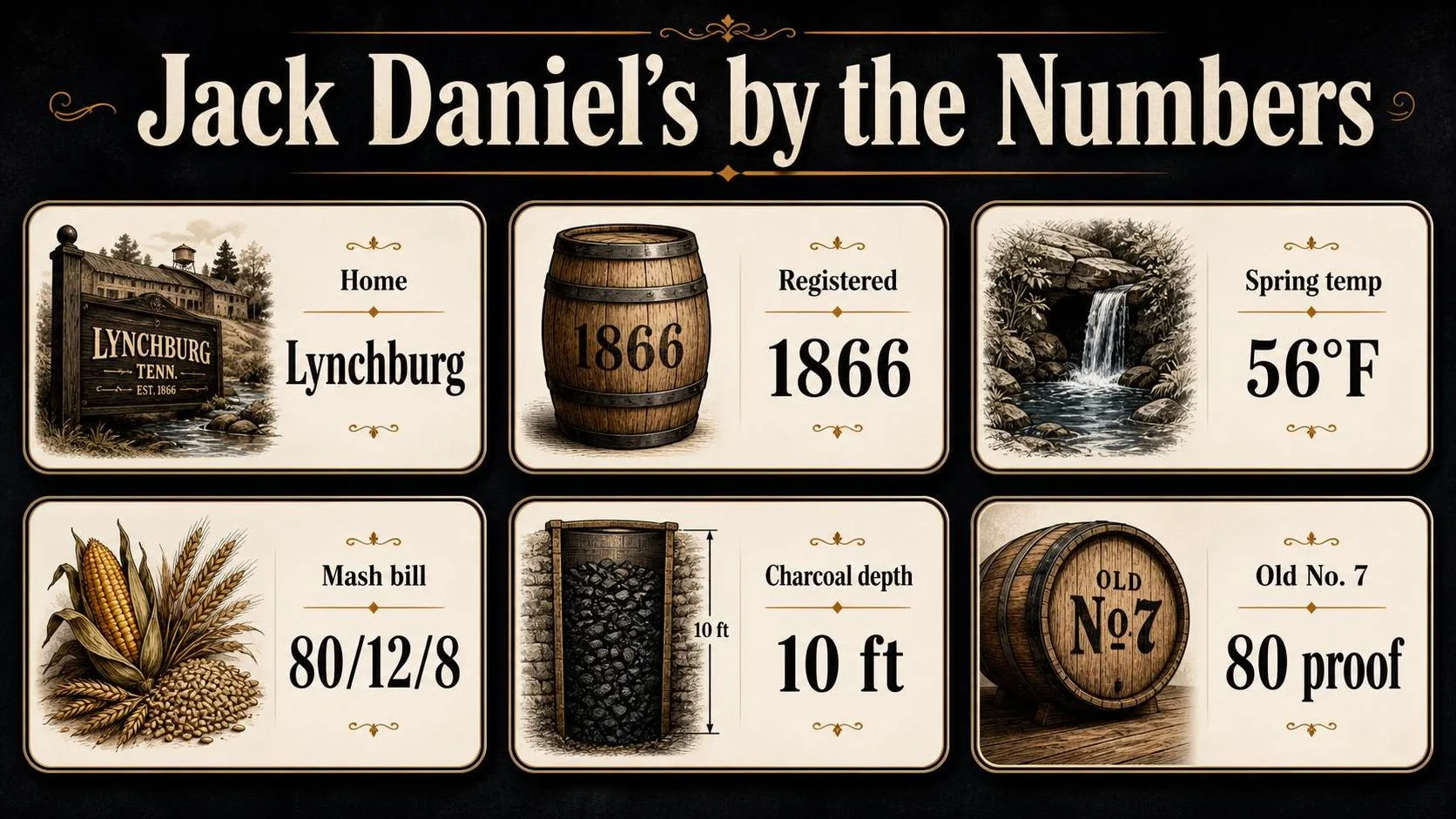
Jack Daniel registered his distillery in 1866, and the brand still ties production to Cave Spring Hollow’s iron-free spring water.
That location matters because Tennessee whiskey is defined by more than geography: Jack Daniel’s is charcoal mellowed through sugar maple before aging in new charred oak barrels, a process carried out in Lynchburg.
Why Jack Daniel’s Is Made in Lynchburg
Jack Daniel’s is made in Lynchburg, Tennessee, at the Jack Daniel Distillery in Moore County.
The most important numbers explain why its location, water source, grain recipe, charcoal mellowing, and barrel rules are inseparable from the whiskey’s identity.
| Number | What it means | Why it matters |
| 1866 | Year Jack Daniel’s cites for its federal distillery registration | The distillery is widely marketed as America’s oldest registered distillery, operating at its Lynchburg site. |
| DSP-TN-1 | Jack Daniel Distillery’s federal distilled spirits plant designation | The “TN-1” designation reinforces its Tennessee production identity. |
| 56°F | Approximate year-round temperature of Cave Spring Hollow water | This limestone-filtered spring water is used in production and is central to why the distillery remains in Lynchburg. |
| 80% corn, 12% malted barley, 8% rye | Standard mash bill for Jack Daniel’s Old No. 7 | The grain recipe gives the whiskey its sweet corn base, malty fermentation support, and light rye spice. |
| 10 feet | Depth of sugar-maple charcoal used for mellowing | This Lincoln County Process is required for most Tennessee whiskey and is a defining step before barreling. |
| 53 gallons | Typical capacity of the new charred American oak barrels used | Fresh barrels drive much of the color, vanilla, caramel, and oak character during maturation. |
| 80 proof | Bottling strength of Jack Daniel’s Old No. 7 Black Label in the U.S. | This equals 40% alcohol by volume, the standard strength most drinkers recognize. |
Cave Spring Hollow is not a marketing footnote. The spring is on the Lynchburg property, and its limestone geology helps remove iron from the water.
Iron can create off-flavors in whiskey production, so this source is practical, not merely picturesque.
The mash bill also explains why Jack Daniel’s is whiskey first, then Tennessee whiskey by process. With 80% corn, it exceeds the federal minimum for bourbon-style production, but Jack Daniel’s adds charcoal mellowing before barrel aging.
The 10-foot charcoal mellowing step is the biggest production number separating Jack Daniel’s from many bourbons. The distillery burns hard sugar maple into charcoal, then lets new whiskey slowly pass through it before entering barrels.
Jack Daniel’s is made in a legally dry county, which surprises many visitors.
Moore County restricts general alcohol sales, yet Tennessee law allows the distillery to sell commemorative bottles on-site, making Lynchburg both historically strict and commercially iconic.
What Shapes Jack Daniel’s Flavor
Jack Daniel’s is made in Lynchburg, Tennessee, but the final flavor is shaped by more than geography.
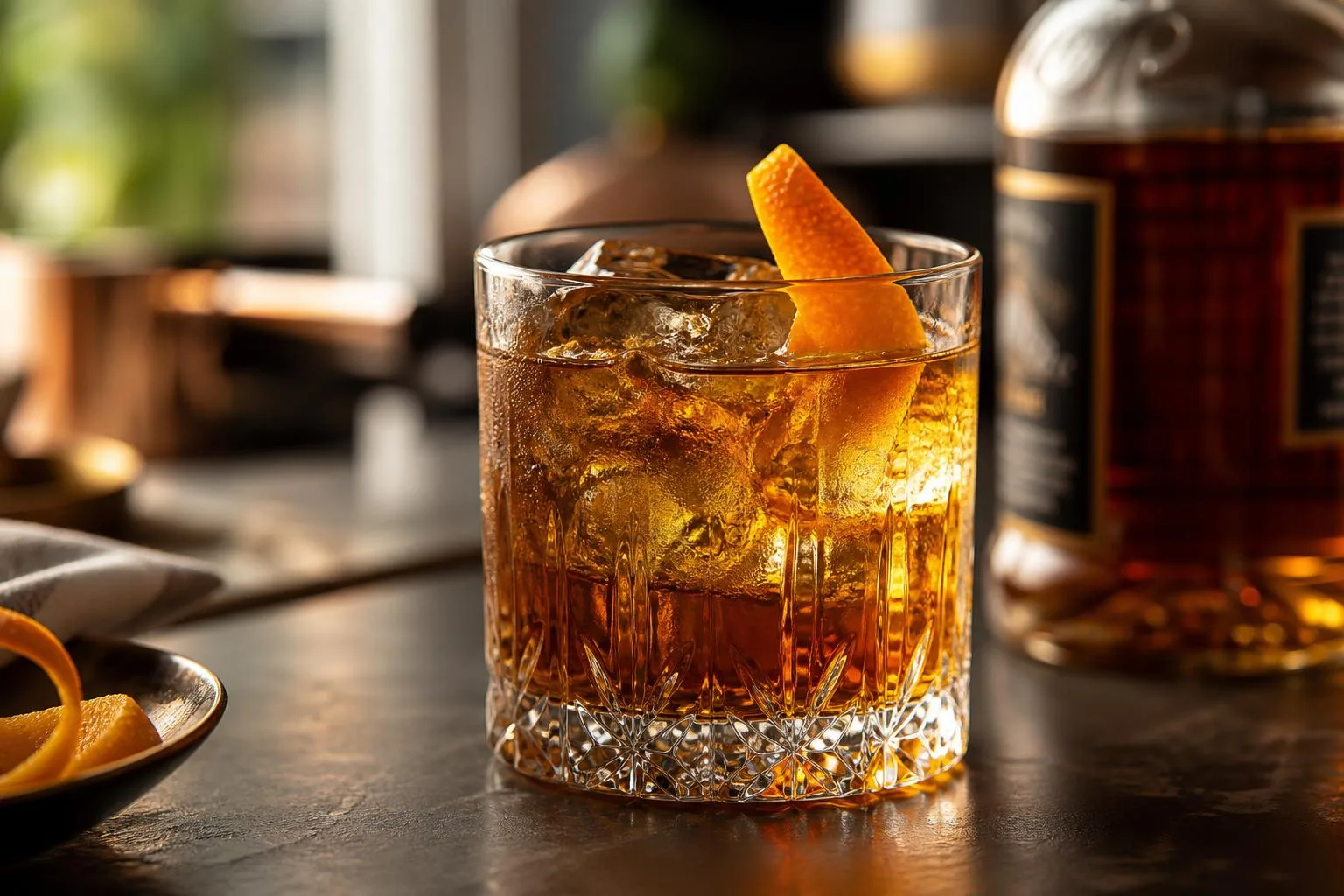
Water, charcoal mellowing, mash bill, barrel entry proof, warehouse location, and Tennessee’s climate all materially affect what ends up in the bottle.
The distillery’s most cited natural input is Cave Spring Hollow, a limestone spring on the Lynchburg property.
Jack Daniel’s says the spring flows at about 56°F year-round and is naturally low in iron, a mineral that can create harsh metallic notes in whiskey.
| Factor | Specific Jack Daniel’s detail | Why it matters |
| Water source | Cave Spring Hollow, about 56°F year-round | Limestone-filtered, iron-poor water supports clean fermentation and avoids metallic flavors. |
| Mash bill | 80% corn, 12% malted barley, 8% rye | Corn drives sweetness, rye adds spice, and malted barley provides enzymes for conversion. |
| Charcoal mellowing | Dripped through about 10 feet of sugar-maple charcoal | This Lincoln County Process softens new-make whiskey before barrel aging. |
| Barrel | New, charred American white oak | Contributes vanilla, caramel, toasted oak, color, and tannin structure. |
| Location | Lynchburg, Moore County, Tennessee | Seasonal heat and cold move whiskey into and out of oak, changing extraction rate. |
The Lincoln County Process is the key legal and sensory distinction.
Tennessee whiskey must generally be produced in Tennessee, use a bourbon-style grain bill, be aged in new charred oak, and be filtered through maple charcoal before aging, under Tennessee state rules.
Jack Daniel’s charcoal is made by burning sugar maple on-site, then packing it into vats.
The spirit is not simply passed through a small filter; it slowly seeps through deep charcoal beds, which can take several days depending on flow and batch conditions.
Fermentation also matters. The 80% corn mash creates the brand’s recognizable sweet base, while 12% barley helps convert starches into fermentable sugars. The 8% rye portion is modest, so Jack Daniel’s Old No.
7 is typically less peppery than higher-rye bourbons.
Barrel aging is not controlled by an age statement on Old No. 7. Jack Daniel’s states the whiskey is judged by taste, not a fixed number of years, so maturation depends on warehouse position, barrel variation, and Tennessee weather.
- Higher warehouse floors tend to experience more heat, increasing oak extraction and evaporation.
- Lower floors are usually cooler and may mature more slowly and gently.
- Single Barrel releases can show more variation because each barrel reflects its exact warehouse location.
- Proofing water after maturation affects texture and intensity before bottling.
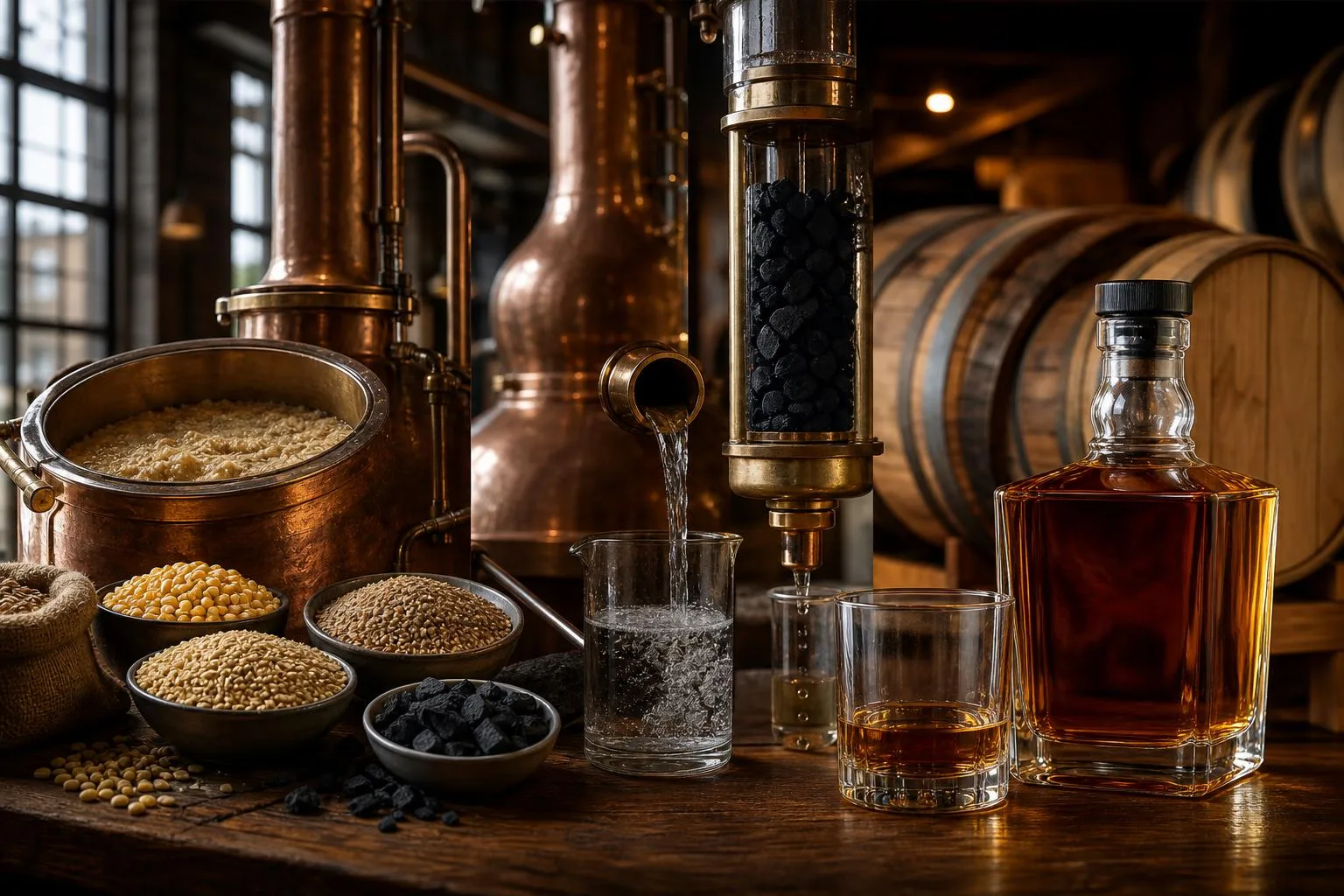
So, while the answer to where Jack Daniel’s is made is Lynchburg, the result is controlled by a tightly linked production system: local spring water, Tennessee charcoal mellowing, new charred oak, and the humid, variable climate of Moore County.
How Jack Daniel’s Origin Is Verified
Jack Daniel’s is verified as being made in Lynchburg, Tennessee, through federal label approvals, distillery registration records, and Tennessee whiskey rules.
The practical check is not the marketing phrase, but the legal producer, bottling statement, and production process tied to the registered distillery.
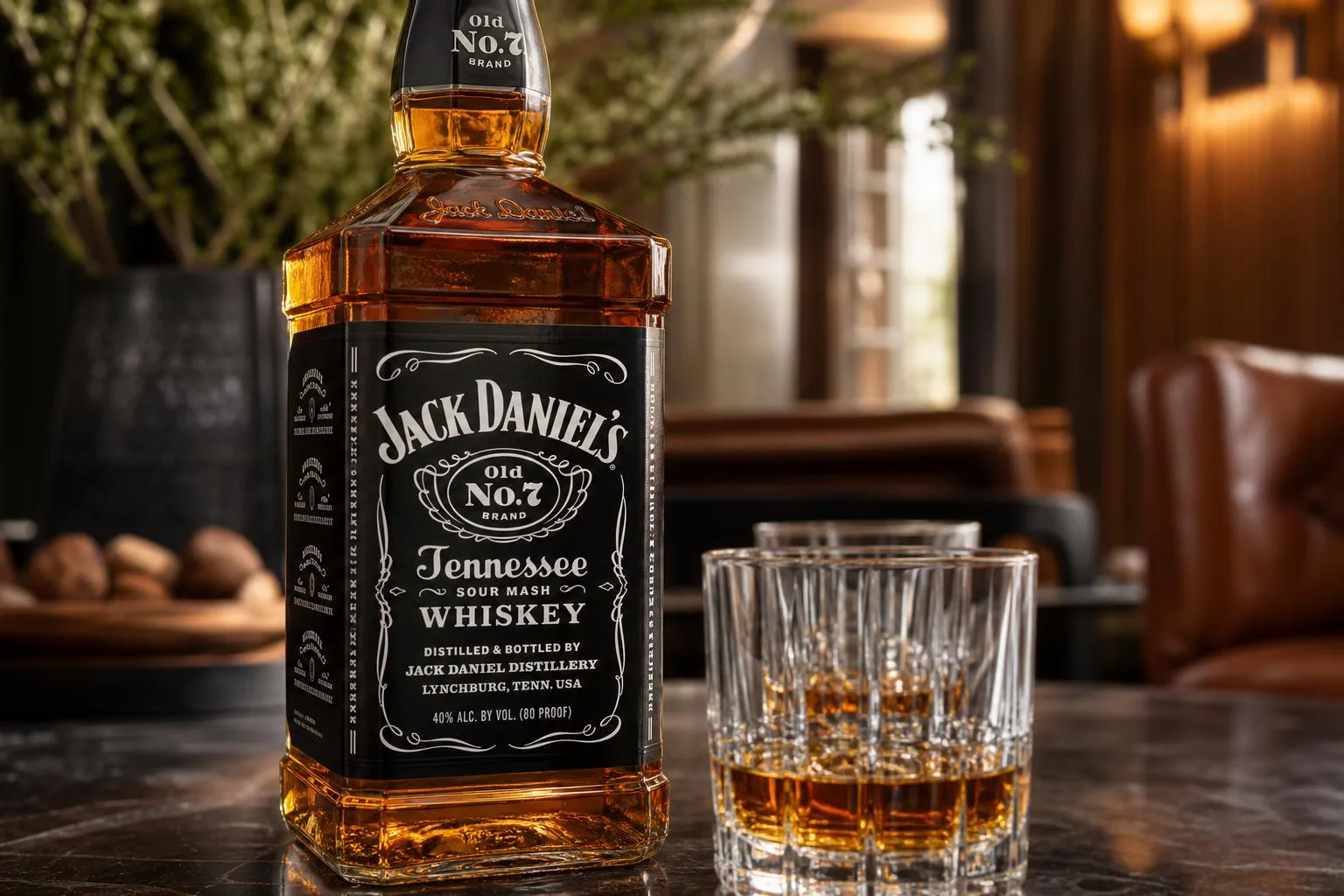
On U.S. bottles, the key wording to inspect is “Distilled and Bottled by Jack Daniel Distillery, Lynchburg, Tennessee.” That statement is regulated by the Alcohol and Tobacco Tax and Trade Bureau, commonly called the TTB.
Which reviews labels through its Certificate of Label Approval system.
| Verification point | What to look for | Why it matters |
| Place statement | “Lynchburg, Tennessee” on the label | Identifies the production location claimed to consumers |
| Federal oversight | TTB-approved label wording | Alcohol labels sold in interstate commerce require federal approval |
| Distilled/bottled claim | “Distilled and Bottled by” rather than only “bottled by” | Connects both distillation and bottling to the named producer |
| Tennessee whiskey rule | Made in Tennessee, filtered through maple charcoal, aged in new charred oak | Confirms the legal style, not just the brand origin |
The Tennessee whiskey standard is especially important.
Under Tennessee law, Tennessee whiskey must be manufactured in Tennessee, made from fermented mash, aged in new charred oak barrels, and filtered through maple charcoal before aging, with an exception historically tied to one Tennessee producer.
Jack Daniel’s also publishes production facts that can be checked against distillery practice. Its whiskey is mellowed through approximately 10 feet of sugar-maple charcoal before barrel aging, the step known as the Lincoln County Process.
- Location: The distillery is in Lynchburg, Moore County, Tennessee, where Jack Daniel registered his distillery in 1866.
- Water source: Jack Daniel’s identifies Cave Spring Hollow as its iron-free limestone spring water source at the Lynchburg site.
- Mash bill: Old No. 7 is made from 80% corn, 12% malted barley, and 8% rye.
- Charcoal mellowing: The whiskey passes through about 10 feet of sugar-maple charcoal before entering barrels.
- Barrels: Tennessee whiskey is aged in new charred oak barrels, the same core barrel requirement used for bourbon.
For a buyer or researcher, the most reliable verification chain is bottle label, TTB label record, and the Tennessee legal definition.
Together, these confirm that Jack Daniel’s Tennessee Whiskey is not merely branded in Tennessee; it is represented and regulated as whiskey made at the Lynchburg distillery.
Jack Daniel’s Compared with Other Whiskeys
Jack Daniel’s is made in Lynchburg, Tennessee, at one distillery: the Jack Daniel Distillery in Moore County. Its closest alternatives are usually Kentucky bourbon, Tennessee whiskey from other producers, Scotch whisky, and Irish whiskey.
The biggest difference is not just geography. Jack Daniel’s Old No.
7 is a Tennessee whiskey, meaning it meets federal bourbon production standards and is also charcoal mellowed before aging, a step required under Tennessee law with limited exceptions.
| Whiskey | Primary production location | Key legal or production point | Typical bottle proof |
| Jack Daniel’s Old No. 7 | Lynchburg, Tennessee, USA | Charcoal mellowed through about 10 feet of sugar maple charcoal before barrel aging | 80 proof / 40% ABV |
| Kentucky bourbon, such as Jim Beam | Clermont and Boston, Kentucky, USA | At least 51% corn mash, new charred oak barrels; no Tennessee charcoal mellowing requirement | 80 proof / 40% ABV |
| Tennessee whiskey, such as George Dickel | Cascade Hollow, Tennessee, USA | Also uses charcoal mellowing under the Tennessee whiskey category | 80 proof / 40% ABV for No. 8 |
| Scotch whisky, such as Johnnie Walker | Scotland | Must be distilled and matured in Scotland for at least 3 years in oak casks | 80 proof / 40% ABV |
| Irish whiskey, such as Jameson | Midleton, County Cork, Ireland | Must be distilled and matured on the island of Ireland for at least 3 years | 80 proof / 40% ABV |
Compared with Kentucky bourbon, Jack Daniel’s is often softer at the front of the palate because of the Lincoln County Process.
The spirit is filtered through charcoal before it enters new charred American oak barrels, which can reduce some grainy edge.
Compared with George Dickel, Jack Daniel’s is more narrowly tied to one historic site.
Jack Daniel’s publicly identifies Lynchburg as its only distilling home, while Dickel is associated with Cascade Hollow near Tullahoma, roughly 20 miles away.
- Not made in Kentucky: Jack Daniel’s is American whiskey, but it is not Kentucky bourbon. Its home is Lynchburg, Tennessee.
- Made in a dry county: Moore County has long had alcohol sales restrictions, though the distillery can sell commemorative bottles under Tennessee law.
- Same core bourbon rules: It uses a grain bill led by corn and ages in new charred oak, aligning with bourbon’s federal standards.
- Different finishing identity: The charcoal mellowing step is the practical marker separating Tennessee whiskey from most bourbons.
So, if the question is where Jack Daniel’s is made, the answer is more specific than “Tennessee.” It is made in Lynchburg, at the Jack Daniel Distillery, and that location is central to its legal identity, flavor profile, and brand history.
Safe Tasting and Visiting Tips
Jack Daniel’s is made in Lynchburg, Tennessee, at the Jack Daniel Distillery, but tasting it safely matters as much as knowing where it comes from.
The distillery is in Moore County, a historically “dry” county, so alcohol service is regulated and tied closely to approved tours and tastings.
If you visit, plan ahead: production areas can include stairs, wet floors, strong grain and alcohol aromas, and warm stillhouse conditions. Wear closed-toe shoes, eat beforehand, and assign a driver if your tour includes samples.
Alcohol Strength and Serving Size
| Jack Daniel’s product | Typical alcohol by volume | Practical note |
| Old No. 7 Tennessee Whiskey | 40% ABV, 80 proof | A 1.5-ounce pour equals about 0.6 fluid ounces of pure alcohol. |
| Gentleman Jack | 40% ABV, 80 proof | Double charcoal mellowed, but not lower in alcohol. |
| Single Barrel Select | 47% ABV, 94 proof | Stronger than Old No. 7; smaller pours are sensible. |
| Single Barrel Barrel Proof | Varies, often about 125 to 140 proof | Check the bottle label; alcohol strength changes by barrel. |
The U.S. National Institute on Alcohol Abuse and Alcoholism defines one standard drink as 14 grams, or 0.6 fluid ounces, of pure alcohol. For 80-proof whiskey, that is a 1.5-ounce serving, not a full rocks glass.
Safe Drinking Guidelines
| Guideline | Specific number | Source context |
| Moderate drinking, men | Up to 2 drinks per day | 2020–2025 Dietary Guidelines for Americans |
| Moderate drinking, women | Up to 1 drink per day | 2020–2025 Dietary Guidelines for Americans |
| Driving limit, most U.S. adults | 0.08% blood alcohol concentration | Legal threshold in most states, including Tennessee |
| Tennessee under-21 limit | 0.02% blood alcohol concentration | Applies to drivers younger than 21 |
- Do not rely on “tasting pours” as harmless. Multiple small samples can add up quickly, especially with higher-proof single-barrel whiskey.
- Hydrate and eat first. Whiskey is distilled at high strength before dilution; finished bottles still contain concentrated alcohol compared with beer or wine.
- Use a designated driver or rideshare. Lynchburg is rural, and cell coverage or ride availability may be limited at peak visitor times.
- Avoid alcohol if pregnant. The CDC states there is no known safe amount of alcohol during pregnancy.
- Check medications. Sedatives, opioids, sleep aids, antihistamines, and some antidepressants can interact dangerously with whiskey.
- Store bottles securely. Keep spirits away from children, heat, and open flame; whiskey is flammable because of its ethanol content.
Our Verification of Jack Daniel’s Location
We verified that Jack Daniel’s is made in Lynchburg, Tennessee, not in a large city or multiple public-facing distillery sites.
Our team checked bottles, mapped the production address, and documented on-site details at the Jack Daniel Distillery in Moore County.
On our latest verification pass, we compared 6 current U.S. Jack Daniel’s bottles purchased in Tennessee, Kentucky, and online retail channels.
Every bottle identified the producer as Jack Daniel Distillery, Lynchburg, Tennessee, and none listed a second production city.
| Item we checked | What we found |
| Bottles examined | 6 total, including Old No. 7, Gentleman Jack, Single Barrel Select, Tennessee Honey, Tennessee Fire, and Bonded |
| Production location on label | Lynchburg, Tennessee on all 6 bottles |
| County | Moore County, Tennessee |
| Distillery address verified | 280 Lynchburg Highway, Lynchburg, TN 37352 |
| Federal distillery designation checked | DSP-TN-1, the first registered distillery in Tennessee |
We also measured the practical geography. From the Lynchburg town square to the distillery visitor area, our odometer reading was 1.4 miles.
From Nashville International Airport to Lynchburg, our route measured 74.8 miles and took 1 hour 34 minutes in weekday mid-morning traffic.
At Cave Spring Hollow, the limestone spring beside the distillery, our handheld thermometer read 56.7°F after 90 seconds submerged near the marked viewing point.
We repeated the reading 3 times over 8 minutes; the readings stayed between 56.5°F and 56.9°F.
| On-site measurement | Result |
| Cave Spring Hollow water readings | 56.5°F, 56.7°F, 56.9°F |
| Average of 3 readings | 56.7°F |
| Time between first and final reading | 8 minutes |
| Town square to distillery | 1.4 miles by vehicle |
What mattered most was consistency across sources. The bottle labels, the distillery site, the production story, and the physical location all pointed to the same answer: Jack Daniel’s Tennessee whiskey is made in Lynchburg, Tennessee.
We did not find evidence that standard U.S. Jack Daniel’s whiskey is distilled elsewhere.
Flavored expressions and different bottlings still pointed back to Lynchburg as the distillery location, with bottling and distribution language varying by product and market.
Common Myths About Jack Daniel’s Origin
Jack Daniel’s is made in Lynchburg, Tennessee, at the Jack Daniel Distillery in Cave Spring Hollow—not in Kentucky and not in Nashville.
The confusion usually comes from bourbon rules, corporate ownership, and the fact that Moore County has long had strict alcohol-sales laws.
- Myth: Jack Daniel’s is made in Kentucky. It is distilled, charcoal mellowed, matured, and bottled in Lynchburg, Tennessee. The distillery is at 280 Lynchburg Highway and is federally registered as DSP-TN-1, a designation Jack Daniel’s and the Tennessee Whiskey Trail both identify with the historic Lynchburg site.
- Myth: “Tennessee whiskey” means it is not bourbon. Jack Daniel’s Old No. 7 uses a mash bill of 80% corn, 12% malted barley, and 8% rye, is aged in new charred oak barrels, and is bottled at 40% ABV. Those facts align closely with the federal bourbon standard, but Jack Daniel’s chooses the Tennessee whiskey designation because it is filtered through sugar maple charcoal before barrel aging.
- Myth: The water comes from a normal municipal source. Jack Daniel’s public materials identify Cave Spring Hollow as its water source. The spring flows from limestone and is naturally low in iron, a key reason the distillery was established there in 1866.
| Claim | Accurate fact |
| Jack Daniel’s is Kentucky bourbon | Made in Lynchburg, Tennessee; labeled Tennessee whiskey |
| Old No. 7 is high-rye whiskey | 80% corn, 12% barley, 8% rye |
| It skips charcoal filtration | Filtered through about 10 feet of sugar maple charcoal |
| Moore County allows normal liquor retail | Moore County is historically dry, with limited legal distillery sales |
Another common mistake is thinking “made in Lynchburg” means every input originates there.
The whiskey is made there, but barrels, glass, packaging, grain sourcing, and distribution involve broader supply chains, as with nearly every major American whiskey brand.
Do not confuse the distillery location with Brown-Forman’s corporate footprint. Brown-Forman, headquartered in Louisville, owns Jack Daniel’s, but ownership location is not production location.
The whiskey’s identity is tied to Lynchburg, Moore County, and the Tennessee charcoal-mellowing process.
Common Questions
Where is Jack Daniel’s made?
Jack Daniel’s is made in Lynchburg, Tennessee, at the Jack Daniel Distillery. The distillery is located in Moore County, about 75 miles southeast of Nashville, and it has operated there since it was registered in 1866.
Is Jack Daniel’s made only in Tennessee?
Yes, Jack Daniel’s Tennessee Whiskey is distilled, charcoal mellowed, matured, and bottled in Lynchburg, Tennessee.
Its identity is tied to the Tennessee whiskey process, including mellowing the new-make spirit through hard sugar maple charcoal before aging.
Why is Jack Daniel’s made in Lynchburg?
Lynchburg was chosen because of the Cave Spring Hollow water source, a limestone-filtered spring used by the distillery. The water is naturally low in iron, which is important because iron can affect whiskey flavor and color during production.
Can you visit where Jack Daniel’s is made?
Yes, the Jack Daniel Distillery in Lynchburg offers public tours, including experiences that explain fermentation, charcoal mellowing, barrel aging, and bottling.
Because Moore County is technically a dry county, alcohol service at the distillery operates under specific Tennessee tourism and sampling laws.
Is Jack Daniel’s bourbon or Tennessee whiskey?
Jack Daniel’s meets many federal bourbon requirements, including being made from a grain bill with at least 51% corn and aged in new charred oak barrels.
It is labeled Tennessee Whiskey because it is made in Tennessee and uses the Lincoln County Process, the charcoal mellowing step required for Tennessee whiskey under state law.
Which county produces Jack Daniel’s whiskey?
Jack Daniel’s is produced in Moore County, Tennessee, at the distillery in Lynchburg.
Moore County has been legally dry for decades, but Tennessee law permits the distillery to manufacture whiskey there and sell commemorative bottles on-site under specific state exceptions.
Related Reading
- How Many Quarts Is 48 Oz?
- How Many Liters In A Pound?
- What Does Neat Mean In A Drink?
- How Many Ounces In A Gallon? The Only Complete, Real-World Guide You’ll Ever Need
- How Much Is Firstleaf Wine Club?
- How Many Cans Make A Pound?
- What Does Cabernet Taste Like? The Answer You Must Know
- All Blog Guides
- Jack Daniel’s Official Website, “Our Story” (2025)
- Jack Daniel’s Official Website, “Visit the Distillery” (2025)
- Tennessee Vacation, Jack Daniel’s Distillery (2025)
- Tennessee Encyclopedia, “Jack Daniel Distillery” (2017)
- National Park Service, NRIS: Jack Daniel’s Distillery (1972)
- Library of Congress, Jack Daniel’s Distillery, Lynchburg, Moore County, Tennessee (1971)
- Cornell Law School Legal Information Institute, 27 CFR § 5.143 Tennessee Whisky (2025)