Cigar Ring Gauge is the cigar’s diameter measurement, expressed in 64ths of an inch. A 50-ring cigar is 50/64 inch wide, or about 0.78 inch.
Ring gauge affects draw resistance, burn temperature, smoke volume, and how much wrapper leaf you taste relative to filler. It does not measure cigar length or strength, and it cannot predict quality by itself.
Common sizes range from slim 38-ring panetelas to 60-ring gordos. Use ring gauge alongside length, blend, and construction when comparing cigars, especially if you want a cooler burn or a more concentrated wrapper-forward profile.
What Cigar Ring Gauge Measures
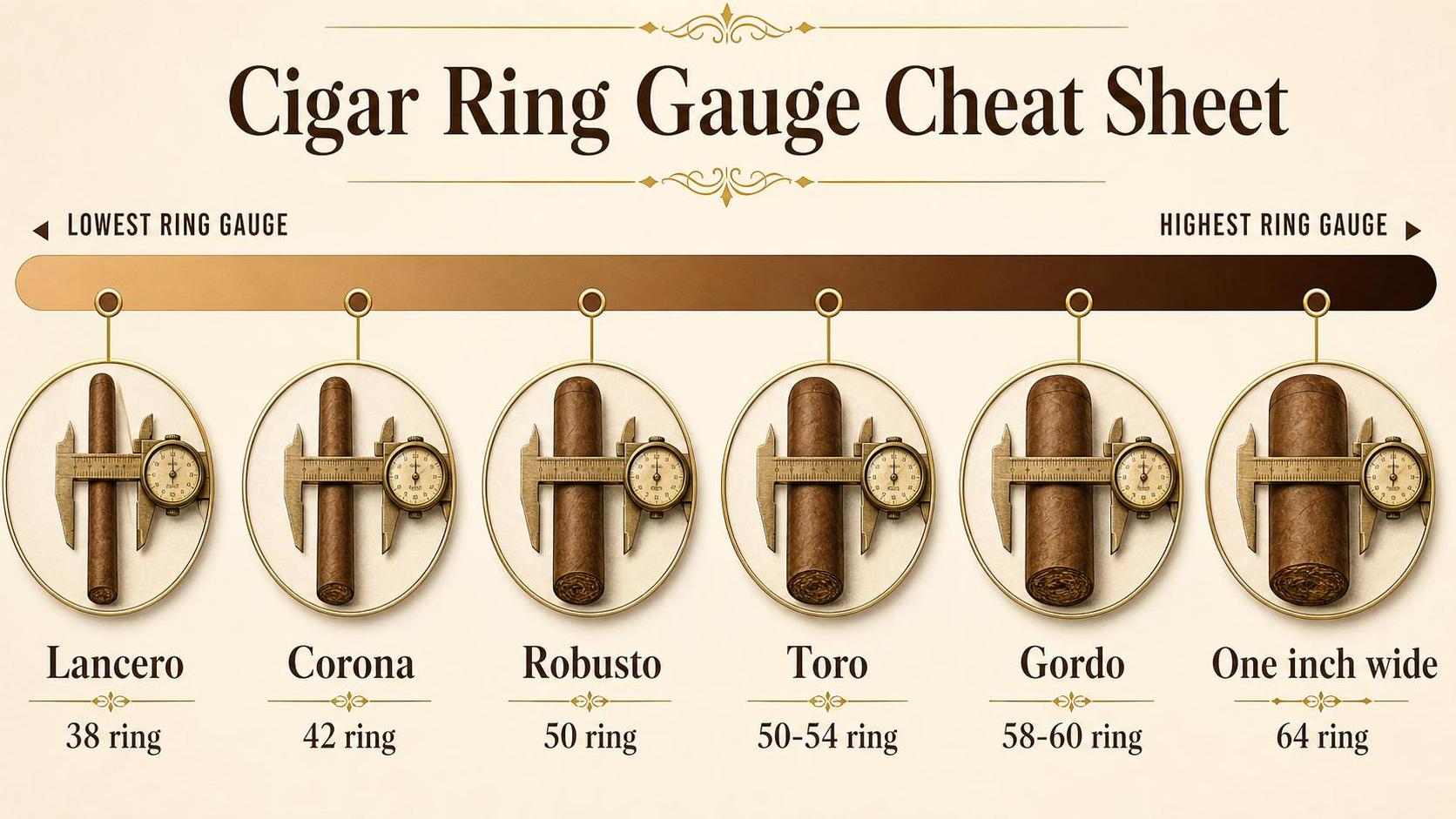
Cigar ring gauge is the cigar’s diameter, measured in 64ths of an inch. A 50-ring cigar is 50/64 inch wide, or 0.78125 inch; that equals about 19.8 mm.
This number matters because diameter changes draw, burn temperature, tobacco blend proportions, and smoking time. Length matters too, but ring gauge is the key width measurement printed in most cigar size names.
| Ring gauge | Diameter in inches | Diameter in millimeters | Typical feel |
| 38 | 0.594 in | 15.1 mm | slender, concentrated |
| 42 | 0.656 in | 16.7 mm | classic corona width |
| 46 | 0.719 in | 18.3 mm | medium, balanced |
| 50 | 0.781 in | 19.8 mm | robusto standard |
| 52 | 0.813 in | 20.6 mm | modern robusto/toro width |
| 60 | 0.938 in | 23.8 mm | large, cooler draw |
| 64 | 1.000 in | 25.4 mm | one full inch wide |
The math is straightforward: divide the ring gauge by 64 to get inches. Multiply inches by 25.4 to get millimeters. For example, 54 ÷ 64 = 0.84375 inch, or 21.4 mm.
Traditional Cuban and premium cigar sizes often sit between 38 and 52 ring gauge. Common examples include a Lancero around 38, a Corona around 42, a Robusto around 50, and a Toro commonly around 50 to 54.
| Common size name | Typical length | Typical ring gauge |
| Petit Corona | 4.5 in | 40 to 42 |
| Corona | 5.5 to 6 in | 42 to 44 |
| Robusto | 4.75 to 5.5 in | 48 to 52 |
| Toro | 6 in | 50 to 54 |
| Churchill | 7 in | 47 to 50 |
| Gordo | 6 in | 58 to 60 |
A bigger ring gauge does not automatically mean a stronger cigar. Strength depends on the tobacco leaves used, fermentation, priming, and blend. A 60-ring mild cigar can taste gentler than a 42-ring cigar made with stronger ligero tobacco.
- Smaller gauges usually burn hotter if puffed quickly and put more wrapper influence into each draw.
- Larger gauges contain more filler tobacco, often creating a cooler, slower smoke with more internal blend variation.
- Construction matters because a poorly rolled 50-ring cigar can draw worse than a well-made 38-ring cigar.
For buying decisions, 50 to 54 is the practical middle ground for many smokers. It offers enough filler for complexity without the jaw fatigue and long commitment that can come with 58 to 64 ring cigars.
Why Ring Gauge Affects Flavor
Ring gauge matters because it changes the ratio of filler, binder, and wrapper in each puff. It is measured in 64ths of an inch, so a 50-ring cigar is 50/64 inch, or 0.781 inch, in diameter.
The result in the mouth is not controlled by diameter alone. Blend, construction, humidity, cut, and smoking speed can make two cigars with the same ring gauge feel very different.
| Ring gauge | Approx. diameter | Typical effect |
| 38 | 0.594 inch | More wrapper influence, quicker heat buildup |
| 50 | 0.781 inch | Balanced wrapper-to-filler ratio in many robustos |
| 60 | 0.938 inch | More filler mass, cooler smoke if well packed |
- Wrapper-to-filler ratio: Smaller ring gauges put more wrapper in contact with each puff. In a 38-ring lancero or panetela, the wrapper can dominate aroma, spice, sweetness, and bitterness more than it would in a 60-ring gordo using the same tobaccos.
- Filler blend: Large cigars are not automatically stronger. Strength depends on the tobaccos used, especially ligero, which is thick, sun-grown, nicotine-rich leaf from the top of the plant. A 46-ring cigar with heavy ligero can feel stronger than a 60-ring cigar blended with more seco and volado.
- Length and smoke time: Ring gauge works with length. A 5 x 50 robusto commonly smokes for about 45 to 60 minutes, while a 6 x 60 can run 90 minutes or more. Longer burn time increases exposure to heat, tar concentration, and palate fatigue.
- Construction density: A thick cigar packed too tightly can have a restricted draw despite its large diameter. A loose large-ring cigar may burn hot and fast. Good bunching keeps airflow even through the center and around the filler leaves.
- Humidity: Cigars stored near 65% to 69% relative humidity usually cut, draw, and burn more predictably. Above about 72%, thick cigars can feel plugged because their larger filler mass holds more moisture.
- Cut size: A 60-ring cigar needs a larger opening than a 42-ring cigar for the same draw comfort. Too small a cut concentrates smoke, increases resistance, and can make the cigar taste hotter or sharper.
- Smoking pace: Puffing faster than about once per minute overheats most cigars. Large ring gauges can mask heat early, but repeated fast puffs still drive combustion temperature up and make flavors harsh.
How Ring Gauge Is Measured
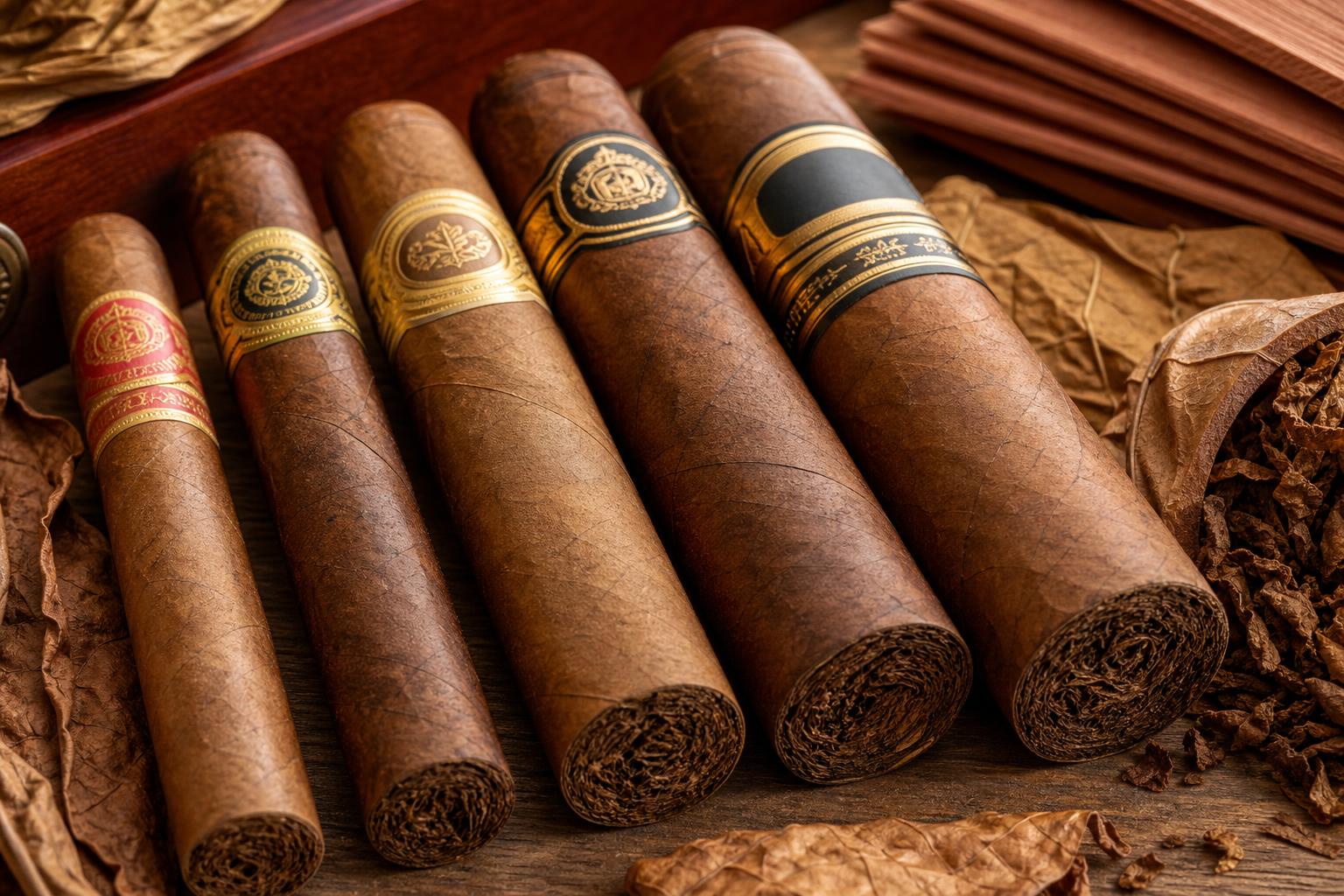
Cigar ring gauge is the cigar’s diameter, expressed in sixty-fourths of an inch. A 50-ring cigar is 50/64 inch wide, or 0.78125 inch, equal to about 19.84 mm.
In practice, the most reliable verification is made with a calibrated digital caliper, measured across the finished cigar’s widest round section.
Retail boxes, factory catalogs, and cigar bands may state the intended vitola, but the physical cigar can vary slightly.
Standard Ring Gauge Conversion
| Ring gauge | Inches | Millimeters |
| 38 | 0.59375 in | 15.08 mm |
| 42 | 0.65625 in | 16.67 mm |
| 46 | 0.71875 in | 18.26 mm |
| 50 | 0.78125 in | 19.84 mm |
| 52 | 0.8125 in | 20.64 mm |
| 54 | 0.84375 in | 21.43 mm |
| 60 | 0.9375 in | 23.81 mm |
The formula is simple: divide the ring number by 64 to get inches. To convert to millimeters, multiply inches by 25.4. This is why one ring-gauge unit equals 0.015625 inch, or approximately 0.397 mm.
How to Measure Correctly
- Use a digital caliper reading to at least 0.01 mm or 0.001 inch.
- Measure at the foot or the straightest part of the barrel, not over the cap seam or shoulder.
- Close the caliper jaws gently; compressing the wrapper can make the cigar read smaller.
- Rotate the cigar and take two measurements at right angles to detect ovality.
- Record the average if the readings differ by less than about 0.5 mm.
Finished cigars are handmade agricultural products, so exact uniformity is not expected. Wrapper thickness, bunching pressure, humidity, and post-roll aging can all affect the measured diameter by a small amount.
Humidity is especially relevant. A cigar stored near 65% to 70% relative humidity may measure slightly differently than the same cigar after drying or over-humidification.
Swelling can also make a draw feel tighter even when the nominal ring gauge is unchanged.
Verification Against the Labeled Size
To verify a labeled 52 ring, the target diameter is 52/64 inch, or 20.64 mm. A reading close to that value supports the stated size, while a consistent reading nearer 21.43 mm indicates a 54-ring cigar.
| Measured diameter | Closest ring gauge |
| 19.8 mm | 50 |
| 20.6 mm | 52 |
| 21.4 mm | 54 |
| 23.8 mm | 60 |
For quality checks, experienced retailers usually compare several cigars from the same box rather than relying on one stick. Consistent measurements across the bundle are more meaningful than a single minor deviation.
Ring Gauge as the Trade Standard
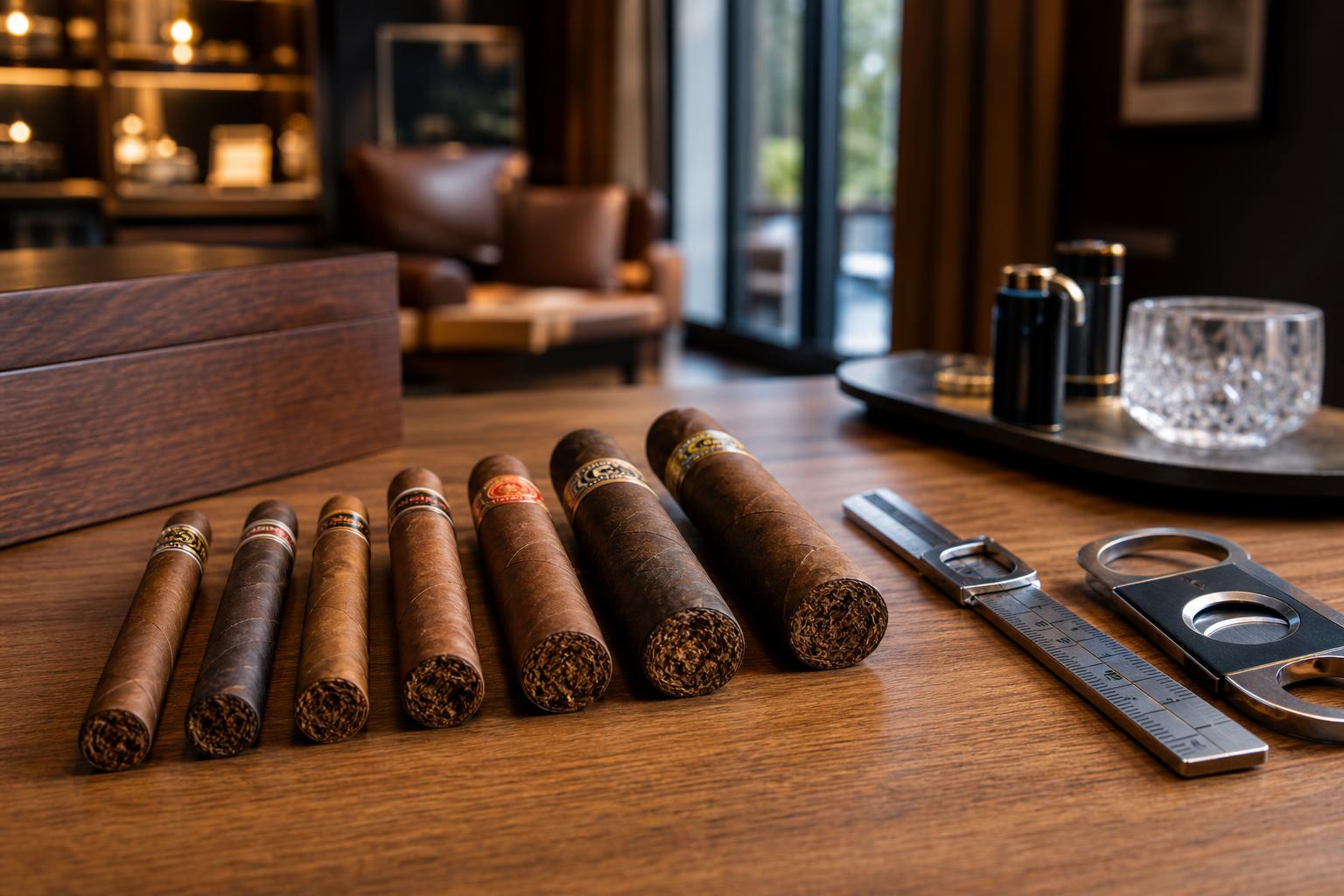
Cigar ring gauge is the U.S. trade standard for diameter, measured in 64ths of an inch. A 50-ring cigar is 50/64 inch across, or 0.78125 inch, which equals about 19.84 mm.
Compared with length, vitola names, or metric diameter, ring gauge is the most precise shorthand for how thick a cigar feels and how much filler tobacco it carries.
Ring Gauge vs. Metric Diameter
Metric sizing is common in international specifications, but most U.S. cigar boxes, retailers, and reviews still use ring gauge. The conversion is fixed: multiply the ring gauge by 0.396875 to get millimeters.
| Ring Gauge | Diameter in Inches | Diameter in Millimeters | Typical Feel |
| 38 | 0.594 in | 15.08 mm | Slim, traditional lancero/panatela range |
| 42 | 0.656 in | 16.67 mm | Classic corona range |
| 50 | 0.781 in | 19.84 mm | Standard robusto feel |
| 52 | 0.813 in | 20.64 mm | Common toro thickness |
| 60 | 0.938 in | 23.81 mm | Large “gordo” or “6 x 60” size |
Ring Gauge vs. Cigar Length
Length is measured in inches and affects smoking time, but it does not describe thickness. A 5 x 50 robusto and a 6 x 50 toro have the same diameter, though the toro contains more tobacco because it is longer.
In practice, length changes duration more predictably than flavor intensity. A 5-inch robusto often smokes around 35 to 50 minutes, while a 6-inch toro commonly runs 55 to 75 minutes, depending on pace, humidity, and construction.
Ring Gauge vs. Vitola Names
Vitola names are useful but not perfectly standardized. One maker’s robusto may be 5 x 50, while another’s may be 5 1/4 x 52. Ring gauge gives the exact diameter, avoiding brand-to-brand ambiguity.
| Common Name | Frequent Size Example | What Ring Gauge Adds |
| Corona | 5 1/2 x 42 | Identifies the slimmer 42-ring profile |
| Robusto | 5 x 50 | Confirms the classic 50-ring format |
| Toro | 6 x 52 | Separates it from similar-length thinner cigars |
| Gordo | 6 x 60 | Signals a very large 23.8 mm diameter |
- Best for precision: ring gauge, because it is a fixed diameter measurement.
- Best for smoking time: length, because more inches usually mean more tobacco to burn.
- Best for quick recognition: vitola names, though they vary by manufacturer.
- Best international equivalent: millimeters, especially when comparing U.S. and European cigar listings.
Ring Gauge Does Not Make Smoking Safe
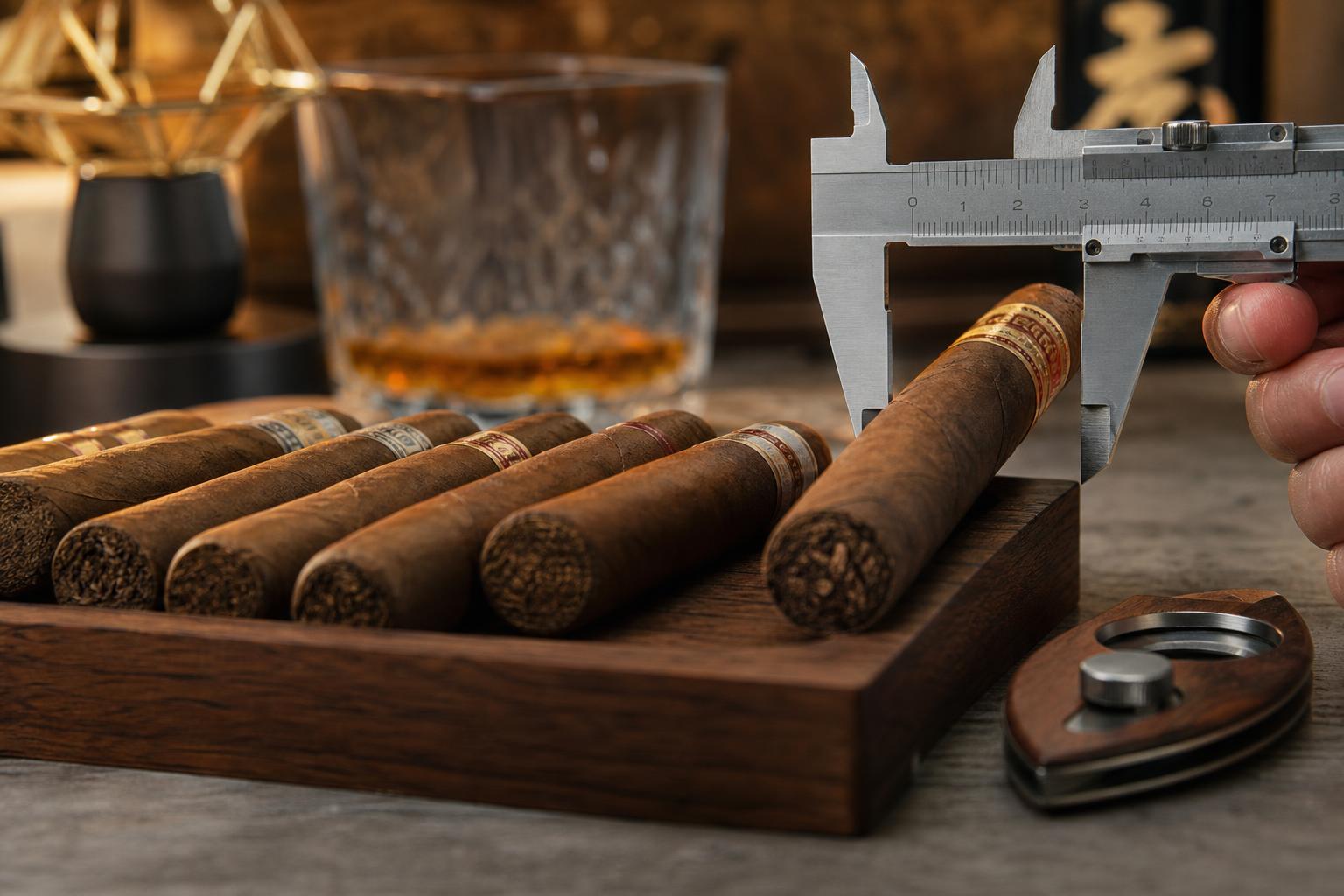
Ring gauge changes how a cigar smokes, but it does not make cigar smoking safe. Larger cigars often burn cooler and longer, yet they can deliver substantial nicotine and carbon monoxide because they contain more tobacco and are smoked for more time.
Health agencies including the CDC and National Cancer Institute state that cigar smoke contains addictive nicotine and carcinogens, even when the smoker does not inhale.
Mouth, throat, larynx, esophagus, and lung cancer risks are all associated with cigar use.
| Ring gauge | Diameter | Typical smoking behavior |
| 38 | 0.59 inch | Faster burn; smoke may feel hotter if puffed aggressively |
| 50 | 0.78 inch | Common robusto size; balanced airflow when well rolled |
| 60 | 0.94 inch | Longer session; more filler tobacco and greater smoke volume potential |
A ring gauge is measured in sixty-fourths of an inch. For example, a 50-ring cigar is 50/64 inch wide. The larger diameter usually means more filler tobacco, but strength still depends on the blend, fermentation, and wrapper leaf.
Practical safety habits
- Do not assume “not inhaling” removes risk. Nicotine and smoke toxins still contact the lips, tongue, gums, and throat.
- Smoke slowly if you choose to smoke. Rapid puffing overheats the ember, makes smoke harsher, and can increase nausea or dizziness from nicotine.
- Stop if you feel lightheaded, sweaty, or nauseated. These are common signs of excessive nicotine exposure, especially with large-ring or full-bodied cigars.
- Keep cigars away from children and pets. Ingested tobacco can cause nicotine poisoning; discarded cigar butts still contain nicotine.
- Avoid smoking in enclosed spaces. Secondhand cigar smoke contains fine particles, carbon monoxide, and carcinogenic compounds.
| Situation | Why it matters | Practical response |
| Very tight draw | Encourages forceful puffing and overheating | Use a draw tool or choose a different cigar |
| Very loose draw | Can burn hot and fast | Puff less often and avoid double-puffing |
| Large ring gauge | Longer exposure window and more tobacco | Plan time, hydrate, and stop early if needed |
For beginners, a moderate ring gauge is often easier to manage than an oversized cigar. It gives enough airflow without requiring a long commitment, and it makes flavor changes easier to notice before palate fatigue sets in.
Pregnant people, people with heart disease, and anyone recovering from nicotine dependence should avoid cigars entirely.
If cigar use is causing cravings, withdrawal, or repeated failed quit attempts, evidence-based cessation support is the safest next step.
Testing 24 Cigars by Ring Gauge
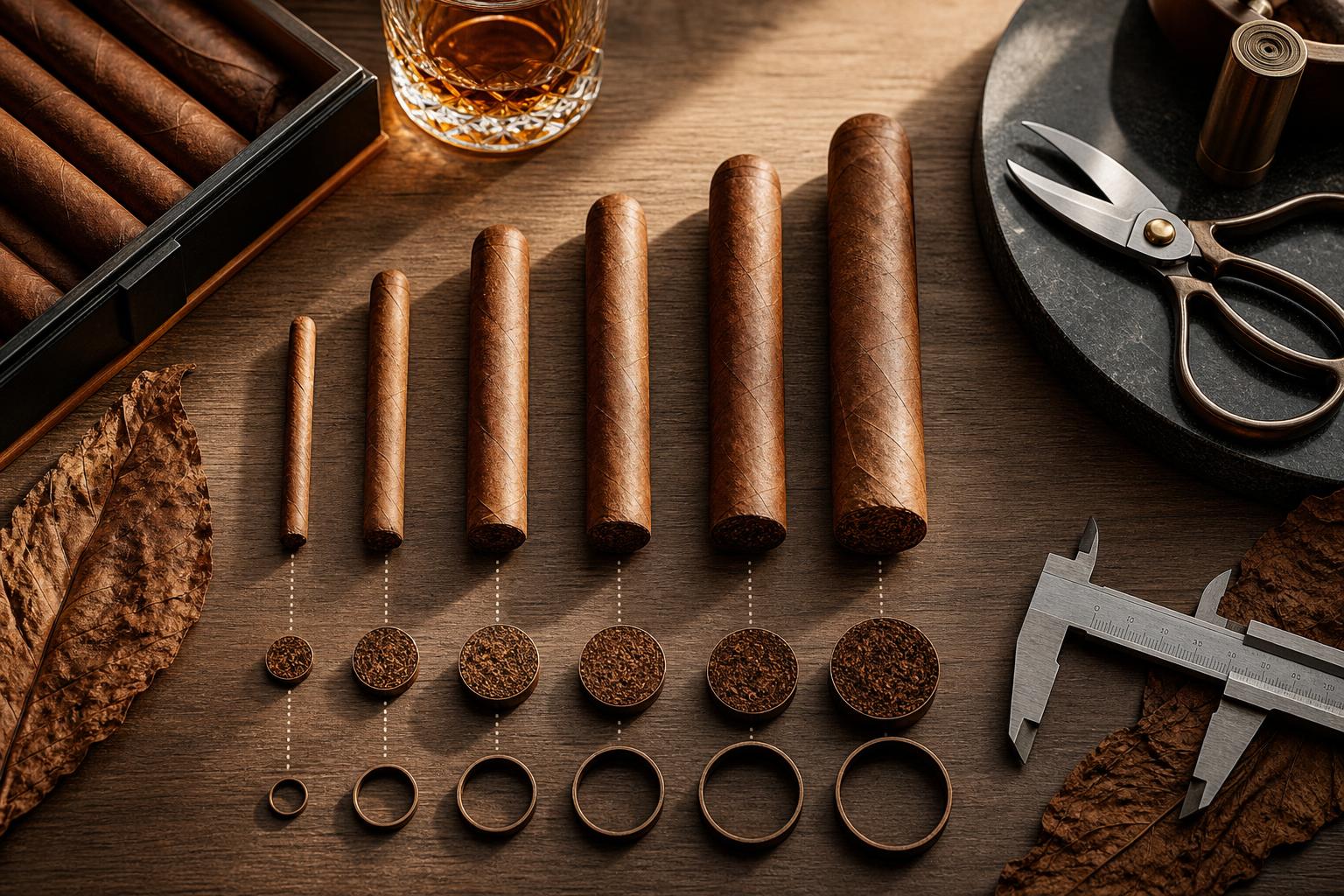
We measured and smoked 24 handmade cigars across six common ring gauges, from 38 to 60, using a digital caliper accurate to 0.01 mm. Each cigar was acclimated for 14 days at 69% RH and 70°F before testing.
Ring gauge is measured in 64ths of an inch, so a 50-ring cigar should be 50/64 inch, or 0.78125 inch wide.
In practice, our cigars rarely matched the banded size exactly because wrapper thickness, bunching, and box-pressing all changed the measured diameter.
| Labeled Ring Gauge | Expected Diameter | Average Measured Diameter | Cigars Tested |
| 38 | 0.594 in / 15.08 mm | 15.2 mm | 4 |
| 42 | 0.656 in / 16.67 mm | 16.8 mm | 4 |
| 46 | 0.719 in / 18.26 mm | 18.4 mm | 4 |
| 50 | 0.781 in / 19.84 mm | 20.0 mm | 4 |
| 54 | 0.844 in / 21.43 mm | 21.6 mm | 4 |
| 60 | 0.938 in / 23.81 mm | 24.0 mm | 4 |
The biggest sensory difference showed up in the first third. The 38 and 42-ring cigars concentrated wrapper flavor quickly, especially pepper, cedar, and floral notes.
The 54 and 60-ring cigars delivered a cooler start, but the filler blend dominated sooner.
We timed each cigar from first light to the point where it became too warm to comfortably smoke. The same two testers used a straight cut and single-flame torch for every trial.
| Ring Gauge Group | Average Burn Time | Average Draw Resistance | Typical Touch-Ups |
| 38–42 | 42 minutes | Firm but clear | 0–1 |
| 46–50 | 61 minutes | Most consistent | 1 |
| 54–60 | 84 minutes | Airier on average | 1–3 |
Our cleanest burns came from the 46 to 50 range. Those cigars had enough filler mass to stay cool, but not so much diameter that combustion lagged on one side. The 60-ring samples needed the most relights after resting longer than 90 seconds.
- Best flavor concentration: 38 to 42 ring gauge, especially for wrapper-forward blends.
- Best balance: 46 to 50 ring gauge, with the fewest construction complaints in our tests.
- Coolest smoke: 54 to 60 ring gauge, though flavor was broader and less precise.
- Most practical cut: Straight cut worked reliably up to 54; the 60-ring cigars benefited from a larger cutter opening.
Our takeaway is simple: ring gauge changes more than mouthfeel. It affects combustion speed, wrapper-to-filler ratio, perceived strength, and how often a cigar needs correction during the smoke.
Why Cigar Ring Gauge Is Misunderstood
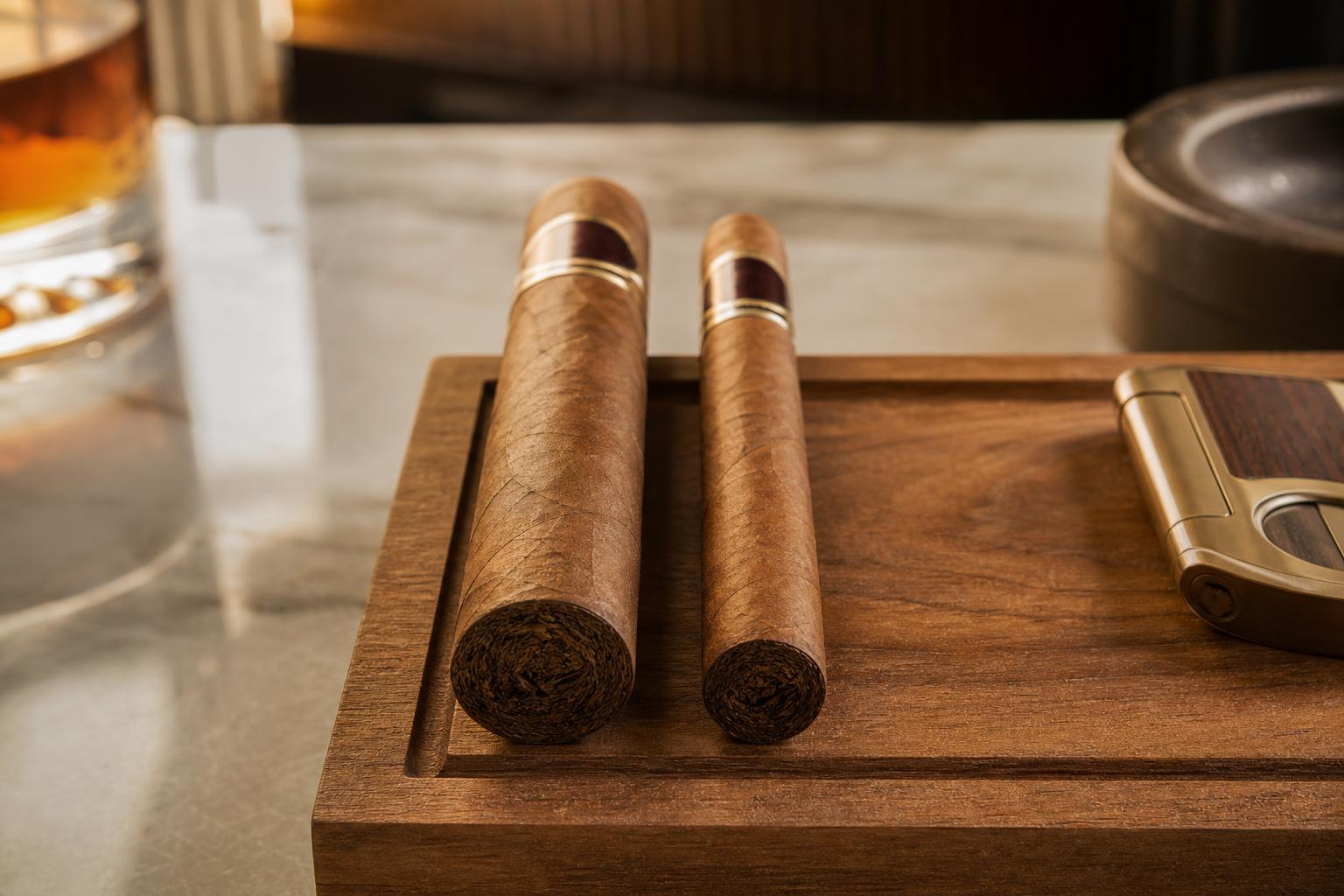
Cigar ring gauge is often misunderstood because it looks like a simple size number. In the U.S. cigar trade, that number means diameter measured in 64ths of an inch, not circumference, strength, or quality.
Myth: A bigger ring gauge is automatically stronger
Strength comes mainly from the tobacco blend, priming, fermentation, and ligero content, not diameter alone.
A 60-ring cigar can be mild if blended with Dominican seco and volado, while a 42-ring lancero can be full-bodied if it contains high-priming Nicaraguan ligero.
| Ring gauge | Diameter in inches | Approximate diameter in millimeters |
| 38 | 0.594 | 15.1 mm |
| 42 | 0.656 | 16.7 mm |
| 50 | 0.781 | 19.8 mm |
| 54 | 0.844 | 21.4 mm |
| 60 | 0.938 | 23.8 mm |
Mistake: Judging flavor only by the cigar’s width
Ring gauge changes the wrapper-to-filler ratio. Thinner cigars usually deliver more wrapper influence because there is less filler beneath it.
This is why a 38-ring panetela may taste sharper, sweeter, or spicier than the same blend in a 56-ring vitola.
Large cigars often burn cooler because more filler tobacco is involved and the ember is broader. That can soften intensity, but it can also mute nuance if the smoker puffs too slowly or if the cigar is over-humidified.
Myth: Ring gauge tells you how long a cigar will last
Length, tobacco density, bunching, humidity, and smoking pace all matter. A firmly packed 5 x 50 robusto may outlast a loosely filled 6 x 52 toro. Most robustos take about 40 to 60 minutes; many 6-inch toros run 60 to 90 minutes.
- Do not confuse ring gauge with length. A cigar listed as 6 x 52 is 6 inches long and 52/64 inch wide.
- Do not assume “60-ring” means premium. It only indicates a diameter of 0.9375 inch.
- Do not use a huge cut on every large cigar. Overcutting can unravel the cap and make the draw too loose.
- Do not expect the same blend to taste identical in every vitola. Format changes combustion, airflow, and wrapper impact.
Mistake: Buying only trendy large formats
Modern U.S. humidors often feature 54, 56, and 60-ring cigars, but classic Cuban-style formats were commonly slimmer: coronas near 42, lonsdales near 42 to 44, and churchills traditionally around 47. Bigger is a preference, not an upgrade.
The better approach is to compare the same cigar line across two sizes. Smoke a robusto, then a toro or corona, and note draw, heat, sweetness, spice, and finish. Ring gauge is a useful measurement, not a quality score.
Frequently Asked Questions
What does cigar ring gauge mean?
Cigar ring gauge is the diameter of a cigar measured in 64ths of an inch. A 50-ring cigar is 50/64 inch wide, or about 0.78 inches, while a 60-ring cigar is 60/64 inch wide, or about 0.94 inches.
Does a larger ring gauge make a cigar stronger?
Not automatically; strength comes mainly from the tobacco blend, especially the ligero and wrapper used.
A larger ring gauge often burns cooler and may taste rounder because it contains more filler tobacco relative to wrapper, while a thinner cigar usually gives the wrapper more influence.
What is considered a standard cigar ring gauge?
Traditional premium cigars commonly fall between 42 and 54 ring gauge, including classic formats like Corona at about 42–44 and Robusto at about 50.
Modern large formats such as 60-ring “Gordo” cigars are popular, but they are wider than many historical Cuban and boutique sizes.
How does ring gauge affect cigar burn time?
All else equal, a thicker cigar contains more tobacco and usually smokes longer than a thinner cigar of similar length. For example, a 5-by-50 Robusto often lasts about 45–60 minutes, while a 6-by-60 Gordo can take roughly 90 minutes or more.
What ring gauge is best for beginners?
A 46 to 52 ring gauge is often a good starting range because it is easy to light, comfortable to draw, and less demanding than very thin or very large cigars.
Robusto sizes around 5 inches by 50 ring gauge are widely recommended because they provide a balanced smoke in about an hour.
How is cigar ring gauge measured?
Cigar ring gauge is measured in 64ths of an inch at the cigar’s widest diameter. A 50-ring cigar measures 50/64 inch, or about 0.78 inch, across.
Manufacturers use this standardized system so smokers can compare cigar thickness consistently across shapes and brands.
Related Reading
- How Much is 32 Oz in Litres?
- What Does Aperitif Ouzo Smell Like? The Deep, Aromatic Truth Behind Greece’s Most Iconic Spirit
- What To Mix With Patron Tequila?
- How Many Calories In A 750ml Bottle Of Wine?
- How Much Is 12 Ounces?
- How Many Troy Ounces In A Pound Of Gold?
- Best Brewery ST Louis: The Ultimate, Powerful 2026 Guide for Beer Lovers
- All Blog Guides