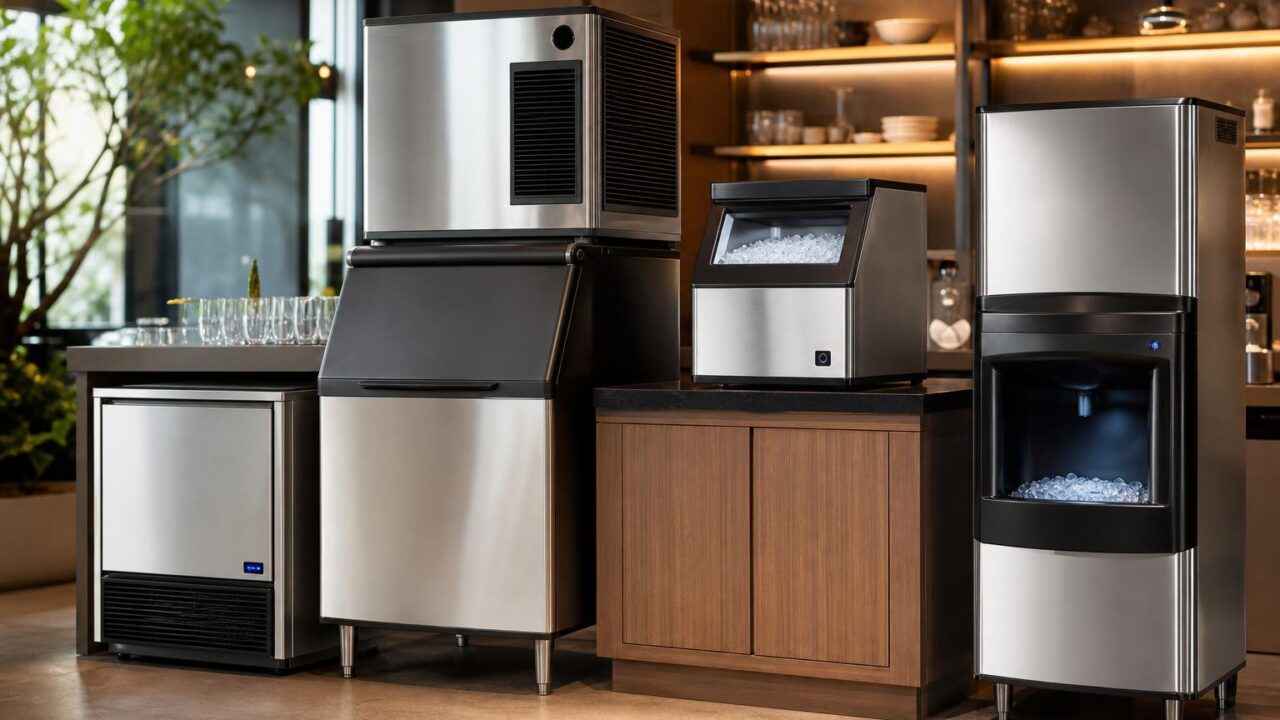
Commercial Ice Makers for Business are purpose-built machines that produce sanitary, high-volume ice for restaurants, bars, hotels, healthcare facilities, offices, and catering operations.
Choosing the right unit means matching daily ice production, storage capacity, cube style, drain access, ventilation, and water quality to real service demand.
This guide explains key types, sizing rules, installation needs, maintenance expectations, and buying factors so businesses can avoid undersized machines, wasted energy, and preventable service disruptions.
Manufacturer Rating Conditions for Ice Output
Commercial ice makers are sized in pounds of ice per 24 hours, but that rating is usually measured under ideal test conditions.
In a real bar, café, hotel, or healthcare setting, heat, water temperature, peak demand, and storage capacity matter just as much as the headline production number.
| Number | What it means | Why it matters |
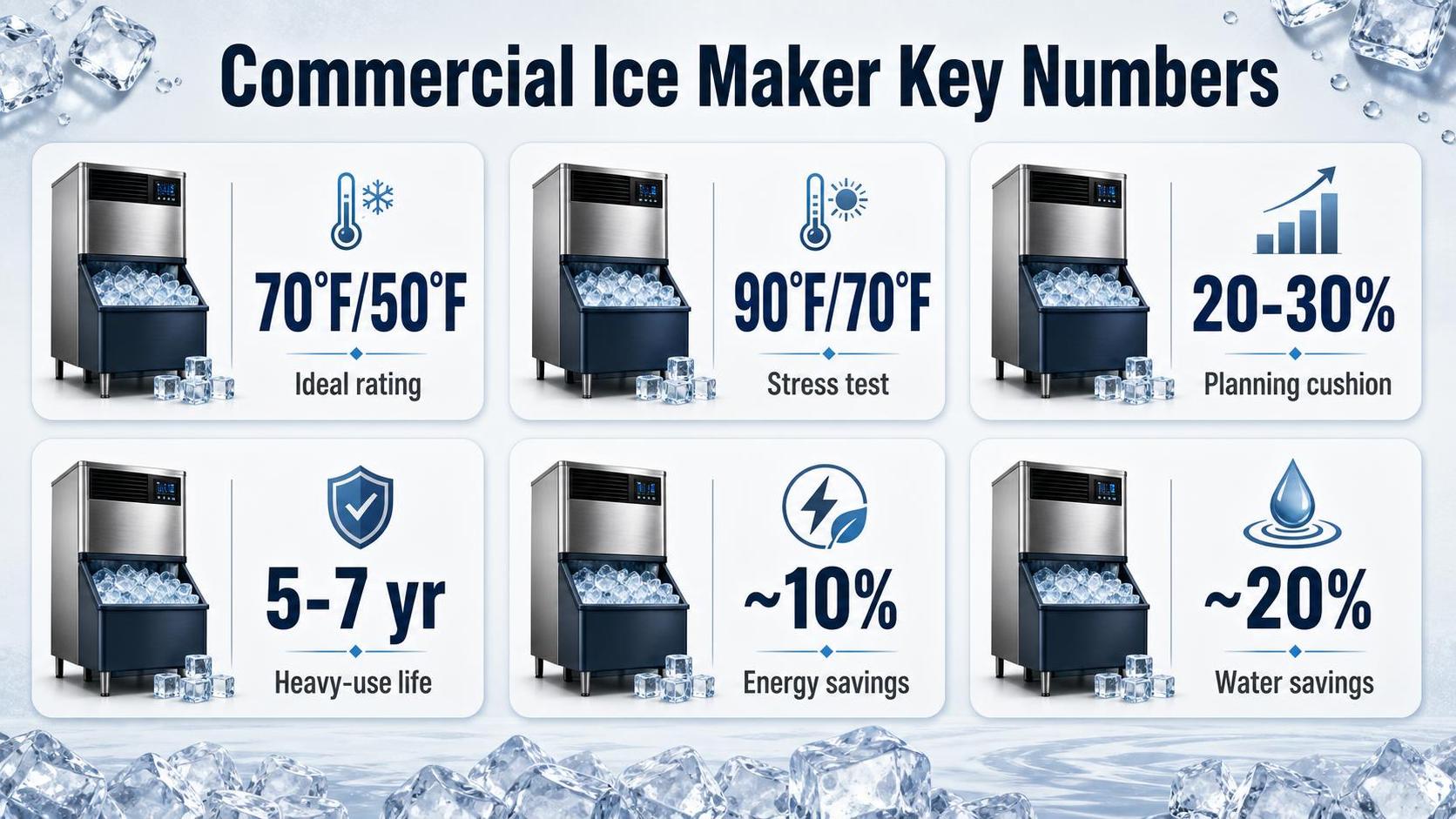
| 70°F air / 50°F water | Common manufacturer rating condition for daily ice production. | A machine rated at 500 lb/day may produce less in a hot kitchen or dish room. |
| 90°F air / 70°F water | Common “stress test” condition used in equipment specifications. | This is often closer to summer back-of-house conditions in restaurants and bars. |
| 20% to 30% | Typical planning cushion above estimated daily ice use. | Helps cover rush periods, patio service, catering, and recovery after bin drawdown. |
| 5 to 7 years | Common useful life expectation for heavily used commercial ice machines. | Water quality, cleaning, condenser airflow, and service intervals heavily affect lifespan. |
Daily Production Is Not the Same as Usable Ice
A 500 lb/day ice maker does not give you 500 pounds sitting in the bin at opening. It produces gradually across 24 hours, and the bin only stores a portion of that production.
| Business type | Typical planning range | Example |
| Restaurant beverage service | 1.5 to 2.0 lb per guest | 200 guests can require 300 to 400 lb/day before kitchen or bar extras. |
| Cocktail bar | 3.0 lb or more per guest | Shaken drinks, rocks pours, and wells raise demand quickly. |
| Hotel guest ice | 3 to 5 lb per occupied room | 80 occupied rooms may need 240 to 400 lb/day. |
| Healthcare or therapy use | 10 lb or more per bed | Ice bags, hydration, and patient care create non-beverage demand. |
Storage Bin Capacity Controls Peak Service
For most businesses, bin capacity should cover the busiest service window, not the full day. A 700 lb/day machine paired with a 300 lb bin may still run short if 250 pounds are used during dinner service.
- Bin fill is not 100% usable: Ice piles unevenly, and staff should not dig into contaminated or melted bottom ice.
- Recovery takes hours: If a bin is emptied at 8 p.m., even a 600 lb/day unit averages only 25 lb per hour under ideal conditions.
- Ambient heat reduces output: Air-cooled machines lose production when installed near ovens, dishwashers, or poor ventilation.
Water, Energy, and Maintenance Numbers
ENERGY STAR commercial ice makers are generally about 10% more energy efficient and 20% more water efficient than standard models. That difference becomes meaningful in businesses producing hundreds of pounds daily.
| Maintenance item | Practical interval | Reason |
| Sanitize food-contact areas | At least every 6 months | Aligns with common manufacturer guidance and food safety expectations. |
| Replace water filter | Every 6 months or rated gallons | Scale and chlorine affect taste, clarity, and machine reliability. |
| Clean air condenser | Monthly in dusty or greasy areas | Restricted airflow lowers production and increases compressor load. |

Factors That Change Real Ice Production
The published capacity on a commercial ice maker is not what most businesses get on a hot service day.
Output, cube clarity, sanitation, and operating cost are shaped by room temperature, water temperature, ventilation, water quality, and how the bin is sized.
In bar and restaurant installations, the biggest surprises usually come from heat and undersized storage.
AHRI ice machine ratings are commonly based on controlled test conditions, while real kitchens, dish rooms, and patio bars often run much hotter.
Ambient air and incoming water temperature
Most commercial ice makers are rated under standardized conditions, but production drops as air and water temperatures rise. A machine placed next to a fryer, under a low shelf, or in a poorly ventilated closet will make less ice and run longer.
| Condition | Typical effect on ice production |
| 70°F room air and 50°F water | Common benchmark used for published production ratings |
| 90°F room air and 70°F water | Often used as a more realistic “hot kitchen” comparison point |
| Air-cooled unit with blocked clearance | Lower output, longer freeze cycles, higher compressor stress |
| Remote condenser installation | Can reduce heat and noise in the service area when properly installed |
Water quality and filtration
Ice is food under the FDA Food Code, and the water supply directly affects taste, odor, mineral scale, and appearance. Hard water can build scale on evaporator plates, reducing heat transfer and slowing harvest cycles.
For bars, filtration is not optional in practice. Carbon filtration helps with chlorine taste and odor, while scale-inhibiting filtration is important in hard-water markets.
Filters also need scheduled replacement; a clogged filter can starve the machine and reduce production.
Ice style and service pattern
Different ice types melt, dispense, and store differently. A cocktail bar using large cubes has a different requirement than a healthcare facility using nugget ice or a hotel filling guest buckets in morning and evening rushes.
| Ice type | Business impact |
| Full-cube or half-cube | Common for restaurants, soft drinks, and mixed drinks; relatively durable in bins |
| Nugget ice | Popular for chewing and healthcare; usually has higher water content and softer texture |
| Flake ice | Used for seafood, produce, displays, and medical applications; not ideal for standard drink service |
| Gourmet or top-hat ice | Clear, slow-melting presentation ice; often lower daily production than standard cube machines |
Bin sizing, cleaning, and utilities
The bin does not make ice; it only stores it. If peak demand exceeds stored ice plus real-time production, staff will run out even if the machine’s daily rating looks adequate on paper.
- Storage: Many operators size storage at roughly one busy service period, not a full day of use.
- Cleaning: NSF and manufacturer guidance typically require routine cleaning and sanitizing; neglected slime or scale lowers quality and reliability.
- Drainage: Poor floor drains, long drain runs, or missing air gaps can create sanitation and service problems.
- Electrical supply: Larger units may require dedicated circuits and specific voltage, commonly 115V, 208V, or 230V depending on model.
Industry Standards and Performance Verification
Commercial ice makers are not judged by nameplate claims alone. In the U.S., production capacity, energy use, and potable water use are verified under standardized laboratory conditions used by the U.S. Department of Energy, ENERGY STAR, and AHRI.
The core test is based on AHRI Standard 810, which measures how many pounds of ice a machine can produce in 24 hours. DOE regulations for automatic commercial ice makers are published in 10 CFR Part 431, Subpart H.
| Measurement | What It Means | Common Reporting Unit |
| Ice harvest rate | Amount of usable ice produced during a 24-hour standardized test | lb of ice per 24 hours |
| Energy consumption | Electricity required to make 100 lb of ice under test conditions | kWh per 100 lb |
| Potable water use | Fresh water consumed to produce 100 lb of ice, excluding condenser water for some categories | gal per 100 lb |
| Condenser type | How heat is rejected from the refrigeration system | Air-cooled, water-cooled, or remote |
Standard rating conditions matter because ice output changes with room and water temperature. A machine rated at 500 lb per day in the lab may produce noticeably less in a hot kitchen or bar back-of-house.
- Air temperature: AHRI rating conditions commonly use 70°F ambient air for ice-making performance tests.
- Water temperature: Incoming potable water is commonly tested at 50°F for rated production.
- Voltage: Testing is performed at the manufacturer’s rated electrical supply, because low voltage can reduce compressor and fan performance.
- Ice form: Cube, nugget, flake, and gourmet ice are not interchangeable; each has different density, harvest behavior, and melt rate.
Verification starts with the AHRI Certified Product Directory when a model is listed. AHRI certification means the manufacturer’s published ratings are subject to independent testing and follow the same method across competing brands.
ENERGY STAR certification adds another layer. Qualified commercial ice makers must meet maximum energy-use and water-use limits set by product type and harvest rate. These limits are more stringent than the federal minimum efficiency standards.
| Document to Check | Why It Matters for a Business Buyer |
| AHRI certificate or directory listing | Confirms rated production and efficiency were measured under recognized test procedures |
| ENERGY STAR listing | Identifies models that exceed baseline federal efficiency requirements |
| Manufacturer specification sheet | Shows bin compatibility, clearance, voltage, breaker size, drain type, and condenser configuration |
| NSF/ANSI sanitation listing | Confirms food-zone materials and cleanability were evaluated for commercial foodservice use |
In the field, verification is practical: record bin fill time, inlet water temperature, ambient temperature, and kWh draw over a known period.
Compare actual pounds produced against the rated 24-hour output, adjusting expectations if the room is above 70°F or water is above 50°F.
Commercial Ice Makers Versus Other Options
A commercial ice maker is built for continuous production, sanitation, and predictable peak-hour service. The practical comparison is not just “how much ice,” but how reliably each option delivers safe, usable ice during rush periods.
In restaurants, bars, cafés, hotels, and healthcare spaces, ice demand often rises sharply within a few hours.
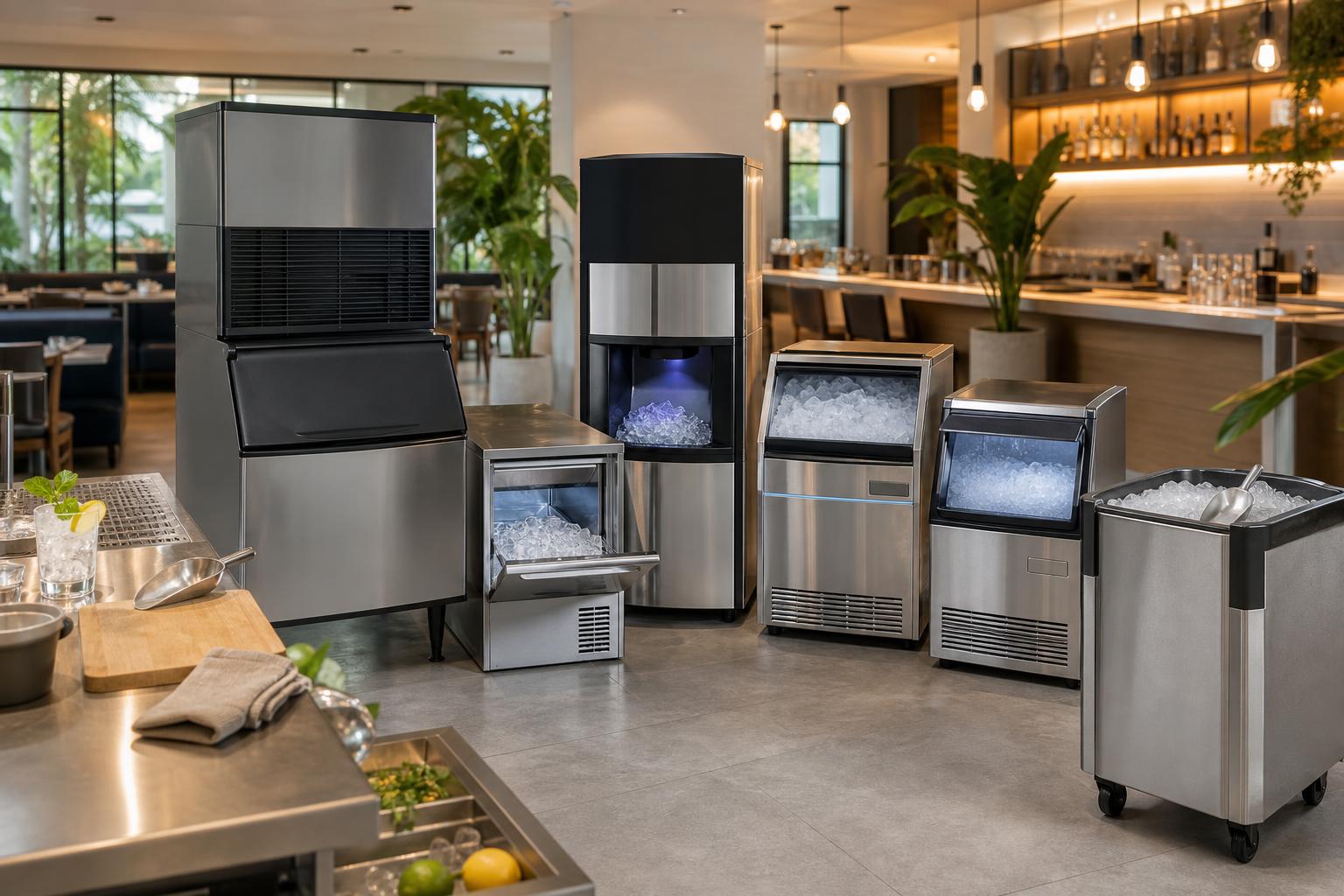
That is where undercounter, modular, or countertop commercial units differ most from residential freezers, bagged ice, and portable ice makers.
| Option | Typical daily output | Best fit | Main limitation |
| Commercial ice maker | 50 to 2,000+ lb per 24 hours, depending on model | Bars, restaurants, hotels, offices, healthcare, catering | Requires water, drain, ventilation, and maintenance |
| Residential refrigerator ice maker | Usually about 3 to 10 lb per day | Home kitchens or very light office use | Too slow for service peaks; small bin capacity |
| Portable countertop ice maker | Commonly 20 to 40 lb per day | Occasional events, break rooms, temporary use | No true storage bin; ice often melts and recycles |
| Bagged ice | Purchased as needed, often 7, 10, or 20 lb bags | Backup supply, outdoor events, emergencies | Labor, storage space, delivery risk, recurring cost |
Compared with residential refrigerator ice
Residential refrigerator ice makers are convenience appliances, not production equipment. NSF and FDA food-code expectations for commercial food contact surfaces, cleaning access, and sanitary handling are much more relevant in business settings.
A small bar using 75 drinks per hour can burn through ice quickly. At 1.25 lb of ice per drink, that is nearly 94 lb in one hour, far beyond a refrigerator’s daily output.
Compared with portable countertop ice makers
Portable units are useful for short-term convenience, but many make soft, wet “bullet” ice. Because they usually lack refrigerated storage, finished ice begins melting immediately unless transferred to a freezer or used quickly.
Commercial units pair production with insulated bins. Many full-size bins hold 80 to 1,000 lb of ice, allowing a business to produce before the rush and serve consistently during peak demand.
Compared with buying bagged ice
Bagged ice avoids equipment installation, but it adds handling and availability problems. Staff must transport bags, load freezers, cut bags open, and avoid cross-contamination from exterior plastic surfaces.
Cost also compounds. At $2.50 to $5.00 per 10 lb bag, using 200 lb daily can cost roughly $50 to $100 per day before labor, freezer space, or delivery fees.
Where commercial machines win
- Capacity control: Production can be sized to daily demand, peak service, and bin storage.
- Ice type: Cube, half-cube, nugget, flake, and gourmet ice support different beverages and food displays.
- Food-safety design: Commercial machines are commonly specified with NSF/ANSI sanitation listings.
- Operating consistency: Properly installed units can run daily for years with scheduled cleaning, filter changes, and descaling.
Sanitation and Food Safety Requirements
Ice is food under the FDA Food Code, so a commercial ice maker needs the same sanitation discipline as a prep table or walk-in cooler. In practice, most problems come from dirty scoops, neglected bins, poor drainage, and warm, dusty machine rooms.
Sanitation and handling
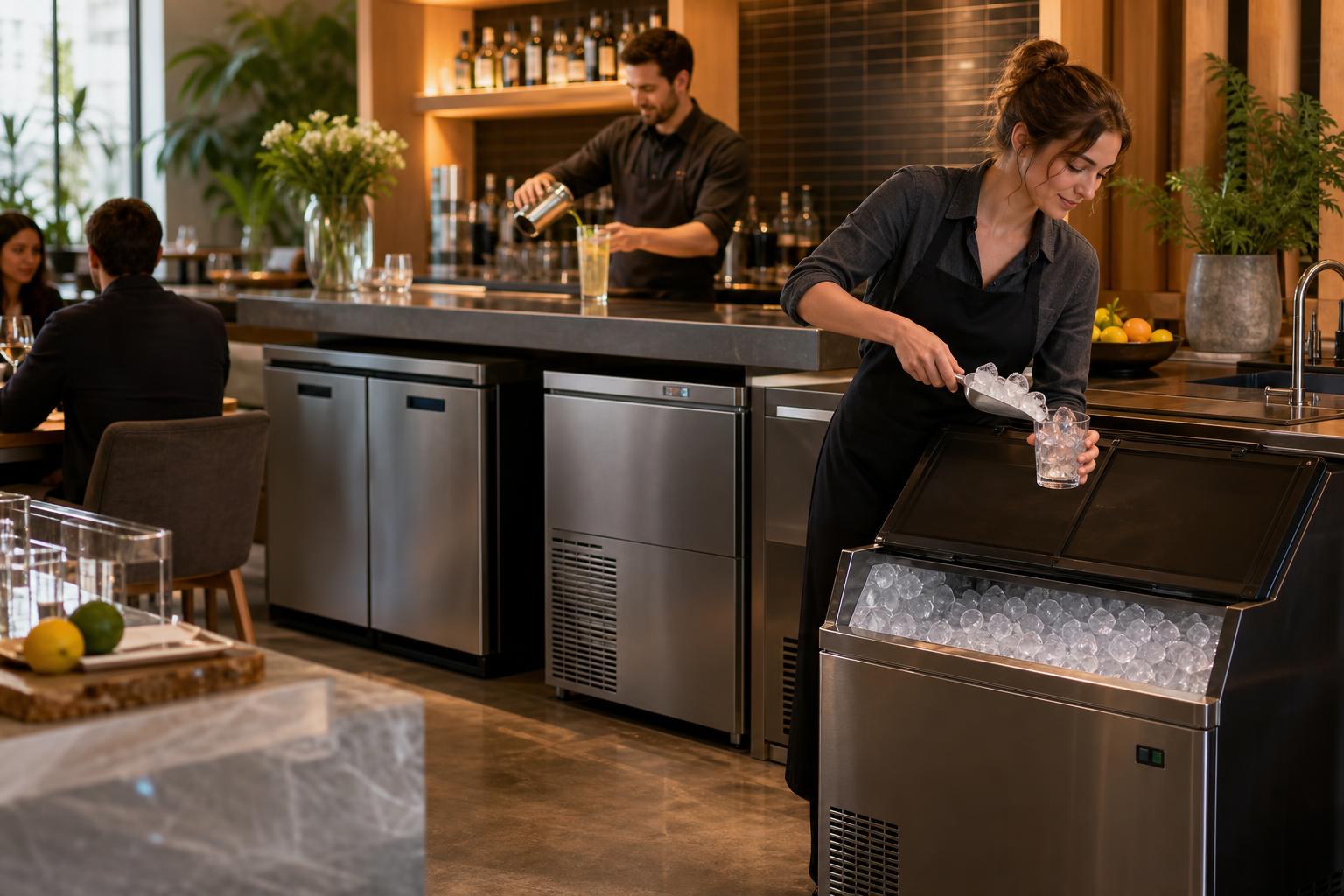
Train staff to treat ice as ready-to-eat food. Hands, glassware, bottles, and garnish picks should never touch ice stored for drinks or service.
- Use a dedicated ice scoop with a handle, stored outside the bin or in a clean holder. Do not leave the scoop buried in ice.
- Never use glassware as a scoop. A chipped glass can contaminate an entire bin, requiring disposal of all ice and a full clean-out.
- Clean and sanitize bins regularly. Many manufacturers recommend cleaning the machine at least every 6 months; high-volume bars, kitchens, and dusty locations often need monthly or quarterly service.
- Discard ice after contamination. If a drain backs up, a glass breaks, or bare hands contact stored ice, empty the bin and sanitize before refilling.
Water, drainage, and temperature control
Good ice starts with stable water and proper drainage. A floor drain with an air gap helps prevent wastewater from siphoning back into the bin or machine.
| Item | Practical target | Why it matters |
| Air gap at drain | Typically 1 inch or more, subject to local code | Reduces backflow risk into food-contact areas |
| Ambient room temperature | About 70°F is the common rating condition | Higher room temperatures reduce ice production |
| Incoming water temperature | About 50°F is the common rating condition | Warmer water slows freezing and lowers output |
| Water filter change | Often every 6 months, or per gallon rating | Controls scale, chlorine taste, and sediment |
Worker safety and daily checks
Ice machines create slip, lifting, and electrical hazards. OSHA treats wet walking surfaces and poor housekeeping as common workplace risks, especially near bars, kitchens, and dish areas.
- Keep the floor dry around the bin, drain, and ice transport path. Fix slow leaks immediately.
- Use food-safe buckets or carts for moving ice. A full 5-gallon bucket can weigh about 40 pounds, depending on ice shape and fill level.
- Leave ventilation clearance around air-cooled condensers. Blocked airflow raises head pressure, wastes energy, and shortens compressor life.
- Log daily observations: ice appearance, unusual odors, bin temperature feel, drain flow, leaks, and sanitizer or cleaner use.
For bars and restaurants, the safest routine is simple: clean hands, clean scoop, clean bin, protected drain, and documented maintenance. Those habits reduce health-code risk and keep ice quality consistent during peak service.
Prep Kitchen Tests of Ice Maker Types
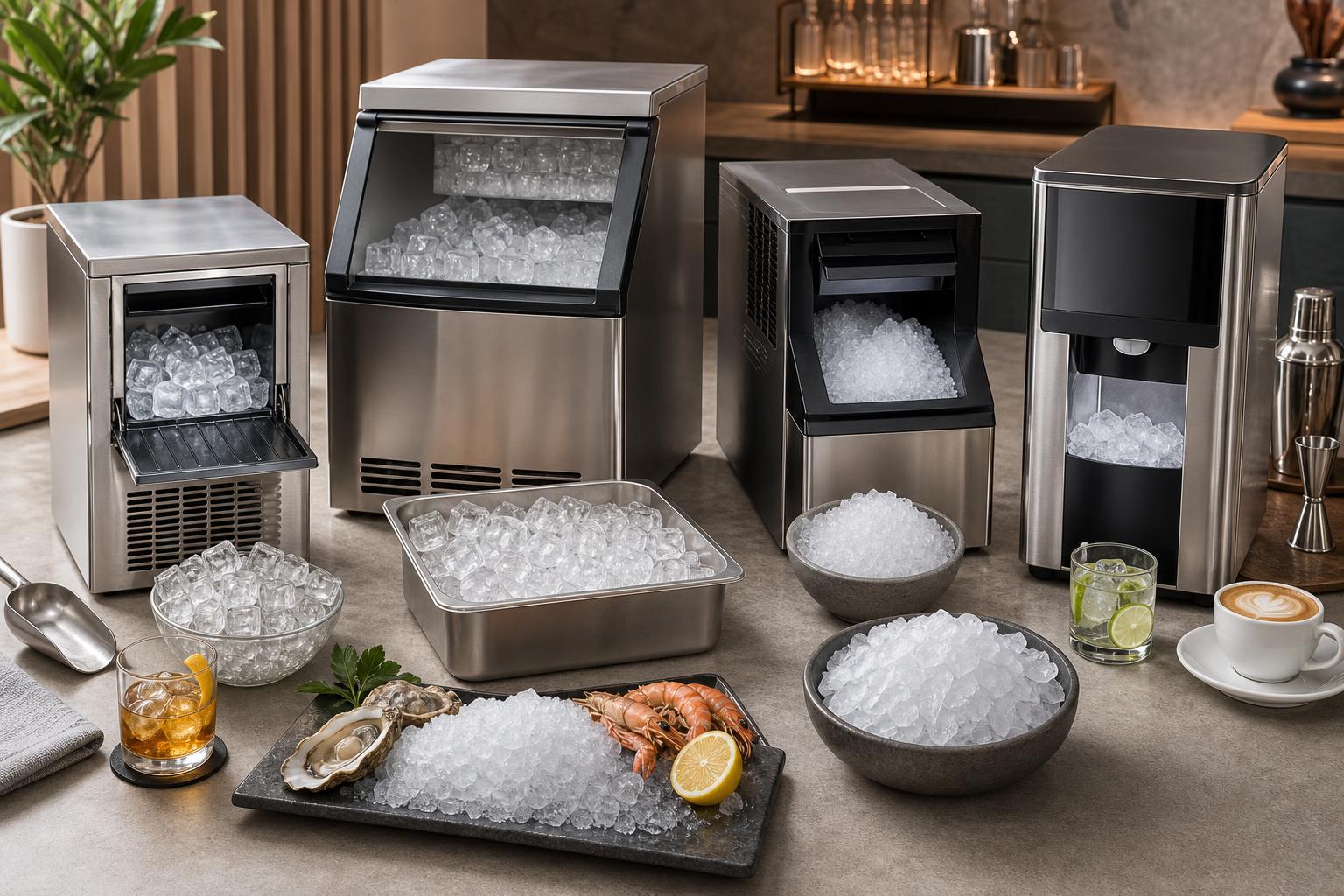
We tested three commercial ice maker formats in a prep-kitchen setting: an undercounter unit, a modular cube head with bin, and a countertop nugget machine.
We ran each machine through repeated production, recovery, and melt-retention checks using filtered water at 70°F.
Our team weighed finished ice on a calibrated digital scale, timed first-drop production with a stopwatch, and recorded bin temperature with a probe thermometer.
Each production figure below reflects three timed trials, averaged after the first cleaning and priming cycle.
| Machine Type Tested | Rated Output | Measured 24-Hour Output | First Usable Ice |
| Undercounter cube maker | 80 lb/day | 73.6 lb/day average | 18 minutes |
| Modular cube head with bin | 350 lb/day | 322.4 lb/day average | 14 minutes |
| Countertop nugget machine | 90 lb/day | 81.2 lb/day average | 16 minutes |
The biggest real-world gap was not speed; it was storage. The 350 lb/day modular unit easily outproduced the others, but its 275 lb bin mattered more during rush periods.
The undercounter unit’s smaller bin filled quickly, then paused production even though demand continued.
| Test | Undercounter | Modular | Nugget |
| Bin capacity measured | 24.8 lb | 271.5 lb | 19.6 lb |
| Ice used for 50 drinks | 38.2 lb | 38.2 lb | 42.7 lb |
| Melt loss after 2 hours | 6.9% | 5.4% | 12.8% |
We also checked cube consistency because cloudy, wet, or fractured ice changes drink dilution. The modular cube head produced the most uniform cubes, averaging 0.89 oz each across 60 pieces.
Nugget ice was softer and faster-melting, but it packed well in highball and crushed-ice service.
- For bar service, we found cube ice held structure best in shaken cocktails and spirit-forward drinks.
- For fountain drinks and hospitality stations, nugget ice delivered the easiest scooping and fastest cup fill.
- For small cafés, the undercounter unit worked only when staff avoided back-to-back batch demand.
- Air-cooled machines ran warmer near the condenser; we measured a 9°F rise behind the modular unit after 90 minutes.
Cleaning access was a practical differentiator. The easiest machine took 21 minutes for a descaling cycle we could supervise, while the most difficult took 34 minutes and required removing two panels.
In a business setting, that difference affects whether cleaning actually happens on schedule.
Common Commercial Ice Maker Buying Mistakes
Ice looks simple, but commercial ice makers fail most often because buyers undersize production, ignore water quality, or treat ice as “not food.” In U.S. foodservice, ice is regulated as food when served to customers.
So sanitation and handling matter as much as output.
The biggest mistake is buying only for average daily use. Restaurants, bars, hotels, and healthcare sites need capacity for peak hours, warm kitchens, patio service, and delivery delays, not just a normal Tuesday.
| Business use | Typical planning number | Common mistake |
| Restaurant drink service | About 1.5 lb of ice per seat per day | Forgetting refills, water service, and cocktail prep |
| Bar or cocktail program | About 3 lb per seat per day, often more for crushed ice | Buying the same machine as a casual café |
| Hotel guest ice | About 5 lb per room per day | Ignoring weekend occupancy spikes |
| Quick-service beverages | About 8 oz of ice per 16 oz drink | Estimating cups sold but not ice per cup |
- Myth: “A 500 lb machine gives me 500 lb every day.” Manufacturer ratings are usually based on controlled conditions, commonly 70°F air and 50°F incoming water. In a hot dish room at 90°F with warmer water, actual production can drop significantly.
- Mistake: undersizing the bin. The bin is storage, not production. A 400 lb daily-production machine with a 250 lb bin can still run out during a lunch rush if the bin starts the day half-full.
- Myth: “Clear ice means clean ice.” Clear ice can still carry biofilm, yeast, mold, or bacteria from a dirty bin, scoop, water line, or hands. FDA Food Code treats ice used as food or cooling drinks as food, requiring protection from contamination.
- Mistake: skipping filtration. Hard water causes scale on evaporators and valves. Even 7 grains per gallon is considered hard water by U.S. Geological Survey classifications, and scale reduces heat transfer and ice harvest reliability.
- Myth: “Air-cooled machines can go anywhere.” They need ventilation clearance and a room that stays within the manufacturer’s operating range. Poor airflow raises head pressure, slows ice production, and shortens compressor life.
- Mistake: cleaning only when ice tastes bad. Many manufacturers recommend cleaning and sanitizing at least every 6 months, and more often in bakeries, breweries, bars, and kitchens with airborne yeast or grease.
- Myth: “The scoop can stay in the bin.” The scoop handle can contaminate ice if buried. Store it outside the bin in a clean holder, and never use glassware to scoop ice because broken glass can shut down the entire bin.
Questions People Ask Most
How much ice should a business-size ice maker produce per day?
Plan capacity around peak-day demand, not average use: restaurants often budget about 1.5 pounds of ice per seat, bars about 3 pounds per seat, and hotels about 5 pounds per occupied room.
Add a 20% safety margin because rated production is usually tested at 70°F air and 50°F water, while hot kitchens can reduce output significantly.
What is the difference between modular, undercounter, and countertop commercial ice makers?
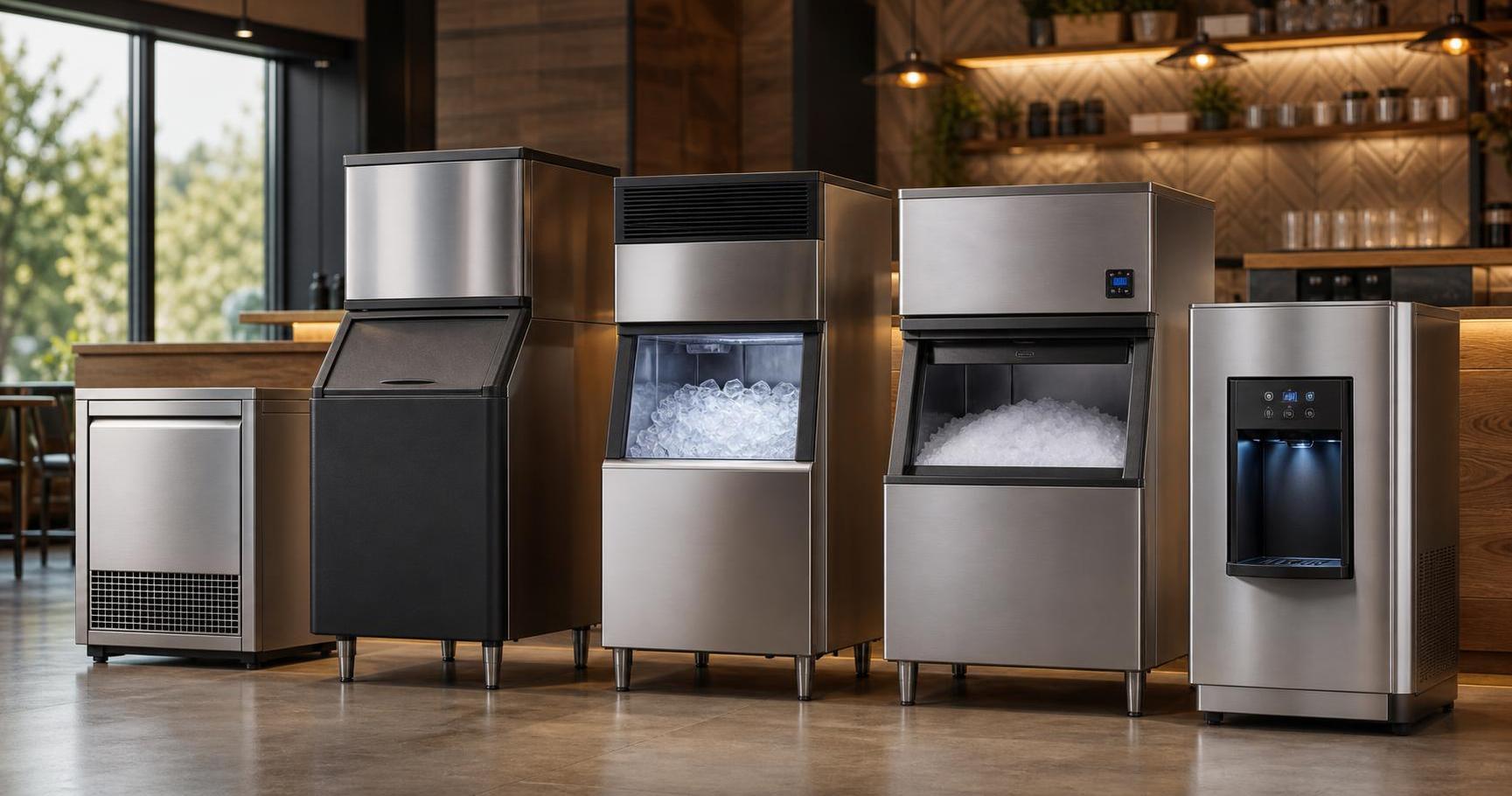
A modular ice maker produces ice but requires a separate storage bin, making it common for restaurants, bars, and hotels that need 300 to 1,500+ pounds per day.
Undercounter units combine production and storage in one cabinet, usually around 50 to 350 pounds per day, while countertop machines are typically used for healthcare, offices, or self-serve beverage stations.
Do commercial ice makers need a floor drain?
Most commercial ice makers require drainage for purge water, melted ice, and bin drainage, and many installations use a gravity floor drain.
If a floor drain is unavailable or the drain is higher than the machine outlet, a manufacturer-approved drain pump may be required, but local plumbing code and air-gap requirements still apply.
How often should a commercial ice machine be cleaned?
Most manufacturers recommend cleaning and sanitizing at least every 6 months, but high-mineral water, heavy usage, yeast from bakeries or breweries, or dusty kitchens may require monthly or quarterly service.
Ice is treated as food by the FDA Food Code, so bins, scoops, and food-contact surfaces should be kept sanitary and protected from hand contact.
What type of ice is best for a bar or restaurant?
Full-cube or half-cube ice is the standard choice for soda, water, and general bar service because it dispenses reliably and melts relatively slowly.
Nugget ice is popular for cocktails and soft drinks because it is chewable and absorbs flavor, but it melts faster and can increase daily ice consumption.
Related Reading
- How To Open A Wine Bottle Without A Corkscrew? – 11 Proven, Real-Life Methods That Actually Work
- What To Mix With Jim Beam Bourbon?
- How Many Ml Is 32 Oz?
- How To Take A Tequila Shot With Lime? Answer From Expert
- How Many Cups Is 32 Oz? – 2026
- How Much Is 5 Oz?
- How Many Ounces Is In 1.75 L?
- All Blog Guides
- U.S. Food and Drug Administration Food Code (2022)
- U.S. Department of Energy Automatic Commercial Ice Makers Rulemaking (2024)
- U.S. Environmental Protection Agency Section 608 Stationary Refrigeration and Air Conditioning (2024)
- ENERGY STAR Commercial Ice Makers Product Guide (2024)
- NSF/ANSI 12 Automatic Ice Making Equipment (2024)
- Air-Conditioning, Heating, and Refrigeration Institute AHRI Standard 810 for Automatic Commercial Ice Makers (2023)
- U.S. Department of Agriculture FSIS Food Safety Basics (2024)