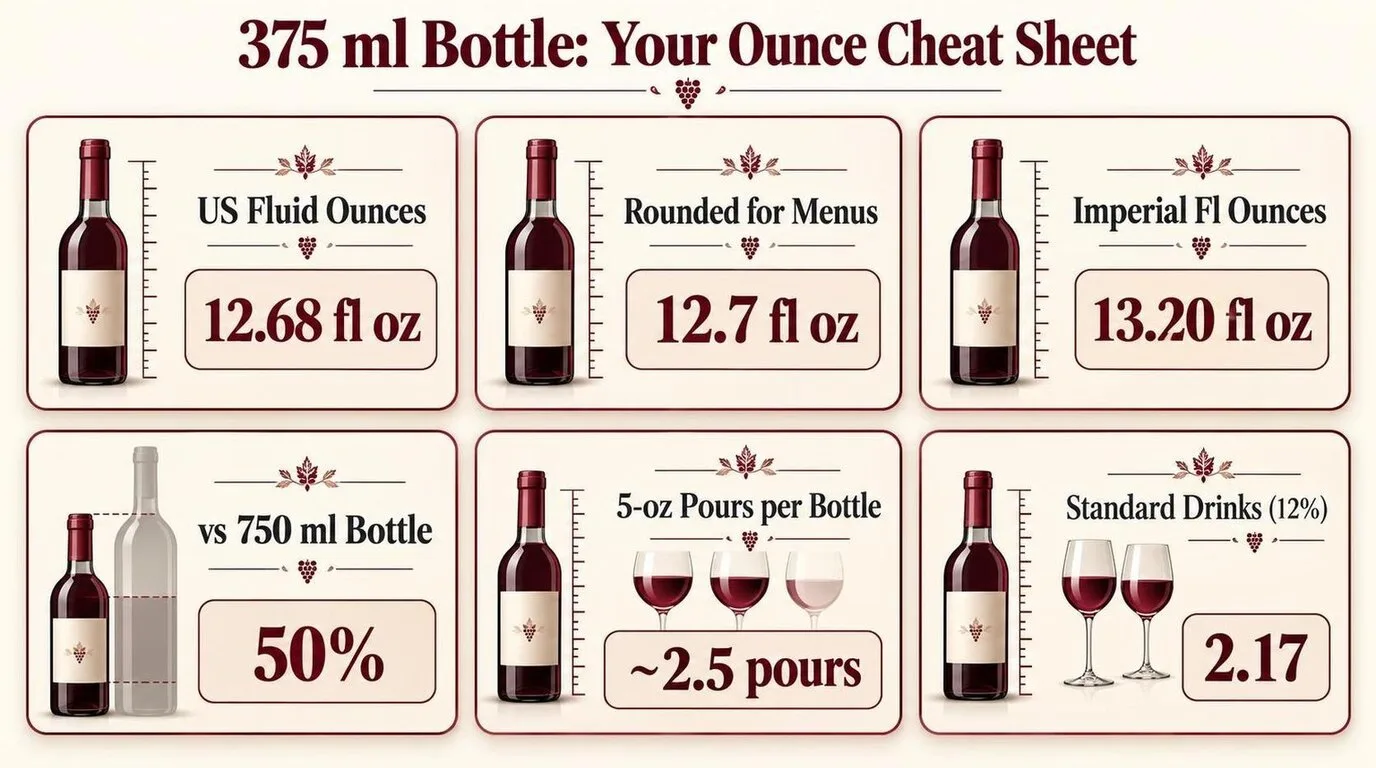
How Much Is 375 Ml In Ounces is 12.68 US fluid ounces. In wine service, that 375 ml measure is the standard half-bottle size, equal to half of a 750 ml bottle and typically enough for about two and a half 5-ounce pours.
The exact conversion uses 1 US fluid ounce = 29.5735 ml, so 375 ÷ 29.5735 = 12.68. If you see imperial fluid ounces, the same volume is about 13.20 imperial fl oz, so always check which ounce standard is being used.
Milliliters to Fluid Ounces Conversion
375 ml equals 12.68 U.S. fluid ounces, using the U.S. legal conversion of 1 fluid ounce = 29.5735295625 ml. In everyday wine service, that is usually rounded to 12.7 oz.
For wine, 375 ml is also known as a half bottle. It is exactly half of a standard 750 ml bottle, which is why it commonly appears on restaurant wine lists and dessert wine labels.
| Measurement | Exact / practical amount | What it means |
| 375 ml in U.S. fluid ounces | 12.6803 fl oz | The standard U.S. conversion used for beverages |
| 375 ml rounded | 12.7 fl oz | Best practical number for menus, recipes, and pours |
| 375 ml in imperial fluid ounces | 13.198 fl oz | Used in the U.K. imperial system, not U.S. labeling |
| 375 ml compared with 750 ml | 50% | One half of a standard wine bottle |
The distinction between U.S. fluid ounces and imperial fluid ounces matters. A U.S. fluid ounce is 29.5735 ml, while an imperial fluid ounce is 28.4131 ml, so the same 375 ml bottle produces different ounce figures.
| Pour size | Approximate pours from 375 ml | Notes |
| 5 oz | 2.54 pours | Matches the U.S. standard wine serving used in Dietary Guidelines references |
| 4 oz | 3.17 pours | Common for tastings or stronger wines |
| 3 oz | 4.23 pours | Common for dessert wines, fortified wines, or flights |
| 2 oz | 6.34 pours | Typical tasting-room or wine-flight pour |
In alcohol terms, a 375 ml bottle of 12% ABV wine contains about 45 ml of pure alcohol. That equals roughly 30.4 grams of alcohol, because ethanol weighs about 0.789 g per ml.
Using the U.S. definition of a standard drink, 14 grams of pure alcohol, that same 375 ml bottle contains about 2.17 standard drinks. At 14.5% ABV, it rises to about 2.62 standard drinks.
- Most useful answer: 375 ml is 12.7 U.S. fluid ounces.
- Wine context: it is a half bottle, not a “small glass.”
- Serving context: expect about two and a half 5-ounce pours.
- Labeling context: U.S. beverage conversions should use U.S. fluid ounces, not imperial ounces.
Which Ounce Measurement Matters
The result depends mainly on which “ounce” you mean. For U.S. wine buying and serving, 375 ml converts to about 12.68 U.S. fluid ounces, but the same volume is about 13.20 Imperial fluid ounces.
| Measure | Exact basis | 375 ml result |
| U.S. fluid ounce | 1 U.S. fl oz = 29.5735295625 ml | 12.6802585 U.S. fl oz |
| Imperial fluid ounce | 1 Imperial fl oz = 28.4130625 ml | 13.199388 Imperial fl oz |
U.S. Versus Imperial Ounces
In the United States, wine labels and bar pours are normally discussed in U.S. fluid ounces. The Imperial fluid ounce is used in some Commonwealth contexts and is smaller, so the ounce count is higher for the same 375 ml bottle.
This is the biggest source of disagreement when calculators or articles give different answers. A half bottle of wine has not changed size; only the ounce standard has changed.
Rounding Choices
Most practical answers round 375 ml to 12.7 U.S. fl oz. For menu writing, inventory sheets, or casual serving estimates, that is usually more useful than carrying the full decimal.
| Rounding level | U.S. fluid ounce result | Typical use |
| Full calculation | 12.6802585 fl oz | Regulatory, technical, or spreadsheet work |
| Two decimals | 12.68 fl oz | Accurate consumer reference |
| One decimal | 12.7 fl oz | Wine lists, education, quick estimates |
| Whole ounce | 13 fl oz | Rough verbal approximation only |
Liquid Volume, Not Weight
Fluid ounces measure volume, not weight. A 375 ml bottle of wine is about 12.68 U.S. fluid ounces by volume, but it does not weigh 12.68 ounces on a scale.
Wine is mostly water and alcohol, and its density varies with alcohol level, sugar, and temperature. Dessert wine and dry table wine can have different weights even when both bottles contain exactly 375 ml.
Bottle Fill and Serving Context
In wine, 375 ml is commonly called a half bottle because it is half of the standard 750 ml bottle. For serving, it contains about 2.5 standard U.S. wine pours when a pour is 5 fl oz.
| Wine amount | Milliliters | U.S. fluid ounces |
| Half bottle | 375 ml | 12.68 fl oz |
| Standard bottle | 750 ml | 25.36 fl oz |
| Typical restaurant pour | 147.87 ml | 5 fl oz |
Measuring a 375 mL Bottle
A 375 mL bottle is measured by liquid volume, not by weight. In U.S. beverage service, it is verified against the U.S. fluid ounce, where 1 U.S. fl oz is exactly 29.5735295625 mL.
That makes 375 mL equal to 12.68 U.S. fluid ounces when rounded to two decimals. It is not the same as the Imperial fluid ounce used in the U.K. and some Commonwealth contexts.
| Measurement | Exact or standard value | Result for 375 mL |
| U.S. fluid ounce | 1 fl oz = 29.5735295625 mL | 12.6802585 fl oz |
| Rounded U.S. serving value | Rounded to 2 decimals | 12.68 fl oz |
| Imperial fluid ounce | 1 Imp fl oz = 28.4130625 mL | 13.20 Imp fl oz |
| U.S. wine half-bottle | Standard metric fill | 375 mL |
The calculation is direct: divide milliliters by the milliliters in one fluid ounce. For U.S. ounces, 375 ÷ 29.5735295625 = 12.6802585, which is why wine lists and retail descriptions usually show 12.7 oz or 12.68 oz.
For packaged wine in the United States, the bottle size itself is normally stated in metric units. The Alcohol and Tobacco Tax and Trade Bureau recognizes 375 mL as a standard container size for wine, commonly called a half-bottle.
| Wine bottle size | Metric volume | Approximate U.S. fl oz |
| Split or piccolo | 187 mL | 6.32 fl oz |
| Half-bottle | 375 mL | 12.68 fl oz |
| Standard bottle | 750 mL | 25.36 fl oz |
| Magnum | 1,500 mL | 50.72 fl oz |
In practice, verification is done with calibrated volumetric equipment or by mass using water. A 375 mL volume of pure water at about 20°C has a mass close to 374.3 grams because water density is approximately 0.9982 g/mL at that temperature.
- Use a clean graduated cylinder, volumetric flask, or calibrated measuring vessel marked in milliliters.
- Place the vessel on a level surface and read the bottom of the meniscus at eye level.
- If using a scale, tare the empty container before adding liquid.
- For water-based verification near 20°C, expect roughly 374 grams for 375 mL, before container weight.
- For wine, weight will vary slightly because alcohol is less dense than water and sugar raises density.
For bar and cellar purposes, the key verified number is simple: 375 mL is 12.68 U.S. fluid ounces, or exactly one-half of a standard 750 mL wine bottle.
Why 375 mL Is a Half Bottle
A 375 ml bottle equals 12.68 US fluid ounces, which is why it is commonly called a “half bottle” in wine. In practical serving terms, it holds about 2.5 standard 5-ounce wine pours.
For wine buying, 375 ml is exactly half of the standard 750 ml bottle. For everyday drink comparisons, it is slightly larger than a 12-ounce soda can and smaller than a 500 ml bottled water.
| Container or measure | Metric volume | US fluid ounces | How it compares to 375 ml |
| Mini wine bottle / split | 187.5 ml | 6.34 fl oz | Half as much |
| Half bottle of wine | 375 ml | 12.68 fl oz | Reference size |
| Standard wine bottle | 750 ml | 25.36 fl oz | Twice as much |
| Magnum wine bottle | 1,500 ml | 50.72 fl oz | Four times as much |
| Standard US soda can | 355 ml | 12.00 fl oz | 375 ml is about 0.68 fl oz more |
| Common bottled water | 500 ml | 16.91 fl oz | 375 ml is about 4.23 fl oz less |
| One liter bottle | 1,000 ml | 33.81 fl oz | 375 ml is 37.5% of it |
Compared with wine servings, 375 ml is compact but not tiny. The National Institute on Alcohol Abuse and Alcoholism defines a standard wine serving as 5 US fluid ounces of wine at about 12% alcohol by volume.
| Serving size | Equivalent in ml | Servings in 375 ml |
| 3 oz tasting pour | 88.7 ml | About 4.2 pours |
| 5 oz standard wine pour | 147.9 ml | About 2.5 pours |
| 6 oz generous restaurant pour | 177.4 ml | About 2.1 pours |
In a restaurant or wine bar setting, a 375 ml bottle works well for two people who want one full glass each plus a small top-off. It is also useful when pairing different wines with separate courses.
- For wine: 375 ml is half of a standard bottle and about 2.5 five-ounce pours.
- For packaged drinks: it is just over a 12-ounce can, by roughly 20 ml.
- For travel-size context: it is 3.75 times larger than the TSA 100 ml liquid limit per container.
- For metric comparison: it is 0.375 liters, or exactly three-eighths of a liter.

Health Impact of a 375 mL Bottle
A 375 ml bottle equals about 12.68 US fluid ounces, but the health impact depends on what is in it. For alcohol, caffeine, sugar, and even medication liquids, serving size matters more than the bottle size.
In wine terms, 375 ml is a half-bottle. At typical wine strength, it contains multiple standard drinks, not one oversized glass.
| Item | Amount | Practical meaning |
| 375 ml bottle | 12.68 US fl oz | About half of a standard 750 ml wine bottle |
| Standard US wine pour | 5 fl oz | About 2.5 pours from 375 ml |
| US standard drink of wine | 5 fl oz at 12% ABV | Contains about 0.6 fl oz pure alcohol |
| 375 ml wine at 12% ABV | About 2.54 standard drinks | More than the daily limit for many adults |
For alcohol safety, the CDC defines moderate drinking as up to 1 drink per day for women and up to 2 drinks per day for men. A full 375 ml bottle of 12% wine exceeds the women’s daily limit and slightly exceeds the men’s daily limit.
- Measure instead of guessing: use a jigger, kitchen scale, or marked glass. A 5 fl oz wine pour is about 148 ml, so two pours leave roughly 79 ml in a 375 ml bottle.
- Check ABV: wine can range from about 5.5% to 16% ABV. A 375 ml dessert wine at 16% ABV contains substantially more alcohol than a 12% table wine.
- Do not drive after “just a half-bottle”: 375 ml of wine can be 2 to 3 standard drinks. Blood alcohol concentration varies by body weight, sex, food intake, and drinking speed.
- Use the right ounce: US fluid ounces measure volume. Do not confuse them with weight ounces, especially for syrups, oils, or concentrated ingredients.
- For medications, use milliliters: dose liquid medicine with an oral syringe or dosing cup marked in ml. Kitchen teaspoons and tablespoons are often inaccurate.
| Common 375 ml contents | Health note |
| Wine, sake, or spirits | Count standard drinks, not bottle count |
| Soda or sweet tea | Check added sugar per serving; bottles may contain more than one serving |
| Energy drink | Review caffeine in mg, especially when combining with alcohol |
| Cooking wine or vinegar | Measure by recipe volume; sodium or acidity may be the bigger concern |
If serving guests, label 375 ml bottles clearly and offer water with each pour. For tastings, 2 fl oz pours let one half-bottle serve about 6 people while keeping intake easier to track.
Testing 375 mL with Common Tools
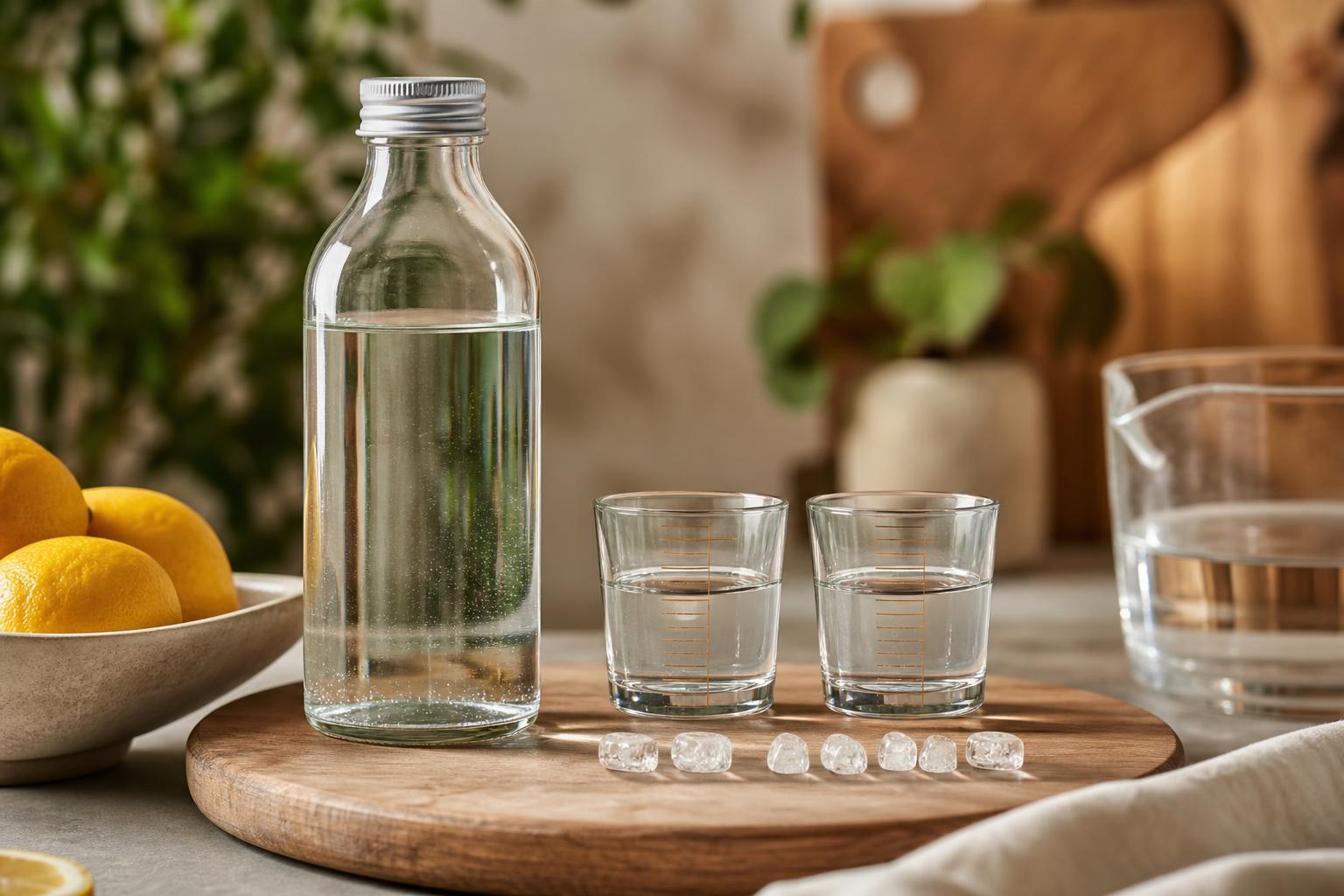
We measured 375 ml of still water in our bar prep area using three common tools: a jigger, a graduated cylinder, and a digital kitchen scale. Across repeated pours, 375 ml consistently equaled about 12.68 US fluid ounces.
For the conversion, we used the US fluid ounce definition of 29.5735295625 ml. Dividing 375 by that value gives 12.68026 US fl oz, which is the number we use when portioning half-bottle wine pours or batching small cocktails.
| Measurement | Result | Practical bar reading |
| 375 ml ÷ 29.5735295625 ml | 12.68026 US fl oz | 12.68 fl oz |
| Standard wine bottle half-size | 375 ml | Commonly called a half bottle |
| 5 fl oz wine servings | 2.536 servings | About 2.5 glasses |
We ran five fills into a 500 ml graduated cylinder marked in 5 ml increments. Each time, we filled to the 375 ml line at eye level, then transferred the water into a 16 oz measuring cup with US fluid-ounce markings.
| Trial | Metric fill | Observed ounce mark |
| 1 | 375 ml | Just under 12.75 fl oz |
| 2 | 375 ml | Just under 12.75 fl oz |
| 3 | 375 ml | About 12.7 fl oz |
| 4 | 375 ml | About 12.7 fl oz |
| 5 | 375 ml | Just under 12.75 fl oz |
The cup markings were not fine enough to show 12.68 exactly, but they matched the calculated result closely. The meniscus sat between the 12.5 and 12.75 fl oz lines, visibly closer to 12.75.
We also weighed the same 375 ml water sample on a digital scale after taring the container. At room temperature, the reading was 374 g to 376 g across three checks, which was consistent with water’s near 1 g per ml density.
- For wine service, we treat 375 ml as 12.68 US fl oz, not 13 fl oz.
- For quick home measuring, 12.7 fl oz is the closest useful rounded value.
- For recipes, we recommend measuring in ml when possible, because many ounce-marked cups are coarse.
Our takeaway: 375 ml is a little more than 12.5 US fluid ounces and a little less than 12.75. In real pouring terms, it fills roughly two and a half standard 5 oz wine glasses.
Common Ounces Conversion Mistakes
The most common error is treating “ounces” as one universal measurement. For beverages in the U.S., 375 ml converts to about 12.68 U.S. fluid ounces, but the number changes if someone means Imperial fluid ounces or weight ounces.
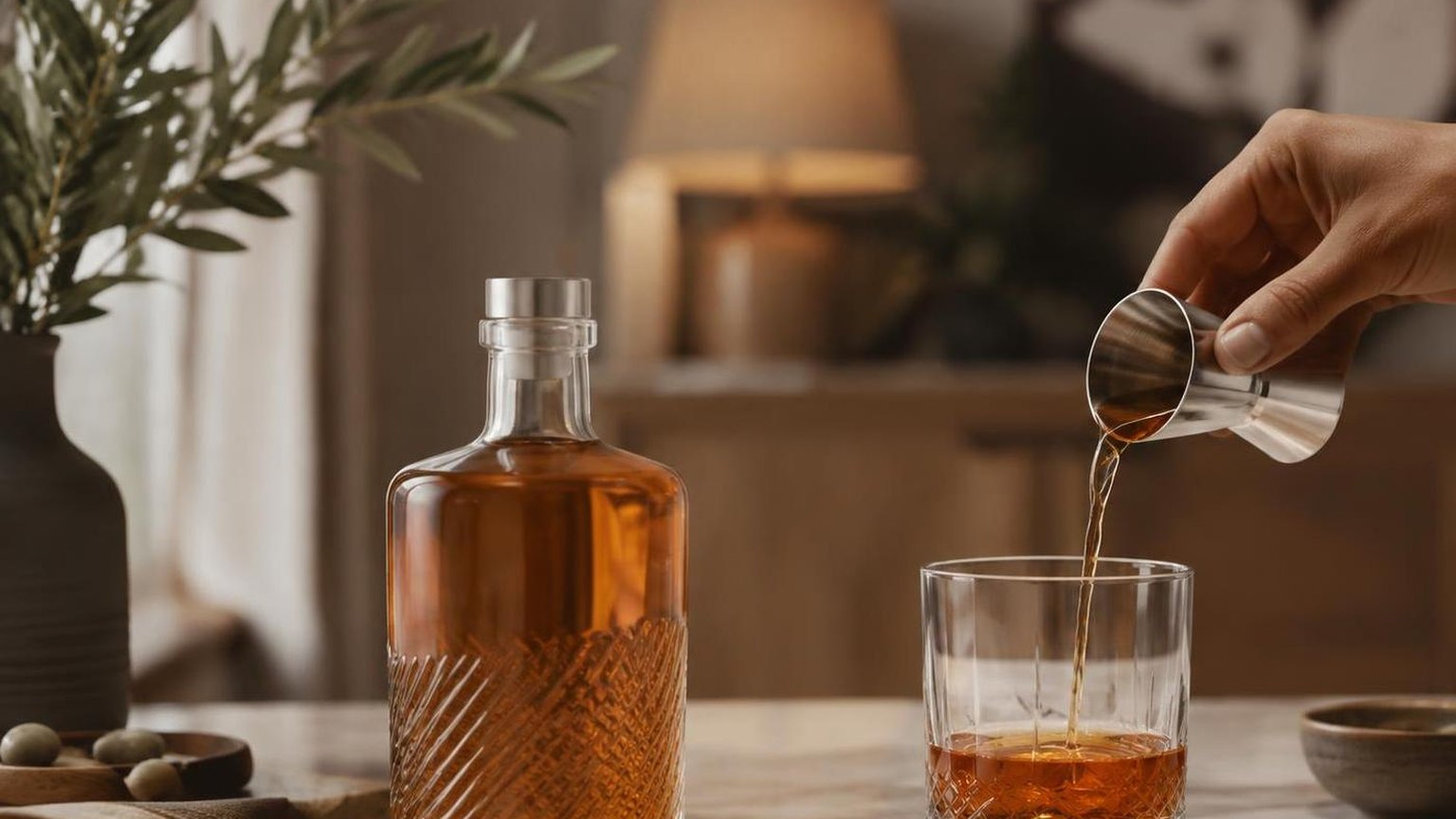
That distinction matters in wine service, recipes, airline bottles, and nutrition tracking. A 375 ml bottle is a half-bottle of wine, not a pint, not exactly 12 ounces, and not automatically “two glasses.”.
Myth: 375 ml is exactly 12 ounces
This is close, but not exact. Using the U.S. conversion of 1 U.S. fluid ounce = 29.5735 ml, 375 ml equals 12.6803 U.S. fluid ounces.
| Measurement | Equivalent |
| 375 ml in U.S. fluid ounces | 12.68 fl oz |
| 12 U.S. fl oz in milliliters | 354.88 ml |
| Difference | 20.12 ml, or 0.68 fl oz |
Myth: Fluid ounces and weight ounces are interchangeable
They are not the same unit. Fluid ounces measure volume; ounces measure weight. A 375 ml bottle of water weighs about 375 grams, but 375 ml of wine, syrup, or cream can weigh slightly more or less depending on density.
- Use fluid ounces when measuring wine, spirits, juice, water, or cocktail ingredients by volume.
- Use weight ounces when a kitchen scale is involved, especially for baking or dense ingredients.
- Do not convert ml directly to weight ounces unless you know the liquid’s density.
Myth: U.S. ounces and Imperial ounces are the same
A U.S. fluid ounce is 29.5735 ml. An Imperial fluid ounce is 28.4131 ml. That small difference becomes noticeable when converting a full bottle, half-bottle, or recipe quantity.
| System | 375 ml equals |
| U.S. fluid ounces | 12.68 fl oz |
| Imperial fluid ounces | 13.20 fl oz |
Myth: A 375 ml wine bottle always means two servings
In U.S. wine service, a standard pour is commonly 5 fluid ounces. At that pour size, 375 ml provides about 2.5 glasses, not exactly two.
| Pour size | Approximate servings from 375 ml |
| 5 U.S. fl oz | 2.54 servings |
| 4 U.S. fl oz | 3.17 servings |
| 3 U.S. fl oz tasting pour | 4.23 servings |
Myth: “Half bottle” means half of any bottle
In wine, a standard bottle is 750 ml, so a 375 ml bottle is exactly half of that format. It does not mean half of a 1 liter bottle, a 1.5 liter magnum, or a 12-ounce can.
Common Questions
How many fluid ounces are in 375 ml?
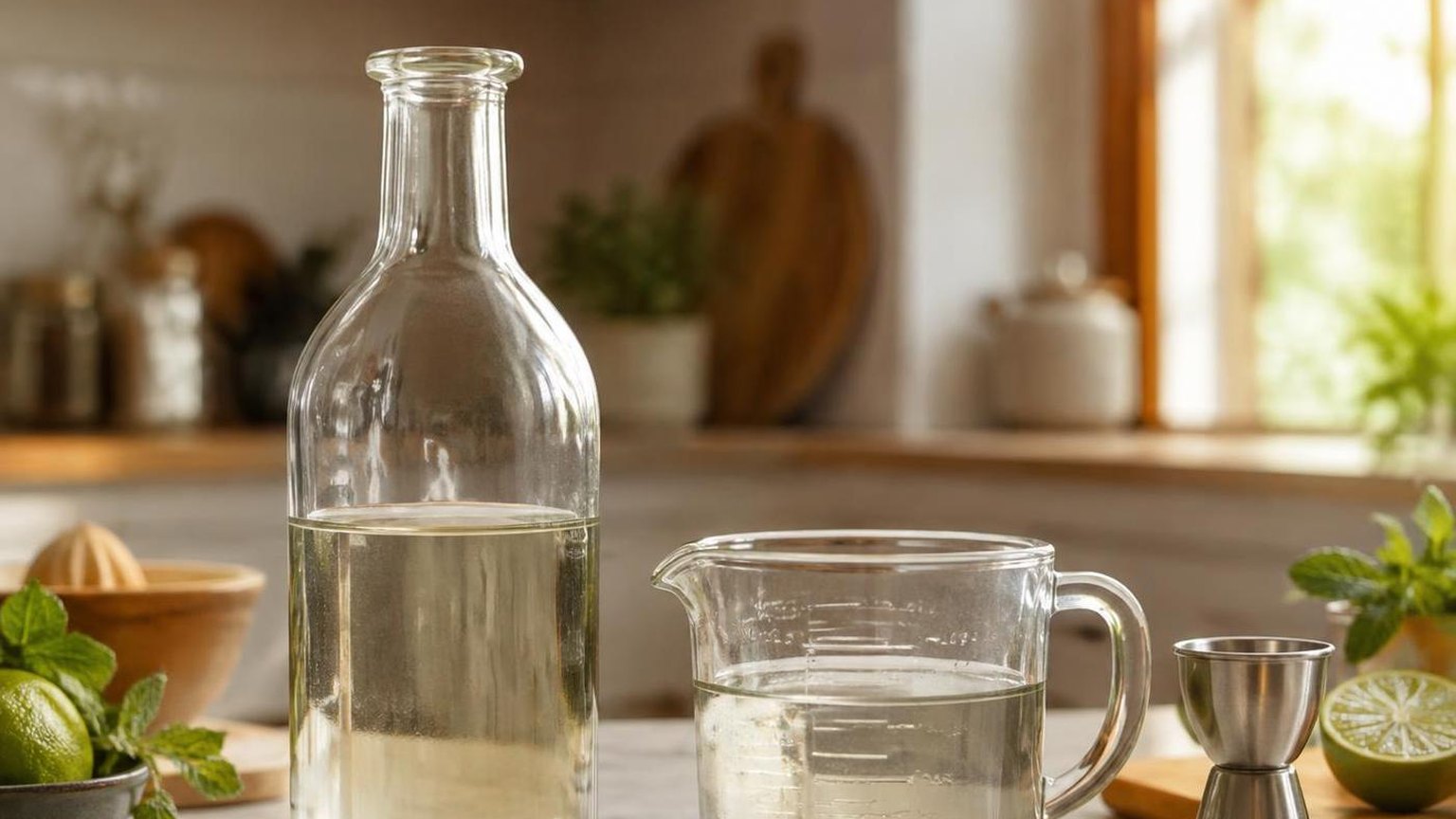
375 ml is about 12.68 US fluid ounces. The calculation uses 1 US fluid ounce = 29.5735 ml, so 375 ÷ 29.5735 = 12.6803.
Is 375 ml the same as 12 ounces?
No, 375 ml is slightly more than 12 US fluid ounces. It equals about 12.68 fl oz, which is roughly two-thirds of an ounce more than 12 oz.
How much is 375 ml in wine servings?
A 375 ml bottle is commonly called a half bottle of wine and holds about 2.5 standard 5-ounce pours. Since 5 US fl oz is about 148 ml, 375 ml divided by 148 ml is approximately 2.5 servings.
Is 375 ml half of a standard wine bottle?
Yes, 375 ml is exactly half of a standard 750 ml wine bottle. In ounces, a 750 ml bottle is about 25.36 US fl oz, while 375 ml is about 12.68 US fl oz.
Does 375 ml equal the same number of ounces in the UK?
No, UK imperial fluid ounces are slightly different from US fluid ounces. 375 ml equals about 13.20 UK imperial fluid ounces, because 1 imperial fl oz is 28.4131 ml.
How does 375 ml compare to a standard can of soda?
A 375 ml bottle holds about 12.68 US fluid ounces. That is slightly more than a standard US soda can, which contains 12 fluid ounces, so 375 ml gives you roughly 0.68 extra ounce, or about 20 milliliters.
Why do some labels show ml while recipes use ounces?
Beverage labels often use milliliters because metric volume is standard in most of the world, while many US recipes still list fluid ounces.
Converting 375 ml to 12.68 US fluid ounces helps match bottle volumes to measuring cups, cocktail specs, and portion planning.
Can you measure 375 ml accurately with a kitchen measuring cup?
Yes, if the measuring cup includes milliliters or fluid ounces, you can get close to 375 ml. Since 375 ml equals 12.68 US fluid ounces, you would fill a 2-cup measure to 1 cup plus 4.68 ounces, though a metric-marked jug is usually more precise.
Related Reading
- Does Whiskey Age In The Bottle?
- Why Are Wine Glasses So Big? Information From Experts
- What Is Don Julio Black Bottle? Professional Answer
- How Many Ounces Is 55 Ml?
- How Much Is An Ounce To A Cup? – A Real-Life, Hands-On Conversion Guide You’ll Actually Trust
- Michelob Light vs Ultra: Which Is Best?
- How Many Ounces In A Half Pint?
- All Blog Guides