How Long After Drinking Alcohol Can I Take Nyquil? Wait at least 12 hours after your last standard drink before taking NyQuil, and wait 24 hours after heavy drinking.
Alcohol can intensify NyQuil’s sedating ingredients and raise the liver-risk of acetaminophen.
NyQuil products often contain acetaminophen, doxylamine, and dextromethorphan; alcohol makes each riskier, especially before sleep.
If you drank heavily, have liver disease, take other acetaminophen products, or feel unusually drowsy, skip NyQuil and ask a pharmacist or clinician for a safer cold-symptom option.
Why Alcohol and NyQuil Clash
Alcohol and NyQuil create a dangerous pharmacological overlap because both depress the central nervous system (CNS).
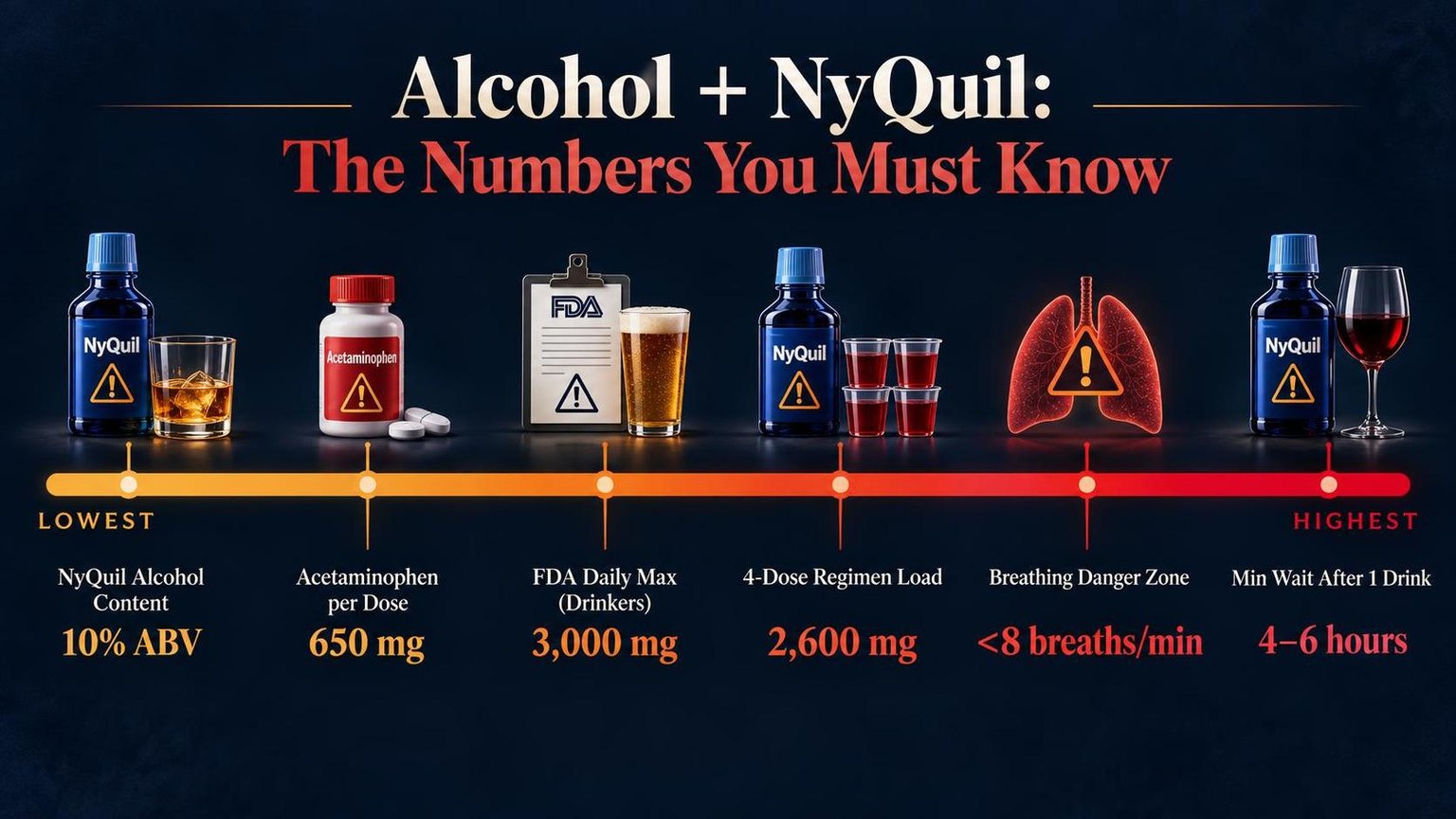
NyQuil itself contains 10% alcohol by volume, and its active antihistamine ingredient — doxylamine succinate — amplifies sedation when combined with additional ethanol.
Both alcohol and doxylamine succinate enhance gamma-aminobutyric acid (GABA) activity in the brain. GABA is the primary inhibitory neurotransmitter.
When two GABA-enhancing substances combine, sedation doesn’t just double — it compounds unpredictably.
Dextromethorphan (DXM), NyQuil’s cough suppressant dosed at 15 mg per 30 mL, also carries CNS-depressant properties. Adding alcohol introduces a third sedating agent into an already potent combination.
Key Active Ingredients in NyQuil (per 30 mL dose)
| Ingredient | Amount | Primary Risk with Alcohol |
| Acetaminophen | 650 mg | Liver toxicity — combined hepatotoxicity |
| Dextromethorphan HBr | 15 mg | Excessive sedation, serotonin syndrome risk |
| Doxylamine succinate | 6.25 mg | Compounded CNS depression, respiratory slowing |
| Alcohol (inactive ingredient) | 10% by volume | Adds to total ethanol load |
The Acetaminophen–Alcohol Liver Risk
Acetaminophen is metabolized in the liver by the enzyme CYP2E1. Chronic or acute alcohol consumption upregulates CYP2E1 activity, generating more of the toxic metabolite NAPQI (N-acetyl-p-benzoquinone imine).
The FDA maximum for acetaminophen is 3,000 mg per day for adults who consume alcohol. A standard NyQuil regimen of four doses delivers 2,600 mg of acetaminophen alone — leaving almost no safe margin for error.
According to the American Liver Foundation, acetaminophen-alcohol combinations are a leading cause of acute liver failure in the United States, responsible for roughly 50% of all cases annually.
Respiratory and Cardiac Dangers
Combined CNS depression slows breathing rate. Normal adult respiration sits at 12–20 breaths per minute.
Studies on sedative–alcohol interactions show respiratory rates can drop below 8 breaths per minute, a threshold considered clinically dangerous.
Heart rate and blood pressure also decrease. This compounds fall risk, particularly in adults over 65, who already metabolize both alcohol and antihistamines more slowly due to reduced hepatic blood flow.
Impairment Multiplier
The combination produces measurably worse psychomotor impairment than either substance alone:
- Reaction time increases by up to 30–40% compared to alcohol alone
- Risk of next-morning drowsiness persists 8–10 hours after ingestion
- Coordination deficits mimic blood alcohol levels 1.5–2× higher than actual BAC
- Memory consolidation during sleep is significantly disrupted
The FDA’s NyQuil label explicitly states: “Do not consume alcoholic beverages while taking this product.” This warning exists because the interaction is dose-dependent but individually unpredictable — body weight.
Liver health, and genetic enzyme variations all affect severity.

Wait Time After One Drink
After consuming one standard alcoholic drink, wait a minimum of 4 to 6 hours before taking NyQuil.
This window allows your liver to fully metabolize the alcohol and reduces the risk of compounding central nervous system depression from both substances.
NyQuil contains 10% alcohol by volume in its liquid formulation, plus doxylamine succinate (a sedating antihistamine) and acetaminophen—both processed by the liver.
Adding these to residual blood alcohol creates measurable pharmacological overlap.
How Fast Your Body Clears One Drink
The average adult liver metabolizes alcohol at a rate of approximately 0.015 g/dL per hour. One standard drink raises blood alcohol concentration (BAC) to roughly 0.02–0.04 g/dL in most adults.
| Drink Type | Standard Size | Approximate Clearance Time |
| Regular beer (5% ABV) | 12 oz (355 mL) | 1.5–2 hours |
| Glass of wine (12% ABV) | 5 oz (148 mL) | 1.5–2 hours |
| Distilled spirit (40% ABV) | 1.5 oz (44 mL) | 1.5–2 hours |
| Strong craft beer (8–9% ABV) | 12 oz (355 mL) | 2.5–3.5 hours |
These clearance times represent complete elimination from the bloodstream. The recommended 4-to-6-hour wait adds a deliberate safety buffer beyond metabolic clearance alone.
Why the Buffer Matters
Alcohol and doxylamine both depress the central nervous system. Even low residual BAC levels—below 0.01 g/dL—can amplify drowsiness, impaired coordination, and slowed breathing when combined with a sedating antihistamine.
Acetaminophen in NyQuil (325 mg per dose) shares the same hepatic enzyme pathway (CYP2E1) that metabolizes alcohol. Overlapping these processes strains liver function and increases the risk of hepatotoxicity over repeated doses.
Factors That May Extend Your Wait
- Body weight under 150 lbs (68 kg): slower alcohol distribution means higher peak BAC per drink
- Biological sex: women generally produce less alcohol dehydrogenase, slowing metabolism by 20–30%
- Empty stomach: alcohol absorbs up to 3 times faster without food, peaking sooner and straining the liver
- Age over 65: reduced hepatic blood flow and enzyme activity extend clearance time significantly
- Existing liver conditions: fatty liver disease or hepatitis can cut metabolic capacity by 50% or more
If any of these factors apply, extend the waiting period to a full 6 hours or longer. When in doubt, skip the NyQuil dose entirely and consult a pharmacist about alcohol-free alternatives like NyQuil Alcohol-Free formulations.
The safest approach remains straightforward: finish your drink, note the time, and do not take NyQuil until at least 4 full hours have passed—6 hours if you have any risk factors listed above.
When Overnight Waiting Is Safer
Waiting overnight—at least 8 to 10 hours—before taking NyQuil is the safest strategy when you’ve consumed more than one or two standard drinks.
This extended window allows your body to clear alcohol more completely, reducing dangerous compounding sedation and liver stress.
Why Standard Wait Times Fall Short
The liver metabolizes alcohol at roughly 0.015 g/dL per hour. After moderate-to-heavy drinking, blood alcohol concentration (BAC) may not reach zero for many hours beyond the commonly cited “one drink per hour” guideline.
| Drinks Consumed | Estimated Peak BAC | Hours to Reach 0.00 BAC | Overnight Wait Advised? |
| 1 standard drink | ~0.02 g/dL | ~1.5 hours | Not typically necessary |
| 2 standard drinks | ~0.04 g/dL | ~3 hours | Recommended if taken near bedtime |
| 3 standard drinks | ~0.06 g/dL | ~4.5 hours | Yes |
| 4 standard drinks | ~0.08 g/dL | ~6 hours | Yes |
| 5+ standard drinks | ~0.10+ g/dL | ~7–10+ hours | Strongly yes |
These estimates assume a 160-pound person. Individuals with lower body weight, liver impairment, or those taking other medications may metabolize alcohol more slowly.
Compounding CNS Depression Risks
NyQuil contains doxylamine succinate (6.25 mg per dose), a sedating antihistamine, plus dextromethorphan (15 mg per dose). Both depress the central nervous system. Residual alcohol amplifies these effects unpredictably.
Combining even low residual BAC with NyQuil’s sedative ingredients can produce:
- Dangerously slowed breathing (respiratory depression)
- Severe drowsiness impairing emergency arousal during sleep
- Increased fall risk if waking during the night
- Impaired cognitive function persisting into the next morning
The Acetaminophen Factor
NyQuil contains 325 mg of acetaminophen per dose. The FDA maximum is 3,000 mg daily for adults who consume alcohol regularly. Alcohol induces CYP2E1 enzymes, which convert acetaminophen into the toxic metabolite NAPQI at higher rates.
After heavy drinking, the liver remains enzymatically primed to produce excess NAPQI for 12 to 24 hours. Taking acetaminophen-containing NyQuil during this window increases hepatotoxicity risk even at standard doses.
Who Should Always Wait Overnight
- Anyone who consumed 3 or more standard drinks
- Adults over 65, whose alcohol metabolism slows by approximately 20–30%
- People weighing under 140 pounds
- Those with fatty liver disease, hepatitis, or any liver condition
- Anyone taking other CNS depressants such as benzodiazepines or opioids
- Individuals who feel any residual intoxication symptoms—dizziness, warmth, or impaired coordination
When uncertain, the simplest rule holds: if you can still feel the alcohol, do not take NyQuil. Wait until morning and reassess. No cold symptom justifies risking respiratory depression or liver damage from a preventable drug interaction.
Risks of Mixing With Acetaminophen
NyQuil contains 325 mg of acetaminophen per 15 mL dose. Combining acetaminophen with alcohol forces the liver to metabolize both substances simultaneously, increasing the risk of acute hepatotoxicity.
The FDA maximum for acetaminophen is 3,000 mg/day for adults who consume alcohol.
How Alcohol Amplifies Acetaminophen Toxicity
Chronic alcohol use induces the CYP2E1 enzyme pathway in the liver. This pathway converts a larger proportion of acetaminophen into NAPQI (N-acetyl-p-benzoquinone imine), a highly reactive toxic metabolite.
Under normal conditions, only about 5–10% of acetaminophen is metabolized through CYP2E1. In regular drinkers, that percentage can double, overwhelming glutathione stores that neutralize NAPQI.
When glutathione reserves drop below approximately 30% of normal levels, unbound NAPQI attacks liver cells directly, causing centrilobular hepatic necrosis.
Acetaminophen Thresholds: Non-Drinkers vs. Drinkers
| Factor | Non-Drinkers | Regular Alcohol Users |
| FDA daily acetaminophen limit | 4,000 mg | 3,000 mg (or less per physician) |
| CYP2E1 activity level | Baseline | Up to 2× induced |
| NAPQI production rate | 5–10% of dose | Up to 15–20% of dose |
| Hepatotoxicity risk threshold | ~7,500 mg single ingestion | As low as 4,000 mg or less |
| Glutathione depletion risk | Lower | Significantly elevated |
Clinical Consequences
Acetaminophen overdose remains the leading cause of acute liver failure in the United States, responsible for approximately 56,000 emergency department visits annually, according to FDA reporting data.
Roughly 29,000 hospitalizations per year are linked to acetaminophen-related liver injury. Among those cases, concurrent alcohol use is identified as a significant contributing factor in a substantial portion.
- Stage 1 (0–24 hours): Nausea, vomiting, malaise — symptoms often mistaken for a hangover when alcohol is involved
- Stage 2 (24–72 hours): Elevated AST and ALT liver enzymes, right upper quadrant pain, declining symptoms that create false reassurance
- Stage 3 (72–96 hours): Peak hepatotoxicity with AST levels potentially exceeding 10,000 IU/L, possible coagulopathy, jaundice, and organ failure
- Stage 4 (4+ days): Recovery or progression to multi-organ failure requiring liver transplantation
Who Faces the Greatest Risk
People who consume three or more alcoholic drinks daily face the highest danger. The FDA specifically warns this group to consult a physician before taking any acetaminophen-containing product, including NyQuil.
Individuals with pre-existing liver conditions, those who are fasting or malnourished, and adults over 65 have reduced glutathione synthesis capacity. These groups should treat acetaminophen-alcohol interactions with particular caution.
The safest approach is to allow alcohol to fully clear your system — typically 1 hour per standard drink — before taking any NyQuil dose containing acetaminophen.
Safer Options for Cold Symptoms
When alcohol is still in your system, choosing alcohol-free cold remedies eliminates the risk of dangerous interactions.
Several effective alternatives exist that treat the same symptoms NyQuil targets—without containing acetaminophen, dextromethorphan, or doxylamine.
Alcohol-Free Cold Remedies by Symptom
| Symptom | Safer Alternative | Active Ingredient | Wait Time After Alcohol |
| Nasal congestion | Sudafed PE | Phenylephrine 10 mg | No liver interaction |
| Nasal congestion | Afrin nasal spray | Oxymetazoline 0.05% | No liver interaction |
| Cough | Honey (2 tsp) | Natural demulcent | None required |
| Sore throat | Chloraseptic spray | Phenol 1.4% | No liver interaction |
| Runny nose | Saline nasal rinse | Sodium chloride 0.9% | None required |
| Fever/pain | Ibuprofen (Advil) | Ibuprofen 200 mg | Lower liver risk than acetaminophen |
Why Ibuprofen Over Acetaminophen
NyQuil contains 650 mg of acetaminophen per dose. Acetaminophen is metabolized by the liver through the CYP2E1 enzyme pathway—the same pathway alcohol uses. This overlap increases production of the toxic metabolite NAPQI.
Ibuprofen at standard 200–400 mg doses bypasses this liver pathway entirely. It carries its own gastrointestinal risks with heavy alcohol use, but the acute liver danger is substantially lower.
Non-Drug Approaches That Work
- Steam inhalation: Breathing steam at 42–47°C for 15 minutes reduces nasal congestion by improving mucociliary clearance
- Honey: A 2020 BMJ Evidence-Based Medicine systematic review of 14 studies found honey outperformed usual care for upper respiratory symptoms, particularly cough frequency and severity
- Hydration: Consuming 2–3 liters of fluids daily thins mucus secretions and counters alcohol’s diuretic effect, which depletes approximately 160 mL of fluid per 10 g of alcohol consumed
- Saline irrigation: Neti pots or squeeze bottles with 0.9% saline solution reduce nasal congestion without any drug interactions
- Elevated sleeping position: Raising the head 30–45 degrees reduces postnasal drip and nighttime cough mechanically
When to Take NyQuil After Drinking
The liver metabolizes alcohol at roughly 0.015 g/dL per hour. After 3 standard drinks producing a blood alcohol concentration around 0.06 g/dL, full clearance takes approximately 4 hours.
Waiting a minimum of 4–6 hours after your last drink before taking NyQuil gives your liver time to process both substances separately. Heavy drinkers (8+ drinks) should wait at least 12–24 hours.
If cold symptoms are severe enough to need multi-symptom medication while alcohol remains in your system, contact a pharmacist. They can recommend single-ingredient products that avoid compounding liver stress or excessive CNS depression.
Questions Readers Ask
How long after drinking alcohol can I take NyQuil?
Wait at least 72 hours after your last alcoholic drink before taking NyQuil, according to pharmacological guidance on acetaminophen-alcohol interactions.
NyQuil contains 650 mg of acetaminophen per dose and up to 10% alcohol by volume, both of which are metabolized by the liver through the same CYP2E1 enzyme pathway.
Taking them too close together increases the risk of acute liver damage, especially if you consumed three or more drinks.
What happens if I accidentally take NyQuil after one glass of wine?
A single glass of wine (approximately 5 oz at 12% ABV) combined with one dose of NyQuil is unlikely to cause acute liver failure in a healthy adult, but it can intensify drowsiness, dizziness, and impaired motor function.
The sedative effects of doxylamine succinate (6.25 mg per dose in NyQuil) are amplified by alcohol, increasing fall risk and respiratory depression.
Contact Poison Control at 1-800-222-1222 if you experience nausea, vomiting, or upper abdominal pain.
Does NyQuil itself contain alcohol?
NyQuil Liquid contains 10% alcohol by volume, which is comparable to a glass of wine. NyQuil LiquiCaps and NyQuil SEVERE Caplets are alcohol-free formulations.
If you are avoiding alcohol entirely, choose the capsule form or check the inactive ingredients list on the label.
Why is mixing NyQuil and alcohol dangerous for the liver?
Acetaminophen, the pain reliever in NyQuil (325 mg per 15 mL dose), is converted into a toxic metabolite called NAPQI by the liver enzyme CYP2E1.
Chronic or heavy alcohol use upregulates CYP2E1 activity, producing more NAPQI than glutathione stores can neutralize.
The FDA warns that taking more than 3,000 mg of acetaminophen per day while consuming alcohol significantly raises the risk of hepatotoxicity.
Can I take alcohol-free NyQuil sooner after drinking?
Choosing alcohol-free NyQuil LiquiCaps eliminates the additive alcohol content but does not remove the acetaminophen-alcohol interaction risk.
You should still wait until alcohol is fully cleared from your system—the liver metabolizes roughly one standard drink per hour, so after four drinks, a minimum wait of 4–6 hours is needed for alcohol clearance alone.
A 24-hour gap remains the conservative clinical recommendation for moderate drinkers to protect liver function.
Should heavy drinkers avoid NyQuil entirely?
The FDA defines heavy drinking as more than 3 alcoholic beverages per day, and the NyQuil label explicitly warns this group to consult a doctor before use.
Chronic alcohol consumption depletes hepatic glutathione reserves by up to 50%, making even standard 650 mg acetaminophen doses potentially hepatotoxic.
Heavy drinkers should ask their physician about acetaminophen-free alternatives such as NyQuil Cough (dextromethorphan and doxylamine only) or single-ingredient cold medications.
Keep Exploring
- How Many Ml Is 4 Fl Oz?
- How to Make 3/4 Cup with Measuring Cups?
- How Many Beers Are in a 40?
- How Many Oz In A Quart?
- How Many Water Bottles In A Gallon? A Real-World, Practical Guide You’ll Actually Use
- All Blog Guides
- National Institute on Alcohol Abuse and Alcoholism – Harmful Interactions: Mixing Alcohol with Medicines (2014)
- U.S. Food and Drug Administration – Acetaminophen Information (2023)
- National Library of Medicine/PubMed – Acetaminophen Hepatotoxicity and Alcohol (2006)
- MedlinePlus – Dextromethorphan (2023)
- MedlinePlus – Acetaminophen (2022)
- Cleveland Clinic – Can You Mix NyQuil and Alcohol? (2023)
- Mayo Clinic – Doxylamine and Alcohol Interactions (2023)
- National Institute on Drug Abuse – Misuse of Over-the-Counter Medicines (2020)
- Vicks NyQuil – Drug Facts Label / Procter & Gamble (2024)
- American Liver Foundation – Liver and Medications (2023)