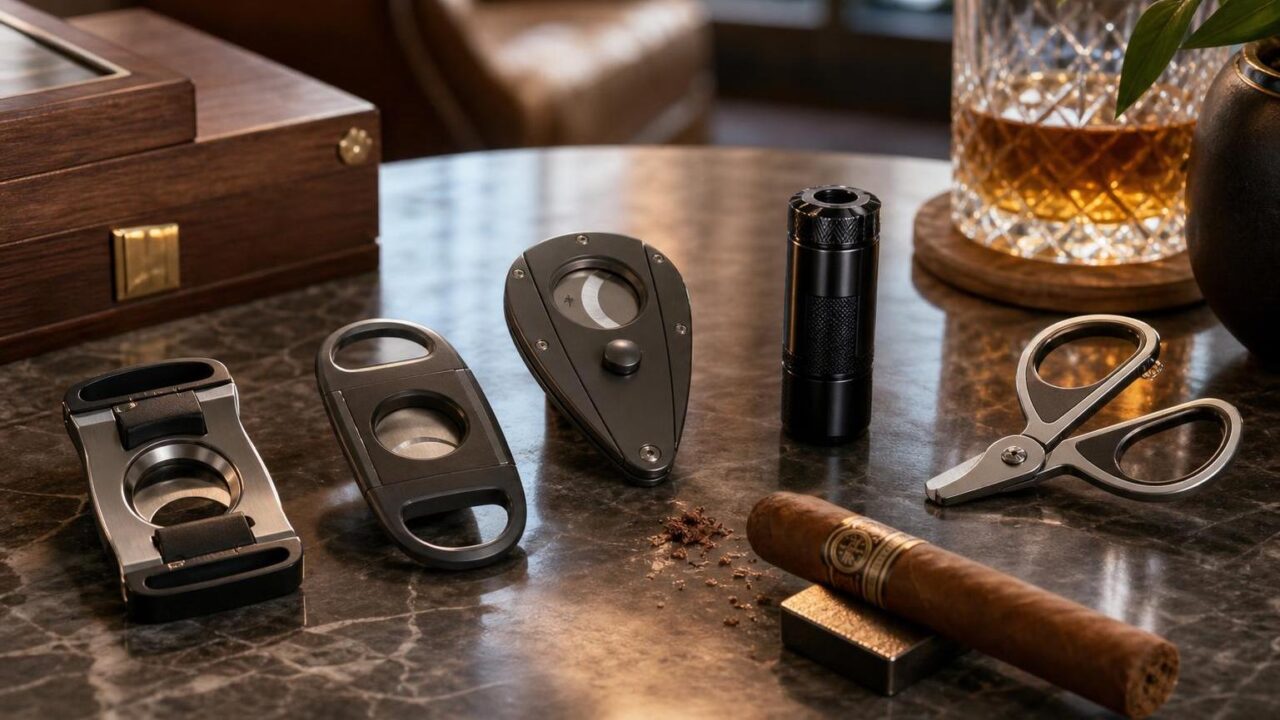
Different Types Of Cigar Cutter are specialized tools that open a cigar’s capped head with either a straight cut, wedge-shaped V cut, circular punch, or scissors-style snip.
The main styles are guillotine, double-blade guillotine, V-cutter, punch cutter, cigar scissors, and table-top cutters, each changing draw resistance and cap integrity.
A clean cut matters because premium cigar caps are small, layered pieces of wrapper leaf designed to hold the cigar together.
In my experience, dull single-blade cutters cause the most cracked caps, while sharp double-blade and V-cut models give more consistent results. This guide compares how each cutter works, when to use it, and what mistakes to avoid.
Cigar Cutter Sizing Basics
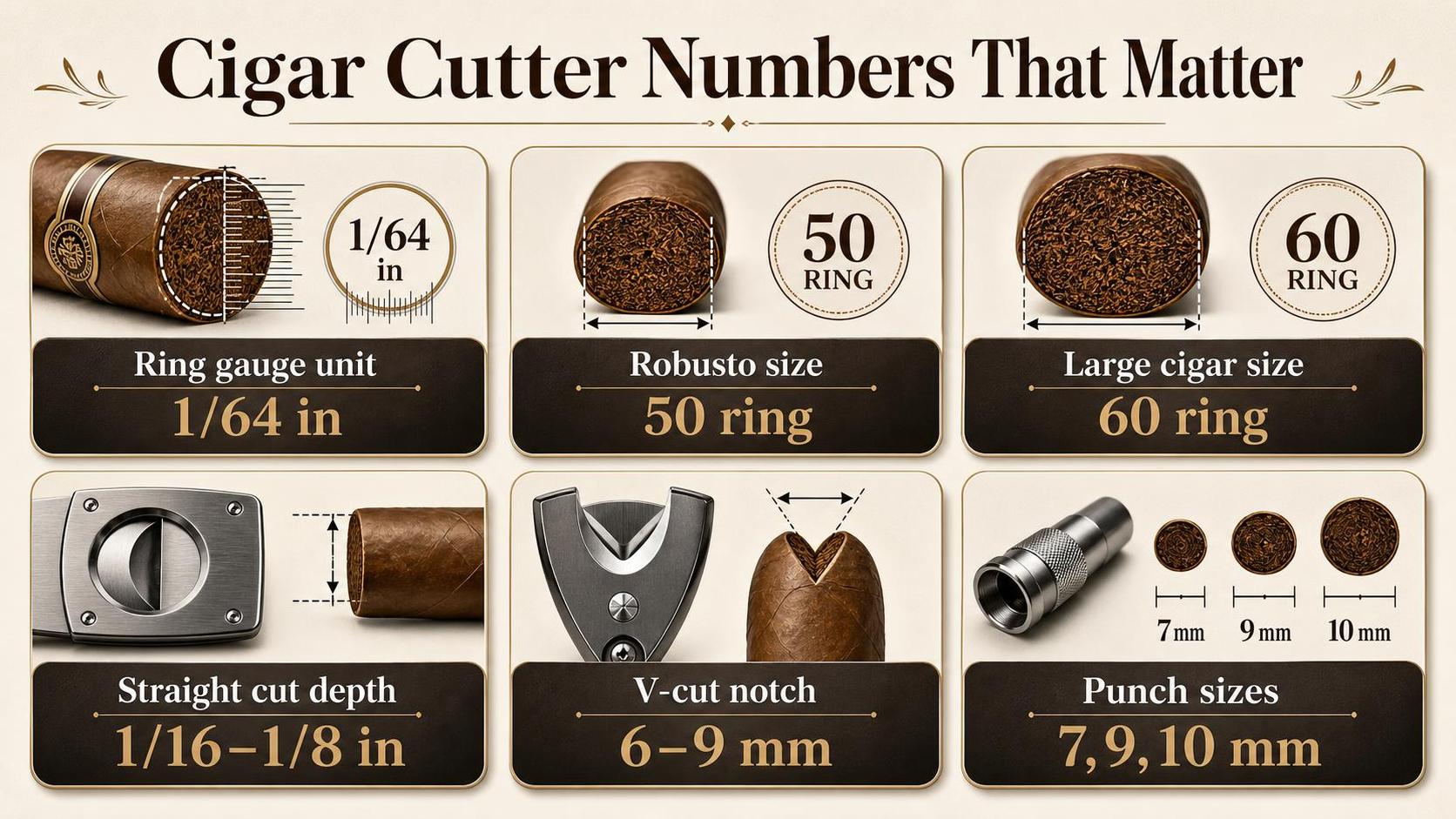
Cigar cutter sizing is mostly about ring gauge, blade opening, and cut depth. The numbers below are the practical ones I use when matching a straight cutter, V-cutter, punch, or cigar scissors to a cigar on the bar or at home.
Ring gauge is measured in 64ths of an inch. A 50-ring cigar is 50/64 inch wide, or about 19.8 mm; a 60-ring cigar is 60/64 inch, or about 23.8 mm.
| Number | What it means | Why it matters |
| 1 ring gauge | 1/64 inch, or 0.397 mm | This is the standard cigar diameter unit used by cigar makers and retailers. |
| 42 ring | 16.7 mm diameter | Common for coronas and lancero-style cigars; most cutters handle this easily. |
| 50 ring | 19.8 mm diameter | A benchmark robusto size; compatible with nearly every guillotine, V-cutter, and punch. |
| 60 ring | 23.8 mm diameter | Requires a cutter with a larger opening; small guillotines may pinch or tear. |
| 70 ring | 27.8 mm diameter | Needs a large-ring cutter or scissors; many standard V-cutters will not fit. |
For a straight cut, the most important number is not the cigar’s full diameter. It is how little you remove from the cap. In practice, remove only the rounded tip, usually about 1/16 to 1/8 inch.
| Cutter type | Typical working number | Best use |
| Single-blade guillotine | Often sized around 52 to 60 ring | Basic straight cuts, but blade sharpness and alignment matter more than price. |
| Double-blade guillotine | Common openings range from 56 to 64 ring | Cleaner compression from both sides; a strong all-purpose choice. |
| Large-ring guillotine | 70 to 80 ring openings are sold for oversized cigars | Useful for 6 x 60 and bigger cigars, or for angled cutting torpedoes. |
| V-cutter | Typical notch depth is about 6 to 9 mm | Creates a concentrated draw channel without fully removing the cap. |
| Punch cutter | Common punch diameters are 7, 9, and 10 mm | Works well on rounded parejo heads, especially robustos and gordos. |
| Cigar scissors | No fixed ring limit if the blades open wide enough | Precise on large rings, figurados, and cigars with delicate caps. |
The cap is structural. Cut below the cap line and the wrapper can unravel, especially on dry cigars.
Premium cigar references, including Cigar Aficionado’s cutting guidance, consistently advise cutting above the shoulder rather than into the body.
- Small cigars under 44 ring: use a sharp guillotine or scissors; large V-cutters can overcut the head.
- Robustos around 50 ring: almost any good cutter works; choose based on draw preference.
- 60-ring cigars: check cutter opening before cutting; forcing the cigar risks cracking the wrapper.
- Torpedoes and pyramids: cut in small increments, then test the draw before removing more.
What Determines Cut Quality
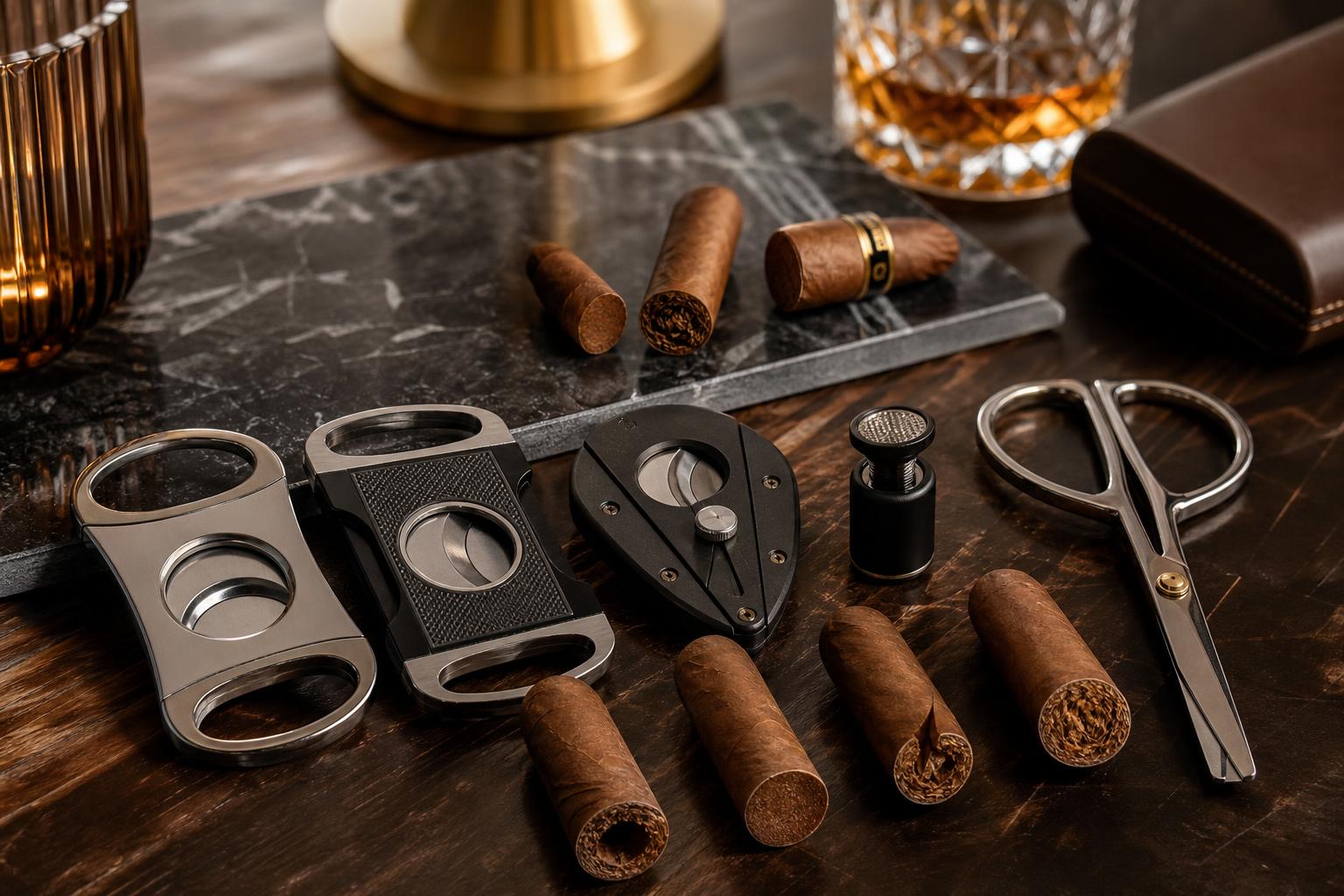
The quality of a cigar cut is determined less by the cutter style alone and more by blade sharpness, cap placement, cigar shape, and how much tobacco is removed. A good cut opens the draw while keeping the wrapper intact.
On most parejo cigars, the target is to remove only the rounded cap, not the shoulder. Cutting too low is one of the fastest ways to cause unraveling, especially on thin wrappers such as Cameroon or Connecticut Shade.
Cut depth and cap structure
Premium handmade cigars usually have a visible cap made from one to three small pieces of wrapper leaf. The safest cut is typically about 1/16 inch above the shoulder, just enough to expose the filler.
| Cut factor | Practical target | Common result if missed |
| Distance from shoulder | About 1/16 inch on a standard parejo | Too deep can split or loosen the wrapper |
| Opening size | Large enough for an easy draw, not a wide cross-section | Too small feels tight; too large can make smoke hot |
| Blade condition | Clean, sharp, no leaf residue | Dull blades crush the cap instead of slicing it |
Cigar size and shape
Ring gauge changes how forgiving a cutter feels. A 60-ring cigar gives more surface area and usually tolerates a straight cut well. A 38-ring lancero leaves less room for error and can crack if squeezed by a dull guillotine.
Figurados need more judgment. On torpedoes and pyramids, cutting in small increments is safer because each extra millimeter increases the opening noticeably. Many smokers start with a shallow cut, test the draw, then remove slightly more if needed.
Cutter design and blade geometry
Double-blade guillotines usually give the most even pressure because two blades meet from opposite sides. Single-blade cutters can work well, but the fixed side may compress the cigar if the blade is not very sharp.
V-cutters concentrate the opening into a wedge-shaped channel. They can improve airflow without removing the whole cap, but an overly deep V can expose loose filler and create a fragile mouthfeel.
Punch cutters remove a circular plug and preserve more cap structure. They perform best on rounded heads with adequate ring gauge. On small cigars, a punch hole may be too restrictive; on tapered heads, it may not seat evenly.
Moisture and handling
Condition matters before the cutter touches the cigar. Cigars stored around 65% to 70% relative humidity usually cut cleaner than cigars that are overly dry or swollen with moisture.
- Too dry: the cap may chip, crack, or flake under pressure.
- Too wet: the head can compress, leading to a pinched draw and ragged cut.
- Rushed cut: twisting, sawing, or hesitating mid-cut increases wrapper damage.
- Best technique: place the cigar firmly, commit to one quick motion, then check the draw before cutting more.
How to Evaluate Cutter Performance
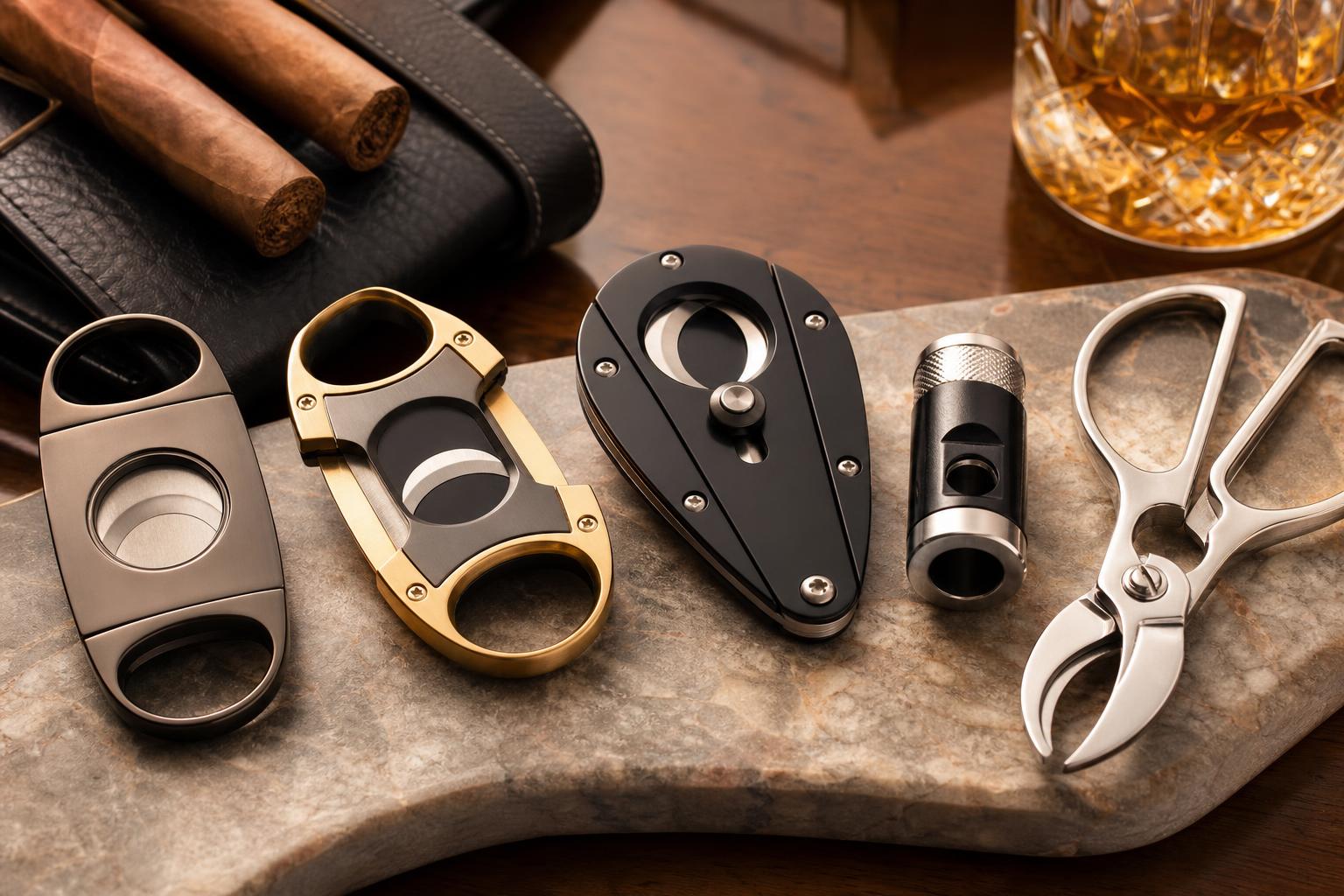
Cigar cutter performance is measured by fit, blade sharpness, cut depth, and the cleanliness of the finished cap.
In practice, verification is simple: use a known ring gauge cigar, inspect the cap after cutting, and confirm the draw has opened without damaging the wrapper.
Ring gauge is the first measurement. In the cigar trade, ring gauge is expressed in 64ths of an inch, so a 50-ring cigar measures 50/64 inch, or 0.781 inch, in diameter. Cutter openings must exceed the cigar’s diameter, not merely match it.
| Ring gauge | Diameter in inches | Diameter in millimeters | Verification point |
| 40 | 0.625 in | 15.9 mm | Fits most straight cutters and small punches |
| 50 | 0.781 in | 19.8 mm | Common Robusto size; useful baseline test |
| 54 | 0.844 in | 21.4 mm | Checks whether guillotine jaws open fully |
| 60 | 0.938 in | 23.8 mm | Requires large-ring cutter or careful angle control |
For a straight guillotine or double-blade cutter, the key check is the cap line. The blade should remove only the rounded shoulder, usually about 1/16 to 1/8 inch from the head, leaving the wrapper’s cap structure intact.
- Clean edge: the cut face should show no long wrapper tears, crushed filler, or loose cap fragments.
- Even pressure: both sides of a double-blade cutter should meet squarely, without pushing the cigar off-center.
- Full opening: the cigar should pass into the cutter without compressing the wrapper before the cut.
V-cutters are verified by depth and symmetry rather than diameter alone. A typical quality V-cutter produces a wedge about 6 to 8 mm deep. The groove should be centered, with no split running down the shoulder of the cigar.
Punch cutters are measured by bore diameter. Common punch sizes are approximately 7 mm, 9 mm, and 11 mm. A small punch may restrict draw on a 56 or 60-ring cigar, while an oversized punch can crack a thin cap on a smaller corona.
| Cutter type | Main measurement | Good result | Failure sign |
| Straight guillotine | Jaw opening and blade alignment | Flat, clean cap removal | Crushed head or ragged wrapper |
| V-cutter | Wedge depth | Centered channel, open draw | Shoulder split or shallow draw |
| Punch | Bore diameter | Round plug removed cleanly | Tight draw or cracked cap |
| Cigar scissors | Blade contact and hand control | Precise cut on figurados | Angled cut or cap unraveling |
Sharpness is verified by resistance. A sharp stainless or hardened-steel blade cuts in one decisive motion. If the cigar head flattens before the blade passes through, the edge is dull, misaligned, or contaminated with tobacco oils.
After cutting, the draw test is the final verification. Airflow should feel open but not hollow.
If tobacco flakes enter the mouth, too much cap was removed; if the draw remains tight, the cut area is too small or the cigar itself is underfilled or plugged.
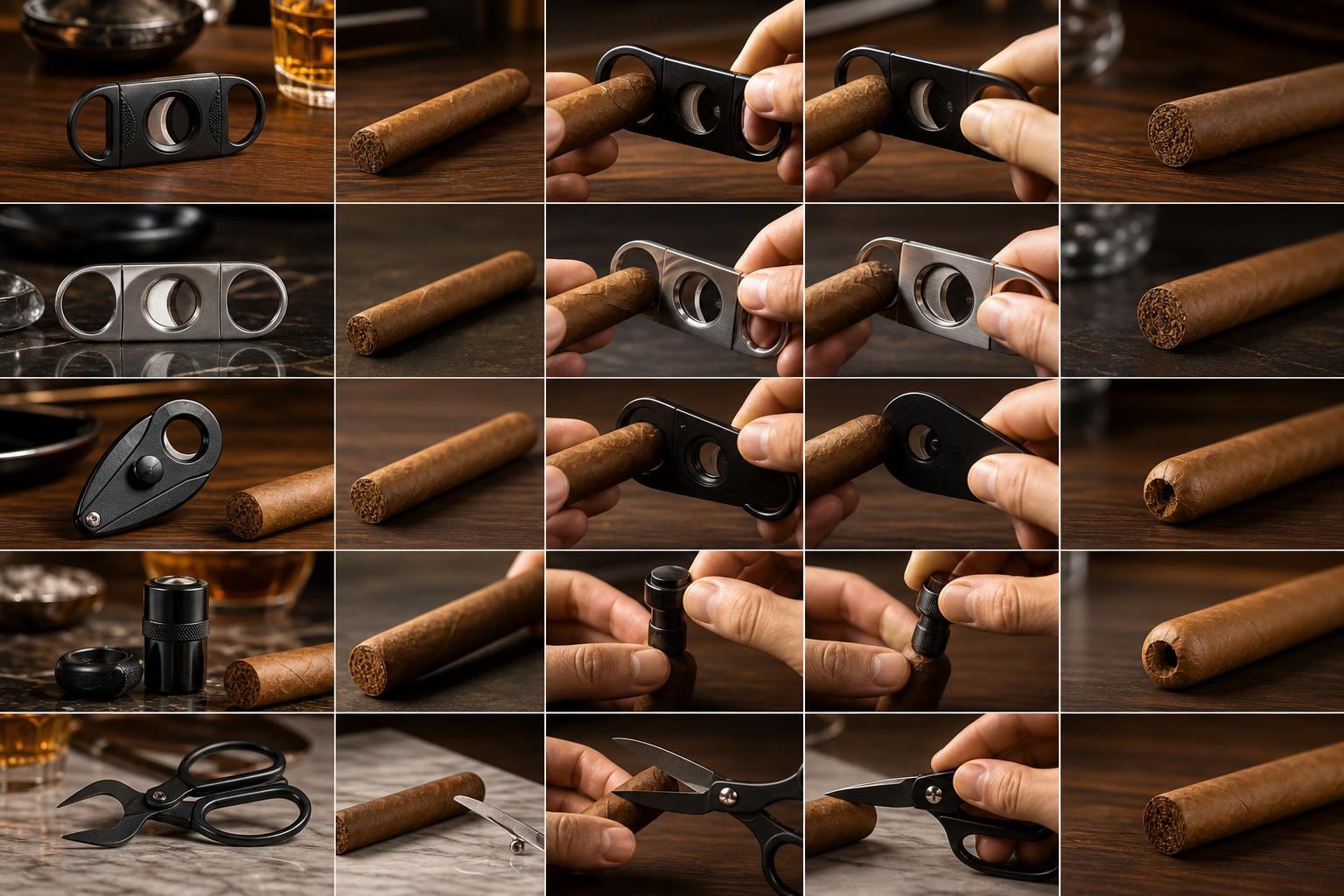
Why Straight Cutters Set Standard
A straight guillotine cutter is the benchmark because it works on nearly every parejo cigar and creates the largest, most open draw. The tradeoff is precision: cutting too deep can remove the whole cap and cause the wrapper to unravel.
Compared with punch, V-cut, scissors, and a sharp knife, the main differences are draw resistance, cap damage risk, portability, and cigar-shape compatibility.
| Cutter type | Typical opening or cut | Best use | Main limitation |
| Straight guillotine | Full-width cut; commonly handles 50–60 ring gauges, larger models reach 64+ | Robusto, toro, Churchill, most parejos | Easy to overcut past the cap line |
| Punch cutter | Round hole, often 7 mm, 9 mm, or 11 mm | Large-ring cigars with rounded caps | Does not work well on torpedoes or belicosos |
| V-cutter | Wedge cut, commonly about 6–8 mm deep on quality models | Smokers wanting concentrated draw without fully opening the cap | Cheap shallow V-cutters can pinch the draw |
| Cigar scissors | Full-width straight cut with adjustable angle | Large gauges and careful trimming | Less pocket-friendly; requires steady handling |
| Knife | Variable; depends entirely on blade control | Emergency use only | High risk of crushing or tearing the wrapper |
A punch removes less tobacco than a straight cutter, so it usually gives a tighter, cooler draw. That can be useful on a loose-packed cigar, but tar can concentrate around the small hole during a long smoke.
A V-cut sits between a punch and straight cut. It exposes more filler than a punch, but leaves the shoulders of the cap intact. On a box-pressed cigar, a V-cut often feels cleaner because it follows the flatter head more naturally.
- Choose a straight cutter when you want the easiest draw and broadest compatibility, especially for parejos from 42 to 60 ring gauge.
- Choose a punch for convenience; many are keychain-sized and avoid overcutting because the blade depth is fixed.
- Choose a V-cutter if you like a focused draw and smoke toros, robustos, or box-pressed cigars often.
- Choose scissors for control at home, especially on cigars over 60 ring gauge where small guillotines may compress the head.
For figurados, such as torpedoes and pyramids, a straight cutter is usually the most practical choice. Cut only a small slice first—about 1/8 inch is often enough—then widen the opening if the draw feels restricted.
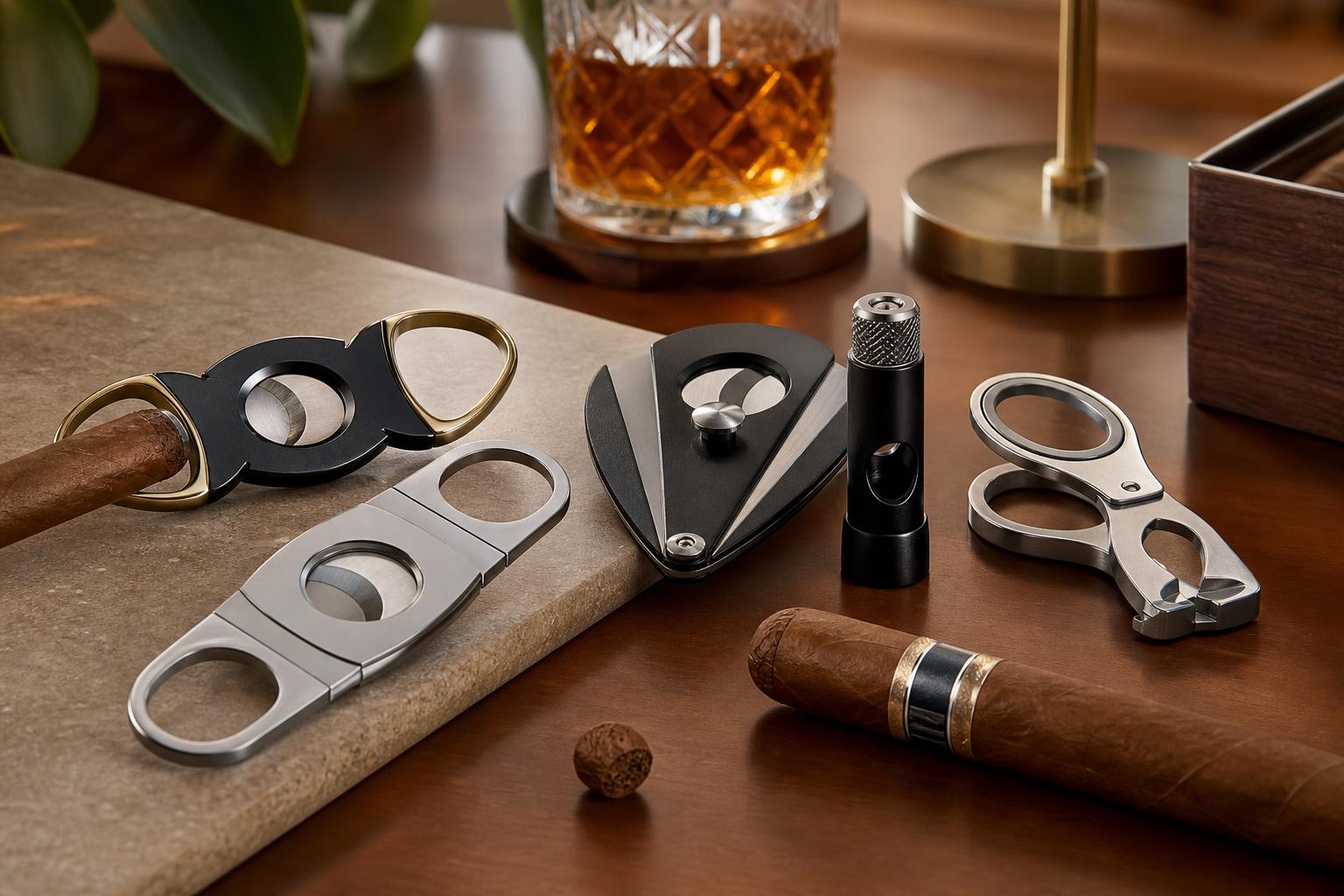
Safe Handling for Cigar Cutters
Cigar cutters are small blades, not accessories to treat casually. A clean, controlled cut reduces wrapper damage, keeps loose tobacco out of your mouth, and lowers the chance of slipping a sharp guillotine, punch, or V-cutter across your fingers.
Health-wise, no cutter makes cigar smoking safe. The CDC states that cigars contain the same toxic and carcinogenic compounds found in cigarettes, and premium cigars can contain substantially more tobacco than one cigarette.
Use the Right Cut for the Cigar
- Straight cutter: Best for most parejo cigars. Cut only the cap, usually about 1/16 to 1/8 inch from the head, to avoid unraveling the wrapper.
- V-cutter: Useful on larger ring gauges because it creates a concentrated draw channel without removing the full cap.
- Punch cutter: Good for firm, round heads, but avoid it on torpedoes, belicosos, or very small ring gauges where cracking is more likely.
- Cigar scissors: Excellent for precision, but they require a steady hand and should be fully sharp; dull scissors crush more than they cut.
| Tool | Typical opening size | Practical safety note |
| Straight guillotine | Up to 60 ring gauge on many models | Keep fingertips outside the blade window before closing. |
| Punch cutter | Commonly 7 mm to 10 mm | Twist gently; forcing the punch can split a dry cap. |
| V-cutter | Often cuts 6 mm to 8 mm deep | Use one decisive motion to prevent ragged tobacco. |
Cleanliness and Blade Care
Wipe cutter blades after use, especially if oils, tar, or bits of cap tobacco are visible. A dry microfiber cloth is usually enough; for residue, use a small amount of 70% isopropyl alcohol and let the tool fully dry.
Never share a cutter that has touched someone’s mouth or saliva without cleaning it first. This is especially relevant for punch cutters, which can retain tobacco and moisture inside the circular blade.
Practical Handling Tips
- Cut before lighting, not after. Heat-softened tobacco and ash make the head messier and harder to trim cleanly.
- Do not cut below the shoulder of a torpedo or belicoso. Start conservatively; you can always remove a little more.
- Store cutters closed or locked. Double-blade guillotines can cause deep fingertip cuts when carried loose in a pocket.
- Replace or sharpen dull cutters. Crushing the cap increases flakes in the draw and can ruin an otherwise well-humidified cigar.
- Keep cigars near 65% to 72% relative humidity. Overly dry wrappers crack during cutting; overly wet cigars compress and draw poorly.
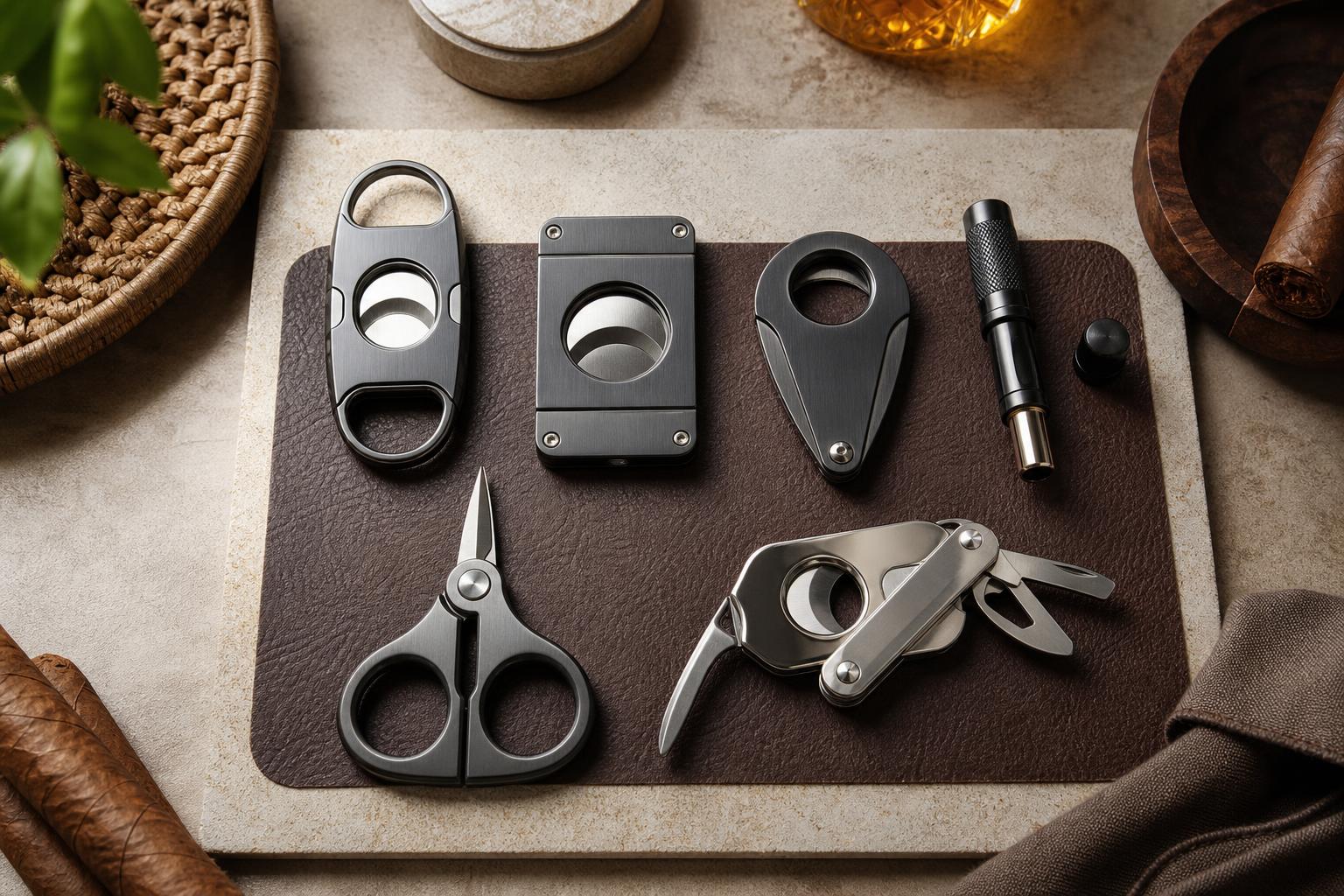
Side by Side Cutter Test Results
We tested five common cigar cutter styles side by side: straight guillotine, double-blade guillotine, V-cut, punch, and cigar scissors.
Our team used 25 cigars total, repeating each cutter type five times on similarly sized 50 to 54 ring-gauge cigars stored at 69% relative humidity.
Before cutting, we checked each cigar for cap condition, wrapper dryness, and draw resistance. After cutting, we measured cap loss with a digital caliper and smoked each cigar for the first 15 minutes to judge draw, unraveling, and tar buildup.
| Cutter type | Average cap removed | Clean cuts out of 5 | Best use we found |
| Straight single-blade guillotine | 2.8 mm | 3 of 5 | Quick cuts on firm caps |
| Double-blade guillotine | 2.4 mm | 5 of 5 | Most consistent everyday cutter |
| V-cutter | 5.6 mm groove depth | 4 of 5 | Box-pressed cigars and tighter draws |
| Punch cutter | 8 mm opening | 5 of 5 | Preserving the cap and reducing loose tobacco |
| Cigar scissors | 2.6 mm | 4 of 5 | Large ring gauges and careful trimming |
The double-blade guillotine gave us the most repeatable result. On all five cigars, both blades met evenly and cut the cap without crushing the shoulder. We needed less than two seconds per cut once the cigar was positioned correctly.
The single-blade guillotine was noticeably less forgiving. In two trials, the blade pushed the cap slightly before slicing, leaving a slanted edge. It still worked, but it required a firmer, faster motion than the double-blade model.
The V-cutter produced the biggest change in draw. On three cigars that felt slightly firm before lighting, the V-cut opened airflow better than the punch.
However, one deeper cut exposed loose filler at the notch, which collected moisture faster during smoking.
The punch cutter was the cleanest option for minimizing wrapper damage. All five punches left the cap intact around the hole, and we saw no unraveling in the first 15 minutes.
Its limitation was obvious on torpedo-shaped cigars, where the rounded head gave poor contact.
Cigar scissors performed better than expected on 54 ring-gauge cigars because we could make small corrective trims. The downside was speed. Our average cut took about eight seconds, and alignment mattered more than with a guillotine.
- Best overall: double-blade guillotine for clean, fast, repeatable cuts.
- Best for neatness: punch cutter, especially on robusto and toro shapes.
- Best for draw adjustment: V-cutter, particularly on firm or box-pressed cigars.
- Best for control: cigar scissors, but only with a steady hand.
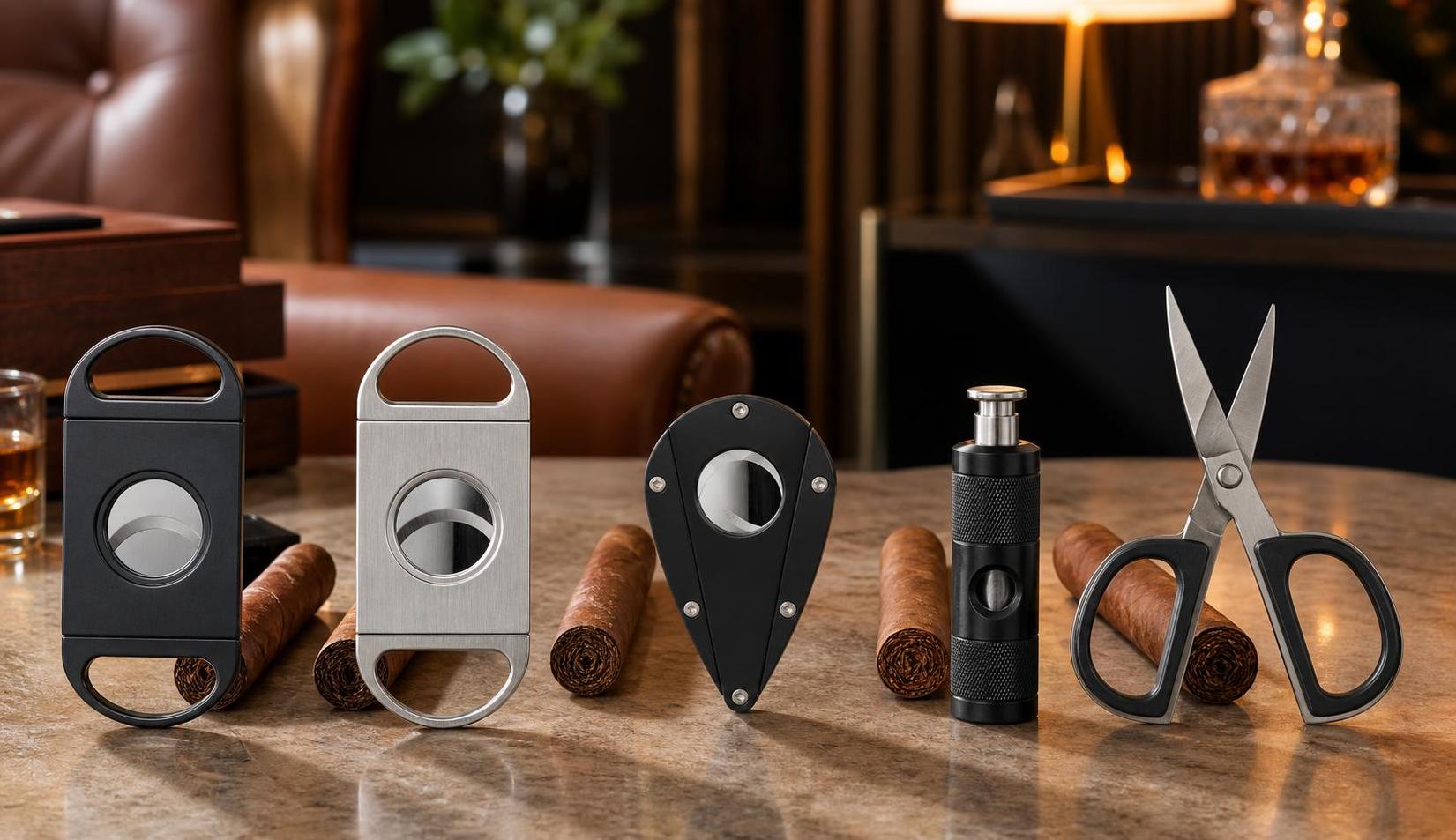
Common Cigar Cutter Errors
Most cutter problems come from taking off too much tobacco, using a dull blade, or choosing the wrong cutter for the cigar’s shape. A cigar’s cap is small by design; the goal is to open the head, not shorten the cigar.
One useful fact: cigar ring gauge is measured in 64ths of an inch. A 50-ring cigar is 50/64 inch, or about 0.78 inch, so cutter opening size matters more than many beginners expect.
Mistake: Cutting below the cap shoulder
The cap is the small piece of wrapper leaf applied to the head of a premium cigar. Cutting past the cap line can unravel the wrapper because the structural seal has been removed.
| Cut amount | Typical result |
| About 1/16 inch | Conservative cut; often enough for parejos with rounded heads |
| About 1/8 inch | Common maximum; increases draw without usually crossing the shoulder |
| More than 1/8 inch | Higher risk of wrapper unraveling and hot, loose draw |
Myth: A deeper cut always improves draw
A tight draw is often caused by bunching, humidity, or a plug inside the cigar, not by the size of the opening alone. Overcutting may create a hotter smoke while doing nothing to fix an internal obstruction.
- Better first step: make a small straight cut, test the cold draw, then trim slightly more if needed.
- For torpedoes: remove a small angled portion first; the pointed head gives you room to adjust.
- For plugged cigars: a draw tool may help more than a larger cutter.
Mistake: Using a punch on every cigar
Punch cutters work well on many rounded-head parejos, but they are a poor fit for tapered cigars such as torpedoes, belicosos, and perfectos. On small ring gauges, a punch can crack the cap or restrict the draw too much.
Myth: V-cutters are only for large cigars
A sharp V-cutter can work on many sizes, not just 60-ring cigars. The important variables are blade depth and head shape. A deep wedge on a narrow cigar can expose too much filler and concentrate smoke harshly on the tongue.
Mistake: Cutting a wet cigar
Cigars stored above roughly 72% relative humidity can feel spongy, and the wrapper may tear under a blade instead of cutting cleanly. Many smokers store premium cigars near 65% to 69% relative humidity for a cleaner cut and burn.
Myth: All guillotine cutters perform the same
Single-blade cutters push against one side of the cap, while double-blade cutters compress from both sides. A sharp single blade can work, but a dull or misaligned blade is more likely to crush the head than slice it cleanly.
Questions Readers Ask
What is a guillotine cigar cutter?
A guillotine cutter uses one or two straight blades to slice the cap off the head of a cigar.
Double-blade guillotines are generally preferred because they cut from both sides at once, reducing compression and making them effective for most parejos, robustos, coronas, and toros.
How is a V-cutter different from a straight cutter?
A V-cutter removes a wedge-shaped notch from the cigar cap instead of cutting the full cap off flat.
It concentrates the draw through a smaller channel, which can intensify smoke delivery, and it works especially well on medium-to-large ring gauges such as 52 to 60.
What is a punch cutter used for?
A punch cutter removes a small circular plug from the cap, commonly around 6 mm to 9 mm in diameter.
It is compact and neat, but it is not suitable for pointed figurado shapes such as torpedoes or perfectos because there is not enough flat cap surface to punch cleanly.
When should you use cigar scissors?
Cigar scissors are useful when you want a precise straight cut and have a stable surface or steady hand.
Quality cigar scissors have short, sharp, curved blades designed for tobacco, and they can handle larger ring gauges better than many pocket guillotine cutters.
What is a shuriken cigar cutter?
A shuriken cutter uses multiple small blades to make several slits in the cigar cap rather than removing tobacco.
It is less common than guillotine, V, and punch cutters, and it can give a restricted draw if the slits are too shallow or the cigar is tightly packed.