Beers under 20 ppm gluten are beers that test below the FDA gluten-free threshold of 20 parts per million, but only certain categories can be labeled gluten-free in the U.S.
The exact keyword matters because “gluten-free,” “gluten-reduced,” and “crafted to remove gluten” do not mean the same thing.
For shoppers, the safest distinction is source grain. Beers brewed from naturally gluten-free grains such as sorghum, millet, rice, buckwheat, or corn can qualify as gluten-free when testing supports it.
Beers made from barley, wheat, or rye and treated with enzymes may test under 20 ppm, but U.S. labeling rules do not allow them to be called gluten-free.
What Under 20 ppm Means
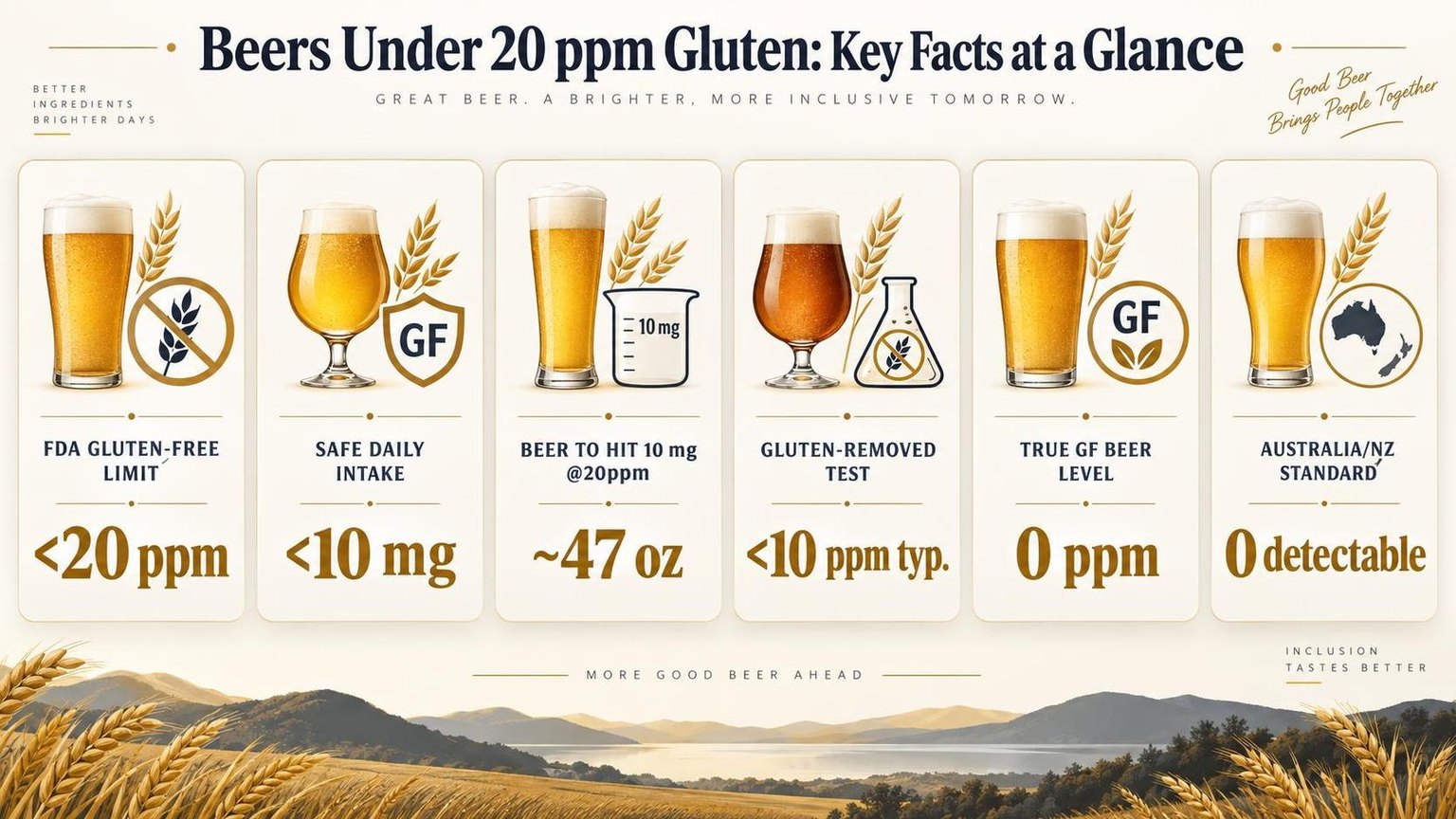
The 20 parts per million threshold is the internationally recognized safety cutoff for gluten in food and beverages. This standard originates from Codex Alimentarius guidelines adopted in 2008 and enforced by the FDA since August 2014.
One ppm equals 1 milligram of gluten per kilogram of product. At 20 ppm, a 355 ml (12 oz) can of beer contains roughly 7 micrograms of gluten — an amount clinical research considers unlikely to trigger symptoms in most celiac patients.
Regulatory Standards by Region
| Region | Authority | Gluten-Free Threshold | Labeling Rule |
| United States | FDA / TTB | <20 ppm | Fermented/hydrolyzed beverages cannot use “gluten-free” if made from gluten grains |
| European Union | EC Regulation 41/2009 | <20 ppm | “Gluten-free” permitted; 21–100 ppm labeled “very low gluten” |
| Canada | CFIA | <20 ppm | “Gluten-free” allowed on qualifying products |
| Australia/NZ | FSANZ | No detectable gluten | Strictest standard globally; no measurable threshold |
The U.S. rule creates a unique complication for beer. The TTB prohibits barley-based beers from labeling as “gluten-free” even if they test below 20 ppm after enzymatic treatment.
These beers can only state “crafted to remove gluten.”.
Why 20 ppm Specifically
A 2007 systematic review published in Alimentary Pharmacology & Therapeutics found that daily gluten intake below 10 mg caused no measurable intestinal damage in celiac patients over 90 days.
The 20 ppm limit was set to keep total daily exposure well under that threshold.
- At 20 ppm: a person would need to drink over 1,400 ml (~47 oz) of beer daily to reach the 10 mg danger zone
- At 10 ppm: many “gluten-removed” beers test in this range, roughly doubling the safe consumption volume
- At 5 ppm: some dedicated gluten-free beers (sorghum, rice, millet-based) reach this level or lower
Testing methodology matters. The competitive R5 ELISA (Mendez method) is the only validated assay for measuring gluten in fermented and hydrolyzed products.
Standard sandwich ELISA tests undercount fragmented gluten peptides, potentially giving false low readings.
Individuals with celiac disease should distinguish between “gluten-free” (made without gluten grains) and “gluten-removed” (enzymatically treated). The latter carries residual risk that current testing cannot fully quantify.

Gluten Free Versus Gluten Reduced Beer
The FDA sets 20 ppm (parts per million) as the threshold for “gluten-free” labeling on food and beverages.
Beer occupies a regulatory gray zone because the TTB, not the FDA, governs alcohol labeling—and the two agencies apply different standards.
Gluten-free beers are brewed entirely from grains that contain no gluten proteins. Gluten-reduced beers start with barley or wheat, then use enzymes like Brewers Clarex (AN-PEP) to break down gluten peptides post-fermentation.
Key Regulatory Differences
| Category | Gluten-Free Beer | Gluten-Reduced Beer |
| Base grains | Sorghum, millet, rice, buckwheat, quinoa | Barley, wheat, rye (treated with enzymes) |
| Gluten level | Inherently 0 ppm | Typically tested below 20 ppm, sometimes below 10 ppm |
| TTB label allowed | “Gluten-free” | “Crafted to remove gluten” (cannot say “gluten-free”) |
| ELISA testing reliability | Accurate for intact proteins | May undercount hydrolyzed gluten fragments |
| Celiac safety consensus | Considered safe | Debated; not recommended by most celiac organizations |
The Testing Problem
The competitive R5 ELISA test—the standard method—was validated for intact gluten proteins. Enzyme treatment fragments gluten into smaller peptides that the test may not fully detect.
A 2017 study in Food Chemistry (vol. 217) found that sandwich ELISA underestimated residual gluten in enzyme-treated barley beer by up to 80% compared to mass spectrometry methods.
The Gluten Intolerance Group and Beyond Celiac both advise people with celiac disease to avoid gluten-reduced beers, regardless of reported ppm levels.
What This Means for Consumers
- Diagnosed celiacs should choose beers brewed from inherently gluten-free grains—brands like Ghostfish, Glutenberg, or Ground Breaker.
- People with non-celiac gluten sensitivity may tolerate gluten-reduced options like Omission or Stone Delicious IPA, which consistently test below 20 ppm.
- Always check for the TTB-mandated label language: “crafted to remove gluten” signals enzyme treatment, not gluten-free brewing.
The distinction matters. A beer testing below 20 ppm on a standard ELISA is not equivalent to a beer brewed without gluten grains, particularly for the roughly 1 in 133 Americans living with celiac disease.

US Label Rules for Low Gluten Beer
The United States splits regulatory authority over beer labeling between two federal agencies. Beers made from gluten-containing grains fall under TTB jurisdiction, while those brewed entirely from gluten-free grains answer to the FDA.
TTB vs. FDA Jurisdiction
The Alcohol and Tobacco Tax and Trade Bureau (TTB) regulates beverages made from malted barley, wheat, rye, or their derivatives. The FDA governs beers brewed exclusively from inherently gluten-free grains like sorghum, rice, millet, or buckwheat.
| Agency | Grain Source | Allowed Label Claim | Threshold |
| FDA | Gluten-free grains only | “Gluten-Free” | <20 ppm |
| TTB | Barley, wheat, rye | “Processed to Remove Gluten” (with qualifier) | No accepted threshold |
The 20 ppm Standard — With a Catch
The FDA’s 20 ppm cutoff, codified in 21 CFR §101.91 since August 2013, applies only to foods and beverages under FDA oversight. TTB-regulated beers cannot use this standard to claim “gluten-free” status.
TTB Ruling 2020-2 permits barley-based beers treated with enzymes like Brewers Clarex (prolyl endopeptidase) to state “Processed or Treated to Remove Gluten.” The label must also carry this mandatory qualifier:
- “This product was crafted to remove gluten. The gluten content of this product cannot be verified, and this product may contain gluten.”
Why TTB Rejects the 20 ppm Test for Hydrolyzed Beers
The competitive R5 ELISA — the standard sandwich ELISA validated by Codex Alimentarius — measures intact gluten proteins. Enzyme-treated beers contain hydrolyzed gluten fragments that this assay cannot reliably quantify.
Research published in the Journal of AOAC International (2019) confirmed that R5 competitive ELISA may underestimate or inconsistently detect hydrolyzed gluten peptides in fermented beverages.
Until a validated method exists for fragments, TTB maintains its restrictive labeling position.
Practical Implications for Consumers
- A beer labeled “Gluten-Free” in the US was brewed from naturally gluten-free grains and tested below 20 ppm.
- A beer labeled “Processed to Remove Gluten” started with barley or wheat and may still contain immunoreactive peptides.
- Individuals with celiac disease should consult their gastroenterologist before consuming enzyme-treated beers, regardless of advertised ppm levels.

Trusted Beers Testing Under 20 ppm
The 20 ppm threshold is the international standard set by the Codex Alimentarius and adopted by the FDA in 2020 for “gluten-free” fermented beverage labeling.
Several breweries now produce beers that consistently test below this level using enzyme treatment or gluten-free grains.
Craft-Brewed With Enzyme Treatment (Gluten-Reduced)
These beers start with barley or wheat, then use Brewers Clarex (DSM’s prolyl endopeptidase) to hydrolyze gluten proteins during fermentation. Results vary by batch.
| Beer | Brewery | Style | Reported Gluten (ppm) |
| Omission Lager | Omission Brewing (Portland, OR) | Lager | <10 ppm (batch-tested via R5 competitive ELISA) |
| Omission Pale Ale | Omission Brewing | Pale Ale | <10 ppm |
| Stone Delicious IPA | Stone Brewing (Escondido, CA) | IPA | <20 ppm (internal testing) |
| Daura Damm | S.A. Damm (Barcelona, Spain) | Lager | <6 ppm (certified by FACE, Spain) |
Omission publishes individual batch test results online, making it one of the most transparent gluten-reduced brands on the market.
Brewed From Inherently Gluten-Free Grains
These beers contain zero barley or wheat. They use sorghum, millet, rice, buckwheat, or other grains that are naturally free of gluten-forming prolamins.
| Beer | Brewery | Base Grain | Gluten Level |
| Glutenberg Blonde | Glutenberg (Montréal, QC) | Millet, buckwheat, corn | <5 ppm |
| Ground Breaker IPA No. 5 | Ground Breaker Brewing (Portland, OR) | Lentils, chestnuts | <5 ppm |
| Holidaily Favorite Blonde | Holidaily Brewing (Golden, CO) | Millet, buckwheat, rice | <10 ppm |
| Ghostfish Shrouded Summit | Ghostfish Brewing (Seattle, WA) | Millet, rice, buckwheat | <10 ppm |
Ghostfish and Ground Breaker operate dedicated gluten-free facilities, eliminating cross-contamination risk entirely.
Key Testing Distinction
- R5 Sandwich ELISA — standard for intact gluten; unreliable for hydrolyzed (enzyme-treated) proteins.
- R5 Competitive ELISA — designed for fermented and hydrolyzed products; used by Omission and required under Codex guidelines for beer.
- Mass spectrometry — emerging gold standard; detects peptide fragments the ELISA methods can miss.
Celiac disease organizations such as the Celiac Disease Foundation generally recommend dedicated gluten-free beers over gluten-reduced options for individuals with confirmed celiac disease.

How Breweries Remove Gluten From Beer
Most beer starts with barley or wheat, grains that contain hordein and gliadin—prolamin proteins collectively called gluten.
Breweries targeting sub-20 ppm use two primary strategies: enzymatic gluten reduction or brewing with inherently gluten-free grains.
Enzymatic Gluten Reduction (Gluten-Removed Beer)
Breweries add prolyl endopeptidase (AN-PEP) or Brewer’s Clarex (DSM’s product containing proline-specific endoprotease) during fermentation. The enzyme cleaves proline-rich gluten peptides into fragments below the immunogenic threshold.
Brewer’s Clarex, dosed at approximately 1–2 mL per hectoliter, typically reduces gluten from 20,000–40,000 ppm in raw wort to below 20 ppm in the finished product.
Many craft breweries report achieving levels under 10 ppm with proper dosing.
The R5 competitive ELISA—the standard test method recognized by the Codex Alimentarius—measures intact gluten peptides. It has a detection limit of approximately 3 ppm.
Sandwich R5 ELISA may not accurately detect hydrolyzed fragments, creating ongoing scientific debate about true residual gluten levels.
Gluten-Free Grain Brewing
The second approach avoids barley and wheat entirely. Breweries use naturally gluten-free grains that contain no prolamins of concern.
| Grain | Gluten Content | Common Beer Styles |
| Sorghum | 0 ppm | Pale ales, lagers |
| Millet | 0 ppm | Light ales, session beers |
| Rice | 0 ppm | Lagers, cream ales |
| Buckwheat | 0 ppm | Dark ales, stouts |
| Quinoa | 0 ppm | Blonde ales |
Groundbreaker Brewing in Portland, Oregon, and Holidaily Brewing in Golden, Colorado, produce exclusively from gluten-free grains. Their beers test at 0 ppm gluten consistently.
Key Regulatory Distinction
- FDA (United States): Only beers brewed from gluten-free ingredients may carry a “gluten-free” label. Gluten-removed beers cannot use this designation, regardless of test results.
- TTB ruling (2020): Gluten-removed beers may state “crafted to remove gluten” with a qualifying disclaimer that gluten content cannot be verified.
- Codex Alimentarius: Sets the international threshold at below 20 ppm for “gluten-free” claims.
For individuals with celiac disease, the Celiac Disease Foundation recommends beers brewed entirely from gluten-free grains rather than enzymatically treated options due to testing limitations.
Lab Testing Limits for Fermented Beer
Measuring gluten in fermented beverages remains scientifically contentious.
The standard ELISA test—designed for intact gluten proteins—struggles with the hydrolyzed fragments created during brewing’s enzymatic and fermentation processes.
The Codex Alimentarius Standard
The Codex Alimentarius Commission sets the international threshold at 20 ppm (20 mg/kg) for “gluten-free” labeling. The FDA adopted this identical cutoff in August 2013 under 21 CFR §101.91.
Testing Methods Compared
Two primary sandwich ELISA methods dominate gluten quantification. Their reliability diverges sharply when applied to fermented or hydrolyzed products.
| Method | Antibody | Detection Limit | Reliable for Fermented Beer? |
| R5 Sandwich ELISA (Méndez) | R5 | 3 ppm | No — underestimates hydrolyzed fragments |
| R5 Competitive ELISA | R5 | ~5 ppm | Partially — detects smaller peptide fragments |
| G12 Sandwich ELISA | G12 | 2 ppm | No — same hydrolysis limitations |
| Mass Spectrometry (LC-MS/MS) | N/A | <5 ppm | Promising but not yet standardized |
The Core Problem
Barley-based beers treated with enzymes like Brewer’s Clarex (prolyl endopeptidase AN-PEP) break gluten into fragments smaller than the ~30 amino acid threshold detectable by sandwich ELISA.
A 2014 study in the Journal of AOAC International confirmed that R5 sandwich ELISA returned readings below 20 ppm for enzyme-treated barley beers that competitive ELISA measured at significantly higher levels.
Regulatory Consequences
- The TTB (Alcohol and Tobacco Tax and Trade Bureau) does not allow barley-based beers testing under 20 ppm to use “gluten-free” on labels.
- These products may only state “crafted to remove gluten” — a distinction the TTB finalized in 2020.
- Beers brewed entirely from gluten-free grains (sorghum, rice, millet, buckwheat) face no such restriction and can label “gluten-free” outright.
- Australia and the EU similarly require the 20 ppm threshold but have not resolved the hydrolyzed testing gap.
Until a validated method for hydrolyzed gluten in fermented beverages gains AOAC approval, the sub-20 ppm claim on enzyme-treated barley beers remains analytically unverifiable by current regulatory standards.

Celiac Safety and Cross Contact Risks
The 20 ppm threshold adopted by the FDA in 2013 (21 CFR §101.91) applies to food labeling but does not currently permit fermented or hydrolyzed products to carry a “gluten-free” claim.
This regulatory gap leaves beer in a gray zone that demands closer scrutiny.
Why 20 ppm Is Not Zero Risk
Research published in the American Journal of Clinical Nutrition (2007) found that daily gluten intake below 10 mg is safe for most celiac patients. A 12 oz (355 ml) beer at 20 ppm contains approximately 7.1 mg of gluten per serving.
Drinking two of those beers pushes intake to ~14.2 mg—above the 10 mg daily threshold. Three beers reach ~21.3 mg, well into the range associated with mucosal damage over time.
| Beers Consumed (12 oz each) | Gluten at 20 ppm | Gluten at 10 ppm | Gluten at 5 ppm |
| 1 | 7.1 mg | 3.6 mg | 1.8 mg |
| 2 | 14.2 mg | 7.1 mg | 3.6 mg |
| 3 | 21.3 mg | 10.7 mg | 5.3 mg |
The ELISA Testing Problem
Competitive R5 ELISA (the R5 Mendez method) is the standard for detecting gluten in hydrolyzed products. However, the Codex Alimentarius acknowledges that no validated method fully quantifies gluten fragments in fermented beverages.
Enzyme treatment (used by brands like Omission and Stone Delicious IPA) breaks gluten into smaller peptides. These fragments may still trigger immune responses in sensitive celiac patients while reading below 20 ppm on ELISA tests.
Cross-Contact Risk Factors
- Shared brewing equipment: Facilities producing barley-based beers risk residual gluten contamination in lines, fermenters, and packaging systems.
- Ingredient supply chain: Gluten-free grains like sorghum and millet can be contaminated during harvesting, transport, or milling if shared with wheat or barley.
- Batch variation: Enzyme-treated beers show inconsistent ppm readings across production runs, with some batches testing higher than labeled.
Practical Guidance
The Celiac Disease Foundation recommends that individuals with celiac disease choose beers brewed entirely from gluten-free grains rather than enzyme-treated barley-based beers tested below 20 ppm.
Dedicated gluten-free breweries—such as Ghostfish Brewing, Ground Breaker Brewing, and Holidaily Brewing—eliminate cross-contact risk by never processing gluten-containing grains on-site.

Questions People Ask Most
What does “under 20 ppm gluten” mean for beer?
The 20 parts-per-million threshold is the international standard set by the Codex Alimentarius and adopted by the U.S.
FDA in 2013 for labeling a product “gluten-free.” A beer testing below 20 ppm contains less than 0.002% gluten by weight, a level that peer-reviewed research (published in the American Journal of Clinical Nutrition,.
2007) found safe for the vast majority of people with celiac disease.
Which mainstream beer brands consistently test under 20 ppm gluten?
Omission Brewing (owned by Widmer Brothers) uses a proprietary enzyme process and batch-tests every run, with results typically between 5–10 ppm.
Estrella Daura Damm, brewed in Barcelona, tests below 6 ppm and has carried gluten-free certification in Europe since 2006. Stone Brewing’s Delicious IPA has also been independently tested below 20 ppm in multiple batches.
How is gluten reduced in barley-based beers to fall under 20 ppm?
Brewers add a proline-specific endopeptidase enzyme—most commonly Brewer’s Clarex (DSM)—during fermentation, which cleaves the immunotoxic peptide sequences in hordein, barley’s gluten protein.
The enzyme works at fermentation temperatures (15–20 °C) over 7–14 days and is deactivated by the finished beer’s pH and alcohol content.
The result is hydrolyzed gluten fragments too small to trigger an immune response in most celiac patients.
Can the R5 competitive ELISA test accurately measure gluten in enzyme-treated beers?
This is a contested point. The R5 competitive ELISA (Méndez method) is the only test currently accepted by the TTB and FDA for hydrolyzed or fermented products, but some researchers argue it may undercount or overcount residual fragments.
A 2019 study in Food Chemistry found that mass spectrometry detected immunoreactive peptides in beers that tested below 20 ppm on ELISA, so enzyme-treated beers carry more uncertainty than beers made from inherently gluten-free grains.
Are beers brewed from sorghum, rice, or millet different from gluten-reduced beers under 20 ppm?
Yes—beers made entirely from gluten-free grains like sorghum, rice, buckwheat, or millet are naturally free of gluten and can carry an unqualified “gluten-free” label under FDA rules.
Gluten-reduced beers start with barley or wheat and use enzyme treatment, so the TTB prohibits them from using the “gluten-free” claim.
They may only state “crafted to remove gluten.” Brands like Ghostfish Brewing (Seattle) and Ground Breaker Brewing (Portland) use dedicated gluten-free facilities and grains, eliminating cross-contamination risk entirely.
Is it safe for someone with celiac disease to drink beers labeled under 20 ppm gluten?
Medical organizations remain cautious.
The Celiac Disease Foundation and Beyond Celiac both note that enzyme-treated, gluten-reduced beers have not been proven safe for all celiac patients, largely because of testing limitations with hydrolyzed proteins.
A 2017 position statement from the Australasian Society of Clinical Immunology and Allergy recommended that individuals with celiac disease choose beers made from naturally gluten-free grains rather than gluten-reduced options.
What specific gluten ppm levels have independent labs reported for popular gluten-reduced beers?
The Gluten Free Watchdog, an independent testing service run by dietitian Tricia Thompson, has published results showing Omission Lager at 5–14 ppm across batches, Estrella Daura at less than 5 ppm.
And some craft “gluten-reduced” IPAs spiking to 25–40 ppm in individual tests.
These variations underscore why batch-level testing matters and why consumers should look for brands that publish lot-specific results, as Omission does via QR codes on each package.
How should gluten-sensitive beer drinkers verify a beer’s ppm level before purchasing?
Check the brewer’s website for batch-specific test results—Omission, for example, lets you enter a lot number to see that batch’s competitive ELISA result.
Look for third-party certifications such as the Gluten-Free Certification Organization (GFCO) seal, which requires products to test below 10 ppm, half the FDA threshold.
When in doubt, portable gluten test kits like Nima Sensor can screen a serving on the spot, though their accuracy with fermented beverages is limited and they should not replace medical advice.
- How Many Pounds Is 18 Stone?
- What Does The Term Bruising Mean In Bartending?
- How Many Grams In A Kilogram? A Simple Question with Real-World Importance
- How Many Ml In A Fluid Ounce?
- How Much Sugar Is In Bourbon?
- All Blog Guides
- U.S. Food & Drug Administration – "Gluten and Food Labeling" (2023)
- Alcohol and Tobacco Tax and Trade Bureau – "Gluten Content Statements in the Labeling and Advertising of Wine, Distilled Spirits, and Malt Beverages" (2020)
- National Institutes of Health – Celiac Disease Awareness Campaign (2024)
- Journal of AOAC International via PubMed – "Evaluation of ELISA Kits for Measuring Gluten in Beer" (2013)
- Food and Chemical Toxicology via PubMed – "Gluten Determination in Beers by ELISA and Mass Spectrometry" (2019)
- University of Chicago Celiac Disease Center – "Gluten-Free Beer" (2024)
- Codex Alimentarius / WHO – "Standard for Foods for Special Dietary Use for Persons Intolerant to Gluten (CODEX STAN 118-1979, revised 2015)" (2015)
- European Commission – Regulation (EU) No 828/2014 on Gluten-Free Labeling (2014)
- Celiac Disease Foundation – "Gluten-Removed vs. Gluten-Free Beer" (2024)
- Journal of Agricultural and Food Chemistry via PubMed – "Towards the Assessment of Safety of Celiac Disease Patients Consuming Gluten-Removed Beers" (2017)