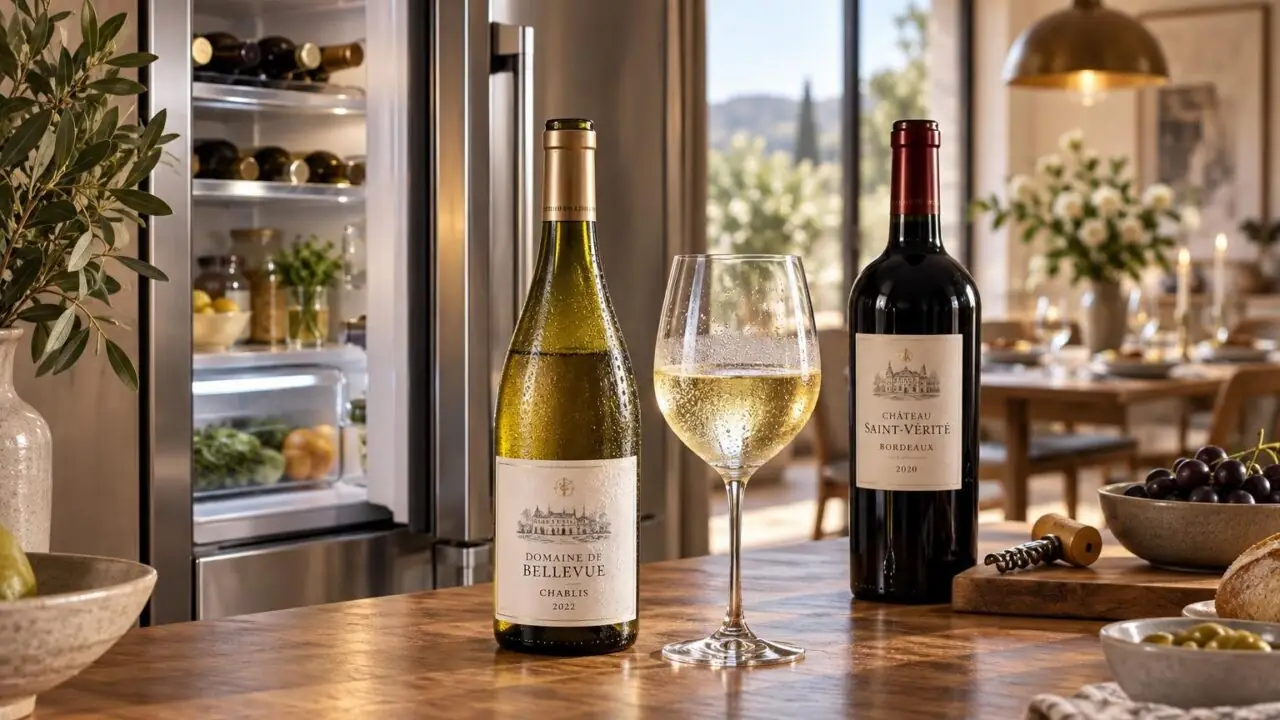
Refrigerate wine selectively: whites, rosés, and sparkling wines benefit from 45–55 °F storage, while most reds perform best at 55–65 °F — meaning even reds belong in the fridge 30 minutes before serving if your room exceeds 70 °F.
Temperature directly shapes aroma volatility, tannin perception, and acidity balance. The Wine Scholar Guild notes that serving a red just 5 °F too warm amplifies alcohol burn and mutes fruit.
Whether you should refrigerate wine long-term or briefly chill before pouring depends on the style, your storage conditions, and how quickly you plan to drink it.
When Refrigeration Actually Matters for Wine
Refrigeration isn’t optional for every bottle sitting on your counter. Specific wine categories degrade measurably without cold storage, and the timeline from “fine” to “flawed” can be shorter than most drinkers expect.
Opened Bottles: The Oxidation Clock
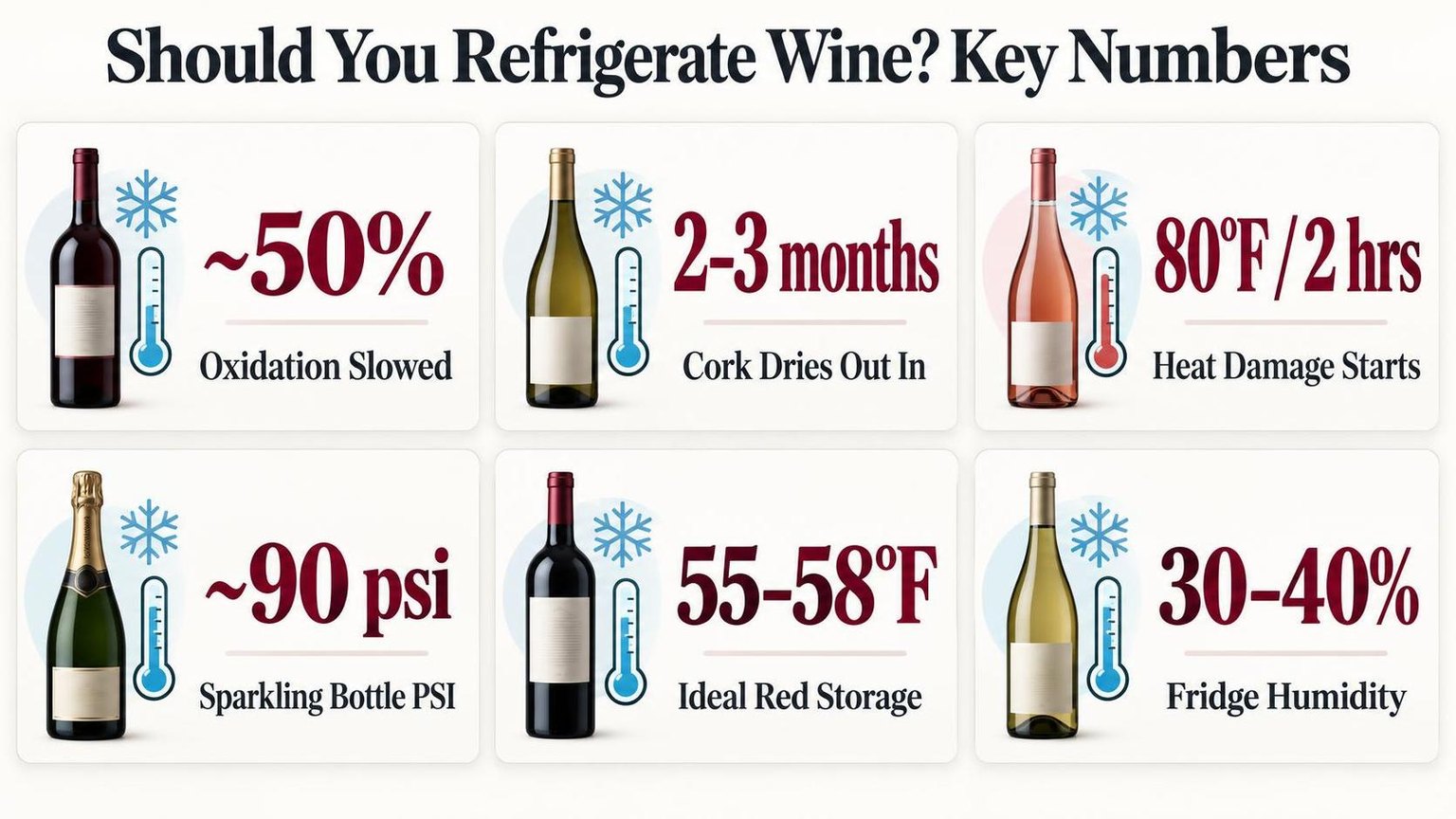
Once a cork is pulled, oxygen triggers acetic acid bacteria and acetaldehyde formation. Refrigeration at 35–45°F (2–7°C) slows these reactions by roughly 50% compared to a 72°F (22°C) room.
| Wine Type (Opened) | Room Temperature Lifespan | Refrigerated Lifespan |
| Sparkling wine | 4–6 hours | 1–3 days |
| Light white / rosé | 1 day | 5–7 days |
| Full-bodied white | 1–2 days | 3–5 days |
| Red wine | 1–2 days | 3–5 days |
| Fortified wine (Port, Sherry) | 1–3 weeks | 4–6 weeks |
These ranges assume a standard 750 mL bottle recorked with minimal headspace. Half-empty bottles oxidize faster because the oxygen-to-wine ratio doubles.
Wines That Demand Cold Storage Before Opening
Not every sealed bottle tolerates a pantry shelf. Delicate, low-alcohol, and biologically active wines are particularly vulnerable to heat damage above 70°F (21°C).
- Natural and unfiltered wines — residual microbial activity can restart fermentation above 60°F (15°C), producing off-flavors and carbonation.
- Sparkling wines — CO₂ pressure inside a Champagne bottle reaches approximately 90 psi (6 atmospheres) at 68°F. Higher temperatures increase pressure and risk of premature aging.
- Sweet wines with residual sugar above 30 g/L — sugar feeds residual yeast if the wine is imperfectly stabilized, especially in low-sulfite bottlings.
- Rosé and light whites under 12% ABV — lower alcohol provides less antimicrobial protection, making cold storage more important.
When Refrigeration Is Unnecessary or Harmful
Sealed, dry reds with 13%+ ABV and standard sulfite levels (30–80 mg/L free SO₂) tolerate a cool, dark cupboard at 55–65°F (13–18°C) for weeks without measurable degradation.
Long-term refrigeration below 35°F (2°C) poses risks. Tartrate crystals precipitate more aggressively, and low humidity inside a refrigerator—typically 30–40%—can dry natural corks within two to three months, admitting oxygen.
The 2-Hour Rule
The UC Davis Department of Viticulture and Enology has documented that wine left above 80°F (27°C) for two or more hours undergoes accelerated ester hydrolysis, stripping fruit aromatics permanently. This applies to all styles, sealed or open.
If ambient temperature in your home regularly exceeds 75°F (24°C), refrigerating every bottle—red included—is the pragmatic choice. Remove reds 30–45 minutes before serving to reach the ideal 60–65°F (15–18°C) range.
Ideal Storage Temperatures by Wine Type
Every wine style has a specific temperature range that preserves its chemistry and slows unwanted oxidation. Storing wine outside these ranges accelerates aging, dulls aromatics, and can push corks out of bottles.
The differences between types matter more than most drinkers realize.
| Wine Type | Ideal Storage Temp | Serving Temp |
| Full-bodied reds (Cabernet Sauvignon, Syrah) | 55–58°F (13–14°C) | 60–65°F (16–18°C) |
| Medium-bodied reds (Pinot Noir, Merlot) | 53–57°F (12–14°C) | 55–60°F (13–16°C) |
| Light-bodied reds (Beaujolais, Valpolicella) | 50–55°F (10–13°C) | 53–57°F (12–14°C) |
| Full-bodied whites (oaked Chardonnay, Viognier) | 50–55°F (10–13°C) | 48–55°F (9–13°C) |
| Light-bodied whites (Sauvignon Blanc, Pinot Grigio) | 45–50°F (7–10°C) | 44–50°F (7–10°C) |
| Rosé | 45–50°F (7–10°C) | 46–52°F (8–11°C) |
| Sparkling (Champagne, Cava, Prosecco) | 40–50°F (4–10°C) | 40–46°F (4–8°C) |
| Dessert and fortified (Sauternes, Port, Sherry) | 53–57°F (12–14°C) | 55–65°F (13–18°C) |
Why 55°F Is the Universal Benchmark
The wine industry treats 55°F (13°C) as the gold standard for mixed-collection storage. Professional storage facilities, including those certified by the International Wine & Spirit Competition, target this temperature consistently.
At 55°F, chemical reactions in wine proceed slowly enough that tannins polymerize gradually, esters develop complexity, and volatile acidity stays in check. Move 10°F higher and the aging rate roughly doubles.
The Danger Zones
Temperatures above 70°F (21°C) begin to “cook” wine, producing flat, stewed flavors. The Wine Spectator has documented that sustained exposure above 75°F degrades most wines within weeks.
Below 25°F (−4°C), wine freezes and expands by approximately 9%, risking cracked bottles and ejected corks. Even short freezing episodes permanently alter texture and aromatic profile.
Temperature Consistency Matters as Much as Range
- Fluctuations greater than 5°F (3°C) per day cause the liquid to expand and contract, pumping air past the cork seal and accelerating oxidation.
- A kitchen counter in a typical American home swings 10–15°F daily—far too volatile for any wine kept longer than a few days.
- Wine fridges maintain ±1°F stability, making them the most practical home solution for bottles stored beyond one week.
Red Wine Still Benefits from Refrigeration
A common misconception holds that red wine should stay at “room temperature.” That guideline dates to 18th-century European châteaux, where rooms sat at 60–65°F.
Modern American homes average 72°F year-round—too warm for any wine.
Storing reds in a refrigerator set to 55°F, or even a standard fridge at 37°F for short durations of one to two weeks, protects them far better than a countertop or pantry shelf ever could.
How Cold Damages or Preserves Wine
Temperature directly controls the speed of chemical reactions inside a bottle.
Cooling wine to 45–55 °F slows oxidation and preserves freshness, while freezing below 15–20 °F risks pushing the cork out or cracking the glass as the liquid expands roughly 9% upon solidification.
The Chemistry of Cold Storage
Wine is a living solution of water, ethanol, acids, sugars, and phenolic compounds. The Arrhenius principle dictates that for every 18 °F (10 °C) increase in temperature, chemical reaction rates approximately double.
Refrigeration at 40 °F therefore cuts the rate of oxidative aging to roughly one-quarter of what occurs at 76 °F room temperature.
Tartrate crystals—harmless potassium bitartrate deposits—form more readily below 40 °F. Commercial wineries cold-stabilize wines at 25–32 °F for one to three weeks specifically to precipitate these crystals before bottling.
Temperature Thresholds That Matter
| Temperature Range | Effect on Wine |
| 55 °F (13 °C) | Ideal long-term cellar storage; slows aging without halting development |
| 40–45 °F (4–7 °C) | Standard refrigerator; safe for weeks; slows oxidation significantly |
| 32–39 °F (0–4 °C) | Tartrate crystal formation accelerates; minimal risk to sealed bottles |
| 25 °F (−4 °C) | Wine begins to freeze (exact point depends on alcohol content) |
| 15–20 °F (−9 to −7 °C) | Full freezing likely; cork may push out; bottle may crack |
A wine’s freezing point depends on its alcohol by volume. A 12.5% ABV wine freezes near 22 °F (−5.5 °C). A fortified wine at 20% ABV won’t solidify until approximately 15 °F (−9.4 °C).
What Refrigeration Preserves
- Volatile aromatics: Fruity esters and floral terpenes degrade faster above 70 °F. Cold storage locks these compounds in place.
- Acidity balance: Heat accelerates the breakdown of malic and tartaric acid, flattening a wine’s structure.
- Color stability: Anthocyanins in red wine polymerize and precipitate more rapidly at higher temperatures, dulling the hue.
- Dissolved CO₂: Sparkling wines retain carbonation longer at refrigerator temperatures because gas solubility increases as temperature drops.
What Cold Can Damage
Repeated freeze-thaw cycles stress the cork seal. Expansion pushes the cork upward, allowing oxygen ingress upon thawing. Even a single freezing event can break the seal permanently.
Prolonged storage below 45 °F may mute aromatic expression temporarily.
Wines served too cold taste less expressive because fewer volatile molecules reach the nose at lower temperatures—a reversible effect corrected by warming the glass in hand for two to three minutes.
Vibration from a kitchen refrigerator compressor can also disturb sediment in aged reds. For bottles stored longer than two months, a dedicated wine fridge with a quieter thermoelectric cooling system is preferable.
Refrigerating Open Bottles After Pouring
Once you pull the cork or twist the cap, oxygen begins degrading wine immediately. Refrigeration slows oxidation and microbial activity by reducing molecular kinetic energy.
Every open bottle—red, white, rosé, or sparkling—benefits from cold storage between pours.
The chemical reality is straightforward: oxidation reaction rates roughly double with every 10°C (18°F) increase in temperature. A kitchen counter at 22°C (72°F) accelerates spoilage approximately four times faster than a refrigerator at 4°C (39°F).
How Long Open Wines Last Refrigerated
| Wine Type | Refrigerated Shelf Life | Room Temperature Shelf Life |
| Sparkling (Champagne, Cava, Prosecco) | 1–3 days with sparkling stopper | 4–6 hours |
| Light white & rosé | 3–5 days with cork/screw cap | 1 day |
| Full-bodied white (oaked Chardonnay) | 3–5 days | 1–2 days |
| Light red (Pinot Noir, Gamay) | 3–5 days | 1–2 days |
| Full-bodied red (Cabernet, Syrah) | 4–6 days | 2–3 days |
| Fortified (Port, Sherry, Madeira) | 4–6 weeks | 2–4 weeks |
Fortified wines last significantly longer because their higher alcohol content (17–22% ABV) acts as a natural preservative against bacterial spoilage.
Best Practices for Refrigerating Open Wine
- Reseal immediately. Reinsert the cork or use a dedicated wine stopper within minutes of pouring. Every hour of open-air exposure at room temperature costs noticeable freshness.
- Store bottles upright. This minimizes the surface area of wine exposed to oxygen trapped inside the bottle—approximately 3.1 cm² for a standard 750 ml bottle neck versus 45 cm² if laid on its side.
- Use a vacuum pump. Devices like the Vacu Vin remove roughly 70% of headspace oxygen, extending drinkability by 1–2 additional days compared to a simple re-cork.
- Transfer to a smaller container. Pouring remaining wine into a clean 375 ml half-bottle eliminates headspace almost entirely, dramatically slowing oxidation.
- Bring reds back to serving temperature. Remove refrigerated reds 20–30 minutes before pouring. Serving a full-bodied red below 14°C (57°F) mutes aromatic compounds and amplifies tannin astringency.
When Refrigeration Cannot Save a Wine
If an open wine develops a sharp vinegar aroma, acetic acid bacteria have already converted ethanol to acetic acid. This reaction is irreversible. No amount of chilling reverses that spoilage.
Wines showing brown discoloration in whites or brick-orange edges in reds have undergone advanced oxidation. These bottles are past recovery and should be repurposed for cooking or discarded.
Inert gas preservation systems like Coravin or Private Preserve spray argon or nitrogen into the bottle, displacing oxygen entirely.
Studies show these systems can extend open-wine freshness to 2–4 weeks refrigerated—far beyond what stoppers or vacuum pumps achieve alone.
Cellar vs Kitchen Fridge for Storage
A proper wine cellar and a kitchen refrigerator serve fundamentally different purposes.
Understanding the measurable differences between these two environments determines whether your bottles age gracefully or deteriorate prematurely over weeks, months, or years.
Temperature and Humidity Compared
The core variables separating these storage options are temperature, humidity, vibration, and light exposure. Each factor directly impacts wine chemistry and cork integrity.
| Factor | Wine Cellar | Kitchen Fridge |
| Temperature | 12–14 °C (54–57 °F) | 2–4 °C (35–39 °F) |
| Humidity | 60–75% | ~30–40% |
| Vibration | Minimal to none | Compressor cycles constantly |
| Light exposure | Near-zero UV | Interior bulb activates with each opening |
| Temperature fluctuation | ±1 °C annually | ±3–5 °C daily from door openings |
| Ideal storage duration | Years to decades | 1–3 days (opened); 2–4 weeks (unopened) |
Why Kitchen Fridges Fall Short for Long-Term Storage
Kitchen refrigerators maintain humidity around 30–40%, well below the 60% minimum recommended for cork preservation. Corks dry out within a few months, allowing oxygen ingress that oxidizes the wine.
The average household opens the fridge 20–30 times per day. Each opening introduces warm air, creating temperature swings of 3–5 °C that stress wine and accelerate chemical reactions.
Compressor vibrations in standard refrigerators agitate sediment and may disrupt slow aging reactions. Wine cellars or passive storage environments eliminate this mechanical disturbance entirely.
When the Kitchen Fridge Works Fine
Short-term chilling is the fridge’s legitimate role. White wines need 45–60 minutes to reach serving temperature of 7–10 °C. Sparkling wines benefit from 2–3 hours to hit 6–8 °C.
Opened bottles sealed with a vacuum stopper or inert gas spray survive 3–5 days in a kitchen fridge. The cold temperature slows oxidation significantly compared to leaving wine on a countertop at 20–22 °C.
The Wine Fridge Compromise
Dedicated wine refrigerators bridge the gap. They operate at 10–14 °C with humidity closer to 50–70%, use low-vibration thermoelectric or absorption cooling, and block UV with tinted glass doors.
Entry-level 12-bottle wine fridges start around $150–$200. Dual-zone models that separate red and white storage at different temperatures range from $300–$600 for 30–50 bottle capacity.
- Cellar: best for aging bottles 1 year or longer at stable 12–14 °C
- Wine fridge: suitable for medium-term storage of 1–12 months
- Kitchen fridge: acceptable only for short-term chilling or preserving opened bottles up to 5 days
- Countertop: worst option — room temperature, light, and vibration all degrade wine rapidly
Store wine on its side in any environment to keep cork contact with liquid. This single habit prevents premature drying regardless of which storage method you choose.
Common Questions
Should you refrigerate red wine before serving?
Red wine benefits from 15–20 minutes in the refrigerator before serving, bringing it from typical room temperature (around 72°F/22°C) down to the ideal 60–68°F (15–20°C) range.
Serving red wine too warm amplifies alcohol vapors and mutes fruit character, a problem first documented in UC Davis sensory studies on perceived ethanol volatility above 20°C.
How long can an opened bottle of wine last in the refrigerator?
A re-corked bottle stored upright in the refrigerator maintains drinkable quality for 3–5 days for most whites and rosés, and 3–7 days for fuller-bodied reds.
The cold slows oxidation reactions by roughly half for every 10°C drop in temperature, according to food science kinetics principles. Sparkling wines lose pressure fastest—expect 1–3 days even with a hermetic stopper.
Does refrigerating wine long-term damage it?
A standard kitchen refrigerator set to 35–38°F (1.5–3°C) is too cold and too dry (humidity often below 25%) for storing wine beyond a few weeks.
Prolonged exposure can dry out natural corks, allowing oxygen ingress, and the constant compressor vibration may disturb sediment in aged bottles.
For storage beyond 30 days, a wine fridge holding 50–59°F (10–15°C) at 60–70% humidity is the safer choice.
Should you refrigerate fortified wines like Port and Sherry?
Fino and Manzanilla Sherry must be refrigerated immediately after opening and consumed within one week, as their delicate flor-influenced profiles deteriorate rapidly.
Tawny Port and Oloroso Sherry, already oxidatively aged, stay stable at cool room temperature for 4–6 weeks after opening.
Vintage and Late Bottled Vintage Ports behave more like table reds—refrigerate after opening and finish within 5 days.
At what temperature should white and sparkling wines be refrigerated for serving?
Serve light-bodied whites and sparkling wines at 40–50°F (4–10°C), which takes roughly 2–2.5 hours from room temperature in a standard refrigerator or 20–25 minutes in an ice-water bath.
Full-bodied whites like oaked Chardonnay and Viognier show more aromatic complexity at the warmer end, around 50–55°F (10–13°C).
Over-chilling below 39°F suppresses volatile aroma compounds, effectively muting the very qualities you paid for.
Can you put wine in the freezer instead of the refrigerator?
Wine freezes at approximately 15–20°F (−9 to −7°C) depending on alcohol content, and a household freezer at 0°F (−18°C) will solidify a bottle in about 5 hours.
Expansion during freezing can push corks out or crack glass, and the resulting ice crystal formation disrupts colloidal structures that contribute to body and mouthfeel.
A 15-minute freezer stint is a reasonable shortcut for quick chilling, but set a timer—forgotten bottles are one of the most common causes of wine loss at home.
Further Reading
- Good Wine with Pizza for Every Type of Slice
- How Long Does Wine Last Unopened?
- Who Makes Kirkland Chardonnay Wine? Get the Answer
- Where Is The Expiration Date On Wine Bottles? Find Out Now
- Why Store Wine On Its Side? Complete 2026 Guide for Proper Wine Storage
- All Alcohol Guides
- UC Davis Department of Viticulture and Enology (2023)
- USDA FoodData Central – Wine Nutrient Composition (2023)
- FDA – Food Safety: What You Need to Know (2024)
- National Center for Biotechnology Information – Effect of Storage Temperature on Wine Phenolic Composition (2019)
- Wine Spectator – How to Store Open Wine (2023)
- The Wine Institute (2023)
- Journal of Agricultural and Food Chemistry – Temperature Effects on Wine Oxidation (2020)
- Cornell University College of Agriculture – Wine Chemistry and Storage (2023)
- Decanter – Wine Storage Temperature Guide (2023)