How Long Can You Store Wine at Room Temperature? is answered by wine style: unopened still wine can sit at 68–72°F for about 6 months before quality loss becomes likely.
Heat, light, and temperature swings shorten that window faster than age alone, especially for delicate whites, rosé, sparkling wine, and natural wine.
Opened wine has a much shorter room-temperature life: 1–3 days for most still bottles and 1 day for sparkling wine. Fortified wines last longer because higher alcohol and sugar slow oxidation.
This guide explains safe storage limits, quality warning signs, and when room temperature is acceptable versus risky.
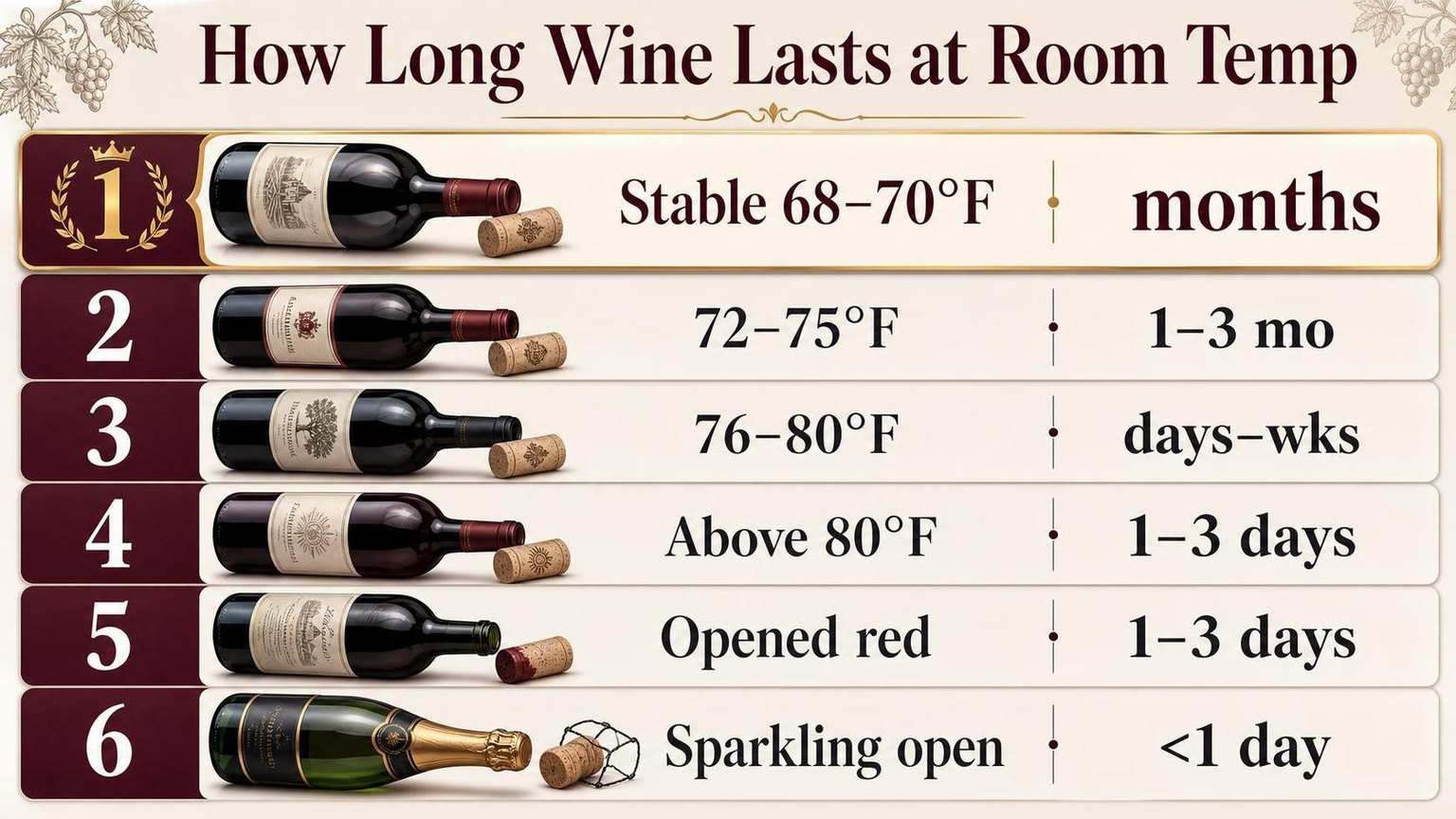
Room Temperature Storage Time Limits
Room temperature is not a single safe number for wine. In most U.S. homes, it means about 68°F to 77°F, and wine ages faster across that range than it does in a cellar at 55°F. Short exposure is usually harmless.
Long exposure steadily increases oxidation, pushes corks, and can flatten fruit and aroma.
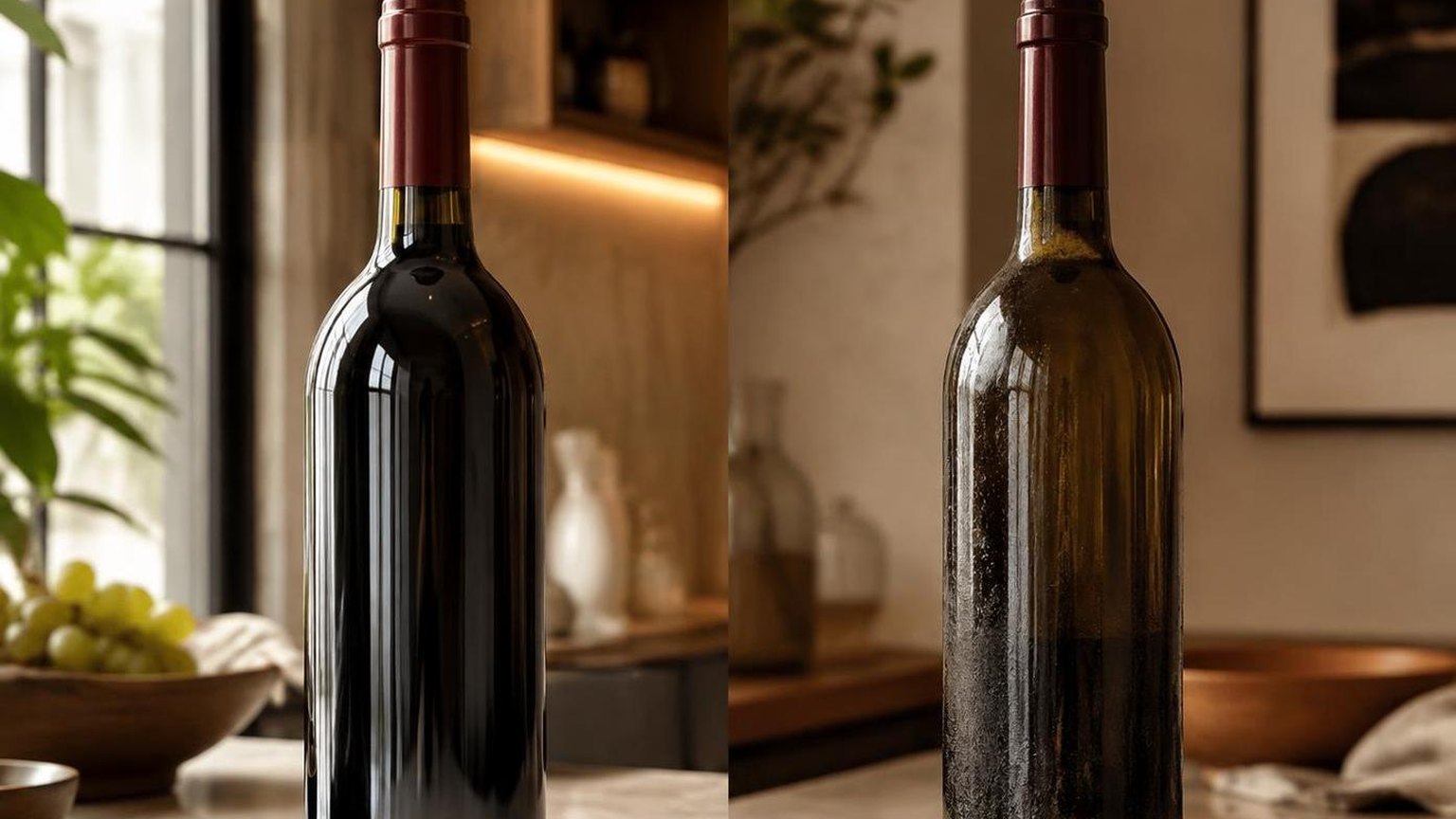
For unopened wine, the practical limit at room temperature depends on both the style and the actual heat. A stable 68°F is far less damaging than a daily swing between 68°F and 80°F.
Temperature fluctuation matters because expansion and contraction can stress the closure and pull in oxygen.
| Condition | Typical room-temperature limit | Why |
| Stable 68°F to 70°F, dark closet, unopened table wine | Several months | Moderate heat can be tolerated briefly if light and vibration are low |
| 72°F to 75°F, unopened table wine | About 1 to 3 months | Heat accelerates chemical aging and dulls freshness |
| 76°F to 80°F, unopened table wine | Days to a few weeks | Noticeable risk of cooked flavors, seepage, and premature oxidation |
| Above 80°F, unopened table wine | As little as 1 to 3 days can cause damage | Rapid expansion can force wine past the cork and degrade aromas |
Fine wine intended for aging should not sit at room temperature for months. Even when no bottle failure is visible, warmer storage speeds maturation.
A common rule in wine storage is that chemical reactions roughly speed up as temperature rises, so years of careful cellaring can be undermined by one hot season.
After opening, room-temperature limits become much shorter because oxygen is already inside the bottle. Red wine can often stay drinkable for 1 to 3 days on the counter if the room is cool.
Whites, rosés, and sparkling wines deteriorate faster and should be refrigerated after service.
| Wine after opening | At 68°F to 72°F | Best action |
| Still red | About 1 to 3 days | Recork and refrigerate after the first day |
| Still white or rosé | Hours, not days | Refrigerate immediately |
| Sparkling | Often loses mousse within 1 day | Use a sparkling stopper and refrigerate |
| Fortified wine | Several days to weeks, depending on style | Keep cool and sealed |
Packaging changes the risk. Natural cork is most vulnerable to heat-related seepage and oxygen ingress. Screw-cap bottles tolerate short room-temperature storage better, but they do not stop heat damage to the wine itself.
- If the room stays near 70°F and the bottle is unopened, drink standard table wine within a few months, not years.
- If the room often reaches 75°F or higher, move wine within weeks.
- If the bottle has been above 80°F for days, expect possible quality loss even if the cork looks normal.
- If you see pushed corks, sticky capsules, or low fill levels, drink soon and do not cellar further.
The safest limit is simple: room temperature is acceptable for short holding, not long-term storage. For anything valuable, age-worthy, or heat-sensitive, move it to about 55°F with low light and minimal fluctuation as soon as possible.
Opened Versus Unopened Wine
Opened and unopened wine behave very differently at room temperature. An unopened bottle is protected by its closure and low oxygen exposure.
An opened bottle starts oxidizing immediately, so room-temperature storage shifts from quality preservation to short-term damage control.
For unopened wine, “room temperature” matters. A steady 55°F to 60°F is traditional cellar range.
Typical indoor room temperature in the U.S. is closer to 68°F to 72°F, and repeated exposure above 70°F speeds chemical aging, dulls fruit, and can push corks.
Short exposure is usually not catastrophic. A sealed bottle can sit at 68°F to 72°F for days or a few weeks without becoming unsafe. The main risk is faster quality decline, especially for delicate sparkling, rosé, and low-tannin whites.
| Wine status | Room-temperature guidance | Main reason |
| Unopened, stable 68°F to 72°F | Usually acceptable for days to a few weeks | Low oxygen exposure; quality loss is gradual |
| Unopened, above 75°F | Risk increases after repeated or prolonged exposure | Heat accelerates aging and can damage closure integrity |
| Opened, re-corked at room temperature | Best within 1 day for most styles | Oxygen contact rapidly changes aroma and flavor |
| Opened, refrigerated after use | Usually 3 to 5 days for still wines | Cold slows oxidation and microbial activity |
Once opened, room temperature becomes a poor storage choice. Oxygen enters the headspace, volatile aromas escape faster, and acetaldehyde notes build.
In practical terms, an opened still wine left on the counter often tastes noticeably flatter by the next day.
Red wine lasts slightly better than many whites after opening because tannin and phenolic compounds offer some oxidative buffering. That said, room temperature still shortens its life.
A medium-bodied red may remain drinkable overnight, but freshness drops quickly after 24 hours.
White, rosé, and sparkling wines lose definition even faster when opened at room temperature. Sparkling wine can lose much of its carbonation within hours.
Aromatic whites such as Sauvignon Blanc or Riesling often show muted fruit and more bruised-apple character after one day.
| Opened wine type | At room temperature | Refrigerated |
| Red still wine | About 1 day, sometimes 2 if structured | 3 to 5 days |
| White still wine | About 1 day | 3 to 5 days |
| Rosé | About 1 day | 3 to 5 days |
| Sparkling wine | Hours to 1 day | 1 to 3 days with a sparkling stopper |
| Fortified wine | Several days to weeks, style dependent | Up to several weeks |
Fortified wines are the main exception. Port, Sherry, and Madeira contain more alcohol, and some styles are intentionally oxidative. Madeira is especially resilient.
A basic Ruby Port can outlast table wine after opening, while Fino Sherry is much less forgiving and should be chilled.
For unopened bottles, the priority is stability: dark place, no sun, no radiator, minimal temperature swings. For opened bottles, the priority is refrigeration, tight closure, and smaller headspace.
If you opened it, refrigerate it, even if it is red.
- Do not confuse safety with quality. Wine rarely becomes dangerous first; it becomes dull, oxidized, or cooked first.
- Sunlight and heat together are worse than room temperature alone.
- If a cork protrudes, seepage appears, or the wine smells stewed, heat damage is likely.
Temperature Thresholds That Damage Wine
Wine degrades through predictable chemical reactions that accelerate with heat. Every 10°C (18°F) increase roughly doubles the rate of chemical aging, a principle rooted in the Arrhenius equation applied to food science.
Critical Temperature Zones
Not all temperatures pose equal risk. The damage timeline depends on both intensity and duration of exposure.
| Temperature Range | Risk Level | Effect on Wine | Safe Exposure Window |
| 50–59°F (10–15°C) | Ideal | Slow, controlled maturation | Indefinite (cellar conditions) |
| 60–68°F (15–20°C) | Low | Slightly accelerated aging | Months to 1–2 years |
| 69–75°F (20–24°C) | Moderate | Noticeable flavor flattening; fruit character fades | Weeks to a few months |
| 76–85°F (24–29°C) | High | Rapid oxidation; cooked aromas develop | Days to weeks |
| Above 86°F (30°C) | Severe | Thermal expansion pushes cork; irreversible damage | Hours to days |
What Happens Chemically
At 77°F (25°C), Maillard-type browning reactions in white wines accelerate measurably. Research published in the American Journal of Enology and Viticulture confirmed significant color darkening in whites stored at 25°C within 6 months.
Above 80°F (27°C), volatile esters—responsible for fruity aromas—break down at rates 2–4 times faster than at cellar temperature. The wine smells stewed or jammy rather than fresh.
At 86°F (30°C) and higher, liquid expansion increases pressure inside the bottle. This pressure can push the cork outward, breaking the seal and allowing oxygen ingress. Leaked wine around the capsule is a telltale sign.
The Fluctuation Factor
Temperature swings cause as much harm as sustained heat. Repeated expansion and contraction of the liquid pumps air past the cork seal, accelerating oxidation.
- Daily swings over 10°F (5.5°C) measurably increase ullage (headspace) within months.
- Seasonal swings of 20°F+ (11°C+) in garages or attics can ruin wine in a single summer.
- Consistent 68°F (20°C) is safer than fluctuating between 55°F and 75°F, despite the higher average.
Cold Extremes
Wine freezes at approximately 15–20°F (−9 to −7°C), depending on alcohol content. A 12% ABV wine freezes near 20°F. Freezing forces the cork out or cracks the bottle as the liquid expands roughly 9% in volume.
Brief exposure below 40°F (4°C) poses minimal risk. Prolonged cold storage can cause tartrate crystals to precipitate—harmless but cosmetically undesirable in finished wines.
Practical Takeaway
Standard room temperature in most U.S. homes sits between 68–76°F (20–24°C). At this range, drink wines within 3–6 months of purchase. Wines stored above 75°F lose measurable quality within weeks, not years.
Best Short Term Storage Conditions
For short-term storage, wine does best in a cool, dark, stable spot, not on a sunny counter or near a stove. The goal is to slow chemical change, protect the cork, and avoid temperature swings that age wine faster than time alone.
If room temperature is the only option, keep the bottle there for days or a few weeks, not months. Short-term storage is about damage control: lower heat, less light, and fewer fluctuations preserve aroma, fruit, and structure.
The best target is 55-65°F. That range is cool enough to limit rapid oxidation and heat damage, but practical in many homes. Once storage moves much above 70°F, wine ages faster, and the risk rises sharply if bottles sit there for extended periods.
| Condition | Best short-term target | Why it matters |
| Temperature | 55-65°F | Slows chemical reactions and preserves freshness |
| Upper caution point | 70°F | Above this, aging speeds up noticeably |
| High-risk heat | 80°F+ | Can push wine, dull fruit, and stress corks |
| Humidity | 50-70% | Helps natural cork stay from drying out |
| Light | Minimal | UV can damage delicate aromas, especially in clear bottles |
Temperature stability matters as much as the number itself. A bottle held at a steady 68°F usually fares better than one bouncing from 60°F at night to 78°F every afternoon. Expansion and contraction can stress the closure and pull air past the cork.
Choose an interior closet, pantry, basement shelf, or cabinet on an inside wall. These locations usually avoid the worst daily swings. Avoid kitchens, laundry rooms, garages, and any shelf above a refrigerator, where heat and vibration are common.
Light is a direct storage problem, not a cosmetic one. Ultraviolet exposure can create “lightstruck” aromas, especially in sparkling wine and delicate whites. Dark glass helps, but it is not complete protection.
A closed box or dark cabinet is safer than open shelving.
Humidity matters most for bottles sealed with natural cork. Around 50-70% relative humidity helps prevent the cork from drying and shrinking. In most homes, short-term storage is forgiving, but very dry air over time can increase oxygen exposure.
Store cork-finished bottles on their side if they will sit for more than a week or two. Horizontal storage keeps the wine against the cork, which helps maintain a seal. Screw-cap bottles can stand upright without the same concern.
| Bottle type | Best position short term | Reason |
| Natural cork | Side | Helps keep cork from drying |
| Synthetic cork | Side or upright | Less moisture-sensitive than natural cork |
| Screw cap | Upright | No cork to protect |
Vibration is a smaller threat than heat, but it still belongs on the avoidance list. Constant movement from appliances may disturb sediment in older reds and is best avoided.
A still shelf in a quiet room is better than a rack attached to a busy kitchen wall.
For opened wine, room temperature storage is not the standard. Re-cork it and refrigerate, even for reds. Cold storage slows oxidation dramatically.
Most table wines stay sound for about 3-5 days after opening, while sparkling wine often shows best for 1-3 days.
When Room Stored Wine Spoils
Wine stored at room temperature spoils faster when heat, oxygen, and light work together. The risk rises sharply above 70°F, and repeated swings between warm days and cooler nights can damage wine even before it is opened.
Spoilage does not always mean the wine is unsafe. It usually means the aroma, fruit, structure, and color have degraded enough that the wine tastes flat, cooked, brown, or sour.
Temperature is the main driver. Most producers and storage professionals target about 55°F for long-term cellaring, with modest humidity and minimal vibration.
A typical room in the United States runs about 68°F to 72°F, and many kitchens exceed 75°F.
At those warmer temperatures, chemical reactions move faster. Oxygen ingress through the closure also has a larger effect, pushing fresh fruit toward bruised apple, stewed jam, caramel, or vinegar-like notes.
Delicate wines show damage first, especially sparkling wines, rosés, and inexpensive whites meant for early drinking.
| Storage condition | Likely effect on quality |
| 60°F to 65°F, dark and stable | Short-term room storage usually causes little immediate harm |
| 68°F to 72°F, dark and stable | Faster aging; good for weeks or months, not ideal for years |
| 75°F to 80°F | Noticeable risk of cooked flavors, premature oxidation, and seepage over time |
| Above 80°F | High spoilage risk, especially with repeated exposure or long storage |
Look at the bottle before opening it. Wine that has pushed past the cork, stained the capsule, or leaked around the closure may have expanded during heat exposure. A cork protruding upward is another warning sign of temperature stress.
Then inspect the wine in the glass. Whites may shift from pale straw to deep gold or amber. Reds may lose purple tones and turn brick-brown at the rim earlier than expected for their age.
Smell gives the clearest signal. Spoiled room-stored wine often shows stewed fruit, raisin, prune, nutty oxidation, dull sweetness, or a sharp volatile edge resembling nail polish remover or vinegar.
Sparkling wine may seem flat because dissolved carbon dioxide escapes faster when warm.
Taste confirms the problem. Heat-damaged wine can feel loose and hot, with muted fruit, shortened finish, and less freshness.
Oxidized wine often tastes tired and maderized, with apple-cider or sherry-like notes that do not belong in a fresh table wine.
| Wine style | What room-temperature spoilage often looks like |
| Sparkling | Loss of fizz, bruised apple aroma, dull finish |
| Light white or rosé | Deepened color, flat citrus, honeyed or stale notes |
| Full-bodied white | Nutty oxidation, caramel, reduced freshness |
| Light red | Brown rim, faded fruit, sour or stewed character |
| Structured red | Cooked fruit, dried-out palate, early browning |
Once a wine has been cooked by heat, the damage cannot be reversed. Chilling the bottle may make it more drinkable for the moment, but it will not restore lost acidity, fruit, or aroma.
If the bottle has been at ordinary room temperature for a short period, drink it sooner rather than later.
If it spent days in a hot car, near a stove, or in a sunny window, expect spoilage and check for seepage, raised corks, and cooked aromas before serving.
Frequently Asked Questions
How long can unopened wine stay at room temperature?
Most unopened wine can sit at normal indoor room temperature, around 68 to 72 degrees Fahrenheit, for several weeks without immediate spoilage if the temperature stays stable.
Quality declines faster when bottles face heat swings, direct sunlight, or storage above 75 degrees Fahrenheit, because heat speeds chemical aging and can push wine past its intended drinking window.
How long can opened wine remain at room temperature before it goes bad?
Opened table wine left at room temperature usually starts losing freshness within hours and is often noticeably oxidized after 1 to 3 days.
Refrigeration slows oxygen exposure, so recorking and chilling the bottle is the practical step if you want to preserve aroma, fruit, and structure.
Is red wine safe to keep at room temperature longer than white or sparkling wine?
Red wine is commonly served closer to room temperature, but that does not mean it stores better long term in a warm room.
Whites, rosés, and sparkling wines show heat damage faster because their freshness and acidity are more exposed, while reds may hide damage briefly before tasting flat, stewed, or alcoholic.
What room temperature is too warm for wine storage?
Long-term storage above about 70 degrees Fahrenheit increases the risk of premature aging, and sustained exposure above 80 degrees Fahrenheit can damage wine quickly.
The bigger problem is not a single warm afternoon but repeated daily spikes, which expand and contract the liquid and can stress the closure.
Can wine be ruined after one hot day in the house or car?
A bottle left in a 90 to 100 degree Fahrenheit car or sunlit room for several hours can suffer noticeable damage, especially sparkling wine or delicate white wine.
Signs include pushed corks, seepage, cooked fruit aromas, and a dull or brownish color, all caused by accelerated heat exposure.
Does boxed wine or screw-cap wine last longer at room temperature than cork-finished bottles?
Packaging changes how wine handles oxygen, but it does not make heat harmless.
Boxed wine often keeps longer after opening because the bag limits air contact, and screw caps reduce cork-related leakage, yet both still lose quality faster if stored warm instead of in a cool, dark place.
What is the best rule for storing wine at room temperature at home?
Use room temperature only as short-term holding, not aging storage, and keep bottles in a dark spot with minimal temperature fluctuation.
For anything beyond a few weeks, aim for about 55 degrees Fahrenheit with moderate humidity, because stable cool conditions preserve flavor, aroma, and structure far better than a typical kitchen or apartment shelf.
Related Reading
- Good Semi Sweet Wine Bottles for Easy Drinking
- Does Wine Have Caffeine?
- What Wine Is Sweet? – Expert Guide from Flight Wine Bar
- What Does Wine Taste Like? – 2026
- Best Buy Wine and Liquor: The Complete 2026 Guide to Quality, Pricing & Top Picks
- How Many Oz In A Bottle Of Wine?
- All Alcohol Guides
- Wine Spectator (2023)
- Wine Enthusiast (2023)
- Decanter (2023)
- Wine Folly (2022)
- Michigan State University Extension (2015)
- Iowa State University Extension and Outreach (2020)
- National Library of Medicine – PubMed (2019)
- National Library of Medicine – PubMed (2015)
- University of California, Davis (2022)