Does Wine Expire if Unopened? is answered by storage and wine style: unopened wine does not expire on a fixed date, but it can fade, oxidize, or develop bottle faults before you pull the cork.
Most everyday white, rosé, and sparkling wines are best within 1–3 years of release; many everyday reds hold 2–5 years. Sweet, fortified, and high-acid cellar wines can last decades when kept cool, dark, still, and sealed.
This guide separates safety from quality, explains label dates and cork condition, and gives practical checks for color, aroma, seepage, and storage history so you know when to open, save, or discard an unopened bottle without guessing at dinner.
Does Unopened Wine Actually Expire
Unopened wine does not expire on a fixed calendar date, but it does age toward a point where quality declines. The key question is not safety first. It is whether the wine still tastes balanced, fresh, and true to style.
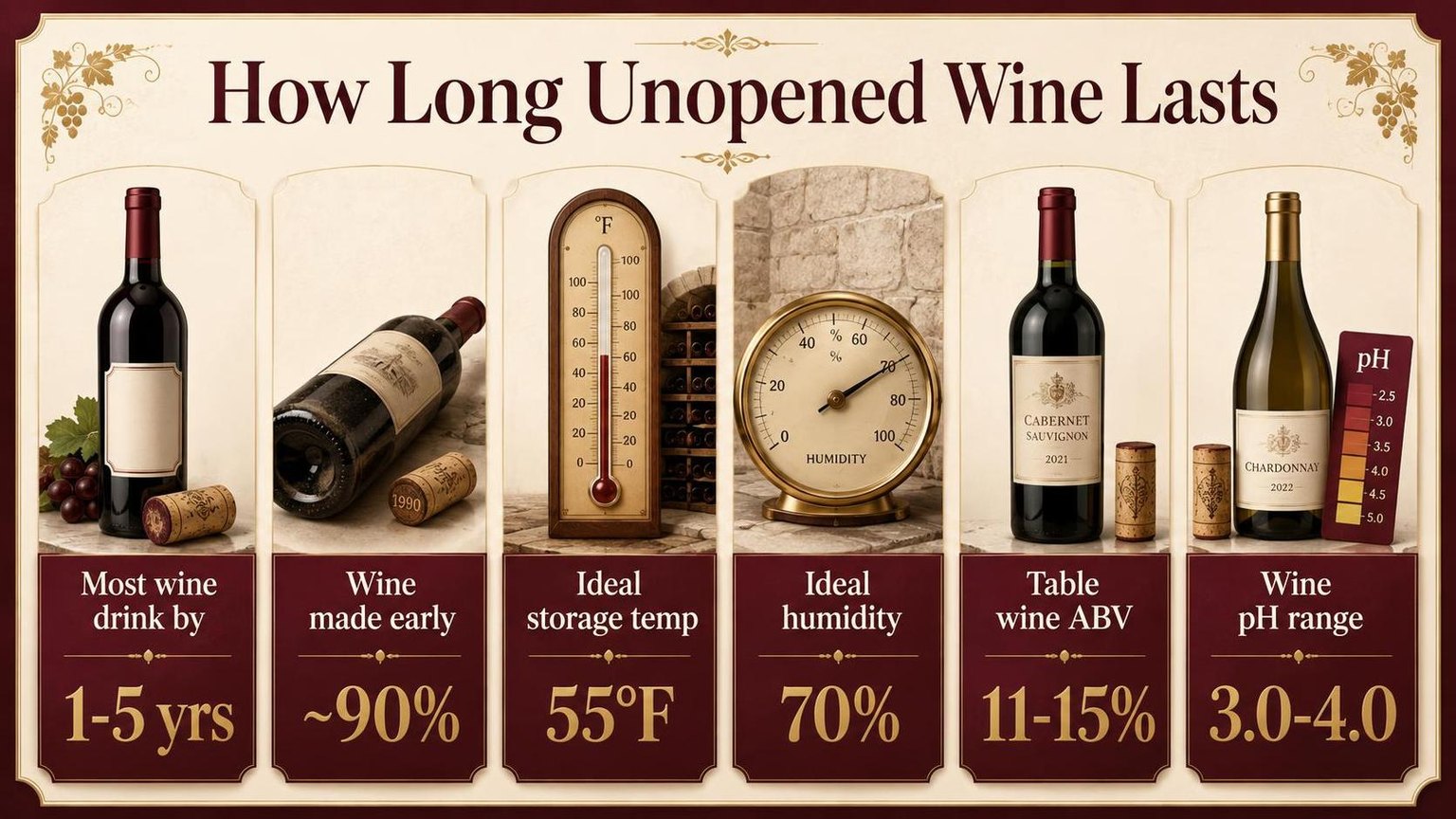
Most commercial wine is made for early drinking, not decades of storage. Industry estimates commonly place that share around 90% of wine within one to five years, with a much smaller fraction built for long aging under controlled conditions.
Wine changes because oxygen slowly enters through the closure, while heat speeds chemical reactions. Fruit aromas fade, acids soften, tannins polymerize, and color shifts.
If storage is poor, those changes happen faster and the unopened bottle can seem “expired” long before it becomes unsafe.
An unopened bottle is usually still microbiologically stable because wine is acidic, low in oxygen, and often contains sulfites. Typical table wine has a pH around 3.0 to 4.0 and alcohol near 11% to 15%, both of which help limit spoilage organisms.
That does not mean every old bottle drinks well. A fresh Sauvignon Blanc stored at 75°F can lose brightness in months, while a structured Cabernet kept near 55°F may improve for years.
Style, vintage quality, closure, and storage conditions decide the result.
| Wine type | Typical unopened drinking window | Main reason |
| Basic light white, rosé | 1-3 years | Low phenolics and fruit-forward style fade early |
| Premium white | 3-7 years | Higher acid, concentration, and better balance |
| Basic red | 2-5 years | Moderate tannin supports short aging only |
| Structured premium red | 5-15+ years | Tannin, acid, and extract slow development |
| Sparkling, non-vintage | 1-3 years | Freshness and mousse decline over time |
| Fortified wine | 10-30+ years | Higher alcohol and oxidative style increase stability |
Storage temperature matters more than people think. A long-term target around 55°F is widely accepted, with about 70% humidity helping protect corks.
Repeated swings are worse than a stable cool room because expansion and contraction stress the closure and accelerate oxygen movement.
Light and vibration also matter. Ultraviolet light can trigger “lightstruck” aromas, especially in delicate wines and clear bottles.
Constant vibration is less studied, but collectors avoid it because sediment stays disturbed and long aging conditions become less stable.
Signs that an unopened wine has passed its best window usually appear after opening.
Look for dull brown color in whites, brick-orange fade in reds, weak fruit, flat palate, or aromas resembling bruised apple, nuts, vinegar, wet cardboard, or cooked jam.
- Cork closure can support slow aging, but only with cool storage.
- Screw caps often preserve freshness longer in aromatic whites.
- Large-format bottles usually age more slowly than 750 mL bottles.
- Cheap wine can still last, but most is designed for immediate fruit expression.
So, unopened wine can “expire” in a practical sense when quality drops below its intended style. It rarely turns dangerous first.
It more often turns tired, oxidized, or muted because the bottle outlived its drinking window or was stored badly.
Shelf Life by Wine Type
Unopened wine does not expire on a fixed date, but it does have a useful drinking window. That window depends on sugar, acid, tannin, alcohol, closure, and storage, especially a steady 55°F and low light.
Most wines sold in U.S. retail are made for early consumption, not decades of aging. Industry guidance often estimates that about 90% of wine is intended for drinking within one year of release and about 99% within five years.
| Wine type | Typical unopened shelf life | Why it lasts that long |
| Non-vintage sparkling | 1-3 years | Fresh fruit style; lower phenolic structure; bubbles fade with time |
| Vintage sparkling | 5-10 years | Higher acidity and more structure support longer aging |
| Light-bodied white | 1-3 years | Low tannin; best for primary fruit and crispness |
| Full-bodied white | 2-5 years | More extract, sometimes oak, and moderate acidity |
| Rosé | 1-3 years | Built for freshness, not long bottle development |
| Light-bodied red | 2-5 years | Moderate tannin and acid give modest aging capacity |
| Full-bodied red | 5-10 years | Higher tannin, color, and extract slow oxidation |
| Dessert wine | 10-20+ years | High sugar acts as a preservative |
| Fortified wine | 10-30+ years | Higher alcohol improves stability |
Sparkling wine is the least forgiving category. Non-vintage Prosecco, Cava, and Champagne usually show best within one to three years because pressure and mousse gradually decline, even when the bottle stays sealed.
White wines vary by body and acidity. Sauvignon Blanc, Pinot Grigio, and simple unoaked Chardonnay usually peak in one to three years, while white Burgundy, quality Riesling, and oaked Chardonnay can improve for two to five years or longer.
Rosé generally has the shortest target window after non-vintage sparkling. Most dry rosé is bottled to preserve bright fruit, pale color, and crisp acidity, so one to three years is the practical range for unopened bottles.
Red wines usually outlast whites because tannin and phenolic compounds help protect against oxidation.
Pinot Noir, Beaujolais, and lighter Grenache often drink well for two to five years, while Cabernet Sauvignon, Nebbiolo, Syrah, and Bordeaux blends commonly last five to ten years.
Sweet and fortified wines are the most durable. Sauternes, Tokaji, Ice Wine, Vintage Port, and Madeira can age for decades because sugar and, in fortified styles, alcohol create a stronger barrier against spoilage and slow flavor loss.
- Natural cork allows tiny oxygen transfer. That can help aging but also raises risk if storage is warm or dry.
- Screw caps reduce oxygen ingress and often preserve fresh white and aromatic styles longer.
- Temperature swings age wine faster. Storage above 70°F can noticeably shorten the ranges above.
- Humidity near 60%-70% helps corks stay elastic, though temperature matters more than humidity.
An unopened bottle is usually still safe if it has passed these ranges, but quality may have faded. Expect dull fruit, browning in whites, brick tones in reds, lower acidity, and flattened aromas rather than a sudden “expiration” event.
How Storage Changes Expiration Risk
Unopened wine does not spoil on a fixed calendar date. Storage conditions control how fast oxygen slips past the closure, how quickly chemical reactions accelerate, and whether the wine keeps developing or declines early.
Heat is the fastest way to shorten a wine’s safe drinking window. A bottle stored at 75°F to 80°F ages much faster than one held near 55°F, because higher temperatures speed oxidation and can push wine past the cork.
Most professionals treat 55°F as the long-term target for fine wine storage.
Short swings are less damaging than constant warmth, but repeated cycling between cool nights and hot days expands and contracts the liquid and closure, increasing leakage risk.
| Storage factor | Best-practice range | Why it matters |
| Temperature | About 55°F; generally 45°F to 65°F acceptable | Slows oxidation and preserves aromas |
| Humidity | About 60% to 70% | Helps natural cork stay from drying out |
| Light | Very low, especially no direct sunlight | UV light can damage delicate compounds |
| Bottle position | Sideways for cork closures | Keeps cork in contact with wine |
| Vibration | Minimal | Reduces disturbance to sediment and aging stability |
Humidity matters most for bottles sealed with natural cork. If air is extremely dry for long periods, the cork can shrink, allowing more oxygen into the bottle and raising the chance of a flat, oxidized wine years before expected.
Excess moisture is less dangerous to the wine itself than low humidity. A cellar at 80% humidity may damage labels and cartons, but cork drying becomes the more urgent problem once humidity falls well below 50% for extended storage.
Light exposure creates a separate risk. Ultraviolet light can trigger “lightstrike,” especially in sparkling wine and delicate whites, producing stale or sulfur-like aromas.
Clear bottles are more vulnerable than dark glass, which is one reason many age-worthy wines use green or amber bottles.
Closure type changes the risk profile. Natural cork allows tiny oxygen transfer that can support long aging. Screw caps usually reduce oxygen ingress and protect freshness well, but they do not make wine immortal if the bottle sits in heat.
| Storage setup | Typical risk | Effect on unopened wine |
| 55°F dark cellar or wine fridge | Low | Best chance of reaching normal aging potential |
| 68°F interior closet, stable year-round | Moderate | Fine for short- to medium-term storage, not ideal for decades |
| 75°F apartment shelf near kitchen | High | Accelerated aging, earlier loss of fruit and freshness |
| Garage with seasonal swings from 40°F to 90°F | Very high | High chance of premature oxidation, seepage, or cooked flavors |
Position also matters, but only for cork-finished bottles. Storing them on their side helps keep the cork moist from wine contact. Bottles under screw cap or synthetic cork do not depend on horizontal storage in the same way.
Vibration is a smaller factor than heat or light, yet constant movement is still avoided in professional storage.
Long-term vibration may disturb sediment and interfere with slow maturation, which matters more for collectible reds than for everyday young whites.
For most households, the practical rule is simple. Keep unopened wine cool, dark, stable, and away from kitchen heat or attic conditions, because storage determines whether a bottle lasts its intended 2 years, 10 years, or far less.
Signs an Unopened Bottle Spoiled
An unopened bottle can spoil, but the signs are usually physical and sensory, not a calendar date alone. Heat, oxygen seepage, and poor storage damage wine long before a cork is pulled.
Check the bottle before serving. Then confirm with smell and taste after opening, because one sign alone is not always conclusive.
Fill level dropped too far
Wine slowly evaporates if the closure leaks. In a standard 750 mL bottle, a noticeably low fill level often means the cork has lost its seal.
For still wine, the ullage should stay high in younger bottles. A shoulder-level fill in a bottle less than 10 years old is a warning sign, especially for wines meant for early drinking.
| Bottle condition | Typical concern level |
| Fill 5-10 mm below cork | Usually normal in a younger bottle |
| Fill at base of neck | Moderate concern if bottle is under 10 years old |
| Fill at shoulder or lower | High spoilage risk in most still wines |
Cork pushed up or leaking
A raised cork often points to heat exposure. Wine expands as temperature rises, and repeated storage above about 70°F can force liquid against the closure and break the seal.
Sticky residue, dried drips, or staining around the capsule are strong clues. They suggest seepage occurred, which means oxygen may have entered the bottle.
Color changed more than expected
Premature browning is common in spoiled white wine. A fresh Sauvignon Blanc or Pinot Grigio should not look deep gold or amber after only 1 to 3 years unless it was made in an oxidative style.
Red wines also fade when damaged. Brick-orange edges in an older red can be normal, but a young Cabernet turning dull brown is not.
| Wine style | Normal appearance | Spoilage warning |
| Young dry white | Pale straw to light gold | Dark gold, amber, or brown |
| Young rosé | Pink to salmon | Brown-orange, tea-like tone |
| Young red | Ruby to purple | Dull brown, flat brick color |
Smells point to oxidation or cork taint
After opening, spoiled wine often smells flat or stale. Oxidized wine can show bruised apple, sherry-like, nutty, or vinegar notes when those aromas do not fit the style.
Cork taint is different. It usually smells like damp cardboard, wet newspaper, or a musty basement, caused by TCA contamination measured at extremely low levels, often parts per trillion.
Bubbles in a still wine
A still wine that fizzes lightly without being intended as sparkling may have refermented. That can happen if microbes remained active or storage conditions accelerated instability.
Do not confuse this with a tiny prickle in some very young whites. Persistent bubbling with dull fruit and sour notes is the stronger warning.
Taste confirms the problem
If the wine tastes like vinegar, cider, cooked fruit, or nothing at all, it is likely spoiled. Heat-damaged bottles often lose fruit first, then show a stewed, jammy, flattened finish.
- Low fill plus seepage usually means oxygen exposure.
- Brown color plus bruised-apple aroma usually means oxidation.
- Musty smell with muted fruit usually means cork taint.
- Fizz in still wine plus sour taste can mean refermentation.
One clue can mislead. Two or three matching signs make spoilage much more likely.
When to Drink or Discard
An unopened bottle does not become unsafe on a fixed expiration date, but it can pass its best drinking window.
The decision is practical: drink bottles while fruit, acid, tannin, and aroma are still balanced; discard bottles that show clear spoilage or heat damage.
Most everyday wines sold in the U.S. are made for early consumption, not decades of cellaring.
A sound bottle stored near 55°F can outlast the same wine kept warm, bright, or upright for years, because heat, light, and oxygen transmission accelerate decline.
Start with the wine style, vintage, and storage history. If the bottle came from a closet that regularly reached 75°F to 80°F, shorten expectations sharply.
If it stayed dark, still, and around cellar temperature, the wine usually keeps its intended quality longer.
| Wine type | Typical best window unopened | Why |
| Basic Pinot Grigio, Sauvignon Blanc, rosé | 1-3 years from vintage | Low phenolics and fresh-fruit style fade first |
| Unoaked Chardonnay, inexpensive Riesling | 2-4 years | Acid helps, but primary fruit still drives quality |
| Oaked Chardonnay, Chenin Blanc, better Riesling | 3-7 years | Acid, extract, and oak support slower development |
| Light reds like Pinot Noir, Gamay | 2-5 years | Lower tannin means less structural buffer |
| Cabernet Sauvignon, Merlot, Syrah, Sangiovese | 3-10 years | Tannin and acidity extend life in stronger examples |
| Premium age-worthy reds | 10-20+ years | Concentration, tannin, acid, and proven track record |
| Port, Madeira, Sauternes, Tokaji | 10-40+ years | Sugar, alcohol, and oxidation tolerance increase stability |
Use those ranges as a screening tool, not a guarantee. Producer quality, closure type, fill level, and transport matter.
A $12 supermarket white from a hot trunk can taste old within months, while a well-stored classified Bordeaux may improve for 15 years or more.
Inspect the bottle before opening. A cork pushed up, sticky capsule, or wine seepage suggests heat expansion or leakage. Excessively low fill, especially in older bottles, means more oxygen exposure and a higher chance the wine is tired or oxidized.
| Sign | What it usually means | Action |
| Cork protruding or capsule stained | Likely heat damage or leakage | Open soon; discard if cooked or brown |
| White wine deep gold or brown far too early | Oxidation | Discard if aroma is flat, sherry-like, or bruised-apple heavy |
| Red wine brick-brown with dull aroma | Advanced oxidation or decline | Drink immediately if pleasant; discard if sour or lifeless |
| Fizz in a still wine | Possible refermentation | Discard unless the wine style is meant to sparkle |
| Wet cardboard, moldy basement smell | Cork taint from TCA | Discard for quality; it is not dangerous, but it is spoiled |
| Vinegar or nail-polish remover smell | High volatile acidity or microbial spoilage | Discard |
If the bottle is within its likely window and shows no warning signs, drink it. If it is beyond the window but from a reputable producer and good cellar conditions, open it with food and moderate expectations rather than throwing it out unopened.
Discard when spoilage is obvious in both smell and taste. Wine that tastes cooked, sharply vinegary, mousy, or completely stripped of fruit has crossed from mature to defective.
Unopened wine rarely becomes dangerous, but stale or spoiled wine is not worth serving.
Questions Readers Ask
Does unopened wine expire?
Yes. Unopened wine does not stay at peak quality forever, and many bottles eventually lose fruit, structure, and aroma even if they remain safe to drink.
Most everyday table wines are best within about 1 to 5 years of release, while well-made fine wines can improve for 10, 20, or more years under proper storage.
How long does unopened red, white, sparkling, and rosé wine last?
Light whites, most rosés, and many inexpensive reds usually show best within 1 to 3 years.
Fuller reds often hold 3 to 7 years, non-vintage sparkling wine about 1 to 3 years, and vintage Champagne or age-worthy reds can last a decade or much longer depending on producer, vintage, and storage.
Can unopened wine go bad if it is stored the wrong way?
Yes. Heat is the fastest way to damage wine; sustained storage above about 70°F can cook the wine, flatten aromas, and push liquid past the cork.
UV light, temperature swings, and very dry conditions can also shorten a bottle’s life by degrading the wine or drying the cork.
How can you tell if an unopened bottle is likely past its prime?
Look for seepage around the cork, a pushed-up cork, low fill level in the neck, or capsule staining, all of which can indicate heat damage or oxidation.
For clear bottles, unusually brown color in white wine or dull brick-brown tones in a young red can also signal the wine is no longer in good condition.
Does the closure matter for how long unopened wine lasts?
It can. Natural cork allows tiny oxygen transfer over time and is common on wines meant for aging, while screw caps are excellent for preserving freshness in aromatic whites and early-drinking wines.
Neither closure guarantees longevity by itself; grape quality, winemaking, and storage conditions matter more.