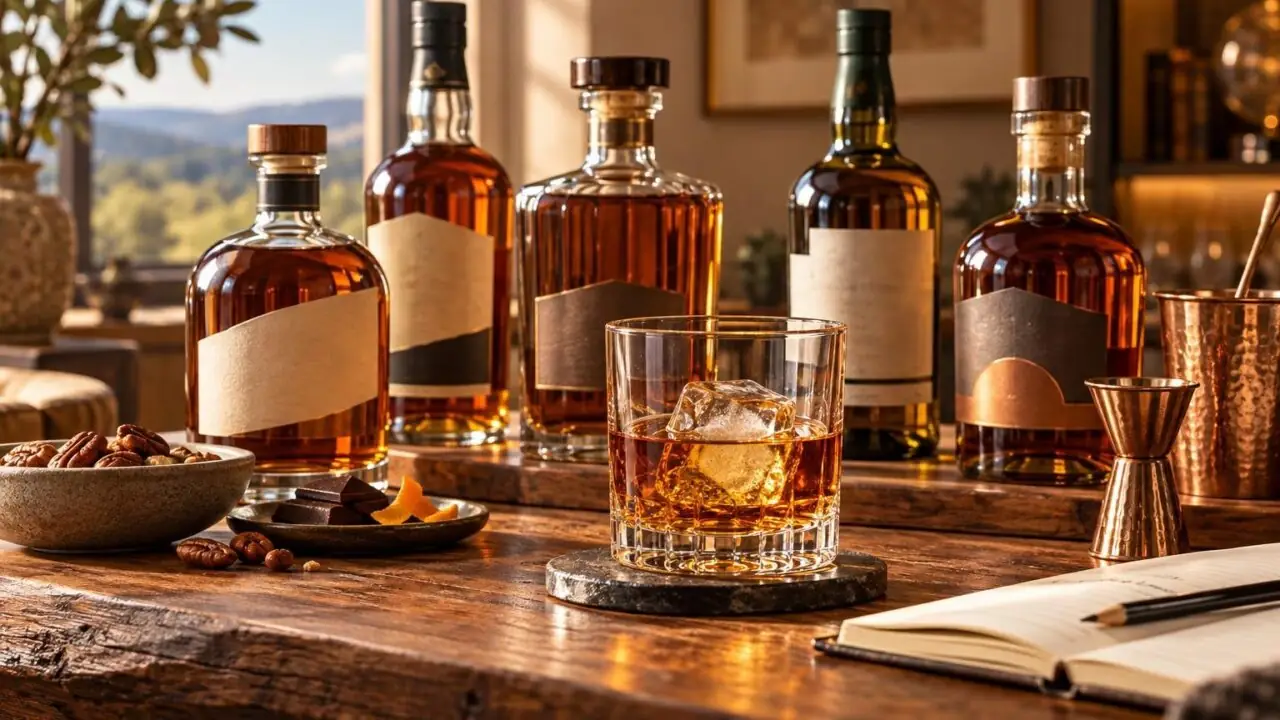
How Many Ounces Are in a Fifth of Whiskey? A fifth of whiskey contains 25.36 U.S. fluid ounces, because the modern fifth-size bottle holds 750 milliliters. For practical measuring, bartenders often round that figure to 25.4 ounces.
The term “fifth” comes from an older bottle size equal to one-fifth of a U.S. gallon.
This guide explains how the 750-milliliter standard compares with common pour sizes. A 1.5-ounce shot yields about 16 full pours, while 2-ounce servings provide roughly 12 pours, with a small remainder.
Bottle labels, recipes, and bar measurements may use ounces differently, so distinguishing fluid ounces from weight ounces matters.
The conversion also helps estimate servings for cocktails, tastings, and event planning without opening the bottle prematurely.
Fifth Bottle Size in Ounces
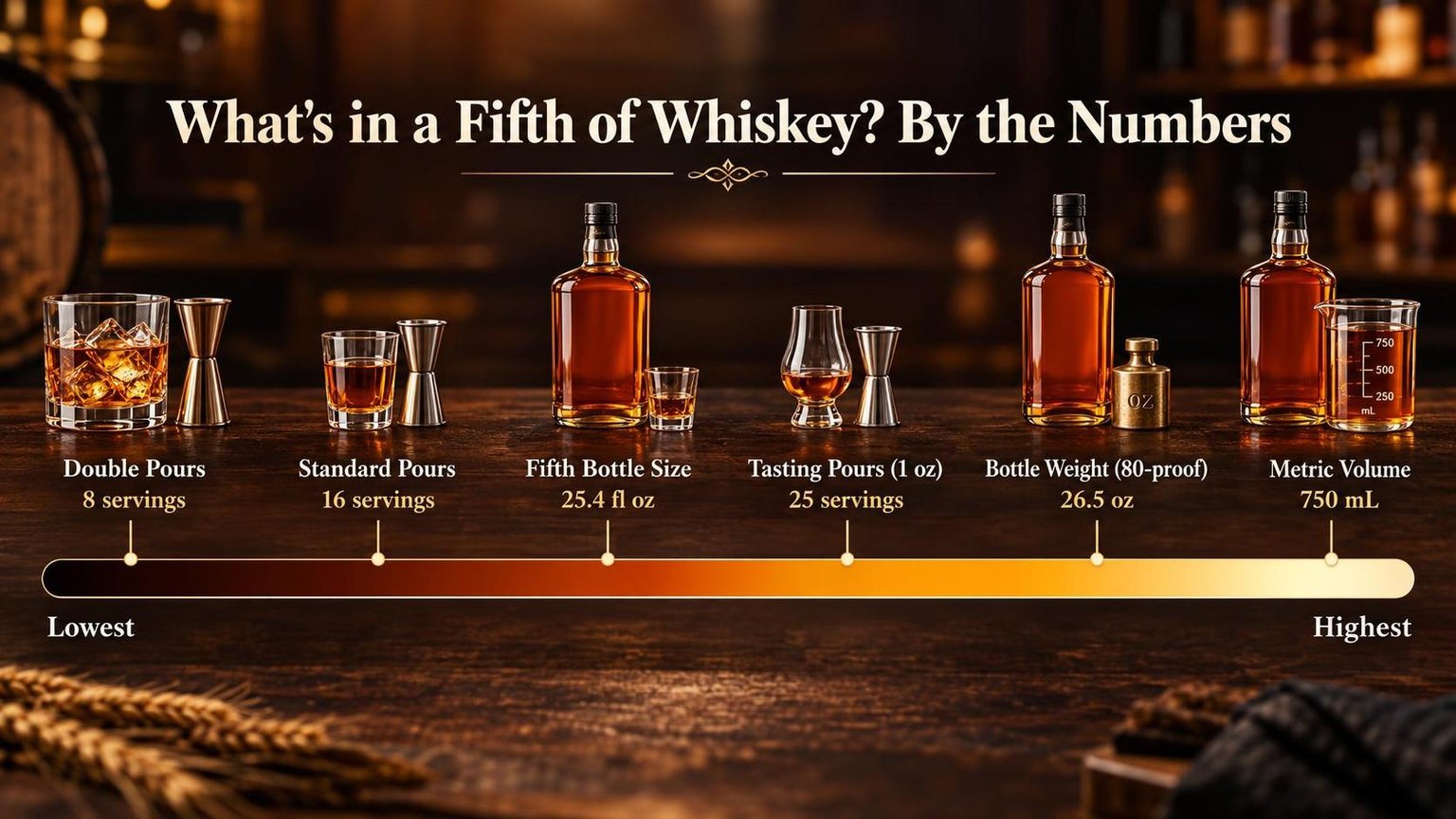
A fifth of whiskey contains 25.4 fluid ounces (750 milliliters). The term “fifth” originated because the bottle equaled one-fifth of a U.S. gallon, which is exactly 128 fluid ounces divided by five.
The U.S. government standardized the 750 mL bottle size on January 1, 1980, replacing the old 4/5-quart (757 mL) fifth through metric conversion mandates from the Bureau of Alcohol, Tobacco and Firearms.
Fluid Ounces vs. Weight Ounces
Fluid ounces measure volume, not weight. A fifth of 80-proof whiskey weighs approximately 26.5 avoirdupois ounces because ethanol-water mixtures are slightly denser than pure water at room temperature.
This distinction matters when shipping or traveling with bottles. Airlines and postal services reference fluid ounces for liquid limits, not weight.
How a Fifth Compares to Other Bottle Sizes
The 750 mL fifth sits in the middle of standard spirit bottle sizes recognized by U.S. federal regulations (27 CFR 5.47a).
| Bottle Name | Milliliters | Fluid Ounces | Relation to a Fifth |
| Miniature (Nip) | 50 mL | 1.7 oz | 1/15 of a fifth |
| Half Pint | 200 mL | 6.8 oz | ~1/4 of a fifth |
| Pint | 375 mL | 12.7 oz | 1/2 of a fifth |
| Fifth | 750 mL | 25.4 oz | 1 fifth |
| Liter | 1,000 mL | 33.8 oz | 1.33 fifths |
| Handle | 1,750 mL | 59.2 oz | 2.33 fifths |
Practical Pour Counts from a Fifth
Knowing the ounce count lets you calculate servings precisely. A standard whiskey pour is 1.5 fluid ounces, per the National Institute on Alcohol Abuse and Alcoholism.
- Standard 1.5 oz pours: approximately 16 servings per fifth
- Double 3 oz pours: approximately 8 servings per fifth
- Tasting pours (1 oz): approximately 25 servings per fifth
- Cocktail pours (2 oz): approximately 12 servings per fifth
Bar professionals commonly round to 16 standard pours per 750 mL bottle when calculating inventory costs and pricing cocktails by the glass.
Why a Fifth Equals 750 Milliliters
A “fifth” originally meant one-fifth of a U.S. gallon, which equals exactly 25.6 fluid ounces or 757 milliliters. The modern 750 mL bottle replaced it in 1980 when the U.S. adopted metric standards for distilled spirits.
The Math Behind the Name
One U.S. liquid gallon equals 128 fluid ounces. Divide 128 by 5, and you get 25.6 fluid ounces — the original fifth.
Converting 25.6 fl oz to metric yields 757.08 mL, not 750 mL. The 7 mL difference exists because the Bureau of Alcohol, Tobacco and Firearms rounded down to align with international metric bottle sizes already in use across Europe.
The 1980 Metric Conversion
On January 1, 1980, the ATF mandated standardized metric bottle sizes for all distilled spirits sold in the United States. The old system allowed irregular sizes that created consumer confusion and complicated international trade.
The regulation eliminated several legacy bottle sizes and replaced them with a fixed set of metric volumes.
| Pre-1980 Name | Old Size (fl oz) | New Metric Size |
| Miniature | 1.6 | 50 mL |
| Half pint | 8.0 | 200 mL |
| Pint | 16.0 | 375 mL |
| Fifth | 25.6 | 750 mL |
| Quart | 32.0 | 1 L |
| Half gallon | 64.0 | 1.75 L |
Why the Term Persists
Despite the metric switch over four decades ago, bartenders, retailers, and consumers still say “a fifth.” The term stuck because the size difference is negligible — 750 mL holds 25.36 fl oz versus the original 25.6 fl oz.
- 750 mL is the global standard for wine and spirits, used in over 100 countries.
- The term “fifth” appears nowhere on modern U.S. labels; federal law requires metric volume declarations.
- A 750 mL bottle yields approximately 16 standard 1.5-oz pours or about 25 one-ounce pours.
Understanding this history clarifies why “fifth” and “750 mL” are used interchangeably in American whiskey culture, even though they differ by exactly 7.08 milliliters.
Whiskey Ounces Versus Shots
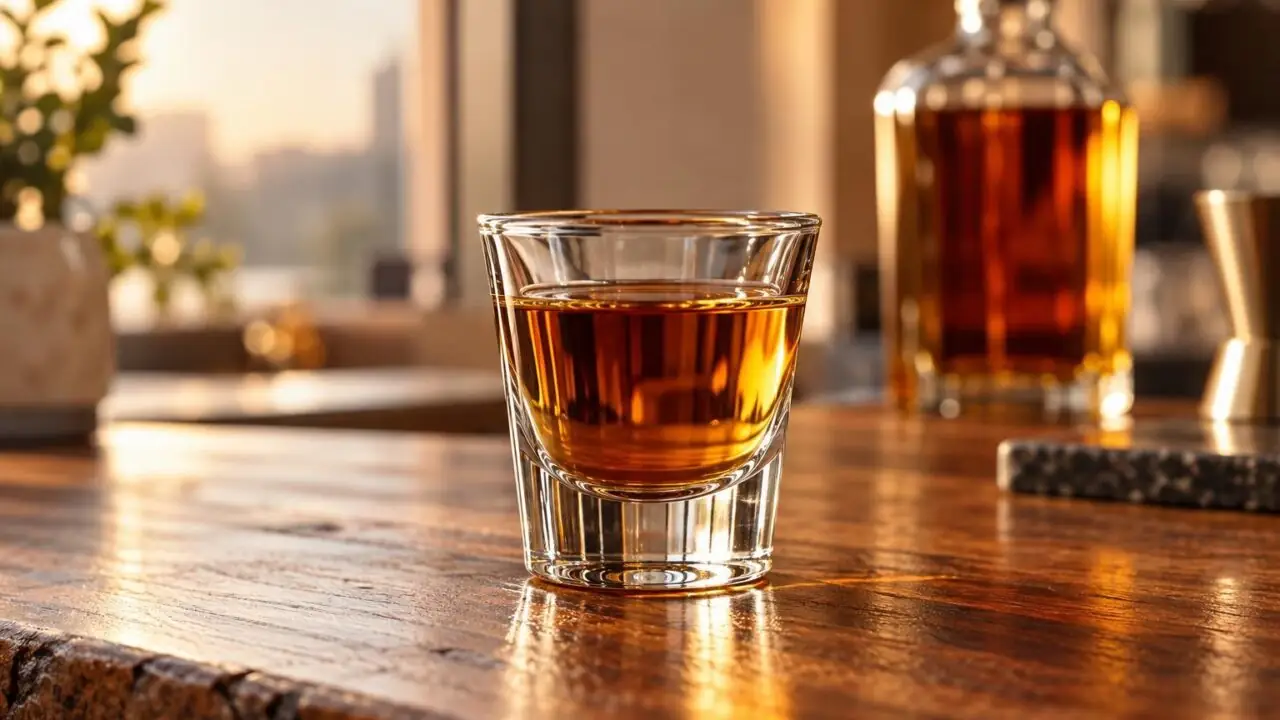
A fifth of whiskey holds 25.4 ounces, and a standard U.S. shot measures 1.5 ounces. That math yields approximately 16.9 shots per bottle—effectively 16 full pours with a small remainder.
Shot sizes vary globally, which directly changes how many servings you get from a single fifth.
| Country | Shot Size (oz) | Shots per Fifth |
| United States | 1.5 | 16.9 |
| United Kingdom | 0.84 (25 ml) | 30.2 |
| Germany | 0.68 (20 ml) | 37.4 |
| Japan | 2.03 (60 ml) | 12.5 |
| Australia | 1.01 (30 ml) | 25.1 |
| Italy | 1.35 (40 ml) | 18.8 |
U.S. bars sometimes pour “tall” or “double” shots at 2 ounces each. A fifth poured in doubles gives only 12.7 servings—roughly 25% fewer drinks.
Converting Ounces to Standard Drinks
The National Institute on Alcohol Abuse and Alcoholism defines one standard drink as 1.5 ounces of 80-proof (40% ABV) spirit. A fifth at 80 proof therefore contains roughly 17 standard drinks.
Higher-proof whiskeys shift the calculation. A fifth of cask-strength bourbon at 120 proof (60% ABV) contains the alcohol equivalent of approximately 25.4 standard drinks despite holding the same 25.4 fluid ounces.
- 80 proof (40% ABV): ~17 standard drinks per fifth
- 90 proof (45% ABV): ~19 standard drinks per fifth
- 100 proof (50% ABV): ~21 standard drinks per fifth
- 120 proof (60% ABV): ~25 standard drinks per fifth
Practical Pouring Tips
Free-pouring at a home bar typically yields inconsistent 1.25–2.0 ounce shots. A jigger eliminates guesswork and keeps your pour at exactly 1.5 ounces.
For cocktail planning, budget 2 ounces of whiskey per mixed drink. A single fifth covers 12 cocktails—enough for a small gathering of four guests at three drinks each.
How Many Drinks a Fifth Makes
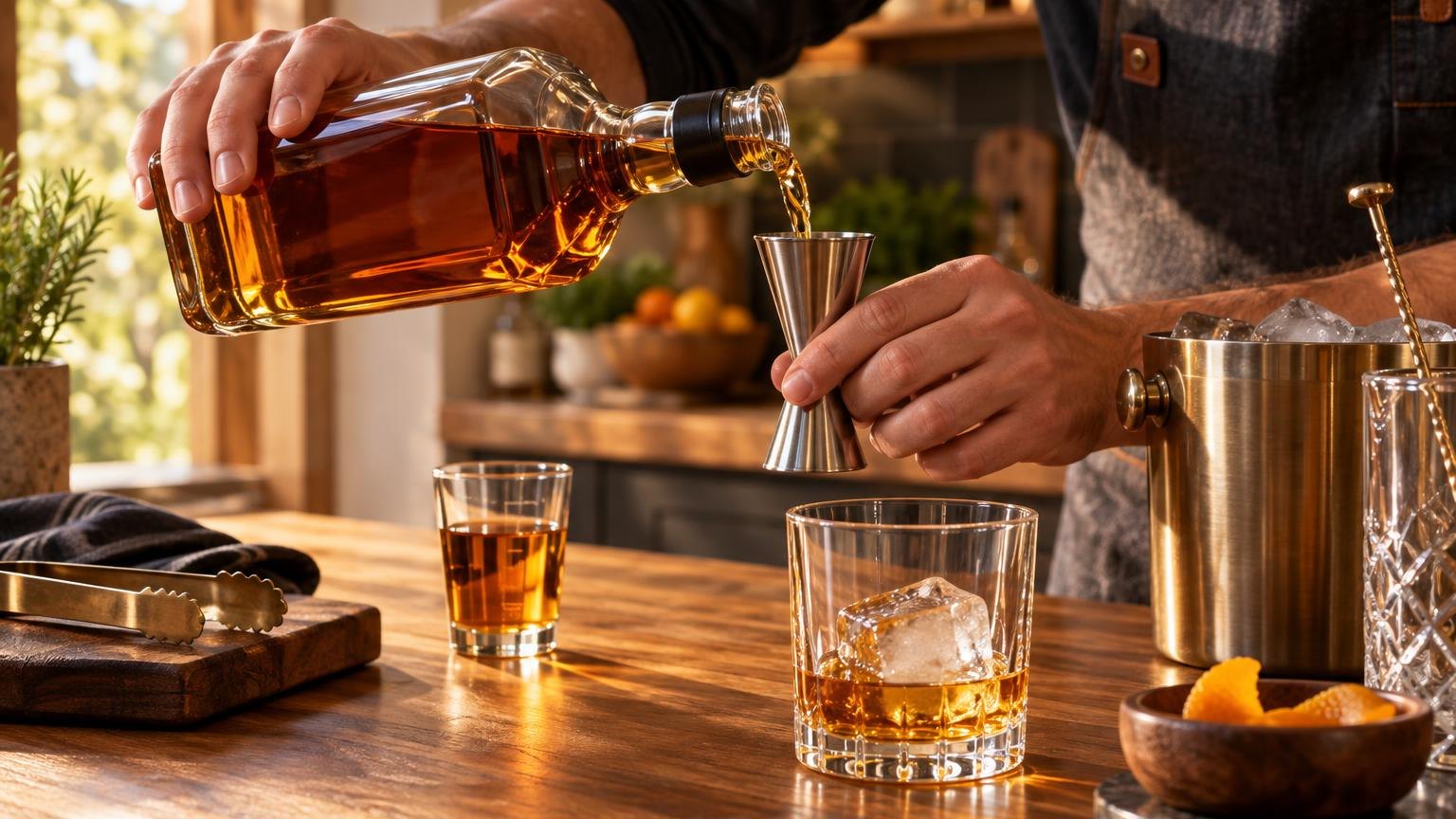
A fifth contains 25.4 fluid ounces (750 ml) of whiskey. Using the standard drink measurement of 1.5 ounces per pour, one fifth yields approximately 16.9 standard drinks—effectively 17 servings per bottle.
Actual drink count shifts depending on pour size and cocktail style. The table below breaks down servings by common pour volumes.
| Pour Size | Drinks per Fifth | Common Use |
| 1 oz | 25 | Tasting pours, whiskey flights |
| 1.25 oz | 20 | Cocktail recipes (e.g., whiskey sour) |
| 1.5 oz (standard) | 17 | NIAAA standard drink, neat pours |
| 2 oz | 12–13 | Old Fashioneds, generous rocks pours |
| 3 oz | 8 | Double pours, heavy cocktails |
The National Institute on Alcohol Abuse and Alcoholism (NIAAA) defines one standard drink as 1.5 oz of 80-proof (40% ABV) distilled spirit, containing roughly 14 grams of pure alcohol.
Bar vs. Home Pouring
Professional bartenders use jiggers or measured pourers calibrated to 1.25–1.5 oz. Free-pouring at home typically runs 2–2.5 oz per glass, cutting your bottle’s yield significantly.
A 2023 study published in Alcoholism: Clinical and Experimental Research found that self-poured drinks exceeded the standard serving by 26–34% on average.
That means a home drinker often gets closer to 12–13 drinks from a fifth rather than 17.
Planning for Events
Use these benchmarks when buying whiskey for gatherings:
- Cocktail party (2–3 drinks per guest): One fifth serves 6–8 guests
- Dinner party (1–2 drinks per guest): One fifth serves 8–12 guests
- Whiskey tasting with 1 oz pours: One fifth covers 25 samples across guests
- Wedding or large event: Plan one fifth per 6 guests over a 4-hour reception
Knowing your exact pour size prevents both waste and mid-party shortages. Measure once with a kitchen scale—1.5 oz of whiskey weighs approximately 44 grams—and calibrate your glassware accordingly.
Fifth Size Compared With Other Bottles
A fifth holds 750 mL (25.4 oz), placing it squarely in the middle of standard spirit bottle sizes sold in the United States. Understanding where it sits relative to smaller and larger formats helps when planning purchases for home bars or events.
| Bottle Name | Metric Size | Fluid Ounces | Standard 1.5 oz Shots |
| Miniature (Nip) | 50 mL | 1.7 oz | 1 |
| Half Pint | 200 mL | 6.8 oz | 4 |
| Pint | 375 mL | 12.7 oz | 8 |
| Fifth | 750 mL | 25.4 oz | 16 |
| Liter | 1,000 mL | 33.8 oz | 22 |
| Handle | 1,750 mL | 59.2 oz | 39 |
How a Fifth Stacks Up
A fifth contains exactly twice the volume of a pint (375 mL) and half the volume of a 1.5-liter magnum. It delivers roughly 16 standard 1.5 oz pours of whiskey.
Compared to a handle—the largest common retail size at 1,750 mL—a fifth holds about 43% as much liquid. You need 2.33 fifths to equal one handle.
Cost Efficiency by Size
Larger bottles typically offer a lower per-ounce price. A handle of bourbon averaging $35 works out to roughly $0.59 per ounce, while the same brand in a 750 mL fifth at $22 costs about $0.87 per ounce.
Miniatures and half pints carry the highest per-ounce premiums, often 40–60% more than the equivalent fifth. They suit sampling, not stocking a bar.
When to Choose a Fifth
- Home entertaining: One fifth serves 8 guests two cocktails each at 1.5 oz per drink.
- Recipe testing: 750 mL provides enough whiskey for 10–12 cocktail experiments without overcommitting budget.
- Storage: The 750 mL bottle stands roughly 12 inches tall and 3 inches wide, fitting standard bar shelving and most refrigerator doors.
- Travel: Under the TTB-regulated sizes, a 750 mL bottle remains the most widely available format at airports, liquor stores, and duty-free shops across all 50 states.
For gatherings exceeding 12 people, stepping up to a handle saves money and reduces mid-party bottle swaps. For everyday sipping, the fifth remains the benchmark size.
US Liquor Bottle Sizes Explained
The US adopted metric bottle sizes for distilled spirits in 1980, replacing older measurements like the fifth, pint, and half-pint.
The Bureau of Alcohol, Tobacco, Firearms and Explosives (ATF) currently recognizes six standard bottle sizes for commercial sale.
These standardized sizes replaced a system rooted in fractions of a US gallon. The term “fifth” referred to one-fifth of a gallon, or 25.6 fluid ounces—slightly more than today’s 750 ml (25.36 oz) replacement.
| Bottle Name | Metric Size | Fluid Ounces | Standard Shots (1.5 oz) |
| Miniature (Nip) | 50 ml | 1.7 oz | 1 |
| Half Pint | 200 ml | 6.8 oz | 4 |
| Pint | 375 ml | 12.7 oz | 8 |
| Fifth (Standard) | 750 ml | 25.36 oz | 16 |
| Handle (Half Gallon) | 1.75 L | 59.2 oz | 39 |
| Liter | 1 L | 33.8 oz | 22 |
Why the 750 ml Bottle Dominates
The 750 ml bottle became the global standard partly because it already matched the traditional European wine bottle. Adopting it for spirits simplified international trade and labeling requirements.
In the US market, roughly 60% of all spirits are sold in 750 ml bottles. The 1.75-liter handle ranks second, favored for its lower per-ounce cost.
Key Differences From the Old System
- A pre-1980 “fifth” held exactly 25.6 oz (one-fifth of a 128 oz gallon); the metric replacement holds 25.36 oz—a difference of 0.24 oz per bottle.
- The old “quart” (32 oz) was replaced by the 1-liter bottle (33.8 oz), giving consumers 1.8 oz more per bottle.
- Miniatures shrank from 1.6 oz to 1.7 oz (50 ml), a slight increase under metrication.
State laws add further complexity. Some states like Utah restrict single-serve bottles to on-premise consumption only, while others prohibit 50 ml nip sales entirely to reduce litter.
Converting Whiskey Ounces for Recipes
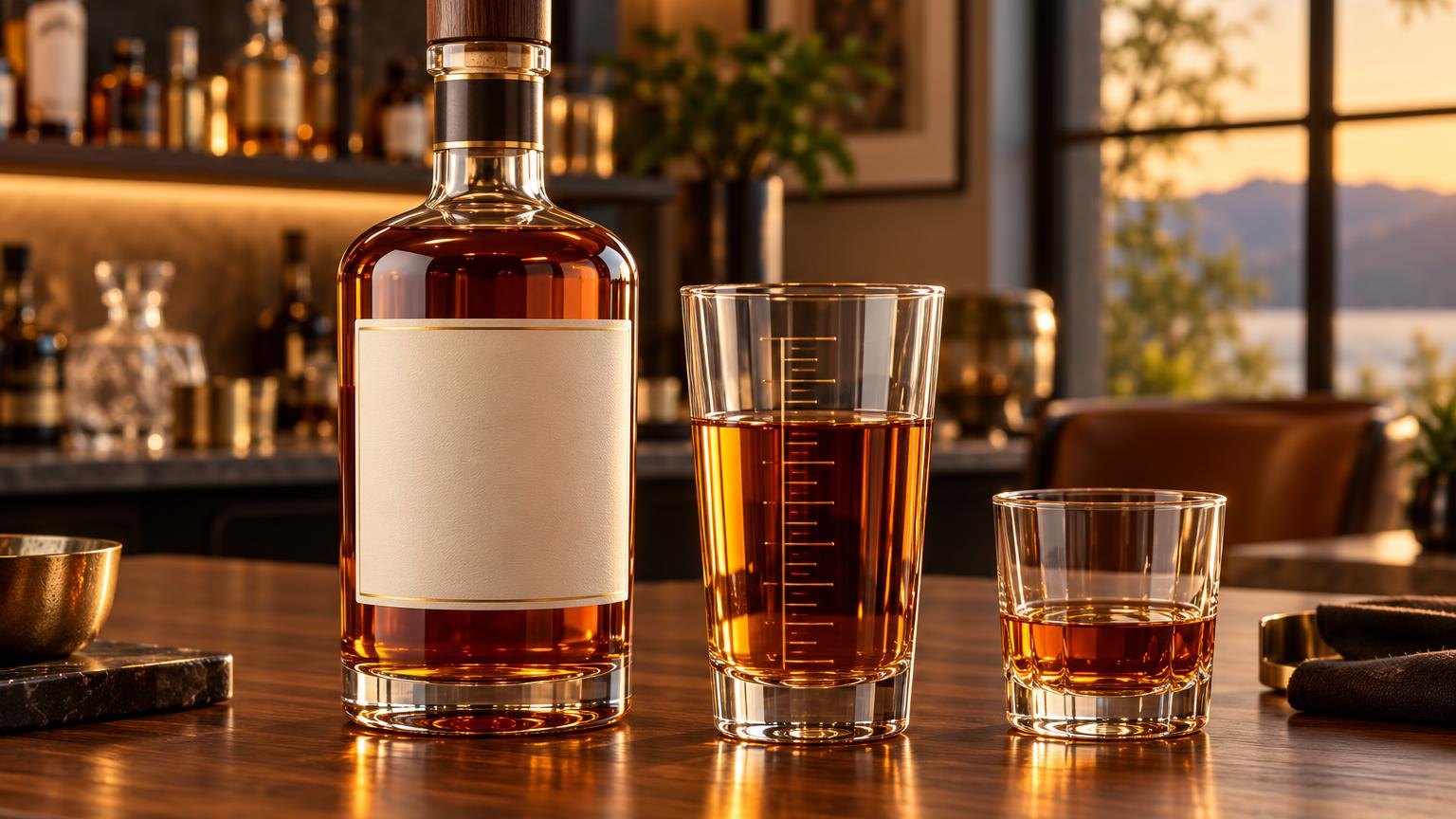
A fifth of whiskey contains 25.4 ounces (750 ml), making it the standard bottle for both cocktail mixing and cooking. Knowing exact pour conversions prevents wasted whiskey and ensures recipe consistency across drinks and dishes.
Standard Pour Conversions from a Fifth
Bartenders use a standard pour of 1.5 ounces per shot. A fifth yields approximately 16.9 standard pours, effectively giving you 16 full cocktails per bottle.
| Recipe Measurement | Fluid Ounces | Servings per Fifth |
| Single shot | 1.5 oz | 16.9 |
| Double shot | 3.0 oz | 8.5 |
| Jigger (large side) | 1.5 oz | 16.9 |
| Jigger (small side) | 0.75 oz | 33.8 |
| Tablespoon | 0.5 oz | 50.8 |
| Teaspoon | 0.17 oz | 149.4 |
Cocktail Recipe Scaling
Most classic cocktail recipes call for 2 ounces of whiskey per drink. At that pour size, one fifth produces 12 full cocktails — critical information for party planning.
- Old Fashioned: 2 oz whiskey — 12 drinks per fifth
- Manhattan: 2 oz whiskey — 12 drinks per fifth
- Whiskey Sour: 2 oz whiskey — 12 drinks per fifth
- Mint Julep: 2.5 oz whiskey — 10 drinks per fifth
- Hot Toddy: 1.5 oz whiskey — 16 drinks per fifth
Cooking Conversions
Culinary recipes typically measure whiskey in tablespoons or cups rather than ounces. One cup equals 8 fluid ounces, so a fifth holds just over 3 cups (3.175 cups exactly).
| Cooking Measure | Equivalent in Ounces | Amount per Fifth |
| 1 tablespoon | 0.5 oz | 50.8 tablespoons |
| ¼ cup | 2 oz | 12.7 quarter-cups |
| ½ cup | 4 oz | 6.35 half-cups |
| 1 cup | 8 oz | 3.175 cups |
Whiskey-glazed recipes for meats like bourbon-glazed salmon typically require 2–4 tablespoons (1–2 oz). A single fifth provides enough whiskey for 12 to 25 glaze batches, making it an economical pantry staple.
Common Questions
How many ounces are in a fifth of whiskey?
A fifth of whiskey contains 25.6 fluid ounces (750 milliliters). The term “fifth” originated because the bottle size was one-fifth of a US gallon (128 ÷ 5 = 25.6 oz).
Since 1980, the US has used the metric standard of 750 mL, which is functionally identical to the old fifth measurement.
How many standard drinks are in a fifth of whiskey?
A fifth contains approximately 17 standard drinks. The NIAAA defines one standard drink as 1.5 fluid ounces of 80-proof (40% ABV) distilled spirits, so 25.6 ÷ 1.5 = roughly 17 servings per bottle.
Why is it called a “fifth” instead of just saying 750 mL?
Before 1980, US distilled spirits were sold in fractions of a gallon — a fifth (1/5 gallon), a half-pint, a pint, and a quart.
The Distilled Spirits Council and the Bureau of Alcohol, Tobacco, and Firearms standardized bottle sizes to metric units in January 1980.
But the colloquial term “fifth” persisted in everyday American English because the 750 mL replacement was nearly identical in volume.
How does a fifth compare to a handle of whiskey in ounces?
A handle (1.75 liters) holds 59.2 fluid ounces, which is 2.33 times the volume of a fifth (25.6 oz). Put differently, one handle equals roughly 2⅓ fifths. A handle typically yields about 39 standard 1.5-oz pours.
Is a fifth of whiskey the same size worldwide?
The 750 mL bottle is a global standard adopted by most wine- and spirits-producing countries, including the EU, which mandated it under Directive 2007/45/EC.
However, the slang term “fifth” is exclusively American; in the UK, consumers simply refer to a 75 cl or 700 mL bottle, with 700 mL being the EU standard for spirits specifically since 1990.
How many ounces are in smaller whiskey bottle sizes compared to a fifth?
A standard 375 mL “half-bottle” or “pint” holds 12.7 fluid ounces — exactly half a fifth.
A 200 mL bottle (sometimes called a “half-pint”) contains 6.8 oz, and a 50 mL miniature or “nip” holds just 1.7 oz, slightly more than one standard pour.
All four sizes are among the TTB-approved bottle formats for US spirits sales.
How long does an opened fifth of whiskey stay good?
An opened fifth of whiskey remains at peak quality for roughly 1–2 years if stored upright with the cap tightly sealed and kept away from direct sunlight and temperature swings.
Unlike wine, whiskey’s high ABV (typically 40–60%) prevents microbial spoilage, but oxidation gradually dulls flavors once the bottle is less than one-third full because the increased air-to-liquid ratio accelerates chemical change.
- What Is a Good Whiskey to Drink Straight?
- What Does Moonshine Taste Like?
- Basil Hayden Toast Review – What You Need to Know
- What To Mix With Jim Beam Apple?
- Which Country Consumes The Most Whiskey Overall?
- What To Mix With Irish Cream?
- What Is A Whiskey Neat?
- All Alcohol Guides
- Alcohol and Tobacco Tax and Trade Bureau – Standards of Fill for Distilled Spirits (2023)
- National Institute on Alcohol Abuse and Alcoholism – What Is a Standard Drink? (2024)
- Centers for Disease Control and Prevention – Dietary Guidelines for Alcohol (2024)
- U.S. National Library of Medicine / MedlinePlus – Alcohol Use and Safe Drinking (2023)
- Cornell Law School Legal Information Institute – 27 CFR § 5.47a Standards of Fill (2023)
- The Distilled Spirits Council of the United States – Industry Facts (2024)
- MasterClass – Guide to Liquor Bottle Sizes (2023)