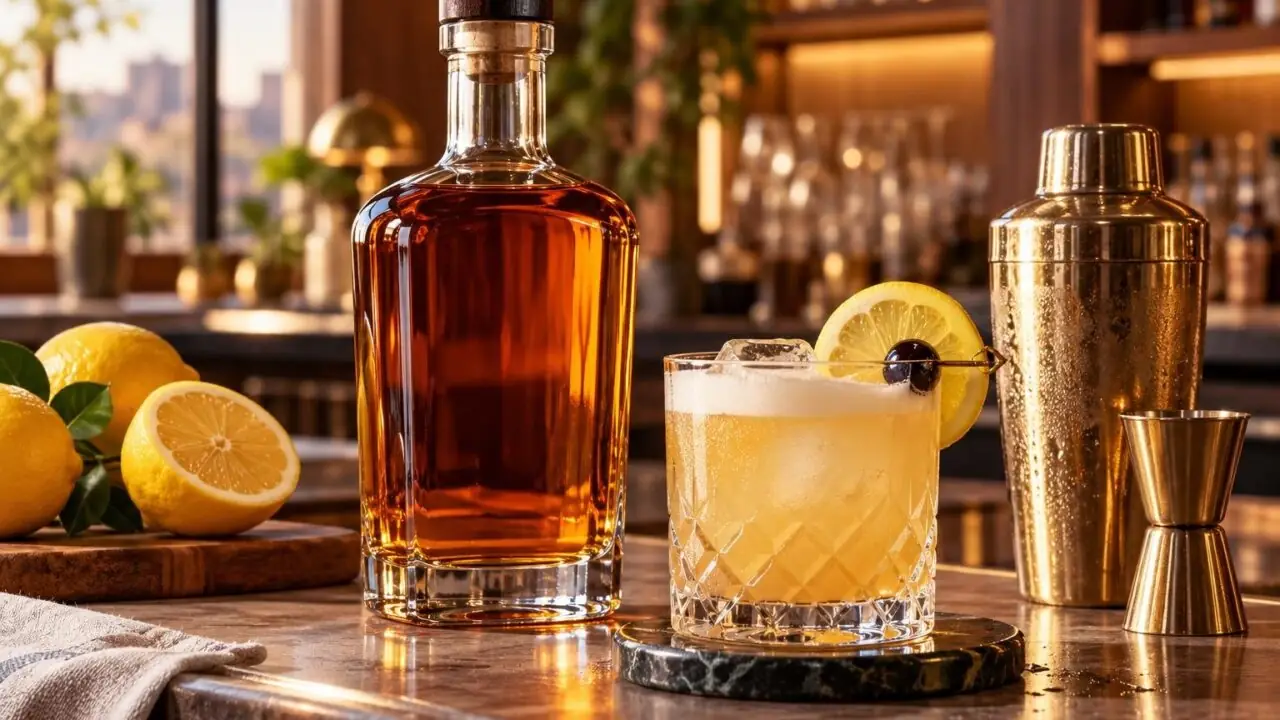
Good whiskey for whiskey sour is a 90-proof bourbon with enough sweetness, oak, and spice to balance fresh lemon juice and simple syrup.
Bourbon works especially well because its corn-forward flavor brings vanilla and caramel notes without overpowering the drink. Choose a bottle with moderate oak rather than a heavily smoky or intensely peated profile.
Look for bourbon or rye between 90 and 100 proof. Bourbon creates a rounder, softer sour; rye gives the cocktail a drier, spicier edge. Avoid expensive, highly aged whiskey, because citrus and sugar can conceal its delicate flavors.
A reliable mid-priced bottle makes a better whiskey sour and keeps the cocktail’s proportions easy to adjust.
Best Whiskey Styles for Whiskey Sours
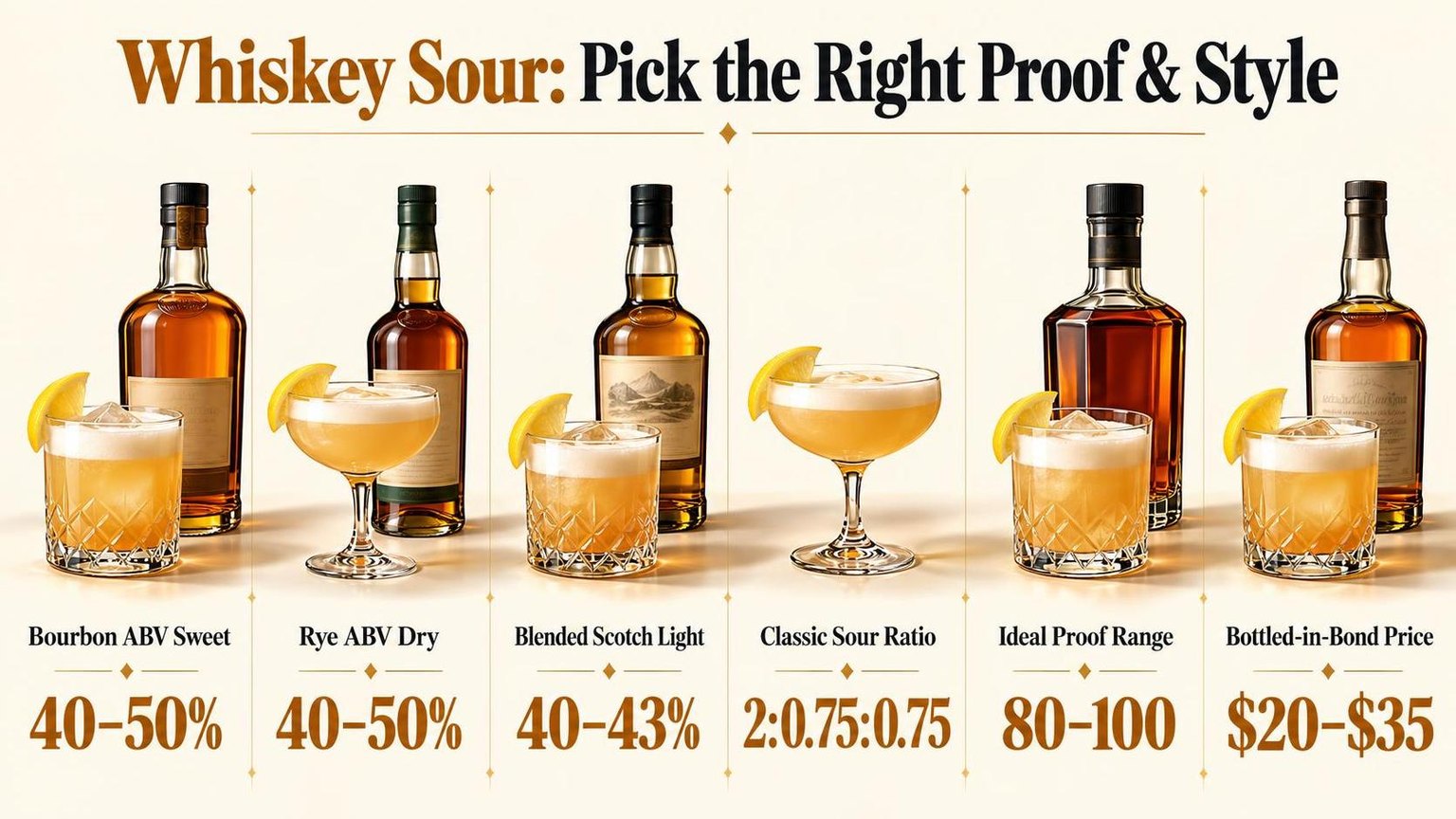
Not every whiskey performs equally in a sour. The balance between grain sweetness, proof, and flavor intensity determines whether a whiskey cuts through citrus and simple syrup or disappears entirely. Three styles consistently outperform the rest.
Bourbon
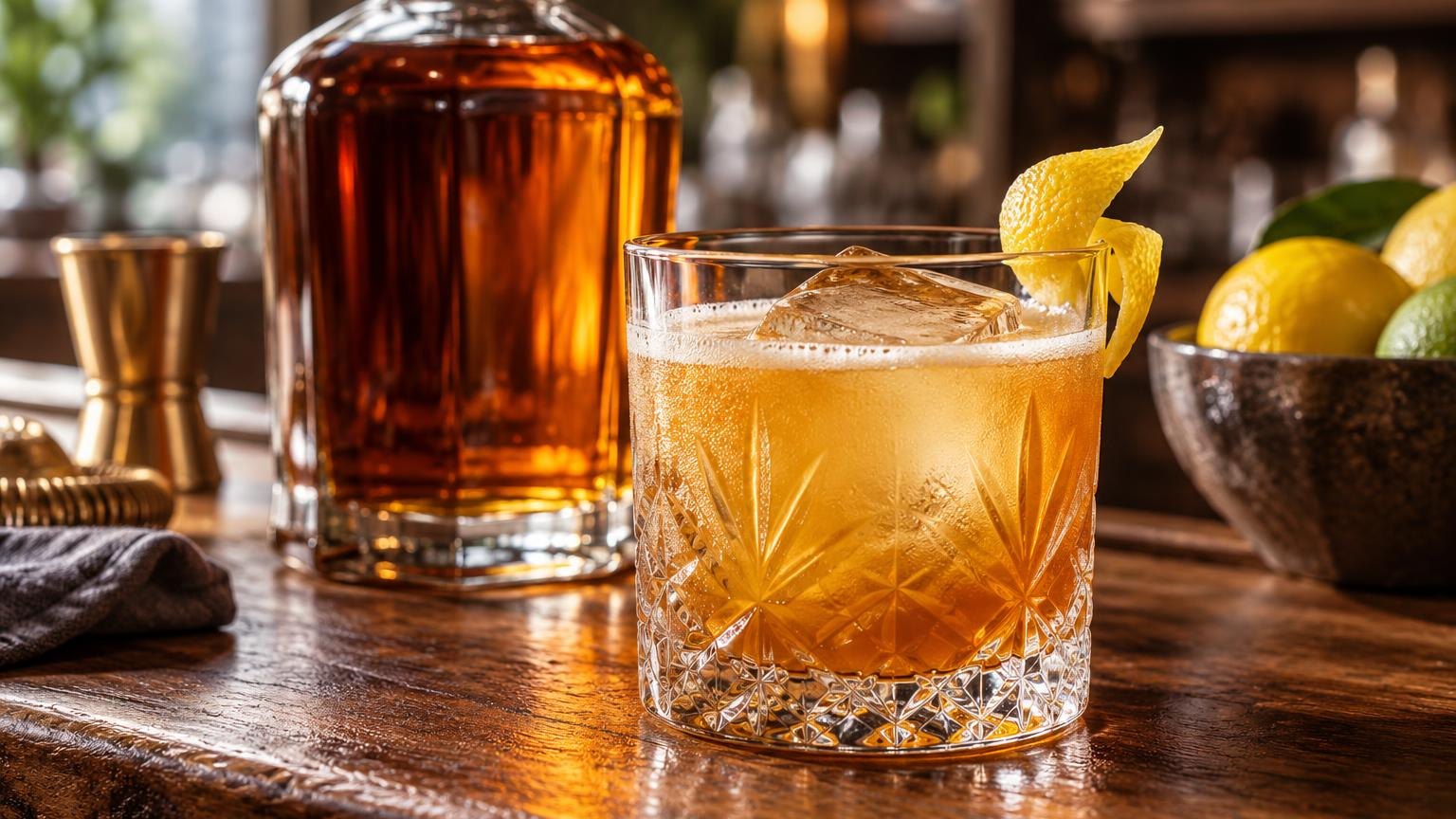
Bourbon remains the most popular choice for whiskey sours. Federal law requires at least 51% corn in the mashbill, producing caramel and vanilla notes that complement lemon juice naturally.
High-rye bourbons like Buffalo Trace (approximately 10% rye in the mashbill) add spice that prevents the cocktail from becoming cloying. Wheated bourbons like Maker’s Mark substitute wheat for rye, yielding a softer, rounder sour.
Rye Whiskey
Rye whiskey requires a minimum 51% rye grain mashbill. The result is drier, spicier, and more herbaceous than bourbon—qualities that create a sharper, more structured sour with pronounced backbone.
Rittenhouse Rye Bottled-in-Bond at 100 proof stands as a bartender benchmark. Its higher ABV (50%) maintains flavor integrity when diluted by ice and citrus juice during shaking.
Blended Scotch
Blended Scotch produces a lighter, more nuanced whiskey sour. Brands like Monkey Shoulder (a vatted malt at 40% ABV) bring malt sweetness and subtle fruit notes without overpowering smoke.
Avoid heavily peated single malts. Phenol levels above 30 ppm (common in Islay malts) clash with citrus and create a medicinal bitterness in the finished cocktail.
Style Comparison for Whiskey Sours
| Style | Typical ABV | Primary Flavor | Sour Character |
| Bourbon | 40–50% | Caramel, vanilla | Sweet, rounded |
| Rye | 40–50% | Baking spice, pepper | Dry, structured |
| Blended Scotch | 40–43% | Malt, honey | Light, nuanced |
| Irish Whiskey | 40% | Green apple, grain | Smooth, mild |
Proof Matters
Target whiskeys between 80 and 100 proof (40–50% ABV). Below 80 proof, the spirit gets buried under 0.75 oz lemon juice and 0.75 oz simple syrup in the classic 2:0.75:0.75 ratio.
- 80 proof (40% ABV): Works for lighter, sessionable sours
- 90 proof (45% ABV): Ideal middle ground for balanced cocktails
- 100 proof (50% ABV): Best for egg white sours where foam further mutes spirit flavor
Bottled-in-bond whiskeys (100 proof by law, aged minimum 4 years) offer reliable cocktail performance at reasonable prices, typically $20–$35 per 750 ml bottle.
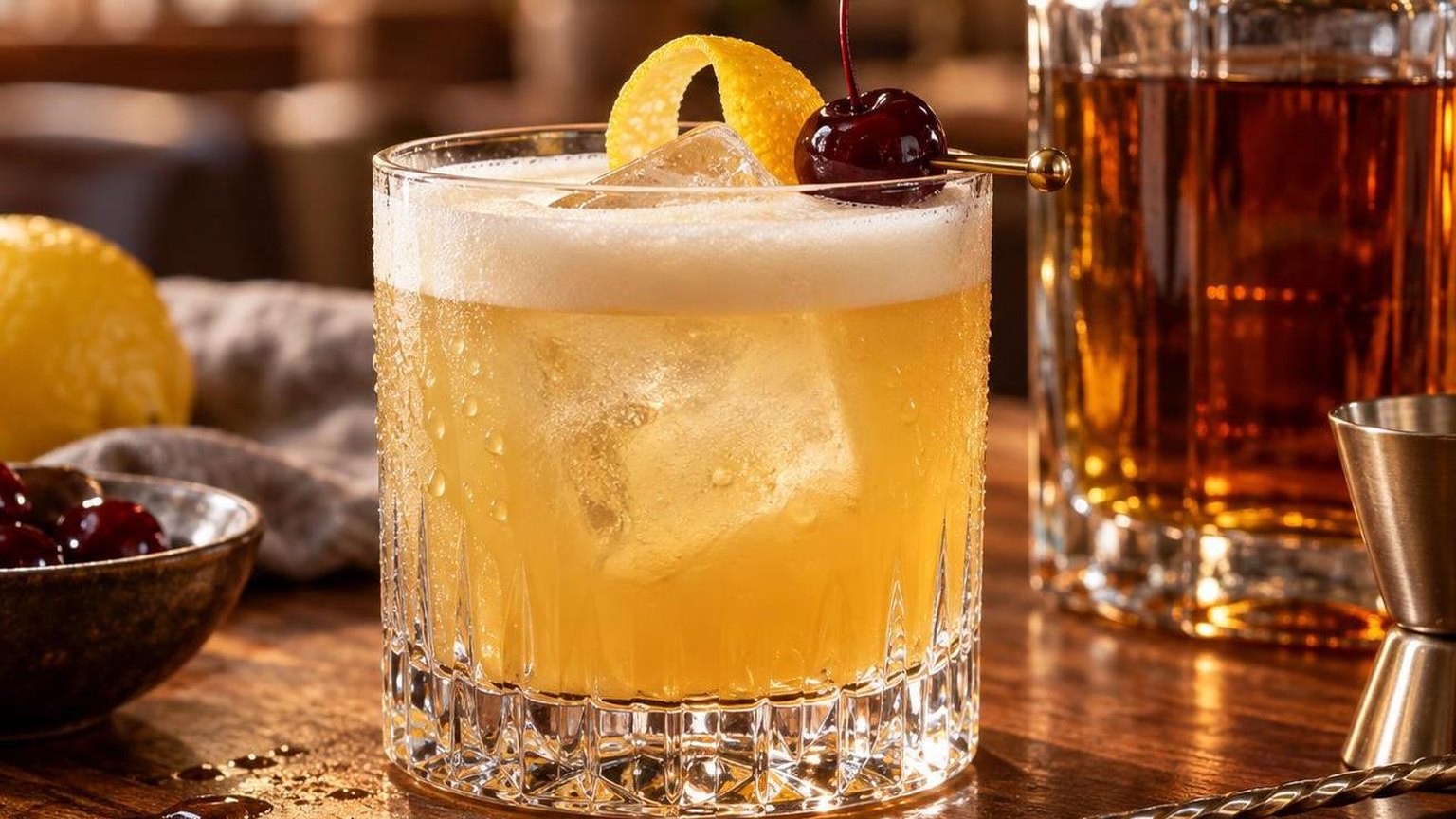
Bourbon Versus Rye Whiskey
Bourbon and rye whiskey produce fundamentally different Whiskey Sours because their mash bill compositions create distinct flavor foundations.
Understanding the legal requirements and grain profiles of each category helps you choose the right bottle for your preferred cocktail style.
Mash Bill Requirements and Flavor Impact
U.S. federal law (27 CFR §5.143) mandates bourbon contain at least 51% corn in its mash bill. Rye whiskey must contain at least 51% rye grain. These minimums drive the core flavor divergence.
| Attribute | Bourbon | Rye Whiskey |
| Primary grain minimum | 51% corn | 51% rye |
| Dominant flavor notes | Caramel, vanilla, brown sugar | Black pepper, baking spice, herbal |
| Typical proof range (bottling) | 80–100 proof | 80–100 proof |
| Max distillation proof | 160 proof (80% ABV) | 160 proof (80% ABV) |
| Max barrel entry proof | 125 proof (62.5% ABV) | 125 proof (62.5% ABV) |
| Barrel requirement | New charred oak | New charred oak |
| Sweetness in sour cocktail | Higher perceived sweetness | Lower; drier finish |
Why Bourbon Works Well in a Whiskey Sour
Corn’s natural sweetness complements the citrus-sugar balance of a classic Whiskey Sour. Bourbon’s vanilla and caramel notes from new charred oak aging merge smoothly with fresh lemon juice and simple syrup.
- Higher corn content (often 60–78% in popular brands) amplifies roundness and body
- Brands like Buffalo Trace (mash bill estimated at ~75% corn) deliver a full, approachable sour
- The sweetness allows bartenders to reduce simple syrup by roughly 0.25 oz per drink
Why Rye Excels in a Whiskey Sour
Rye’s spice and dryness counterbalance the cocktail’s sweetness, producing a more structured, aromatic drink. Many pre-Prohibition Whiskey Sour recipes specified rye exclusively.
- Rittenhouse Rye (bottled at 100 proof, ~51% rye) adds backbone without overwhelming citrus
- High-rye expressions like Bulleit Rye (~95% rye mash bill) push pepper and cinnamon forward
- Rye’s inherent dryness keeps the cocktail from tasting cloying when egg white is added
Choosing Between Them
Preference drives the final decision. Bourbon produces a rounder, sweeter Whiskey Sour suited to drinkers who favor dessert-adjacent cocktails. Rye creates a sharper, spicier version that pairs better with savory appetizers and charcuterie.
Many bartenders split the base — 1 oz bourbon and 1 oz rye — to capture both sweetness and spice in a single 2 oz pour. This “split-base” technique is standard at craft cocktail bars nationwide.
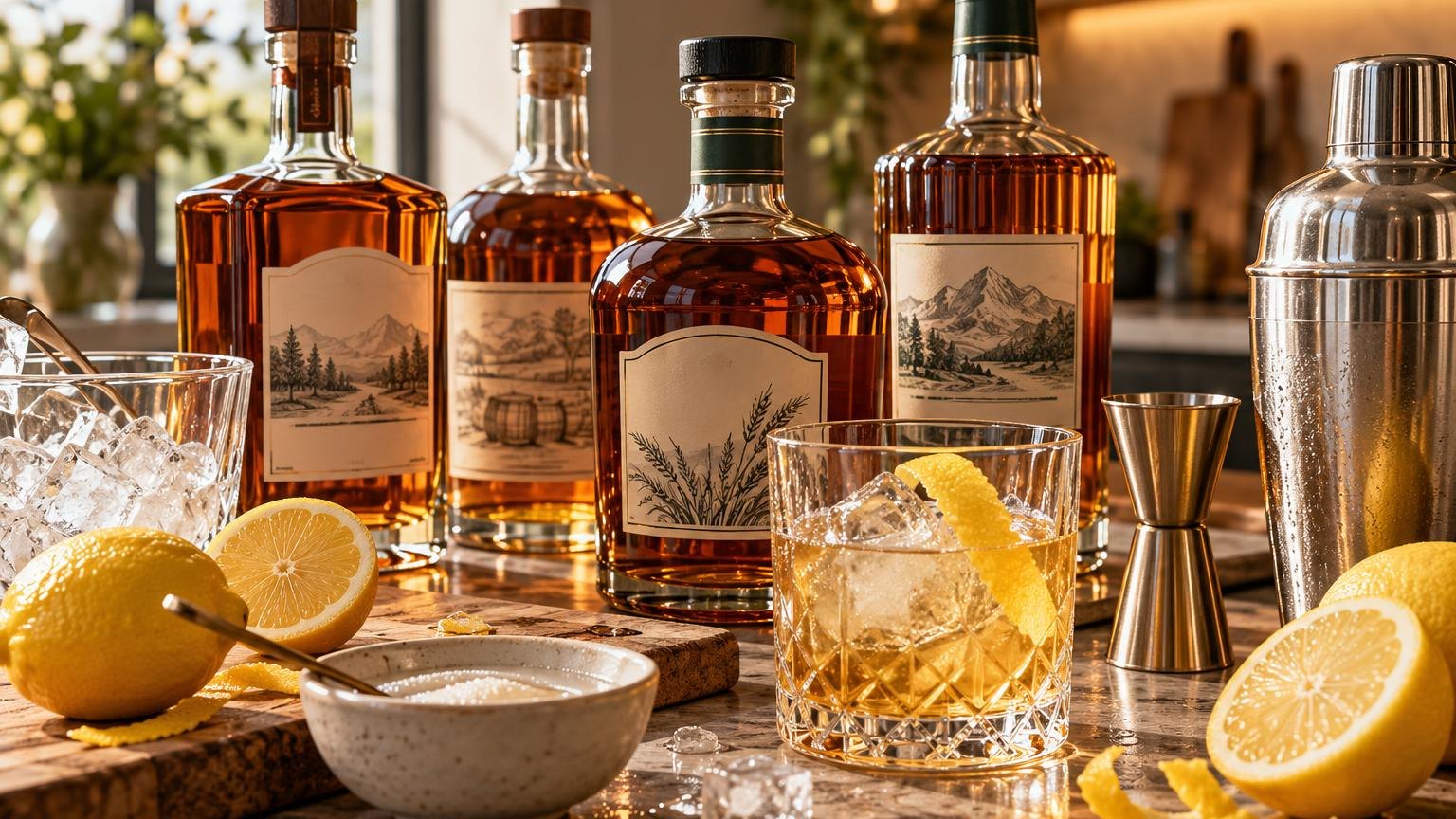
Top Whiskey Brands for Sours
Not every bourbon or rye performs equally in a whiskey sour. The best bottles balance proof, sweetness, and spice so they cut through citrus and simple syrup without disappearing.
These brands consistently rank highest among bartenders and home mixologists.
Best Bourbons for Whiskey Sours
| Brand | Proof | Mash Bill | Why It Works |
| Buffalo Trace | 90 | Corn-heavy, ~8% rye | Caramel and vanilla stand up to lemon without overpowering |
| Wild Turkey 101 | 101 | 75% corn, 13% rye, 12% malted barley | Higher proof punches through dilution from shaking with ice |
| Maker’s Mark | 90 | 70% corn, 16% red winter wheat, 14% malted barley | Wheated profile adds soft sweetness, lets you reduce simple syrup |
| Evan Williams Black Label | 86 | Corn-forward with rye | Budget-friendly at roughly $15 per 750 ml; clean, mild flavor |
Best Rye Whiskeys for Whiskey Sours
Rye whiskeys bring peppery spice and drier character, producing a more complex sour with pronounced herbal and citrus interplay.
| Brand | Proof | Rye Content | Tasting Note in a Sour |
| Rittenhouse Rye | 100 | 51%+ rye | Bold cinnamon-spice backbone; bartender favorite for decades |
| Bulleit Rye | 90 | 95% rye, 5% malted barley | Exceptionally dry and spicy; pairs well with egg white foam |
| Old Overholt | 86 | 59% rye | Light-bodied and affordable (~$16); clean rye bite |
Key Selection Criteria
- Proof range 90–101: Whiskeys below 86 proof tend to taste watery after shaking with ice for 10–15 seconds.
- Price sweet spot $15–$35: Premium single-barrel bottles over $50 lose nuance behind lemon juice and sweetener.
- Barrel age 4–8 years: Younger whiskeys lack depth; over-aged expressions introduce tannic bitterness that clashes with citrus.
- Avoid heavily peated Scotch: Smoky phenols (measured in ppm) create medicinal off-notes in sours. Islay malts at 25–50 ppm phenol are particularly problematic.
Rittenhouse Rye and Wild Turkey 101 dominate professional bar programs. Both carry enough proof and flavor intensity to remain the star ingredient in a 2:1:¾ oz whiskey-to-lemon-to-syrup ratio.
For a balanced starting point, use a 100-proof bourbon or rye shaken with fresh lemon juice and ¾ oz simple syrup. Adjust sweetener by ¼ oz increments based on the bottle’s inherent sweetness profile.
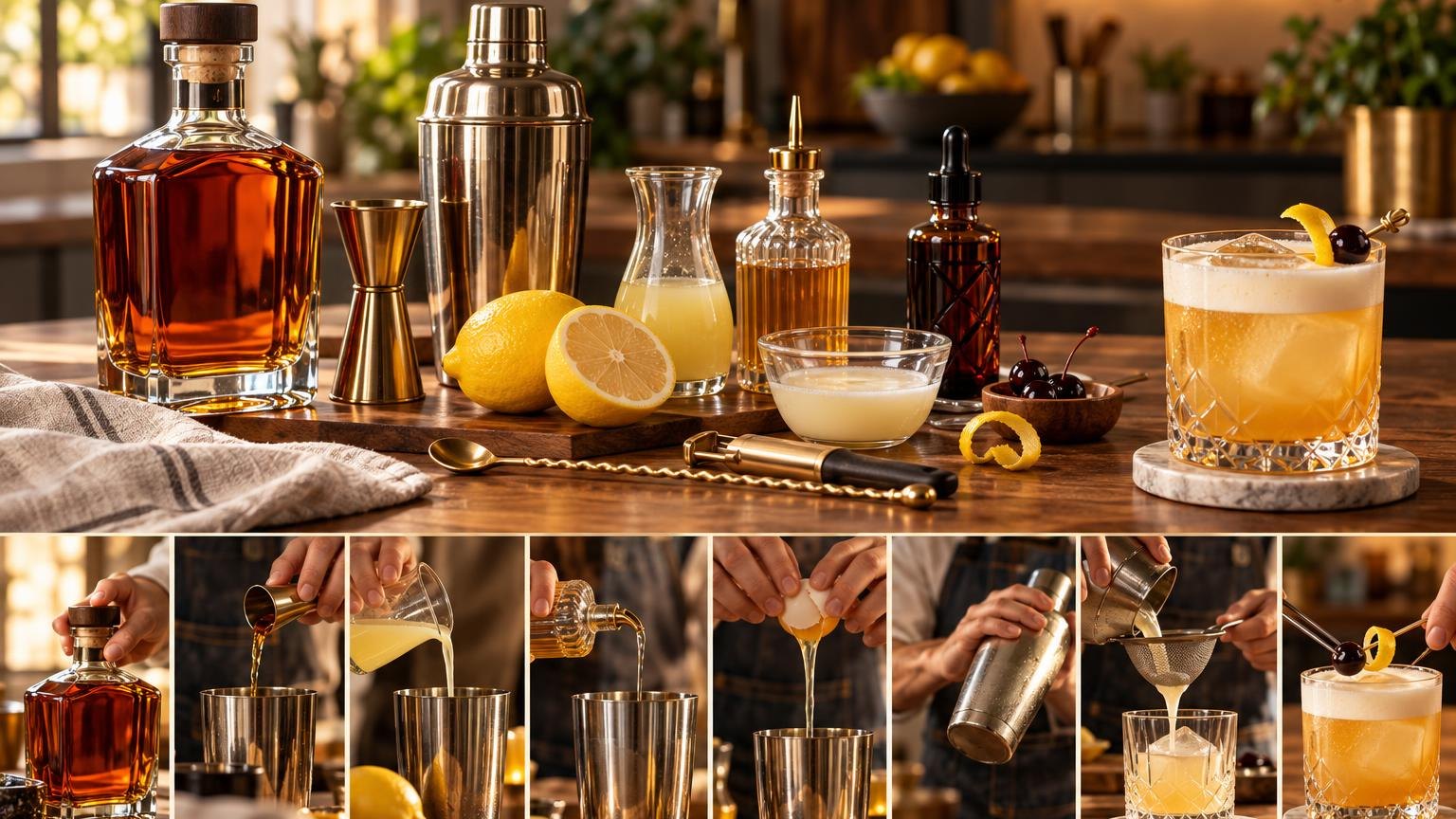
Best Bottles Under $40
The $25–$40 range delivers the strongest value for whiskey sours. These bottles carry enough character to stand up to citrus and simple syrup without wasting nuanced flavors that get buried in cocktails.
Top Picks Compared
| Bottle | Proof | Avg. Price | Mash Bill | Why It Works |
| Buffalo Trace | 90 | $25–$30 | Corn-heavy with rye | Caramel and vanilla balance citrus cleanly |
| Wild Turkey 101 | 101 | $22–$28 | 75% corn, 13% rye, 12% malted barley | High proof punches through dilution from ice and citrus |
| Evan Williams Single Barrel | 86.6 | $28–$33 | 78% corn, 10% rye, 12% malted barley | Honey and dried fruit add depth |
| Rittenhouse Rye BiB | 100 | $25–$30 | 51%+ rye | Spice-forward profile creates a drier, more complex sour |
| Four Roses Small Batch | 90 | $30–$36 | Blend of 4 recipes | Floral and spice notes layer well under lemon |
| Elijah Craig Small Batch | 94 | $28–$34 | 78% corn, 10% rye, 12% malted barley | Oak and char backbone survives egg white foam |
Why Proof Matters in a Sour
A whiskey sour typically contains 2 oz whiskey, ¾ oz lemon juice, and ¾ oz simple syrup. That ratio dilutes the spirit significantly. Bottles below 90 proof often taste flat in the finished drink.
Wild Turkey 101 at 101 proof and Elijah Craig at 94 proof maintain backbone after shaking with ice for 10–15 seconds. The dilution drops effective ABV by roughly 25–30%, so starting higher keeps flavor intact.
Bourbon vs. Rye: Different Sour Profiles
Bourbon-based sours lean sweeter with vanilla and caramel. Rye-based versions — like those made with Rittenhouse — deliver a spicier, drier cocktail that needs less simple syrup.
- For a classic sweet sour: Buffalo Trace or Elijah Craig Small Batch
- For a drier, bar-style sour: Rittenhouse Rye Bottled-in-Bond
- For maximum punch with egg white: Wild Turkey 101 — its high proof and bold oak cut through foam
- For a more nuanced, aromatic sour: Four Roses Small Batch adds floral complexity
Where the Money Goes
Bottles above $40 like Maker’s Mark 46 ($38–$42) or Woodford Reserve Double Oaked ($45–$55) offer extra complexity. But in a three-ingredient cocktail, those subtleties largely disappear behind lemon and sweetener.
Spend $25–$35 on the whiskey and invest the savings in fresh lemons, quality simple syrup made with 2:1 demerara sugar, and large-format ice. Those elements improve a whiskey sour more than an extra $20 on the bottle.
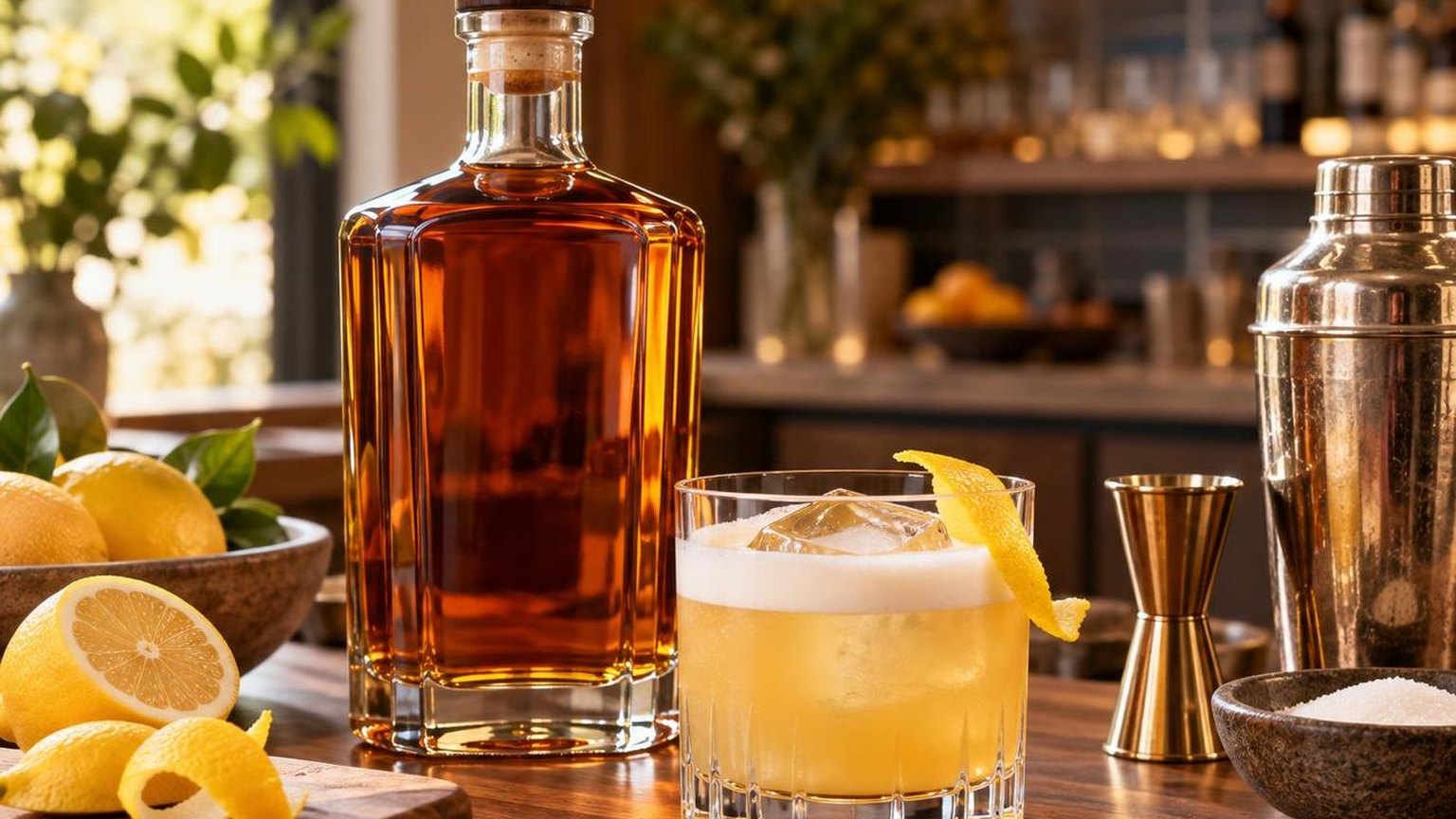
How Proof Changes the Cocktail
Proof directly controls how much whiskey flavor survives dilution from citrus juice, simple syrup, and shaking ice.
A whiskey sour typically contains 2 oz whiskey, 0.75 oz lemon juice, and 0.75 oz simple syrup—meaning roughly 57% of the drink volume is non-spirit.
When you shake with ice for 10–15 seconds, you add approximately 1–1.5 oz of water through dilution. The final ABV in the glass shifts dramatically based on your bottle’s proof.
| Bottle Proof | Bottle ABV | Estimated Final ABV in Glass | Flavor Impact |
| 80 proof | 40% | ~14–15% | Light, citrus-forward, whiskey recedes |
| 90 proof | 45% | ~16–17% | Balanced; whiskey and citrus hold equal weight |
| 100 proof | 50% | ~18–20% | Whiskey-forward, spice and oak punch through |
| 114–115 proof | ~57% | ~21–23% | Intense, barrel character dominates |
Most bartenders consider the 90–100 proof range the sweet spot for whiskey sours. Below 80 proof, the cocktail tastes more like flavored lemonade than a proper sour.
Why Higher Proof Holds Up Better
Ethanol is the primary solvent carrying flavor compounds—vanillin, lactones, tannins—extracted during barrel aging. More ethanol means more flavor molecules reach your palate despite competing ingredients.
Citric acid in lemon juice (about 5–6% concentration) suppresses perception of sweetness and rounds off alcohol burn. Higher-proof whiskeys benefit most from this effect because the acid tames heat without stripping flavor.
Practical Guidelines by Proof Range
- 80 proof (Jameson, Maker’s Mark): Reduce simple syrup to 0.5 oz to prevent the drink from becoming too sweet and losing whiskey presence.
- 90 proof (Buffalo Trace, Wild Turkey 81): Use the standard 0.75 oz syrup ratio. No recipe adjustments needed.
- 100 proof (Rittenhouse Rye, Knob Creek, Old Grand-Dad Bonded): Standard recipe works well; the extra proof adds structure and a longer finish.
- 110+ proof (Rare Breed at 116.8, Stagg Jr.): Consider increasing lemon juice to 1 oz and syrup to 0.75–1 oz to offset intensity. Shake an extra 3–5 seconds for additional dilution.
Temperature matters too. A properly shaken whiskey sour reaches approximately 23–28°F (−5 to −2°C). Higher-proof whiskeys chill slightly slower due to ethanol’s lower freezing point, so extend shaking time accordingly.
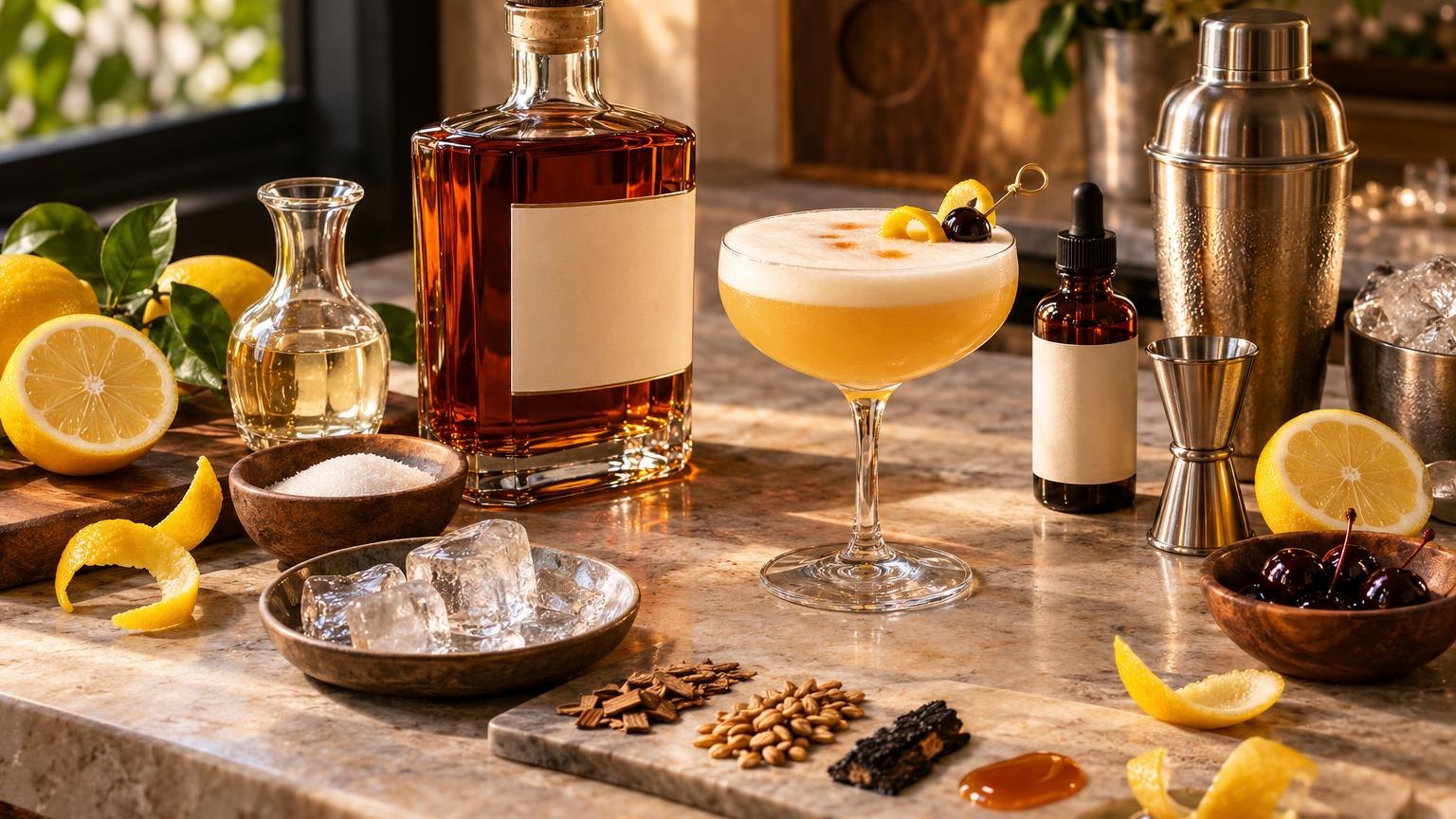
Whiskey Sour Pairing and Garnish Choices
A whiskey sour’s balance of sweet, tart, and spirit makes it remarkably versatile with food.
The cocktail’s acidity (pH around 3.0–3.5) cuts through fat and richness, while its residual sweetness complements savory and umami flavors.
Food Pairings That Work
Rich, fatty proteins pair best because the lemon juice acts as a palate cleanser between bites. Match intensity: bourbon sours with heavier dishes, rye sours with spiced or smoked preparations.
| Food Category | Specific Pairing | Why It Works |
| Charcuterie | Country pâté, aged salami | Fat cut by citrus acidity |
| Fried foods | Fried chicken, tempura shrimp | Acid and carbonation (if shaken hard) refresh the palate |
| Aged cheese | 18-month Comté, sharp cheddar | Nutty sweetness echoes bourbon caramel notes |
| Smoked meats | Brisket, smoked pork belly | Rye spice complements smoke; lemon lifts richness |
| Desserts | Lemon tart, pecan pie | Citrus-on-citrus harmony; bourbon mirrors pecan’s toasted sugars |
Classic Garnish Options
The traditional garnish is an orange half-wheel and a Luxardo maraschino cherry. Brandied cherries (about $18–$22 per jar for Luxardo) outperform artificially dyed versions in both flavor and presentation.
- Orange half-wheel: Expressed oils add 0.1–0.2 mL of citrus oil to the drink’s aroma, enhancing perceived sweetness
- Luxardo maraschino cherry: Candied in syrup at 50% sugar concentration; adds a sweet, slightly bitter finish
- Lemon wheel: Reinforces tartness; best on rye-based sours where extra brightness helps
- Angostura bitters dash on foam: 3–5 drops atop egg white foam creates aromatic complexity and visual contrast
- Dehydrated citrus wheel: Holds structure longer than fresh; concentrates flavor by removing roughly 90% of water content
Garnishes to Avoid
Mint sprigs compete with the cocktail’s citrus-forward profile. Olive or savory garnishes clash with the simple syrup’s sweetness. Cocktail umbrellas add nothing to aroma or flavor.
Seasonal Variations
In fall, substitute a thin apple fan and a cinnamon stick—apple’s malic acid (roughly 0.4–0.7 g per 100 g) complements lemon’s citric acid.
During summer, a sprig of thyme adds herbal depth without overpowering the drink’s 2:1 spirit-to-citrus ratio.
Questions Readers Ask
What proof whiskey works best in a whiskey sour?
Choose a bourbon or rye between 90–100 proof.
Higher-proof spirits (such as Wild Turkey 101 at 101 proof or Rittenhouse Rye at 100 proof) hold their flavor against the lemon juice and simple syrup instead of tasting watered down once shaken with ice.
Is rye or bourbon better for a whiskey sour?
Rye delivers a spicier, drier cocktail because its mash bill must contain at least 51% rye grain, which counters the drink’s sweetness. Bourbon, with its 51%+ corn mash bill, produces a rounder, sweeter sour.
Most bartenders recommend trying both—Buffalo Trace for a smooth bourbon version, Bulleit Rye for a sharper, more herbaceous one.
Can you use a budget whiskey under $20 for a whiskey sour?
Evan Williams Black Label (roughly $15 for 750 ml) and Old Grand-Dad Bonded ($22–25 but often on sale under $20) are two widely recommended budget picks.
The citrus and sweetener in a sour mask subtle imperfections, so spending more than $30 per bottle yields diminishing returns in this cocktail.
Should you avoid single malt Scotch or peated whisky in a whiskey sour?
Heavily peated Scotch like Laphroaig 10 (at ~48 ppm phenol) can overwhelm the balance with campfire smoke, clashing with the bright citrus.
Lightly peated or unpeated options such as Monkey Shoulder (a blended malt at 40% ABV) can work, but American whiskey remains the traditional and most forgiving base for this cocktail.
Does using an egg white change which whiskey you should pick?
Egg white mutes sharp edges and adds body, so a bolder, higher-proof whiskey like Knob Creek 9-Year (100 proof) or Wild Turkey 101 punches through the foam better.
With a lighter 80-proof bourbon such as Maker’s Mark, the egg white can flatten the whiskey’s presence, leaving the drink tasting more of citrus than spirit.
Related Reading
- Crown Royal Vanilla Drinks – Our Top 12 Recipes
- Who Taught Jack Daniel’S To Make Whiskey?
- How To Drink Japanese Whisky Like A Pro? Find Out Now
- What Is Elijah Craig 18 Msrp? Answer From Expert
- Bushmills Vs Jameson
- Is Sazerac Rye Hard To Find?
- How Long Does It Take To Make Whiskey?
- All Alcohol Guides
- Alcohol and Tobacco Tax and Trade Bureau – Standards of Identity for Distilled Spirits (2023)
- USDA FoodData Central – Whiskey Nutrient Profile (2024)
- National Institute on Alcohol Abuse and Alcoholism – What Is a Standard Drink? (2023)
- CDC – Dietary Guidelines for Alcohol (2024)
- Cornell University Department of Food Science – Citrus Juice Acidity and Cocktail Balance (2022)
- Difford's Guide – Whiskey Sour Recipe and Spirit Selection (2024)
- The Oxford Companion to Spirits and Cocktails, Oxford University Press (2021)
- Distilled Spirits Council of the United States – American Whiskey Category Report (2024)