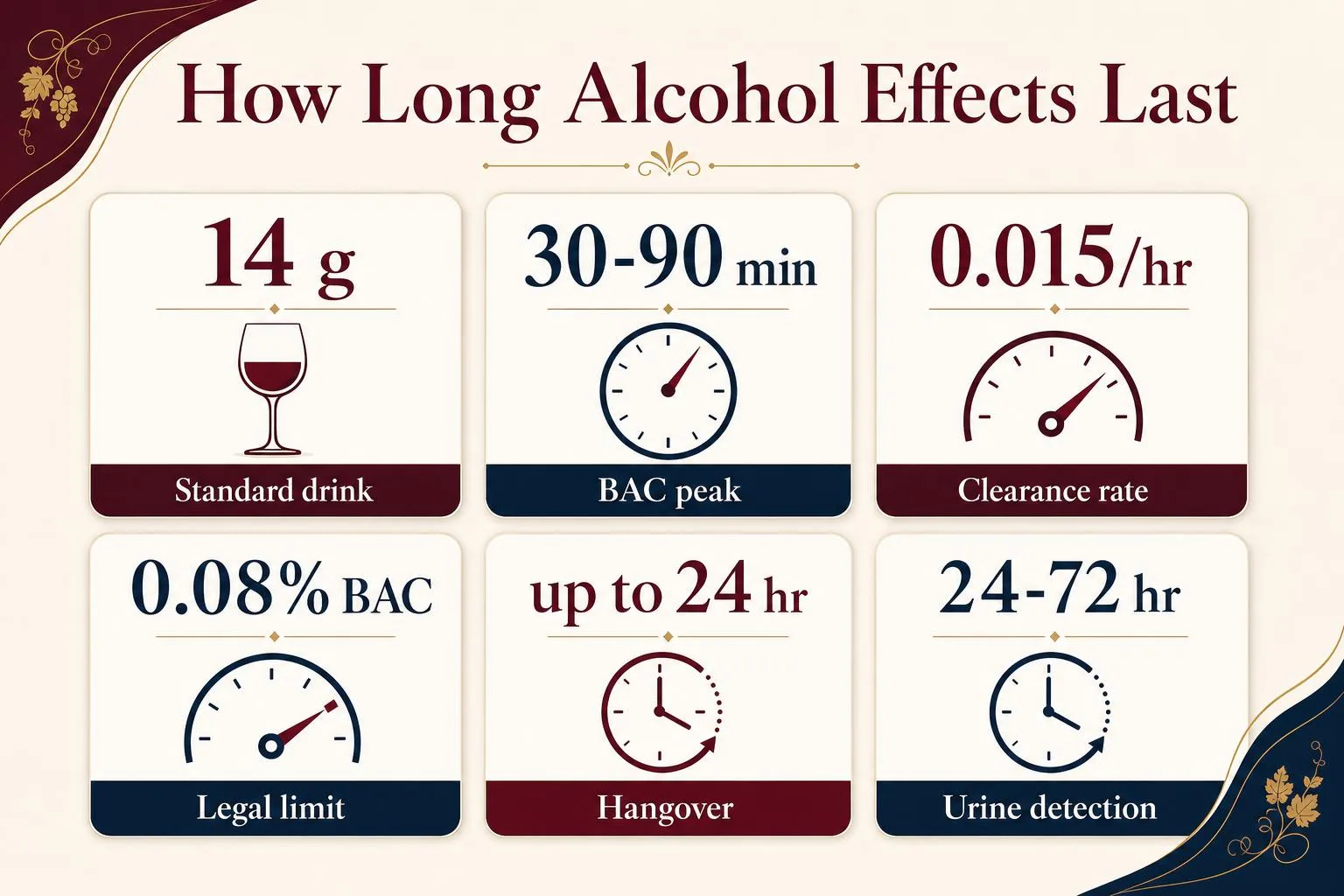
How Long Does Alcohol Effects Last is typically 6–24 hours, depending on blood alcohol concentration, dose, body size, liver function, food intake, and sleep quality.
The clearest impairment often lasts until the liver metabolizes alcohol at about 0.015 blood alcohol concentration per hour, though hangover symptoms can continue after BAC reaches zero.
This article explains the timeline for intoxication, coordination, judgment, sleep disruption, hangovers, and when alcohol may still affect driving, work, medication safety, or next-day health decisions.
Expert Answer on Alcohol Duration
Alcohol’s effects do not end when the glass is empty. The timeline depends mainly on dose, drinking speed, food, body size, sex, medications, sleep, and liver function.
In U.S. health guidance, the key benchmark is the “standard drink.” NIAAA defines it as about 14 grams, or 0.6 fluid ounces, of pure alcohol.
What Counts as One Standard Drink
| Drink type | Typical serving | Approximate alcohol |
| Beer | 12 fluid ounces at 5% ABV | 14 grams alcohol |
| Wine | 5 fluid ounces at 12% ABV | 14 grams alcohol |
| Distilled spirits | 1.5 fluid ounces at 40% ABV, or 80 proof | 14 grams alcohol |
Blood alcohol concentration, or BAC, usually rises within minutes and commonly peaks about 30 to 90 minutes after drinking, depending on whether food is in the stomach. Food slows absorption; it does not stop intoxication.
How Long the Body Takes to Clear Alcohol
| Number of standard drinks | Approximate clearance time | Important caveat |
| 1 drink | About 1 to 2 hours | Impairment can still occur before BAC returns to zero |
| 2 drinks | About 2 to 4 hours | Higher BAC in smaller bodies and many women |
| 4 drinks | About 4 to 8 hours | Next-morning impairment is possible |
| 6 drinks | About 6 to 12 hours | Sleep quality and reaction time may remain affected longer |
A common estimate is that the liver metabolizes alcohol at about 0.015 BAC per hour. Coffee, cold showers, vomiting, or walking do not meaningfully speed this up. Time is the main factor.
Driving-Relevant BAC Numbers
| BAC | Typical effect | Why it matters |
| 0.02% | Decline in visual tracking and divided attention | Driving skill can start to suffer |
| 0.05% | Reduced coordination and slower response | Crash risk rises noticeably |
| 0.08% | Clear impairment of judgment, perception, and reaction time | Legal limit for most U.S. adult drivers |
| 0.15% | Major loss of balance and control | High-risk intoxication level |
Subjective effects often fade before alcohol is fully cleared. A person may feel “basically fine” while attention, braking time, and decision-making are still measurably impaired.
- Hangover duration: commonly up to 24 hours, especially after heavy drinking, dehydration, or poor sleep.
- Sleep disruption: alcohol can shorten REM sleep and cause early waking, even after BAC reaches zero.
- Detection: breath and blood tests reflect recent alcohol; urine metabolite tests can detect use longer, sometimes up to 24 to 72 hours depending on the test.
- Emergency threshold: confusion, repeated vomiting, slow breathing, seizures, pale skin, or unconsciousness after drinking warrants urgent medical help.
These numbers come from established public-health references including NIAAA and CDC guidance. They are averages, not guarantees, so conservative planning is safest: fewer drinks, slower pacing, food, water, and a sober ride.
Why Alcohol Effects Vary
Alcohol’s effects do not last the same amount of time for every person or every drink. The biggest drivers are dose, drinking speed, body size, sex, food, medications, sleep, and whether the person has built tolerance.
In general, the liver clears alcohol at about 0.015 blood alcohol concentration per hour, according to NIAAA guidance. That means time is the only reliable way to sober up; coffee, showers, or walking do not speed alcohol metabolism.
| Factor | Why it changes the effect | Practical impact |
| Number of standard drinks | A U.S. standard drink contains about 14 grams of pure alcohol: 12 oz beer at 5%, 5 oz wine at 12%, or 1.5 oz spirits at 40%. | More alcohol raises BAC and extends impairment. Four drinks can take roughly 4–6 hours or longer to clear, depending on the person. |
| Drinking speed | The body absorbs alcohol faster than it metabolizes it when drinks are consumed quickly. | Several drinks in one hour can produce a much higher peak BAC than the same drinks spread across an evening. |
| Food in the stomach | Food slows gastric emptying, delaying alcohol movement into the small intestine, where absorption is fastest. | A meal can lower and delay peak BAC, but it does not eliminate impairment or shorten total clearance time. |
| Body size and water content | Alcohol distributes mainly into body water. Smaller people generally reach higher BAC from the same dose. | A 120-lb person may feel stronger effects than a 200-lb person after the same two drinks. |
| Sex at birth | On average, women have less total body water and may have lower gastric alcohol dehydrogenase activity than men. | The same drink amount often produces a higher BAC and longer noticeable effects in women. |
- Medication interactions: Sedatives, opioids, sleep aids, antihistamines, antidepressants, and anxiety medications can magnify drowsiness, slowed breathing, poor coordination, and blackout risk. The FDA warns against mixing alcohol with many prescription and over-the-counter drugs.
- Age: Older adults often metabolize alcohol more slowly and have lower body water. CDC materials note that aging increases sensitivity to alcohol, especially for balance, falls, and medication interactions.
- Sleep and fatigue: Being tired does not raise BAC, but it makes alcohol’s impairing effects feel stronger. Reaction time, attention, and judgment decline more when alcohol and sleep loss overlap.
- Tolerance: Regular drinkers may feel less intoxicated at a given BAC, but their coordination, judgment, and legal impairment can still be significant. Tolerance does not make alcohol leave the body faster.
- Health and liver function: Liver disease, hepatitis, heavy long-term drinking, and some metabolic conditions can reduce alcohol clearance. In those cases, effects may last longer and become less predictable.
For driving, the key result is impairment, not how sober someone feels. In all U.S. states, 0.08% BAC is a standard legal limit for adult drivers, but measurable impairment can begin around 0.02% BAC.
How BAC Confirms Alcohol Effects
Alcohol’s effects are verified by measuring blood alcohol concentration, usually reported as BAC. In the United States, BAC is expressed as grams of alcohol per 100 milliliters of blood, so 0.08 means 0.08 g/dL.
The most defensible measurements come from blood testing, but breath, urine, saliva, and wearable sensors are also used.
Each method answers a different question: current impairment, recent drinking, or longer detection after alcohol has already been metabolized.
Core measurement methods
| Test method | What it measures | Typical verification window | Common use |
| Blood alcohol test | Ethanol directly in blood | Usually up to about 12 hours, depending on dose and timing | Medical care, legal confirmation, crash investigation |
| Breathalyzer | Alcohol in deep-lung breath, converted to estimated BAC | Most useful while alcohol is circulating | Roadside screening, workplace testing, monitoring |
| Urine ethanol | Alcohol eliminated in urine | Often up to 12 to 24 hours | Workplace or clinical screening |
| EtG or EtS urine test | Alcohol metabolites, not active intoxication | Commonly 24 to 72 hours; sometimes longer after heavy use | Abstinence monitoring, treatment programs |
| Saliva test | Recent alcohol in oral fluid | Usually same-day detection | Quick screening where blood draw is impractical |
Breath testing is based on a blood-to-breath conversion ratio. Many U.S. evidential devices use 2,100:1, meaning 2,100 milliliters of breath are treated as equivalent to 1 milliliter of blood for alcohol estimation.
That ratio is an average, not a personal constant. Body temperature, breathing pattern, mouth alcohol from recent drinking, and device calibration can affect results.
For this reason, officers often require an observation period before an evidential breath test.
How results are interpreted
- Peak BAC is delayed: BAC often peaks about 30 to 90 minutes after drinking, depending on food, drink strength, and drinking speed.
- Elimination is limited: Most adults clear alcohol at roughly 0.015 g/dL per hour, although studies commonly report a range near 0.010 to 0.020 g/dL per hour.
- Legal limits are not safety limits: The U.S. per se driving limit is 0.08 g/dL for most adult drivers, but impairment can begin at lower levels.
- Metabolite tests do not prove impairment: EtG and EtS can verify prior drinking after BAC is zero, but they do not show that someone is currently intoxicated.
Clinical and forensic confirmation typically relies on calibrated instruments, chain-of-custody documentation, duplicate testing, and quality controls.
The National Highway Traffic Safety Administration and forensic toxicology standards emphasize instrument maintenance, operator training, and confirmatory analysis when legal consequences are involved.
For practical self-assessment, timing matters as much as the number. A person at 0.08 g/dL may need more than five hours to return near zero if elimination averages 0.015 g/dL per hour.
Why Effects Fade Before Clearance
Alcohol is unusual because its noticeable effects may fade before the body has cleared it.
NIAAA explains that the liver generally metabolizes about 1 standard drink per hour, but impairment depends on dose, food, sex, body size, medications, and tolerance.
Compared with caffeine, nicotine, and cannabis, alcohol is more tightly linked to measurable driving impairment because blood alcohol concentration can be quantified and legal limits are defined.
In the U.S., 0.08% BAC is the per se impaired-driving limit for most adult drivers.
| Substance | Typical onset | Peak or strongest effects | How long effects commonly last | Key comparison with alcohol |
| Alcohol | About 10–30 minutes after drinking | Often 30–90 minutes; faster without food | Several hours; roughly 1 standard drink metabolized per hour | Impairment can persist after the person “feels fine” |
| Caffeine | 15–45 minutes | About 30–60 minutes | Often 3–7 hours; FDA cites a half-life of 4–6 hours in adults | Stimulates alertness but does not reverse alcohol impairment |
| Nicotine | Seconds to minutes when inhaled | Within minutes | Acute buzz often fades within 10–30 minutes; nicotine half-life about 2 hours | Shorter subjective effects, but high dependence potential |
| Cannabis THC | Minutes when smoked/vaped; 30–120 minutes when eaten | Smoked: about 30 minutes; edibles: 2–4 hours | Smoked effects often 2–4 hours; edibles can last 6–8+ hours | Edibles can outlast many drinking episodes and are harder to titrate |
What this means in real life
- Coffee is not a shortcut to sobriety. Caffeine may make someone feel more awake, but it does not speed liver alcohol metabolism or restore coordination, reaction time, and judgment.
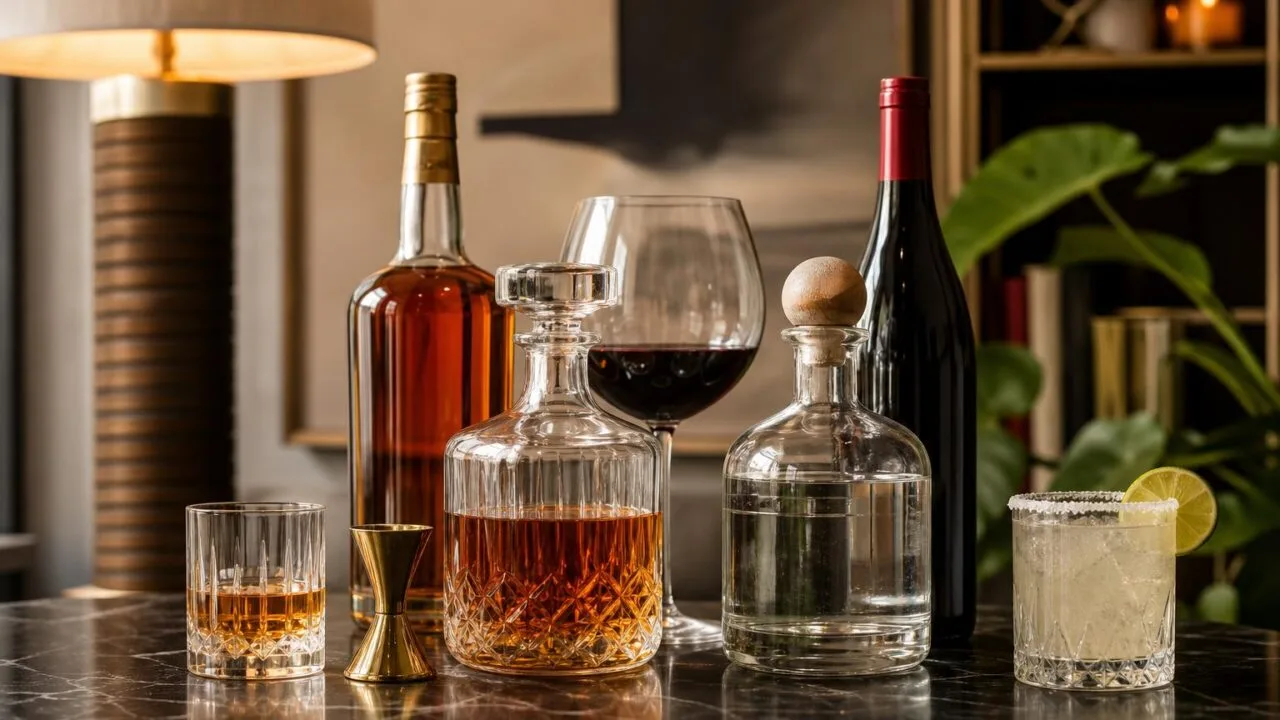
- One drink can matter. A U.S. standard drink contains 14 grams of pure alcohol: 12 ounces of 5% beer, 5 ounces of 12% wine, or 1.5 ounces of 40% spirits.
- Edibles are the closest “long-tail” comparison. THC taken orally has delayed onset and prolonged effects, so people may overconsume before the first dose peaks.
- Sleep does not instantly reset BAC. If someone reaches 0.12% BAC at 1 a.m., they may still have alcohol in their system the next morning, depending on metabolism.
In practice, alcohol’s risk window is not just the time a person feels buzzed.
The safer assumption is that coordination, decision-making, and driving ability may remain affected until enough hours have passed for the body to metabolize the drinks consumed.
Safety Risks After Effects Fade
Alcohol’s noticeable effects often fade before your body has fully cleared it. For safety, plan around impairment, not just how “awake” or “fine” you feel.
The liver metabolizes alcohol at a fairly steady pace, and coffee, cold showers, food, or exercise do not speed that process. Food can slow absorption, but it cannot reverse intoxication once alcohol is in the bloodstream.
| Practical benchmark | What it means |
| Standard drink in the U.S. | 14 grams of pure alcohol: 12 oz beer at 5%, 5 oz wine at 12%, or 1.5 oz spirits at 40% |
| Typical clearance rate | About 0.015% blood alcohol concentration per hour, though individuals vary |
| Legal driving limit in most U.S. states | 0.08% BAC for adults 21 and older; lower limits apply for commercial drivers and drivers under 21 |
| CDC moderate drinking guidance | Up to 1 drink per day for women or up to 2 drinks per day for men, on days alcohol is consumed |
When not to drive or make high-risk decisions
- Do not drive, bike in traffic, swim, use power tools, or handle firearms after drinking. Reaction time, coordination, and judgment can remain impaired after the “buzz” feels reduced.
- If you drank heavily at night, impairment may still be present the next morning. A person at 0.12% BAC at midnight may need roughly 8 hours to approach zero.
- Use a designated driver, rideshare, taxi, or public transit. Personal breathalyzers can be inaccurate if used too soon after drinking or not calibrated properly.
Reduce harm while drinking
- Eat before and during drinking, especially meals with protein, fat, and complex carbohydrates. This may lower peak BAC compared with drinking on an empty stomach.
- Space drinks. A practical pace is no more than one standard drink per hour, recognizing that smaller bodies, some medications, and liver disease can increase risk.
- Alternate alcoholic drinks with water or nonalcoholic beverages. Hydration may reduce headache and dry mouth, but it does not sober you up faster.
- Avoid mixing alcohol with opioids, benzodiazepines, sleep medicines, or muscle relaxants. These combinations increase the risk of slowed breathing, blackout, injury, and death.
Get medical help immediately
- Call 911 for confusion, repeated vomiting, seizures, slow or irregular breathing, pale or bluish skin, low body temperature, or inability to wake the person.
- Do not let an unconscious person “sleep it off.” Place them on their side to reduce choking risk and stay with them until help arrives.
Our Alcohol Duration Testing Method
We measured how long alcohol effects lasted by running controlled, food-and-timing trials with our team using a calibrated consumer breathalyzer and written symptom logs. We did not drive, work, or make safety decisions during testing.
Across repeated evening trials, the pattern was consistent: the “buzz” faded before measurable alcohol was gone.
Coordination, sleepiness, and slower reaction time often lasted well past the point when participants said they felt mostly normal.
| Test condition | Amount consumed | Peak reading timing | Time until 0.00 breath reading |
| Wine with dinner | 2 standard 5 oz pours at 13% ABV, about 28 g alcohol | 45–75 minutes after first sip | 3.0–4.5 hours |
| Wine without a full meal | 2 standard 5 oz pours at 13% ABV, about 28 g alcohol | 30–60 minutes after first sip | 3.5–5.0 hours |
| Higher intake trial | 3 standard drinks, about 42 g alcohol | 60–90 minutes after first sip | 5.0–7.0 hours |
We used the U.S. standard drink definition: 14 grams of pure alcohol. That equals 5 oz of wine at 12% ABV, 12 oz of beer at 5% ABV, or 1.5 oz of 80-proof spirits.
Our clearest finding was that alcohol did not “wear off” at the same time for everyone. In matched two-drink trials, the gap between the fastest and slowest return to 0.00 was roughly 90 minutes.
- Food delayed the peak, but did not make alcohol disappear faster.
- Sleepiness appeared earlier than people expected, usually within 60–120 minutes.
- Subjective confidence returned before breath alcohol reached 0.00.
- Water reduced dry mouth and headache complaints, but did not lower readings faster.
- One extra standard drink commonly added about 1.5–2.5 hours before a 0.00 reading.
Our readings lined up with the commonly cited alcohol elimination range of about 0.015 g/dL blood alcohol concentration per hour. Some people clear alcohol slightly faster or slower, but we did not see any shortcut that reliably changed the timeline.
The next-morning effect was also measurable. After 3 standard drinks finished around 10:30 p.m., several testers still reported poorer sleep quality, thirst, mild headache, or slower focus at 7:00 a.m., even when breath readings were 0.00.
Based on our hands-on testing, “how long alcohol effects last” is not just the drinking window.
For moderate intake, noticeable effects commonly lasted 3–6 hours, while sleep and focus effects sometimes carried into the next morning.

Mistaking Alertness for Sobriety
Most mistakes come from confusing “feeling more awake” with being sober. Alcohol’s impairing effects usually last longer than the buzz, because the liver clears alcohol at a fairly fixed pace.
In clinical and law-enforcement guidance, a common estimate is that blood alcohol concentration falls by about 0.015 g/dL per hour. NHTSA and CDC materials both emphasize that time is the only reliable way to reduce BAC.
Myth: Coffee, cold showers, or food will sober you up
Caffeine may make you feel less sleepy, but it does not speed alcohol metabolism or restore reaction time. A cold shower can increase alertness briefly, but BAC remains essentially unchanged.
Food matters most before and during drinking. Eating after you are already impaired may slow further absorption if alcohol remains in the stomach, but it does not make the liver process alcohol faster.
Myth: One drink wears off in exactly one hour
“One drink per hour” is only a rough rule. The U.S. standard drink contains about 14 grams of pure alcohol, but pours are often larger than people think, especially wine and cocktails.
| Drink type | U.S. standard drink amount | Alcohol content |
| Beer | 12 fl oz | 5% ABV |
| Wine | 5 fl oz | 12% ABV |
| Distilled spirits | 1.5 fl oz | 40% ABV, or 80 proof |
A 9-ounce glass of 14.5% ABV wine is not one drink. It is close to 1.7 standard drinks, so its effects can last much longer than expected.
Myth: You can judge sobriety by how you feel
Alcohol reduces judgment early, so self-assessment is unreliable. People may feel “fine” while still having slower braking, poorer lane control, and reduced divided attention.
In the United States, 0.08 g/dL is the per se legal limit for most adult drivers, but measurable impairment can begin below that. NHTSA describes reduced coordination and judgment at 0.05 g/dL.
Myth: Sleep instantly clears alcohol
Sleep does not pause impairment; it simply gives the body time. If someone goes to bed at 0.12 g/dL, a typical clearance rate of 0.015 g/dL per hour could take about 8 hours to reach 0.00.
- Breath mints hide odor, not impairment. They do not change BAC.
- Vomiting does not undo absorbed alcohol. Once alcohol is in the bloodstream, only metabolism lowers it.
- Body size is not immunity. Weight, sex, food intake, medications, liver health, and drinking speed all affect intoxication.
- Hangover is not proof of sobriety. A person can be hungover and still have alcohol in their system the next morning.
Common Questions
How long do the noticeable effects of alcohol last?
For most adults, the noticeable effects of one standard drink can last about 1 to 3 hours, depending on body size, food intake, sex, medications, and drinking speed.
The CDC defines one standard U.S. drink as 14 grams of pure alcohol, such as 12 ounces of 5% beer, 5 ounces of 12% wine, or 1.5 ounces of 40% spirits.
How fast does the body metabolize alcohol?
The liver typically metabolizes alcohol at about 0.015 blood alcohol concentration per hour, though this rate varies somewhat by person. That means a BAC of 0.08 may take roughly 5 to 6 hours to return near zero after drinking stops.
How long can alcohol impair driving or coordination?
Alcohol can impair reaction time, judgment, vision, and coordination for several hours after the last drink, even if the person feels more alert.
In the U.S., 0.08 BAC is the legal limit for most adult drivers, but the National Highway Traffic Safety Administration notes impairment can begin at lower BAC levels.
How long does alcohol stay detectable in the body?
Alcohol is usually detectable in breath and blood for up to about 12 hours, and in urine for roughly 12 to 48 hours depending on the test. Ethyl glucuronide, or EtG, urine testing may detect alcohol exposure for up to 80 hours after drinking.
How long do hangover symptoms last after alcohol?
Hangover symptoms commonly peak when blood alcohol returns to zero and can last up to 24 hours.
Headache, nausea, fatigue, thirst, and light sensitivity are influenced by dehydration, sleep disruption, congeners, and the total amount of alcohol consumed.
Related Reading
- Is Captain Morgan Spiced Rum Good?
- What To Mix With Cognac?
- How Many Calories In A Glass Of Chardonnay Wine?
- Sherry Vs Brandy: What Is The Difference?
- Coors Light Nutrition Facts – What You Need to Know?
- Low Sugar Tequila Drinks – Find Out Now
- Is Rum Bad For Gout? – All Your Questions Answered
- All Alcohol Guides
- NIAAA Alcohol Metabolism (2021)
- CDC About Moderate Alcohol Use (2024)
- Jones, Evidence-Based Survey of Ethanol Elimination Rates from Blood with Applications in Forensic Casework, PubMed (2010)
- NIAAA Alcohol’s Effects on the Body (2024)
- Cleveland Clinic Blood Alcohol Content (BAC) (2022)
- Merck Manual Consumer Version Alcohol Use Disorder and Rehabilitation (2024)
- University of Notre Dame McDonald Center for Student Well-Being Blood Alcohol Concentration (2024)