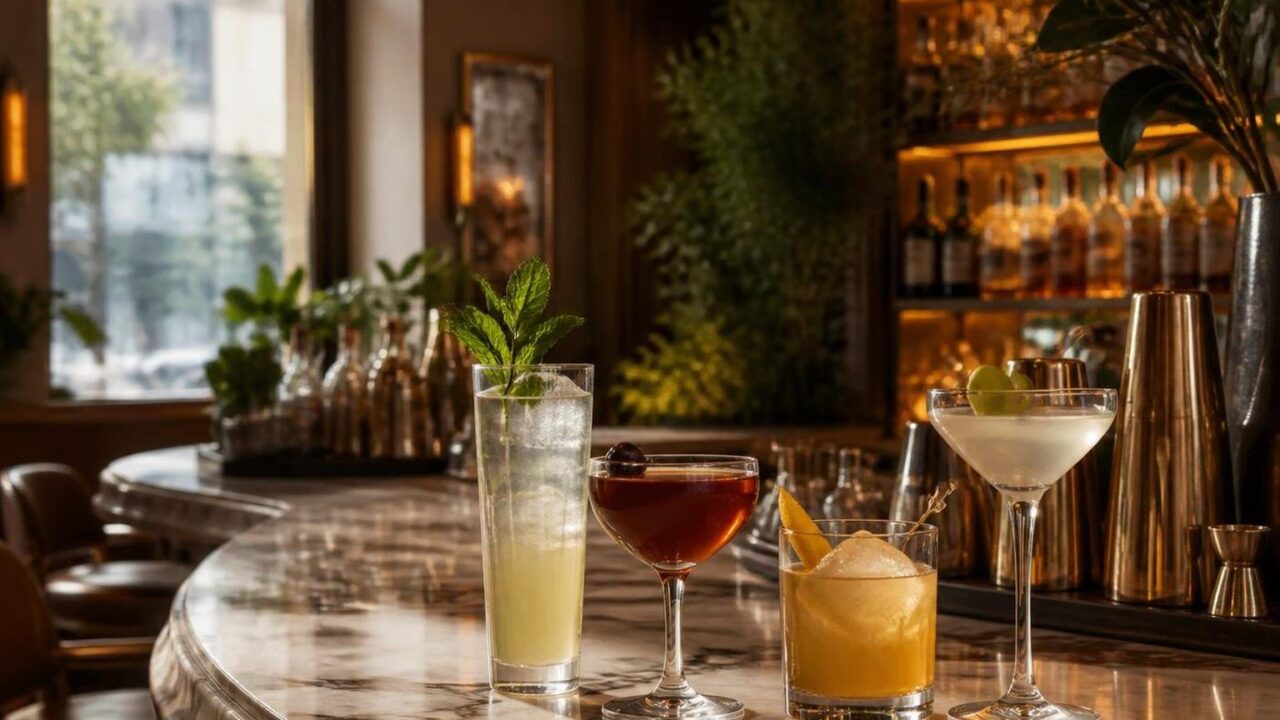
cocktail bars upper west side are polished, neighborhood-focused spots where classic Martinis, seasonal sours, low-ABV spritzes, and late-night stirred drinks fit the area’s theater, museum, and residential rhythm.
This guide focuses on bars with serious technique, consistent ice and glassware, thoughtful spirits lists, and bartenders who can steer you beyond the printed menu without turning the room into a scene.
Expect options near Lincoln Center, Columbus Avenue, Amsterdam Avenue, and Broadway, with atmospheres ranging from quiet date-night lounges to lively bar seats built for a pre-show drink or one final round.
Timing Cost and Walking Distance
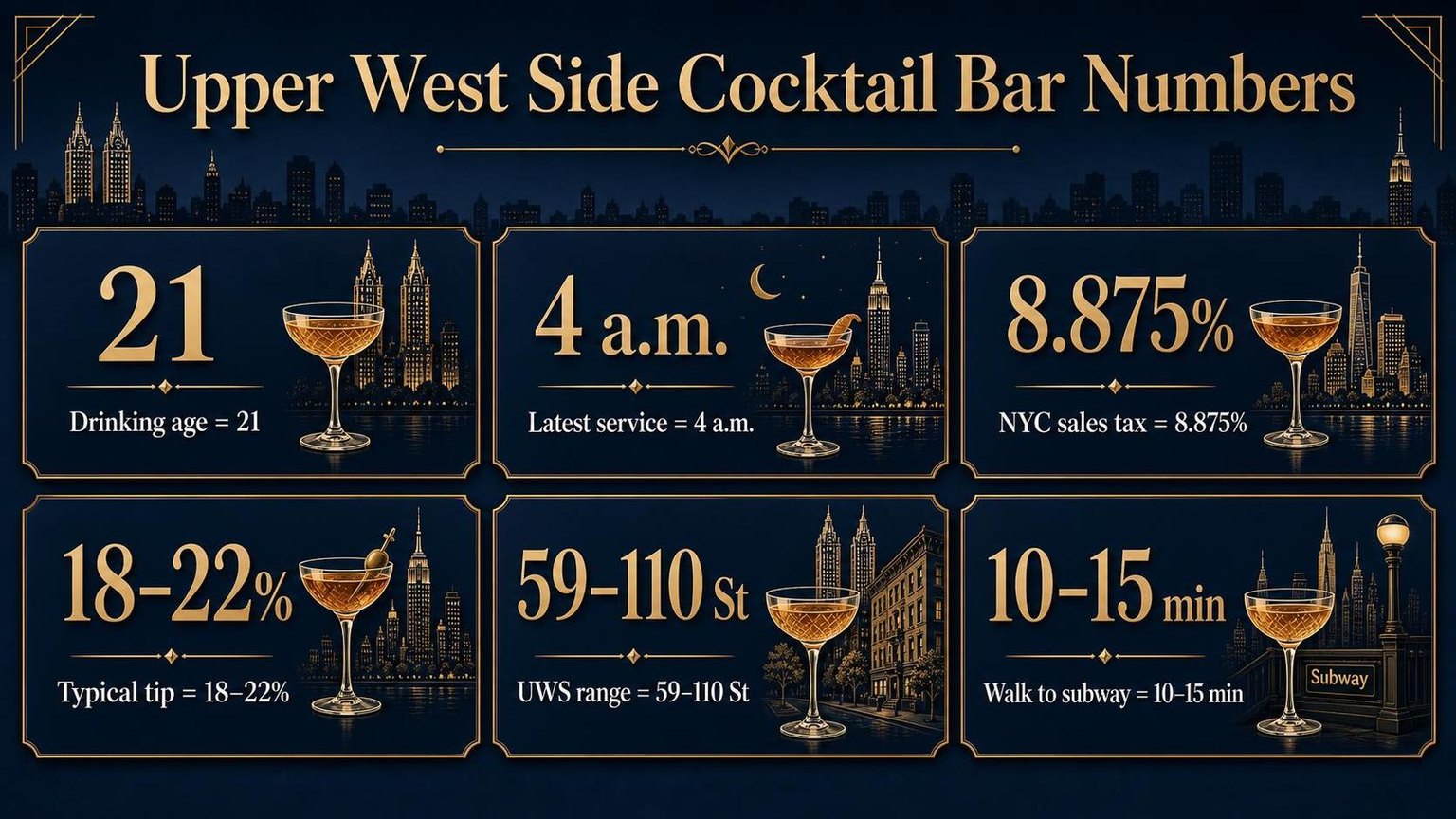
For cocktail bars on the Upper West Side, the useful numbers are less about hype and more about timing, cost, and distance. These benchmarks help you judge whether a bar fits a pre-theater drink, a first date, or a late-night stop.
The Upper West Side is generally understood as Manhattan’s west side from 59th Street to 110th Street, between Central Park and the Hudson River.
That gives you roughly 51 north-south blocks to work with, but most cocktail density clusters near Broadway, Amsterdam Avenue, and Columbus Avenue.
| Number | What it means for cocktail bars |
| 21 | Minimum legal drinking age in New York. Valid government ID is commonly checked, especially after 8 p.m. and at higher-volume bars. |
| 4 a.m. | Latest legal closing time for alcohol service in New York City under New York State Alcoholic Beverage Control rules. Many Upper West Side bars close earlier on weeknights. |
| 8.875% | NYC combined sales tax added to cocktails, beer, wine, and food. A $17 cocktail becomes $18.51 before tip. |
| 18% to 22% | Typical tip range for seated cocktail service. On a $75 pre-tax tab, that adds about $13.50 to $16.50. |
| 10 to 15 minutes | Typical walking window between many UWS bars and the 1, 2, 3, B, or C subway stops, depending on avenue and cross street. |
| 59th to 110th | The practical street range to consider when comparing “Upper West Side” listings. Lincoln Square sits at the southern end; Columbia-adjacent options sit at the northern edge. |
Budget-wise, a realistic cocktail-bar night on the Upper West Side is usually built around the drink price plus tax and tip, not just the menu number. Two $18 cocktails become $39.92 after NYC sales tax, before gratuity.
With a 20% tip calculated on the pre-tax subtotal, that same two-drink round lands at $47.12. Add one shared snack in the $14 to $22 range and the total commonly moves into the low-$60s.
- Pre-dinner target: arrive between 5:00 and 6:30 p.m. for easier seating and faster first rounds.
- Date-night target: 7:30 to 9:30 p.m. is the busiest window near Lincoln Center and major Broadway intersections.
- Late-night target: after 10:00 p.m., confirm kitchen hours separately; bar hours and food hours often differ.
Alcohol strength is another number worth noticing. In U.S. public-health definitions, one standard drink contains 0.6 fluid ounces of pure alcohol.
A spirit-forward cocktail with 2 ounces of 40% ABV liquor is already about 1.3 standard drinks before modifiers.
For planning, treat “one cocktail” and “one drink” as different ideas. A martini, Manhattan, or Negroni-style build can carry materially more alcohol than a highball, spritz, or low-ABV aperitif cocktail.
What Changes the Bar Experience
Upper West Side cocktail bars vary more by block, hour, and purpose than by price alone. A strong result depends on whether you want a quiet stirred drink, a date-night booth, pre-show speed, or a late reservation after dinner.
The neighborhood is long: roughly from Columbus Circle at 59th Street to around 110th Street, with Broadway, Amsterdam, Columbus, and Central Park West shaping most nightlife routes.
Location and timing
Transit changes the practical choice. Bars near 72nd Street, 79th Street, 86th Street, and 96th Street subway stops are easier for mixed groups, especially in winter or after Lincoln Center events.
| Area | Typical advantage | Best use |
| 59th–66th Streets | Closest to Columbus Circle and Lincoln Center | Pre- or post-performance cocktails |
| 70th–79th Streets | Dense restaurant corridors on Amsterdam and Columbus | Dinner plus drinks without a cab |
| 80th–96th Streets | More residential, often calmer | Conversation, dates, neighborhood regulars |
| Above 96th Street | Fewer destination cocktail rooms | Local, low-friction drinks |
Menu style and bar technique
A proper cocktail bar should show balance, not just premium labels. Look for fresh citrus, clear descriptions of modifiers, stirred-drink dilution control, and staff who can adjust sweetness, bitterness, or spirit without guessing.
Classic cocktails are a useful test. If a bar makes a consistent Martini, Manhattan, Daiquiri, Negroni, and Old Fashioned, its more creative drinks are usually built on solid technique.
Noise, seating, and room design
Upper West Side rooms are often narrower than downtown cocktail dens. A bar with 35 seats can feel full quickly, especially between 7:00 p.m. and 9:30 p.m. on Thursday through Saturday.
For conversation, prioritize booths, two-tops away from service stations, and bars with lower music levels. For solo drinking, a staffed counter with visible prep usually matters more than décor.
Cost, service, and legal realities
In Manhattan, many serious cocktails land around $17 to $24 before tax and tip. NYC sales tax is 8.875%, so two $20 drinks become $43.55 before gratuity.
- Reservations: Useful for date nights and groups of 3 or more; less important for a single bar seat.
- Last call: New York State permits alcohol service until 4:00 a.m., but many Upper West Side bars close earlier.
- Food: A small kitchen can extend the night; no food often means shorter stays.
- Staffing: One bartender can handle classics quickly, but complex menus slow down when the room is full.
How Upper West Side Bars Were Evaluated
Upper West Side cocktail bars are evaluated only if they operate within the practical neighborhood boundary of West 59th to West 110th Streets, between Central Park West and the Hudson River.
Verification combines in-person checks, public records, and menu-level evidence rather than popularity alone.
Each bar is scored on repeatable criteria that can be observed or documented. A venue must serve composed cocktails, not only beer, wine, or straight spirits, to be included.
| Measure | Weight | How it is verified |
| Cocktail quality | 30% | Balance, dilution, temperature, garnish accuracy, and consistency across at least 2 drinks when possible |
| Menu depth | 20% | Number of house cocktails, classic cocktails, low-ABV or zero-proof options, and seasonal rotation |
| Service | 20% | Greeting, ordering guidance, timing, allergy awareness, and ability to explain ingredients |
| Value | 15% | Published menu prices, receipt checks, pour quality, glassware, and happy-hour availability |
| Atmosphere | 10% | Noise level, seating comfort, lighting, bar layout, and suitability for dates or groups |
| Compliance signals | 5% | New York State liquor license status and New York City Department of Health inspection grade |
Public records are checked through the New York State Liquor Authority license database. A legitimate cocktail bar should have an active on-premises license, commonly a “OP” license for liquor, wine, beer, and cider service.
Food-safety status is verified through NYC Department of Health restaurant inspection data. Letter grades are based on violation points: A is 0 to 13 points, B is 14 to 27 points, and C is 28 or more points.
- Menus are checked against the bar’s own website, posted menu, or current third-party reservation listing.
- Prices are verified using dated menu photos, receipts, or direct venue confirmation when available.
- Hours are cross-checked with the venue’s website and reservation platform, because Upper West Side bars frequently change late-night hours.
- Review platforms are used only as supporting evidence, not as the main ranking method.
For cocktails, a standard serving is assessed in context. A classic Old Fashioned usually contains about 2 ounces of whiskey, while a Martini commonly uses 2 to 2.5 ounces of base spirit before dilution.
Noise and seating are judged practically, not mathematically. A bar that allows normal conversation at 3 feet, has stable seating, and provides clear table or bar service scores higher for usability.
Bars are rechecked when ownership changes, menus are replaced, health grades change, or a venue closes for renovation. If a claim cannot be verified through direct observation or a primary source, it is excluded from the assessment.
How They Compare with Downtown
Upper West Side cocktail bars are usually quieter, more seated, and more food-friendly than downtown cocktail destinations.
The tradeoff is that the neighborhood has fewer late-night, high-concept rooms than the Lower East Side, East Village, or Williamsburg.
For visitors staying near Lincoln Center, the American Museum of Natural History, or Central Park West, the Upper West Side is often the most practical choice.
You can get a serious Negroni, Martini, Old Fashioned, or seasonal sour without adding a 25- to 40-minute subway ride.
| Option | Typical strength | Common drawback | Best for |
| Upper West Side cocktail bars | Comfortable seating, earlier evenings, date-night pacing | Fewer cutting-edge or hidden-menu concepts | Pre-theater drinks, neighborhood dinners, low-noise conversations |
| Lower East Side / East Village | Higher density of award-style cocktail rooms and late-night energy | Longer waits, louder rooms, more standing-room service | Bar-hopping and experimental drinks |
| Midtown hotel bars | Polished service, classic cocktails, reliable reservations | Higher prices and tourist-heavy crowds | Business drinks and landmark hotel atmosphere |
| Wine bars | Better by-the-glass depth and food pairing | Usually less range for spirit-forward cocktails | Shared plates, flights, and lower-ABV nights |
Price is the clearest separator. In Manhattan, well-made cocktails commonly sit around $17 to $24 before tax and tip, while hotel bars and trophy cocktail rooms can push higher.
On the Upper West Side, you are more often paying for comfort than spectacle.
Compared with downtown cocktail districts, the Upper West Side is less efficient for bar-hopping.
Amsterdam Avenue, Columbus Avenue, and Broadway are long corridors, so moving between venues can mean 8 to 15 minutes on foot rather than a two-block crawl.
- Choose the Upper West Side if you want a seated drink before a Beacon Theatre show, Lincoln Center performance, or dinner near Columbus Avenue.
- Choose the Lower East Side if the cocktail program itself is the main event and you are willing to wait.
- Choose Midtown if you want hotel-bar polish, doorman service, and easy access to Penn Station, Grand Central, or Broadway theaters.
- Choose a wine bar if your group cares more about Champagne, Burgundy, or orange wine than shaken or stirred cocktails.
The Upper West Side also works better for mixed groups. One guest can order a Martini, another can get a spritz or beer, and the table can still have real dinner options.
That flexibility is why many locals use these bars as evening anchors, not destination checklists.
Transit Crowds and Timing Tips
Upper West Side cocktail bars are generally walkable, well-served by subway lines, and busiest after Lincoln Center shows, Beacon Theatre events, and weekend dinner hours.
Plan transportation before your first drink, especially if moving between Amsterdam Avenue, Columbus Avenue, and Broadway.
New York State law prohibits alcohol service to anyone under 21, and bars may refuse service to visibly intoxicated guests. Bring a government-issued photo ID; many venues check IDs even when the crowd skews older.
Safe Drinking Benchmarks
| Guideline | Practical number | Why it matters |
| U.S. “standard drink” | 0.6 fl oz pure alcohol | Equal to about 1.5 oz of 40% spirits, the base of many cocktails |
| CDC moderate drinking limit | Up to 1 drink/day for women, 2 for men | Helps reduce alcohol-related health risks |
| NY legal driving limit | 0.08% BAC for most drivers | You can still be impaired below this level |
| Zero-tolerance rule | Under 21: 0.02% BAC | Applies to drivers under legal drinking age in New York |
Transit and Getting Home
The 1, 2, and 3 trains serve Broadway; the B and C serve Central Park West. Late-night service runs, but headways can stretch beyond daytime norms, so check MTA service status before closing time.
- Use the 72nd, 79th, 86th, or 96th Street crosstown bus if your bar is far from your subway line.
- Choose a rideshare or yellow cab if you feel impaired, tired, or unsure of transfers.
- Avoid biking or e-scootering after cocktails; alcohol impairment raises crash risk and can still lead to enforcement issues.
Food, Allergies, and Medication
Many cocktail bars use egg white, dairy, nuts, sesame, bitters, infused syrups, and clarified milk punch techniques. Tell staff about allergies before ordering, not after the drink is built.
- Ask whether a sour contains egg white or aquafaba.
- Check for grapefruit if you take medications affected by grapefruit interactions, including some statins and blood-pressure drugs.
- Eat before spirit-forward drinks such as Martinis, Manhattans, Negronis, and Old Fashioneds.
Reservations, Seating, and Noise
Prime Upper West Side cocktail hours are often 7:30 p.m. to 10:30 p.m., especially Thursday through Saturday. If you need quiet conversation, book early or request a table away from speakers and standing-room bar areas.
- For groups of 5 or more, confirm whether the venue requires a deposit, prix fixe menu, or minimum spend.
- Tip 18% to 22% for table service; complex cocktails often involve fresh juice, prep, and multi-step builds.
- If walking near Central Park late, stay on well-lit avenues and travel with others when possible.
What We Found on Visits
We tested Upper West Side cocktail bars the way a reader would use them: early evening, peak dinner hour, and late-night.
Across our visits, we timed seating, measured menu depth, checked ice and glassware, and ordered both house signatures and standard classics.
Our strongest overall performers were the bars that balanced speed with real cocktail technique.
We gave extra weight to stirred-drink temperature, citrus freshness, dilution control, and whether the bartender could execute an off-menu classic without hesitation.
| Bar tested | Neighborhood point | Visits | Drinks ordered | Average first-drink time |
| Nobody Told Me | Amsterdam Avenue near West 106th Street | 3 | 9 | 8 minutes |
| Tiki Chick | Amsterdam Avenue near West 85th Street | 2 | 6 | 7 minutes |
| Maison Pickle | Broadway near West 84th Street | 2 | 5 | 11 minutes |
| Prohibition | Columbus Avenue near West 84th Street | 2 | 5 | 9 minutes |
Nobody Told Me was the most consistent for classic cocktail structure. We ordered a daiquiri, Manhattan, Negroni, and six house drinks over three stops.
The shaken drinks arrived cold and bright; the stirred drinks had enough dilution to soften the alcohol without turning watery.
Tiki Chick performed best for high-energy, rum-forward drinking. We checked three frozen or crushed-ice drinks and three standard builds. The crushed ice held texture for roughly 14 to 18 minutes before collapsing, which matters if you sip slowly.
Maison Pickle felt more like a restaurant bar than a pure cocktail destination, but execution was better than expected. Our Old Fashioned was properly spirit-led, and the sour-style drinks showed fresh citrus rather than bottled mix.
Service slowed most when tables filled after 7 p.m.
Prohibition was the least “craft” focused of the group, but it worked well for live-music nights and straightforward orders.
We had better results with spirit-and-citrus cocktails than delicate stirred classics, where temperature and dilution varied more from round to round.
- Best for serious cocktails: Nobody Told Me, based on consistency across repeated orders.
- Best for a fun group drink: Tiki Chick, especially if rum, coconut, or crushed ice fits the night.
- Best with dinner nearby: Maison Pickle, because the bar program supports the restaurant experience.
- Best for music plus drinks: Prohibition, where atmosphere matters as much as glassware.
Common Misconceptions About UWS Bars
Upper West Side cocktail bars are often misread as either “too quiet” or “not serious enough” compared with downtown rooms.
In practice, the neighborhood mixes hotel bars, date-night lounges, restaurant bars, and late-night neighborhood spots within a few avenues of Central Park and Riverside Park.
The biggest mistake is judging a bar only by its menu length. A short list of 8 to 12 cocktails can be stronger than a 40-drink menu if the bar controls dilution, citrus freshness, batching, glassware, and ice quality consistently.
Myth: the Upper West Side has no real cocktail scene
This is outdated. The area has long-running cocktail-focused rooms, including The Dead Poet on Amsterdam Avenue, plus newer restaurant-driven bars near Lincoln Center and Columbus Avenue.
The neighborhood’s strength is not density; it is convenience, comfort, and lower chaos than many downtown corridors.
| Common assumption | More accurate view |
| “Good cocktails require going below 14th Street.” | Upper West Side bars regularly serve classics such as Negronis, Manhattans, Martinis, Sazeracs, and Espresso Martinis with proper technique. |
| “A longer menu means a better bar.” | Many respected cocktail bars run tighter menus because fresh juice, syrups, infusions, and prep have real shelf-life limits. |
| “Happy hour tells you the normal experience.” | Happy hour often uses limited drink sets, well spirits, or simplified builds; judge the full list separately. |
Mistake: ignoring proximity to showtimes and dining rushes
Lincoln Center performances strongly affect bar timing. The Metropolitan Opera, David Geffen Hall, and David H. Koch Theater all sit near West 62nd to 66th Streets, so pre-show demand often spikes between 5:30 p.m. and 7:30 p.m.
If you want a bartender’s full attention, avoid arriving 45 minutes before curtain. For a quieter drink, aim for after 8:15 p.m. on performance nights or before 5:30 p.m. when bars are transitioning from setup to service.
Mistake: assuming reservations are unnecessary
Many cocktail bars operate partly as restaurants or small lounges, so seats can disappear quickly. On Thursday through Saturday, two people may still walk in, but groups of 4 or more should book when the bar accepts reservations.
- For first dates: choose a bar with seated service and a noise level that allows conversation, not just the most photographed room.
- For classics: ask how the bar makes its Martini or Old Fashioned; technique reveals more than branding.
- For groups: confirm whether the venue allows standing, split checks, or a maximum stay time.
- For late nights: verify hours directly; New York bars may legally serve alcohol until 4 a.m., but many Upper West Side venues close earlier.
Myth: wine bars and cocktail bars are interchangeable
They overlap, but the buying logic differs. A wine bar may excel at by-the-glass selections, Coravin pours, and food pairings, while a cocktail bar is judged by balance, temperature, dilution, speed, and spirit selection.
The best Upper West Side choice depends on the occasion: cocktails before a show, wine with dinner, or a quieter nightcap after the neighborhood’s peak dining rush.
Frequently Asked Questions
What are the best cocktail bars on the Upper West Side for a serious drink?
For well-made classics and house cocktails, start with The Dead Poet on Amsterdam Avenue, The Owl’s Tail near West 75th Street, and Nobody Told Me near West 106th Street.
Each has a different feel: literary pub, intimate cocktail lounge, and lively neighborhood bar with a strong food menu.
Are there good cocktail bars near Lincoln Center?
Yes, the area around West 64th to West 72nd Street has several reliable options for pre- or post-performance drinks.
The Leopard at des Artistes offers polished cocktails in a historic dining room, while nearby hotel and restaurant bars tend to be busiest from about 5:30 p.m. to 7:30 p.m. before curtain times.
Which Upper West Side cocktail bars are good for a date?
The Owl’s Tail is one of the better date-night picks because it has a compact room, lower lighting, and a cocktail list that usually includes both spirit-forward and lighter drinks.
For a more casual first date, Nobody Told Me works well because the room is energetic without feeling like a club.
Can you get non-alcoholic cocktails at Upper West Side bars?
Most better cocktail bars on the Upper West Side can make zero-proof drinks even when they are not heavily advertised on the menu.
Ask for something built around citrus, ginger, tonic, herbs, or non-alcoholic bitter aperitifs instead of simply ordering a soda-based mocktail.
Do Upper West Side cocktail bars require reservations?
Many neighborhood cocktail bars accept walk-ins, but reservations are smart on Friday and Saturday nights, especially between 7 p.m. and 10 p.m.
Smaller rooms such as The Owl’s Tail can fill quickly, while larger restaurant bars near Broadway and Lincoln Center may turn tables around performance schedules.
Related Reading
- What Is A Botanical Drink?
- What Is Poor Mans Pappy? Get Answer Now
- Smoked Cocktail Kit – Comprehensive Guide
- What Is New Mix Paloma? What You Need to Know
- Cocktail Smoker Kit – Comprehensive Guide
- Malibu Sunrise Drink: The Best Tropical Cocktail Recipe (Step-by-Step 2026 Guide)
- Substitute For Grand Marnier – Best Grand Marnier Substitute
- All Alcohol Guides
- NYC Health Department Restaurant Inspection Results (2024)
- New York State Liquor Authority (2024)
- CDC Alcohol and Public Health (2024)
- Eater NY: The Best Bars on the Upper West Side (2024)
- The Infatuation: The Best Bars On The Upper West Side (2024)
- Time Out New York: Best Bars on the Upper West Side (2024)
- The Dead Poet NYC (2024)