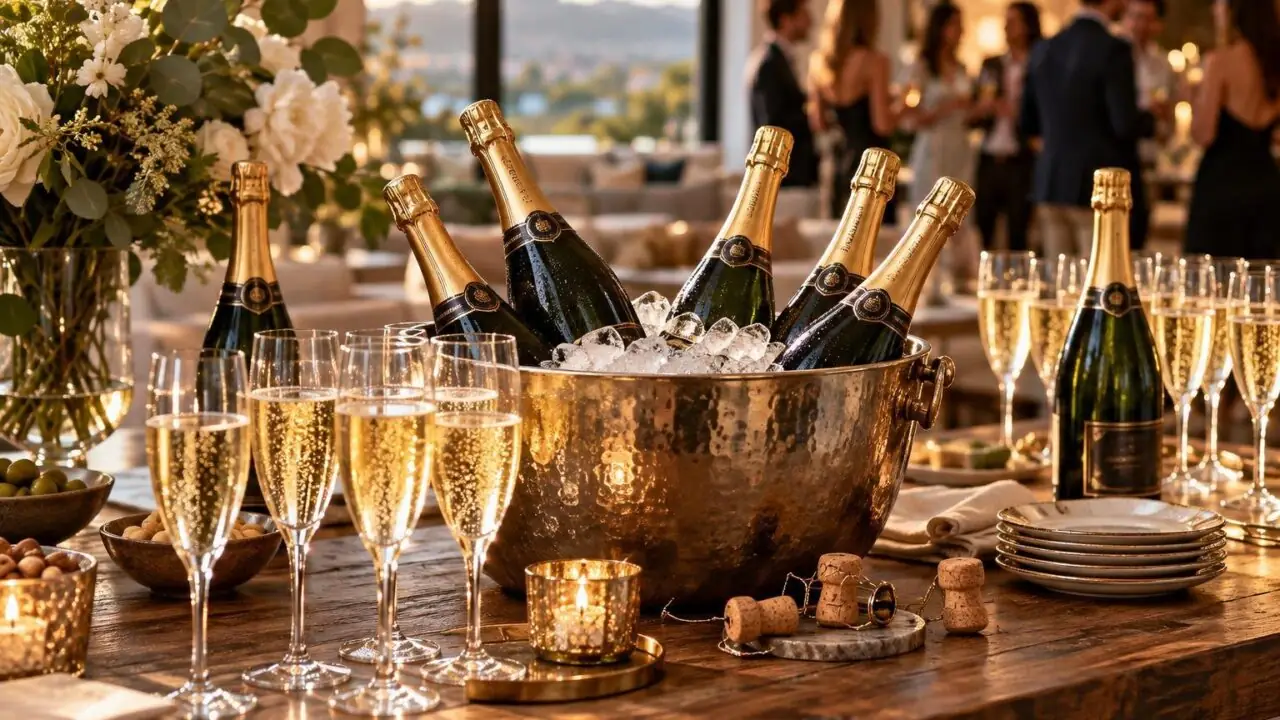
How Many Bottles of Champagne for 20 Guests? Plan on 7 bottles for a standard toast and moderate pours. Each 750-milliliter bottle provides about five 5-ounce glasses, giving 35 servings.
That leaves enough for most guests to enjoy one or two glasses without creating excessive waste.
Use 8 bottles if Champagne will accompany a full meal, continue throughout the evening, or include generous refills. Choose 6 bottles for a brief toast with other drinks available.
This guide explains serving calculations, pour sizes, bottle formats, guest drinking patterns, and practical ways to chill and serve the wine efficiently.
Champagne Bottle Math for 20 Guests
A standard 750 ml bottle of Champagne pours six glasses of approximately 125 ml each. For 20 guests receiving one glass apiece, you need 4 bottles minimum—but real-world pouring, spillage, and refills change that number fast.
Baseline Calculation
The math starts simple: 20 guests × 1 glass = 20 glasses. Divide 20 by 6 glasses per bottle, and you get 3.33 bottles. Round up to 4 bottles for a single-toast event.
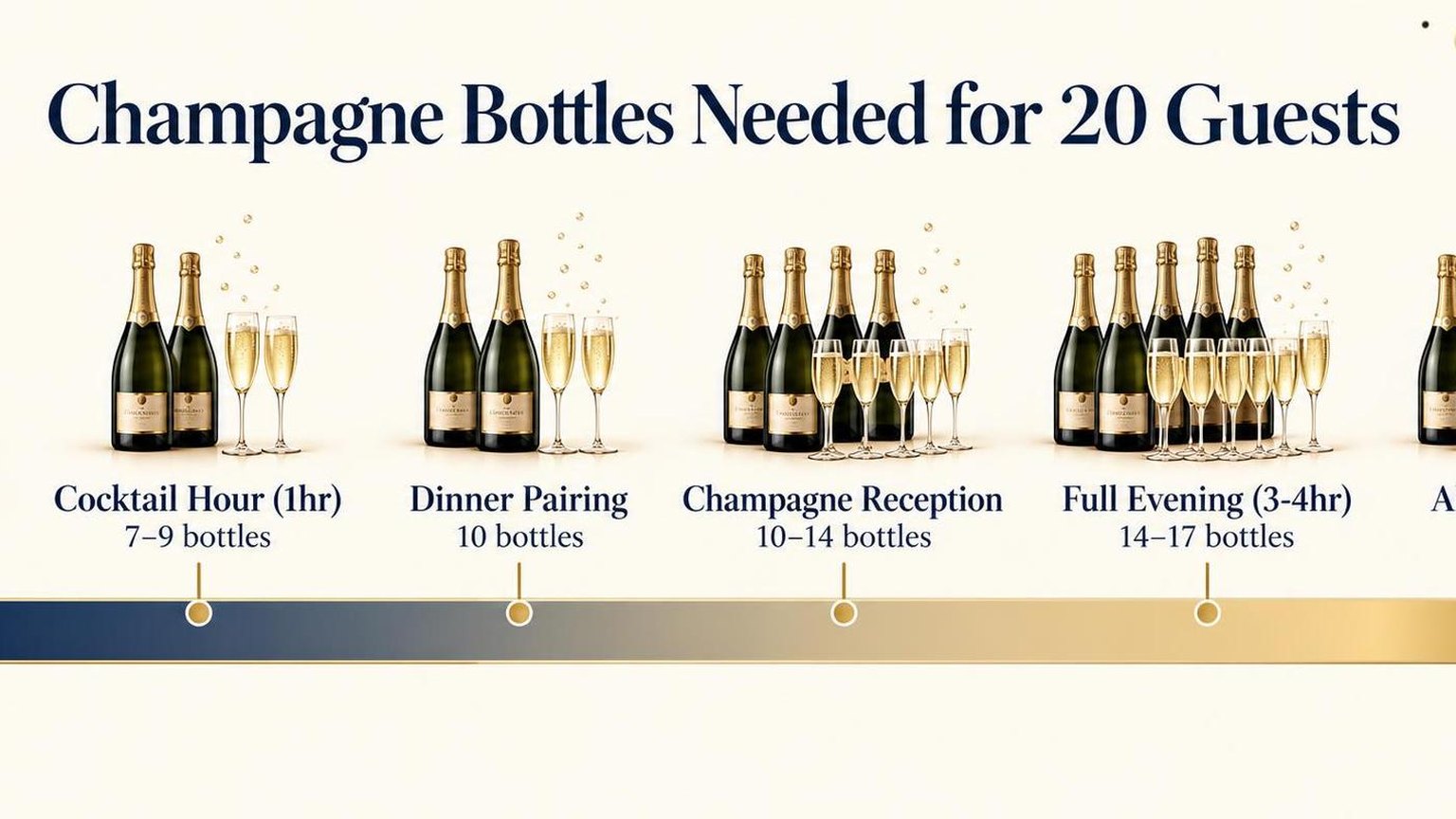
Most gatherings go beyond a single toast. The table below maps bottle counts to different serving scenarios for exactly 20 guests.
| Scenario | Glasses per Guest | Total Glasses | Bottles Needed |
| Toast only | 1 | 20 | 4 |
| Cocktail hour (1 hour) | 2 | 40 | 7 |
| Dinner with Champagne pairing | 3 | 60 | 10 |
| Full evening (3–4 hours) | 4–5 | 80–100 | 14–17 |
| Champagne-only reception (2 hours) | 3–4 | 60–80 | 10–14 |
The 20% Buffer Rule
Industry professionals at catering firms typically add a 15–20% buffer to the calculated bottle count. Pouring slightly over 125 ml per glass, foam overflow, and enthusiastic guests all erode your supply faster than the math suggests.
For a cocktail hour needing 7 bottles, a 20% buffer means purchasing 8–9 bottles. For a full evening requiring 14 bottles, stock 17.
Adjust for Guest Behavior
Not every guest drinks Champagne. Surveys from Wine Intelligence show roughly 15–20% of adults at any event abstain from alcohol entirely. Another segment may prefer beer, cocktails, or still wine over sparkling.
- Mixed-beverage event: Reduce Champagne estimate by 30–40%, since many guests will choose other drinks.
- Champagne-only event: Use the full calculation plus the 20% buffer—non-drinkers will be offset by heavier drinkers.
- Brunch setting: Expect higher Champagne consumption per person; budget 3–4 glasses each over 2 hours.
Magnum Advantage
A magnum holds 1.5 liters—equivalent to two standard bottles, yielding roughly 12 glasses. For 20 guests at a cocktail hour, 4 magnums replace 8 standard bottles and often cost 10–15% less per milliliter.
Magnums also maintain carbonation more effectively due to a lower surface-area-to-volume ratio, keeping the second half of the bottle livelier than a newly opened standard bottle would be.
Quick-Reference Summary
For a toast: 4 bottles. For a 1-hour reception: 7–9 bottles. For a full Champagne-forward evening with 20 guests: 14–17 bottles.
Always round up, never down—leftover Champagne keeps 3–5 days under a hermetic stopper in the refrigerator.
How Many Glasses Each Bottle Serves
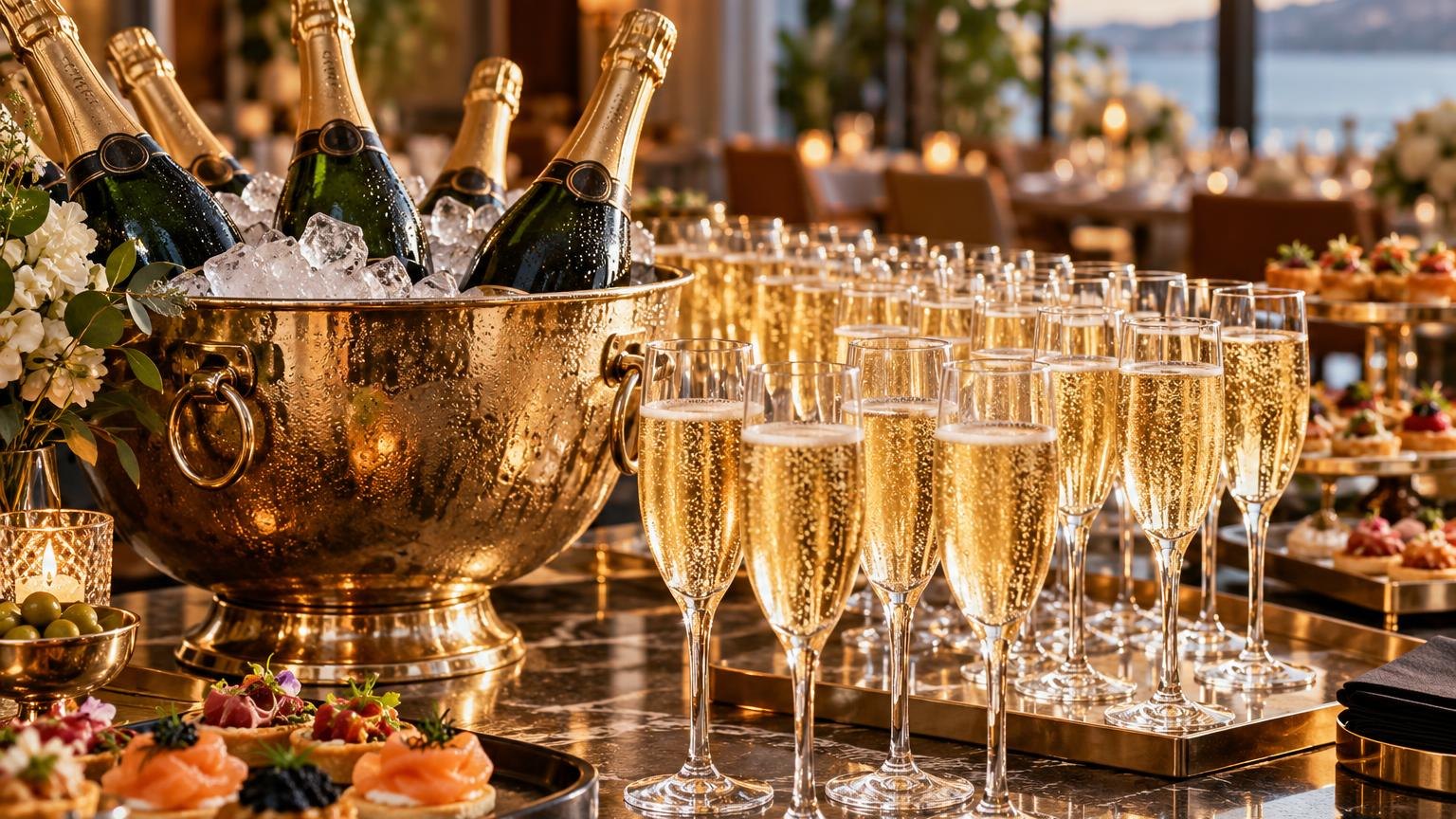
A standard 750ml bottle of Champagne yields approximately 5 to 6 glasses when poured at the traditional 4–5 oz (120–150ml) serving size. This number shifts depending on bottle format, glass shape, and pouring style.
The Comité Champagne, the official trade body governing Champagne production, uses 6 glasses per bottle as its standard calculation based on a 125ml pour.
Most US catering professionals default to 5 glasses, reflecting a more generous 150ml (5 oz) pour common at American events.
Glasses per Bottle by Format
Champagne comes in multiple bottle sizes, each affecting how many guests a single bottle can serve. Here is the breakdown across common formats:
| Bottle Format | Volume | Glasses (125ml pour) | Glasses (150ml pour) |
| Half-bottle (Demi) | 375ml | 3 | 2–3 |
| Standard | 750ml | 6 | 5 |
| Magnum | 1.5L | 12 | 10 |
| Jeroboam | 3L | 24 | 20 |
| Methuselah | 6L | 48 | 40 |
Factors That Change Your Count
Several real-world variables reduce the number of full glasses you actually get from each bottle.
- Glass shape: Wide-rimmed coupe glasses encourage larger pours than narrow flutes. Coupes typically yield only 4 servings per bottle versus 5–6 from flutes.
- Foam and settling: Champagne requires a two-stage pour. The initial foam takes up glass volume, and topping off after settling uses roughly 10–15ml more per glass than a still-wine pour.
- Toast-only pours: For a brief celebratory toast, many hosts pour just 3–4 oz (90–120ml), stretching a single bottle to 7 or even 8 glasses.
- Residual wine: Approximately 10–20ml typically remains in the bottle due to the punt (the deep indentation at the base) and sediment avoidance, reducing actual yield slightly.
The Working Number for Planning
Professional event planners at operations like Wolfgang Puck Catering and Relais & Châteaux properties consistently use 5 glasses per standard 750ml bottle as their working figure for American events.
This accounts for generous pours and minor spillage.
Using 5 rather than 6 builds in a practical buffer. Running short on Champagne mid-event is a far worse outcome than having a few extra bottles, which store well at 45–50°F for future occasions.
For 20 guests, this per-bottle yield becomes the foundation of your purchasing calculation. Multiply guests by desired glasses per person, then divide by 5 to reach your bottle count with confidence.
Bottles Needed for a Champagne Toast
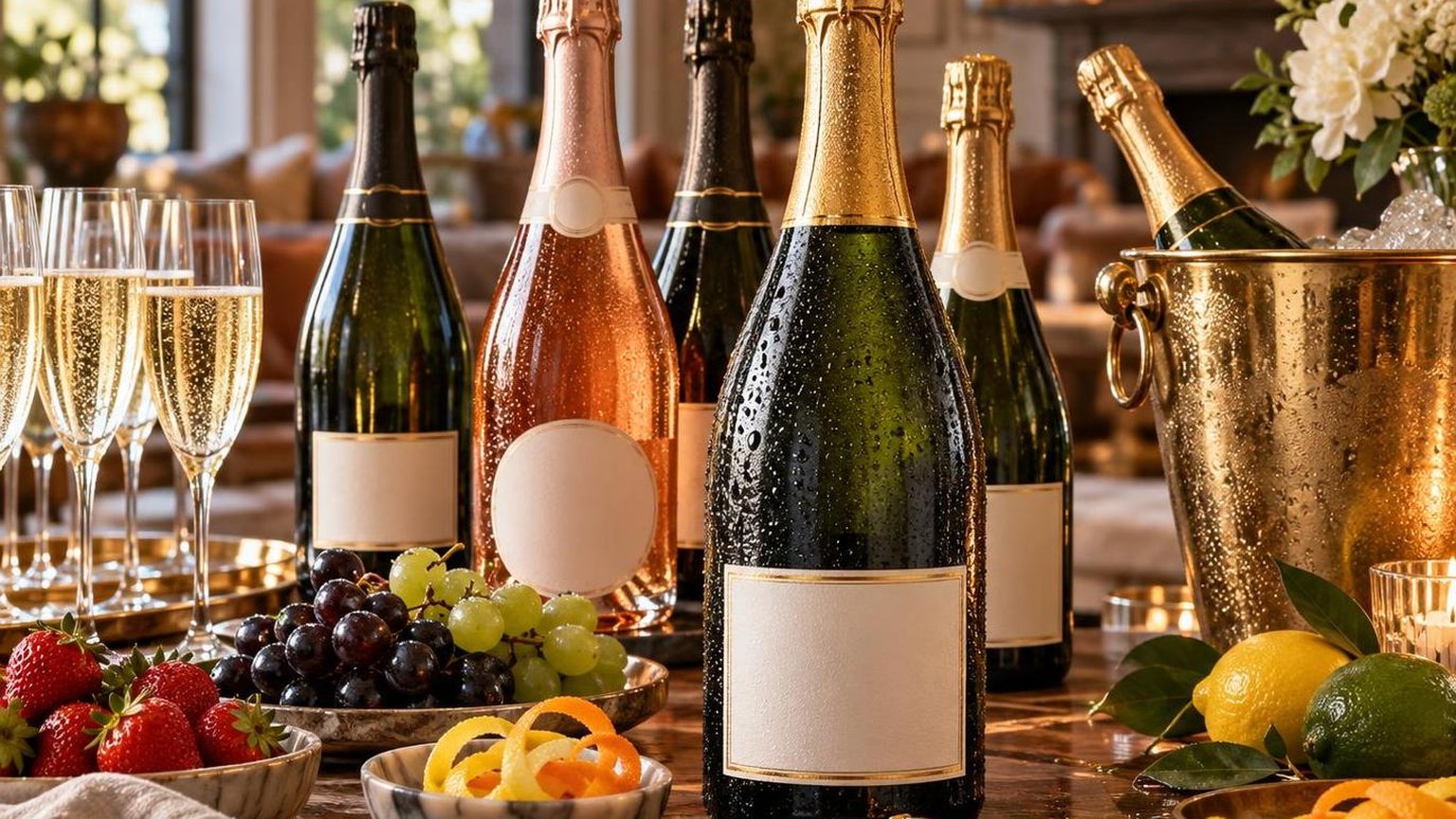
A single toast requires exactly one standard pour per person. For 20 guests, that calculation is straightforward—but the bottle count shifts depending on pour size, glass style, and whether you plan a refill round.
The Standard Calculation
A standard 750 ml bottle of Champagne yields approximately 5 to 6 flutes at a 4–5 oz (120–150 ml) pour. Most toast pours sit at the lower end: 4 oz per flute.
At 4 oz per glass, one bottle delivers 6 servings. Divide 20 guests by 6 servings per bottle, and you need 3.33 bottles—round up to 4 bottles for a single toast.
At a more generous 5 oz pour, each bottle yields 5 glasses. Twenty guests divided by 5 equals exactly 4 bottles with no surplus.
Toast-Only Bottle Guide by Pour Size
| Pour Size | Glasses per 750 ml Bottle | Bottles for 20 Guests (1 Toast) | Bottles for 20 Guests (2 Toasts) |
| 3 oz (90 ml) — minimal toast | 8 | 3 | 5 |
| 4 oz (120 ml) — standard toast | 6 | 4 | 7 |
| 5 oz (150 ml) — full pour | 5 | 4 | 8 |
| 6 oz (180 ml) — generous pour | 4 | 5 | 10 |
Factors That Change the Count
- Coupe glasses: Wider coupes hold 5–7 oz but encourage fuller pours. Expect to use closer to 5 bottles for 20 guests.
- Spillage and foam: Champagne foams during pouring, causing an estimated 5–10% loss per bottle. Budget at least one extra bottle to compensate.
- Non-drinkers: Industry estimates suggest roughly 15–20% of adult guests may decline alcohol. For 20 guests, that’s 3–4 people, potentially saving you one bottle.
- Magnum format: A 1.5 L magnum equals two standard bottles and yields 10–12 flutes. Two magnums cover 20 guests for a single toast with margin.
Practical Recommendation
Purchase 5 standard bottles (750 ml each) for a single Champagne toast with 20 guests. This accounts for foam loss, varied pour sizes, and one or two guests requesting a small top-up.
If the toast transitions into a brief Champagne service—15 to 20 minutes of sipping—plan for 7 to 8 bottles. Guests typically consume 1.5 to 2 glasses during that window.
Unopened Champagne stores well. Non-vintage bottles hold quality for 3 to 4 years from purchase. Buying one or two extra bottles carries zero waste risk if stored properly in a cool, dark space at 45–55°F (7–13°C).
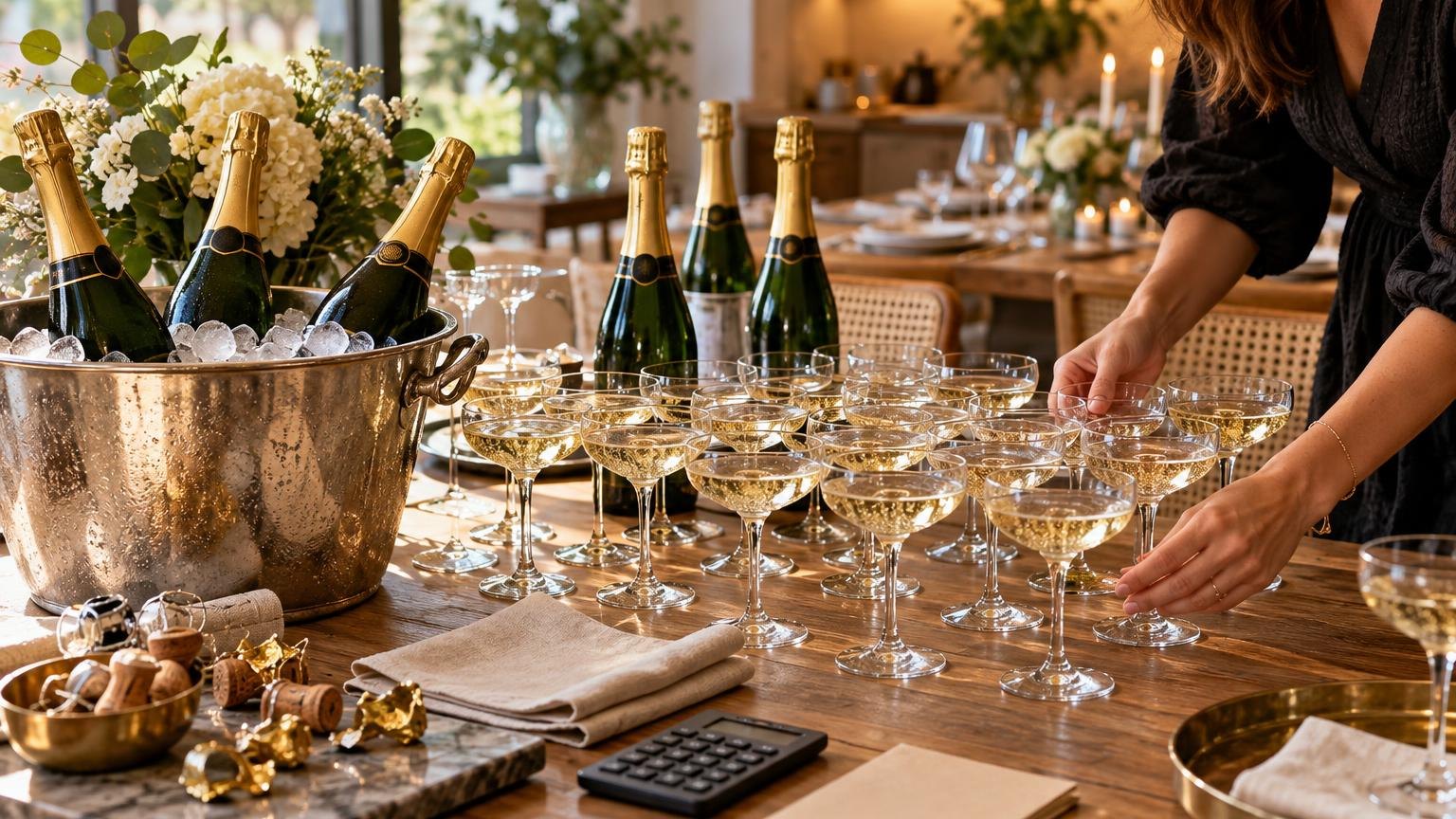
Adjusting Quantities for Full-Service Drinking
When champagne serves as the primary beverage throughout an entire event, consumption rates increase significantly beyond toast-only estimates.
Full-service drinking demands roughly 1 bottle per guest, compared to the 4–5 bottles needed for a simple toast among 20 people.
Consumption Rates by Event Duration
The standard planning metric is 1 glass per person per hour during a full-service champagne event. A standard 750 ml bottle yields approximately 5 flutes at 150 ml (5 oz) each.
| Event Duration | Glasses per Guest | Total Glasses (20 Guests) | Bottles Needed |
| 1 hour (cocktail reception) | 1–2 | 20–40 | 4–8 |
| 2 hours (dinner party) | 2–3 | 40–60 | 8–12 |
| 3 hours (full reception) | 3–4 | 60–80 | 12–16 |
| 4+ hours (wedding or gala) | 4–5 | 80–100 | 16–20 |
These figures assume every guest drinks actively. In practice, approximately 20% of attendees at any gathering drink less than average or abstain entirely, according to hospitality industry benchmarks.
Adjusting for Guest Drinking Profiles
Not every guest consumes at the same rate. Categorizing your guest list produces a more accurate bottle count and reduces both waste and shortages.
- Heavy drinkers (roughly 15–20% of guests): Expect 2 glasses per hour, or about 6–8 glasses across a 4-hour event.
- Moderate drinkers (roughly 50–60%): Plan for 1 glass per hour, totaling 4–5 glasses over 4 hours.
- Light drinkers and non-drinkers (roughly 20–30%): Budget 0–2 glasses total for the entire event.
For a typical 20-person party with mixed drinking habits over 3 hours, 12–14 bottles covers full-service needs comfortably with a small surplus.
The First-Hour Spike
Consumption during the first 60 minutes typically runs 25–30% higher than subsequent hours. Guests arriving at a reception drink faster before settling into conversation and food. Front-load your chilling accordingly.
Have at least 6–8 bottles chilled and ready to pour immediately for 20 guests. Keep remaining bottles at cellar temperature (10–12°C / 50–55°F) and rotate them into ice buckets as the event progresses.
Food Pairing Reduces Consumption
Serving substantial food alongside champagne lowers per-person consumption by roughly 15–20%. A seated dinner with multiple courses slows drinking compared to a standing cocktail reception with only passed canapés.
| Format | Bottles for 20 Guests (3 Hours) |
| Standing reception, light bites | 14–16 |
| Seated dinner, 3+ courses | 10–12 |
| Brunch service | 12–14 |
Always round up by 1–2 bottles beyond your calculated total. Unopened champagne stores well for months when kept at proper cellar conditions, making overestimation a low-risk strategy compared to running dry mid-event.
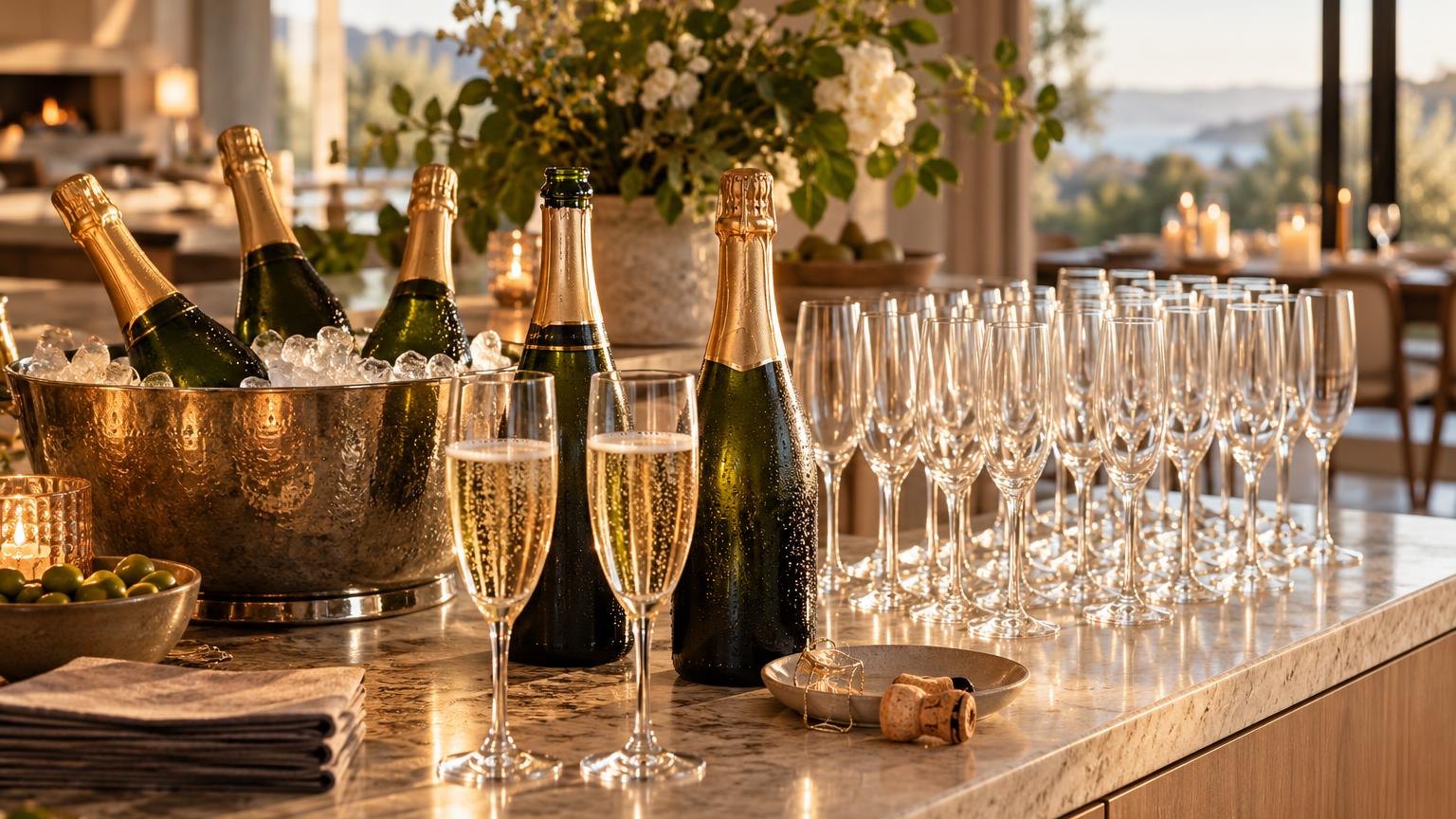
Extra Bottles for Refills and Spillage
Precise bottle counts assume perfect pours and zero waste. Real events never work that way. Adding a buffer of 10–15% beyond your calculated need prevents running out during toasts, dinner service, or late-arriving guests.
Why Your Base Count Falls Short
A standard 750 ml Champagne bottle yields roughly 5 flutes at 150 ml per pour. For 20 guests at one glass each, the math says 4 bottles. That number ignores several real-world losses.
Spillage during pouring accounts for approximately 5–8% of total volume, according to hospitality industry benchmarks. Foam overflow alone can waste 15–20 ml per glass when pouring cold Champagne quickly.
Residual wine left in each bottle—typically 10–20 ml stuck in the punt and neck—adds up across multiple bottles. Four bottles lose a combined 40–80 ml, nearly half a glass.
Common Sources of Waste
- Foam overflow: 15–20 ml lost per glass when bottles are insufficiently chilled or poured too fast
- Residual bottle volume: 10–20 ml remains trapped in each empty bottle
- Abandoned glasses: roughly 10% of poured glasses go unfinished at events, per catering data
- Second pours: at least 20–30% of guests accept a refill if Champagne flows freely
- Breakage: one dropped or cracked flute per 50 guests is a reasonable planning assumption
Buffer Recommendations by Scenario
| Event Type | Base Bottles (20 Guests) | Buffer % | Extra Bottles | Total Bottles |
| Single toast only | 4 | 10% | 1 | 5 |
| Cocktail hour (1 hr) | 8 | 15% | 1–2 | 9–10 |
| Full reception (3–4 hrs) | 13–14 | 15% | 2 | 15–16 |
| Free-flowing celebration | 17–20 | 20% | 4 | 21–24 |
For a single-toast event with 20 guests, one extra bottle covers spillage, foam loss, and a few refills comfortably.
Cocktail hours typically see each guest drink 2 glasses per hour. At that rate, 8 base bottles need at least 1–2 extras to absorb pouring waste and second rounds.
Practical Tips to Minimize Waste
- Chill bottles to 8–10 °C (46–50 °F) to reduce foam overflow by up to 40%
- Pour in two stages—fill each flute halfway, then top off—to control foam
- Use a pourer or Champagne stopper between servings to preserve carbonation and reduce flat-wine waste
- Assign one person to pour rather than letting guests self-serve, cutting spillage significantly
Unopened Champagne stores well for 3–5 years (non-vintage) or longer (vintage), so surplus bottles never go to waste. Buy the buffer confidently.
Running short mid-toast is far worse than having one bottle left over. Round up, not down, every time you calculate.
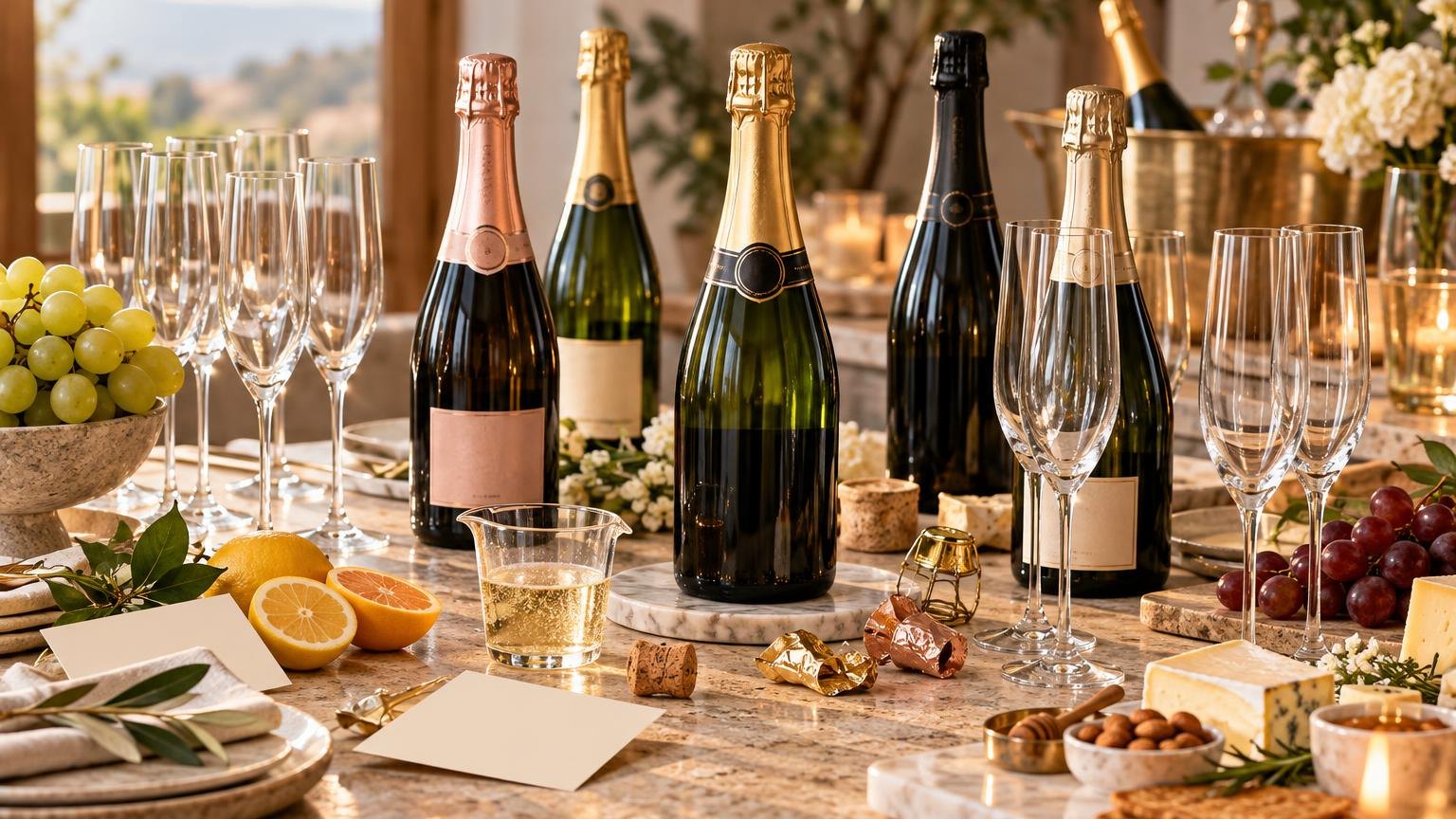
Common Questions
How many bottles of Champagne do I need for 20 guests at a toast-only event?
You need 4 bottles. A standard 750 ml bottle of Champagne pours approximately 5–6 flutes (at 4–5 oz per pour), so 4 bottles yield 20–24 glasses — exactly one toast per guest with a small buffer.
How many bottles should I buy if Champagne is served throughout a 3-hour reception for 20 guests?
Plan for 12–15 bottles. The standard hospitality estimate is 3 glasses per person over a 3-hour event, meaning 60 glasses total, which requires roughly 10–12 bottles plus a 20% buffer for heavier drinkers and spillage.
Does the number change if I’m serving brunch Champagne cocktails like mimosas or Bellinis?
Yes — increase your count by about 30%. Mimosas and Bellinis use roughly 3 oz of Champagne per drink, but guests typically consume more cocktails than straight pours, so plan on 15–18 bottles for 20 guests over a 2–3 hour brunch.
How do I adjust the bottle count if some guests don’t drink alcohol?
Subtract one bottle for every 5 non-drinking guests. If 4 of your 20 guests abstain, reduce a full-reception order from 12–15 bottles to 10–12 and stock a quality sparkling water like San Pellegrino or Perrier as an alternative.
Should I buy magnums instead of standard bottles for 20 guests?
A magnum (1.5 L) equals exactly 2 standard bottles and pours 10–12 flutes.
For 20 guests at a reception, 6–7 magnums replace 12–14 standard bottles and offer a practical advantage: Champagne stays fresher longer in larger-format bottles due to the lower ratio of oxygen to wine.
What is the cost range for buying enough Champagne for 20 guests?
At a toast-only event (4 bottles), expect to spend $120–$200 using a quality non-vintage like Moët Impérial (~$45) or Veuve Clicquot Yellow Label (~$55).
For a full reception requiring 12–15 bottles, budget $540–$825, or cut costs significantly with a well-rated Crémant d’Alsace or Crémant de Bourgogne at $15–$20 per bottle.
How far in advance should I chill 12–15 bottles of Champagne for 20 guests?
Champagne needs 3–4 hours in a standard refrigerator (38–45 °F) or 20–30 minutes in an ice-water bath (50% ice, 50% water) to reach ideal serving temperature of 46–50 °F.
For 12–15 bottles, start chilling in batches — most home refrigerators can only accommodate 6–8 bottles at once on their sides.
How many bottles of Champagne do I need for a New Year’s Eve countdown toast plus 2 hours of drinking for 20 guests?
Budget 8–10 bottles. Allocate 4 bottles for the midnight toast (1 glass each) and 4–6 bottles for roughly 2 additional glasses per person over the remaining party time.
Buy 10 to cover enthusiastic celebrants, and keep any unopened bottles for up to 3–5 years if stored properly at 50–55 °F.
Related Guides
- How Many Oz In A Bottle Of Champagne? The Complete, Real-World Guide (With Sizes, Uses & Serving Math)
- Does Champagne Have Sulfites?
- How To Bottle Champagne Cork? – A Practical, Step-by-Step Guide From Real Experience
- How Does Champagne Taste?
- Dom Perignon Vs Cristal: The Easiest Way to Distinguish
- Does Sparkling Wine Have Alcohol?
- How Champagne Is Made? The Most Understandable Information
- Painted Champagne Bottles – Basic Information You Must Know
- All Alcohol Guides
- National Institute on Alcohol Abuse and Alcoholism (2024)
- Dietary Guidelines for Americans – USDA & HHS (2020)
- CDC – Alcohol Use and Your Health (2024)
- Cornell University – Wine Serving & Portion Guidelines (2023)
- Wine Institute – Industry Statistics (2023)
- The Champagne Bureau – CIVC (Comité Interprofessionnel du Vin de Champagne) (2024)
- University of California, Davis – Viticulture & Enology (2023)
- MasterClass – How to Calculate Wine for a Party (2023)