alcohol percent of champagne is typically 12% ABV, with most bottles falling between 11.5% and 12.5% depending on producer, dosage, and vintage conditions.
That range matches many traditional-method sparkling wines because secondary fermentation raises alcohol while preserving high acidity and pressure.
For drinkers comparing labels, ABV matters more than sweetness terms like Brut or Demi-Sec.
A 5-ounce pour of 12% Champagne contains about 0.6 fluid ounces of pure alcohol, the U.S. standard-drink benchmark used by the National Institute on Alcohol Abuse and Alcoholism.
Typical Champagne ABV Range
Most Champagne falls between 12% and 12.5% ABV, though the full spectrum runs from about 11% to 13%. This range results from strict AOC regulations, harvest conditions in the Champagne region, and winemaking decisions during secondary fermentation.
The Comité Champagne requires a minimum potential alcohol of 9% after primary fermentation. Secondary fermentation in bottle adds approximately 1.2% to 1.3% ABV through the addition of the liqueur de tirage, a measured dose of sugar and yeast.
ABV by Champagne Style
| Style | Typical ABV | Example Producers |
| Brut Non-Vintage | 12% – 12.5% | Moët & Chandon Imperial, Veuve Clicquot Yellow Label |
| Brut Nature / Zero Dosage | 12% – 12.5% | Drappier Brut Nature, Laurent-Perrier Ultra Brut |
| Prestige Cuvée | 12% – 12.5% | Dom Pérignon (12.5%), Krug Grande Cuvée (12%) |
| Blanc de Blancs | 12% – 12.5% | Ruinart Blanc de Blancs (12.5%), Taittinger Comtes de Champagne |
| Rosé | 12% – 12.5% | Billecart-Salmon Brut Rosé (12%), Perrier-Jouët Blason Rosé |
| Demi-Sec | 11% – 12% | Moët & Chandon Nectar Impérial (12%), Veuve Clicquot Rich (12%) |
Demi-sec and doux styles occasionally register slightly lower ABV because higher residual sugar from the dosage can offset perceived and actual alcohol concentration.
Factors That Shift ABV Within the Range
- Vintage conditions: Warmer years like 2018 and 2020 produce riper grapes with higher sugar, pushing ABV toward 12.5% or above.
- Grape variety: Chardonnay-dominant cuvées sometimes reach 12.5% more readily than Pinot Meunier-heavy blends from cooler sites.
- Dosage level: Brut Nature receives 0 g/L added sugar; Brut receives up to 12 g/L. The dosage itself adds negligible alcohol but affects the final balance.
- Base wine blending: Reserve wines from riper vintages can raise the overall blend’s ABV by 0.1% – 0.3%.
Compared to still wines averaging 13.5% to 15% ABV, Champagne’s cooler continental climate — with mean growing-season temperatures around 16°C — naturally limits sugar accumulation and keeps alcohol moderate.
Why Champagne Is Around 12 Percent
Champagne’s alcohol level is not arbitrary. It results from the grape sugar available in a cool climate, strict regional regulations, and a two-stage fermentation process that adds roughly 1.2–1.3% ABV during the second ferment in bottle.
The Champagne region sits at approximately 49°N latitude, making it one of the northernmost wine-producing areas in France. Cool temperatures limit grape sugar accumulation at harvest.
Base Wine and Second Fermentation
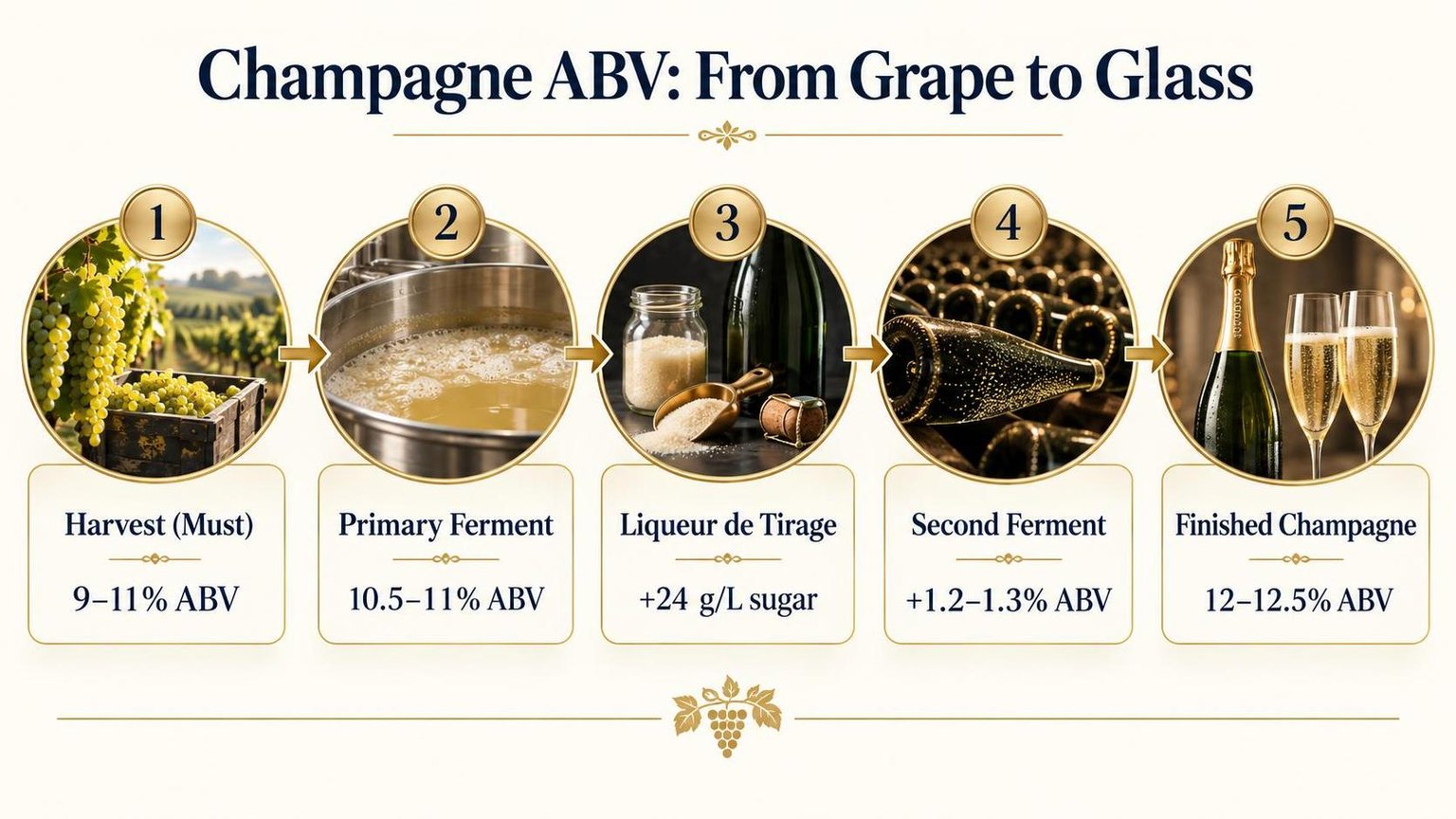
Grapes are typically harvested at 9–11% potential alcohol. The base wine (vin clair) finishes its primary fermentation around 10.5–11% ABV.
During prise de mousse, winemakers add a precise dosage of sugar and yeast called the liqueur de tirage. The standard addition is 24 grams of sugar per liter, which converts to approximately 1.2–1.3% additional alcohol.
| Stage | Typical ABV | Sugar Source |
| Harvest (must) | 9–11% potential | Natural grape sugar |
| After primary fermentation (vin clair) | 10.5–11% | Natural grape sugar fully fermented |
| After second fermentation (in bottle) | 12–12.5% | Added liqueur de tirage (24 g/L) |
Regulatory Constraints
The Comité Champagne (CIVC) sets minimum natural potential alcohol at 9% for non-vintage and 9.5% for vintage Champagne. Chaptalization—adding sugar to the must before primary fermentation—is permitted but capped.
EU regulation No 1308/2013 limits enrichment in Zone A (which includes Champagne) to a maximum increase of 3% ABV. Final wines rarely exceed 13% ABV as a result.
How Climate Shifts Are Nudging ABV Higher
Average harvest dates in Champagne have moved earlier by roughly 13 days since the 1980s, according to CIVC data. Warmer growing seasons produce riper grapes with more sugar.
In the notably warm 2018, 2019, and 2020 vintages, some cuvées reached 12.5–13% ABV. This trend contrasts sharply with the 1990s, when 11.5–12% was more typical across the region.
- Cooler vintages (e.g., 2021): base wines around 10–10.5% ABV, finished Champagne near 11.5%
- Warmer vintages (e.g., 2020): base wines near 11.5%, finished Champagne reaching 12.5–13%
The 12% average reflects a balance between Champagne’s northern terroir, regulated winemaking additions, and a second fermentation calibrated with precision.
Champagne Versus Sparkling Wine Alcohol
Champagne typically falls between 12% and 12.5% ABV, but sparkling wines from other regions span a wider range. Production method, grape variety, and climate drive these differences significantly.
True Champagne comes exclusively from the Champagne region of France and undergoes méthode champenoise, which includes a secondary fermentation in the bottle.
This process contributes roughly 1.2% to 1.5% additional alcohol beyond the base wine’s initial fermentation.
| Sparkling Wine | Region | Typical ABV |
| Champagne | Champagne, France | 12%–12.5% |
| Crémant | Various, France | 11.5%–12.5% |
| Cava | Catalonia, Spain | 11.5%–12% |
| Prosecco | Veneto, Italy | 11%–12% |
| Moscato d’Asti | Piedmont, Italy | 5%–6.5% |
| Sekt | Germany | 10%–13% |
| English Sparkling | England | 12%–12.5% |
| Cap Classique | South Africa | 11.5%–13% |
Prosecco uses the Charmat method, fermenting in pressurized tanks rather than bottles. This typically yields slightly lower alcohol and preserves more residual sugar and fresh fruit character.
Moscato d’Asti stands apart at just 5% to 6.5% ABV. Producers intentionally halt fermentation early, retaining natural grape sweetness while keeping alcohol minimal.
Why Climate Matters
Warmer regions produce grapes with higher sugar content, which converts to more alcohol during fermentation.
Champagne’s cool northerly latitude—around 49°N—naturally limits sugar accumulation in Chardonnay, Pinot Noir, and Pinot Meunier grapes.
New World sparkling wines from California or Australia often reach 12.5% to 13.5% ABV. Warmer growing conditions push grape sugars higher before harvest.
Key Distinctions to Remember
- Champagne holds a narrower ABV range (12%–12.5%) than most other sparkling categories.
- Méthode champenoise wines (Crémant, Cap Classique, English Sparkling) cluster near Champagne’s ABV range because they share the same production technique.
- Tank-method wines like Prosecco and Sekt show more variation depending on residual sugar levels and regional winemaking traditions.
- Moscato d’Asti is the lowest-alcohol mainstream sparkling wine, roughly half the strength of Champagne.
Checking the label remains the most reliable way to know exact ABV. EU regulations require alcohol content to appear within ±0.5% accuracy on every bottle.
Brut Nature to Doux Alcohol Differences
Champagne sweetness levels directly influence final alcohol content. Dosage—the sugar-wine mixture added after disgorgement—affects residual sugar but also slightly lowers ABV by diluting the base wine.
The driest styles consistently measure higher in alcohol than their sweeter counterparts.
Sweetness Categories and Typical ABV
EU Regulation 2019/33 defines seven sweetness levels for sparkling wine based on residual sugar per liter. Each category correlates with a measurable alcohol range.
| Sweetness Level | Residual Sugar (g/L) | Typical ABV Range |
| Brut Nature (Zero Dosage) | 0–3 | 12.0%–12.8% |
| Extra Brut | 0–6 | 12.0%–12.5% |
| Brut | 0–12 | 12.0%–12.5% |
| Extra Dry (Extra Sec) | 12–17 | 11.5%–12.5% |
| Dry (Sec) | 17–32 | 11.0%–12.0% |
| Demi-Sec | 32–50 | 11.0%–12.0% |
| Doux | 50+ | 10.5%–11.5% |
Why Dosage Lowers ABV
The liqueur d’expédition replaces wine lost during disgorgement. A higher-sugar dosage dilutes the alcohol concentration of the base cuvée, which typically sits at 12.0%–12.5% ABV before addition.
A Doux Champagne receiving 50+ g/L of sugar solution can lose 0.5%–1.0% ABV compared to the same base wine bottled as Brut Nature with zero dosage.
Real-World Examples
- Moët & Chandon Brut Impérial — 12.0% ABV, dosed at approximately 9 g/L residual sugar.
- Drappier Brut Nature — 12.5% ABV, zero dosage, zero added sulfur.
- Veuve Clicquot Demi-Sec — 12.0% ABV, residual sugar around 45 g/L.
- Laurent-Perrier Doux — historically produced at roughly 11.0% ABV with 50+ g/L sugar.
Practical Takeaway
Brut Nature styles deliver the full undiluted alcohol of the base wine, typically 12.0%–12.8%. Doux styles trade roughly 0.5%–1.5% ABV for pronounced sweetness.
Most Champagne drinkers encounter Brut, which lands reliably at 12.0%–12.5% ABV.
Checking the label remains the most accurate method. French law requires ABV to be printed within ±0.5% tolerance on every bottle sold in the EU market.
Serving Size and Alcohol Intake
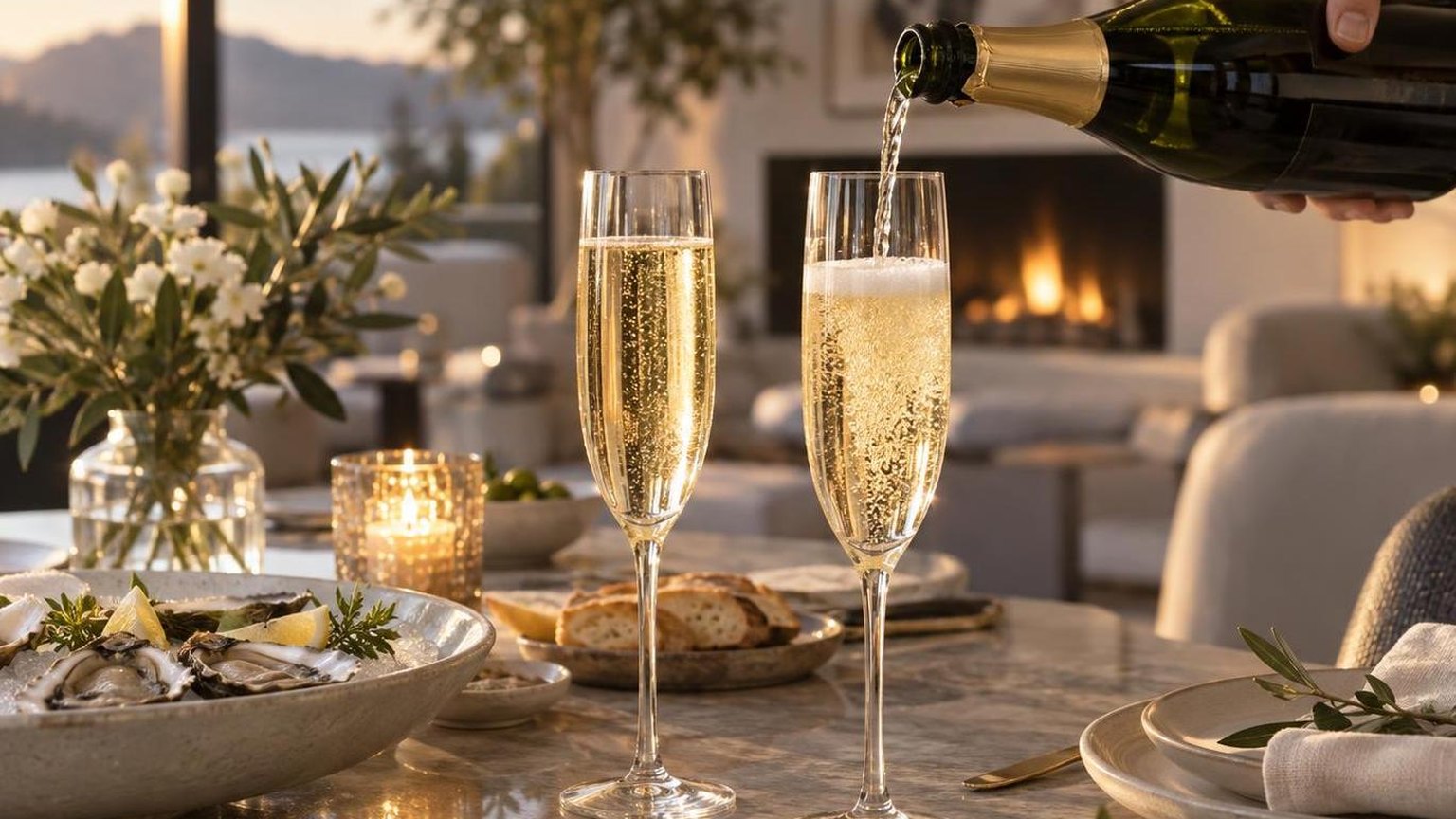
A standard pour of Champagne is 150 ml (5 oz), containing roughly 1.5 units of alcohol at 12% ABV. Understanding how serving size affects total intake helps drinkers moderate consumption during celebrations and tastings.
Alcohol Units per Serving Size
The formula for alcohol units is: volume (ml) × ABV (%) ÷ 1,000. Champagne’s typical 12–12.5% ABV produces these values across common pours:
| Serving | Volume | ABV | Alcohol (grams) | US Standard Drinks |
| Champagne flute | 150 ml (5 oz) | 12% | 14.2 g | 1.0 |
| Coupe glass | 180 ml (6 oz) | 12% | 17.0 g | 1.2 |
| Tasting pour | 90 ml (3 oz) | 12% | 8.5 g | 0.6 |
| Full bottle (shared 5 ways) | 150 ml (5 oz) | 12.5% | 14.8 g | 1.1 |
| Full bottle (one person) | 750 ml (25.4 oz) | 12.5% | 74.0 g | 5.3 |
One US standard drink equals 14 grams of pure ethanol, per the National Institute on Alcohol Abuse and Alcoholism (NIAAA).
Why Champagne Hits Faster
Carbonation accelerates alcohol absorption. A 2007 study in the Journal of Forensic and Legal Medicine found that sparkling wine raised blood alcohol concentration faster than flat wine of identical ABV in the first 20 minutes after consumption.
CO₂ increases gastric emptying rate, pushing ethanol into the small intestine more quickly. This means a single 150 ml flute can feel more potent than the same volume of still Pinot Noir at the same 12% ABV.
Practical Guidelines
- The 2020–2025 Dietary Guidelines for Americans recommend no more than 2 standard drinks per day for men and 1 for women.
- Two flutes of 12% Champagne equal approximately 2.0 standard US drinks — hitting the male daily limit exactly.
- Switching to a 90 ml tasting pour cuts intake by 40% per glass.
- Eating protein-rich canapés before drinking slows absorption by up to 50%, according to research published in the BMJ.
Tracking pours by volume rather than by “glasses” gives far more accurate intake data, especially when coupe glasses or generous pours exceed the standard 150 ml measure.
Label Rules for Champagne ABV
Champagne labeling follows strict European Union regulations and additional French appellation rules that govern how alcohol content appears on every bottle.
These rules protect consumers and ensure transparency across all producers within the AOC Champagne designation.
EU Labeling Requirements
EU Regulation 1169/2011 mandates that all wines exceeding 1.2% ABV display alcohol content on the label. The figure must appear as a number followed by “% vol.” in the same field of vision as the bottle’s volume statement.
A permitted tolerance of ±0.5% vol. applies to still wines, but sparkling wines including Champagne receive a wider tolerance of ±0.8% vol. This means a Champagne labeled 12.5% ABV may legally contain anywhere from 11.7% to 13.3% actual alcohol.
| Wine Category | Labeling Tolerance | Example (Labeled 12.5%) |
| Still wine | ±0.5% vol. | 12.0%–13.0% actual |
| Sparkling wine (Champagne) | ±0.8% vol. | 11.7%–13.3% actual |
| Fortified wine | ±0.5% vol. | 18.0%–19.0% actual |
AOC Champagne Specifications
The INAO cahier des charges for AOC Champagne sets a minimum natural alcohol potential of 9% vol. from the base grape must before any chaptalization. After disgorgement, finished Champagne must reach at least 11% ABV.
Chaptalization — adding sugar before primary fermentation — is permitted but capped. The maximum enrichment allowed raises alcohol by no more than 1.5% vol. in most vintages, subject to annual decree from regional authorities.
Display Format Rules
- ABV must be printed in characters at least 3 mm high on bottles 20 cl or larger.
- The number must be expressed in increments of 0.5% vol. or smaller (e.g., 12.0% or 12.5%).
- The abbreviation “% vol.” is mandatory; alternatives like “ABV” or “alc.” alone are non-compliant under EU law.
- On back labels, ABV must remain within the same visual field as net volume.
Producers occasionally round down rather than up to stay within tolerance. A 2021 study in OENO One found that 62% of sampled Champagnes measured higher in actual alcohol than stated on the label, averaging 0.37% vol. above the declared figure.
Lower Alcohol Champagne Buying Tips
Finding Champagne below the typical 12–12.5% ABV range requires deliberate label reading and producer research. Several strategies help you identify bottles that sit closer to 11% ABV or even lower without sacrificing quality.
Check the Label ABV Declaration
EU law requires ABV to appear on every bottle, with a permitted tolerance of ±0.5%. A label reading 12% could legally contain 11.5–12.5% actual alcohol. Always treat the printed figure as an estimate, not an absolute.
Prioritize Blanc de Blancs
100% Chardonnay Champagnes frequently finish at 11.5–12% ABV. Chardonnay grapes in the Côte des Blancs often reach optimal ripeness at lower sugar levels than Pinot Noir, translating to less alcohol after fermentation.
Seek Out Specific Low-ABV Producers
| Producer / Cuvée | Typical ABV | Style |
| Laherte Frères Ultradition | 12% | Extra Brut, minimal dosage |
| Pierre Gimonnet Cuis 1er Cru | 12% | Blanc de Blancs, bright acidity |
| Waris-Hubert Lilyale | 11.5% | Blanc de Blancs, zero dosage |
| Nicolas Maillart Platine 1er Cru | 11.5% | Pinot-dominant, low dosage |
Understand How Dosage Affects Perception
Dosage adds sugar but does not raise ABV—the liqueur d’expédition is added post-fermentation. Brut Nature (0–3 g/L dosage) Champagnes taste drier and let lower alcohol express itself more cleanly on the palate.
Consider Cooler Vintages
Grapes harvested in cooler years accumulate less sugar. Vintages like 2014 and 2021 produced musts averaging 9.5–10.5% potential alcohol before secondary fermentation added its typical 1.2–1.3% ABV boost.
Quick Buying Checklist
- Read the back label for exact ABV—not the front marketing copy
- Filter by Blanc de Blancs and Extra Brut or Brut Nature designations
- Ask retailers for non-vintage blends from cooler base years
- Avoid prestige cuvées from warm vintages (2018, 2020) which regularly hit 12.5–13% ABV
- Compare prices: lower-alcohol grower Champagnes often retail between $35–$55, undercutting major houses
Common Questions
What is the typical alcohol percentage of Champagne?
Most Champagne falls between 12% and 12.5% ABV (alcohol by volume). The Comité Interprofessionnel du Vin de Champagne (CIVC) requires a minimum of 11% ABV for wines carrying the Champagne appellation, and few houses exceed 13%.
Why does Champagne have a higher ABV than many other sparkling wines?
Champagne undergoes a second fermentation in the bottle (méthode champenoise), during which added yeast and sugar (liqueur de tirage) produce CO₂ and an additional 1–1.5% alcohol.
This pushes the final ABV above the base wine’s roughly 10.5–11%, landing most bottles near 12–12.5%.
Does the dosage level (brut, extra brut, demi-sec) change the alcohol content?
Dosage primarily affects residual sugar, not alcohol. A Brut Nature (0–3 g/L sugar) and a Demi-Sec (32–50 g/L sugar) from the same house typically differ by less than 0.5% ABV.
The sugar added at disgorgement is too small in volume to significantly alter the alcohol percentage.
How does Champagne’s alcohol compare to Prosecco and Cava?
Prosecco (DOC) generally ranges from 10.5% to 11.5% ABV because it uses the Charmat method with the aromatic Glera grape picked at lower ripeness. Cava sits closer to Champagne at 11.5–12% ABV.
Champagne’s 12–12.5% average places it at the higher end among major sparkling wines.
Which Champagne houses produce notably higher-alcohol cuvées?
Prestige cuvées from warmer vintages can reach 12.5–13% ABV. Krug Grande Cuvée, for example, often registers at 12.5%, while Bollinger R.D. vintages have been recorded at 12–12.5%.
Blanc de Noirs bottlings from riper Pinot Noir fruit also trend toward the upper range.
Has climate change affected the alcohol level in Champagne?
Yes. Average harvest sugar levels in Champagne have risen roughly 0.7° potential alcohol since the 1980s, according to CIVC data.
Base wines that once averaged about 10% potential ABV now regularly reach 10.5–11%, pushing finished bottles closer to 12.5% and occasionally beyond.
Can you find low-alcohol Champagne below 11% ABV?
True Champagne below 11% ABV is essentially nonexistent because appellation rules mandate that minimum. Some producers have experimented with lighter styles around 11–11.5%, but these remain rare.
For sparkling wine under 11% ABV, consumers typically need to look outside the Champagne AOC to options like Moscato d’Asti at 5–5.5%.
Does vintage Champagne have more alcohol than non-vintage?
Vintage Champagne is produced only in exceptional years when grapes achieve optimal ripeness, so it tends to sit at 12.2–12.5% ABV, slightly above the non-vintage average of 12–12.2%.
The difference is modest—usually no more than 0.3–0.5 percentage points—because both styles undergo the same second fermentation process.
Further Reading
- Is Champagne Gluten Free? The Most Accurate Answer
- 11 Essential Facts About How Much Alcohol Is In Champagne (2026 ABV Guide, Serving Strength, Effects & Real Tasting Experience)
- Alcohol Content in Champagne Explained
- Moet Vs Veuve: The Easiest Way to Distinguish Between Them
- Dom Perignon Vs Cristal: The Easiest Way to Distinguish
- 9 Must-Know Facts About How Many Glasses Of Champagne To A Bottle (2026 Expert Serving Guide)
- All Alcohol Guides
- USDA FoodData Central – Champagne Wine Entry (2024)
- National Institutes of Health / NIAAA – What Is a Standard Drink? (2024)
- TTB / U.S. Alcohol and Tobacco Tax and Trade Bureau – Wine Alcohol Content Regulations (2024)
- CDC – Alcohol and Public Health FAQs (2024)
- University of California Davis, Department of Viticulture & Enology – Sparkling Wine Production (2023)
- Comité Champagne / CIVC – Official Champagne Appellation Regulations (2024)
- Institut National de l'Origine et de la Qualité / INAO – AOC Champagne Cahier des Charges (2023)
- Wine Institute – Wine Alcohol Levels Overview (2023)
- MasterClass – Guide to Champagne (2023)
- GuildSomm – Champagne Study Guide (2024)