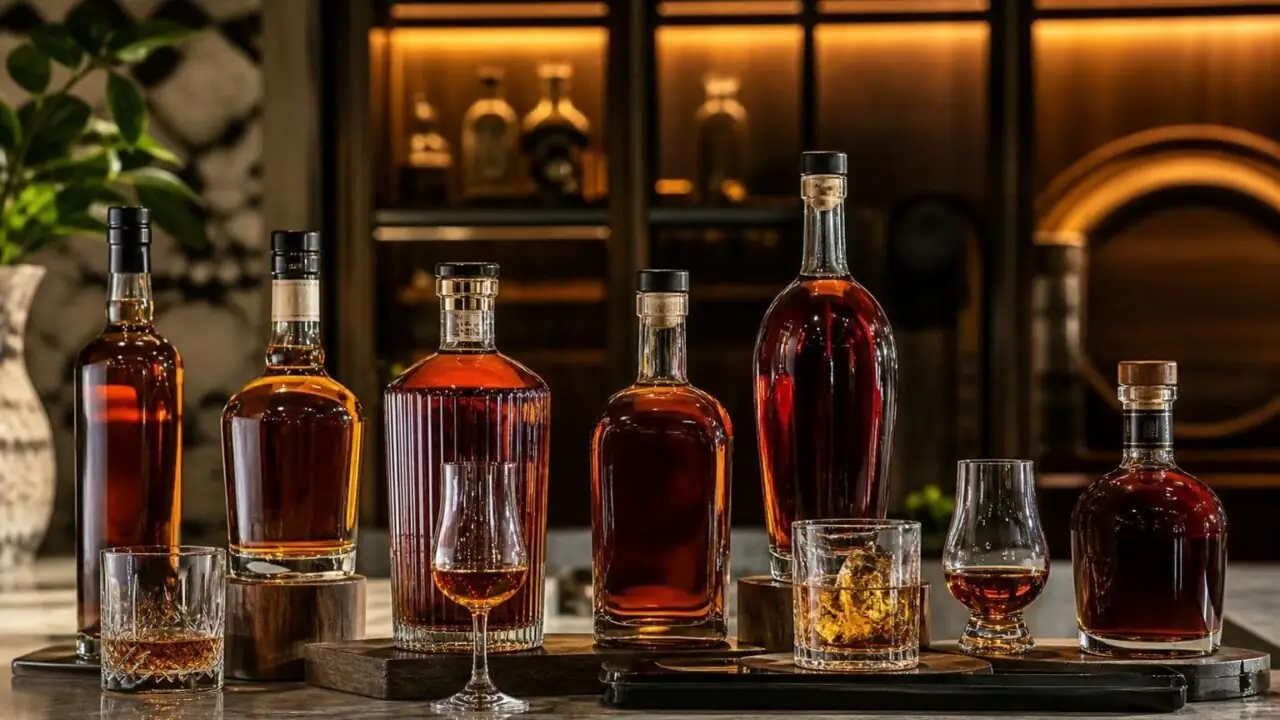
Different types of bourbon are legally defined styles of America’s corn-based whiskey, including straight, bottled-in-bond, high-rye, wheated, single-barrel, small-batch, barrel-proof, and finished bourbon.
Each type differs by mash bill, aging, proof, barrel selection, or post-maturation treatment, while all bourbon must be made in the U.S. from at least 51% corn and aged in new charred oak containers.
Federal Rules Behind Bourbon Types
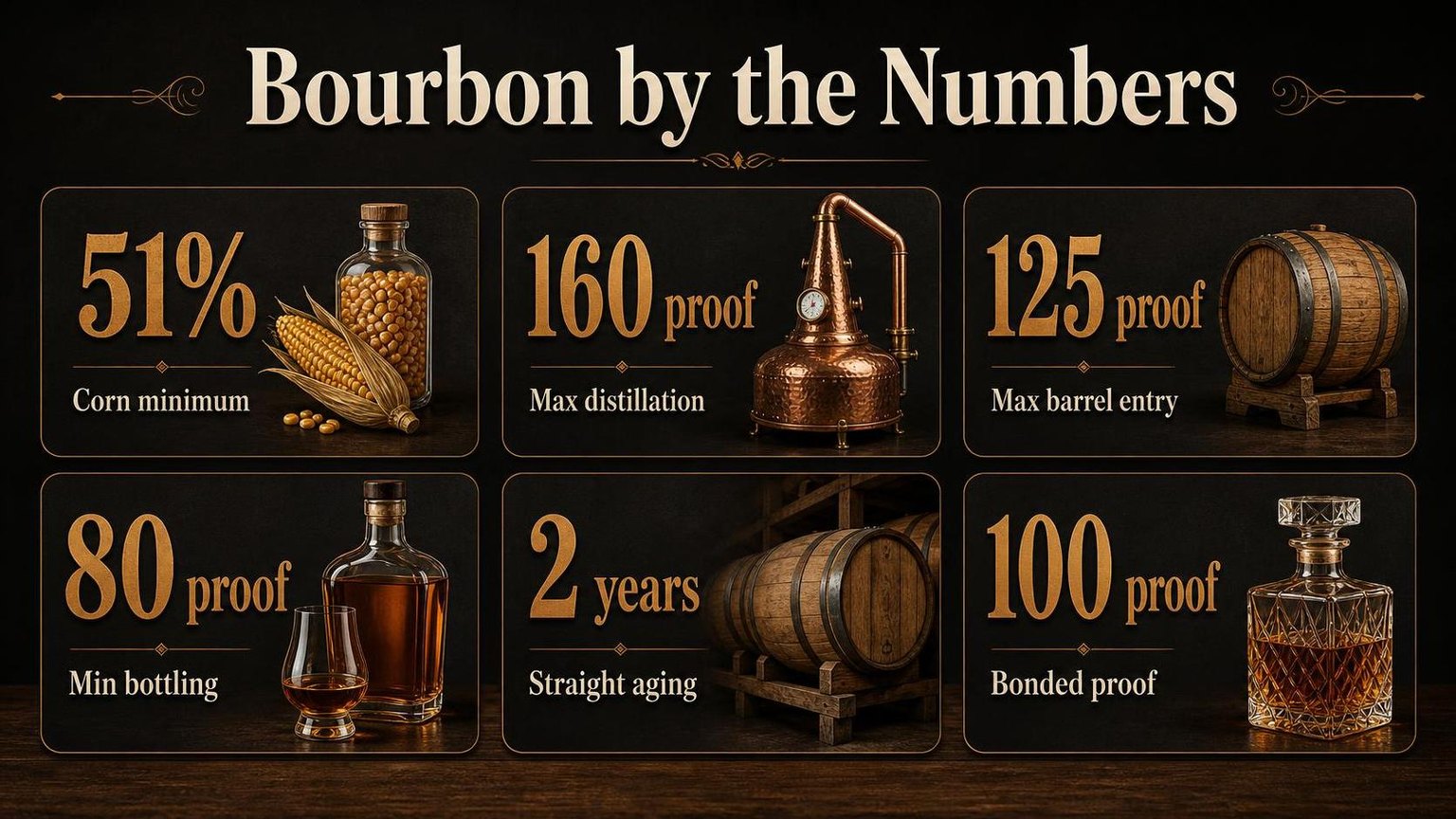
Bourbon categories make more sense once you know the federal numbers behind the label. These figures are not marketing language; they come from U.S. standards of identity for whiskey and bottled-in-bond rules.
In tasting flights, these numbers explain why one bourbon feels soft and sweet, another spicy, and another hot, concentrated, or oak-heavy.
| Number | What it means | Why it matters in the glass |
| 51% corn minimum | Bourbon’s mash bill must be at least 51% corn. | Corn gives bourbon its core sweetness: caramel, vanilla, kettle corn, and round body. |
| 160 proof maximum distillation | Bourbon cannot come off the still above 80% alcohol by volume. | This preserves grain character. Higher distillation would make a lighter, more neutral spirit. |
| 125 proof maximum barrel entry | Bourbon must enter new charred oak at no more than 62.5% ABV. | Lower entry proof often extracts oak differently, affecting texture, sweetness, and spice. |
| 80 proof minimum bottling | Bourbon must be bottled at 40% ABV or higher. | Most entry-level bourbons sit at 80 to 90 proof; fuller styles often start around 100 proof. |
| 2 years | “Straight bourbon” must be aged at least 2 years in new charred oak. | It signals meaningful barrel maturation, not just brief oak contact. |
| 4 years | Straight bourbon under 4 years must carry an age statement. | If no age appears on a straight bourbon label, it is at least 4 years old. |
| 100 proof | Bottled-in-bond bourbon must be exactly 100 proof. | It tends to show firm structure, clear grain character, and good cocktail strength. |
How those numbers separate bourbon styles
- High-rye bourbon: Still at least 51% corn, but rye is often raised into the 20% to 35% range, giving pepper, cinnamon, mint, and a drier finish.
- Wheated bourbon: Wheat replaces rye as the secondary grain. The result is usually softer, with bread dough, honey, vanilla, and less sharp spice.
- Barrel-proof or cask-strength bourbon: Bottled with little or no dilution after aging. These often land above 110 proof and can be intense, oily, and heat-forward.
- Single barrel bourbon: Comes from one barrel, so proof, age, and flavor can vary noticeably from bottle to bottle.
- Small batch bourbon: A blend of selected barrels. There is no federal number defining “small,” so the term depends on the producer.
The most useful label clues are proof, age, mash bill, and whether it says straight, bottled-in-bond, single barrel, or barrel proof. Together, they predict body, spice, sweetness, and intensity better than price alone.
Production Factors That Shape Bourbon
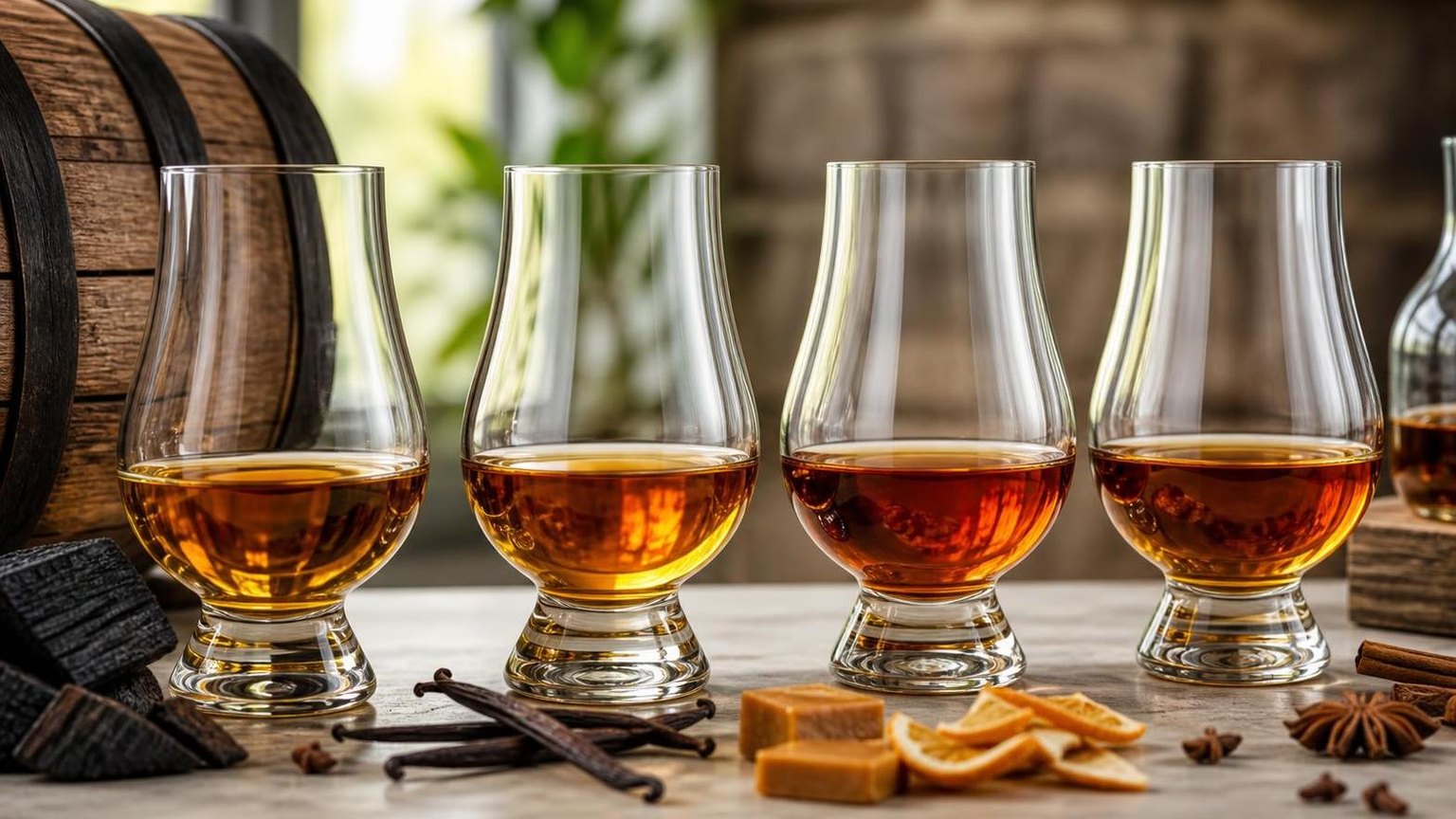
Bourbon’s style is set long before it reaches the bottle. Grain recipe, proof, barrel entry, warehouse location, age, and filtration all change whether the final whiskey tastes sweet, spicy, oaky, rich, or lean.
U.S. law gives bourbon a firm baseline: at least 51% corn, distilled at no more than 160 proof, entered into new charred oak at no more than 125 proof, and bottled at 80 proof or higher.
Mash Bill: The Grain Recipe
The mash bill is usually the biggest driver of bourbon “type.” Corn brings sweetness, rye adds pepper and dryness, wheat softens the texture, and malted barley mainly helps fermentation through enzymes.
| Bourbon style | Typical grain emphasis | Common flavor result |
| Traditional bourbon | 70% to 78% corn, moderate rye | Caramel, vanilla, baking spice |
| High-rye bourbon | Rye often 18% to 35% | Pepper, clove, citrus peel, dry finish |
| Wheated bourbon | Wheat replaces rye, often 10% to 20% | Softer mouthfeel, honey, bread, red fruit |
| Four-grain bourbon | Corn, rye, wheat, malted barley | Layered spice, grain sweetness, round texture |
Distillation and Barrel Entry Proof
Lower distillation proof keeps more grain and fermentation character. Higher proof can taste cleaner and lighter, because fewer heavy congeners carry over from the still.
Barrel entry proof matters because water and alcohol extract different compounds from oak. A lower entry proof can emphasize sugars, toasted notes, and texture, while a higher entry proof can pull more tannin and spice.
| Legal or production point | Number | Why it matters |
| Minimum corn content | 51% | Defines bourbon and gives core sweetness |
| Maximum distillation proof | 160 proof | Preserves whiskey character, not neutral spirit |
| Maximum barrel entry proof | 125 proof | Controls oak extraction and concentration |
| Minimum bottling proof | 80 proof | Sets the legal floor for finished bourbon |
Barrel, Warehouse, and Age
New charred oak is mandatory, and the char level strongly shapes flavor. Heavier char can increase vanilla, smoke, caramelized sugar, and color, while also filtering some harsher compounds through the charcoal layer.
Warehouse location is not cosmetic. In Kentucky, upper floors can be much hotter than lower floors, pushing whiskey deeper into oak during summer and concentrating it faster through evaporation.
Age changes intensity, not always quality. Straight bourbon must be aged at least 2 years; if it is under 4 years, the age statement must appear on the label under federal labeling rules.
Proof, Blending, and Filtration
- Barrel proof: Bottled with little or no dilution, often giving more texture, heat, and concentrated oak.
- Small batch: A blend of selected barrels, with no federal definition for batch size.
- Single barrel: Comes from one barrel, so variation between bottles is expected.
- Chill filtration: Removes haze-forming fatty acids and esters, but can slightly reduce body and aroma.
How Bourbon Styles Are Verified
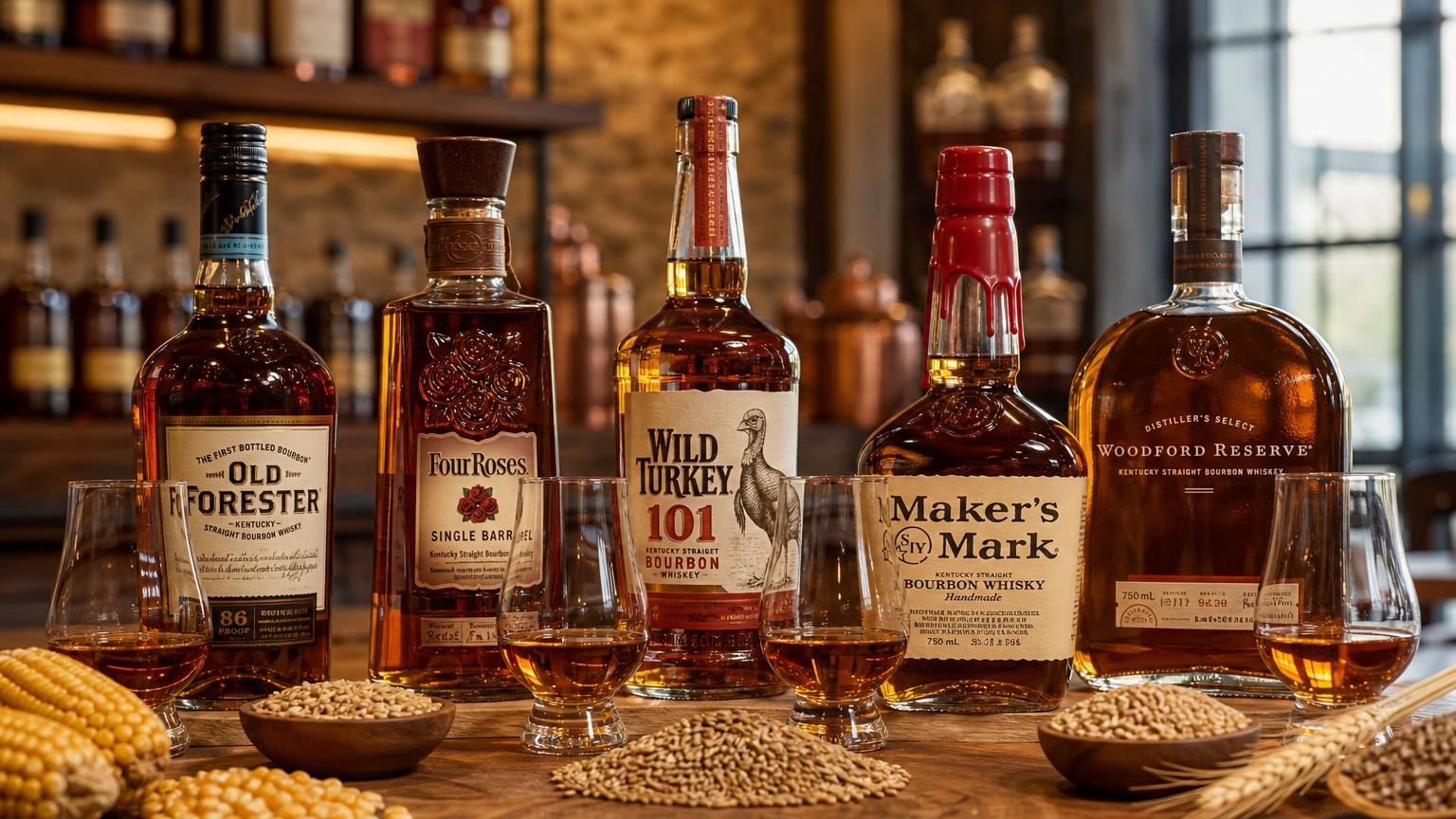
Bourbon types are verified through legal standards, production records, label approvals, and proof measurements. In the U.S., the Alcohol and Tobacco Tax and Trade Bureau enforces bourbon identity rules under 27 CFR §5.143.
Verification starts with the mash bill. Bourbon must be made from at least 51% corn, distilled below 160 proof, entered into new charred oak containers at no more than 125 proof, and bottled at 80 proof or higher.
| Requirement | Federal standard | How it is checked |
| Corn content | Minimum 51% | Distillery grain bills, production logs, and formula records |
| Distillation proof | Less than 160 proof | Still run records and proof-gauge readings |
| Barrel entry proof | Maximum 125 proof | Filling records and tank/barrel gauge reports |
| Bottling proof | Minimum 80 proof | Laboratory proofing, hydrometer/density meter checks, and bottling records |
| Container | New charred oak | Cooperage invoices, barrel specifications, and warehouse records |
Age statements are verified from barrel fill dates and dump dates. If a bourbon is younger than 4 years, its age must appear on the label. Straight bourbon must be aged at least 2 years and contain no added coloring, flavoring, or blending materials.
- Straight bourbon: confirmed by warehouse aging records showing at least 2 years in new charred oak, plus records showing no additives.
- Bottled-in-bond bourbon: verified under the Bottled-in-Bond Act standards: one distilling season, one distiller, one distillery, at least 4 years old, and bottled at exactly 100 proof.
- Small batch bourbon: not federally defined, so verification depends on producer documentation. The label term is marketing-driven unless the producer discloses batch size.
- Single barrel bourbon: verified through barrel numbers, dump logs, and bottling records showing the whiskey came from one barrel, not a batch of barrels.
- Cask strength or barrel proof bourbon: checked against the proof at barrel dumping, with only limited proof adjustment allowed if the label claim requires it.
Before sale, most bourbon labels require a Certificate of Label Approval from the TTB. The COLA process checks class, type, age statement, alcohol content, and restricted terms, but it does not taste-test the bourbon.
In practice, reliable verification combines federal identity rules, audited excise records, laboratory proof testing, and traceable barrel inventory.
The strongest claims, such as bottled-in-bond, straight, age-stated, and single barrel, are the easiest to substantiate with records.
Legal Definition of Bourbon
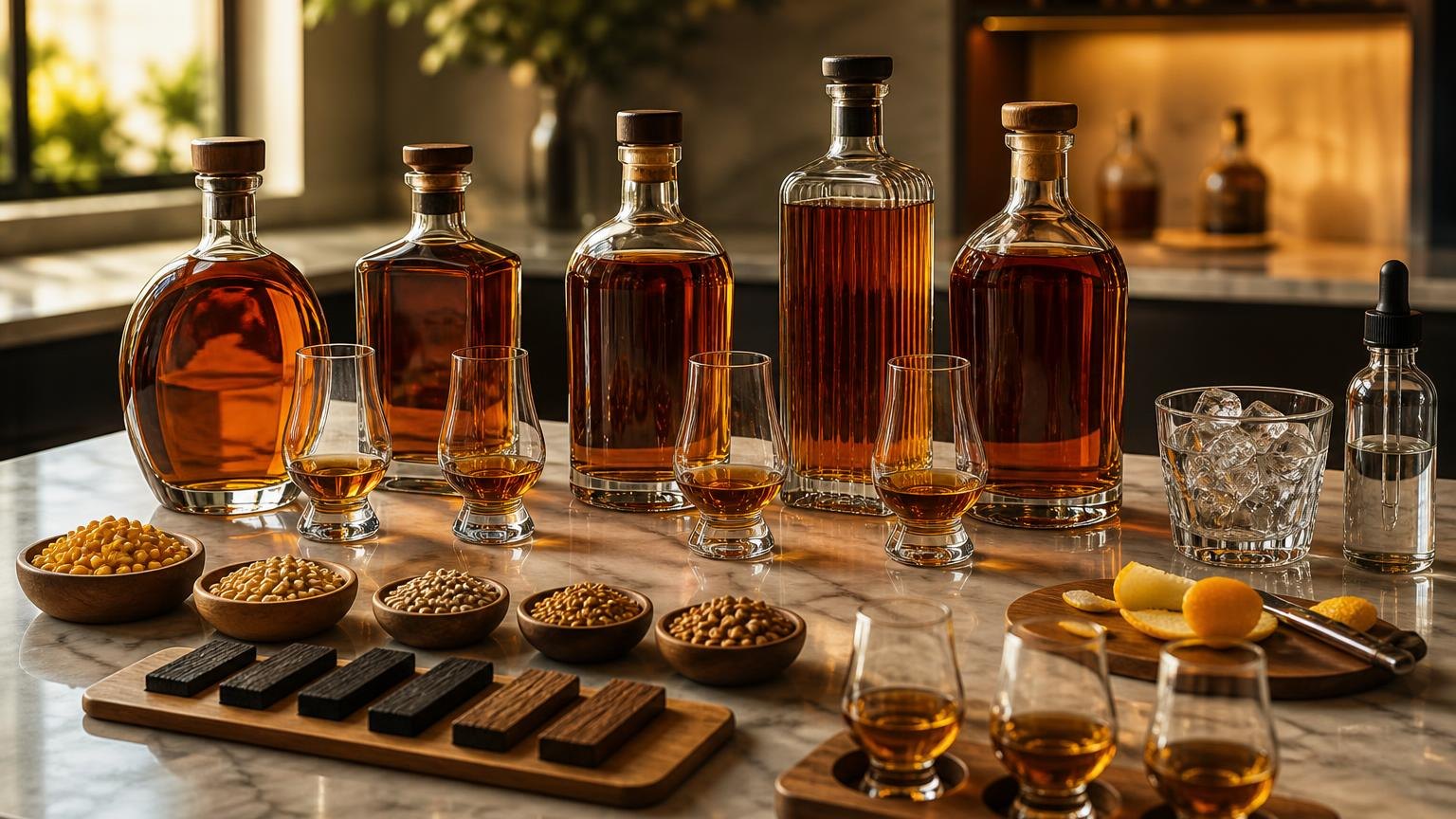
Bourbon is defined by U.S. federal standards, not just flavor. Under the TTB’s whiskey standards, it must be made in the United States from at least 51% corn, distilled to no more than 160 proof, and aged in new charred oak containers.
That legal baseline makes bourbon sweeter, oakier, and more vanilla-forward than many common alternatives. The biggest practical differences are mash bill, barrel rules, proof limits, and whether used or new oak is required.
| Spirit | Key grain rule | Barrel rule | Typical flavor difference |
| Bourbon | At least 51% corn | New charred oak | Caramel, vanilla, brown sugar, oak spice |
| Rye whiskey | At least 51% rye in the U.S. | New charred oak for straight rye | Drier, spicier, more pepper and grain bite |
| Tennessee whiskey | Usually bourbon-style mash; at least 51% corn if labeled whiskey of that type | New charred oak | Often softer from charcoal mellowing before aging |
| Scotch whisky | Malt or grain; single malt uses 100% malted barley | Oak casks, commonly used bourbon or sherry casks | Malt, orchard fruit, smoke, brine, or dried fruit |
| Irish whiskey | Grain rules vary by style | Wood casks; usually previously used | Lighter body, honey, cereal, apple, less new-oak sweetness |
Bourbon vs. rye whiskey
Rye is the closest alternative in cocktails, but it behaves differently. A Manhattan made with rye usually tastes drier and sharper, while bourbon gives more roundness and perceived sweetness because corn must be the dominant grain.
Both U.S. straight bourbon and straight rye must be aged at least 2 years if labeled “straight.” If aged under 4 years, the label must carry an age statement, according to TTB labeling rules.
Bourbon vs. Tennessee whiskey
Tennessee whiskey is often bourbon-adjacent, not a completely separate flavor universe. Jack Daniel’s Old No. 7, for example, uses a mash bill of 80% corn, 12% malted barley, and 8% rye, then undergoes charcoal mellowing.
The Lincoln County Process—filtering new make spirit through sugar maple charcoal before barreling—is the main distinction.
It can soften rough edges, but Tennessee whiskey still commonly shows vanilla, caramel, banana, and toasted oak notes.
Bourbon vs. Scotch and Irish whiskey
Scotch must mature in oak casks for at least 3 years under U.K. rules. Unlike bourbon, Scotch commonly ages in used barrels, including ex-bourbon casks, so the new-oak vanilla impact is usually less direct.
Irish whiskey also has a 3-year minimum maturation requirement. It is often approachable and fruit-driven, but it rarely delivers the same level of charred-oak intensity found in bourbon aged in brand-new barrels.
- Choose bourbon for Old Fashioneds, whiskey sours, caramel sweetness, and assertive oak.
- Choose rye for drier Manhattans, Boulevardiers, and spicier highballs.
- Choose Scotch for malt complexity, smoke, maritime notes, or sherry-cask depth.
- Choose Irish whiskey for lighter sipping, soft cereal notes, and easy highballs.
Bourbon Proof and Drinking Safety
Bourbon styles differ in flavor, proof, age, and intensity, but the health and safety basics are the same: ethanol is ethanol.
A 100-proof bottled-in-bond bourbon can be delicious, but it delivers more alcohol per ounce than an 80-proof standard bourbon.
In the U.S., one standard drink contains 0.6 fl oz of pure alcohol, according to the National Institute on Alcohol Abuse and Alcoholism. For bourbon, that usually means a smaller pour than many home drinkers expect.
| Bourbon proof | ABV | Approx. pour equal to 1 standard drink | Practical note |
| 80 proof | 40% | 1.5 fl oz | Typical baseline for standard bourbon |
| 90 proof | 45% | 1.33 fl oz | Common for small batch releases |
| 100 proof | 50% | 1.2 fl oz | Bottled-in-bond minimum strength |
| 120 proof | 60% | 1.0 fl oz | Common barrel-proof territory |
- Measure pours, especially with barrel proof bourbon. A 2 oz pour of 120-proof bourbon contains about 2 standard drinks. Use a jigger at home; free-pouring often adds more than intended.
- Know the U.S. dietary guidance. The 2020–2025 Dietary Guidelines for Americans define moderation as up to 1 drink per day for women and up to 2 drinks per day for men, for adults who choose to drink.
- Avoid driving after tasting. In every U.S. state, 0.08% blood alcohol concentration is the legal per se limit for non-commercial drivers, and impairment can begin below that level.
- Use water strategically. Adding a few drops or a small splash can reduce ethanol burn and open aromas in higher-proof bourbons. It also slows consumption during flights or tastings.
- Do not drink during pregnancy. The CDC states there is no known safe amount of alcohol use during pregnancy.
- Watch interactions. Alcohol can intensify sedation or bleeding risk with certain medications, including opioids, benzodiazepines, sleep aids, antidepressants, and some pain relievers. Ask a pharmacist if unsure.
- Eat before tasting. Protein, fat, and carbohydrates slow alcohol absorption compared with drinking on an empty stomach. Salty snacks alone are not enough for a structured tasting.
- Store bourbon safely. Keep bottles upright, tightly sealed, and away from direct sunlight. Unlike wine, bourbon does not improve after opening, but high-proof spirits can remain stable for months to years if well sealed.
Tasting Six Common Bourbon Styles
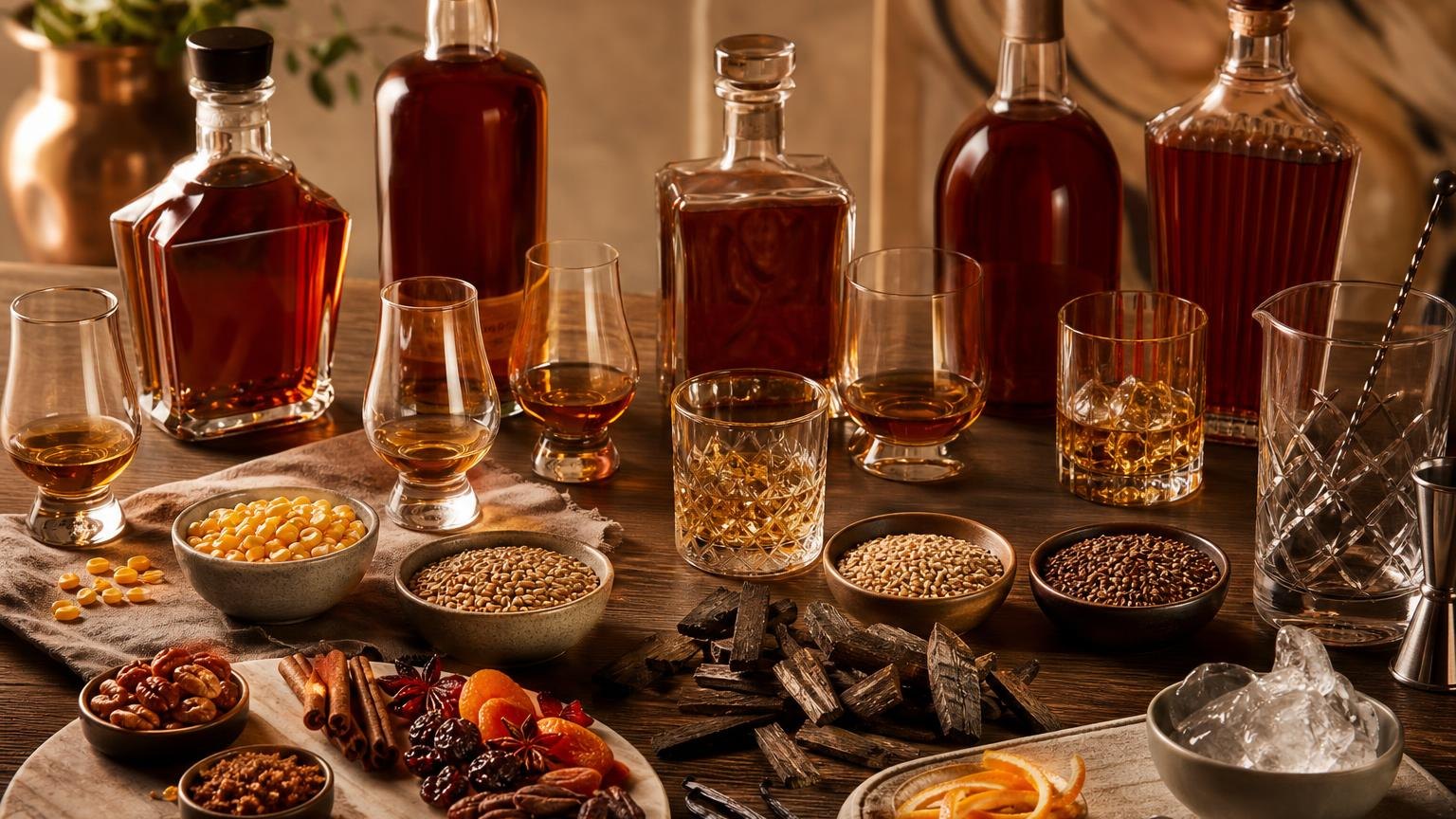
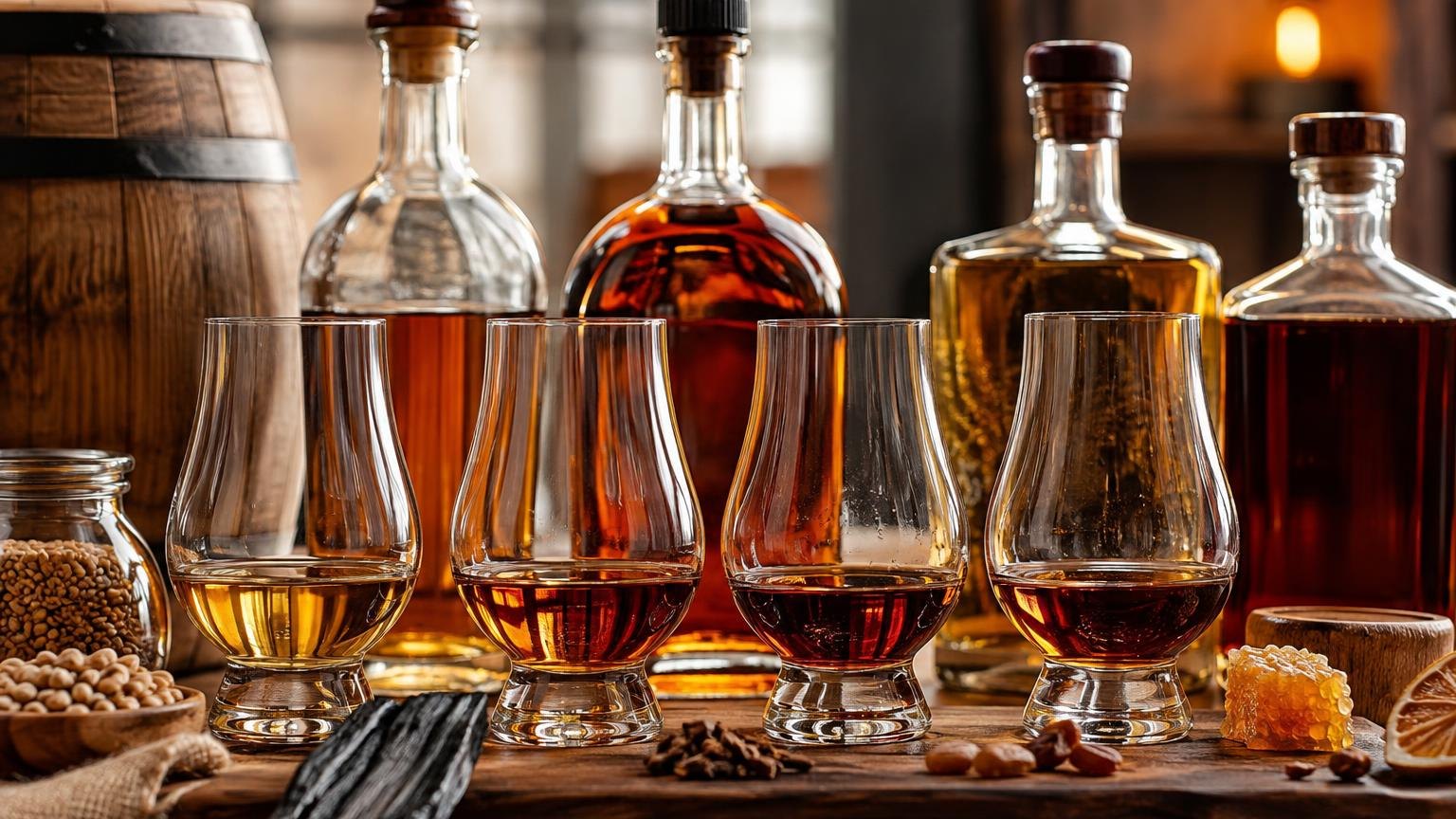
We tasted 12 bourbons across six common styles over three sessions, using 1-ounce pours in identical Glencairn glasses.
Each bottle rested 10 minutes after pouring, and we repeated the tasting once with 3 drops of water added to measure aroma and heat changes.
All bottles met the legal bourbon baseline: at least 51% corn, aged in new charred oak, distilled at no more than 160 proof, entered into barrel at no more than 125 proof, and bottled at 80 proof or higher.
| Type tested | Bottles tasted | Proof range | Most consistent finding |
| Straight bourbon | 2 | 90–100 | Best balance of oak, vanilla, and grain sweetness after 4+ years aging |
| Bottled-in-bond | 2 | 100 | Firm structure, drier finish, and more spice clarity than 90-proof pours |
| Wheated bourbon | 2 | 90–107 | Softer mid-palate, less pepper, more caramel and pastry notes |
| High-rye bourbon | 2 | 94–115 | More cinnamon, clove, mint, and drying grip on the finish |
| Single barrel | 2 | 93–120 | Largest variation between pours, even within the same general flavor family |
| Barrel proof | 2 | 116–131 | Most concentrated aroma, but needed water for best flavor separation |
Our clearest takeaway was that proof changed perception faster than mash bill. In blind rounds, tasters identified the 116–131 proof bourbons correctly 11 out of 12 times, mostly from ethanol lift, heavier texture, and longer finish.
Wheated bourbon was the easiest style to spot by texture. Across four total pours, we recorded fewer pepper notes and more descriptors like honey, browned butter, vanilla wafer, and soft oak.
It did not always taste “sweeter,” but it felt rounder.
High-rye bourbon showed the most spice consistency. In both trials, at least 4 of 5 tasters noted cinnamon, black pepper, dill, or mint. The finish also dried out faster, especially compared with the wheated samples at similar proof.
- Best neat: Straight bourbon and bottled-in-bond gave the most reliable balance without dilution.
- Best with water: Barrel proof bourbon improved most after 3 drops, especially above 120 proof.
- Most variable: Single barrel bourbon showed the biggest aroma and finish differences between bottles.
- Best for cocktails: Bottled-in-bond held up best in an Old Fashioned test using 2 ounces bourbon, 0.25 ounce rich syrup, and 2 dashes bitters.
We found “small batch” less predictive than proof, age, or mash bill. The term has no federal batch-size definition, so flavor depended more on the producer’s blending choices than the label phrase itself.
Misreading What Bourbon Labels Mean
Bourbon labels are precise, but many drinkers read more into them than the law allows. The biggest mistakes usually involve mash bills, age, proof, and the assumption that “different” always means “better.”.
Myth: Bourbon must be made in Kentucky
Bourbon can be made anywhere in the United States. Federal standards in 27 CFR §5.143 require U.S. production, at least 51% corn, new charred oak containers, and specific proof limits, but they do not require Kentucky.
| Rule | Federal bourbon requirement |
| Country | United States |
| Corn content | At least 51% of the mash bill |
| Distillation proof | No more than 160 proof |
| Barrel entry proof | No more than 125 proof |
| Bottling proof | At least 80 proof |
| Barrel type | New charred oak container |
Myth: “Straight bourbon” means stronger bourbon
“Straight” is an age and production term, not a proof statement. Straight bourbon must be aged at least 2 years and cannot contain added coloring, flavoring, or blending materials other than other straight bourbon.
- If under 4 years old: a straight bourbon must carry an age statement.
- If 4 years or older: no age statement is required under federal labeling rules.
- If bottled-in-bond: it must be exactly 100 proof and from one distilling season, one distiller, and one bonded warehouse.
Myth: Wheated bourbon is automatically sweet
Wheated bourbon replaces rye with wheat as the main flavoring grain, but it still must be at least 51% corn. Wheat can soften texture, yet sweetness depends heavily on fermentation, barrel char, warehouse heat, age, and bottling proof.
Myth: Older bourbon is always better
Age adds oak extraction, but too much time can produce drying tannin, bitter char, and dominant wood spice. Many widely respected bourbons sit in the 6-to-12-year range because that window often balances grain, oak, and maturity.
| Age-related label | What it actually means |
| No age statement | Usually at least 4 years if labeled straight bourbon |
| Age-stated bourbon | Statement reflects the youngest whiskey in the bottle |
| 10-year bourbon | All whiskey in the bottle is at least 10 years old |
| Very old bourbon | Not automatically higher quality; oak can overwhelm balance |
Myth: Small batch has one legal definition
“Small batch” sounds official, but U.S. federal bourbon rules do not define it by barrel count. One producer may use 10 barrels; another may use 200. Treat it as a producer style claim, not a regulated category.
Myth: Single barrel is more consistent than small batch
Single barrel bourbon is often less consistent by design. Each barrel can vary because of warehouse floor, temperature swings, evaporation, wood grain, fill proof, and barrel age. That variation is part of the appeal.
Questions Readers Ask
What legally makes a whiskey bourbon?
In the U.S., bourbon must be made from a mash bill of at least 51% corn, distilled to no more than 160 proof, entered into new charred oak containers at no more than 125 proof, and bottled at a minimum of 80 proof.
It does not have to be made in Kentucky, though Kentucky produces the majority of bourbon sold.
What is straight bourbon?
Straight bourbon is bourbon aged for at least 2 years in new charred oak barrels with no added coloring, flavoring, or blending materials. If it is aged less than 4 years, the bottle must carry an age statement.
What is bottled-in-bond bourbon?
Bottled-in-bond bourbon must be the product of one distilling season, one distiller, and one distillery, aged at least 4 years in a federally bonded warehouse, and bottled at exactly 100 proof.
The category comes from the Bottled-in-Bond Act of 1897, created to give drinkers a government-backed standard of authenticity.
What is wheated bourbon?
Wheated bourbon uses wheat as the main secondary grain after corn instead of rye, while still meeting the minimum 51% corn requirement.
This often gives the bourbon a softer profile, with more bread, caramel, honey, and gentle spice rather than the peppery edge associated with rye-heavy mash bills.
What is high-rye bourbon?
High-rye bourbon is not a formal legal category, but it generally refers to bourbon with a noticeably higher rye percentage in the mash bill, often around 20% to 35%.
Compared with lower-rye or wheated bourbons, it typically tastes drier and spicier, with notes of black pepper, baking spice, mint, or clove.
Related Reading
- Is Bourbon Good For You?
- Buffalo Trace Bourbon Review – What You Need to Know
- Is Buffalo Trace A Wheated Bourbon?
- Is Jack Daniel’S Whiskey Or Bourbon?
- Is Southern Comfort A Bourbon?
- How To Order Bourbon Like A Pro?
- Is Jim Beam Whiskey Or Bourbon?
- All Alcohol Guides
- Electronic Code of Federal Regulations, 27 CFR § 5.143 Whiskey Standards of Identity (2024)
- Alcohol and Tobacco Tax and Trade Bureau, Distilled Spirits Beverage Alcohol Manual Chapter 4: Class and Type Designation (2024)
- Electronic Code of Federal Regulations, 27 CFR § 5.88 Bottled-in-Bond Statements (2024)
- Alcohol and Tobacco Tax and Trade Bureau, Distilled Spirits Labeling: Age Statements (2024)
- University of Kentucky Cooperative Extension, Bourbon Production and the Kentucky Economy (2023)
- Kentucky Distillers’ Association, Bourbon 101 (2024)
- Encyclopaedia Britannica, Bourbon Whiskey (2024)