
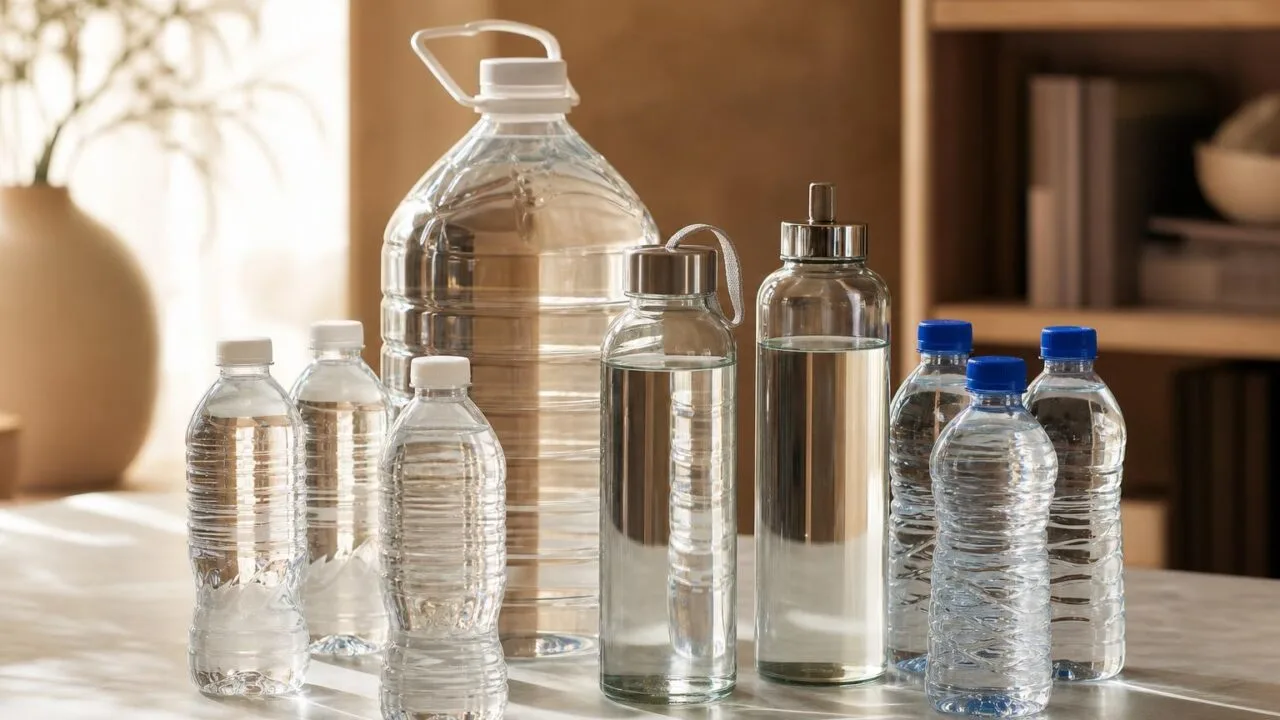
How Many Water Bottles Is A Gallon is 8 bottles of 16 fluid ounces. A U.S. gallon equals 128 fluid ounces, so the bottle count depends entirely on bottle size, not the label’s shape, brand, or pack count.
For common sizes, 128 ÷ 16 = 8, 128 ÷ 20 = 6.4, and 128 ÷ 12 = 10.67 bottles. That means a gallon is not always a whole number of bottles unless the bottle size divides evenly into 128 ounces.
Use the formula 128 ÷ bottle ounces to convert any bottle size into gallons accurately. This matters for daily water goals, event planning, emergency storage, and comparing bulk packs without guessing.
Gallons in Fluid Ounces
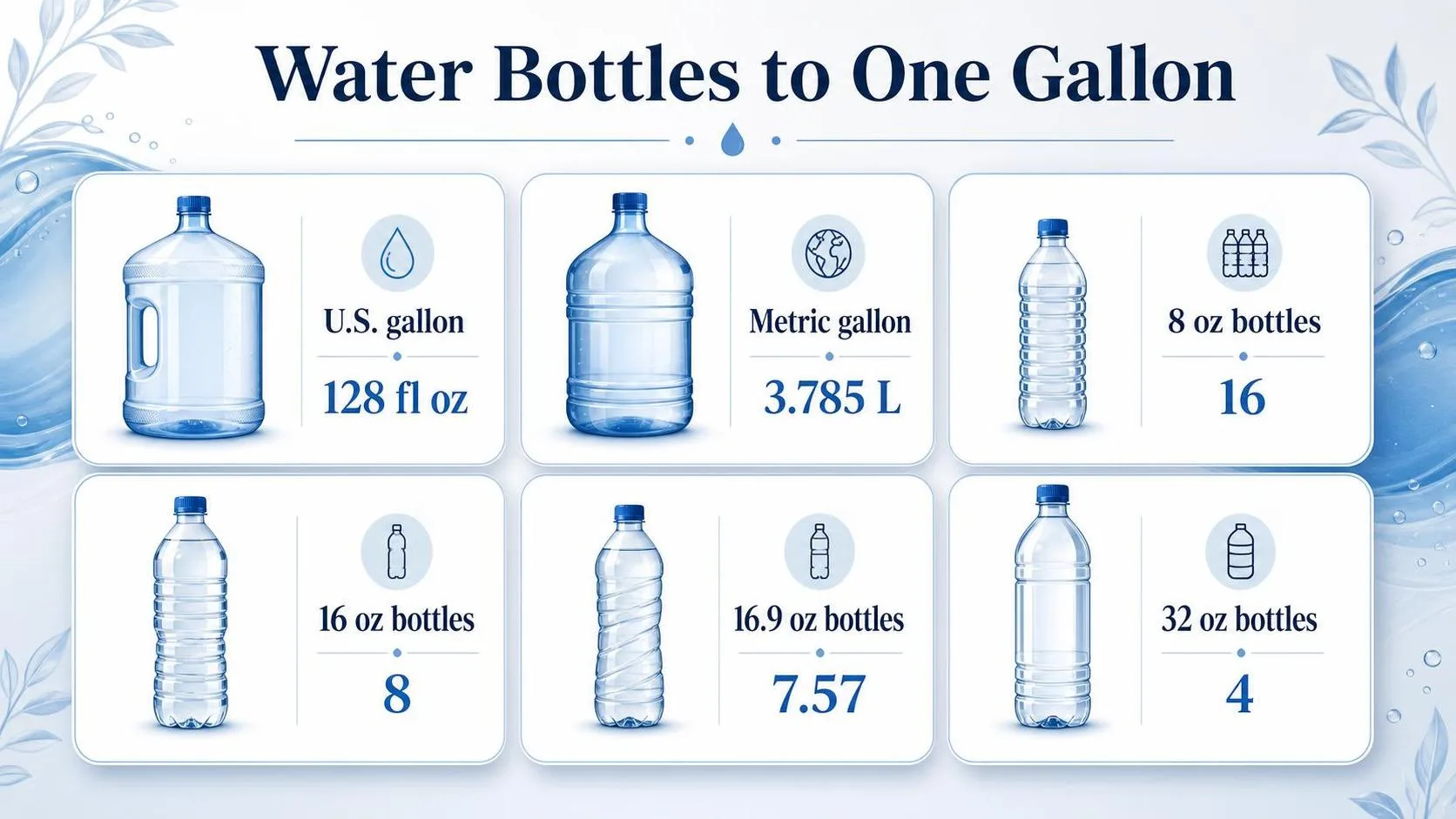
A U.S. gallon equals 128 U.S. fluid ounces, which is the number that matters when counting water bottles. In metric terms, one U.S. gallon is about 3.785 liters, or 3,785 milliliters.
Most bottled water in the United States is labeled in fluid ounces and milliliters. To find how many bottles make a gallon, divide 128 by the bottle’s fluid-ounce size.
| Bottle size | Calculation | Bottles per U.S. gallon |
| 8 fl oz | 128 ÷ 8 | 16 bottles |
| 12 fl oz | 128 ÷ 12 | 10.67 bottles |
| 16 fl oz | 128 ÷ 16 | 8 bottles |
| 16.9 fl oz / 500 mL | 128 ÷ 16.9 | 7.57 bottles |
| 20 fl oz | 128 ÷ 20 | 6.4 bottles |
| 24 fl oz | 128 ÷ 24 | 5.33 bottles |
| 32 fl oz | 128 ÷ 32 | 4 bottles |
| 1 liter / 33.8 fl oz | 128 ÷ 33.8 | 3.79 bottles |
The common 16.9-ounce bottle is the U.S. version of a 500 mL bottle. Because 500 mL is about 16.907 U.S. fluid ounces, it takes about 7.57 bottles to equal one gallon.
In practical terms, that means 7 bottles is slightly under a gallon, while 8 bottles is slightly over. Eight 16.9-ounce bottles equal about 135.2 fluid ounces, or 1.056 U.S. gallons.
| Amount | Total fluid ounces | Compared with 1 gallon |
| 7 bottles of 16.9 fl oz | 118.3 fl oz | 9.7 fl oz short |
| 8 bottles of 16.9 fl oz | 135.2 fl oz | 7.2 fl oz over |
Be careful not to confuse a U.S. gallon with an imperial gallon. The imperial gallon, used in the United Kingdom and some Commonwealth contexts, is about 160 imperial fluid ounces, or 4.546 liters.
| Gallon type | Fluid ounces | Liters |
| U.S. liquid gallon | 128 U.S. fl oz | 3.785 L |
| Imperial gallon | 160 imperial fl oz | 4.546 L |
For U.S. bottled water, use 128 fluid ounces per gallon. Then divide by the exact bottle size printed on the label, since “standard bottle” can mean 8, 12, 16, 16.9, 20, 24, or 32 fluid ounces.
Why Bottle Counts Vary
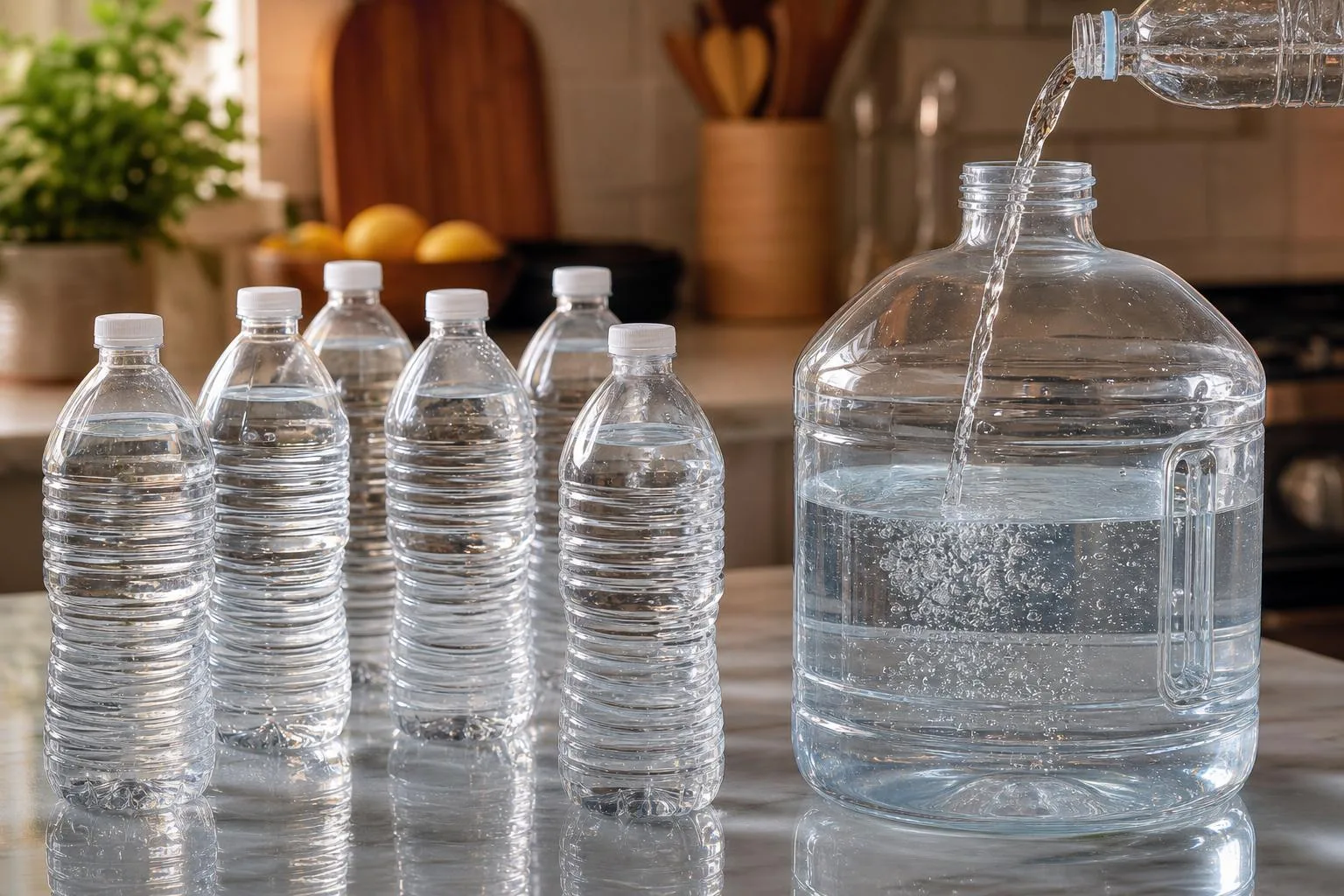
The answer changes because “a gallon” and “a water bottle” are not always the same size. In the United States, 1 liquid gallon is exactly 128 U.S. fluid ounces, but bottle labels may use ounces, milliliters, or rounded values.
The biggest factor is the bottle’s actual volume. A common single-serve bottle is labeled 16.9 fl oz because it is 500 mL, which converts to about 16.907 U.S. fl oz.
| Bottle size | Bottles per U.S. gallon | Practical result |
| 8 fl oz | 16 | Exactly 16 bottles |
| 12 fl oz | 10.67 | 10 full bottles plus 8 fl oz |
| 16 fl oz | 8 | Exactly 8 bottles |
| 16.9 fl oz / 500 mL | 7.57 | About 7 and a half bottles |
| 20 fl oz | 6.4 | 6 full bottles plus 8 fl oz |
| 1 liter / 33.814 fl oz | 3.79 | Nearly 4 bottles |
Country also matters. A U.S. liquid gallon is 3.78541 liters, while an Imperial gallon used historically in the U.K. and some Commonwealth contexts is 4.54609 liters.
| Gallon type | Liters | U.S. fluid ounces | 500 mL bottles |
| U.S. liquid gallon | 3.78541 L | 128 fl oz | 7.57 bottles |
| Imperial gallon | 4.54609 L | 153.72 U.S. fl oz | 9.09 bottles |
Rounding on packaging can shift the final count slightly. A bottle marketed as 16.9 fl oz is usually 500 mL, not exactly 16.900 fl oz, so dividing 128 by the precise metric volume gives 7.57 bottles.
- Label units: Milliliter-based bottles convert to uneven ounce values, such as 500 mL equaling about 16.907 fl oz.
- Fill line and manufacturing tolerance: Bottled beverages are filled to declared net contents, but tiny production variations can occur within regulatory limits.
- “About” answers: For hydration tracking, people often round 7.57 standard bottles to 8 bottles, which equals about 135.3 fl oz, slightly more than a gallon.
- Reusable bottles: A “32 oz bottle” may mean capacity to the rim, while the usable fill level can be lower if you leave space for ice or a lid insert.
For the most accurate answer, read the bottle’s net contents and divide 128 by that number in U.S. fluid ounces. For everyday use, eight 16 oz bottles or about seven and a half 16.9 oz bottles equals one U.S. gallon.
A Gallon Measures Volume
A U.S. gallon is measured by volume, not by bottle count. The exact legal basis is 1 U.S. liquid gallon = 231 cubic inches = 3.785411784 liters = 128 U.S. fluid ounces.
To verify how many water bottles equal a gallon, read the bottle’s net contents in fluid ounces or milliliters, then divide 128 fluid ounces by that amount.
Standard Measurement Reference
| Unit | Exact or Standard Value | Use |
| 1 U.S. gallon | 128 U.S. fluid ounces | Main calculation for U.S. bottles |
| 1 U.S. gallon | 3.785411784 liters | Metric verification |
| 1 U.S. fluid ounce | 29.5735295625 milliliters | Converting bottle labels |
| 1 liter | 33.814 U.S. fluid ounces | Checking liter bottles |
Most single-serve water bottles in the U.S. are labeled in fluid ounces, commonly 16.9 fl oz, which is also 500 mL. Because labels are rounded, the practical bottle count may be slightly above or below the mathematical result.
Bottle Count Verification
| Bottle Size | Equivalent Volume | Bottles per U.S. Gallon |
| 8 fl oz | 236.6 mL | 16 bottles |
| 12 fl oz | 354.9 mL | 10.67 bottles |
| 16 fl oz | 473.2 mL | 8 bottles |
| 16.9 fl oz | 500 mL | 7.57 bottles |
| 20 fl oz | 591.5 mL | 6.4 bottles |
| 1 liter | 33.814 fl oz | 3.79 bottles |
For a kitchen check, use a marked 1-gallon container or a laboratory-style graduated pitcher. Pour bottles into the container until the liquid reaches the 1-gallon mark, keeping the container level and reading the meniscus at eye height.
A scale can also verify volume by mass. At about 20°C, water has a density near 0.9982 g/mL, so 1 U.S. gallon weighs about 3,778 grams, or 8.33 pounds, excluding the container.
- Best method: use the bottle’s printed net quantity, not the bottle’s physical size.
- Formula: 128 ÷ bottle fluid ounces = bottles per gallon.
- Metric formula: 3.785411784 ÷ bottle liters = bottles per gallon.
- Accuracy note: temperature, label rounding, and fill tolerances can create small differences.
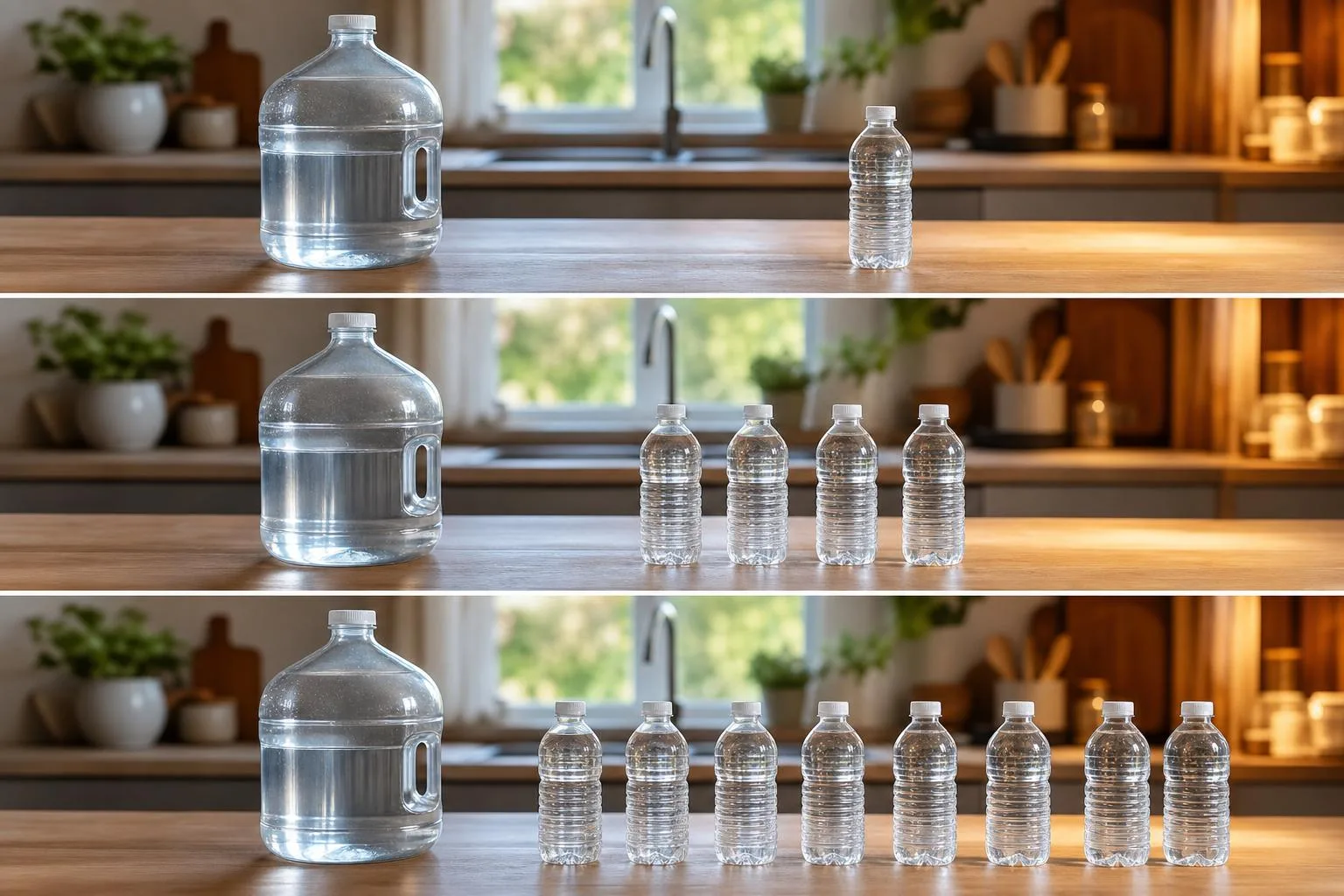
Bottle Size Determines Count
A U.S. gallon equals 128 U.S. fluid ounces, so the bottle count depends entirely on bottle size. The most common single-use water bottle in the U.S. is 16.9 fluid ounces, or 500 milliliters, which means one gallon is about 7.57 bottles.
In practical terms, that is usually counted as eight 16.9-ounce bottles if you are filling, buying, or tracking water by the bottle.
| Container size | Fluid ounces | How many equal 1 U.S. gallon |
| Standard disposable bottle | 16.9 fl oz | 7.57 bottles |
| Small water bottle | 8 fl oz | 16 bottles |
| Sports bottle | 20 fl oz | 6.4 bottles |
| Large bottled water | 33.8 fl oz / 1 liter | 3.79 bottles |
| Quart bottle | 32 fl oz | 4 bottles |
| Half-gallon jug | 64 fl oz | 2 jugs |
Compared with a liter, a gallon is larger: 1 U.S. gallon equals about 3.785 liters. That means four 1-liter bottles slightly exceed a gallon, totaling about 135.3 fluid ounces.
| Measure | U.S. fluid ounces | Relation to 1 gallon |
| 1 cup | 8 fl oz | 16 cups per gallon |
| 1 pint | 16 fl oz | 8 pints per gallon |
| 1 quart | 32 fl oz | 4 quarts per gallon |
| 1 half-gallon | 64 fl oz | 2 half-gallons per gallon |
| 1 liter | 33.814 fl oz | 3.785 liters per gallon |
For home use, a gallon is also one-fifth of a standard 5-gallon water cooler jug. A full 5-gallon jug holds 640 fluid ounces, equal to about 37.9 standard 16.9-ounce bottles.
- For grocery shopping: one gallon is closest to eight standard 16.9-ounce bottles.
- For refillable bottles: a 32-ounce bottle needs four full refills to equal a gallon.
- For large bottles: four 1-liter bottles are slightly more than a gallon.
- For coolers: a 5-gallon jug equals five gallons, not five bottles.
The key distinction is U.S. versus imperial measurement. A U.S. gallon is 128 fluid ounces, while an imperial gallon used in some countries is about 153.7 U.S. fluid ounces, so bottle counts are higher under the imperial system.
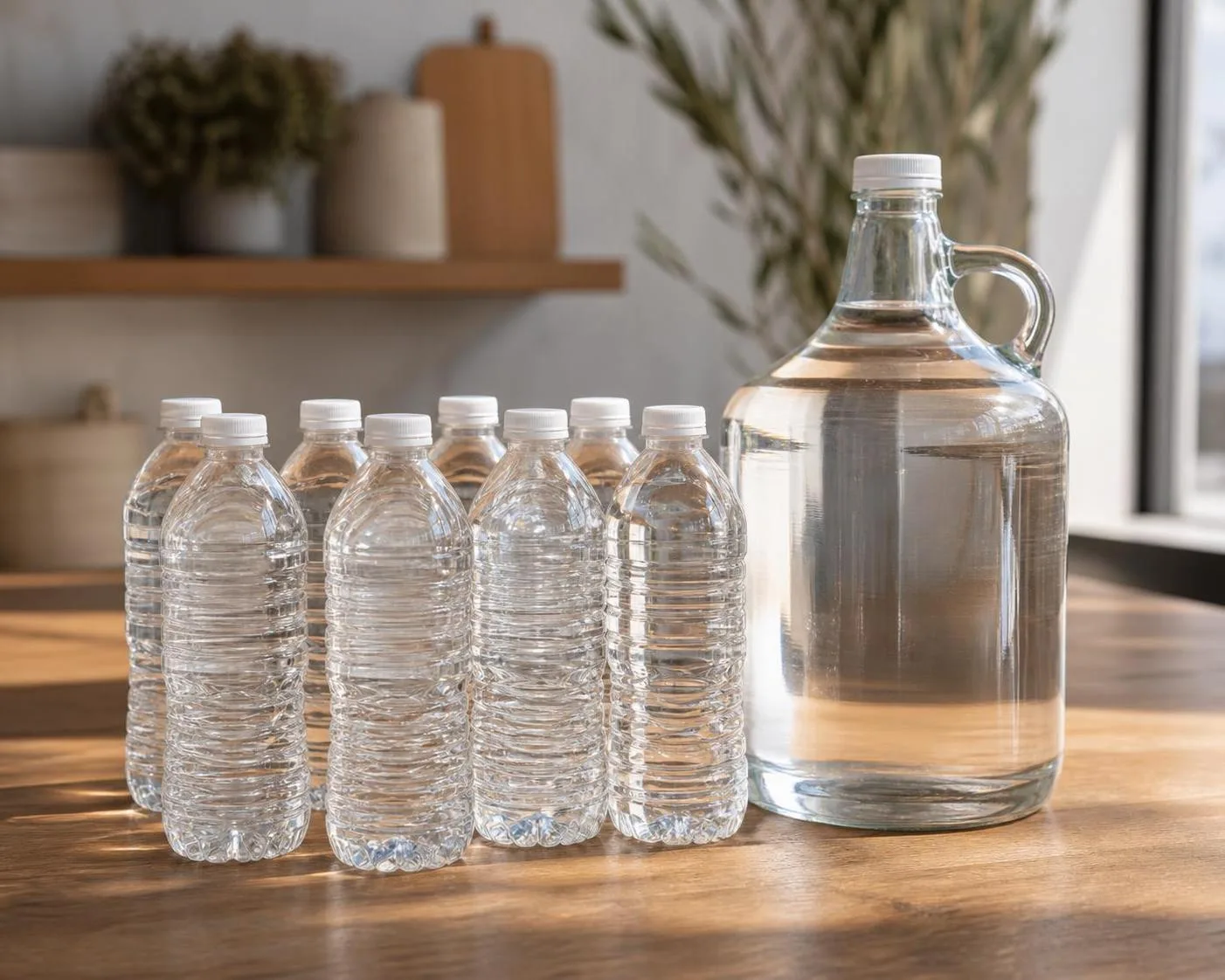
Bottle Count and Hydration Needs
A U.S. gallon is 128 fluid ounces, so the “right” number of bottles depends on the bottle size.
For everyday hydration, the bigger issue is not just bottle math, but drinking an amount that fits your body, activity level, climate, and medical needs.
| Bottle size | Bottles per 1 U.S. gallon | Practical note |
| 8 fl oz | 16 bottles | Common small school or event bottle |
| 12 fl oz | 10.67 bottles | About 10 full bottles plus 8 fl oz |
| 16.9 fl oz | 7.57 bottles | Standard single-use bottle; practically 7½ bottles |
| 20 fl oz | 6.4 bottles | Common convenience-store size |
| 32 fl oz | 4 bottles | Typical large reusable bottle |
The National Academies of Sciences, Engineering, and Medicine lists adequate total water intake at about 3.7 liters per day for men and 2.7 liters per day for women. That includes water from food and all beverages, not only bottled water.
| Daily total water intake | Approximate gallons | Approximate 16.9 fl oz bottles |
| 2.7 liters | 0.71 gallon | 5.4 bottles |
| 3.7 liters | 0.98 gallon | 7.4 bottles |
- Do not force a gallon daily without reason. Drinking far beyond thirst, especially quickly, can contribute to hyponatremia, a dangerous drop in blood sodium. Risk rises during endurance exercise when large amounts of plain water are consumed without electrolytes.
- Use urine color as a rough check. Pale yellow usually suggests adequate hydration. Completely clear urine all day may mean overdrinking, while dark yellow urine can suggest you need fluids, especially with heat or sweating.
- Increase intake with heat, altitude, and sweat. The CDC notes workers in heat may need about 1 cup of water every 15–20 minutes, which equals roughly 24–32 fl oz per hour, but not more than 48 fl oz per hour.
- Clean reusable bottles daily. Wash with hot, soapy water, scrub the cap and mouthpiece, and let it air-dry. Moist lids and straws can harbor bacteria and mold.
- Check bottle material and storage. Avoid leaving plastic bottles in hot cars. Heat can affect taste and may increase chemical migration from some plastics.
- Plan portions, not guesses. If you use a 32 fl oz bottle, four refills equal a gallon. If you use a 16.9 fl oz bottle, eight bottles slightly exceed a gallon at 135.2 fl oz.
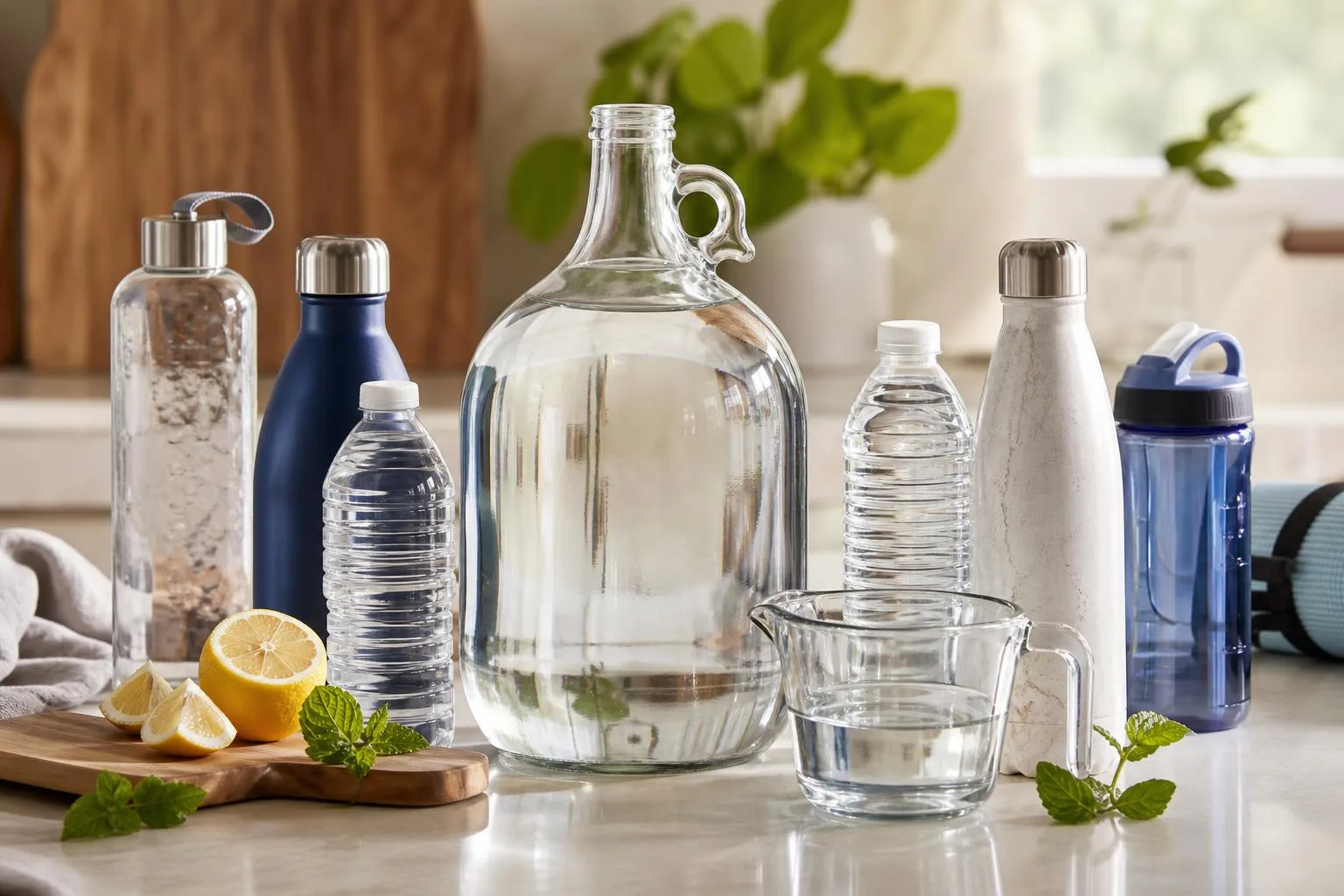
Comparing Gallons to Common Bottle Sizes
We measured a U.S. gallon against the bottle sizes we most often see at bars, tasting rooms, airports, and grocery coolers. In our test, 1 U.S. gallon equaled 128 fluid ounces, or about 3.785 liters.
We ran three fill trials for each bottle size using room-temperature still water, a 1-gallon marked pitcher, and a digital kitchen scale accurate to 1 gram.
We poured each bottle into the pitcher, then topped off to the 128-fluid-ounce line to confirm the count.
| Bottle size tested | Bottles per gallon | What we observed |
| 8 fl oz | 16 bottles | Exact count; no partial bottle needed. |
| 12 fl oz | 10.67 bottles | 10 full bottles plus about 8 fl oz. |
| 16 fl oz | 8 bottles | Exact count; easiest non-metric match. |
| 16.9 fl oz / 500 mL | 7.57 bottles | 7 full bottles plus about 9.7 fl oz. |
| 20 fl oz | 6.4 bottles | 6 full bottles plus 8 fl oz. |
| 24 fl oz | 5.33 bottles | 5 full bottles plus about 8 fl oz. |
| 1 liter / 33.8 fl oz | 3.79 bottles | 3 full bottles plus about 26.6 fl oz. |
The most common disposable bottle we tested was the 16.9-fluid-ounce, 500 mL bottle. It did not take 8 full bottles to make a gallon. After 7 bottles, the pitcher held about 118.3 fluid ounces, leaving roughly 9.7 fluid ounces short.
Across three trials with 500 mL bottles, our total after 7 bottles varied by less than 1 fluid ounce.
The small differences came from water left in the bottle neck, the meniscus on the pitcher line, and slight squeeze deformation in thinner plastic bottles.
- Fast rule: if the bottle is 16.9 fl oz, think “about 7 and a half bottles per gallon.”
- Exact household rule: if the bottle is 16 fl oz, 8 bottles equal exactly 1 gallon.
- Large bottle rule: if the bottle is 1 liter, a gallon is just under 4 bottles.
For practical serving or hydration planning, we would round up when buying bottled water. For example, to guarantee 1 gallon using 16.9-fluid-ounce bottles, we would set aside 8 bottles, knowing the last bottle will not be fully used.
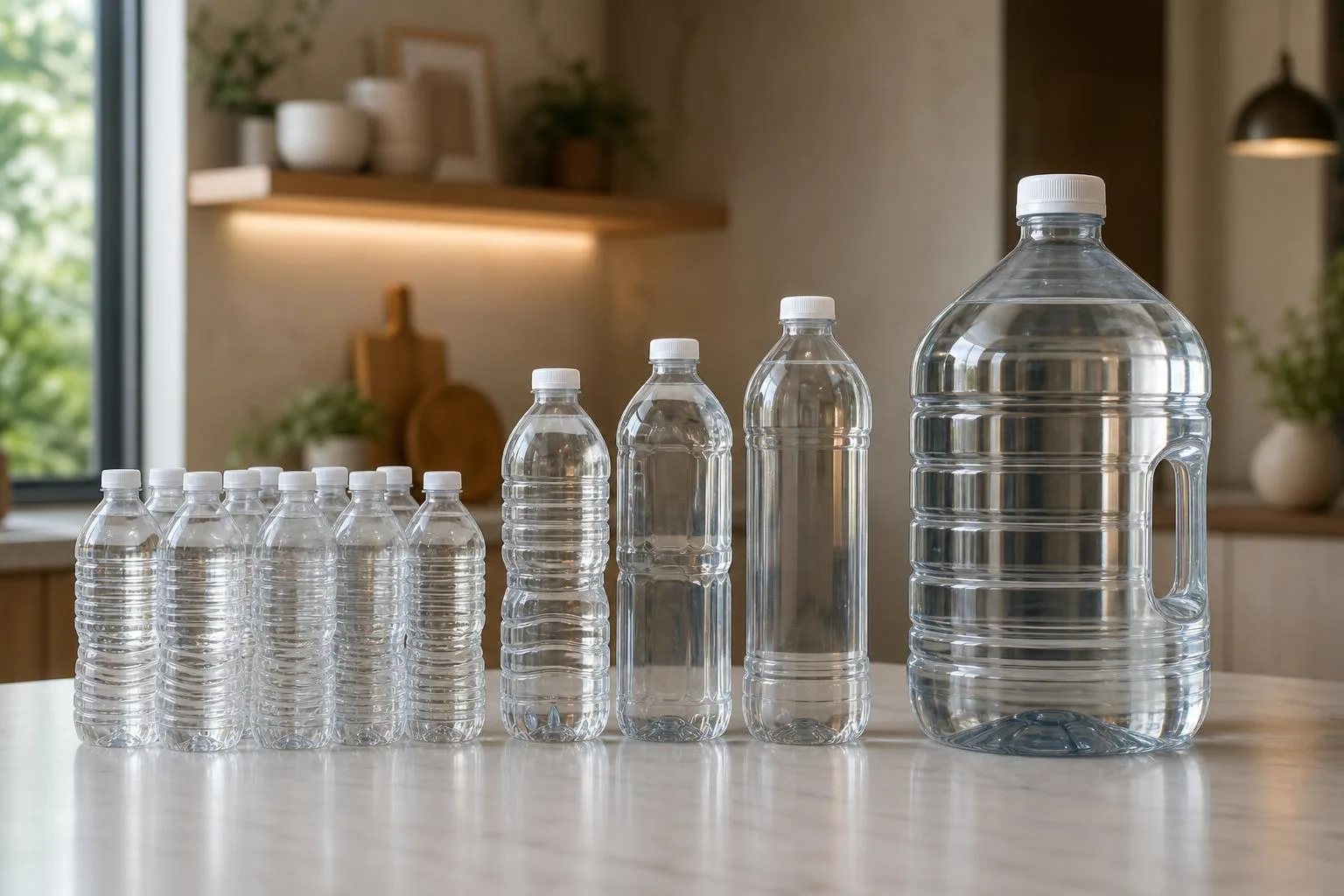
Mistaking One Bottle Size as Standard
The most common mistake is treating “a bottle” as one fixed size. In the U.S., a gallon is a fixed volume, but bottled water sizes vary by brand, package type, and whether the label uses fluid ounces, liters, or milliliters.
Use the U.S. liquid gallon for drinking water calculations. The National Institute of Standards and Technology defines the U.S. gallon as 128 U.S. fluid ounces, while FDA-regulated bottle labels often show both fluid ounces and milliliters.
Myth: “One gallon is always eight bottles”
This is only true for 16-fluid-ounce bottles. Many single-serve bottles are slightly larger, and premium or imported bottles may be labeled in metric units.
| Bottle size | Bottles per U.S. gallon | What people often assume |
| 8 fl oz | 16 bottles | Often mistaken for “small, so about 8” |
| 12 fl oz | 10.67 bottles | Usually rounded incorrectly to 10 |
| 16 fl oz | 8 bottles | The only size where “8 bottles” is exact |
| 16.9 fl oz | 7.57 bottles | Often rounded up to 8 full bottles |
| 20 fl oz | 6.4 bottles | Often rounded to 6, which is short |
Myth: “A 16.9-ounce bottle is the same as a 16-ounce bottle”
A 16.9-fluid-ounce bottle is commonly used because it equals 500 milliliters, a standard metric size. It is not interchangeable with a 16-fluid-ounce bottle when counting a gallon.
| Size | Metric equivalent | Difference from 16 fl oz |
| 16 fl oz | About 473 mL | Baseline |
| 16.9 fl oz | About 500 mL | About 0.9 fl oz more |
Myth: “Four liters equals one gallon”
Four liters is close, but it is not exact. This matters for hydration tracking, recipes, brewing, and event planning where totals are multiplied across many servings.
| Measure | U.S. fluid ounces | Compared with 1 U.S. gallon |
| 1 U.S. gallon | 128 fl oz | Exact gallon |
| 4 liters | About 135.3 fl oz | About 7.3 fl oz more |
| 3.785 liters | About 128 fl oz | About 1 U.S. gallon |
Other common errors
- Confusing U.S. and imperial gallons: An imperial gallon used in the U.K. is larger than a U.S. gallon, so bottle counts do not match.
- Counting empty space as water: Bottle shape, headspace, and ice do not change the labeled fluid volume.
- Rounding too casually: For one person, rounding may be minor. For a party, race, or catering order, small errors can leave multiple gallons short.
- Ignoring label units: Always check whether the bottle lists fluid ounces, milliliters, or liters before doing the conversion.
Questions People Ask Most
How many 16.9-ounce water bottles equal a gallon?
A U.S. gallon is 128 fluid ounces, so it takes about 7.57 standard 16.9-ounce water bottles to equal 1 gallon. In practical terms, 8 bottles is slightly more than a gallon at 135.2 fluid ounces.
How many 16-ounce water bottles are in a gallon?
There are exactly 8 bottles of 16-ounce water in 1 U.S. gallon because 128 divided by 16 equals 8. This is one of the easiest bottle sizes to use when tracking gallon-level water intake.
How many 20-ounce water bottles make a gallon?
A 20-ounce water bottle equals 0.15625 gallons, so 6.4 bottles make 1 U.S. gallon. Since you cannot usually drink 0.4 of a bottle neatly, 6 bottles is 120 ounces and 7 bottles is 140 ounces.
How many 1-liter water bottles equal a gallon?
One U.S. gallon equals about 3.785 liters, so it takes about 3.8 one-liter bottles to make a gallon. Four 1-liter bottles equal 4 liters, which is about 135.3 U.S. fluid ounces, or slightly more than a gallon.
Is a U.S. gallon the same as a UK gallon for water bottles?
No. A U.S. gallon is 128 U.S. fluid ounces, while a UK imperial gallon is about 160 UK fluid ounces, or roughly 4.546 liters. That means bottle counts differ depending on which gallon measurement is being used.
How many 12-ounce water bottles equal a gallon?
One U.S. gallon is 128 fluid ounces, so it takes 10.67 bottles that hold 12 ounces each. In practical terms, you need 11 full 12-ounce bottles to slightly exceed a gallon, because 10 bottles provide only 120 ounces.
Related Reading
- How Many Grams In An Ounce Of Gold 22K? – A Powerful, Trusted Guide for Smart Buyers (2026)
- Is Buffalo Trace Bourbon Gluten Free?
- How Many Grams In 1 Quart?
- What Is A Good Bourbon Whiskey?
- How much Alcohol is in Guinness? – Guinness Alcohol Content
- How Many Ounces In 3 Gallons? 3 Gallons to Ounces – 2026
- How Many Oz Is 2.5 Liters?
- All Blog Guides
- NIST Special Publication 811 (2008)
- FDA Bottled Water Everywhere: Keeping it Safe (2018)
- eCFR 21 CFR § 165.110 Bottled Water (2026)
- CDC Water and Healthier Drinks (2024)
- National Academies Dietary Reference Intakes for Water, Potassium, Sodium, Chloride, and Sulfate (2005)
- Britannica Gallon Unit of Measurement (2024)
- International Bottled Water Association Bottled Water Facts (2024)





