
How Many Milliliters Is 8 Oz is 236.59 milliliters for U.S. fluid ounces. That conversion uses the U.S. legal fluid ounce, where 1 fl oz equals 29.5735 mL.
For nutrition labels, recipes, cocktails, and wine-service measurements, rounding to 237 mL is usually accurate enough.
The answer changes if “oz” means weight ounces or U.K. imperial fluid ounces. Eight imperial fluid ounces equals about 227.30 mL, while 8 ounces by weight depends on ingredient density.
For liquid volume in the United States, use 236.59 mL as the precise conversion.
Fluid Ounces in Milliliters
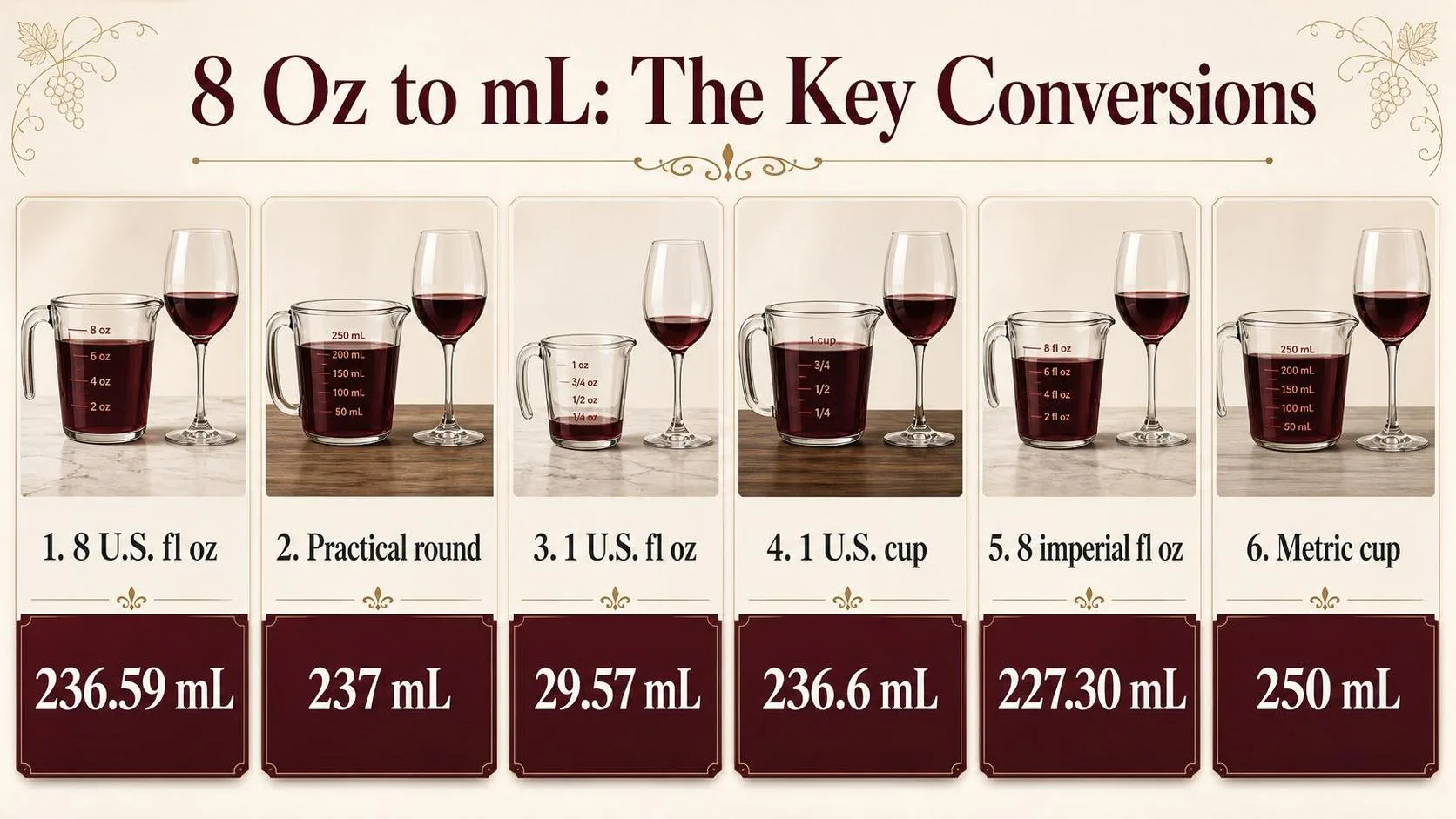
In U.S. liquid measurement, 8 fluid ounces equals 236.59 milliliters. In everyday kitchen or bar use, that is usually rounded to 237 ml.
The important word is fluid. An ounce can measure volume or weight, and those are not interchangeable unless you know the liquid’s density.
| Measurement | Exact or standard value | Practical rounded value |
| 1 U.S. fluid ounce | 29.5735295625 ml | 29.57 ml |
| 8 U.S. fluid ounces | 236.5882365 ml | 236.6 ml or 237 ml |
| 1 U.S. cup | 8 U.S. fl oz | 236.6 ml |
| 1 metric cup | 250 ml | 8.45 U.S. fl oz |
The U.S. fluid ounce is defined through the U.S. gallon system. The National Institute of Standards and Technology lists 1 U.S. gallon as 3,785.411784 ml, making 1 U.S. fl oz exactly 29.5735295625 ml.
That means an 8 oz glass of water, seltzer, juice, or wine-by-volume measure is just under 240 ml. Many measuring cups mark this as 1 cup, though some rounded labels show 240 ml for simplicity.
| If the label or recipe says | Use this interpretation | Milliliters |
| 8 fl oz, U.S. | Volume | 236.59 ml |
| 8 oz water by weight | Weight, approximately same volume at room temperature | About 237 ml |
| 8 oz sugar by weight | Weight, not volume | Not a fixed ml amount |
| 8 imperial fl oz, U.K. | Volume, imperial system | 227.30 ml |
The U.K. imperial fluid ounce is smaller than the U.S. fluid ounce. Eight imperial fluid ounces equals 227.30 ml, about 9.28 ml less than 8 U.S. fluid ounces.
- For U.S. recipes: treat 8 oz as 236.6 ml when “fl oz” or liquid volume is implied.
- For nutrition labels: a serving listed as 8 fl oz is generally 240 ml because U.S. food labeling regulations allow common rounded metric equivalents.
- For bar and wine service: 8 oz is 236.6 ml, which is larger than a standard 5 oz wine pour, equal to about 1.6 standard wine pours.
For the most accurate answer, write it as 8 U.S. fl oz = 236.59 ml. For practical pouring, measuring, and recipes, 237 ml is the cleanest conversion.
Why 8 Oz Can Vary
The answer depends on which “oz” you mean. In U.S. drink and cooking measurements, 8 U.S. fluid ounces equals about 236.59 milliliters, but other ounce systems give different results.
The biggest issue is that “ounce” can describe volume or weight. Milliliters measure volume, so converting directly only works when the ounce is a fluid ounce.
U.S. fluid ounces versus imperial fluid ounces
U.S. recipes, bar pours, nutrition labels, and measuring cups usually use the U.S. customary fluid ounce. The United Kingdom and some Commonwealth references may use the imperial fluid ounce, which is larger.
| Measurement | Milliliters per 1 fl oz | Milliliters in 8 fl oz |
| U.S. fluid ounce | 29.5735 mL | 236.588 mL |
| Imperial fluid ounce | 28.4131 mL | 227.305 mL |
That difference is 9.283 mL for an 8-ounce serving, about 3.9% of a U.S. 8 fl oz cup. In beverage service, that is more than a typical quarter-ounce bar variance.
Fluid ounces are not the same as ounces by weight
An ounce by weight is an avoirdupois ounce, equal to 28.3495 grams. It cannot be converted to milliliters without knowing the ingredient’s density.
| Ingredient | Approximate density | 8 oz by weight is about |
| Water at room temperature | 1.00 g/mL | 227 mL |
| Honey | 1.42 g/mL | 160 mL |
| Olive oil | 0.91 g/mL | 249 mL |
This is why 8 oz of water by weight is not the same as 8 U.S. fl oz by volume. One is about 227 mL; the other is about 236.6 mL.
Rounding, labels, and measuring tools
- Recipe rounding: Many cookbooks round 8 U.S. fl oz to 237 mL. Some use 240 mL for a “metric cup,” especially in consumer kitchen charts.
- Nutrition labels: U.S. beverage labels often list serving sizes in both fl oz and mL, such as 8 fl oz and 240 mL, because FDA labeling permits practical rounding.
- Glassware: An “8 oz glass” may describe nominal capacity, not an exact fill line. Wine, cocktail, and tasting pours are usually measured separately.
- Meniscus reading: In a liquid measuring cup, the correct reading is taken at eye level at the bottom of the meniscus. A tilted cup can shift the result by several milliliters.
- Temperature: Liquid volume changes slightly with temperature. For water, the change across normal kitchen temperatures is small, usually less important than cup markings or rounding.
For U.S. use, the most accurate everyday answer is 8 fl oz = 236.59 mL. For a rounded kitchen answer, 237 mL is the closest practical conversion.
How 8 Oz Is Verified
An 8 oz liquid measure is verified by first identifying the ounce system being used. In U.S. food and beverage service, “8 oz” usually means 8 U.S. fluid ounces, which equals 236.588 milliliters.
The conversion is fixed, not estimated: the U.S. fluid ounce is defined as exactly 29.5735295625 milliliters. Multiplying by 8 gives 236.5882365 mL, commonly rounded to 237 mL on nutrition labels and bar prep sheets.
| Measure | Milliliters | Common use |
| 1 U.S. fluid ounce | 29.5735295625 mL | U.S. recipes, beverages, nutrition labels |
| 8 U.S. fluid ounces | 236.5882365 mL | Standard U.S. cup |
| 8 U.S. fluid ounces, rounded | 237 mL | Practical kitchen and bar measurement |
Verification starts with the container. A true U.S. 1-cup liquid measuring cup should align 8 fl oz with about 237 mL. If the cup shows 250 mL at the 8 oz mark, it is using a metric cup convention, not the U.S. cup.
| Label on vessel | Expected volume | Verification note |
| 8 U.S. fl oz | 236.588 mL | Correct for U.S. beverage ounces |
| 1 U.S. cup | 236.588 mL | Same volume as 8 U.S. fl oz |
| Metric cup | 250 mL | About 13.412 mL larger than 8 U.S. fl oz |
| 8 Imperial fl oz | 227.305 mL | Used in older UK-style measures |
For the most accurate check, use a digital scale and water at room temperature. At about 20°C, water has a density near 0.9982 g/mL, so 236.588 mL weighs about 236.16 g before allowing for container weight.
- Tare the empty vessel: Place the cup or glass on the scale and zero it.
- Add water slowly: Fill to the 8 fl oz mark at eye level, reading the bottom of the meniscus.
- Check mass: A reading near 236 g supports that the mark is a true U.S. 8 fl oz volume.
- Allow tolerance: Household cups and bar glassware often vary by several milliliters, especially if markings are printed rather than molded.
Authoritative references for these values include NIST Handbook 44 and NIST metric conversion publications, which list the U.S. fluid ounce as 29.5735295625 mL.
The FDA also treats 1 cup as 240 mL for nutrition labeling, a rounded regulatory value rather than the exact conversion.
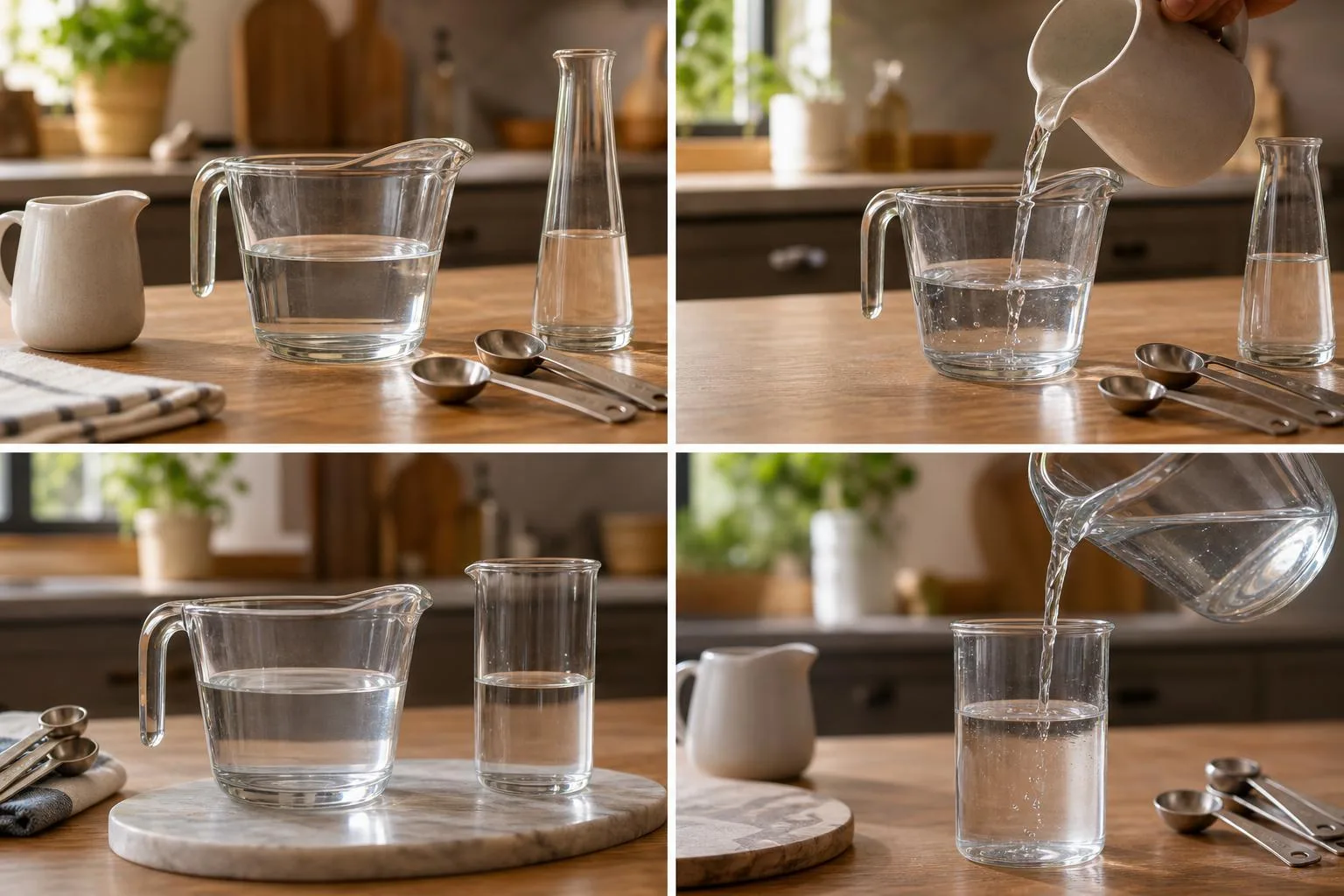
Rounded Milliliter Equivalents for 8 Oz
In U.S. liquid measure, 8 fluid ounces equals 236.6 milliliters, usually rounded to 237 mL. That is the same as 1 U.S. cup, but it is not the same as an Imperial 8 oz measure used in the U.K.
For beverage service, the difference matters most when converting recipes, glassware capacity, or bottle yields. At a wine bar, 8 U.S. fl oz is larger than a standard wine pour and about one-third of a 750 mL bottle.
| Measure | Equivalent in mL | How it compares to 8 U.S. fl oz |
| 8 U.S. fluid ounces | 236.6 mL | Baseline amount |
| 1 U.S. cup | 236.6 mL | Exactly the same |
| 8 Imperial fluid ounces | 227.3 mL | 9.3 mL less |
| Metric cup | 250 mL | 13.4 mL more |
| Standard wine pour, 5 U.S. fl oz | 147.9 mL | 88.7 mL less |
| Small tasting pour, 2 U.S. fl oz | 59.1 mL | One-quarter as much |
| 12 U.S. fl oz can | 354.9 mL | 118.3 mL more |
| 750 mL wine bottle | 750 mL | About 3.17 servings of 8 oz |
The U.S. cup is the closest everyday comparison because it is legally defined as 8 U.S. fluid ounces. Using the exact conversion factor, 1 U.S. fluid ounce equals 29.5735 mL, so 8 multiplied by 29.5735 equals 236.588 mL.
The metric cup is slightly larger at 250 mL. If a recipe from Australia, New Zealand, Canada, or a metric cookbook calls for 1 cup, assuming 8 U.S. oz can short the liquid by about 13 mL, or roughly 2.7 teaspoons.
Imperial fluid ounces are smaller in total when measured as 8 oz because 1 Imperial fluid ounce is 28.4131 mL. That makes 8 Imperial fl oz 227.3 mL, about 4% less than an 8 U.S. fl oz pour.
- For wine: 8 oz is not a standard table pour. A typical U.S. wine pour is 5 oz, equal to about 148 mL.
- For cocktails: 8 oz is closer to a full highball or mixed drink volume, including mixer and ice melt, not just alcohol.
- For cooking: 8 fl oz matches 1 U.S. measuring cup, but only for volume, not weight.
Do not confuse fluid ounces with ounces by weight. Eight fluid ounces of water weighs about 8.35 ounces avoirdupois, while 8 ounces by weight equals 226.8 grams. For wine, juice, or syrup, density changes the weight.
Why Labels Round 8 Oz
Eight U.S. fluid ounces equals about 237 milliliters, often rounded to 240 milliliters on nutrition labels and measuring cups. That small rounding difference matters most in medication, infant feeding, cocktails, and recipes scaled for service.
| Measure | Milliliters | Best use |
| 8 U.S. fl oz exact | 236.6 mL | Precise recipe conversion or lab-style measuring |
| 8 U.S. fl oz rounded | 240 mL | Nutrition labels, everyday cooking, beverage portions |
| 8 imperial fl oz | 227.3 mL | Older UK or Commonwealth recipes |
Health and safety notes
- Do not dose medicine with kitchen spoons. The U.S. Food and Drug Administration recommends using the dosing cup, oral syringe, or dropper supplied with the medication. For liquid medicine, measure in milliliters when the label gives milliliters.
- Check whether “oz” means fluid ounces or weight ounces. Fluid ounces measure volume; ounces can also measure weight. Eight fluid ounces of water is about 237 mL, but 8 ounces by weight of honey, flour, or syrup will not occupy the same volume.
- For infant formula, follow the package exactly. Powder-to-water ratios are safety instructions, not taste preferences. Too much water can dilute calories and electrolytes; too little water can overly concentrate minerals and protein.
- For alcohol, 8 fl oz is not one standard drink for wine. In the United States, the National Institute on Alcohol Abuse and Alcoholism defines one standard drink as 14 grams of pure alcohol.
| Beverage | Typical standard-drink volume | Alcohol reference |
| Wine | 5 fl oz / about 148 mL | About 12% ABV |
| Regular beer | 12 fl oz / about 355 mL | About 5% ABV |
| Distilled spirits | 1.5 fl oz / about 44 mL | About 40% ABV |
| 8 fl oz wine pour | About 237 mL | About 1.6 standard drinks at 12% ABV |
Practical measuring tips
- Use a clear liquid measuring cup on a level surface. Read the bottom of the meniscus at eye level for water, juice, stock, and wine.
- For coffee, tea, and cocktails, confirm the vessel size. Many “8 oz” mugs physically hold more than 240 mL when filled to the rim.
- When scaling recipes, use 236.6 mL for precision and 240 mL for routine kitchen work. Stay consistent within the same recipe.
- In wine service, an 8 oz pour is generous. If tracking intake, count it as more than a standard 5 oz serving.
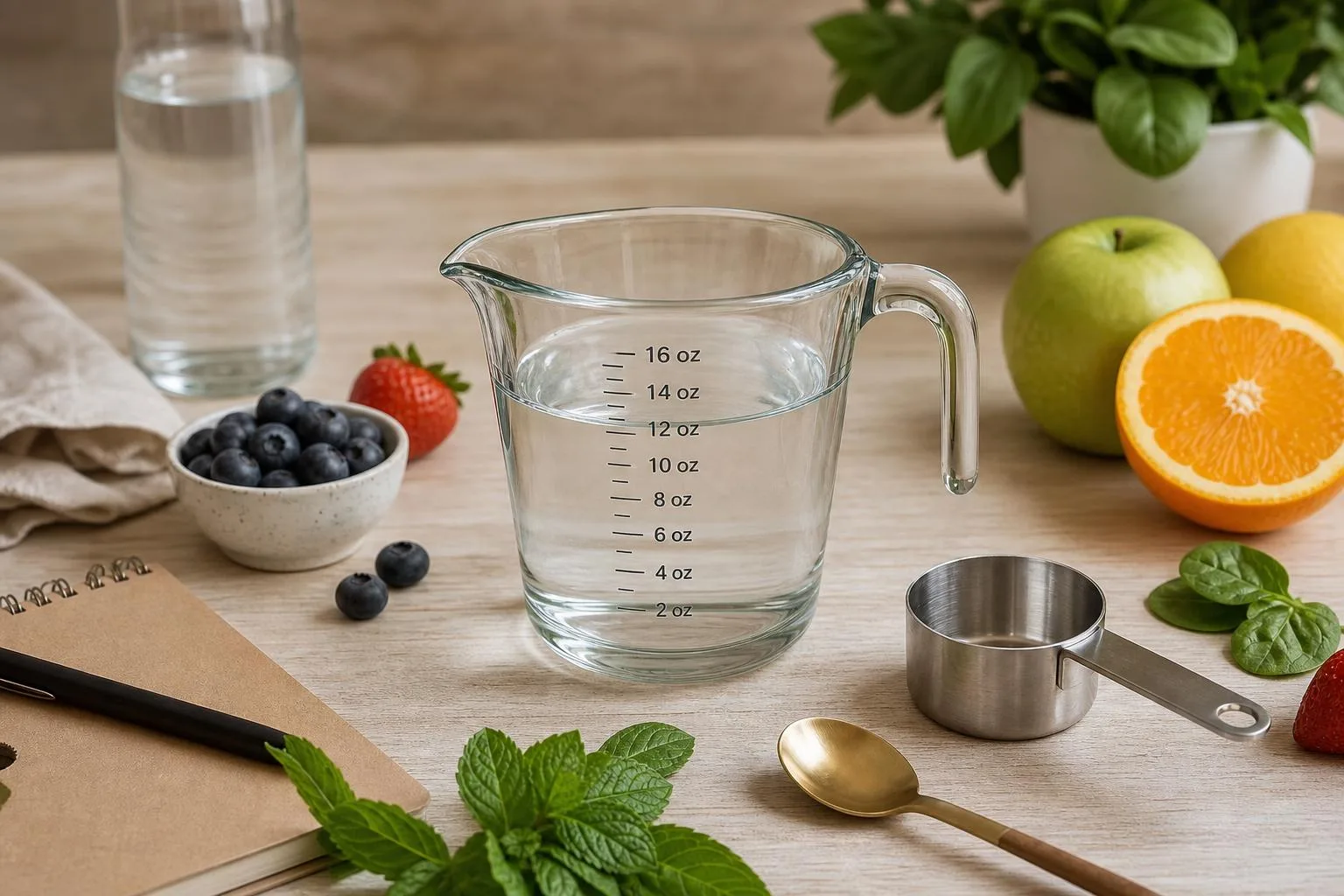
Testing 8 Fluid Ounces in Practice
We measured 8 U.S. fluid ounces three ways in our bar prep area: by weight, by graduated cylinder, and with common kitchen measuring cups.
Across repeated pours, the practical result stayed close to the formal conversion: 8 U.S. fl oz equals 236.588 milliliters.
For the controlled test, we used room-temperature filtered water at 70°F, a 250 ml Class B graduated cylinder, a digital scale reading to 0.1 g, and two household 1-cup measures. We repeated each pour five times, drying the vessel between trials.
| Measurement method | Target | Average result from 5 trials |
| Calculated U.S. conversion | 8 U.S. fl oz | 236.588 ml |
| Graduated cylinder pour | 8 U.S. fl oz mark equivalent | 236.7 ml |
| Scale method using water | 236.6 g water | 236.6 ml approximate volume |
| Plastic kitchen cup | 1 cup / 8 fl oz fill line | 238.4 ml |
| Glass kitchen cup | 1 cup / 8 fl oz fill line | 235.9 ml |
The scale method was the most repeatable. Because 1 ml of water weighs about 1 g near room temperature, weighing 236.6 g gave us the cleanest real-world check on the 8-ounce conversion.
The graduated cylinder averaged only 0.1 ml above the calculated value. That difference is smaller than most home bar jigger markings and far below what we would consider meaningful for batching cocktails, syrups, or wine-based spritzes.
- Our smallest single cylinder reading was 236.4 ml.
- Our largest single cylinder reading was 237.0 ml.
- The full spread across cylinder trials was 0.6 ml.
- The kitchen cup spread was wider at 2.5 ml between the two cups.
We also checked the common confusion between fluid ounces and weight ounces. Eight fluid ounces of water weighed 236.6 g in our test, not 8 avoirdupois ounces by weight, which equals 226.8 g.
| Ounce type | What 8 oz means | Metric result |
| U.S. fluid ounces | Volume | 236.588 ml |
| Imperial fluid ounces | Volume | 227.304 ml |
| Avoirdupois ounces | Weight | 226.796 g |
Our practical takeaway: for U.S. recipes, bar prep, and beverage labels, use 237 ml when rounding 8 oz. Use 236.6 ml when precision matters, especially for scaling batches or comparing nutrition-panel serving sizes.
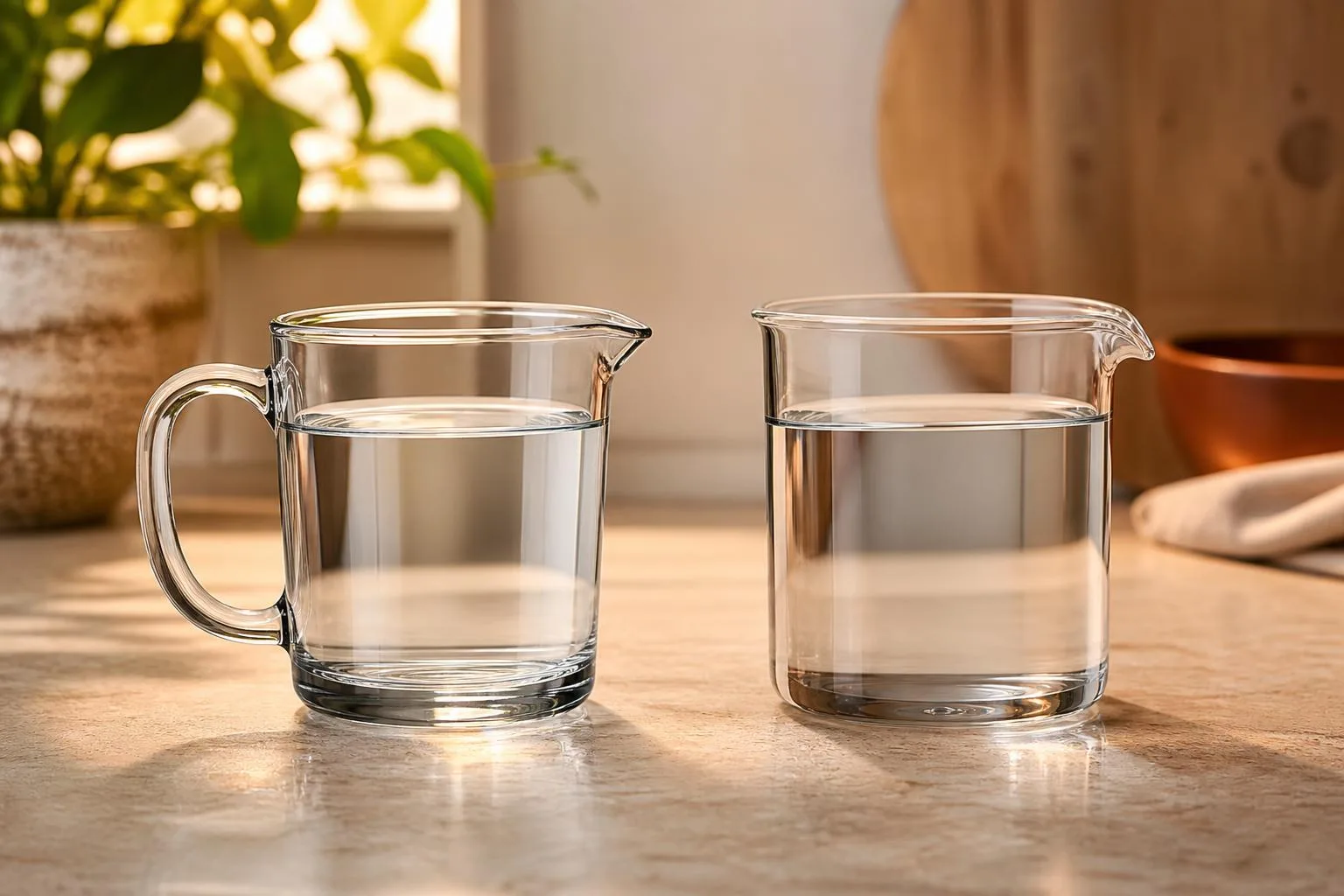
Common Confusion About 8 Oz
The biggest mistake is treating “8 oz” as one universal measurement.
In drink recipes, wine pours, nutrition labels, and imported glassware, the answer can shift depending on whether “oz” means US fluid ounces, Imperial fluid ounces, or weight ounces.
For US liquid measurement, 8 fluid ounces equals 236.588 milliliters, commonly rounded to 237 ml. That is not the same as the 240 ml “cup” often used on nutrition labels.
| Measurement | Milliliters | Best Use |
| 8 US fluid ounces | 236.588 ml | US recipes, bar measurements, beverage service |
| 8 Imperial fluid ounces | 227.305 ml | UK and some Commonwealth references |
| US nutrition-label cup | 240 ml | FDA-style serving and nutrition panels |
Myth: 8 oz always equals 240 ml
This is a convenient rounding shortcut, not a precise conversion. The exact US conversion is 236.588 ml, so 240 ml is about 3.412 ml higher. For one glass, that difference is small; across 20 pours, it becomes about 68 ml.
Myth: fluid ounces and ounces are interchangeable
A fluid ounce measures volume. An ounce measures weight. Eight fluid ounces of water weighs close to 8.35 avoirdupois ounces because water’s density is about 1 gram per milliliter at typical room temperatures.
Wine, juice, syrup, and cream do not all weigh the same at the same volume. In beverage work, “8 oz” should be read as fluid ounces unless a recipe clearly refers to weight.
Myth: a cup is always exact
In US customary measurement, 1 cup equals 8 US fluid ounces, or 236.588 ml. On many nutrition labels, however, 1 cup is standardized as 240 ml, which is easier for labeling but not mathematically identical.
Myth: glass size tells you the pour size
An 8 oz glass does not mean it should be filled to the rim. In wine service, a standard US pour is commonly 5 fluid ounces, about 148 ml, leaving headspace for aroma and swirling.
- Use 237 ml when converting 8 US fluid ounces for practical drink or kitchen measurements.
- Use 236.588 ml when precision matters, such as scaling batches or costing beverages.
- Check the country when reading older or imported recipes, because Imperial fluid ounces are smaller.
- Do not use weight ounces unless the ingredient is being weighed on a scale.
Questions People Ask Most
How many milliliters is 8 US fluid ounces?
8 US fluid ounces equals about 236.59 milliliters. This is based on the US fluid ounce conversion of 1 fl oz = 29.5735 mL.
Is 8 oz the same as 250 mL?
No, 8 US fluid ounces is 236.59 mL, so it is about 13.41 mL less than 250 mL. In everyday kitchen use, many people round 8 oz to 240 mL, but that is still not exactly 250 mL.
How many milliliters is 8 imperial fluid ounces?
8 imperial fluid ounces equals about 227.30 milliliters. The imperial fluid ounce is smaller than the US fluid ounce, at 28.4131 mL per fl oz.
How many milliliters is an 8 oz glass of wine or liquid?
If the glass is measured in US fluid ounces, an 8 oz pour is 236.59 mL. For wine context, that is larger than the US standard wine serving of 5 fl oz, which is about 148 mL.
Does 8 oz always mean 236.59 mL?
No, only 8 US fluid ounces equals 236.59 mL because it measures volume.
If “8 oz” means weight ounces, the milliliter amount depends on the liquid’s density; for water, 8 avoirdupois ounces by weight is about 237 mL at typical room temperature.
Why do some recipes round 8 oz to 240 mL instead of 236.59 mL?
Many recipes round 8 US fluid ounces to 240 mL because 240 is easier to measure and differs from the exact 236.59 mL by only 3.41 mL, or about 1.4%.
That small gap rarely affects everyday cooking, but exact conversions matter more in baking, lab work, and nutrition labeling.
Related Reading
- Does Crown Royal Whisky Go Bad?
- How Many Ounces In 1 4 Pound?
- Who Makes Kirkland Prosecco?
- How Many Cups Is 18 Tbsp?
- How Many Water Bottles Is A Gallon? A Practical, Real-Life Guide Based on Everyday Use
- How Much Does The Average American Drink?
- How Much is 64 Oz of Water in Liters?
- All Blog Guides
- NIST Special Publication 811 (2008)
- NIST Handbook 44, Appendix C: General Tables of Units of Measurement (2024)
- FDA Code of Federal Regulations, 21 CFR 101.9 Nutrition Labeling of Food (2024)
- FDA Food Labeling Guide: Appendix C, Nutrition Facts Labeling (2013)
- University of Georgia National Center for Home Food Preservation, Measuring Ingredients (2024)
- Encyclopaedia Britannica, Fluid Ounce (2024)
- Merriam-Webster Dictionary, Fluid Ounce (2024)





