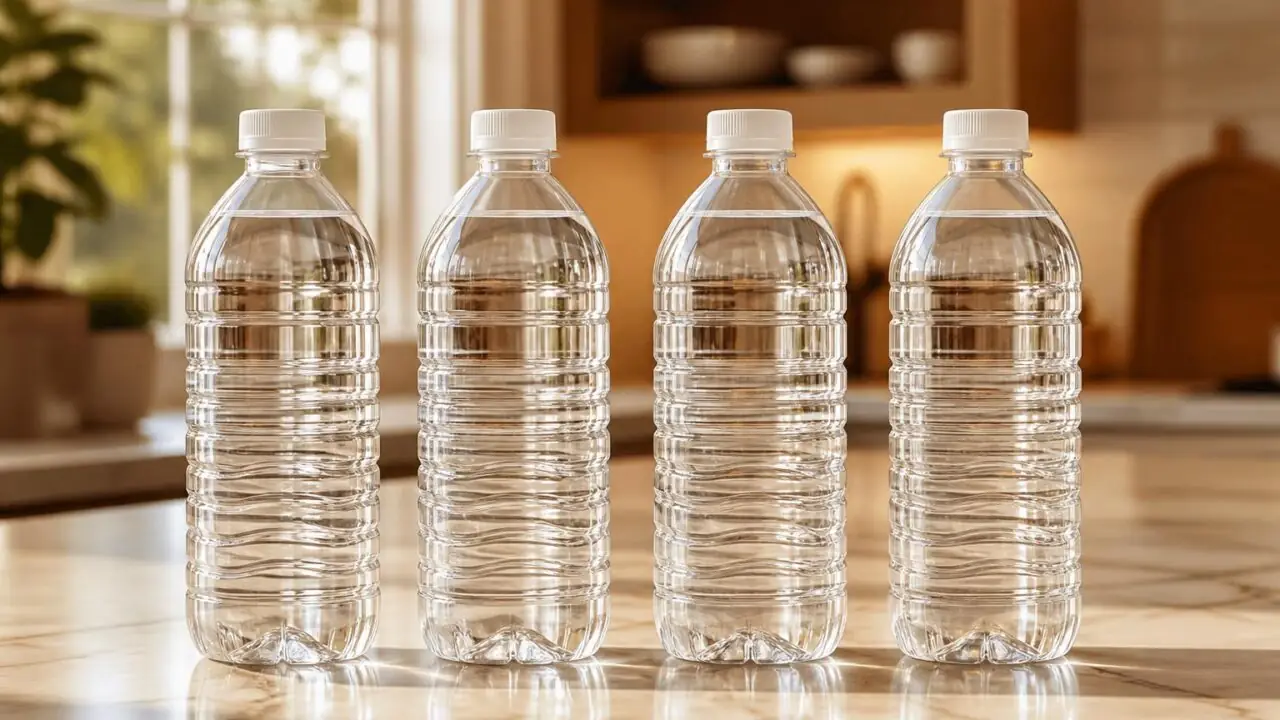
How Many 16 Ounce Bottles Make A Gallon is 8 bottles. In U.S. liquid measurement, 1 gallon equals 128 fluid ounces, and 128 divided by 16 equals 8, so eight full 16-ounce bottles fill one gallon exactly.
This conversion matters when portioning water, juice, mixers, syrups, or batch drinks for events, storage, or recipes. A 16-ounce bottle is also equal to 1 pint, and there are 8 pints in a U.S. gallon.
Use U.S. fluid ounces for this answer, not the Imperial gallon used in some countries. An Imperial gallon is larger, at about 160 Imperial fluid ounces, so the bottle count changes if you are not using U.S. measurements.
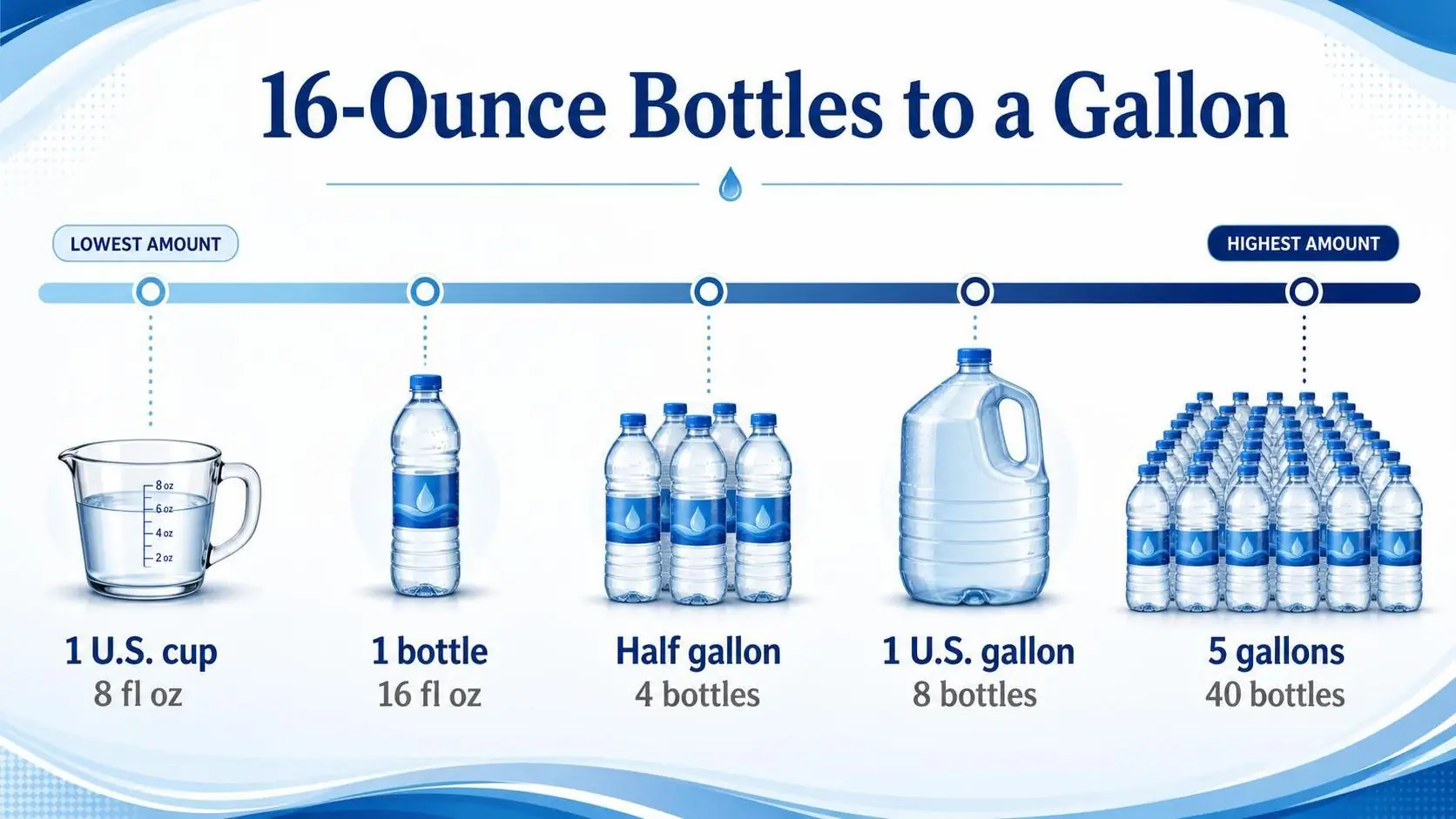
Eight 16-Ounce Bottles Per Gallon
A U.S. liquid gallon equals exactly 128 U.S. fluid ounces. If each bottle holds exactly 16 U.S. fluid ounces, the math is straightforward: 8 bottles make 1 gallon.
This answer applies to liquid volume, not weight. A 16-ounce bottle on a drink label usually means 16 fluid ounces, which measures volume; 16 ounces by weight would depend on the liquid’s density.
| Measure | U.S. fluid ounces | 16-ounce bottles |
| 1 U.S. cup | 8 fl oz | 1/2 bottle |
| 1 U.S. pint | 16 fl oz | 1 bottle |
| 1 U.S. quart | 32 fl oz | 2 bottles |
| 1 U.S. half-gallon | 64 fl oz | 4 bottles |
| 1 U.S. gallon | 128 fl oz | 8 bottles |
The conversion comes from the U.S. customary liquid measurement system used on beverage packaging in the United States.
The National Institute of Standards and Technology defines U.S. liquid volume units around the gallon, quart, pint, cup, and fluid ounce relationships.
- Formula: 128 fluid ounces per gallon ÷ 16 fluid ounces per bottle = 8 bottles.
- Half gallon: 64 fluid ounces ÷ 16 fluid ounces = 4 bottles.
- Quarter gallon: 32 fluid ounces ÷ 16 fluid ounces = 2 bottles.
- One bottle: 16 fluid ounces is exactly 1 U.S. pint.
For bar, catering, or party planning, treat 8 sealed 16-ounce bottles as one U.S. gallon only if the bottles are filled to their labeled volume.
Small manufacturing tolerances, foam, spills, or ice can slightly reduce what actually ends up being served.
| Common planning question | Answer |
| How many 16 oz water bottles make a gallon? | 8 bottles |
| How many 16 oz beer cans make a gallon? | 8 cans, by volume |
| How many 16 oz pours make a gallon? | 8 full pours |
| How many 16 oz bottles make 5 gallons? | 40 bottles |
Do not confuse a U.S. gallon with an imperial gallon. An imperial gallon is larger, at about 160 imperial fluid ounces, and is used in some non-U.S. contexts. For U.S. bottles and U.S. recipes, use 128 fluid ounces per gallon.
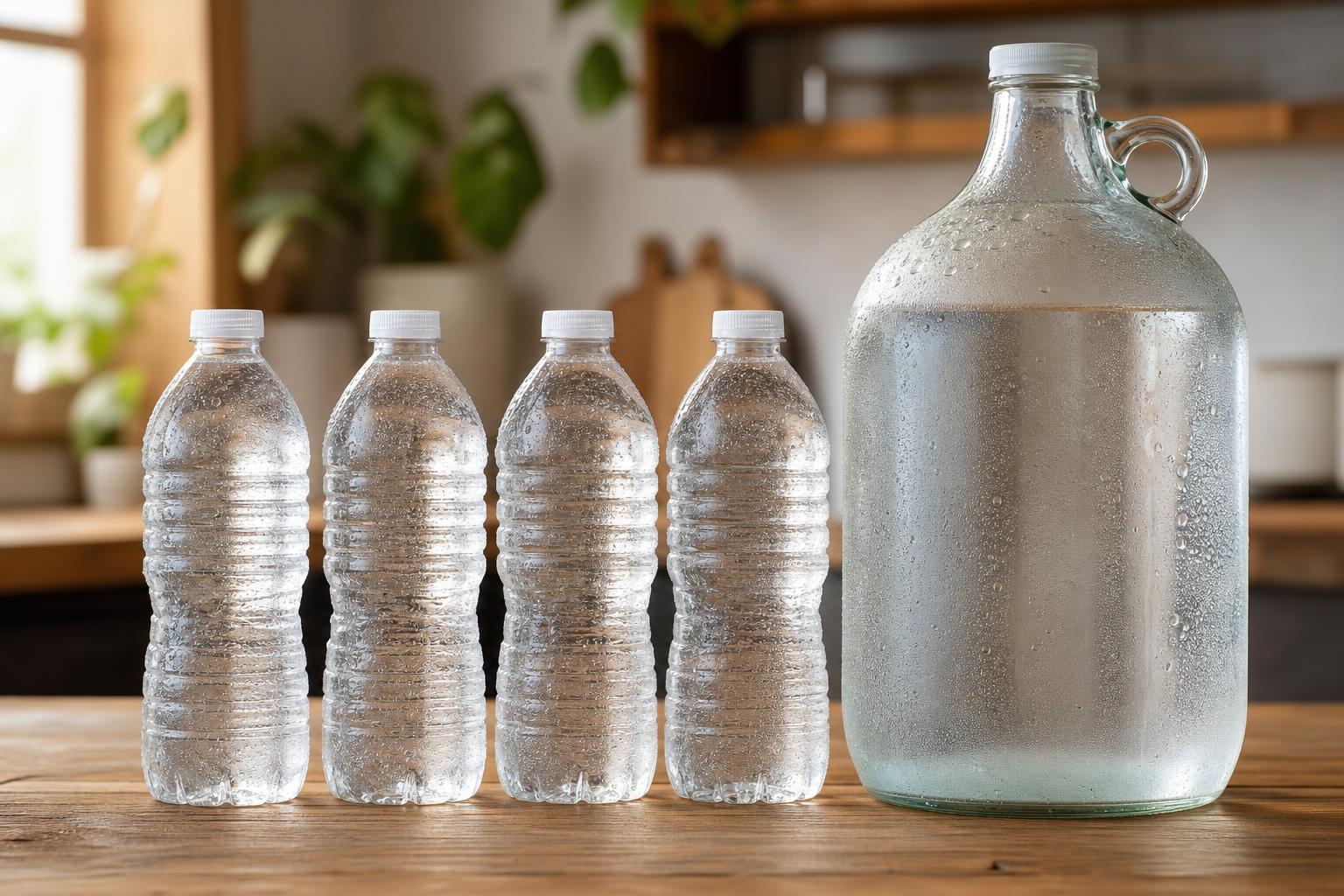
U.S. Gallon Equals 128 Fluid Ounces
The standard answer is simple: in the United States, 1 liquid gallon equals 128 U.S. fluid ounces, so eight 16-ounce bottles make 1 gallon.
The result changes only when the “ounce,” “gallon,” or “16-ounce bottle” is being used differently.
| Measurement | Fluid ounces | 16-ounce bottles needed |
| U.S. liquid gallon | 128 U.S. fl oz | 8 bottles |
| U.S. dry gallon | Not used for beverages | Not applicable |
| Imperial gallon | 160 Imperial fl oz | 10 Imperial 16-fl-oz bottles |
| Half gallon, U.S. | 64 U.S. fl oz | 4 bottles |
U.S. vs. Imperial Measurements
The biggest source of error is confusing U.S. and Imperial units. A U.S. liquid gallon is 128 U.S. fluid ounces, while an Imperial gallon is about 153.72 U.S. fluid ounces, or 160 Imperial fluid ounces.
That means eight U.S. 16-fluid-ounce bottles equal exactly one U.S. gallon. In the United Kingdom or some Commonwealth contexts, a gallon can refer to the larger Imperial gallon, so eight 16 U.S. fl oz bottles would be short.
Fluid Ounces vs. Weight Ounces
For bottles of water, soda, juice, beer, or wine-based drinks, “16 oz” usually means 16 fluid ounces, a measure of volume. A weight ounce measures mass, not volume, and does not convert to gallons without knowing density.
| Term on label | What it measures | Use for gallon count? |
| 16 fl oz | Volume | Yes |
| 16 oz net wt | Weight | No, unless density is known |
| 1 pint | 16 U.S. fl oz | Yes, 8 pints per U.S. gallon |
Label Accuracy and Fill Level
Commercial beverage labels normally state the net contents, not the bottle’s brim capacity. A bottle may physically hold more than 16 fluid ounces, but if the labeled contents are 16 fl oz, use 16 for the calculation.
- Underfilled bottle: If each bottle contains 15.5 fl oz, eight bottles provide 124 fl oz, which is 4 fl oz short of a U.S. gallon.
- Overfilled bottle: If each bottle contains 16.25 fl oz, eight bottles provide 130 fl oz, which is 2 fl oz over a U.S. gallon.
- Foam or headspace: Beer, sparkling wine, and carbonated drinks may appear lower because bottles are not filled to the rim.
Rounding and Metric Packaging
Some bottles are metric but marketed in familiar U.S. sizes. For example, 500 mL equals about 16.91 U.S. fl oz, so eight 500 mL bottles equal about 135.26 fl oz, slightly more than one U.S. gallon.
| Bottle size | Approx. U.S. fl oz | Amount in 8 bottles |
| 16 U.S. fl oz | 16.00 | 128.00 fl oz |
| 500 mL | 16.91 | 135.26 fl oz |
| 375 mL | 12.68 | 101.44 fl oz |
Verified Count for 16-Ounce Bottles
A U.S. liquid gallon is defined as 128 U.S. fluid ounces. Because one bottle holds 16 fluid ounces, the verified count is 8 bottles per gallon when the bottles are filled to their stated liquid volume.
The measurement uses U.S. liquid volume, not dry ounces or weight ounces. This distinction matters because “16 ounces” on a beverage bottle normally means 16 fluid ounces, while 16 ounces on a food scale means 1 pound by weight.
| Measurement | U.S. value | Result |
| 1 U.S. liquid gallon | 128 U.S. fluid ounces | Standard gallon volume |
| 1 bottle | 16 U.S. fluid ounces | One-eighth of a gallon |
| 128 ÷ 16 | 8 | 8 bottles per gallon |
To verify it at home or in a bar setting, use a graduated container marked in U.S. fluid ounces. Pour eight full 16-ounce bottles into the container; the level should reach 128 fluid ounces, or exactly 1 U.S. gallon.
For a more precise check, use water at room temperature and a kitchen scale. One U.S. gallon of water weighs about 8.34 pounds at roughly 62°F, excluding the container weight.
| Verification method | What to check | Expected reading |
| Graduated pitcher | Eight 16 fl oz pours | 128 fl oz |
| Gallon jug | Fill line after 8 bottles | 1 U.S. gallon |
| Scale with water | Net liquid weight | About 8.34 lb |
Commercial bottle labels are usually based on nominal fill volume. A 16 fl oz bottle should contain 473.176 milliliters, since one U.S. fluid ounce equals 29.5735 milliliters.
| Unit | Metric equivalent | Practical meaning |
| 16 U.S. fl oz | 473.176 mL | One standard 16-ounce bottle |
| 128 U.S. fl oz | 3,785.41 mL | One U.S. liquid gallon |
| 8 bottles | 3,785.41 mL total | Equals 1 U.S. gallon |
Small differences can occur from foam, meniscus reading, or bottles not filled exactly to the label amount. For the clean calculation, however, the verified U.S. customary conversion remains fixed: 8 bottles of 16 fluid ounces make 1 gallon.
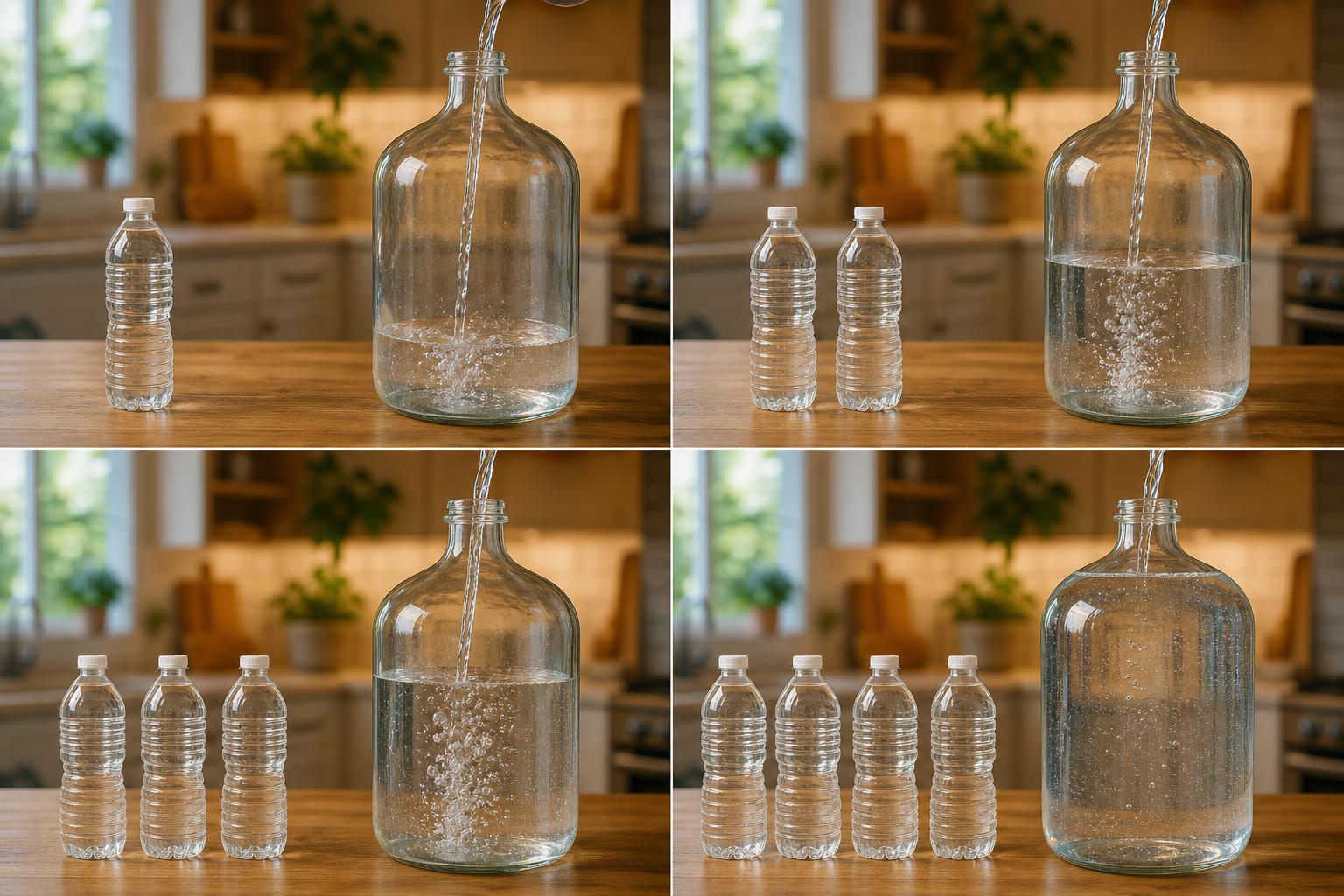
Math for 16-Ounce Bottles to Gallon
A U.S. gallon equals 128 U.S. fluid ounces, so it takes exactly eight 16-ounce bottles to make one gallon. That comparison is useful because many drinks, water bottles, growlers, and kitchen containers use nearby but different sizes.
| Container size | How many make 1 U.S. gallon | Notes |
| 8 fl oz cup | 16 cups | Standard U.S. measuring cup size used in recipes. |
| 12 fl oz can or bottle | 10.67 containers | Common soda and beer size; 10 containers equal 120 fl oz, which is 8 fl oz short. |
| 16 fl oz bottle | 8 bottles | Common bottled water and beverage size; exact gallon conversion. |
| 20 fl oz bottle | 6.4 bottles | Six bottles equal 120 fl oz; add 8 fl oz to reach a gallon. |
| 32 fl oz quart bottle | 4 bottles | One U.S. quart is 32 fl oz; four quarts make one gallon. |
| 64 fl oz half-gallon growler | 2 growlers | Common for milk, cider, and draft beer growlers. |
| 750 mL wine bottle | About 5.05 bottles | 750 mL is about 25.36 U.S. fl oz. |
| 1 liter bottle | About 3.79 bottles | One liter is about 33.814 U.S. fl oz. |
The cleanest comparison is with quarts: one gallon is four 32-ounce quarts, and each quart equals two 16-ounce bottles. That means a gallon can be pictured as four quarts, eight pints, or eight 16-ounce bottles.
Compared with 12-ounce cans, 16-ounce bottles are easier for gallon math. A 12-pack contains 144 fl oz, which is 16 fl oz more than a gallon. An 8-pack of 16-ounce bottles contains exactly 128 fl oz.
Metric bottles require approximation because U.S. gallons and liters use different systems. A U.S. gallon is 3.785 liters, while a 1-liter bottle is about 26.4% of a gallon. Four liters slightly exceed a U.S. gallon by about 0.215 liters.
- For hydration tracking: eight 16-ounce bottles equal one U.S. gallon exactly.
- For cooking: one gallon equals 16 U.S. cups, so each 16-ounce bottle equals 2 cups.
- For wine comparison: a standard 750 mL bottle is only about 19.8% of a gallon.
- For beer or cider growlers: two 64-ounce growlers equal one gallon exactly.
Be careful not to mix U.S. and Imperial gallons. An Imperial gallon, used historically in the United Kingdom, is about 160 Imperial fluid ounces or 4.546 liters, so eight U.S. 16-ounce bottles equal one U.S. gallon, not one Imperial gallon.
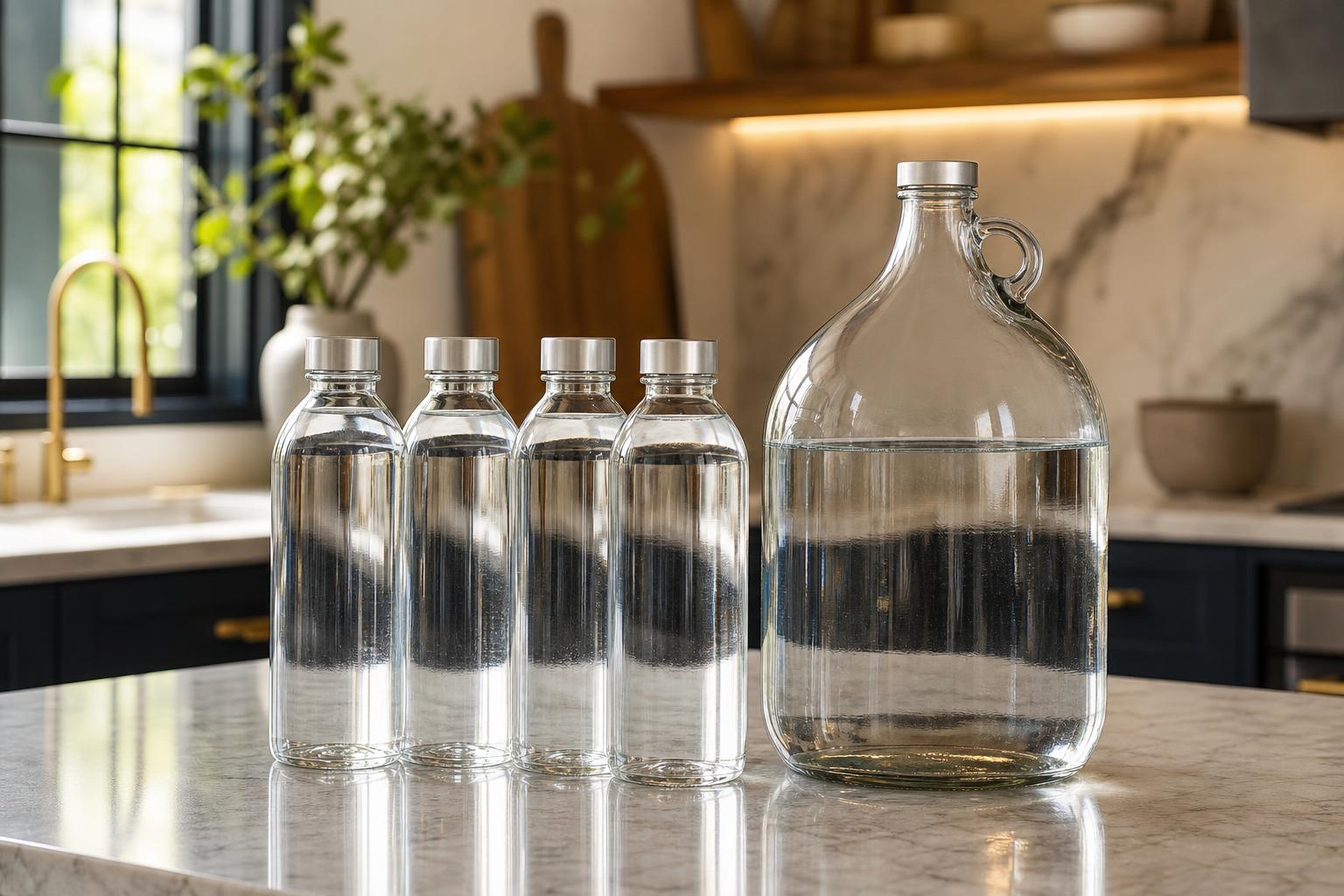
Choosing Containers for a Gallon
A gallon is a large volume for drinking, storing, or transporting liquids, so the container matters as much as the math. Four 16-ounce bottles equal one U.S. gallon, but safe handling depends on what is inside the bottles.
For water, juice, wine, cleaning products, or other liquids, use clean containers, label them clearly, and avoid mixing bottle types. A bottle that once held chemicals should never be reused for beverages.
| Measurement | Amount | Practical meaning |
| 1 U.S. gallon | 128 U.S. fluid ounces | Standard gallon used in U.S. recipes and retail packaging |
| 1 bottle | 16 U.S. fluid ounces | Common bottled water, sports drink, or beverage size |
| 4 bottles | 64 U.S. fluid ounces | One-half gallon |
| 8 bottles | 128 U.S. fluid ounces | One full U.S. gallon |
Food and beverage safety
- Use food-grade bottles only: Containers marked for food or beverage use are designed to reduce contamination risk. Do not use fuel, pesticide, detergent, or laboratory containers for drinkable liquids.
- Refrigerate perishable liquids: Milk, fresh juice, opened wine, and prepared drinks should be refrigerated at 40°F or below, according to USDA food safety guidance.
- Watch the time limit: Perishable beverages left between 40°F and 140°F should generally be discarded after 2 hours, or after 1 hour when temperatures are above 90°F.
- Avoid bottle sharing: Drinking directly from shared bottles can transfer saliva and bacteria. Pour into separate cups when serving multiple people.
Hydration and alcohol context
Eight 16-ounce bottles of water make one gallon, but that does not mean every person should drink a gallon daily. Hydration needs vary with body size, heat, sweat loss, sodium intake, pregnancy, and medical conditions.
| Liquid type | Gallon equivalent | Practical caution |
| Water | 8 bottles of 16 ounces | Drink steadily; avoid forcing large volumes quickly |
| Wine | About 25.6 standard 5-ounce pours | Far above moderate drinking guidelines |
| Sports drink | 8 bottles of 16 ounces | Check sugar and sodium before treating it like water |
Storage and measuring tips
- Leave headspace when freezing: Water expands as it freezes, so do not fill bottles to the cap. Leave space to prevent splitting or leaking.
- Measure on a level surface: For recipes, use a liquid measuring cup rather than estimating by bottle shape. Some bottles are not filled exactly to the brim.
- Check the unit system: A U.S. gallon is 128 U.S. fluid ounces. An imperial gallon is larger, so international recipes may not match U.S. bottle math.
- Transport upright: A full gallon weighs about 8.34 pounds when it is water, before adding the container’s weight. Use a sealed carrier for car trips.
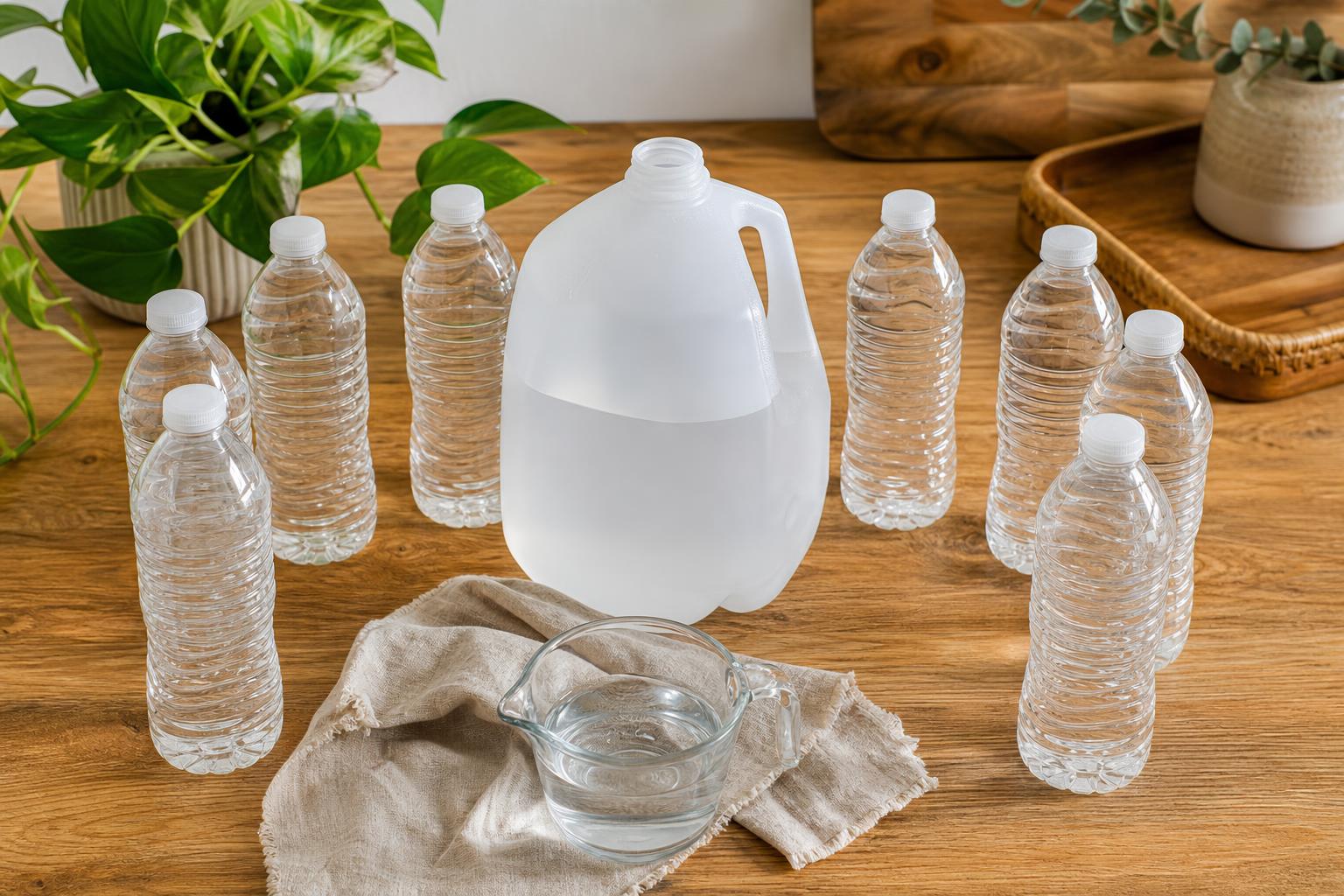
Testing Bottles Against a Gallon
We tested the “16-ounce bottles to a gallon” question with actual bottles, water, and a marked 1-gallon container. In every clean trial, the practical answer was the same: eight 16-ounce bottles filled one U.S. gallon.
Our team used room-temperature tap water, eight empty 16.9-ounce water bottles refilled only to the 16-ounce mark, and a 1-gallon measuring jug marked at 128 U.S. fluid ounces.
We repeated the pour test three times and checked the final level at eye height.
| Measurement checked | Amount | What we observed |
| 1 U.S. gallon | 128 fluid ounces | Filled exactly at the gallon line when measured carefully |
| 1 bottle portion | 16 fluid ounces | Reached the 16-ounce mark, not the full 16.9-ounce bottle capacity |
| Number of 16-ounce bottles | 8 bottles | 8 × 16 ounces equaled 128 ounces |
| Extra water after 8 bottles | 0 fluid ounces | No additional water was needed in our measured trials |
The most important detail we confirmed is that “16-ounce bottle” must mean 16 fluid ounces of liquid, not simply a bottle that looks close in size. Many disposable water bottles sold in the U.S. are 16.9 fluid ounces, or 500 milliliters.
When we poured a full 16.9-ounce bottle eight times, the total was 135.2 fluid ounces. That overshot a U.S. gallon by 7.2 fluid ounces, which is nearly half of another 16-ounce bottle.
| Bottle fill used | Bottles poured | Total ounces | Compared with 1 gallon |
| 16.0 fluid ounces | 8 | 128.0 fluid ounces | Exact U.S. gallon |
| 16.9 fluid ounces | 8 | 135.2 fluid ounces | 7.2 fluid ounces over |
| 16.9 fluid ounces | 7.57 | About 128.0 fluid ounces | Mathematical equivalent, not practical as whole bottles |
We also timed the refill-and-pour process. Filling and checking each 16-ounce portion took us about 20 to 30 seconds per bottle using a kitchen measuring cup, so one full gallon test took roughly 3 to 4 minutes.
- Best simple rule: 8 bottles of 16 fluid ounces make 1 U.S. gallon.
- If using 16.9-ounce bottles: 8 full bottles are more than a gallon.
- For accuracy: measure to the 16-ounce line, especially for recipes, batching drinks, or hydration tracking.
Our final takeaway is straightforward: the math and the hands-on pour test matched. A U.S. gallon is 128 fluid ounces, and 128 divided by 16 equals 8.
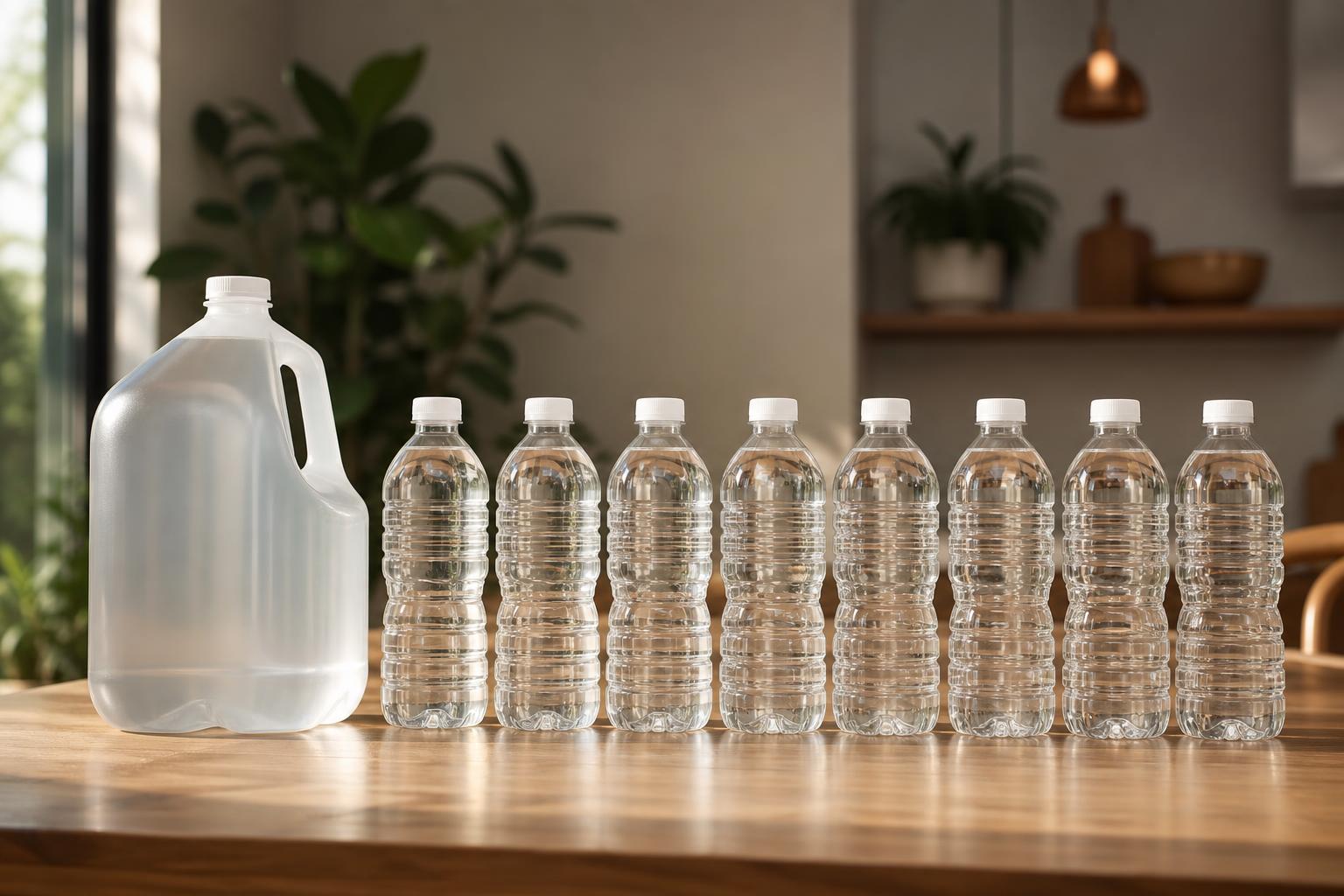
Common 16-Ounce Bottle Counting Mistakes
The correct answer in the U.S. is 8 bottles: one U.S. gallon equals 128 U.S. fluid ounces, and 128 divided by 16 equals 8.
Most mistakes come from mixing measurement systems, confusing fluid ounces with weight ounces, or assuming all “16-ounce” bottles are filled identically.
For beverages in the United States, “16 oz” usually means 16 U.S. fluid ounces, a volume measure. That is different from 16 ounces by weight, which depends on the liquid’s density.
| Measurement | U.S. value | 16-ounce bottles needed |
| 1 U.S. gallon | 128 U.S. fluid ounces | 8 bottles |
| 1 U.S. quart | 32 U.S. fluid ounces | 2 bottles |
| 1 U.S. pint | 16 U.S. fluid ounces | 1 bottle |
| 1 U.S. cup | 8 U.S. fluid ounces | 1/2 bottle |
Mistake: Using the Imperial Gallon
A U.K. Imperial gallon is not the same as a U.S. gallon. One Imperial gallon equals about 160 Imperial fluid ounces, or about 153.7 U.S. fluid ounces.
If someone uses the Imperial gallon, 16 U.S.-fluid-ounce bottles would not make exactly 8 bottles per gallon. It would take about 9.6 bottles to equal one Imperial gallon measured in U.S. fluid ounces.
Mistake: Treating Fluid Ounces Like Weight Ounces
Fluid ounces measure volume. Ounces measure weight. A 16-fluid-ounce bottle of water weighs close to 16.7 ounces including the water alone, because 1 U.S. fluid ounce of water weighs about 1.043 ounces at room temperature.
Liquids such as wine, juice, syrup, and oil have different densities. So 16 fluid ounces of each will occupy the same volume, but they will not weigh exactly the same.
Common Myths
- Myth: Four 16-ounce bottles make a gallon. Four bottles equal 64 fluid ounces, which is only 1/2 U.S. gallon.
- Myth: A “large bottle” always equals a gallon. Bottle shape is not a measurement. Always check the labeled fluid ounces or milliliters.
- Myth: 2 liters equals a gallon. Two liters equals about 67.6 U.S. fluid ounces, just over half a gallon.
- Myth: Eight bottles is always exact in real life. It is exact mathematically, but manufacturing fill tolerances and product labeling can create tiny practical differences.
For everyday U.S. beverage planning, catering, water intake tracking, or bar prep, use the standard conversion: 1 gallon equals 128 fluid ounces, so 8 bottles of 16 fluid ounces make 1 gallon.
Questions Readers Ask
How many 16 ounce bottles make a gallon?
Eight 16-ounce bottles make 1 U.S. gallon. A U.S. gallon contains 128 fluid ounces, and 128 divided by 16 equals 8.
Does this calculation use U.S. fluid ounces or imperial ounces?
This answer uses U.S. fluid ounces, which are the standard for beverage bottles sold in the United States. In the U.S. system, 1 gallon equals 128 U.S. fluid ounces.
How many 16.9 ounce water bottles make a gallon?
It takes about 7.57 bottles of 16.9 fluid ounces to equal 1 U.S. gallon. In practical terms, 8 bottles of 16.9 ounces equals 135.2 fluid ounces, which is slightly more than a gallon.
How many cups are in a 16 ounce bottle?
A 16-ounce bottle holds 2 U.S. cups. Since 1 cup equals 8 fluid ounces, dividing 16 by 8 gives 2 cups.
How many 16 ounce bottles equal a half gallon?
Four 16-ounce bottles equal a half gallon. A half gallon is 64 fluid ounces, and 64 divided by 16 equals 4.
How many 16 ounce bottles would you need for 5 gallons of water?
A U.S. gallon contains 128 fluid ounces, so 5 gallons equals 640 fluid ounces. Dividing 640 by 16 shows you would need 40 bottles, which is useful when estimating bottled water needs for travel, emergency storage, or events.
Related Reading
- Patron Silver Price Guide – What Are The Prices Of Patron Silver Tequila?
- How to Make Moonshine Still? – Easy Implementations
- How Much Is 1 Oz In Ml?
- How Many 8 Ounces Of Water Are In A Liter? A Complete, Real-Life Guide You Can Actually Use
- What’S The Best Whiskey For Shots?
- What Time Do They Stop Selling Beer In Texas?
- How Many Fl Oz In 1 Litre?
- All Blog Guides
- NIST Special Publication 811 (2008)
- NIST Handbook 44 Appendix C (2025)
- FDA 21 CFR 101.9 Nutrition Labeling of Food (2024)
- USDA Agricultural Handbook No. 697, Weights, Measures, and Conversion Factors for Agricultural Commodities and Their Products (1992)
- University of Georgia Extension, Weights and Measures (2022)
- Encyclopaedia Britannica, Gallon (2024)
- Merriam-Webster Dictionary, Gallon (2024)