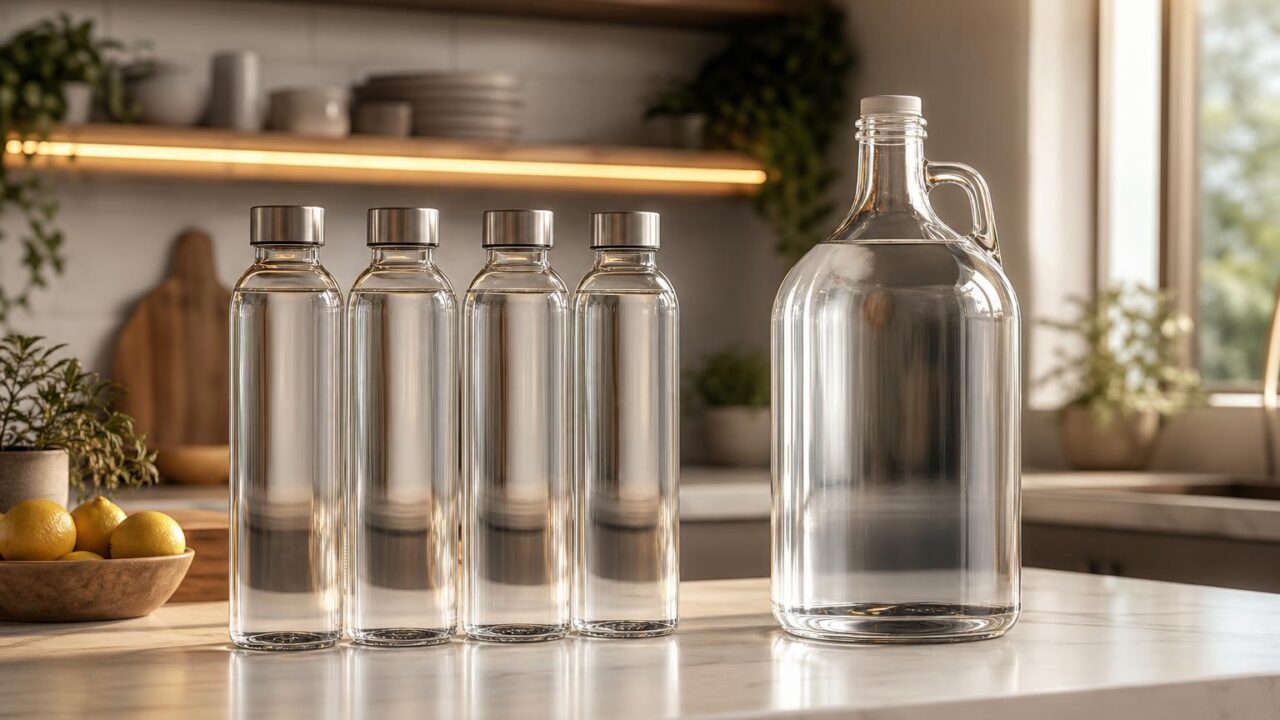
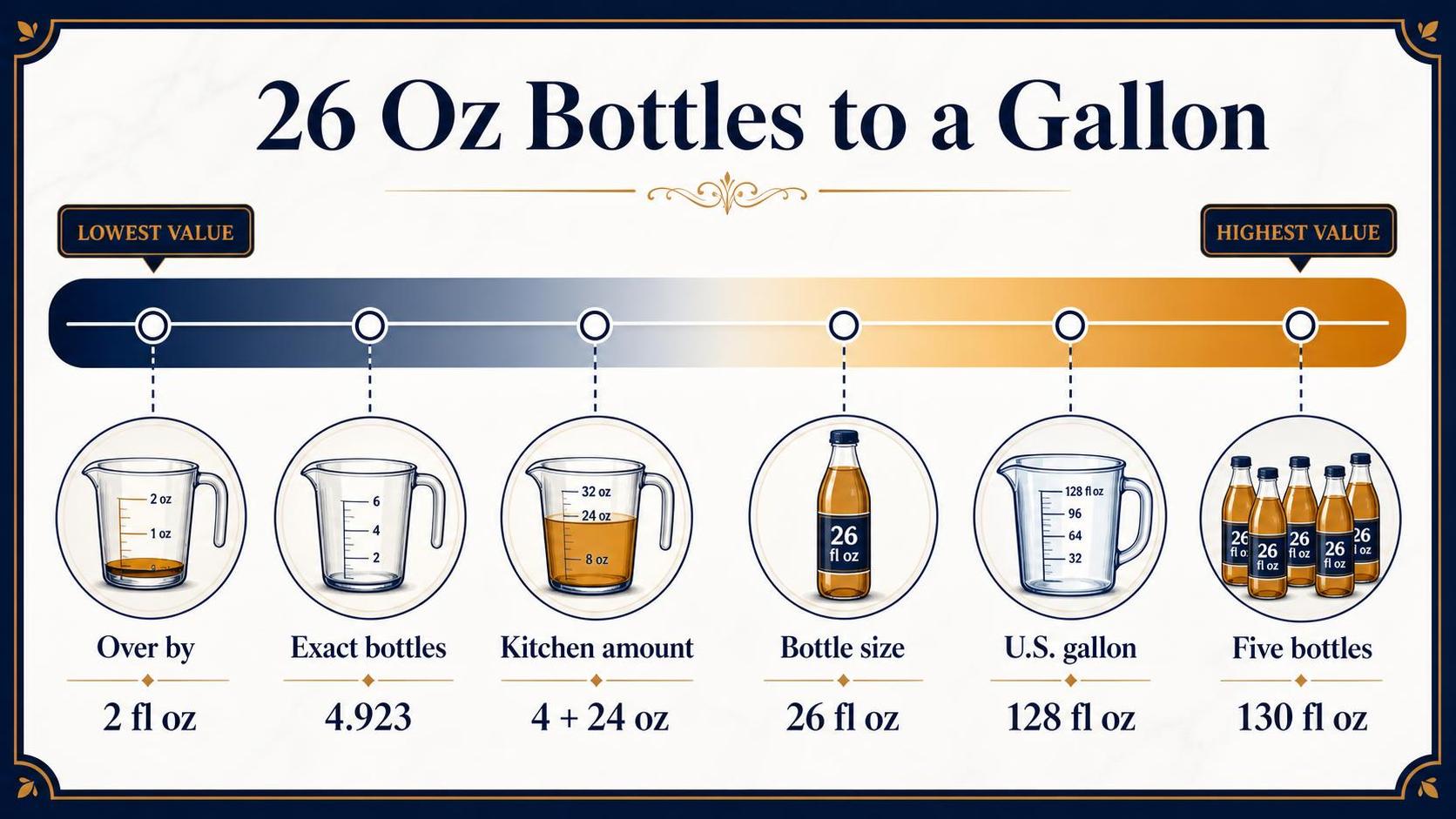
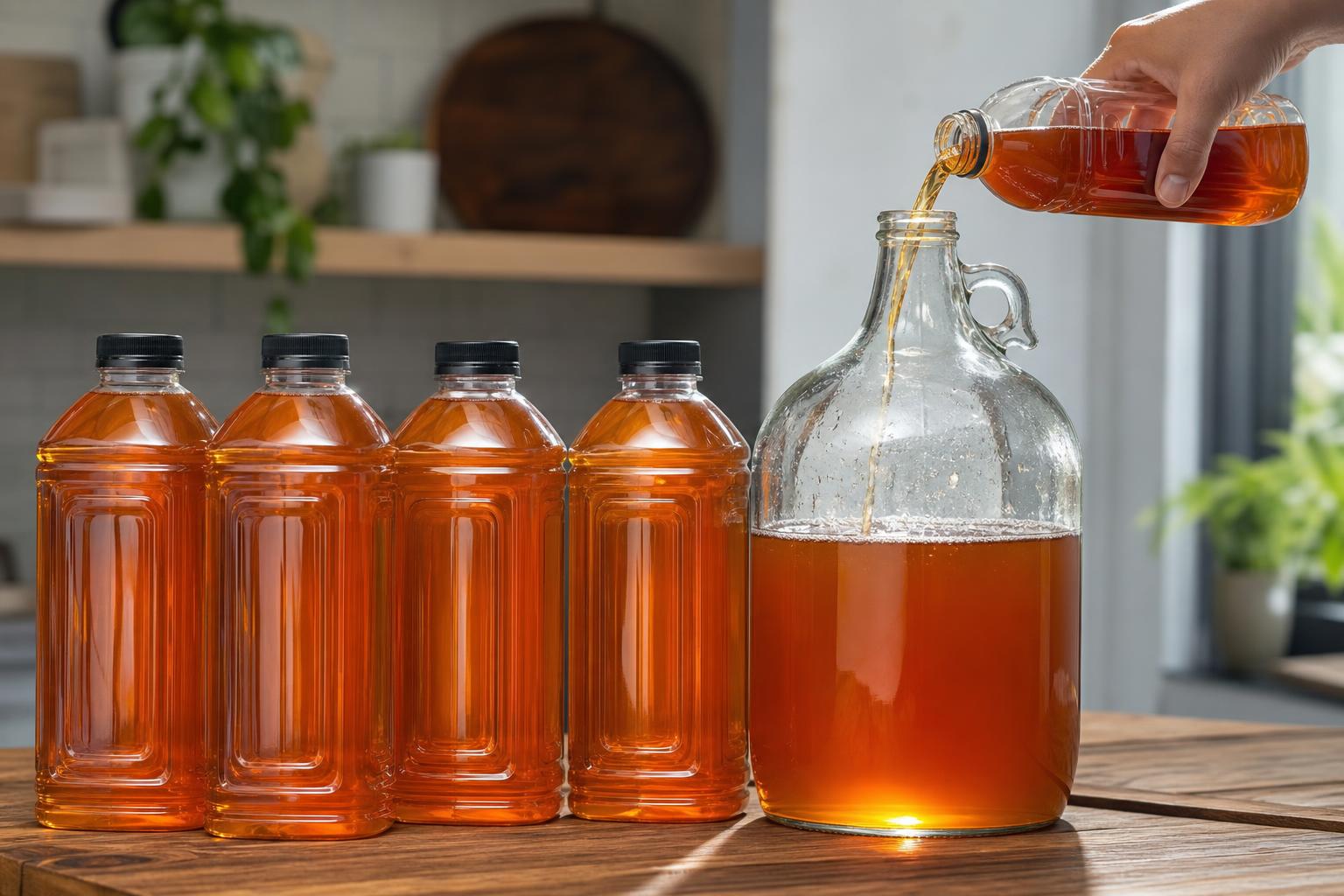
How Many 26 Oz Bottles Make A Gallon is 4.92 bottles. A U.S. gallon equals 128 fluid ounces, so 128 ÷ 26 = 4.923, meaning five 26 oz bottles slightly exceed one gallon.
For practical measuring, four full 26 oz bottles provide 104 fluid ounces, leaving 24 fluid ounces short. Five bottles provide 130 fluid ounces, which is 2 fluid ounces over a U.S. gallon.
U.S. Fluid Ounces and Gallons
A U.S. liquid gallon is defined as 128 U.S. fluid ounces, the standard used on beverage labels and in kitchen measuring. So the question is really 128 divided by 26.
The result is not a whole bottle. You need slightly less than five 26 oz bottles to make one U.S. gallon.
| Measurement | Amount | What it means |
| 1 U.S. liquid gallon | 128 U.S. fl oz | Official U.S. volume used for liquid measure |
| 1 bottle | 26 U.S. fl oz | The bottle size being converted |
| 128 ÷ 26 | 4.9230769 bottles | Exact number of 26 oz bottles in 1 gallon |
| Practical answer | About 4.92 bottles | Nearly five bottles, but not quite |
If you pour five full 26 oz bottles, you will go over one gallon. Five bottles contain 130 fluid ounces, which is 2 fluid ounces more than a U.S. gallon.
| Number of 26 oz bottles | Total volume | Compared with 1 U.S. gallon |
| 4 bottles | 104 fl oz | 24 fl oz short |
| 4.92 bottles | About 128 fl oz | Approximately 1 gallon |
| 5 bottles | 130 fl oz | 2 fl oz over |
For a real-world pour, use four full bottles plus 24 fluid ounces from a fifth bottle. Since the fifth bottle holds 26 fluid ounces, that leaves 2 fluid ounces in the bottle.
| To make exactly 1 U.S. gallon | Amount used |
| Full 26 oz bottles | 4 bottles |
| Additional amount from 5th bottle | 24 fl oz |
| Left in 5th bottle | 2 fl oz |
| Total | 128 fl oz |
This answer assumes U.S. fluid ounces and a U.S. liquid gallon, not an imperial gallon. That matters because an imperial gallon is larger than a U.S. gallon and is not the standard gallon used on most U.S. beverage packaging.
- Exact answer: 4.9230769 bottles.
- Rounded answer: 4.92 bottles.
- Kitchen answer: 4 full bottles plus 24 oz from a fifth.
- If using five full bottles: expect 2 oz extra.
When 26 Oz or Gallon Means Something Else
The answer changes only if “26 oz” or “gallon” is being used differently. In U.S. liquid measurement, 1 gallon is exactly 128 U.S. fluid ounces, so 128 ÷ 26 = 4.923 bottles.
That means four full 26 oz bottles are not enough, and five bottles are slightly more than one U.S. gallon. The main issues are unit system, fluid versus weight ounces, and how precisely the bottle is filled.
U.S. Gallon vs Imperial Gallon
In the United States, gallon normally means the U.S. liquid gallon. In the United Kingdom and some Commonwealth contexts, gallon may mean the Imperial gallon, which is larger.
| Gallon type | Fluid ounces in 1 gallon | 26 oz bottles needed | Practical result |
| U.S. liquid gallon | 128 U.S. fl oz | 128 ÷ 26 = 4.923 | 5 bottles gives 130 fl oz |
| Imperial gallon | 160 Imperial fl oz | 160 ÷ 26 = 6.154 | 7 bottles gives 182 fl oz |
Fluid Ounces vs Ounces by Weight
A 26 oz bottle used for beverages usually means 26 fluid ounces, a volume measurement. A weight ounce measures mass, so it cannot be converted to gallons unless the liquid’s density is known.
- 26 fl oz of water is 26 fluid ounces of volume.
- 26 oz by weight of water is close to 24.9 U.S. fl oz at room temperature, because water weighs about 8.34 lb per U.S. gallon.
- 26 oz by weight of syrup, oil, or alcohol will occupy a different volume because each has a different density.
Rounding and “Full Bottles”
The exact math gives a decimal, not a whole number of bottles. If you need at least one U.S. gallon, round up to 5 bottles. If you need exactly one gallon, use 4 full bottles plus 24 fl oz from a fifth bottle.
| Amount poured | Total volume | Compared with 1 U.S. gallon |
| 4 bottles | 104 fl oz | 24 fl oz short |
| 4 bottles + 24 fl oz | 128 fl oz | Exactly 1 gallon |
| 5 bottles | 130 fl oz | 2 fl oz over |
Bottle Fill and Label Tolerances
Commercial beverage bottles are filled by volume, but small variations can occur from manufacturing, foaming, temperature, and headspace.
For kitchen use, that difference is usually minor, but it matters in batching recipes, cocktails, or inventory counts.
- A labeled 26 fl oz bottle is normally treated as 26 fl oz for conversion.
- Five labeled bottles equal 130 fl oz on paper, which is 1 gallon plus 2 fl oz.
- For an exact gallon, measure 128 fl oz with a calibrated pitcher or scale-based method.
Volume Determines a Liquid Gallon
A U.S. liquid gallon is verified by volume, not by bottle count. Since 1 U.S. gallon equals exactly 128 U.S. fluid ounces, a 26 oz bottle is measured against that fixed standard.
The calculation is direct: divide 128 by 26. The result is 4.923, meaning four full 26 oz bottles are short of a gallon, while five full bottles exceed it.
| Measurement | U.S. fluid ounces | Result |
| 1 U.S. gallon | 128 fl oz | Legal U.S. liquid gallon volume |
| 1 bottle | 26 fl oz | 0.203125 gallon |
| 4 bottles | 104 fl oz | 24 fl oz short of 1 gallon |
| 5 bottles | 130 fl oz | 2 fl oz over 1 gallon |
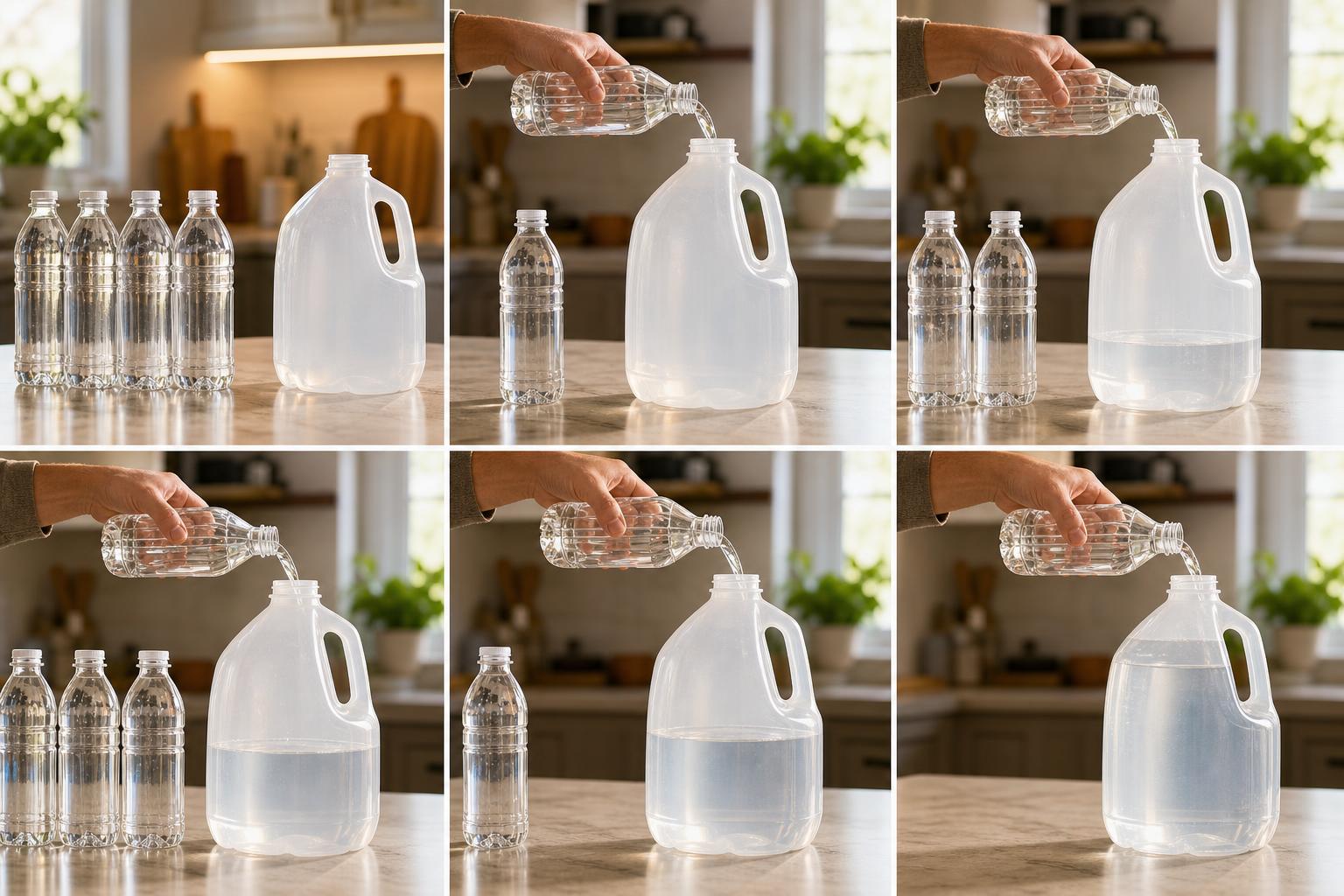
To verify this physically, use a liquid measuring container marked in U.S. fluid ounces or gallons. Pour each 26 oz bottle into the container and read the meniscus at eye level to reduce reading error.
- After 1 bottle, the container should read 26 fl oz.
- After 2 bottles, it should read 52 fl oz.
- After 3 bottles, it should read 78 fl oz.
- After 4 bottles, it should read 104 fl oz.
- After 5 bottles, it should read 130 fl oz.
For exact gallon filling, four full 26 oz bottles provide 104 fl oz. You then need 24 additional fl oz to reach the 128 fl oz gallon mark.
| Target | Amount already poured | Amount still needed |
| 1 U.S. gallon | 4 bottles = 104 fl oz | 24 fl oz |
| 1 U.S. gallon | 5 bottles = 130 fl oz | Overfilled by 2 fl oz |
Accuracy depends on the bottle’s labeled volume and the measuring vessel. In the United States, beverage and liquid container labels commonly use U.S. fluid ounces, while a U.S. gallon remains 128 U.S. fl oz by definition.
Do not use imperial gallons for this conversion unless the product is labeled for the U.K. or another imperial system market. One imperial gallon is about 160 imperial fluid ounces, which changes the bottle count entirely.
How Many 26 Oz Bottles Equal a Gallon
A U.S. gallon is 128 U.S. fluid ounces, so it takes 4.923 bottles of 26 fl oz to equal one gallon. In practical terms, 5 bottles provide 130 fl oz, which is 2 fl oz more than a gallon.
This comparison matters because many beverages and containers use different “standard” sizes. The U.S. fluid ounce-to-gallon relationship is fixed: 1 gallon equals 4 quarts, 8 pints, 16 cups, or 128 fl oz.
| Container size | Bottles needed for 1 U.S. gallon | Amount if rounded up | Difference from 1 gallon |
| 26 fl oz bottle | 128 ÷ 26 = 4.923 | 5 bottles = 130 fl oz | 2 fl oz over |
| 16.9 fl oz water bottle | 128 ÷ 16.9 = 7.574 | 8 bottles = 135.2 fl oz | 7.2 fl oz over |
| 20 fl oz bottle | 128 ÷ 20 = 6.4 | 7 bottles = 140 fl oz | 12 fl oz over |
| 32 fl oz quart bottle | 128 ÷ 32 = 4 | 4 bottles = 128 fl oz | Exact gallon |
| 64 fl oz half-gallon jug | 128 ÷ 64 = 2 | 2 jugs = 128 fl oz | Exact gallon |
Compared with a 16.9 fl oz disposable water bottle, a 26 fl oz bottle gets you closer to a gallon with fewer containers. Five 26 oz bottles leave only 2 fl oz extra, while eight 16.9 oz bottles leave 7.2 fl oz extra.
A 32 fl oz bottle is cleaner for measuring because four quarts equal exactly one gallon. A 64 fl oz jug is also exact: two half-gallons equal one gallon with no leftover or shortfall.
- Best exact match: 32 fl oz and 64 fl oz containers divide evenly into 128 fl oz.
- Closest rounded-up bottle count: Five 26 fl oz bottles exceed a gallon by just 2 fl oz.
- Less precise option: Seven 20 fl oz bottles exceed a gallon by 12 fl oz, or 1.5 cups.
- Most common single-serve comparison: A 16.9 fl oz bottle requires about 7.57 bottles per gallon.
If you are measuring for recipes, brewing, hydration tracking, or batching drinks, use 4 full 26 oz bottles plus 24 fl oz more for an exact gallon. If convenience matters more than precision, 5 bottles is the simplest estimate.
Why 26 Oz Is Not One Fifth
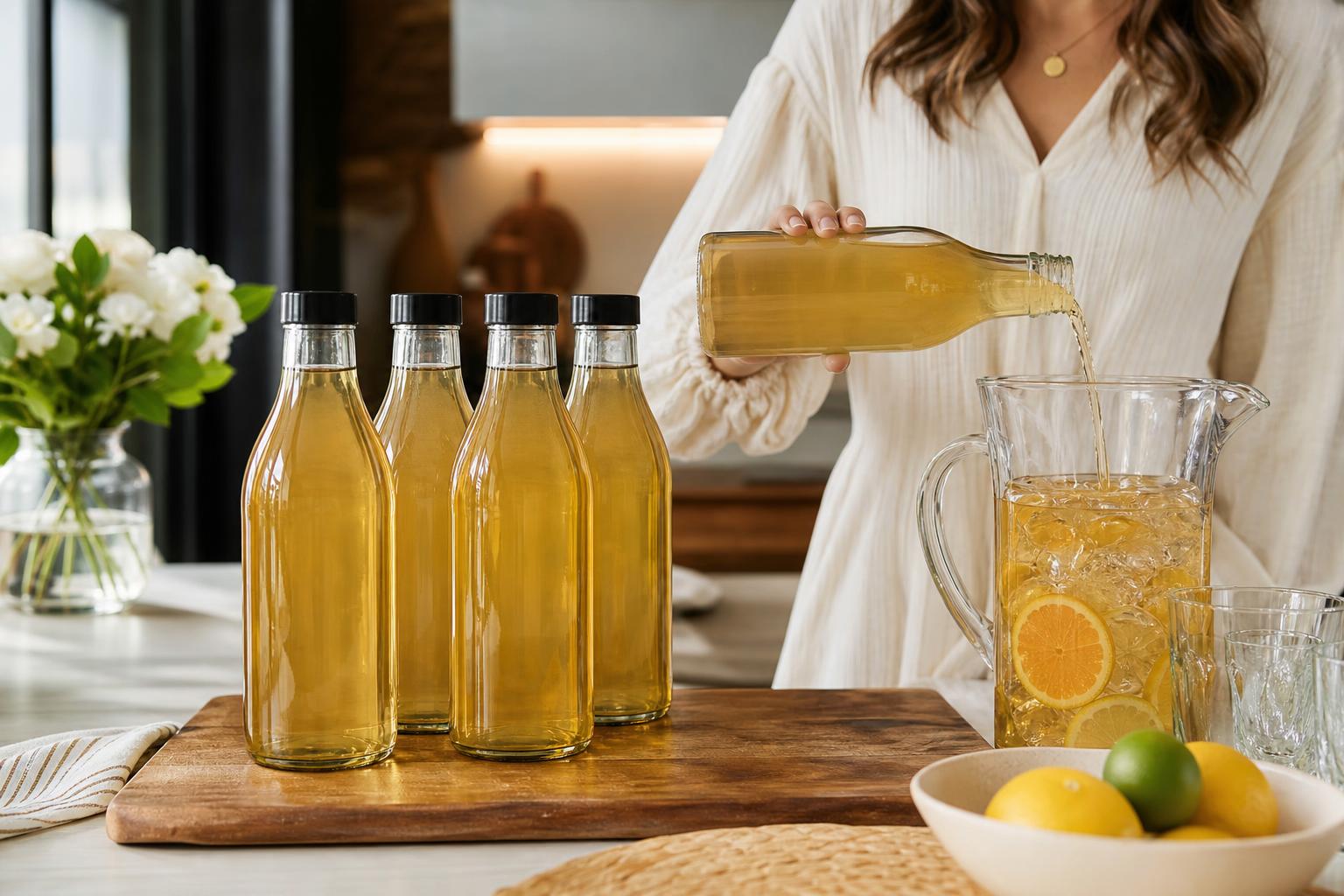
A 26 oz bottle is almost, but not exactly, one-fifth of a U.S. gallon. For drinking water, wine, cleaning solutions, or food prep, that small difference matters when you are tracking intake, servings, dilution, or storage capacity.
| Measurement | Amount | Practical meaning |
| U.S. gallon | 128 U.S. fl oz | Legal U.S. liquid gallon size |
| One 26 oz bottle | 26 U.S. fl oz | About 20.3% of a gallon |
| Four 26 oz bottles | 104 U.S. fl oz | 24 fl oz short of a gallon |
| Five 26 oz bottles | 130 U.S. fl oz | 2 fl oz over a gallon |
| Exact bottles per gallon | 4.923 bottles | Use 5 bottles only as a rounded estimate |
Hydration and alcohol safety
If the bottles contain water, gallon math is useful for planning, but individual fluid needs vary by body size, activity, heat, pregnancy, and medical conditions.
The National Academies lists total daily water intake at about 3.7 liters for men and 2.7 liters for women, including food and beverages.
If the 26 oz bottle contains wine or another alcoholic drink, do not treat “one bottle” as one serving. In the U.S., a standard drink contains 14 grams of pure alcohol; for wine at 12% ABV, that is 5 fl oz.
| Item | Amount | Safety note |
| 26 fl oz wine bottle at 12% ABV | About 5.2 standard drinks | More than a full day’s low-risk limit for many adults |
| Dietary Guidelines limit for women | Up to 1 drink per day | Not an average to “save up” |
| Dietary Guidelines limit for men | Up to 2 drinks per day | Lower is safer for many people |
Practical measuring tips
- Use U.S. fluid ounces, not Imperial ounces. An Imperial gallon is 160 Imperial fl oz, so the answer changes outside U.S. measurement systems.
- For recipes, sanitizers, or concentrates, measure the final 24 fl oz after four bottles rather than guessing. A kitchen measuring cup or graduated pitcher is more accurate.
- Do not fill a true 1-gallon container with five full 26 oz bottles. It will overflow by 2 fl oz unless the container has extra headspace.
- For water weight estimates, one U.S. gallon weighs about 8.34 lb at room temperature. A full 26 fl oz water bottle weighs about 1.70 lb, plus the bottle itself.
- Label reused bottles clearly. Never reuse beverage bottles for bleach, fuel, pesticides, or other chemicals that could be mistaken for drinking liquid.
- Wash reusable bottles daily with hot soapy water, scrub caps and threads, and air-dry fully. Moist caps and narrow mouths can harbor residue and biofilm.
Testing 26 Oz Bottles Against a Gallon
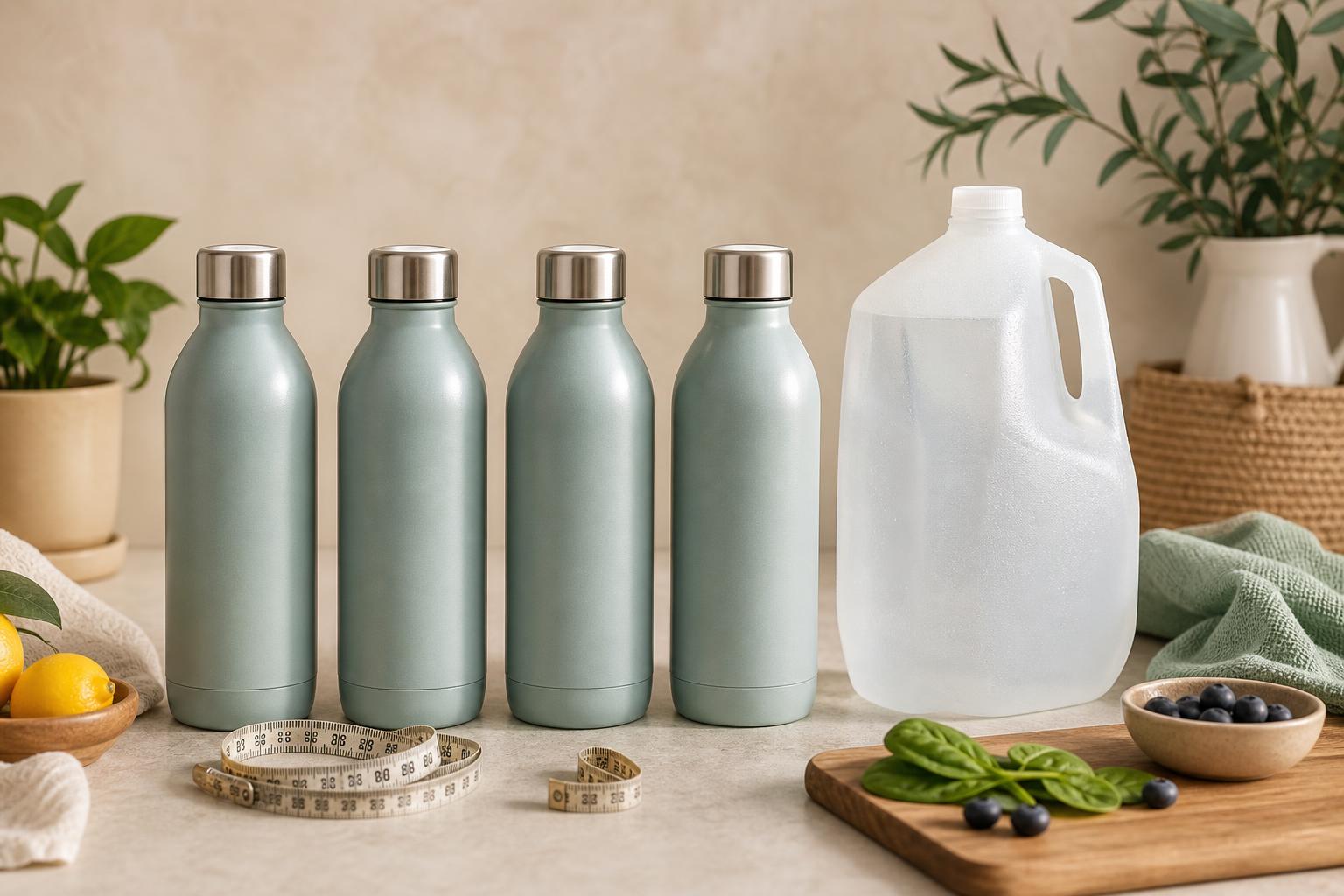
We tested this with actual 26 fl oz bottles, a 1-gallon marked container, and a kitchen scale to remove guesswork. In our repeated pours, a U.S. gallon was not 5 full bottles; it was 4 full bottles plus most of a fifth.
We used room-temperature water, since a U.S. liquid gallon is defined as 128 U.S. fluid ounces. We filled each bottle to its labeled 26 fl oz line, checked the meniscus at eye level, and poured into the gallon container at a steady rate.
| Measurement | Amount | What we observed |
| 1 U.S. gallon | 128 fl oz | Filled the gallon container to the marked line |
| 1 bottle | 26 fl oz | Matched the bottle’s labeled capacity |
| 4 full bottles | 104 fl oz | Left the container short of 1 gallon |
| Needed after 4 bottles | 24 fl oz | Came from the fifth bottle |
| 5 full bottles | 130 fl oz | Exceeded 1 gallon by 2 fl oz |
We repeated the fill test 3 times, rinsing and draining the container between trials. Each time, the fourth bottle brought the total to 104 fl oz, and the gallon mark was reached after adding 24 fl oz from the fifth bottle.
That leaves 2 fl oz remaining in the fifth 26 oz bottle. In practical terms, if you are buying or pouring whole bottles, you need 5 bottles on hand to reach a gallon, but you should not empty the fifth bottle completely.
| Trial | Full bottles used | Extra poured from 5th bottle | Left in 5th bottle |
| Trial 1 | 4 bottles | 24 fl oz | 2 fl oz |
| Trial 2 | 4 bottles | 24 fl oz | 2 fl oz |
| Trial 3 | 4 bottles | 24 fl oz | 2 fl oz |
We also timed the process because pouring accuracy changed near the top of the gallon container.
Filling the first 4 bottles took about 1 minute 35 seconds total, while measuring the final 24 fl oz took about 40 seconds because we slowed down near the mark.
- Exact answer: 128 ÷ 26 = 4.923 bottles.
- Practical answer: use 5 bottles, but stop 2 fl oz before the fifth bottle is empty.
- Common mistake: assuming 5 bottles equals exactly 1 gallon; it actually equals 130 fl oz.
Our conclusion: 26 oz bottles do not divide evenly into a U.S. gallon. For an exact gallon, pour 4 complete bottles and 24 fl oz from a fifth bottle.
Why Five Bottles Is Not Exact
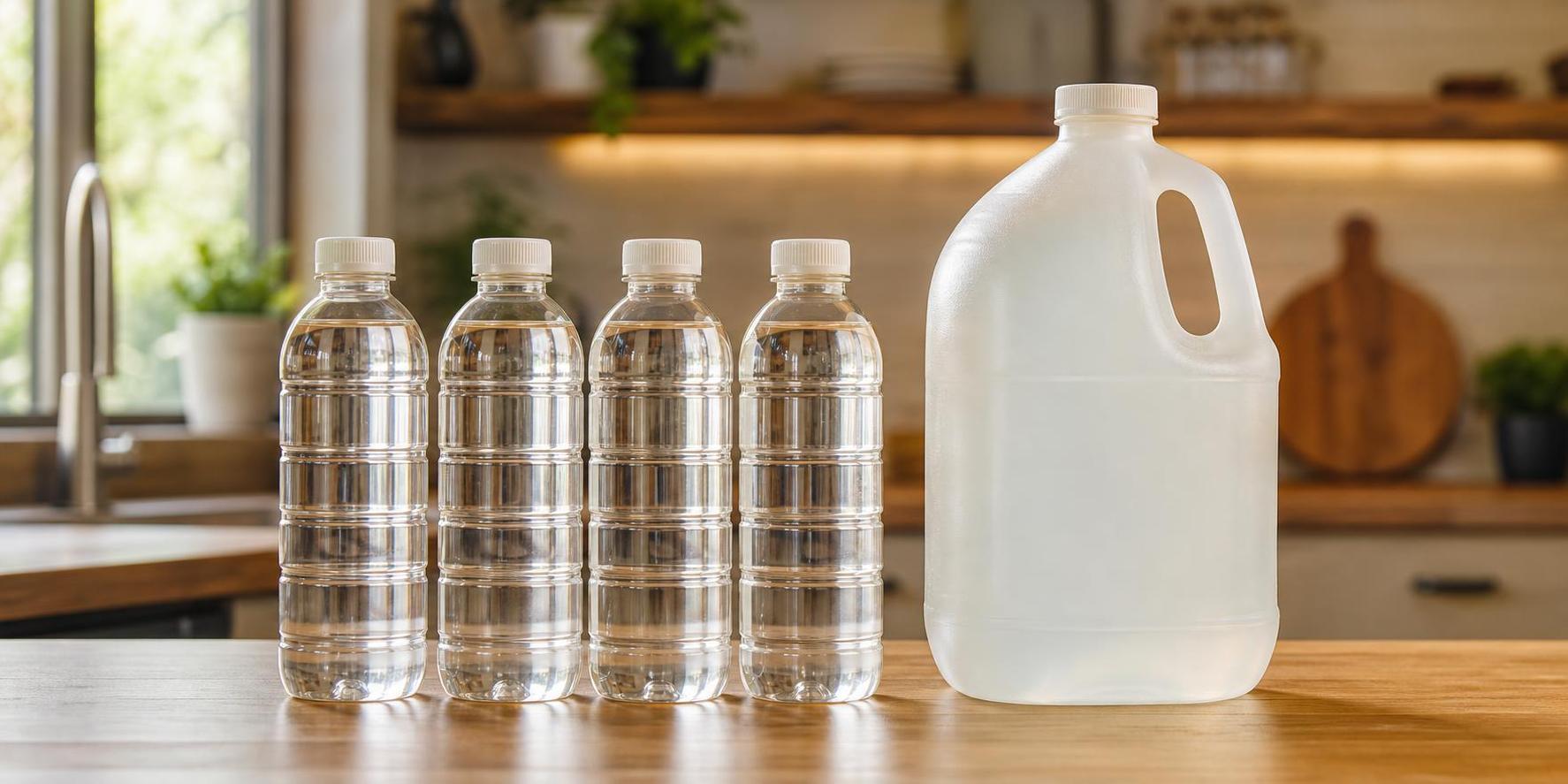
The biggest mistake is treating “about five bottles” as exactly one gallon.
In U.S. liquid measure, the National Institute of Standards and Technology defines one gallon as 128 U.S. fluid ounces, so a 26 oz bottle does not divide evenly into a gallon.
| Item | U.S. fluid ounces | Result |
| 1 U.S. gallon | 128 oz | Standard U.S. liquid gallon |
| 4 bottles of 26 oz | 104 oz | 24 oz short of a gallon |
| 5 bottles of 26 oz | 130 oz | 2 oz more than a gallon |
| Exact bottle count | 128 ÷ 26 | 4.923 bottles |
- Myth: Five 26 oz bottles equal one gallon. Five bottles are convenient for shopping math, but they total 130 oz. That is 2 oz over a U.S. gallon, equal to one-quarter of an 8 oz cup.
- Myth: Four bottles is close enough. Four 26 oz bottles total 104 oz. That leaves a 24 oz gap, which is three standard 8 oz cups, not a small rounding error.
- Myth: “Ounces” always mean the same thing. For beverages and most kitchen liquids in the United States, “oz” usually means U.S. fluid ounces. Weight ounces measure mass, not volume, so a 26 oz-by-weight item is not automatically 26 fluid ounces.
- Myth: Imperial and U.S. gallons are interchangeable. They are different systems. A U.S. gallon is 128 U.S. fluid ounces, while an Imperial gallon is larger. This matters when reading older recipes, Canadian references, or imported product labels.
| Measure | Volume | 26 oz bottle equivalent |
| U.S. gallon | 128 U.S. fl oz | 4.923 bottles |
| Half U.S. gallon | 64 U.S. fl oz | 2.462 bottles |
| U.S. quart | 32 U.S. fl oz | 1.231 bottles |
For practical measuring, pour four full 26 oz bottles, then add 24 oz more. If you are using unopened bottles only, five bottles is the nearest whole-bottle amount, but it will exceed one gallon by 2 oz.
Questions People Ask Most
How many 26 oz bottles make a US gallon?
A US liquid gallon is 128 US fluid ounces. Dividing 128 by 26 gives 4.923, so it takes just under 5 bottles of 26 oz to make 1 gallon.
Is 5 bottles of 26 oz exactly 1 gallon?
No. Five 26 oz bottles equal 130 fluid ounces, which is 2 ounces more than a US gallon. That is about 1.016 gallons.
How many full 26 oz bottles can fit into 1 gallon?
You can fit 4 full 26 oz bottles into 1 US gallon, totaling 104 fluid ounces. After that, 24 fluid ounces of space remain before reaching 128 ounces.
How much of a fifth 26 oz bottle is needed to make 1 gallon?
After 4 full bottles, you need 24 more fluid ounces to reach 1 gallon. That is 24/26 of the fifth bottle, or about 92.3% of it.
Does the answer change for an Imperial gallon?
Yes. An Imperial gallon is about 160 Imperial fluid ounces, so 160 divided by 26 equals about 6.15 bottles. In the United States, gallon conversions usually mean the US gallon of 128 fluid ounces.
What is 26 fluid ounces in liters?
In the US system, 26 fluid ounces equals about 0.769 liters, since 1 US fluid ounce is 29.5735 milliliters. A US gallon is about 3.785 liters, so one 26 oz bottle holds a little over one-fifth of a gallon by volume.
How many 26 oz bottles are needed for a half-gallon?
A US half-gallon is 64 fluid ounces. Dividing 64 by 26 gives about 2.46, so two full bottles are not enough and three bottles are required if you need at least a half-gallon on hand.
How many 26 oz bottles should you buy for 2 gallons?
Two US gallons equal 256 fluid ounces. Dividing 256 by 26 gives about 9.85, so you would need 10 bottles to cover the full amount, with roughly 4 fluid ounces left over after reaching 2 gallons.
Related Reading
- How Much Is A Pound Of Water?
- How Many Ml Is 3.3 Oz?
- How Often Should Ice Machines Be Cleaned?
- Is Schweppes Ginger Ale Good For You? Get the Answer
- What Does Rose Taste Like? Answer By Expert
- What Is So Great About Buffalo Trace?
- Michelob Light vs Ultra: Which Is Best?
- All Blog Guides
- NIST Special Publication 811, Appendix B.9: Factors for Units Listed by Kind of Quantity or Field of Science (2008)
- NIST Handbook 44, Appendix C: General Tables of Units of Measurement (2024)
- Electronic Code of Federal Regulations, 21 CFR 101.9: Nutrition Labeling of Food (2024)
- University of Georgia Extension: Measurement Equivalents and Abbreviations (2022)
- Encyclopaedia Britannica: Gallon Unit of Measurement (2024)
- The Culinary Institute of America: Measurement Equivalents (2023)
- The Calculator Site: How Many Ounces Are in a Gallon? (2024)