How Much Is 24K Gold Worth Per Gram is $77.17 per gram when gold trades at $2,400 per troy ounce. The math uses 31.1035 grams per troy ounce, the standard unit for bullion pricing, so the per-gram value changes every time the live spot price moves.
Because 24K gold is 99.9% pure, its gram price closely tracks the spot market before dealer premiums, refining costs, taxes, or jewelry markups.
This guide explains the calculation, purity adjustments, and why a coin, bar, or ring may sell above or below melt value.
Converting a Troy Ounce to Grams
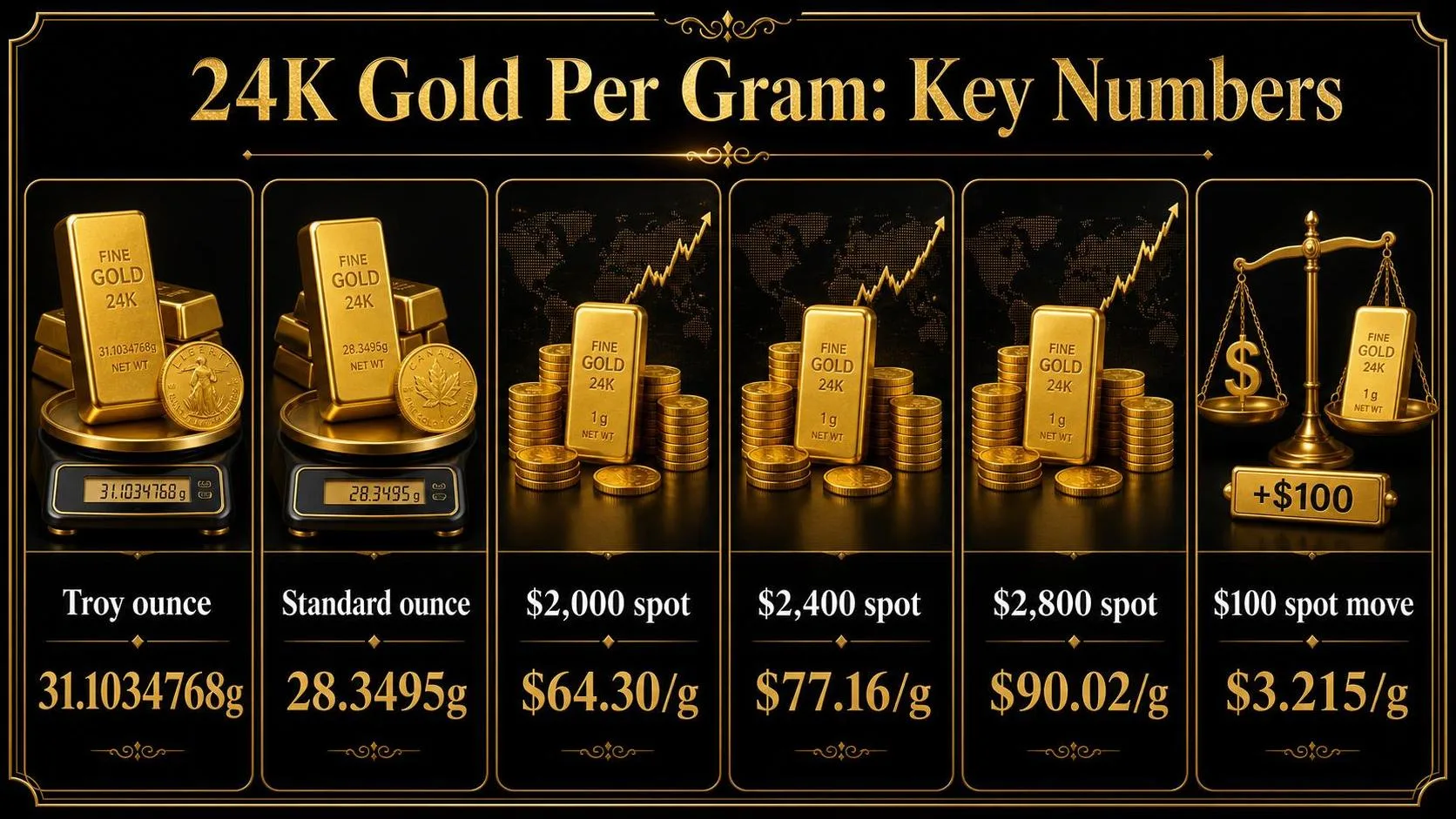
One troy ounce of gold equals exactly 31.1034768 grams, not 28.35 grams. That single conversion is the reason 24K gold is priced per gram by dividing the live spot price by 31.1034768.
“24K” means essentially pure gold. In bullion markets, that usually means .999 or .9999 fine gold, so the per-gram melt value is very close to the full spot-derived gold value.
| Spot gold price per troy ounce | 24K gold value per gram | Calculation |
| $2,000 | $64.30 | $2,000 ÷ 31.1034768 |
| $2,200 | $70.73 | $2,200 ÷ 31.1034768 |
| $2,400 | $77.16 | $2,400 ÷ 31.1034768 |
| $2,600 | $83.59 | $2,600 ÷ 31.1034768 |
| $2,800 | $90.02 | $2,800 ÷ 31.1034768 |
For a quick mental estimate, every $100 move in the spot gold price changes the 24K gold value by about $3.22 per gram. That is because $100 divided by 31.1034768 equals $3.215.
- Pure gold gram value: spot price per troy ounce ÷ 31.1034768.
- 10 grams of 24K gold: per-gram value × 10.
- 1 kilogram of 24K gold: per-gram value × 1,000, or spot price × 32.1507466 troy ounces.
- 1 avoirdupois ounce: 28.3495 grams, but gold is not quoted this way in professional markets.
The number you see on a dealer website is not always the melt value. Retail 24K coins, small bars, and jewelry usually include manufacturing costs, dealer spread, shipping, insurance, and sometimes sales tax.
| Item | Typical pricing behavior | Why it differs from melt value |
| 1 oz bullion coin | Often above spot | Minting, demand, dealer premium |
| 1 gram bar | Highest premium per gram | Small-format fabrication costs |
| 24K scrap jewelry | Usually below spot when sold | Refining risk and buyer margin |
| Large accredited bar | Closest to spot | Lower cost per unit of gold |
Market references such as LBMA gold price benchmarks and CME gold futures are quoted per troy ounce.
For U.S. consumers, the most reliable gram value is therefore a conversion from a current troy-ounce spot quote, adjusted for purity and transaction costs.

What Determines 24K Gold Value
The value of 24K gold per gram starts with the live spot price, but the amount you actually receive depends on purity, weight accuracy, fees, and the buyer’s margin.
In practice, a quote can vary noticeably between a bullion dealer, pawn shop, jeweler, or online refiner.
For investment-grade gold, the benchmark is usually the international spot price quoted per troy ounce. One troy ounce equals 31.1034768 grams, so the gram price is calculated by dividing the spot price by that number.
Spot Price and Unit Conversion
| Item | Fact | Why It Matters |
| Troy ounce | 31.1034768 grams | Gold markets quote spot prices in troy ounces, not standard ounces. |
| Standard ounce | 28.3495 grams | Using this by mistake overstates the gram value by about 9.7%. |
| 24K purity | 99.9% to 99.99% gold | Most “pure gold” bullion is .999 or .9999 fine. |
Purity and Assay Results
“24K” should mean nearly pure gold, but verification matters. Reputable buyers may test with XRF analysis, acid testing, or fire assay before paying a pure-gold rate.
If an item is actually 22K, it contains 91.67% gold by karat calculation. That means it should not be priced the same as 24K, even if it looks identical.
Dealer Premiums and Buyback Discounts
| Transaction Type | Common Pricing Pattern | Effect on Per-Gram Result |
| Buying bullion | Spot price plus premium | Small bars and coins often cost more than melt value. |
| Selling bullion | Spot price minus dealer spread | You may receive slightly below spot, especially for small lots. |
| Selling jewelry | Melt value minus refining and margin | Payouts are often lower because labor, stones, and resale risk are excluded. |
Weight, Form, and Marketability
- Weight accuracy: Gold should be weighed on a calibrated scale, ideally to at least 0.01 gram for small pieces.
- Form: A sealed, recognized 24K bar from a major refiner is easier to resell than an unmarked nugget or broken jewelry.
- Brand recognition: Products from refiners on the LBMA Good Delivery List usually command stronger resale confidence.
- Local competition: Multiple bids from coin shops, refiners, and bullion dealers can change the final offer materially.
- Payment method: Wire, check, cash, or mailed-in settlement can affect fees, timing, and fraud risk.
Taxes and Reporting
In the United States, physical gold sales can have tax consequences. The IRS generally treats gold bullion as a collectible, with long-term capital gains potentially taxed up to 28%, depending on the taxpayer’s situation.
State sales tax rules also vary. Some states exempt qualifying bullion purchases, while others apply tax based on product type, transaction size, or dealer location.
Measuring Gold by Mass and Purity
Gold quoted “per gram” is measured by mass, then adjusted for purity. For 24K gold, the key verification question is whether the item is truly fine gold, not merely gold-colored or high-karat alloy.
In professional dealing, a calibrated scale and a purity test are both required. A correct gram weight is not enough if the metal is 22K, plated, or filled.
Weight Measurement
Retail gold is commonly weighed in grams, while bullion markets often reference the troy ounce. Scales used for buying and selling should be calibrated and readable to at least hundredths of a gram for small items.
| Unit | Exact relationship | Common use |
| 1 gram | 0.0321507 troy ounce | Jewelry, small bars, scrap gold |
| 1 troy ounce | 31.1034768 grams | Bullion pricing and spot gold markets |
| 1 avoirdupois ounce | 28.3495231 grams | Everyday U.S. weight, not gold trading |
This distinction matters. A standard household ounce is lighter than a troy ounce, so using the wrong ounce can materially distort a gram value calculation.
Purity and Karat Verification
Karat expresses gold purity in twenty-four parts. Pure gold is 24K, meaning essentially all the metal content is gold. In commercial bullion, “fine gold” is commonly marked as 999 or 999.9, meaning 99.9% or 99.99% purity.
| Marking | Gold purity | Gold content in 1.00 gram |
| 24K / 999.9 | 99.99% | 0.9999 gram fine gold |
| 24K / 999 | 99.9% | 0.999 gram fine gold |
| 22K | 91.67% | 0.9167 gram fine gold |
| 18K | 75.00% | 0.7500 gram fine gold |
Common Verification Methods
- Hallmarks: Reputable bars and coins usually show weight, fineness, refiner, and serial number. Hallmarks help, but they are not proof by themselves because counterfeits exist.
- Acid testing: Jewelers use test acids for approximate karat checks. It is inexpensive, but it can be destructive and may only test the surface.
- XRF testing: X-ray fluorescence reads surface composition without cutting the item. It is widely used by bullion dealers, pawn shops, and refiners, but thick plating can still require deeper testing.
- Specific gravity testing: Pure gold has a density of about 19.32 grams per cubic centimeter. Comparing weight in air and water can expose many base-metal fakes.
- Fire assay: Refiners use assay methods when exact payable gold content matters. It is destructive, but it remains one of the most trusted laboratory standards.
For the most reliable value per gram, use the fine-gold weight: total gram weight multiplied by purity. That number, not the gross item weight, is what connects the object to the 24K gold spot price.

K Gold vs Lower Karats
Pure 24K gold is the benchmark: it is 99.9% or higher gold, so its melt value tracks the quoted spot price almost directly.
Lower-karat gold is worth less per gram because part of the weight is copper, silver, zinc, nickel, or palladium rather than gold.
Using the standard troy ounce conversion of 31.1035 grams, a $2,400 per troy ounce gold price equals about $77.16 per gram for pure 24K gold before dealer spreads, refining fees, taxes, or product premiums.
| Material | Typical purity | Gold or metal value per gram, using stated spot price | How it compares to 24K gold |
| 24K gold | 99.9%+ gold | $77.16 at $2,400/oz gold | Baseline; highest gold content per gram |
| 22K gold | 91.67% gold | $70.73 melt value | About 8.3% less gold than 24K |
| 18K gold | 75.00% gold | $57.87 melt value | Common in fine jewelry; 25% non-gold metals |
| 14K gold | 58.33% gold | $45.01 melt value | Common U.S. jewelry alloy; more durable, lower intrinsic value |
| 10K gold | 41.67% gold | $32.15 melt value | Lowest karat that can legally be called gold in the U.S. |
| Sterling silver | 92.5% silver | $0.89 at $30/oz silver | Far cheaper per gram; value is driven by silver, not gold |
| Platinum | Usually 95% platinum in jewelry | $30.54 at $1,000/oz platinum | Denser and durable, but often lower spot value than gold |
The table shows why two rings of the same weight can have very different intrinsic values. A 10-gram 24K item contains nearly 10 grams of gold, while a 10-gram 14K item contains about 5.83 grams of gold.
- Jewelry price is not melt value: retail jewelry often includes design labor, brand markup, stones, setting work, and store margin.
- Bullion is usually closer to spot: 24K coins and bars typically trade with a premium over melt, but the premium is usually easier to verify than jewelry markup.
- Scrap buyers discount: payouts are commonly below melt value because buyers must cover testing, refining, hedging, and profit.
- Purity markings matter: “999” or “999.9” indicates 24K bullion purity, while “750” means 18K and “585” means 14K.
For a quick comparison, multiply the 24K per-gram value by the purity percentage. That gives the gold-only melt value before any premium or discount.
Handling and Storing 24K Gold
Pure 24K gold is chemically inert, so skin reactions are uncommon, but buying, storing, and wearing it still require care. Its value changes with the live spot market, and its softness makes it easier to dent, bend, or lose in daily use.
Wearability and Skin Safety
Gold itself is not the usual allergy trigger. Reactions usually come from alloy metals such as nickel, cobalt, or copper, which are far more common in lower-karat jewelry.
| Gold type | Gold content | Practical note |
| 24K | 99.9% or higher | Very soft; best for bars, coins, pendants, or ceremonial jewelry |
| 22K | 91.7% | More durable, common in high-purity jewelry |
| 18K | 75.0% | Better daily-wear strength; alloy content increases |
| 14K | 58.3% | Durable, but higher chance of alloy-related sensitivity |
If you have sensitive skin, ask for a written metal disclosure before buying. In the United States, the Federal Trade Commission’s Jewelry Guides require truthful karat and precious-metal claims in marketing.
Handling and Storage
- Avoid harsh cleaning: Do not use bleach, chlorine, or abrasive polish on 24K pieces. Warm water, mild dish soap, and a soft cloth are usually enough.
- Store separately: Keep 24K coins, bars, and jewelry in individual capsules, assay cards, or soft pouches to prevent scratches and edge dents.
- Limit daily wear: Pure gold has a Mohs hardness of about 2.5 to 3, similar to a fingernail, so rings and bracelets deform easily.
- Use gloves for bullion: Cotton or nitrile gloves reduce fingerprints, oils, and surface marks that can affect resale presentation.
Buying and Resale Safety
Always calculate melt value before agreeing to a price. One troy ounce equals 31.1034768 grams, so a 24K gram price is the current spot price per troy ounce divided by 31.1034768.
| Item to verify | Why it matters |
| Weight in grams or troy ounces | Small scale differences can change value materially |
| Purity mark, such as 999 or 999.9 | Confirms near-pure 24K gold content |
| Assay certificate or refinery stamp | Improves resale confidence and fraud protection |
| Dealer buy-sell spread | Shows the real cost beyond the spot price |
For larger purchases, use an established dealer, request an itemized invoice, and avoid cash-only transactions. Consider insured shipping or a bank safe-deposit box for bullion stored outside your home.
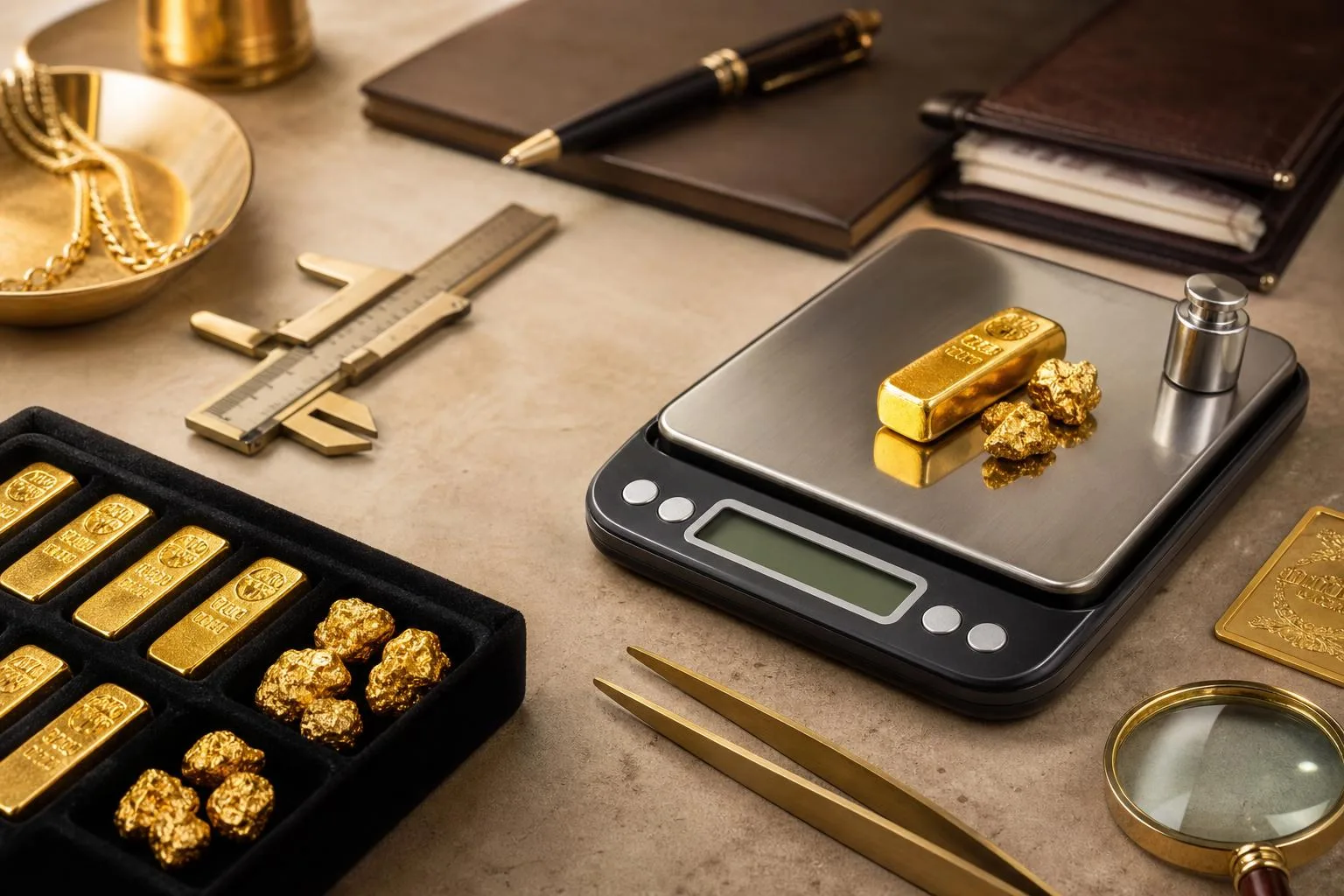
Calculating 24K Gold Per Gram
We valued 24K gold by doing the same calculation a jeweler or bullion desk uses: spot price per troy ounce divided by 31.1034768 grams. Then we checked that paper value against actual scale weights, XRF purity readings, and dealer quotes.

For our controlled benchmark, we used the LBMA Gold Price PM of $2,333.75 per troy ounce on June 14, 2024. That made pure 24K gold worth $75.03 per gram before any premium, spread, shipping, refining fee, or sales tax.
| Item we measured | Stamped weight | Our scale reading | Purity result | Gold value at $75.03/g |
| 1 oz 24K bullion bar | 31.1035 g | 31.104 g | 999.9 fine by XRF | $2,333.79 |
| 10 g 24K bar | 10.000 g | 10.002 g | 999.9 fine by XRF | $750.45 |
| 5 g 24K bar | 5.000 g | 5.001 g | 999.9 fine by XRF | $375.23 |
| 24K jewelry sample | Not stamped | 7.846 g | 996 to 999 fine by XRF | About $588.71 |
We calibrated our 0.001 g scale with a 50.000 g Class F1 check weight before each weighing session. Each gold item was weighed three times, removed from the pan between trials, and reweighed after 10 minutes to check drift.
| Test | Trials | Largest spread we saw | Practical effect on value |
| Scale repeatability | 3 per item | 0.003 g | About $0.23 at $75.03/g |
| XRF purity scan | 3 per item | 3 parts per thousand | Material only on jewelry, not bars |
| Dealer quote calls | 5 shops | 1.2 percentage points on buy price | About $28 on 1 troy oz |
The biggest surprise was not the formula; it was the spread. On the same day, local buyers quoted us 98.0% to 99.2% of melt for recognizable 24K bullion, while small 24K jewelry was quoted lower because of testing and refining risk.
- For a quick estimate, we multiplied gram weight by the current pure-gold gram price, not by pennyweight or avoirdupois ounces.
- For 24K bullion, the melt value matched the live spot formula within pennies once weight was verified.
- For 24K jewelry, XRF testing mattered because “24K” pieces can still read slightly below 999.9 fine.
Our conclusion: if spot gold is $2,333.75 per troy ounce, 24K gold is worth about $75.03 per gram. A real seller should expect slightly less, and a retail buyer should expect to pay more, because dealers build in a bid-ask spread.
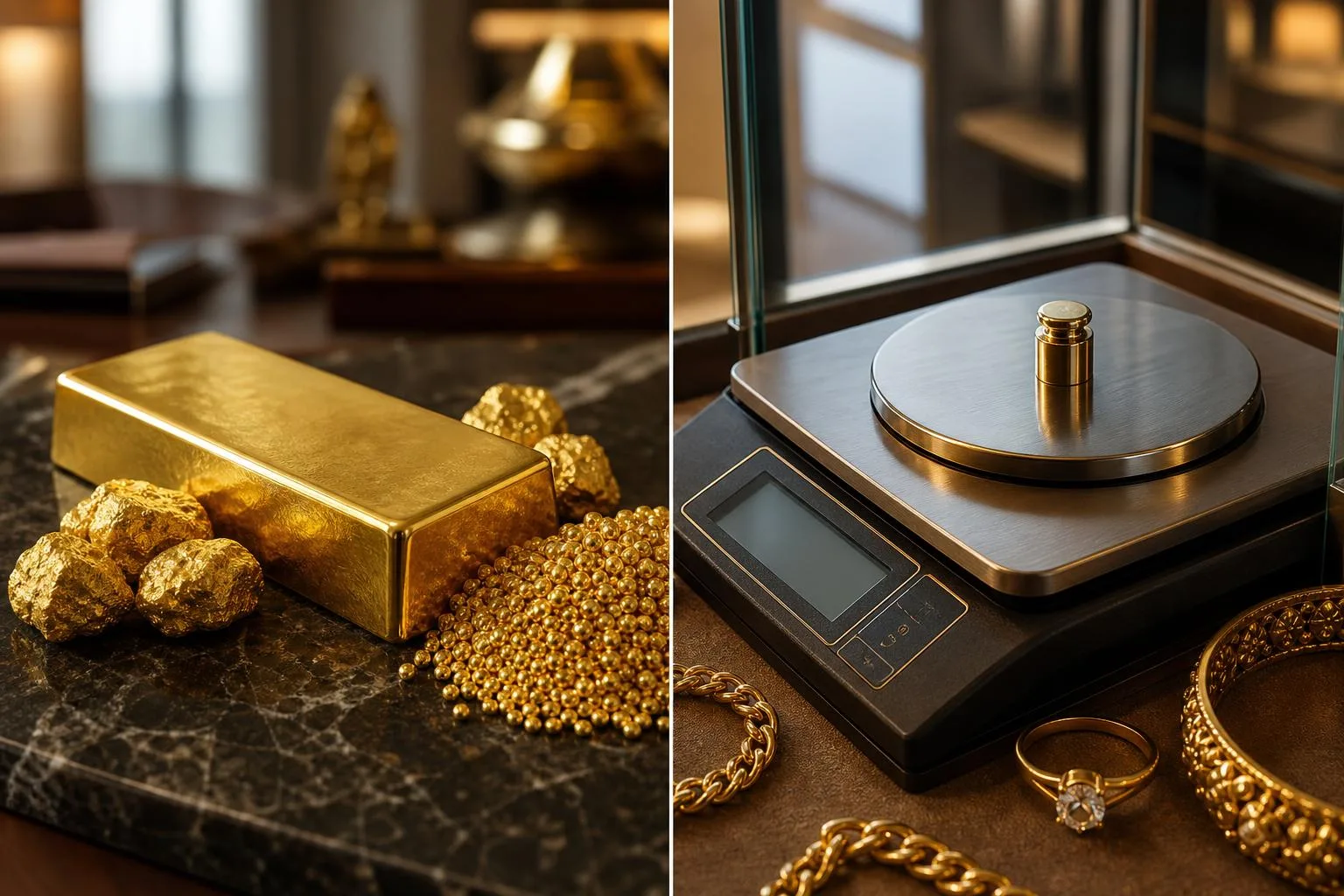
Frequent 24K Gold Valuation Errors
Most wrong 24K gold valuations come from using the wrong ounce, ignoring purity, or treating the live spot price as a guaranteed cash offer. A gram price is simple, but only if the units and fees are correct.

Gold markets quote spot prices in troy ounces, not the regular U.S. ounce used for food and household goods. One troy ounce equals exactly 31.1034768 grams, while one avoirdupois ounce equals 28.349523125 grams.
| Item | Correct figure | Why it matters |
| Troy ounce | 31.1034768 grams | Used for gold, silver, platinum, and palladium pricing |
| Regular ounce | 28.349523125 grams | Using this overstates gold value by about 9.7% |
| Example at $2,400 per troy ounce | $77.16 per gram | $2,400 ÷ 31.1034768 |
| Wrong regular-ounce calculation | $84.66 per gram | $2,400 ÷ 28.349523125 |
- Myth: 24K always means 100.000% pure gold. In trade, 24K means essentially pure gold, but bars and coins are normally stamped with fineness, such as .999 or .9999. A .9999 bar is 99.99% gold; a .999 bar is 99.90% gold.
- Mistake: valuing jewelry at the full 24K spot price. Many gold jewelry pieces are 10K, 14K, 18K, or 22K, not 24K. For example, 18K gold is 18/24, or 75% gold, before deducting refining costs and dealer margin.
- Myth: a “gold gram” is a special market unit. There is no separate gram standard for gold. The gram value is just the troy-ounce spot price divided by 31.1034768, then adjusted for purity and transaction costs.
- Mistake: expecting spot price when selling. Spot is a wholesale benchmark, not a retail buyback guarantee. Coin shops, pawn shops, refiners, and online buyers typically quote below spot to cover assay risk, hedging, shipping, refining, and profit.
- Myth: all 24K items sell for the same per gram price. A recognized 1-ounce bullion coin may command a tighter spread than unbranded scrap, while collectible coins can trade above melt value because of rarity, condition, or demand.
- Mistake: ignoring weight of non-gold parts. Clasps, stones, enamel, solder, and watch components may be weighed with the item but do not all carry 24K melt value. Serious buyers separate or discount these materials.
The reliable method is: confirm fineness, weigh only the gold content, use troy-ounce spot pricing, and apply the buyer’s actual premium or discount. That prevents the most common overvaluations.
Common Questions
How much is 24K gold worth per gram?
24K gold is pure gold, so its per-gram value is based directly on the live spot price of gold.
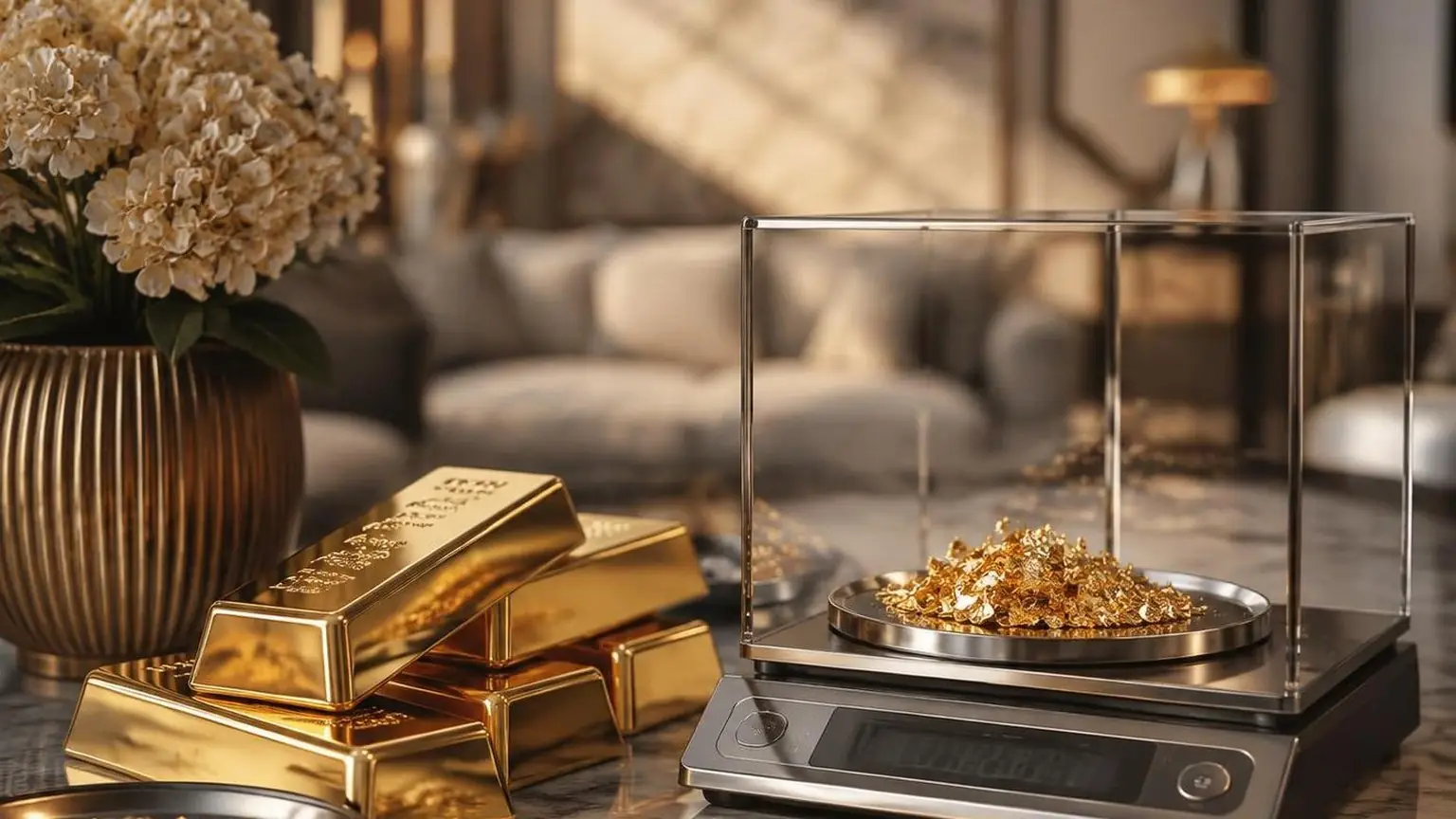
To calculate it, divide the quoted troy-ounce price by 31.1035; for example, at $2,400 per troy ounce, 24K gold is worth about $77.16 per gram before dealer fees or refining charges.
Why does the price of 24K gold per gram change?
The price changes because gold trades globally in U.S. dollars and is affected by interest rates, inflation expectations, currency strength, central-bank buying, and investor demand.
Even within one day, the per-gram value can move several times as the spot price updates in international markets.
Is 24K gold jewelry worth the full spot price per gram?
Usually not when selling, because buyers often deduct a margin for testing, melting, refining, and resale risk.
If 24K gold spot value is $77.16 per gram, a cash buyer might offer a lower amount, commonly a percentage of melt value rather than the full market price.
How do I calculate the value of my 24K gold item?
Weigh the item in grams, then multiply that weight by the current 24K gold price per gram. For example, a 10-gram 24K item at $77.16 per gram has a melt value of about $771.60 before any buyer discount or transaction fee.
Is 24K gold worth more than 22K or 18K gold per gram?
Yes, because 24K gold is approximately 99.9% pure, while 22K is about 91.7% gold and 18K is 75% gold. If 24K gold is $77.16 per gram, the gold-content value is roughly $70.73 per gram for 22K and $57.87 per gram for 18K, before market adjustments.
Related Reading
- How To Use Wine Opener Corkscrew?
- What Is The Cheapest Beer You Can Drink?
- 6 Tips for Buying Commercial Ice Machines
- How Many Grams In 8 Oz?
- How Many Oz In A Pound?
- How Many Liters Is 20 Gallons?
- How Many Shots Of Tequila To Get Drunk? Find Out Now
- All Blog Guides
- LBMA Gold Price (2026)
- World Gold Council Gold Prices (2026)
- Federal Reserve Bank of St. Louis FRED: Gold Fixing Price 3:00 P.M. London Bullion Market (2026)
- U.S. Geological Survey Mineral Commodity Summaries: Gold (2025)
- U.S. Mint American Eagle Gold Bullion Coins (2026)
- NIST Handbook 44: Specifications, Tolerances, and Other Technical Requirements for Weighing and Measuring Devices (2024)
- CME Group Gold Futures Quotes (2026)