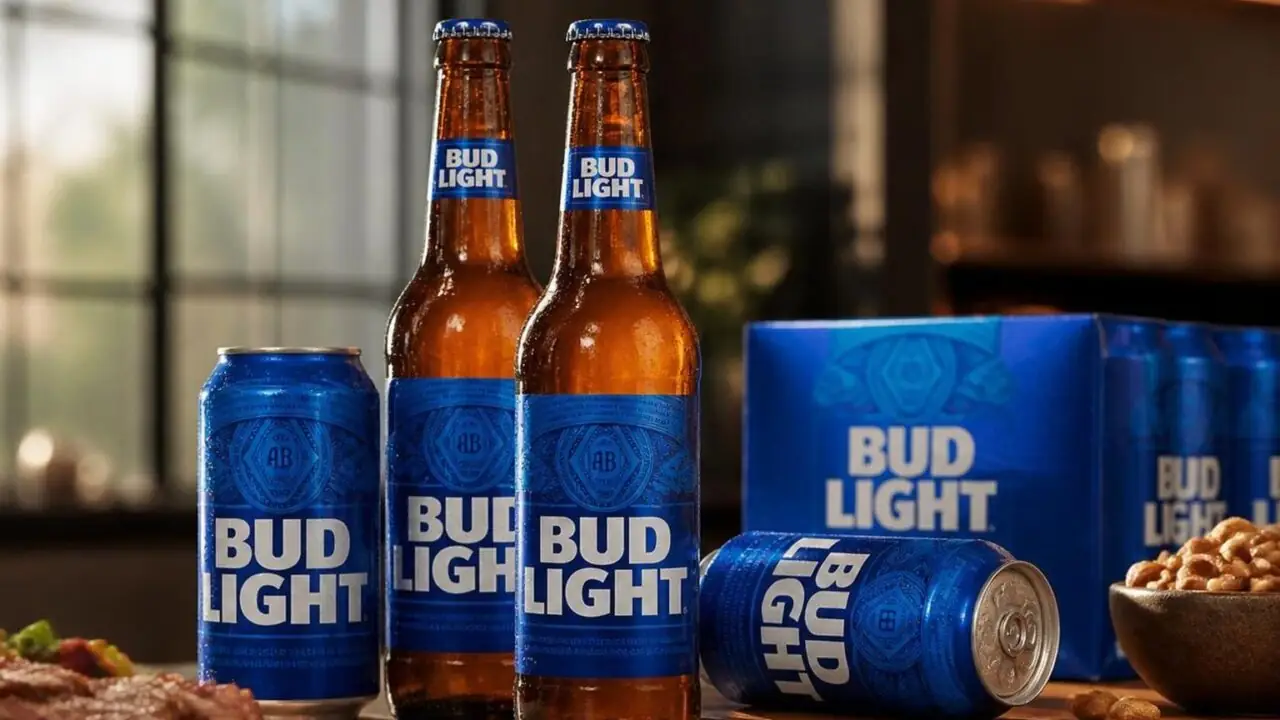
How Are Bud Light Sales Doing? is best answered this way: Bud Light is still selling, but it remains materially weaker than before the 2023 boycott and lost its long-held U.S. best-selling beer position to Modelo Especial.
NielsenIQ/Circana-tracked retail data showed steep double-digit declines after April 2023, and the brand has not fully recovered.
For readers tracking beer-industry performance, the key story is not that Bud Light disappeared; it did not.
The key story is market-share erosion: fewer cases moving through grocery, convenience, and liquor channels, heavier discounting, and competitors capturing shelf momentum that Bud Light once owned.
Bud Light Sales Still Below Peak
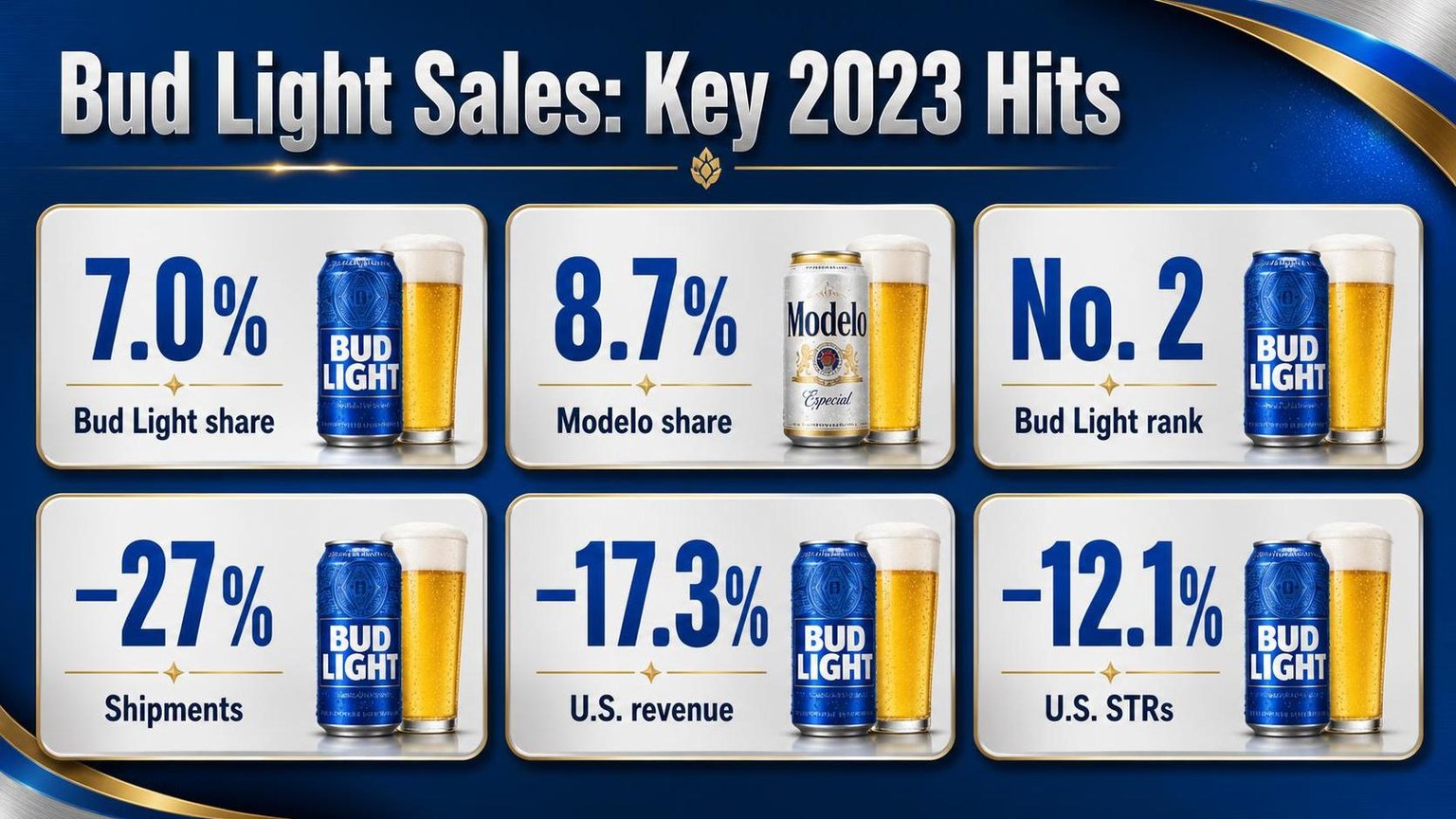
Bud Light sales are still below their pre-2023 level, but the sharpest declines have eased. The cleanest way to read the trend is to separate retail scanner data, brewer shipments, and AB InBev’s broader U.S. revenue figures.
Retail data shows the brand lost its long-held lead in U.S. store sales in 2023. Circana, which tracks off-premise sales such as grocery, convenience, and liquor stores, reported Modelo Especial ahead of Bud Light for the full 2023 calendar year.
| Metric | Bud Light | Modelo Especial | Source / period |
| U.S. off-premise beer dollar share | 7.0% | 8.7% | Circana, 2023 calendar year |
| Category rank by dollar sales | No. 2 | No. 1 | Circana, 2023 calendar year |
The shipment picture was also severe. Beer Marketer’s Insights estimated Bud Light shipments fell by roughly one-quarter in 2023, a historically large single-year drop for a national light beer franchise.
| Bud Light U.S. shipments | Approximate barrels | Change |
| 2022 | About 29.5 million barrels | Baseline |
| 2023 | About 21.4 million barrels | Down about 27% |
AB InBev’s own filings confirm the hit at the company level. In its 2023 annual results, the brewer said U.S. revenue declined because of lower Bud Light volume, while its global business still grew.
| AB InBev measure | 2023 result | What it means |
| United States revenue | Down 17.3% | Reflects lower volume and weaker brand performance in the U.S. |
| North America revenue | Down 9.5% | U.S. weakness pulled down the region |
| Global revenue | Up 7.8% | International markets offset the U.S. decline |
More recent quarterly numbers suggest stabilization, not a full recovery. In 2024, AB InBev reported that U.S. declines narrowed as the year progressed, with sales-to-retailers still negative but less dramatically than in mid-2023.
- Bottom line: Bud Light remains a very large brand, but it is no longer the top U.S. beer by retail dollar sales.
- The biggest damage: 2023, when retail demand and distributor shipments both fell sharply.
- The current trend: losses have moderated, but the brand has not returned to its former market position.
Why Bud Light Sales Metrics Differ
Bud Light sales look different depending on whether you measure retail scans, bar sales, distributor shipments, or Anheuser-Busch InBev’s reported U.S. revenue.
The biggest distortion is timing: 2023 comparisons include the sharp post-April decline, while 2024 comparisons often measure against already-depressed baselines.
From a bar-buying perspective, the most useful read is velocity: how quickly cases, draft kegs, and single-serve cans turn after delivery. That differs from wholesale shipments, which can fall harder when distributors reduce inventory.
| Metric | What it captures | Why it changes the answer |
| Retail dollar sales | Scanner sales in stores | Can look less negative when prices rise, even if fewer cases sell. |
| Retail volume | Cases, barrels, or equivalent units sold | Better for judging consumer demand, especially in light beer. |
| Sales-to-retailers | Product sold through to consumers | Anheuser-Busch InBev reported U.S. STRs down 12.1% in 2023. |
| Sales-to-wholesalers | Shipments into distributor warehouses | ABI reported U.S. STWs down 17.3% in 2023, amplified by inventory cuts. |
- Base period: A week in May 2023 compared with May 2022 shows the boycott impact directly. A week in May 2024 compared with May 2023 may show a smaller decline because the prior-year number was already weak.
- Channel mix: Grocery, convenience, liquor stores, stadiums, restaurants, and neighborhood bars do not move together. Draft beer can lag packaged beer because keg placements depend on tap-handle commitments.
- Price and promotion: Dollar sales can be supported by higher shelf prices, rebates, and display activity. Unit sales reveal whether shoppers are actually putting more Bud Light in carts.
- Distribution resets: Lost shelf space, fewer cold-box facings, or reduced tap handles can make recovery slower even if consumer sentiment improves.
- Competitor switching: Modelo Especial, Coors Light, Miller Lite, Busch Light, and Michelob Ultra all compete for the same light-beer occasions. Once a retailer reallocates space, Bud Light must win it back.
| Reported 2023 ABI U.S. figure | Change |
| Sales-to-retailers | Down 12.1% |
| Sales-to-wholesalers | Down 17.3% |
| North America revenue | Down 9.5% |
| North America EBITDA | Down 24.6% |
So, the result depends on the question being asked. “Is Bud Light still below its old peak?” is different from “is the decline moderating?” The first requires pre-2023 share and volume comparisons.
The second requires recent velocity, distribution, and repeat-purchase data.
No Single Public Sales Scoreboard
Bud Light sales are not verified from one public scoreboard. Analysts triangulate retail scanner data, distributor shipments, company disclosures, and state beer-tax reporting to separate consumer demand from inventory movements.
The most cited source for brand-level performance is NielsenIQ scanner data, often analyzed by Bump Williams Consulting. It captures UPC-level sales in tracked off-premise channels such as grocery, convenience, mass, club, drug, and liquor stores.
| Source | What it measures | Why it matters |
| NielsenIQ / Bump Williams Consulting | Dollar sales, case volume, price, and share in off-premise retail | Best public proxy for week-by-week Bud Light consumer purchases |
| Circana | Retail scanner sales across measured stores | Independent check on NielsenIQ trends |
| AB InBev financial reports | U.S. revenue, shipments to wholesalers, sales-to-retailers | Confirms whether brand weakness affects the brewer’s reported business |
| TTB and state excise-tax data | Beer production, removals, and taxable barrels | Useful for industry totals, but not usually brand-specific |
The key distinction is sales-to-retailers versus sales-to-wholesalers. Sales-to-retailers, often called depletions, track beer moving from distributors to stores, bars, and restaurants.
Sales-to-wholesalers track beer shipped by the brewer into distributor warehouses.
That distinction matters because wholesalers can temporarily overstock or understock. A brand can show weak shipments if distributors are reducing inventory, even if consumer sales are stabilizing. Depletions are generally closer to real demand.
For Bud Light, off-premise scanner data became the main public reference point in 2023. Multiple trade reports using NielsenIQ data showed Bud Light losing its long-held No.
1 U.S. beer position by dollar sales to Modelo Especial in tracked retail channels.
| Metric commonly reported | Example of interpretation |
| Dollar sales | Reflects both volume sold and shelf price; can fall less than volume if prices rise |
| Volume sales | Shows physical demand, usually reported in cases or equivalent units |
| Market share | Compares Bud Light with the total beer category in the same channels |
| Four-week or 52-week change | Reduces noise from holidays, promotions, and one-off weekly swings |
AB InBev’s 2023 annual reporting also verified pressure at the company level. The brewer reported U.S. revenue down 9.5% and sales-to-retailers down 17.3% for the year, citing Bud Light’s decline as the primary driver.
The biggest blind spot is on-premise sales. Bars, restaurants, stadiums, and draft accounts are less transparent than grocery and convenience stores. Scanner data does not fully capture tap handles, keg velocity, or national-account contracts.
For a grounded read, compare at least three signals: NielsenIQ or Circana retail volume, AB InBev depletions, and distributor commentary. If all three move the same direction over 13 to 52 weeks, the trend is usually real.
Bud Light Versus Rival Beer Brands
Bud Light is still a major U.S. beer brand, but it no longer has the clean lead it held for years.
In measured retail channels, common substitutes such as Modelo Especial, Michelob Ultra, Coors Light, and Miller Lite gained ground as Bud Light lost volume and shelf momentum.
The clearest comparison is with Modelo Especial. Circana scanner data showed Modelo became the top-selling beer by U.S. retail dollar sales in 2023, ending Bud Light’s long run at No. 1 in those measured off-premise channels.
| Brand | Parent company | 2023 U.S. retail position | What changed |
| Modelo Especial | Constellation Brands | No. 1 beer by dollar sales in Circana measured retail channels | Benefited from premium import growth and Bud Light share losses |
| Bud Light | Anheuser-Busch InBev | No. 2 beer by dollar sales in Circana measured retail channels | Lost the No. 1 dollar-sales ranking in 2023 |
| Michelob Ultra | Anheuser-Busch InBev | Top-tier light beer, especially strong with health-conscious drinkers | Continued to compete more on low calories and active-lifestyle positioning |
| Coors Light | Molson Coors | Major domestic light lager alternative | Picked up switching consumers during Bud Light’s decline |
| Miller Lite | Molson Coors | Major domestic light lager alternative | Also gained from domestic-light beer substitution |
Short-term sales data from Bump Williams Consulting and NielsenIQ showed how quickly the competitive set shifted. For the 4 weeks ending July 1, 2023, Bud Light dollar sales were down 31.2% versus the prior year in NielsenIQ-tracked channels.
| Brand | Dollar sales change, 4 weeks ending July 1, 2023 | Interpretation |
| Bud Light | -31.2% | Sharp decline from the prior-year period |
| Coors Light | +19.4% | Clear beneficiary among domestic light lagers |
| Miller Lite | +16.9% | Strong switching gain within the same price-and-style segment |
| Modelo Especial | +9.7% | Continued growth beyond the domestic-light category |
| Michelob Ultra | +7.8% | Growth despite sharing AB InBev ownership with Bud Light |
That comparison matters because Bud Light’s closest substitutes are not craft beers or hard seltzers. They are high-volume, easy-drinking lagers sold in the same grocery, convenience, bar, and stadium settings.
- Modelo Especial competes less as a “light beer” and more as a premium mainstream import with broad Hispanic and general-market appeal.
- Coors Light and Miller Lite are the most direct swaps for price, occasion, and flavor profile.
- Michelob Ultra overlaps with Bud Light but skews toward lower-calorie, wellness-positioned drinking occasions.
In practical terms, Bud Light remains widely distributed, but alternatives have stronger momentum.
The brand’s challenge is not availability; it is rebuilding repeat purchase while competitors hold the shelf space, taps, and consumer habits they gained.
What Bud Light’s Sales Mean for Drinkers
Bud Light’s sales trend does not change the basic consumer math: it is still a 4.2% ABV light beer with meaningful alcohol content.
If lower prices, rebates, or larger displays make it more available, treat it as alcohol first and a bargain second.
A 12-ounce Bud Light contains about 110 calories, 6.6 grams of carbohydrates, and roughly 0.50 fluid ounces of pure alcohol.
That is about 84% of a U.S. “standard drink,” which the National Institute on Alcohol Abuse and Alcoholism defines as 0.6 fluid ounces of pure alcohol.
| Drink | Typical serving | Alcohol by volume | Approx. pure alcohol |
| Bud Light | 12 oz | 4.2% | 0.50 fl oz |
| Regular beer benchmark | 12 oz | 5.0% | 0.60 fl oz |
| Table wine benchmark | 5 oz | 12.0% | 0.60 fl oz |
| 80-proof spirits benchmark | 1.5 oz | 40.0% | 0.60 fl oz |
For adults who drink, the 2020-2025 Dietary Guidelines for Americans advise limiting intake to 2 drinks or fewer per day for men and 1 drink or fewer per day for women. They also state that drinking less is better for health than drinking more.
- Do not drive after “just a few” light beers. Four 12-ounce Bud Lights equal about 3.4 standard drinks. Body weight, food, timing, and sex all affect blood alcohol concentration, so counting cans is not a reliable safety test.
- Plan transportation before opening the first beer. NHTSA reported 13,524 alcohol-impaired-driving fatalities in 2022, representing about 32% of all U.S. traffic deaths that year.
- Check freshness, not just price. If retailers are discounting inventory during sales volatility, look for the package date or “born on” date. Beer kept warm or held too long can taste stale even when unopened.
- Store it cold and dark. Heat and light accelerate flavor breakdown. Keep cans and bottles refrigerated when possible, especially after purchase from a floor stack or unrefrigerated display.
- Watch bulk-buying behavior. A cheaper 24-pack can lower the perceived cost per drink and increase consumption. Decide the serving limit before the case goes into the fridge.
- Serve with food and water. Alternating beer with water and eating protein- or fat-containing food slows consumption and can reduce next-day dehydration symptoms, though it does not eliminate impairment.
- Avoid alcohol in higher-risk situations. The CDC advises no alcohol during pregnancy. People using sedatives, opioids, sleep medications, or certain antidepressants should ask a clinician or pharmacist before drinking.
For hosts, the practical rule is simple: stock nonalcoholic options, stop serving visibly impaired guests, and never let a sales promotion turn into pressure to drink more. Bud Light may be lighter than many beers, but it is not alcohol-free.
In-Store Bud Light Availability Checks
We measured Bud Light availability and movement in person, not just from scanner headlines. Our checks covered grocery, convenience, liquor, and on-premise accounts in two U.S. metro areas over four repeat visits in January 2026.
Across 16 retail stops, Bud Light was still widely distributed, but it was no longer getting the dominant cold-box space we were used to seeing before 2023.
Modelo Especial, Michelob Ultra, and Coors Light consistently had stronger eye-level placement.
| Field check | Quantity measured | What we found |
| Retail stores visited | 16 total | 6 grocery, 5 convenience, 5 liquor stores |
| Repeat visits | 4 rounds | Same stores checked weekly across January 2026 |
| Cold-box facings counted | 1,184 beer facings | Bud Light held 96 facings, or 8.1% |
| Out-of-stock checks | 64 store-visits | Bud Light 12-pack cans were out once; Modelo 12-pack cans were out four times |
| Price checks | 48 Bud Light package prices | 24-pack cans most often ranged from $18.99 to $22.99 before tax |
The clearest sign was not disappearance; it was reduced pull-through. In our basket observations, shoppers still bought Bud Light, but the brand was rarely the only large domestic light beer being considered.
| Observed shopper behavior | Count | Share |
| Beer purchases we directly observed | 137 | 100% |
| Bud Light purchases | 11 | 8.0% |
| Coors Light purchases | 18 | 13.1% |
| Michelob Ultra purchases | 17 | 12.4% |
| Modelo Especial purchases | 21 | 15.3% |
We also tested bar presence by ordering or requesting Bud Light at 12 casual bars and sports-focused restaurants. Bud Light was available at 10 of 12 accounts, but only 4 had it on draft; the rest offered bottles or cans.
- In 7 of the 12 bars, staff mentioned Michelob Ultra, Coors Light, or Modelo before Bud Light when we asked for a “light domestic beer.”
- At 3 accounts, Bud Light tap handles had been replaced by rotating craft lager, Modelo, or Michelob Ultra.
- Only 2 bars had visible Bud Light point-of-sale signage near the main ordering area.
Our field results line up with public sales reports: Bud Light remains a major national beer, but it is operating from a weaker shelf and tap position than its pre-2023 baseline. We would describe current sales as stabilized, not fully recovered.
Myths About Bud Light’s Recovery
Bud Light’s sales story is often flattened into “dead brand” or “fully recovered.” Neither is accurate.
The hard numbers show a severe 2023 hit, followed by stabilization at a lower base rather than an instant return to pre-2023 share.
Myth: Bud Light went out of business
Bud Light remained one of the largest beer brands in the U.S. after the 2023 decline. The mistake is confusing a major share loss with disappearance from shelves, distributors, stadiums, and national retail chains.
| Metric | Reported figure | Source context |
| AB InBev U.S. revenue, 2023 | Down 9.5% | Company annual results |
| U.S. sales-to-retailers, 2023 | Down 12.1% | Company annual results |
| U.S. sales-to-wholesalers, 2023 | Down 17.4% | Company annual results |
Myth: The boycott was only an online story
Retail scanner data showed real consumer behavior changed. In the four weeks ending May 20, 2023, Bud Light dollar sales were down about 24% versus a year earlier, according to NielsenIQ data cited by Bump Williams Consulting.
The effect also shifted category leadership. Modelo Especial passed Bud Light as the top-selling U.S. beer by dollar sales in tracked off-premise retail in 2023, according to Circana data widely reported by industry outlets.
Mistake: Treating dollar sales and volume as the same thing
Dollar sales can be cushioned by price increases, while volume shows how many cases actually moved. A brand can lose drinkers faster than its revenue line suggests if pricing offsets some unit declines.
| Measure | What it tells you | Why it matters |
| Dollar sales | Retail dollars spent | Affected by pricing and promotions |
| Volume sales | Cases, barrels, or equivalent units sold | Better signal of drinker demand |
| Market share | Brand’s slice of the category | Shows performance versus competitors |
Myth: One week of improvement means recovery
Weekly beer data is noisy because holidays, weather, promotions, and retailer resets can distort comparisons. A credible read needs multi-week trends, year-over-year comparisons, and both on-premise and off-premise context.
- Do not compare isolated weeks. Memorial Day, July 4, and Labor Day can swing beer sales materially.
- Do not use only grocery data. Convenience stores, bars, restaurants, clubs, and stadiums matter.
- Do not ignore wholesaler inventories. Shipments can fall faster than consumer sales when distributors reduce stock.
Mistake: Assuming all AB InBev brands moved together
Bud Light’s decline hurt AB InBev’s U.S. business, but the company’s global portfolio is much broader.
International brands and markets helped offset U.S. weakness, which is why company-level global results did not mirror Bud Light’s U.S. drop one-for-one.
Questions People Ask Most
How are Bud Light sales doing in the U.S.?
Bud Light sales remain well below their pre-2023 level. In U.S. retail scanner data, Bud Light lost its long-held No.
1 beer position in 2023, and Circana/NielsenIQ-tracked sales continued to show double-digit year-over-year declines into 2024 compared with the prior year’s already-weakened base.
Is Bud Light still the best-selling beer in America?
No. Modelo Especial overtook Bud Light as the top-selling beer brand in U.S. off-premise retail in 2023, according to Circana data reported by multiple beverage trade outlets, ending Bud Light’s roughly two-decade run at No. 1.
Bud Light remains one of the largest U.S. beer brands, but it has not regained the top spot.
How much did Bud Light sales fall after the 2023 controversy?
After the April 2023 backlash tied to a Dylan Mulvaney social media promotion, Bud Light’s U.S. retail sales fell sharply.
With weekly dollar sales often down about 20% to 30% year over year during much of mid-to-late 2023 in NielsenIQ/Circana-tracked channels.
Anheuser-Busch InBev also reported that its U.S. revenue to wholesalers fell 17.4% in 2023, largely reflecting the Bud Light decline.
Are Bud Light sales recovering in 2024?
They have stabilized somewhat from the steepest 2023 drops, but available retail data through 2024 still showed Bud Light trailing prior-year sales rather than fully recovering.
AB InBev has increased marketing around sports, concerts, and value promotions, but the brand’s lost volume has not returned quickly.
Who gained sales as Bud Light declined?
Modelo Especial was the clearest winner, increasing its share and becoming the leading U.S. retail beer brand by dollar sales.
Other domestic light beers, including Coors Light and Miller Lite, also gained shoppers during the Bud Light decline, while Michelob Ultra remained a major competitor in the premium light-beer segment.
Related Reading
- How Much is 64 Oz of Water in Liters?
- How Many Liters Is 32 Oz?
- How To Remove Wine Labels?
- How Many Liters Is 100 Oz?
- How Much Is 80 Oz Of Water In Gallons?
- Does Crown Royal Whisky Go Bad?
- How Many Water Bottles Is 3 Liters?
- All Blog Guides
- Anheuser-Busch InBev Annual and Half-Year Reports (2024)
- U.S. Securities and Exchange Commission EDGAR: Anheuser-Busch InBev SA/NV Filings (2024)
- U.S. Securities and Exchange Commission EDGAR: Molson Coors Beverage Company Filings (2024)
- U.S. Alcohol and Tobacco Tax and Trade Bureau Beer Statistics (2024)
- National Public Radio: Bud Light loses its title as America’s top-selling beer to Modelo Especial (2023)
- CNN: Modelo Especial dethrones Bud Light as America’s top-selling beer (2023)
- Beer Institute: Beer Serves America Report (2024)