Calories in a Pinot Noir Bottle
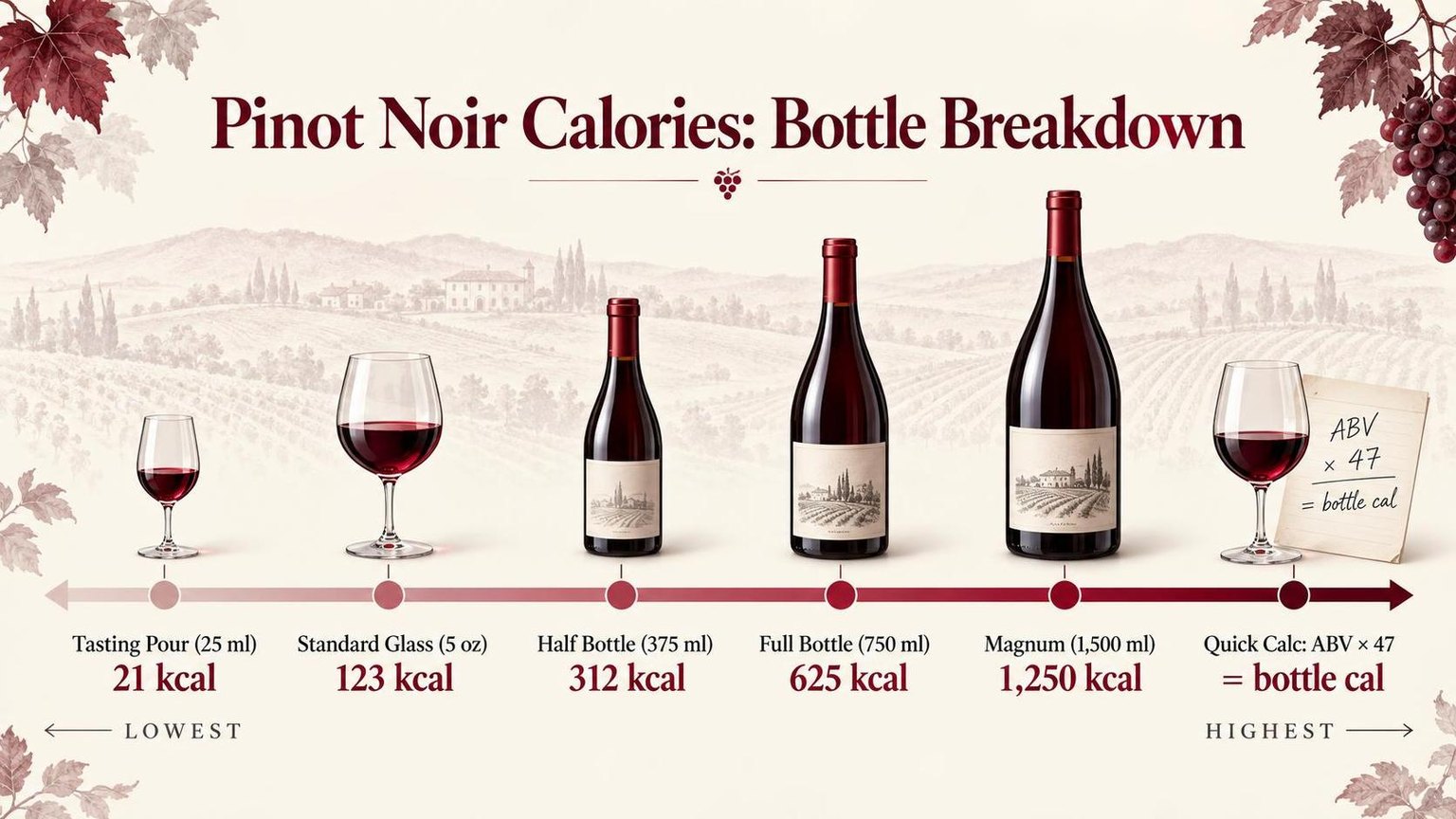
A standard 750 ml bottle of Pinot Noir contains approximately 610–635 calories.
This count varies based on alcohol content and residual sugar, but Pinot Noir consistently ranks among the lower-calorie red wines due to its typically moderate alcohol level of 12–14.5% ABV.
Calorie Breakdown by Serving and Bottle
Wine calories come primarily from alcohol (7 calories per gram) and residual sugar (4 calories per gram). Pinot Noir’s dry profile means sugar contributes minimally—usually under 3 g/L in finished wine.
| Serving Size | Volume | Approximate Calories |
| Standard glass | 5 oz (148 ml) | 121–127 |
| Half bottle | 375 ml | 305–318 |
| Full bottle | 750 ml | 610–635 |
| Magnum | 1,500 ml | 1,220–1,270 |
These figures assume a Pinot Noir at 13.5% ABV with less than 2 g/L residual sugar, which describes the vast majority of commercially available bottles from Burgundy, Oregon, and New Zealand.
How Pinot Noir Compares to Other Red Wines
Alcohol percentage drives the calorie gap between varietals. Higher-alcohol reds like Zinfandel and Shiraz pack noticeably more calories per bottle than Pinot Noir.
| Wine | Typical ABV | Calories per 750 ml Bottle |
| Pinot Noir | 12.5–14.5% | 610–635 |
| Merlot | 13–15% | 625–660 |
| Cabernet Sauvignon | 13.5–15.5% | 640–680 |
| Zinfandel | 14–16% | 670–730 |
| Australian Shiraz | 14.5–16% | 690–740 |
Pinot Noir saves roughly 60–100 calories per bottle compared to a full-bodied Zinfandel. Over a few glasses across a week, that difference becomes meaningful for calorie-conscious drinkers.
Factors That Shift the Calorie Count
- Alcohol level: Each additional 1% ABV adds roughly 40–45 calories per bottle. A 14.5% Pinot Noir hits around 650 calories; a cooler-climate 12.5% version drops closer to 580.
- Residual sugar: Most Pinot Noir ferments to dryness (under 2 g/L), but some producers leave 4–6 g/L for a rounder mouthfeel, adding 12–18 calories per bottle.
- Region: Burgundy and Willamette Valley Pinot Noirs typically range 12.5–13.5% ABV, keeping calories at the lower end. California’s Russian River Valley and Santa Barbara bottlings often reach 14–14.5% ABV, pushing toward 640+ calories.
Quick Estimation Method
Multiply the ABV percentage by 47 to estimate calories per 750 ml bottle. A 13% Pinot Noir: 13 × 47 = 611 calories. A 14% bottling: 14 × 47 = 658 calories. This formula works reliably for dry wines with negligible residual sugar.
Checking the alcohol stated on the label remains the single fastest way to gauge calorie content before opening a bottle of Pinot Noir.
Milliliters of Pinot Noir
Pinot Noir’s calorie count scales directly with volume poured. A standard 750 ml bottle contains approximately 625 calories, making per-milliliter math straightforward: roughly 0.83 calories per ml at typical 13.5% ABV.
Calories by Milliliter Volume
Alcohol contributes 7 calories per gram, and residual sugar adds 4 calories per gram. Pinot Noir typically finishes dry with under 3 g/L residual sugar, so alcohol dominates the calorie equation.
| Volume (ml) | Approximate Calories | Common Serving Context |
| 25 ml | 21 kcal | Tasting pour |
| 75 ml | 62 kcal | Wine tasting flight portion |
| 125 ml | 104 kcal | UK standard small glass |
| 148 ml | 123 kcal | USDA standard pour (5 oz) |
| 175 ml | 145 kcal | UK medium glass |
| 187 ml | 155 kcal | Single-serve mini bottle |
| 250 ml | 208 kcal | UK large glass |
| 375 ml | 312 kcal | Half bottle (demi) |
| 500 ml | 415 kcal | Two-thirds of a standard bottle |
| 750 ml | 625 kcal | Full standard bottle |
| 1,500 ml | 1,250 kcal | Magnum |
These figures assume 13.5% ABV, the midpoint for most Pinot Noir from Burgundy, Oregon, and New Zealand. Higher-alcohol versions from warmer California vintages reaching 14.5% ABV push calories roughly 7–8% higher.
How ABV Shifts Calories Per Milliliter
A 12% ABV Pinot Noir delivers about 0.76 calories per ml. At 14.5% ABV, that rises to approximately 0.91 calories per ml. The difference across a full 750 ml bottle reaches nearly 110 calories.
| ABV Level | Cal per ml | Cal per 148 ml (5 oz) | Cal per 750 ml Bottle |
| 12.0% | 0.76 | 112 kcal | 570 kcal |
| 13.0% | 0.81 | 119 kcal | 605 kcal |
| 13.5% | 0.83 | 123 kcal | 625 kcal |
| 14.0% | 0.87 | 129 kcal | 652 kcal |
| 14.5% | 0.91 | 135 kcal | 680 kcal |
Practical Pouring Tips
- Use a kitchen scale: 1 ml of wine weighs approximately 0.99 grams, so weight in grams nearly equals volume in milliliters.
- Most restaurant pours in the US range from 150–180 ml, meaning 125–150 calories per glass of Pinot Noir.
- Pouring 125 ml instead of 175 ml saves roughly 41 calories per glass—over three glasses, that equals one fewer glass worth of calories.
- Wine-bar “tasting” pours of 60–75 ml keep each sample between 50 and 62 calories, useful for comparing multiple Pinot Noirs without excess intake.
Checking the ABV on the label remains the single most reliable way to estimate calorie content per milliliter. Every additional percentage point of alcohol adds roughly 0.06 calories per ml across the entire bottle.
Calories by Pinot Noir Alcohol Content
Alcohol is the primary calorie driver in Pinot Noir, contributing roughly 7 calories per gram. A single percentage-point increase in ABV adds approximately 10–14 calories per standard 5-oz (150 ml) pour.
Knowing the ABV on your bottle lets you estimate calorie count with real precision.
How Alcohol Generates Calories
Ethanol contains 7 calories per gram—nearly double the 4 calories per gram in carbohydrates. Residual sugar adds calories too, but most Pinot Noir ferments dry, leaving under 3 g/L of sugar.
That means alcohol accounts for 85–95% of total calories in a typical bottle.
Calorie Table by ABV: Per Glass and Per Bottle
The following table uses the standard USDA-aligned formula: calories ≈ oz × ABV × 1.6. Values assume a 5-oz glass and a 750 ml (25.4-oz) bottle of dry Pinot Noir.
| ABV | Calories per 5-oz Glass | Calories per 750 ml Bottle |
| 11.5% | 109 | 554 |
| 12.0% | 114 | 579 |
| 12.5% | 119 | 604 |
| 13.0% | 124 | 630 |
| 13.5% | 129 | 655 |
| 14.0% | 134 | 681 |
| 14.5% | 139 | 706 |
Real-World ABV Ranges by Region
Pinot Noir ABV varies significantly by growing region. Cooler climates produce lower-alcohol wines; warmer areas push grapes to higher ripeness and sugar levels before harvest.
| Region | Typical ABV | Approx. Calories per Glass |
| Burgundy (France) | 12.0–13.0% | 114–124 |
| Oregon (Willamette Valley) | 12.5–13.5% | 119–129 |
| Marlborough (New Zealand) | 13.0–13.5% | 124–129 |
| Sonoma Coast (California) | 13.5–14.5% | 129–139 |
| Central Otago (New Zealand) | 13.5–14.5% | 129–139 |
Practical Calorie-Saving Strategies
- Check the label first. A 12% Burgundy saves roughly 100 calories per bottle compared to a 14.5% Sonoma Pinot Noir.
- Pour accurately. Most home pours reach 6–7 oz, inflating calorie intake by 20–40% over the standard 5-oz serving.
- Choose cooler-climate vintages. German Spätburgunder and Alsatian Pinot Noir frequently land at 11.5–12.5% ABV, yielding 109–119 calories per glass.
- Avoid late-harvest or reserve bottlings. These often exceed 14% ABV and may carry higher residual sugar, pushing a single glass above 140 calories.
The difference between the lightest and heaviest Pinot Noir on this table is 152 calories per bottle—equivalent to a 15-minute jog.
Selecting a lower-ABV bottle is the single most effective way to reduce wine-related calorie intake without reducing volume.
Dry Versus Sweet Pinot Noir Calories
Residual sugar is the single biggest variable separating a 615-calorie bottle from a 780-calorie one.
Dry Pinot Noir contains under 4 g/L residual sugar, while off-dry and sweet versions can carry 12–45 g/L — adding pure carbohydrate calories on top of the alcohol.
Alcohol contributes 7 calories per gram. Sugar contributes 4 calories per gram. A bottle with more residual sugar often has slightly lower alcohol, but the sugar calories more than compensate.
Calorie Comparison by Sweetness Level (750 mL Bottle)
| Style | Residual Sugar (g/L) | Typical ABV | Calories per Bottle | Calories per 5 oz Glass |
| Bone-Dry Pinot Noir | 0–1 | 12.5–13% | 605–625 | 121–125 |
| Dry Pinot Noir | 1–4 | 13–13.5% | 625–645 | 125–129 |
| Off-Dry Pinot Noir | 12–25 | 12–13% | 670–720 | 134–144 |
| Sweet Pinot Noir | 35–45 | 10–12% | 730–785 | 146–157 |
A sweet Pinot Noir bottle can contain roughly 160 more calories than a bone-dry version. That difference equals about 40 grams of additional sugar across 750 mL.
Where the Extra Calories Come From
In a dry Pinot Noir at 13.5% ABV, approximately 97% of the calories derive from alcohol. Sugar contributes a negligible 3–12 calories per bottle.
In an off-dry Pinot Noir with 20 g/L residual sugar, the bottle holds 15 grams of sugar total. That adds 60 calories from carbohydrates alone — roughly 9% of the bottle’s total energy.
- Dry Pinot Noir: ~0.5–3 g sugar per bottle, adding 2–12 calories
- Off-dry Pinot Noir: ~9–19 g sugar per bottle, adding 36–76 calories
- Sweet Pinot Noir: ~26–34 g sugar per bottle, adding 104–136 calories
How to Identify Dry Versus Sweet Before Buying
U.S. wine labels are not required to list residual sugar or calorie counts. Look for ABV as a proxy: bottles at 13–14.5% ABV are almost always fermented dry.
Wines labeled “dry” from Burgundy, Oregon’s Willamette Valley, and New Zealand’s Central Otago reliably contain under 2 g/L residual sugar. These regions prioritize full fermentation.
Mass-market Pinot Noir brands sometimes leave 8–15 g/L residual sugar to soften the palate. Check tech sheets on the producer’s website for exact RS figures when calorie precision matters.
Practical Takeaway
Choosing a bone-dry Pinot Noir at 12.5% ABV over a sweet 12% ABV version saves approximately 32 calories per glass. Over a full bottle, that gap widens to 125–160 calories — equivalent to a medium banana.
For calorie-conscious drinkers, ABV and residual sugar together determine total energy. Prioritize bottles with high ABV and low RS for the fewest calories per serving, or low ABV and low RS for the fewest per bottle.
Serving Size and Bottle Calorie Math
A standard 750 ml bottle of Pinot Noir contains approximately 625 calories, but that number shifts depending on alcohol percentage. Understanding the math behind serving sizes turns label reading into a practical calorie-management tool.
Standard Serving Size Defined
The USDA and Dietary Guidelines for Americans define one serving of wine as 5 fluid ounces (148 ml). A 750 ml bottle therefore holds exactly five standard servings.
Most restaurant pours range from 5 to 6 ounces. A generous 6-ounce pour bumps per-glass calories up by roughly 20%, giving you only 4.2 glasses per bottle instead of five.
Calories Per Glass by ABV
Alcohol contributes 7 calories per gram—nearly double the 4 calories per gram from carbohydrates. Higher-ABV Pinot Noir delivers measurably more calories per glass.
| ABV (%) | Calories per 5 oz Glass | Calories per 750 ml Bottle |
| 12.0% | ~113 | ~565 |
| 12.5% | ~118 | ~590 |
| 13.0% | ~123 | ~615 |
| 13.5% | ~128 | ~640 |
| 14.0% | ~133 | ~665 |
| 14.5% | ~138 | ~690 |
Most Pinot Noir falls between 12.5% and 14.0% ABV. Burgundy and Oregon bottlings typically land at the lower end; warmer-climate California and Australian versions trend higher.
Where the Calories Come From
In a dry Pinot Noir with 13% ABV, roughly 83% of calories come from alcohol itself. The remaining 17% come from residual sugar and trace carbohydrates, typically 3–4 grams per glass.
- Alcohol: ~15.3 grams per 5 oz glass × 7 cal/g = ~107 calories
- Residual sugar/carbs: ~3.5 grams × 4 cal/g = ~14 calories
- Protein and other compounds: negligible, under 2 calories
Comparing Pour Sizes
Pour size has a larger practical impact on total intake than ABV differences between bottles. The table below uses a 13% ABV Pinot Noir as the baseline.
| Pour Size | Volume (oz) | Approximate Calories | Glasses per Bottle |
| Tasting pour | 2 | ~49 | 12.5 |
| Standard pour | 5 | ~123 | 5.0 |
| Generous pour | 6 | ~148 | 4.2 |
| Large glass | 8 | ~197 | 3.1 |
| Half bottle | 12.7 | ~313 | 2.0 |
An 8-ounce home pour—common when using oversized stemware—contains 60% more calories than the standard 5-ounce serving. Measuring once with a kitchen scale or marked glass recalibrates your perception permanently.
Quick Estimation Formula
Multiply the ABV percentage by the fluid ounces poured, then multiply by 1.8. For a 5 oz glass at 13% ABV: 13 × 5 × 1.8 = 117 calories. This shortcut stays accurate within ±5% for any dry red wine.
Questions People Ask Most
How many calories are in a standard 750 ml bottle of Pinot Noir?
A full 750 ml bottle of Pinot Noir contains approximately 610–625 calories. This estimate assumes an average alcohol content of 13–14% ABV, with each of the five standard 5 oz pours delivering roughly 121–125 calories.
Alcohol contributes about 7 calories per gram, making ABV the single biggest calorie driver in dry wines.
Why does Pinot Noir have fewer calories per bottle than Cabernet Sauvignon or Zinfandel?
Pinot Noir typically finishes at 12.5–14% ABV, while Cabernet Sauvignon often reaches 14–15% and Zinfandel can exceed 15%, directly increasing caloric density.
A bottle of 15% ABV Zinfandel can contain around 690 calories—roughly 65–80 more than a 13% Pinot Noir. Residual sugar differences are minimal among these dry reds, so alcohol percentage accounts for nearly all the gap.
Do California and Burgundy Pinot Noirs differ in calories per bottle?
Yes, because of consistent ABV differences. Burgundy Pinot Noir (Bourgogne Rouge) typically ranges from 12.5–13.5% ABV, putting a bottle at roughly 580–620 calories.
California Pinot Noir from regions like Sonoma Coast or Santa Barbara frequently reaches 13.5–14.5% ABV, pushing a bottle closer to 625–670 calories.
How many grams of sugar and carbohydrates are in a bottle of dry Pinot Noir?
A dry Pinot Noir contains less than 4 g of residual sugar per liter, translating to about 3 g or fewer per 750 ml bottle.
Total carbohydrates for the full bottle run approximately 15–18 g, with the remainder coming from non-sugar carbohydrates like glycerol and organic acids.
These carbs contribute only about 60–72 of the bottle’s total calories; the vast majority comes from alcohol.
Does Pinot Noir have fewer calories than a bottle of white wine like Chardonnay?
Not necessarily—calorie counts depend on ABV, not color. A 13.5% ABV Pinot Noir bottle holds roughly 615 calories, while an unoaked Chardonnay at 12.5% ABV comes in around 570 calories.
However, a barrel-fermented Napa Chardonnay at 14.5% ABV can reach 660 calories per bottle, surpassing most Pinot Noirs.
What is the lowest-calorie way to drink a bottle of Pinot Noir?
Choose a Pinot Noir from a cool climate like Germany (Spätburgunder), Alsace, or Tasmania, where ABV commonly stays at 11.5–12.5%, bringing the bottle total to roughly 530–575 calories.
Avoid late-harvest or “reserve” bottlings that may carry higher alcohol or residual sugar.
Serving at proper cellar temperature (55–60 °F) also slows consumption, making it easier to stop at one or two glasses rather than finishing the bottle.
- Does Cooking Wine Need to Be Refrigerated?
- What Does Orange Wine Taste Like? Answer By Expert
- Black Bottles of Wine and Why Winemakers Use Them
- What is a Wine Flight? – 2026
- What Wine Goes with Sushi?
- How Long Does An Unopened Bottle Of Wine Last?
- All Alcohol Guides
- USDA FoodData Central (2024)
- National Institutes of Health – Rethinking Drinking (2024)
- USDA Dietary Guidelines for Americans 2020–2025 (2020)
- CDC – Alcohol and Public Health FAQs (2024)
- Harvard T.H. Chan School of Public Health – Alcohol (2024)
- American Heart Association – Alcohol and Heart Health (2024)
- Wine Institute – Wine Alcohol and Calorie Content (2023)
- Alcohol and Tobacco Tax and Trade Bureau – Wine Labeling (2024)
- PubMed – Caloric and Macronutrient Intake in Alcohol Consumption (2019)