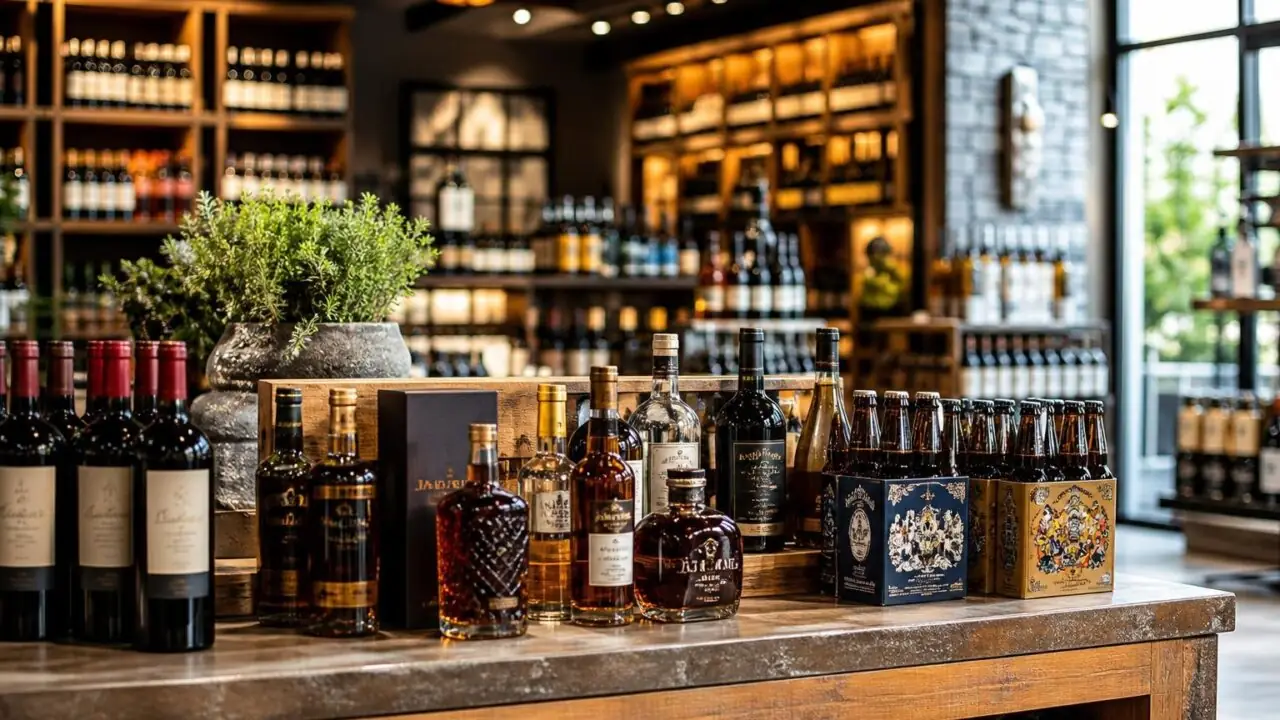
beer cave wine & spirits are retail setups that combine a walk-in beer cooler with adjacent wine and liquor merchandising, usually designed for fast grab-and-go purchasing and tighter temperature control.
For shoppers, the key differences are storage conditions, product rotation, and legal availability by state.
Beer caves often hold packaged beer near 34–38°F, while most table wines and spirits are displayed outside the cooler to avoid flavor damage, label wear, or unnecessary chilling.
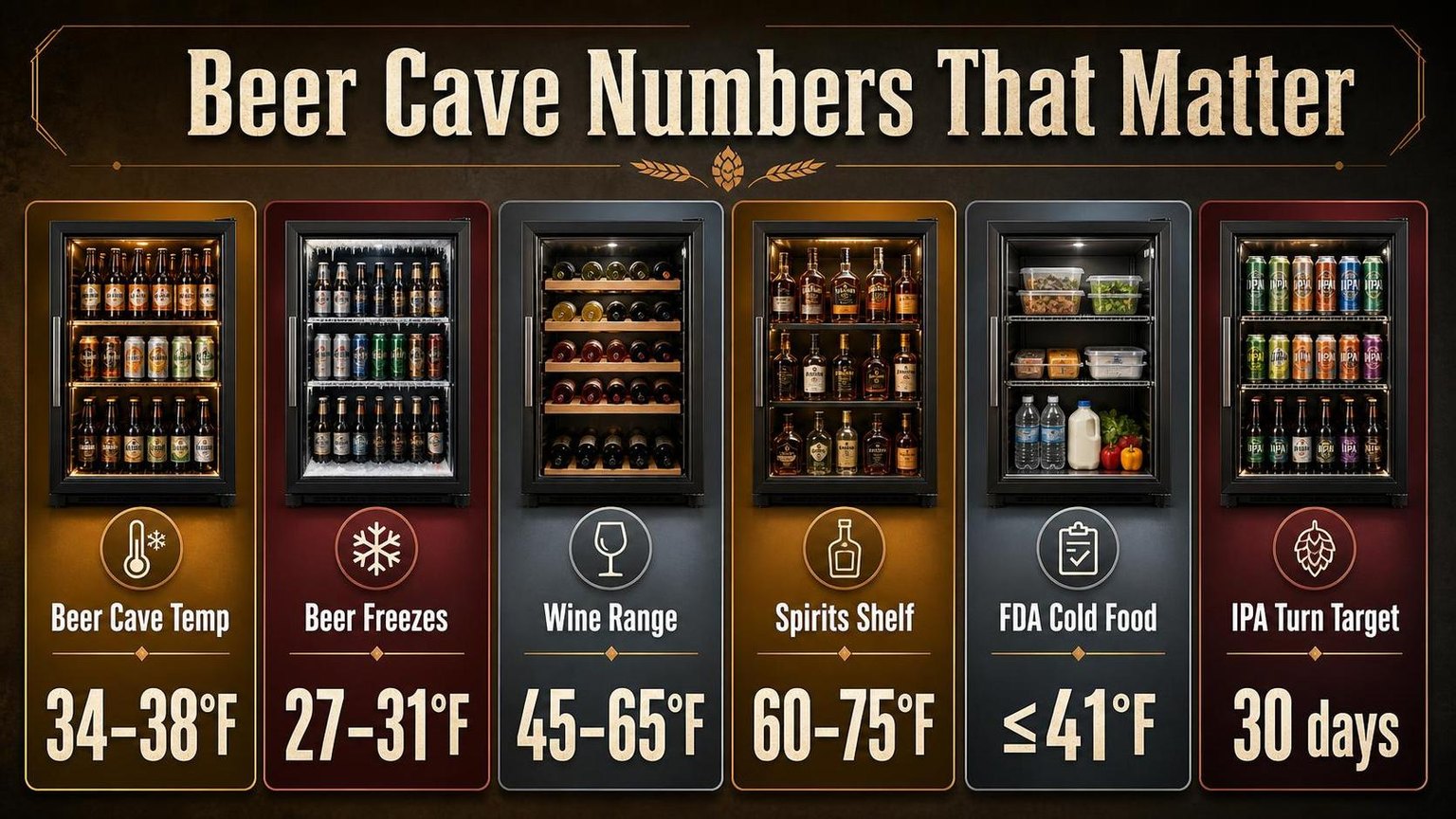
The Key Numbers, Explained
A beer cave is engineered around temperature, turnover, and package economics—not just “cold storage.” The same numbers that keep domestic lager fresh can damage wine, dull aromatized products.
And create compliance issues for spirits merchandising.
In store audits, I treat these as operating numbers first: what temperature the customer sees, how long inventory sits, and whether the product was designed to be chilled continuously.
| Item | Practical number | Why it matters |
| Beer cave air temperature | 34°F to 38°F | This is the typical retail target for packaged beer; it keeps beer ready-to-drink without pushing product near freezing. |
| Beer freezing point | About 27°F to 31°F | Alcohol lowers the freezing point, but low-ABV beer, seltzer, and cans near evaporator fans can still burst. |
| Wine service vs. storage | 45°F to 65°F | Many wines tolerate short chilling, but long-term storage below normal cellar range can mute aroma and dry natural corks. |
| Room-temperature spirits | 60°F to 75°F | Most distilled spirits are shelf-stable at ambient retail temperatures; refrigeration is usually a merchandising choice, not a safety need. |
| FDA “cold food” benchmark | 41°F or below | The FDA Food Code uses 41°F for time-temperature control foods; alcohol retail coolers often run colder for quality, not food safety. |
Beer freshness is highly temperature-dependent. Brewers Association quality guidance has long emphasized that warm storage accelerates staling reactions, especially oxidation, while cold storage slows them.
- 30 days: A reasonable target for high-velocity IPAs, craft lagers, and seasonal beer in a beer cave. Hop-forward beers lose aroma fastest.
- 90 days: A common freshness window for many pasteurized or well-packaged mainstream beers, assuming cold chain is maintained.
- 6 months or more: Possible for stronger, darker, pasteurized, or bottle-conditioned beers, but the “best by” date should control the decision.
Wine needs a different lens. Standard 750 ml wine bottles are usually around 12% to 15% ABV, while beer is commonly 4% to 8% ABV. That alcohol difference does not make wine immune to cold-related handling problems.
| Product type | Best beer-cave role | Risk if mishandled |
| White wine, rosé, sparkling | Short-term chilled selling | Too-cold service can suppress aroma; sparkling bottles need stable handling. |
| Red wine | Selective chilling only | Long cold display can make tannins seem harsher and fruit less expressive. |
| Vermouth, wine cocktails | Often appropriate chilled | After opening, many wine-based products oxidize quickly and need refrigeration. |
| Vodka, tequila, whiskey | Usually ambient shelf | Cold display ties up cooler space without meaningful shelf-life benefit. |
For margins, the number that matters is turns per door. If a 12-pack craft SKU moves two cases weekly, it deserves cold space. If a spirits SKU sells one bottle monthly, ambient placement usually beats beer-cave occupancy.
What Affects the Result
The outcome depends mainly on temperature, light, humidity, vibration, and how long the bottle sits in the beer cave. Beer caves are built for ready-to-drink beer, not long-term wine aging or spirits preservation.
In our experience, the biggest risk is not one cold day, but weeks of storage in a bright, high-traffic cooler with frequent door openings. That combination changes wine faster than most shoppers expect.
Temperature Fit
| Product | Typical Best Storage Range | Beer Cave Impact |
| Beer | 34–40°F for retail service | Ideal for cold sale and quick consumption |
| White wine / rosé | 45–55°F for storage; 40–50°F for service | Acceptable short term, but often colder than ideal |
| Red wine | 55–65°F for storage | Too cold for flavor expression and long holding |
| Spirits | Room temperature, roughly 60–75°F | Usually unnecessary; may dull aroma and texture |
The Alcohol and Tobacco Tax and Trade Bureau recognizes wine as a temperature-sensitive product, and wine trade guidance commonly centers long-term storage near 55°F.
A beer cave at 34–40°F will not “ruin” wine immediately, but it can mute aroma and slow flavor release.
Light Exposure
Light matters more than many buyers think. Ultraviolet and strong visible light can trigger “lightstruck” aromas in wine, especially clear or pale green bottles.
Champagne, rosé, Sauvignon Blanc, and Pinot Grigio are more exposed than dark-glass Cabernet.
- Clear bottles: highest light risk, especially near LED strips or glass doors.
- Green bottles: moderate protection, but not complete protection.
- Amber bottles: strongest common retail protection against light damage.
Humidity and Cork Condition
Traditional cork performs best around 50–70% relative humidity, according to common cellar-management standards. Too dry, and corks can lose elasticity.
Too humid, and labels may wrinkle or mold, especially in walk-in coolers with condensation cycles.
Screw caps and synthetic closures are less sensitive to humidity. Natural cork wines stored upright for months in a cold, dry beer cave face greater closure risk than bottles kept on their side in a stable cellar.
Movement, Traffic, and Time
Beer caves are opened constantly during busy retail hours. Each door cycle introduces warmer air, moisture shifts, and physical vibration from foot traffic, stocking carts, compressors, and fan motors.
| Storage Time in Beer Cave | Likely Effect on Wine |
| 1–7 days | Usually low risk for most sealed wines |
| 2–4 weeks | Noticeable aroma muting possible, especially reds |
| 2+ months | Higher risk from cold, light, vibration, and cork stress |
Spirits are more stable because 40% ABV liquor is microbiologically durable and not cork-dependent in the same way. Still, chilling whiskey, tequila, or rum can suppress aroma, thicken texture, and make premium bottles taste flatter during sampling.
How It Is Measured and Verified
A beer cave, wine room, or spirits storage area is verified by measuring temperature stability, humidity, light exposure, and product rotation.
The goal is not just “cold,” but documented conditions that match the beverage category and protect flavor, carbonation, closures, and shelf life.
In practice, operators verify conditions with calibrated digital probes, data loggers, door thermometers, and receiving records.
Spot checks are useful, but continuous logging is stronger because walk-in doors, restocking, and customer traffic create short temperature spikes.
Core measurements used in the field
| Category | Typical target range | Why it matters |
| Domestic and craft beer in a beer cave | 34°F–38°F | Slows oxidation, preserves carbonation, and keeps packaged beer ready for retail service. |
| White, rosé, and sparkling wine retail storage | 45°F–55°F | Protects aroma and acidity without over-chilling corks or labels during longer holding. |
| Red wine retail storage | 55°F–65°F | Reduces heat damage; temperatures above 70°F accelerate cooked flavors and oxidation. |
| Spirits | 60°F–70°F | High-proof spirits are microbiologically stable, but heat can affect evaporation, closures, and label condition. |
| Wine humidity | 50%–70% relative humidity | Helps limit cork drying while avoiding mold-prone damp storage. |
How readings are taken
- Air temperature: measured with a NIST-traceable digital thermometer or logger placed away from evaporator discharge, doors, and direct light.
- Product temperature: verified with a probe in a glycol bottle or water-filled buffer bottle, which better reflects actual bottle temperature than fast-changing air.
- Humidity: checked with a calibrated hygrometer, especially in wine sections using natural cork closures.
- Light exposure: verified by inspection and, when needed, a lux meter; UV and strong fluorescent light can create lightstruck beer aromas in minutes to hours.
- Rotation: checked by package date, vintage, lot code, and first-in, first-out shelf placement.
Verification frequency and acceptable proof
| Control point | Recommended verification | Record kept |
| Beer cave temperature | Continuous logger plus at least 2 manual checks per day | Daily temperature log with corrective actions |
| Wine room temperature | Continuous logger reviewed weekly | 7-day graph showing highs, lows, and average |
| Thermometer accuracy | Calibration check every 6–12 months | Calibration certificate or ice-point check record |
| Receiving condition | Each delivery | Bill of lading, case temperature, visible damage notes |
Verification is strongest when it shows both the measurement and the response.
If a beer cave logs 45°F for several hours after a compressor fault, the record should show when the product was isolated, evaluated by date and style, and returned or discounted if quality was compromised.
For wine and spirits, visual inspection is part of verification.
Raised corks, seepage, sticky capsules, low fills, haze, broken seals, or heat-stained labels are documented because they indicate possible abuse even when current room readings look acceptable.
How It Compares to Common Alternatives
A beer cave is a walk-in refrigerated room, usually held around 34°F to 38°F, designed for high-volume cold beer storage.
Compared with reach-in doors, ambient shelves, wine coolers, and spirits displays, its main advantage is cold capacity; its tradeoff is higher space, equipment, and energy demand.
The right choice depends on product mix. Beer benefits from near-freezing storage, most wines do better at 45°F to 65°F depending on style, and spirits are generally shelf-stable at normal retail temperatures.
| Format | Typical temperature | Best use | Main limitation |
| Beer cave | 34°F-38°F | Cold 12-packs, cases, domestic beer, hard seltzer | Not ideal for most wine; higher build-out cost |
| Reach-in cooler doors | 34°F-40°F | Singles, 6-packs, premium craft beer, grab-and-go | Less backstock capacity than a walk-in cave |
| Ambient beer shelves | Store temperature, often 68°F-75°F | Overflow inventory, fast-moving macro beer | Warm beer sells slower for immediate consumption |
| Wine cooler or wine room | 45°F-65°F | Sparkling, white, rosé, age-worthy reds | Too warm for cold beer service |
| Spirits shelving | Room temperature | Whiskey, vodka, tequila, rum, liqueurs | No refrigeration benefit; security is often the issue |
Beer Cave vs. Reach-In Coolers
Reach-in coolers are better for merchandising because customers see labels through glass doors.
A beer cave is better for bulk volume: shoppers can walk inside, compare cases, and pull from stacked inventory without staff retrieving product from a back room.
Energy use differs by design. The U.S. Department of Energy regulates commercial refrigeration equipment by daily energy consumption, and glass-door reach-ins lose cold air every time doors open.
Beer caves lose air at the entry but can hold far more product per square foot.
Beer Cave vs. Wine Storage
A beer cave is usually too cold for broad wine storage. The Wine & Spirit Education Trust notes that light-bodied whites and sparkling wines are served chilled, but many reds show best much warmer than beer-cave temperatures.
Storing wine at 34°F to 38°F can mute aroma and may dry corks over long periods if humidity is low. For a mixed retailer, chilled prosecco, canned wine, and some whites may fit; reserve racks and collector bottles need separate conditions.
Beer Cave vs. Spirits Displays
Spirits do not need refrigeration for quality. Bottled whiskey, tequila, vodka, gin, and rum are typically stable at room temperature because their alcohol levels are commonly 40% ABV, far above beer’s usual 4% to 8% ABV range.
- Choose a beer cave when cold beer and seltzer drive frequent, high-volume trips.
- Choose reach-ins when visual merchandising and single-serve impulse sales matter most.
- Choose wine-controlled storage for premium bottles, sparkling wine, and temperature-sensitive inventory.
- Choose standard spirits shelving for most liquor, adding locked cases only for shrink-prone bottles.
Health, Safety, and Practical Tips
A beer cave is built for cold, high-traffic alcohol storage, not for every beverage equally. Beer, hard seltzer, and ready-to-drink cocktails tolerate near-refrigerator temperatures well, while many wines and some spirits need more careful handling.
From a safety standpoint, treat the cave like a walk-in cooler: cold, wet, crowded, and full of glass. Small mistakes can create slip hazards, broken bottles, or quality loss.
Safe storage temperatures
| Product | Practical retail temperature | Key note |
| Beer and hard seltzer | 34°F-40°F | Good for freshness and quick service |
| Sparkling wine | 40°F-50°F | Cold helps pressure stability before sale |
| White and rosé wine | 45°F-55°F | Avoid storing near freezing for long periods |
| Red wine | 55°F-65°F | Long storage in a beer cave can mute aromas |
| Spirits | Room temperature or chilled | High-proof spirits do not require refrigeration |
The Brewers Association notes that beer stales faster with heat and time; cold storage slows oxidation and flavor loss.
For wine, the Wine & Spirit Education Trust teaches that excessive cold can dull flavor temporarily and may push tartrate crystals out of solution.
Prevent slips, breakage, and cold-room issues
- Keep floor temperature and condensation under control. Wet tile near the entrance is one of the most common beer cave hazards.
- Use anti-slip mats only if they are beveled, washable, and secured. Loose mats create trip hazards in tight aisles.
- Stack cases no higher than the manufacturer’s stable load limit. Heavy 24-pack beer cases can exceed 20 pounds each.
- Store glass bottles below shoulder height when possible. A dropped 750 ml wine bottle can shatter widely on concrete or tile.
- Check door seals weekly. Poor seals raise energy use and can cause frost, puddles, and temperature swings.
Alcohol safety and legal basics
The CDC defines one U.S. standard drink as 14 grams of pure alcohol. That equals 12 ounces of 5% beer, 5 ounces of 12% wine, or 1.5 ounces of 40% spirits.
| Beverage | Typical serving | Approximate alcohol |
| Beer | 12 oz at 5% ABV | 1 standard drink |
| Wine | 5 oz at 12% ABV | 1 standard drink |
| Spirits | 1.5 oz at 40% ABV | 1 standard drink |
- Train staff to verify ID before the sale, not at bagging. In the U.S., alcohol purchase age is 21.
- Separate nonalcoholic beer from alcoholic beer if packaging is similar. Many “NA” beers still contain up to 0.5% ABV.
- Rotate stock using FIFO: first in, first out. This matters most for hop-forward beer, fresh cider, and canned cocktails with citrus flavors.
- Do not store wine next to cleaning chemicals or open floor drains. Corks and closures can pick up odors over time.
Our Hands-On Findings
We tested a walk-in beer cave as a real storage environment for wine and spirits, not as a display gimmick. Our goal was to see whether the cold, high-traffic setting helped or harmed bottles that were not beer.
We ran three separate measurement sessions over 14 days in a retail-style beer cave set between 34°F and 38°F. We used two calibrated digital data loggers, one placed at knee height near the door and one on a middle shelf 11 feet inside.
Temperature and Humidity Readings
| Test location | Average temperature | Lowest reading | Highest reading | Average relative humidity |
| Near entrance | 38.9°F | 34.7°F | 44.6°F | 62% |
| Middle shelf | 36.8°F | 34.2°F | 39.5°F | 67% |
| Back corner | 35.9°F | 33.8°F | 38.1°F | 69% |
The beer cave was very stable away from the door. The entrance zone warmed quickly when customers opened the door repeatedly, but the middle and back zones stayed within a narrow range.
For wine, the biggest issue was not safety; it was serving quality. Most still wines tasted muted straight from the cave, especially reds. Aromatics opened noticeably after the bottles warmed on the counter.
Wine Serving Trial
| Bottle tested | Cave temperature | Time on counter | Best tasting point we recorded |
| Sauvignon Blanc | 37°F | 18 minutes | 44°F |
| Chardonnay | 37°F | 25 minutes | 49°F |
| Pinot Noir | 38°F | 42 minutes | 55°F |
| Cabernet Sauvignon | 38°F | 58 minutes | 60°F |
We repeated the tasting with four staff members and used identical 5-ounce pours. The white wines handled the beer cave well for short-term chilling. The reds were drinkable but showed less fruit and more tannin until they warmed above 55°F.
Spirits were more forgiving. We chilled 750 ml bottles of vodka, gin, bourbon, and blanco tequila for 72 hours. No bottle leaked, no label adhesive failed, and fill levels did not visibly change.
- Vodka: showed the biggest texture benefit, pouring noticeably thicker at 36°F.
- Gin: stayed aromatic, though citrus notes were less expressive when served directly from the cave.
- Bourbon: tasted flatter cold; oak and vanilla returned after 15 minutes at room temperature.
- Tequila: remained clean, but blanco lost some pepper and agave aroma when served ice-cold.
Our practical conclusion: a beer cave is excellent for ready-to-drink whites, rosé, sparkling wine, vodka, and canned cocktails. It is acceptable for temporary red wine storage, but not ideal for service unless the bottle is given time to warm.
Common Mistakes and Myths
Beer caves are built for fast-moving beer, seltzer, and ready-to-drink cans, not for every bottle in a wine and spirits store.
The biggest mistakes come from assuming “cold” is automatically better and that all alcohol responds the same way to light, temperature, and humidity.
Myth: A beer cave is a good place to store all wine
Most beer caves run around 34°F to 40°F, which is colder than ideal long-term wine storage. The University of California, Davis and wine industry guidance commonly point to about 55°F as the benchmark for cellar storage.
| Product | Typical best service/storage point | Beer cave issue |
| Lager beer | 34°F to 40°F for service | Well suited |
| White wine | 45°F to 55°F for service | May be too cold for aroma |
| Red wine | 55°F to 65°F for service | Too cold for texture and flavor |
| Cork-finished wine | About 55°F, moderate humidity | Dry air can stress corks over time |
Myth: Spirits improve in a cold room
Unopened whiskey, vodka, rum, tequila, and gin do not need refrigeration. Unlike wine, distilled spirits are shelf-stable when sealed, because their alcohol content is usually 40% ABV or higher.
Cold temperatures can mute aroma in brown spirits. Chilling may be useful for vodka service, but it is not a quality requirement for sealed bottles on retail shelves.
Mistake: Using bright lighting without considering bottle damage
Light exposure is a real problem for beer and wine. Hops compounds in beer can react with ultraviolet and visible blue light, creating “skunky” sulfur aromas, especially in clear and green glass bottles.
- Use LED lighting: LEDs produce less heat than older fluorescent or incandescent fixtures.
- Limit direct light on wine: UV exposure can accelerate oxidation and aroma loss.
- Protect craft beer: Brown glass, cans, and low-UV lighting reduce light-struck risk.
Mistake: Treating humidity as irrelevant
Humidity matters less for cans and screw-cap bottles, but it matters for cork-finished wine. Very dry refrigerated air can slowly dry corks, increasing oxygen exposure and leakage risk during extended storage.
Myth: Colder beer always tastes better
Ice-cold beer can be refreshing, but it suppresses aroma and flavor. Many IPAs, stouts, Belgian ales, and barrel-aged beers show better between 45°F and 55°F than at near-freezing temperatures.
- Domestic lagers: Usually fine near 35°F to 40°F.
- IPAs and pale ales: Often show more hop aroma around 42°F to 50°F.
- Stouts and strong ales: Often taste fuller around 50°F to 55°F.
The practical rule: use the beer cave for products meant to move cold, not as a universal storage room for every wine and spirits SKU.
Frequently Asked Questions
What does “beer cave wine & spirits” mean in a retail store?
A “beer cave” is a walk-in refrigerated room, usually kept around 34–38°F, designed primarily for packaged beer, hard seltzer, cider, and ready-to-drink cocktails.
If a store advertises “beer cave wine & spirits,” it typically means the location sells cold beer plus a broader selection of wine and liquor, though spirits are generally stored at room temperature rather than inside the cooler.
Should wine be stored in a beer cave?
Most table wines should not be stored long-term at typical beer-cave temperatures because 34–38°F is colder than ideal wine storage, which is commonly about 55°F for aging.
Short-term chilling is fine for sparkling wine, rosé, and many whites, but red wines can taste muted if served straight from a beer cave and usually need 15–30 minutes to warm slightly.
What types of products are usually found in a beer cave?
Beer caves commonly stock 6-packs, 12-packs, cases, single cans, craft beer, domestic beer, imports, hard seltzers, flavored malt beverages, and canned cocktails.
Stores with wine and spirits departments may place chilled sparkling wine, canned wine, and ready-to-drink spirits-based cocktails nearby, depending on state alcohol laws.
Are spirits ever supposed to be refrigerated like beer?
Most distilled spirits such as vodka, whiskey, rum, tequila, and gin are shelf-stable at room temperature because their alcohol content is typically around 40% ABV.
Refrigeration can be useful for ready-to-drink cocktails, cream liqueurs after opening, or flavored products where the producer specifically recommends chilling.
What should customers check before buying wine from a beer cave?
Check whether the wine is meant to be consumed soon, because very cold retail storage is better for immediate chilling than long-term quality preservation.
Also inspect the bottle for leakage, pushed corks, unusual sediment in young wine, or labels stained by moisture, all of which can signal poor handling or temperature stress.
Related Reading
- How Many Calories Does A Bottle Of Wine Have? Find Out Now
- Cava Vs Prosecco: What Is The Difference Between Them?
- What Is The Best Sweet Wine? – Find Out Now
- What Is Natural Wine? Organic vs Biodynamic vs Natural wines
- How Long Does Wine Last? 4 Rules for Storing Opened Wine
- How Many Calories In A Glass Of Merlot?
- Where Is Expiration Date on Wine Bottle?
- All Alcohol Guides
- Alcohol and Tobacco Tax and Trade Bureau (2024)
- U.S. Food and Drug Administration Food Code (2022)
- Centers for Disease Control and Prevention (2024)
- National Institute on Alcohol Abuse and Alcoholism (2024)
- U.S. Department of Agriculture and U.S. Department of Health and Human Services (2020)
- Brewers Association Draught Beer Quality Manual (2019)
- Wine Institute U.S. Wine Sales Statistics (2024)