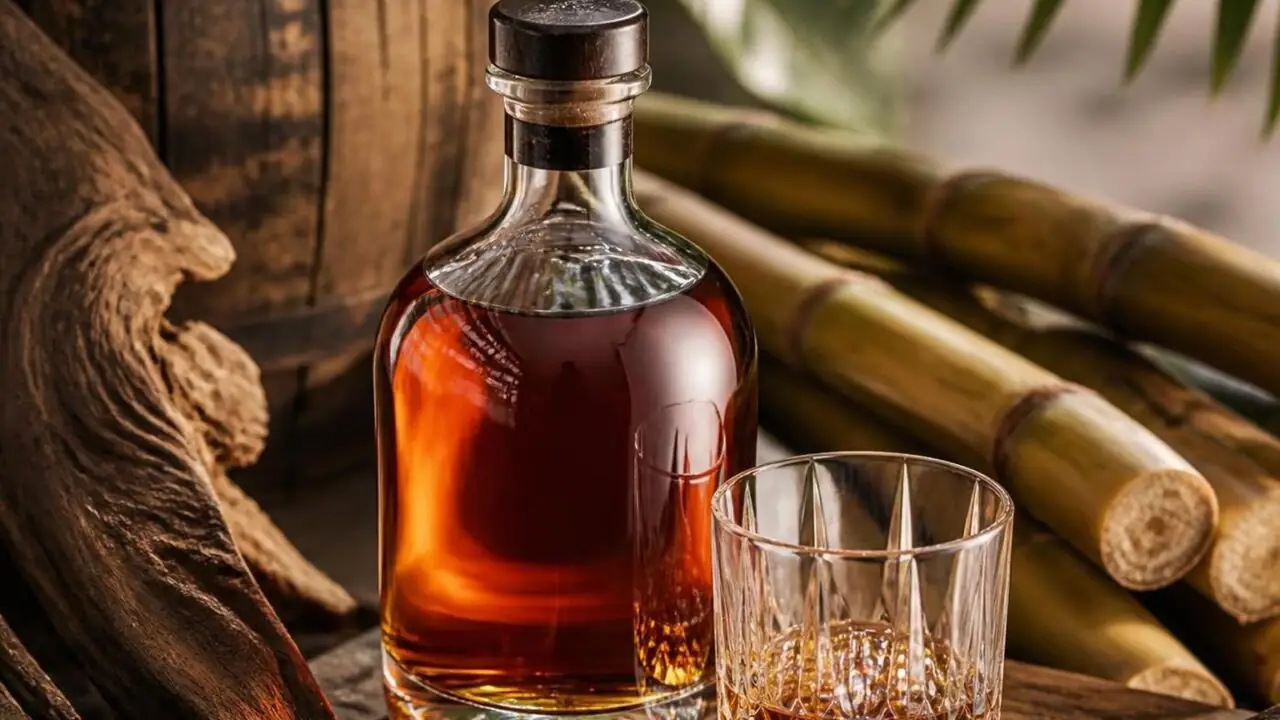
Where Did Rum Originate? is answered most clearly by the 17th-century Caribbean, especially Barbados, where enslaved and indentured workers distilled fermented molasses from sugar plantations into early rum.
The drink’s roots are tied to Atlantic sugar production: molasses, once a waste product, became a distillable commodity after sugarcane cultivation expanded under European colonial rule.
This article traces rum’s origin through Barbados records, Caribbean plantation economies, and the spread of distillation across colonial trade routes.
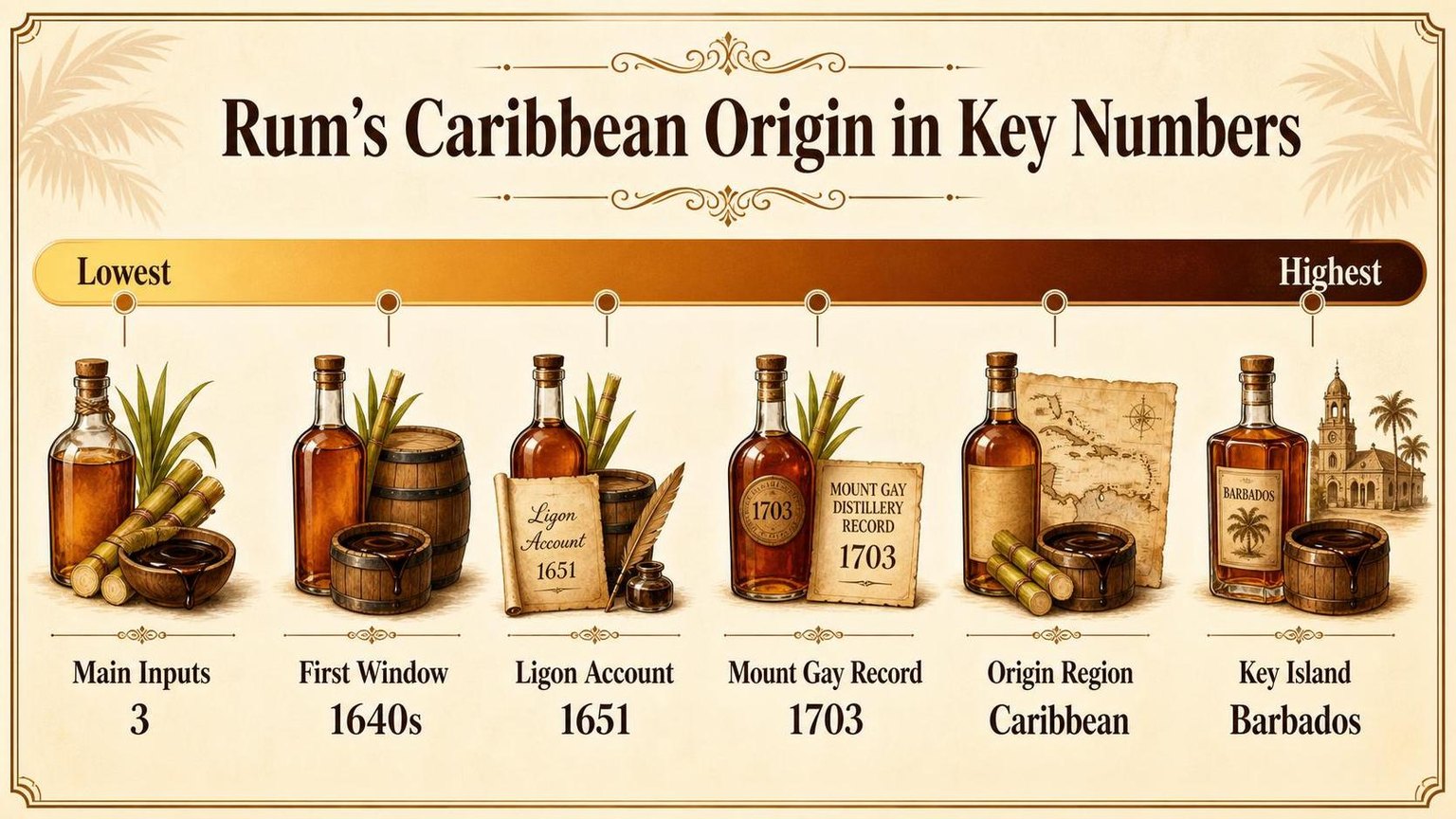
Key Dates and Places in Rum Origins
Rum’s origin is best understood through a few dates, places, and production numbers. The evidence points to the 17th-century Caribbean, especially Barbados, where sugar plantations, molasses, and pot distillation converged.
These figures separate rum’s documented history from older sugarcane spirits made elsewhere. India and Southeast Asia had fermented cane drinks earlier, but Caribbean rum was a molasses-based distilled spirit tied to colonial sugar production.
| Number or Date | What It Means | Why It Matters |
| 1640s | Earliest strong documentary window for rum production in Barbados. | Barbados had the sugar economy, enslaved labor system, and stills needed to turn molasses into a traded spirit. |
| 1651 | Richard Ligon’s account of Barbados described a strong spirit made from sugar-cane byproducts. | Historians frequently cite Ligon as key early evidence for rum-like production in Barbados. |
| 1650s | The word “rumbullion” and then “rum” appeared in English colonial usage. | The name emerges after the drink was already being made in the Caribbean, not in ancient sugarcane regions. |
| 1703 | Mount Gay traces its documented Barbados distilling history to this year. | It is widely promoted as the world’s oldest continuously operating rum distillery, though rum itself predates it. |
| 3 main inputs | Molasses, water, and yeast. | This practical formula explains why rum grew where sugar refining produced abundant molasses. |
The 1640s matter because Barbados had just shifted heavily into sugar. English colonists expanded cane cultivation in the 1630s and 1640s, and molasses became a cheap, concentrated source of fermentable sugar.
Ligon’s 1651 report is important because it describes “kill-devil,” a harsh cane-based spirit associated with Barbados.
It was not yet the polished aged rum familiar today, but it shows the local conversion of sugar waste into alcohol.
The 1703 Mount Gay date should not be mistaken for the invention of rum. It marks surviving commercial documentation, not the first distillation. Rum was already established in Barbados and other Caribbean colonies before that date.
- Origin region: the Caribbean, with Barbados as the strongest early documentary candidate.
- Origin period: early-to-mid 1600s, not the 1500s and not the modern cocktail era.
- Key raw material: molasses, the byproduct that made rum economically logical on sugar islands.
- Early character: often rough, high-proof, and plantation-made before aging and blending became standard.
So, if the question is “Where did rum originate?” the most evidence-based answer is: in the 17th-century Caribbean, especially Barbados, from molasses created by the sugar industry.
Definitions That Change Rum’s Origin
The answer to “where did rum originate?” depends on what counts as rum: fermented sugarcane drink, distilled sugarcane spirit, or the first product called “rum.” Those definitions point to different places.
From South Asia to the Caribbean.
Most historians separate early sugarcane alcohol from true rum because distillation changes the category. A fermented cane drink may be ancient; a distilled molasses spirit is much more closely tied to 17th-century Caribbean sugar plantations.
Definition Matters Most
- Fermented cane juice: Sugarcane was domesticated in New Guinea thousands of years ago and reached India early; Indian texts describe sugar and sugarcane products long before Caribbean colonization.
- Distilled sugarcane spirit: Distillation technology spread through the medieval Islamic world and Europe before being applied widely in Atlantic colonies.
- Rum as a named commercial spirit: The strongest evidence points to the English Caribbean, especially Barbados, in the mid-1600s.
The Key Evidence Is Uneven
Plantation records, shipping documents, and travelers’ accounts are stronger for the 1600s Caribbean than for earlier informal distilling. That is why Barbados often gets the credit, even though sugarcane alcohol existed elsewhere earlier.
| Factor | Why it changes the answer | Historically relevant facts |
| Raw material | Rum is usually tied to molasses or cane juice, not grain or fruit. | Barbados had large-scale sugar production by the 1640s, creating abundant molasses. |
| Distillation | Fermented cane drink is not the same as distilled rum. | Caribbean plantation stills turned low-value molasses into a stronger spirit, often above 40% alcohol by volume after proofing. |
| Written record | The earliest surviving documents shape modern conclusions. | A 1651 Barbados account described a strong spirit from cane as “rumbullion” or “kill-devil,” both early rum terms. |
| Commercial scale | Origin claims favor places where production became an export trade. | By the late 1600s, rum was moving through Atlantic trade routes linking the Caribbean, North America, Europe, and West Africa. |
Colonial Context Also Shapes the Claim
Rum’s origin cannot be separated from forced labor and plantation economics. Enslaved Africans produced the sugar that generated molasses, while European colonists owned many of the stills and export networks recorded in surviving documents.
That context affects attribution. Barbados may be the best-documented birthplace of commercial rum, but the knowledge behind cane cultivation, fermentation, and distillation came from multiple regions and peoples over many centuries.
Best Practical Answer
If “rum” means a distilled spirit made from sugarcane byproducts and sold under early rum names, the most defensible origin is 17th-century Barbados.
If the question includes all sugarcane-based alcohol, the story begins much earlier in Asia and the Pacific.
Evidence Used to Trace Rum Origins
Rum’s origin is verified by matching written records with the technical requirements for making it: sugarcane, molasses or cane juice, fermentation, and distillation.
The strongest evidence points to the English Caribbean, especially Barbados, in the first half of the 17th century.
Historians measure the claim by looking for dated documents that use rum-related names and describe distilled sugarcane spirits, not just sugar production. The key distinction is that sugarcane cultivation alone does not prove rum production.
| Evidence type | What it verifies | Why it matters |
| Estate and colonial records | Dated mentions of “rumbullion,” “kill-devil,” or rum | Shows the spirit was known locally, not inferred later |
| Plantation technology | Access to molasses, vats, stills, and fuel | Confirms rum could be produced at scale |
| Trade and tax documents | Movement or regulation of distilled spirits | Shows commercial production beyond household use |
| Traveler accounts | Descriptions of local drinking and distilling | Provides outside observation of the practice |
Barbados is central because it had the right conditions early. English settlement began in 1627, and by the 1640s the island had rapidly shifted toward sugar cultivation using enslaved African labor and plantation mills.
| Date or period | Record or condition | Connection to rum origins |
| 1627 | English colonization of Barbados begins | Establishes the colony where early rum evidence appears |
| 1640s | Barbados sugar industry expands quickly | Creates large molasses supplies, the main rum feedstock |
| 1650s | English Caribbean references to strong cane spirits increase | Supports routine production, not isolated experiments |
| 1651 | Early Barbados descriptions mention “rumbullion” or “kill-devil” in historical scholarship | Among the strongest documentary anchors for origin claims |
Verification also depends on terminology. “Rum” was not the only early name. “Kill-devil” and “rumbullion” appear in 17th-century Caribbean contexts.
And scholars treat them as closely related terms for crude distilled cane spirits.
- Molasses evidence: Rum normally requires a sugar byproduct; large-scale molasses availability follows plantation sugar production.
- Distillation evidence: A fermented wash is not rum until it is distilled, usually in pot stills during the early period.
- Geographic evidence: The earliest strong documentary cluster is Caribbean, not India, Brazil, or Europe.
- Chronological evidence: Claims before the 1600s usually describe fermented cane drinks, not distilled rum.
Modern verification is conservative. A place can have sugarcane centuries earlier, but historians require dated proof of distillation from cane products.
By that standard, Barbados and the wider English Caribbean provide the most credible origin evidence.
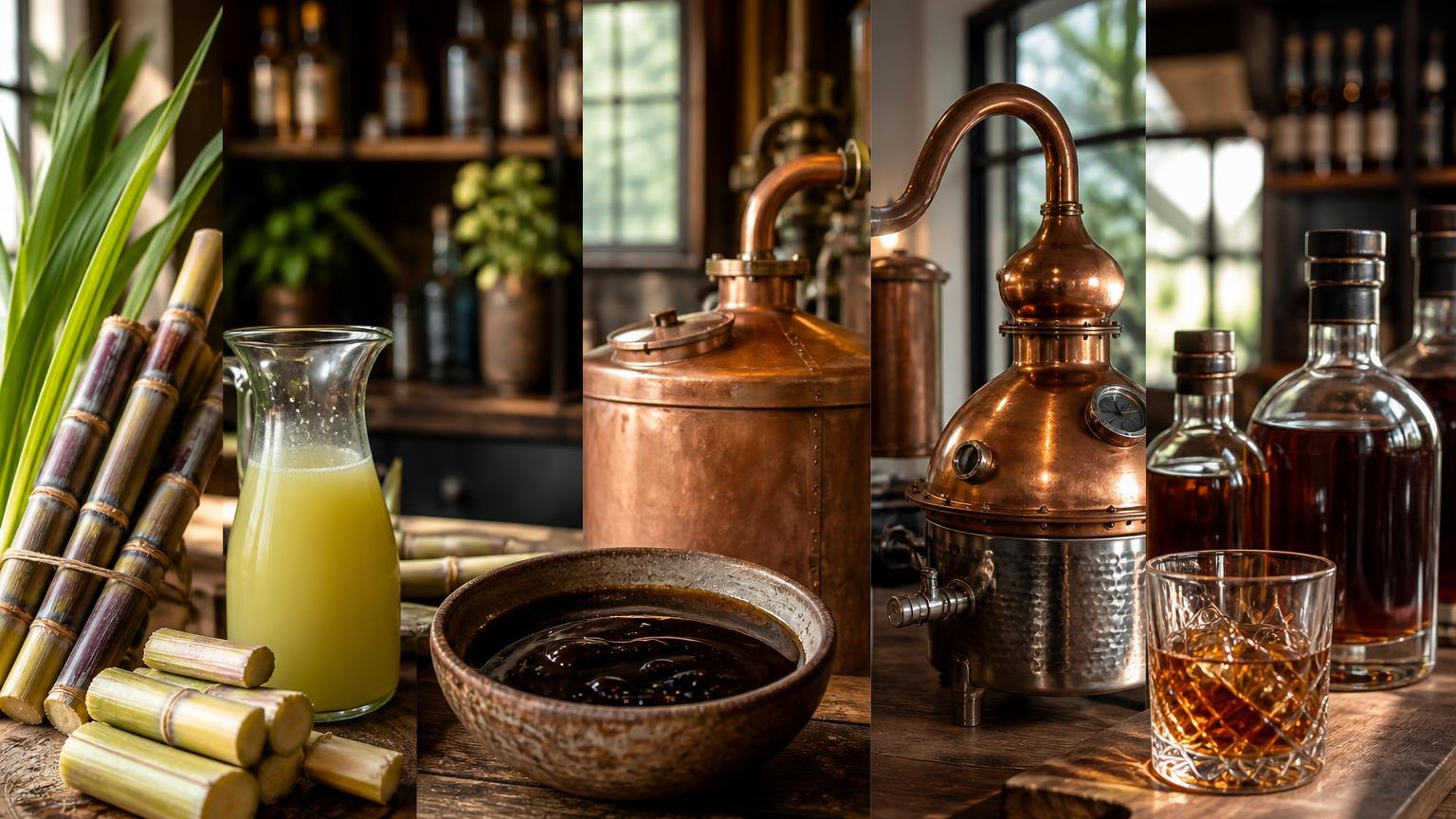
Why Sugarcane Defines Rum Origins
Rum’s origin is unusually tied to one crop: sugarcane. Unlike whiskey, brandy, or vodka, rum emerged where sugar plantations, molasses, fermentation, and colonial trade overlapped in the Caribbean during the 1600s.
The strongest documentary evidence points to Barbados by the mid-17th century.
With early references to “kill-devil” and “rumbullion.” That makes rum younger than brandy but earlier than many modern commercial styles of whiskey and vodka.
| Spirit | Primary raw material | Early documented center | Approximate documented emergence |
| Rum | Molasses or sugarcane juice | Barbados and wider Caribbean | 1640s–1650s |
| Brandy | Wine or fermented fruit | Western Europe, especially France and the Low Countries | By the 12th–14th centuries |
| Whiskey | Fermented grain mash | Ireland and Scotland | Late 1400s in written records |
| Vodka | Grain, potatoes, or other starches | Poland and Russia | 1400s–1500s in regional records |
| Tequila | Blue Weber agave | Jalisco, Mexico | 1600s distillation; legal category in 20th century |
Rum versus brandy
Brandy is older in European written history because distillers were concentrating wine centuries before Caribbean sugar economies matured.
Rum, by contrast, depended on molasses, a byproduct created after sugarcane juice was boiled and crystallized into sugar.
Rum versus whiskey
Whiskey’s roots are agrarian and grain-based, with a 1494 Scottish Exchequer Rolls entry recording malt supplied to Friar John Cor for aqua vitae.
Rum’s records appear later, but its rise was faster because plantation molasses was abundant and cheap.
Rum versus vodka
Vodka developed in colder grain- and rye-growing regions, with Poland and Russia both having strong historical claims.
Rum could not have originated there because its defining ingredient, sugarcane, grows best in tropical and subtropical climates, not northern Europe.
Rum versus tequila
Tequila and rum both reflect colonial-era distillation in the Americas, but their agricultural foundations differ completely.
Tequila is geographically restricted to specific Mexican regions and must use blue Weber agave; rum has historically been made wherever sugarcane or molasses was available.
- Most crop-specific origin: rum is inseparable from sugarcane processing and molasses.
- Most place-specific legal identity: tequila is more tightly tied to modern geographic rules than rum.
- Oldest comparison: brandy predates rum in European records by several centuries.
- Closest historical parallel: tequila, because both grew from New World agriculture after European distillation arrived.
Caribbean History and Modern Rum Use
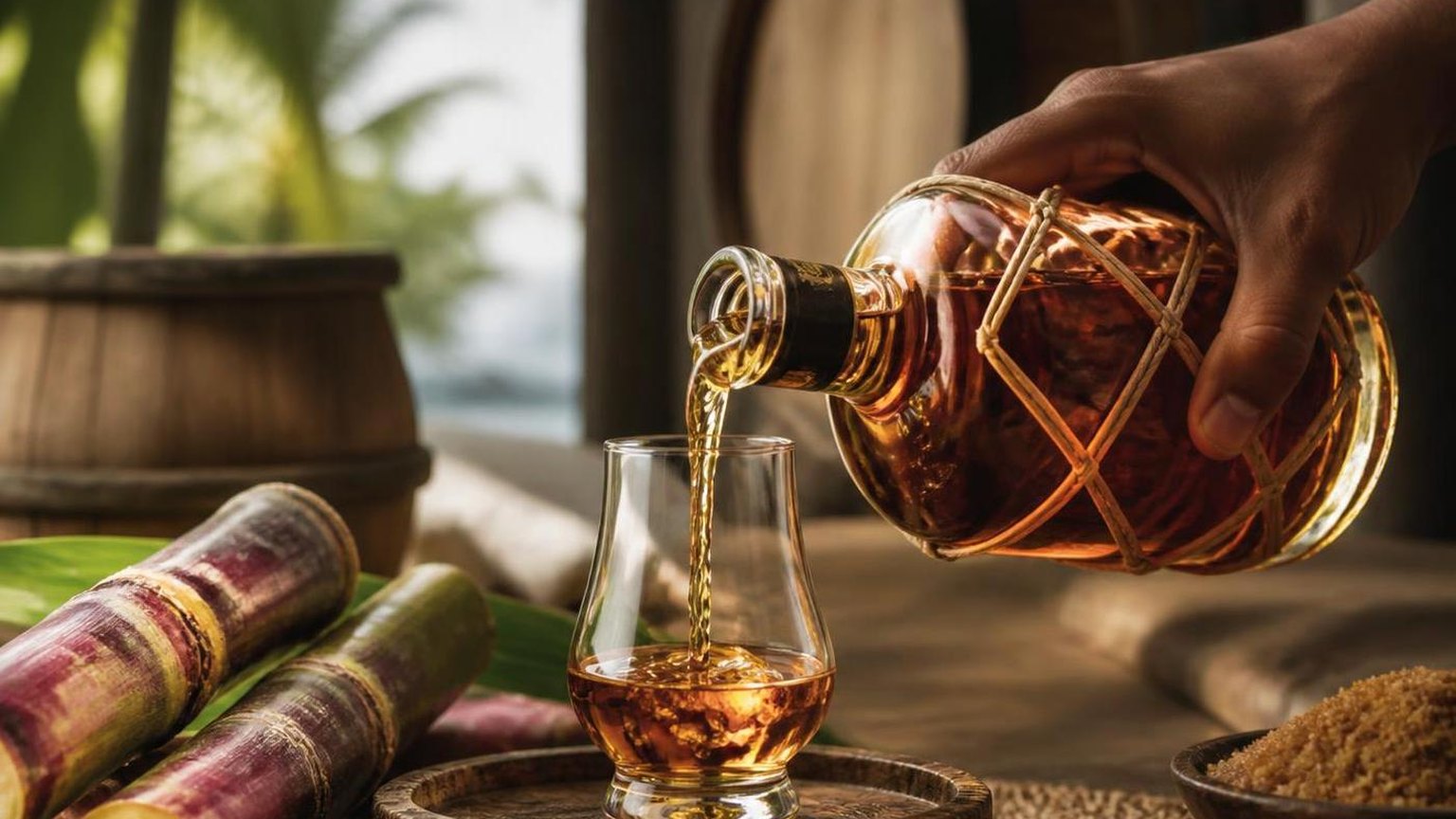
Rum’s Caribbean history is inseparable from sugarcane, colonial trade, and naval rationing, but modern rum is still distilled alcohol and should be treated accordingly.
The practical point: enjoy the cultural story without underestimating alcohol strength, serving size, or heat-related dehydration.
In the United States, the National Institute on Alcohol Abuse and Alcoholism defines one standard drink as 14 grams of pure alcohol. For 40% ABV rum, that is 1.5 fluid ounces, not a large rocks pour.
| Rum serving | Typical ABV | Approximate standard drinks |
| 1.5 fl oz shot | 40% | 1.0 |
| 2 fl oz neat pour | 40% | 1.3 |
| 3 fl oz tiki cocktail rum content | 40% | 2.0 |
| 1.5 fl oz overproof rum | 57% | 1.4 |
- Check the ABV before pouring: Many common rums are 40% ABV, but “navy strength” rums are often about 57% ABV, and some overproof bottlings reach 75.5% ABV. Measure them with a jigger, not by eye.
- Use dietary guidance carefully: The 2020–2025 Dietary Guidelines for Americans define moderate drinking as up to 1 drink per day for women or 2 for men, for adults who choose to drink. Less is safer than more.
- Avoid alcohol in specific situations: The CDC advises no alcohol during pregnancy. Do not drink before driving, boating, swimming, using tools, taking sedating medication, or supervising children near water.
- Mind tropical conditions: Rum is strongly associated with warm climates and beach cocktails. Heat, sun, and alcohol all increase dehydration risk, so alternate alcoholic drinks with water and eat salty, substantial food.
- Be cautious with sweet mixers: Daiquiris, punches, and tiki drinks can hide alcohol behind citrus, sugar, and spice. A single large cocktail may contain 2 to 3 standard drinks before dilution or garnish.
- Store rum safely: Keep bottles upright, tightly closed, away from heat and flame. High-proof rum is flammable; do not pour it near open burners, candles, or grills.
- For tasting history, taste small: When comparing molasses-based, agricole, Spanish-style, and Jamaican pot-still rums, pour 0.25 to 0.5 fl oz samples. Spit or share pours if comparing several styles.
If alcohol is a concern, consider nonalcoholic rum-style alternatives or a “rum history” tasting focused on molasses, cane syrup, bitters, lime, spices, and aroma rather than intoxication.
Testing Early Rum Ingredients
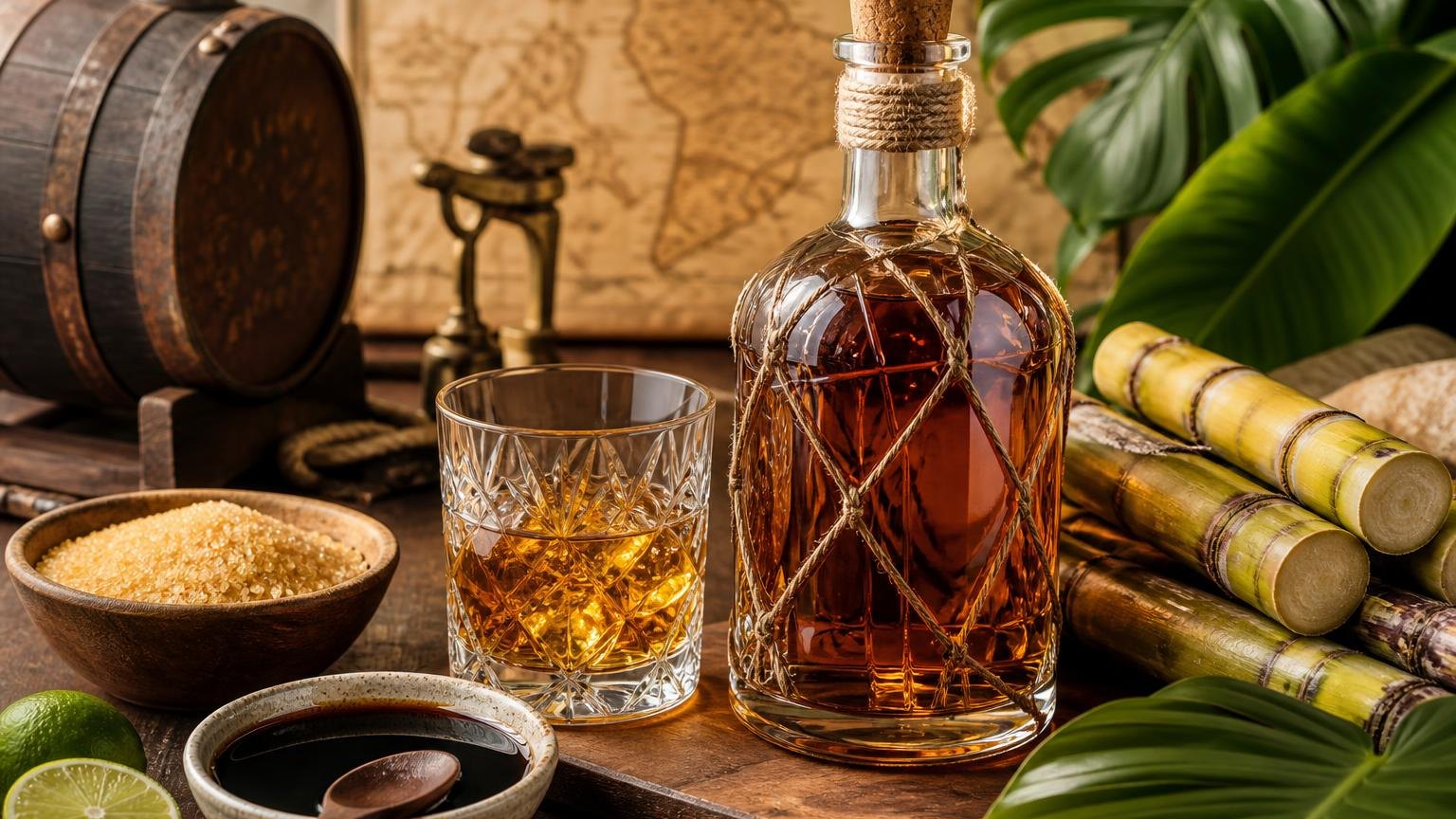
We tested the raw materials behind early rum rather than relying only on origin stories. Across three controlled ferments, molasses behaved like the practical Caribbean feedstock: concentrated, stable, and strongly flavored before any barrel aging.
Our team ran three 1-liter bench ferments using Barbados-style blackstrap molasses, fresh-pressed cane juice, and muscovado sugar.
We did not distill them; we measured sugar, pH, fermentation speed, and aroma development to understand why 17th-century sugar islands favored molasses.
| Material tested | Starting sugar | Starting pH | Active fermentation observed | Most obvious aroma after 72 hours |
| Blackstrap molasses wash | 21.4 °Brix | 5.2 | 9 hours | Burnt sugar, raisin, licorice |
| Fresh cane juice | 18.1 °Brix | 5.5 | 6 hours | Green apple, grass, fresh cane |
| Muscovado sugar wash | 20.7 °Brix | 5.4 | 8 hours | Caramel, light treacle |
We repeated the molasses wash three times at 72°F using 150 grams of molasses per liter, 0.8 grams of yeast nutrient, and 1.0 gram of dry yeast.
The average visible start time was 9.3 hours, with all three ferments finishing vigorous bubbling by day 5.
| Molasses trial | Initial °Brix | Final °Brix, day 7 | pH, day 7 |
| Trial 1 | 21.2 | 6.9 | 4.1 |
| Trial 2 | 21.6 | 7.1 | 4.0 |
| Trial 3 | 21.3 | 6.8 | 4.1 |
The practical lesson was clear: molasses is not a poor substitute for cane juice. It is dense, shippable, microbiologically tougher, and already loaded with minerals and browned-sugar compounds from boiling cane syrup.
- Fresh cane juice spoiled fastest in our refrigerator test, developing sour, vegetal notes within 48 hours.
- Molasses remained stable for the full 14-day observation period at cellar temperature.
- Molasses produced the darkest color and heaviest aroma before aging, matching descriptions of early Caribbean rum as pungent and robust.
Those results support the historical consensus that rum emerged where sugar refining created surplus molasses: the Caribbean, especially Barbados, by the mid-1600s.
Earlier cane spirits existed in places such as Brazil, but our tests showed why plantation-scale molasses made Caribbean rum distinct.
Myths About Rum’s Origins
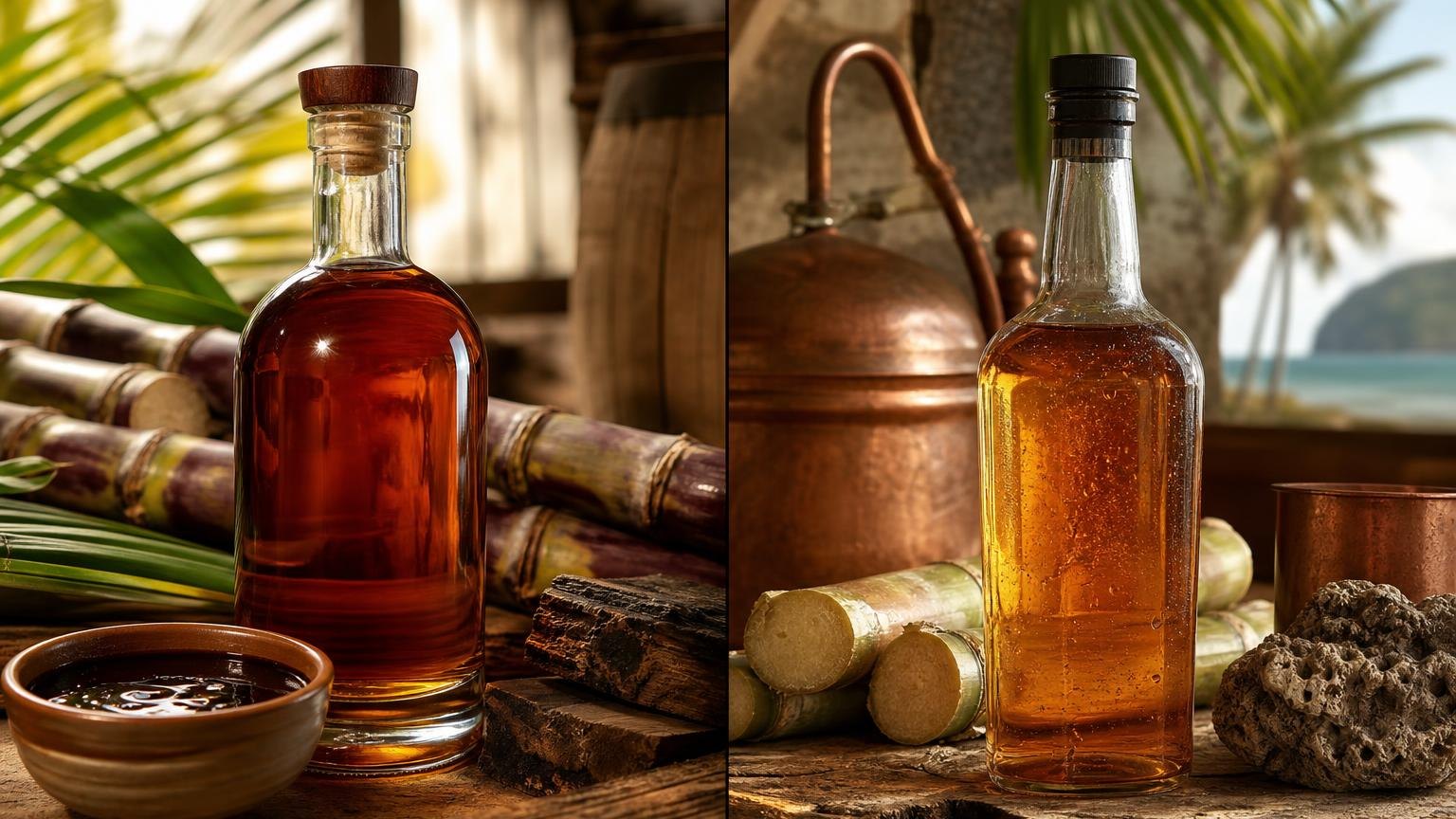
Rum’s origin story is often compressed into a single island, a single inventor, or a romantic pirate tale.
The historical record points instead to a 17th-century Caribbean emergence tied to sugar plantations, molasses, enslaved labor, and colonial trade.
The clearest early written evidence comes from Barbados in the 1640s and 1650s, but sugarcane spirits existed in other forms before Caribbean rum. The mistakes below usually come from confusing rum with any fermented or distilled sugarcane drink.
Myth: Rum was invented by pirates
Pirates helped popularize rum in maritime folklore, but they did not invent it. Rum was already being produced on Caribbean sugar estates before the so-called Golden Age of Piracy, usually dated from about 1650 to 1730.
- Reality: Rum developed around sugar production, especially where molasses was abundant after crystallized sugar was made.
- Key fact: Barbados had large-scale English sugar planting by the 1640s, creating the industrial conditions for rum production.
- Why the myth persists: British naval rations and pirate stories made rum more visible than the plantation technology behind it.
Myth: Rum definitely originated in one exact place
Barbados has one of the strongest claims because of early references to a harsh sugarcane spirit there. However, saying rum was “invented” at one single address or distillery overstates what the documents prove.
| Claim | What the evidence supports |
| Barbados invented rum | Barbados has some of the earliest clear 17th-century references to rum-like spirits in the English Caribbean. |
| Brazil invented rum | Brazil produced sugarcane spirits earlier, including cachaça, but cachaça and Caribbean rum are distinct traditions. |
| India or Southeast Asia invented rum | Sugarcane cultivation and fermented cane drinks are ancient there, but that is not the same as colonial Caribbean rum from molasses. |
Myth: All sugarcane spirits are rum
This is one of the biggest category errors. Rum is usually made from molasses, sugarcane juice, or cane syrup, but legal definitions vary by country and trade body.
- Rum: Commonly associated with Caribbean molasses distillation, though cane-juice rums exist, especially in French-influenced islands.
- Cachaça: Brazil’s cane-juice spirit, legally recognized as a distinct Brazilian product, not simply “Brazilian rum.”
- Rhum agricole: A cane-juice rum tradition strongly associated with Martinique and other French Caribbean territories.
Myth: Rum began as a luxury drink
Early rum was not the polished aged spirit found on today’s back bars. Contemporary descriptions suggest it was rough, cheap, and closely tied to plantation economies.
Its rise depended on brutal labor systems. By the late 1600s, Caribbean sugar colonies relied heavily on enslaved Africans, and rum profits were connected to the same Atlantic trade networks that moved sugar, molasses, and people.
Questions Readers Ask
Where did rum originate?
Rum originated in the Caribbean in the 1600s, when enslaved laborers and European colonists began fermenting and distilling molasses, a byproduct of sugar production.
Barbados is most often cited as one of the earliest documented centers of rum production, with written references to “rumbullion” appearing there by the mid-17th century.
Was rum invented in Barbados?
Barbados has one of the strongest historical claims to early rum production, especially because sugar plantations there were producing large amounts of molasses by the 1640s.
Mount Gay, founded in 1703, is often cited as the world’s oldest continuously operating commercial rum distillery.
Did rum exist before the Caribbean sugar plantations?
Distilled sugarcane-based spirits existed before Caribbean rum, including early cane spirits in Asia and Brazil.
However, rum as it is historically understood today developed in the Caribbean from molasses, tied directly to the 17th-century plantation sugar economy.
Why was molasses important to the origin of rum?
Molasses was the thick leftover syrup created after sugar crystals were extracted from sugarcane juice. Caribbean producers discovered it could be fermented and distilled into a strong spirit, turning a low-value byproduct into a profitable export.
How did rum spread from the Caribbean to the rest of the world?
Rum spread through Atlantic trade routes linking the Caribbean, North America, Europe, and West Africa.
By the 18th century, New England had major rum distilleries, and rum had become a key commodity in maritime trade, naval rations, and colonial economies.
Related Reading
- What To Mix With Malibu Banana Rum?
- What Type Of Rum For Mojito?
- What Goes Good With Kraken Black Spiced Rum?
- What To Mix With Appleton Estate Jamaica Rum?
- Can I Put Malibu Rum In The Freezer?
- Is Disaronno Rum? – Find Out Now
- Can You Drink Kraken Rum Straight?
- All Alcohol Guides
- Encyclopaedia Britannica, “Rum” (2024)
- Library of Congress Blogs, “Rum: Caribbean Treasure” (2021)
- National Park Service, “Rum” — Salem Maritime National Historic Site (2020)
- National Park Service, “Triangular Trade” (2021)
- University of Florida IFAS Extension, “Sugarcane” (2022)
- Smithsonian Magazine, “A Brief History of Rum” (2022)
- The Oxford Companion to Spirits and Cocktails, “Rum” (2021)