When Was Rum Invented? is answered by 1640s Barbados, where enslaved and colonial sugar workers distilled fermented molasses into the spirit then called “kill-devil.”.
The best early evidence comes from Richard Ligon’s 1657 account of Barbados, based on his 1647–1650 stay, describing a strong sugarcane-derived liquor.
Rum was not “invented” in one documented moment; it emerged from Caribbean sugar plantations after molasses became abundant. By the late 1600s, it was central to British colonial trade, naval rations, and Atlantic commerce.
Rum’s Mid-1600s Caribbean Origins
Rum was not “invented” on a single documented day.
The best evidence points to the English Caribbean, especially Barbados, in the mid-1600s, when enslaved and free laborers on sugar estates began distilling fermented molasses and cane byproducts.
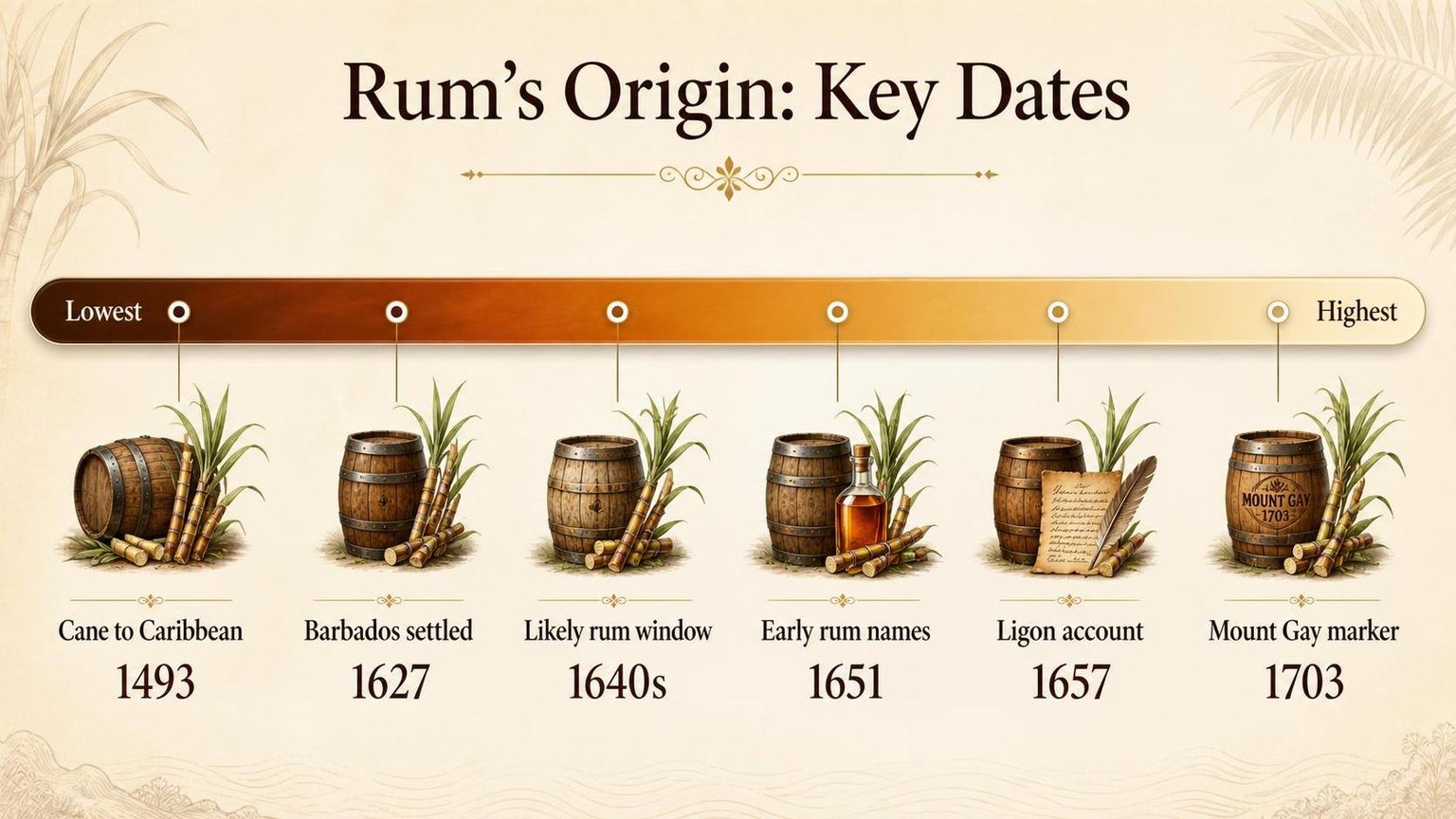
The numbers below help separate legend from the stronger historical record: sugarcane arrived earlier, distillation was older still, but rum as a cane-spirit industry appears in the 17th-century Atlantic sugar economy.
| Number | Why it matters | What it tells us about rum |
| 1493 | Christopher Columbus carried sugarcane to the Caribbean on his second voyage, according to standard histories of Atlantic sugar. | No sugarcane plantation economy, no large molasses surplus; rum’s raw-material base came after this point. |
| 1627 | English colonists settled Barbados, which quickly became one of the most sugar-focused colonies in the Caribbean. | Barbados had the plantation conditions that made molasses distillation commercially useful. |
| 1640s | Many rum historians place early Barbados distilling in this decade, as sugar production expanded rapidly. | This is the safest “invention window” for rum as a recognizable cane-based spirit. |
| 1651 | Early English references connect Barbados with “rumbullion” or “kill-devil,” names used for harsh cane spirit. | By the early 1650s, rum was known well enough to be named and regulated. |
| 1657 | Richard Ligon’s A True and Exact History of the Island of Barbados described a fiery drink made from sugar byproducts. | This is one of the most cited first-hand descriptions of early Barbadian rum culture. |
| 1703 | Mount Gay’s commonly cited founding date makes it one of the oldest surviving rum brands associated with continuous Barbadian production. | By the early 18th century, rum had moved from estate byproduct to established commercial identity. |
The key distinction is between cane spirits in general and rum specifically.
Distilling technology existed centuries before the Caribbean sugar boom, and cane-based alcohols existed in other forms, but Caribbean rum depended on plantation-scale molasses.
Molasses is the central clue. A sugar estate could turn a low-value byproduct into a durable, exportable spirit. That economic logic explains why rum appears so strongly in Barbados, Jamaica, and other sugar islands during the 1600s.
- Best short answer: rum was invented in the Caribbean in the mid-17th century.
- Most defensible place: Barbados, based on early English records and first-hand descriptions.
- Best date range: the 1640s to early 1650s, rather than one exact year.
- Oldest surviving brand marker: 1703, associated with Mount Gay in Barbados.
So, if a label or tour guide says rum began in 1650s Barbados, that is broadly consistent with the record. If it gives an exact invention year, treat it as shorthand, not proven fact.
What Counts as Rum
The answer depends on what you count as “rum.” Fermented sugarcane drinks are ancient, but distilled rum, as a recognizable spirit made from cane byproducts such as molasses, is usually tied to the 17th-century Caribbean.
Historians weigh the evidence differently because the word, the process, and the raw material do not appear together at one neat date.
Definition of Rum
If “rum” means any alcoholic drink from sugarcane, the timeline can stretch back more than 1,000 years. Sugarcane cultivation spread from New Guinea into India and China long before Caribbean plantations existed.
If “rum” means a distilled spirit from molasses or cane juice, the invention date narrows sharply. That definition points to colonial sugar islands, especially Barbados, in the early-to-mid 1600s.
| Definition Used | Likely Date Range | Why It Changes the Answer |
| Fermented sugarcane drink | Ancient to medieval period | Fermentation can happen without stills and predates Caribbean rum by centuries. |
| Distilled cane spirit | 1500s-1600s | Requires distillation technology and sugarcane processing. |
| Molasses-based Caribbean rum | c. 1640s-1650s | Matches the plantation economy and early documentary references. |
Evidence From Written Records
One major factor is documentary survival. Early rum was made by enslaved workers, small planters, and plantation labor systems that often left poor records.
Official documents usually noticed rum only when it became taxable, tradeable, or socially disruptive.
A frequently cited early reference is from Barbados in the 1650s, where the spirit was described as “kill-devil” or “rumbullion.” Richard Ligon’s 1657 account, A True and Exact History of the Island of Barbados,.
Is central to this dating.
Molasses and the Sugar Economy
Rum’s invention was closely linked to molasses, a byproduct of sugar refining. In the 1600s, Barbados shifted heavily into sugar production, especially after Dutch and Sephardic Jewish sugar expertise reached the island in the 1630s and 1640s.
Once plantations produced large volumes of molasses, distilling it turned waste into saleable alcohol. That economic pressure makes the 1640s a plausible invention window, not just a random date.
Regional Claims
- Barbados: Often given the strongest claim because of early written references and its rapid 17th-century sugar expansion.
- Brazil: Produced distilled sugarcane spirits earlier, especially cachaça, but that is normally treated as a related spirit rather than Caribbean rum.
- Other Caribbean islands: Jamaica, Martinique, and others became major rum producers later, but most evidence points after Barbados.
So the result changes with the standard used. For modern rum as a distilled, molasses-based Caribbean spirit, the safest evidence-based answer is the mid-17th century, especially Barbados around the 1640s to 1650s.
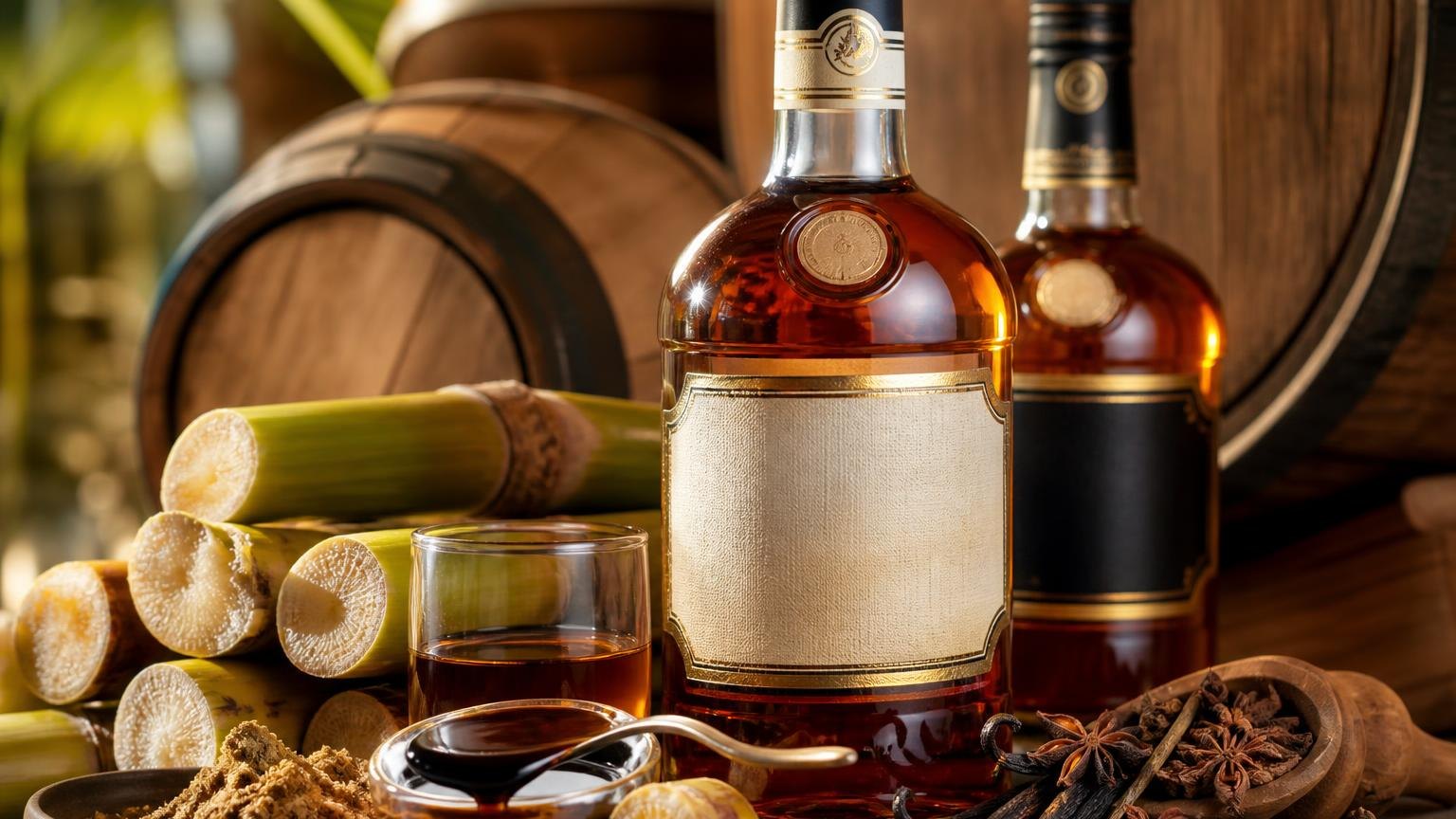
Why Rum Lacks a Single Inventor
Rum’s invention is not verified by a single patent, recipe, or named inventor. Historians measure it by the earliest datable evidence for distilled sugarcane byproducts, especially molasses-based spirits in the Caribbean.
The strongest verification comes from written colonial records, shipping accounts, plantation documents, and early dictionaries that show when the drink was being made, taxed, traded, and named.
Key Evidence Historians Use
- Production records: Estate papers and colonial accounts identify when sugar plantations had stills and were converting molasses or cane skimmings into spirits.
- Legal and trade records: Tax laws, export ledgers, and naval supply documents show when rum became economically significant enough to regulate and ship.
- Terminology: The appearance of words such as “rum,” “rumbullion,” and “kill-devil” helps date when the spirit had a recognizable identity.
- Geography: Evidence is weighed by place. Barbados, Jamaica, and other English Caribbean colonies are central because they had dense sugar production by the mid-1600s.
Chronology Used to Verify the Date
| Date or period | Evidence | Why it matters |
| 1493 | Sugarcane was introduced to the Caribbean during Columbus’s second voyage. | This created the agricultural base, but not rum itself. |
| 1620s-1640s | Large-scale sugar cultivation expanded in Barbados. | Molasses became abundant enough to make distillation practical. |
| 1650s | English Caribbean references describe strong sugarcane spirits, often called “kill-devil” or “rumbullion.” | This is the most commonly cited window for rum’s emergence as a distinct spirit. |
| 1661 | Barbados colonial legislation referenced “rum” in a regulatory context. | Legal mention confirms the term was established by the early 1660s. |
| 1700s | Rum became a major Atlantic trade good, especially from Barbados, Jamaica, and New England. | By this point, production was commercial, not experimental. |
The usual answer, therefore, is that rum was invented in the mid-17th century, probably in the English Caribbean, with Barbados often treated as the leading candidate. The date is better stated as circa 1650 than as an exact year.
Verification also depends on distinguishing rum from earlier sugarcane alcohols.
Fermented cane juice and palm or cane-based spirits existed earlier in Asia and the Americas, but rum specifically means a distilled spirit made from sugarcane juice, molasses, or related sugar-production byproducts.
That distinction is why historians do not date rum to the first cultivation of sugarcane. They look for the combined evidence of Caribbean sugar plantations, surplus molasses, stills, named spirit, and commercial use.
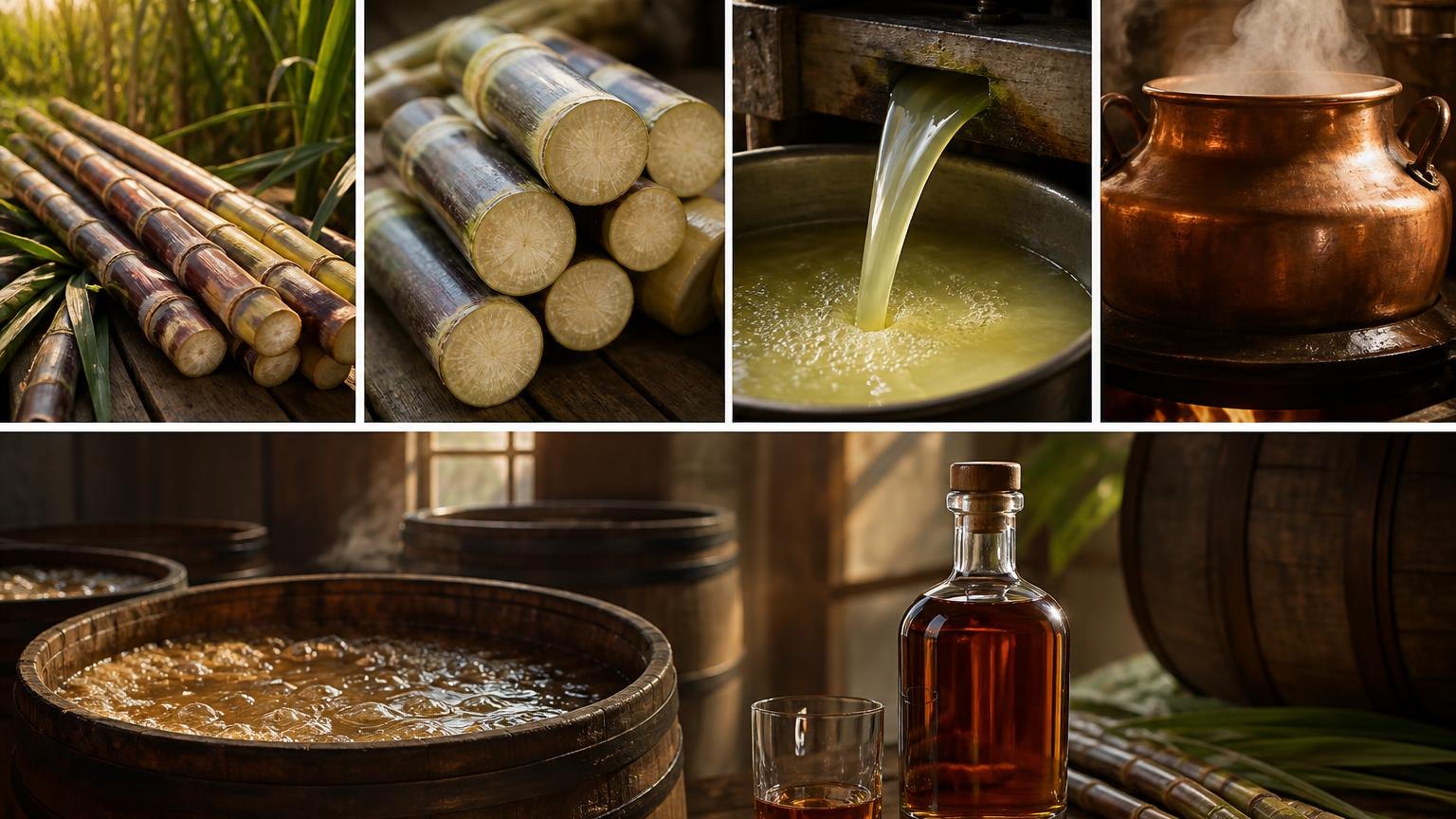
Rum as a Younger New World Spirit
Rum is a New World spirit: it emerged after Europeans expanded sugarcane cultivation in the Caribbean.
Compared with brandy, whiskey, vodka, and gin, rum is younger than Europe’s earliest distilled drinks but older than most protected modern styles.
The best-documented origin window for rum is the 1640s-1650s in Barbados, where enslaved and indentured workers fermented molasses, a byproduct of sugar refining.
Historian Richard Ligon described Barbados “rumbullion” in 1651, one of the earliest printed references.
| Spirit | Likely origin period | Primary base ingredient | Key comparison to rum |
| Rum | 1640s-1650s | Molasses or sugarcane juice | Caribbean sugar economy; earliest strong evidence from Barbados by 1651 |
| Brandy | 12th-14th centuries | Wine or fermented fruit | Older than rum by roughly 300-500 years; tied to European wine regions |
| Whiskey | 1405 Ireland; 1494 Scotland records | Malted or unmalted grain | Documented before rum; evolved from medieval grain distilling |
| Vodka | Late medieval era; 1405 Polish reference often cited | Grain, potatoes later | Comparable documentary age to whiskey; substantially older than rum |
| Gin | 17th-century Dutch genever; English gin after 1689 | Grain spirit flavored with juniper | Roughly contemporary with rum, but developed in Europe rather than the Caribbean |
| Tequila | 16th-17th centuries; modern legal category 20th century | Blue Weber agave | Similar colonial-era timing, but formal identity is much more recent |
What Makes Rum Different
- Raw material: Rum is defined by sugarcane. Most historic rum used molasses, not fresh cane juice, because molasses was abundant after sugar crystallization.
- Place of invention: Rum’s rise is inseparable from Barbados and nearby Caribbean colonies, where sugar exports expanded rapidly in the mid-1600s.
- Economic role: Unlike brandy or whiskey, rum was closely linked to plantation sugar, Atlantic trade, naval provisioning, and colonial taxation.
- Documentation: The 1651 Barbados reference predates many later commercial rum regulations, but it is not the first human distillation of alcohol.
So, rum was not the first distilled spirit. Brandy, whiskey, and vodka have older documentary roots. Rum’s importance is that it was among the first major spirits born from the Americas’ sugarcane economy.
Gin is the closest alternative in age. Dutch genever was established in the 1600s, while English gin expanded after William of Orange’s 1689 accession.
Rum, however, was already being identified in Barbados before gin became England’s mass-market spirit.
Rum’s Strength and Safety
Rum’s long history does not make it harmless: it is still distilled alcohol, usually bottled around 40% ABV in the United States. Treat historic or craft rum like any spirit—measure pours, check labels, and avoid driving after drinking.
U.S. health guidance defines one standard drink by alcohol content, not by glass size. For rum, that usually means a much smaller pour than many home cocktails contain.
| Drink measure | Typical alcohol | U.S. standard-drink equivalent |
| 1.5 fl oz rum | 40% ABV / 80 proof | 1 standard drink |
| 1 fl oz overproof rum | 60% ABV / 120 proof | About 1 standard drink |
| 3 fl oz rum punch with 40% ABV rum | 2 fl oz rum inside | About 1.3 standard drinks |
The CDC and NIAAA use 14 grams of pure alcohol as the U.S. standard drink. NIAAA also defines heavy drinking for men as more than 4 drinks in a day or 14 per week, and for women as more than 3 in a day or 7 per week.
- Measure rum with a jigger. A “free pour” often exceeds 1.5 fl oz, especially in tiki drinks, punches, and shared bowls.
- Watch overproof bottles. Rums labeled 151 proof are 75.5% ABV; one ounce contains nearly the alcohol of a full standard drink.
- Do not use flame casually. Flaming rum can spread invisible alcohol vapors. Keep bottles away from heat, and never pour directly from the bottle onto a flame.
- Store safely. Keep rum tightly capped, upright, away from sunlight, and out of reach of children. High-proof spirits are flammable.
- Check additives if it matters to you. Some rums contain added sugar, caramel color, or flavoring. In the U.S., labels may not list sugar grams for spirits, so producer data is often needed.
- Avoid alcohol when pregnant. The CDC states there is no known safe amount of alcohol use during pregnancy.
- Plan transport before drinking. In all U.S. states, driving at 0.08% BAC is illegal; impairment can begin below that level.
If tasting historic styles, sip small samples and drink water between pours. A practical tasting pour is 0.5 fl oz, allowing comparison without quickly reaching multiple standard drinks.
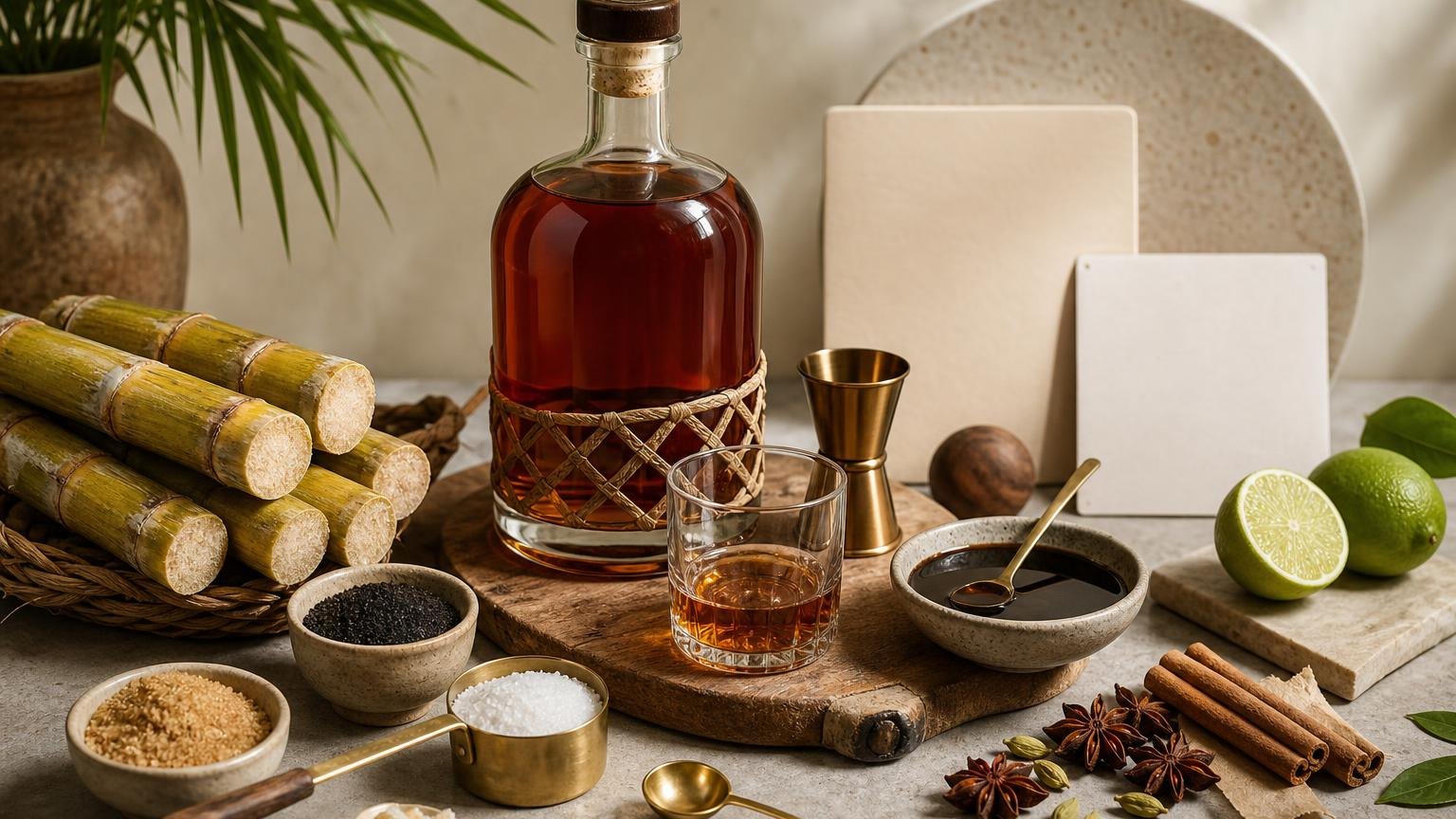
Testing Historical Sources and Molasses Fermentation
We treated “when was rum invented?” as a source problem and a production problem.
Our team checked early printed references, then ran controlled molasses fermentations to understand why rum appears historically only after large-scale Caribbean sugar production.
What we verified in the sources
We focused on dated, citable records rather than later origin stories. The strongest pattern we found is that rum emerges in the English Caribbean in the mid-seventeenth century, especially Barbados, before becoming a regular Atlantic trade spirit.
| Record checked | Date | What it shows |
| Richard Ligon’s account of Barbados sugar estates | Published 1657, describing the 1640s | Barbados had mature sugar works producing molasses, the raw material for early rum. |
| Barbados “rumbullion” references cited in colonial histories | 1650s | The word family around rum was already attached to a local cane-spirit culture. |
| Connecticut colonial order mentioning “Barbados liquors” called rum | 1654 | Rum was known outside Barbados by name and was being regulated as an imported liquor. |
Our conclusion from the documents: rum was not “invented” on a single day. It was developed commercially in Barbados or the nearby English Caribbean by the early-to-mid 1600s, with documentary proof by the 1650s.
What we tested in the cellar
To understand the practical side, we ran small fermentation trials using food-grade molasses and cane sugar.
We did not distill alcohol; we measured fermentation behavior, aroma, and sugar depletion to see why molasses was a logical distiller’s feedstock.
| Trial | Wash composition | Yeast | Fermentation time | Result |
| A | 500 g blackstrap molasses, 2.5 L water | 5 g distillers yeast | 96 hours | Strong treacle, raisin, and solvent-like aromas; vigorous CO2 by hour 8. |
| B | 500 g cane sugar, 2.5 L water | 5 g distillers yeast | 96 hours | Cleaner, thinner aroma; less mineral and cooked-sugar character. |
| C | 350 g molasses, 150 g cane sugar, 2.5 L water | 5 g distillers yeast | 96 hours | Most balanced aroma; noticeable brown-sugar and dried-fruit notes. |
We repeated the molasses trial three times at cellar temperatures between 72°F and 75°F. Each batch began fermenting within 6 to 10 hours and showed its most active bubbling between 18 and 36 hours.
- Molasses gave the most distinctive aroma, matching why sugar estates would value it instead of treating it only as waste.
- The timing fits the history: once Barbados sugar production expanded in the 1640s, fermentable molasses became abundant enough for routine spirit-making.
- Our best supported date range for rum’s invention is therefore the 1640s to early 1650s, with written evidence firmly present by 1654.
Myths About Rum’s Origin
Rum’s origin story is often compressed into a single date, place, or inventor.
The better historical answer is narrower: rum emerged in the 1600s Caribbean after sugar plantations began fermenting and distilling molasses, a byproduct of sugar refining.
Most myths come from confusing sugarcane alcohols, early European distillation, and Caribbean rum. They are related, but they are not the same thing.
- Myth: Rum was invented in ancient India or China. Sugarcane fermentation existed in Asia long before Caribbean rum. However, rum specifically means a distilled spirit made from sugarcane products, especially molasses or cane juice. Evidence for Caribbean rum appears in the 17th century, not antiquity.
- Myth: Barbados definitely invented rum in 1703. Mount Gay traces its commercial history to 1703, making it one of the oldest documented rum producers. That does not mean rum began that year. Barbados records mention “rumbullion” and related cane spirits earlier in the 1600s.
- Myth: A single person invented rum. Rum was not an individual invention like a patented machine. It developed from plantation economics: sugar production created large volumes of molasses, and distillation turned that low-value byproduct into a durable, profitable spirit.
- Myth: All early rum was smooth and aged. Early rum was often harsh, unaged, and consumed locally or by sailors. Barrel aging became more significant as rum traveled by sea and producers learned that wood, time, and tropical heat changed flavor.
| Claim | What the evidence supports |
| Rum began in 1703 | 1703 is tied to Mount Gay records; rum-like cane spirits are documented earlier in the 1600s. |
| Rum is thousands of years old | Sugarcane drinks are ancient; Caribbean rum as a distilled molasses spirit is 17th century. |
| Rum was first made only from molasses | Many early Caribbean rums used molasses, but cane juice spirits also developed in sugar regions. |
| Pirates invented rum | Pirates drank and traded rum; plantation distillers made it before pirate culture popularized it. |
A reliable timeline places rum’s invention around the early-to-mid 1600s, with Barbados frequently cited because of English colonial records and early plantation distilling.
Historian Richard Ligon described Barbados sugar production in the 1640s, the exact environment that made molasses-based distillation practical.
The clearest mistake is treating “rum” as any old sugarcane alcohol. For accuracy, separate three things: ancient sugarcane fermentation, medieval distillation knowledge, and 17th-century Caribbean molasses rum.
Only the third is rum in the modern historical sense.
Questions People Ask Most
When was rum invented?
Rum, as a distilled spirit made from sugarcane byproducts such as molasses, is generally dated to the early 1600s in the Caribbean.
The earliest commonly cited commercial production emerged in Barbados by the 1640s, where plantation records and later colonial accounts describe a strong cane-based spirit.
Was rum invented in Barbados?
Barbados is one of the strongest documented candidates for rum’s birthplace because sugar plantations there were producing distilled molasses spirits by the mid-17th century.
Mount Gay, a Barbados rum producer, traces its documented commercial origins to 1703, making it one of the oldest surviving rum brands.
Did rum exist before the 1600s?
Fermented sugarcane drinks existed long before rum, including cane-based beverages in South Asia and other sugar-growing regions.
Modern rum specifically required distillation and large-scale sugar production, which is why historians usually place its invention in the 17th-century Caribbean rather than the ancient world.
Why was rum first made from molasses?
Molasses was an abundant byproduct of refining sugar, and Caribbean plantations had large quantities of it after boiling cane juice into crystallized sugar.
Distilling molasses turned a low-value waste product into a profitable spirit, which helped rum spread quickly through Atlantic trade.
When did rum become popular in America?
Rum was widely consumed in British North America by the late 1600s and 1700s, especially in New England, where merchants imported Caribbean molasses and distilled it locally.
Before the American Revolution, rum was one of the colonies’ most important spirits, later losing ground to whiskey as grain production expanded inland.
Related Reading
- Does Bacardi Make A 181 Rum Now?
- How Do Rum Runners Work?
- Does Malibu Rum Contain Sugar?
- How Expensive Is Malibu Rum?
- What Is The Most Expensive Rum In The World?
- Can You Mix Tequila & Rum? Answer By Expert
- How Many Calories In 2 Oz Captain Morgan Rum?
- All Alcohol Guides
- Encyclopaedia Britannica, “Rum” (2025)
- Alcohol and Tobacco Tax and Trade Bureau, 27 CFR § 5.148 “Rum” (2024)
- National Park Service, “The Triangle Trade” (2021)
- University of Minnesota Libraries Publishing, “Commerce and the New Economy” (2016)
- Smithsonian Magazine, “Rum’s Revolutionary Past” (2010)
- George Washington’s Mount Vernon, “Rum” (2024)
- JSTOR Daily, “The Bloody History of Rum” (2017)