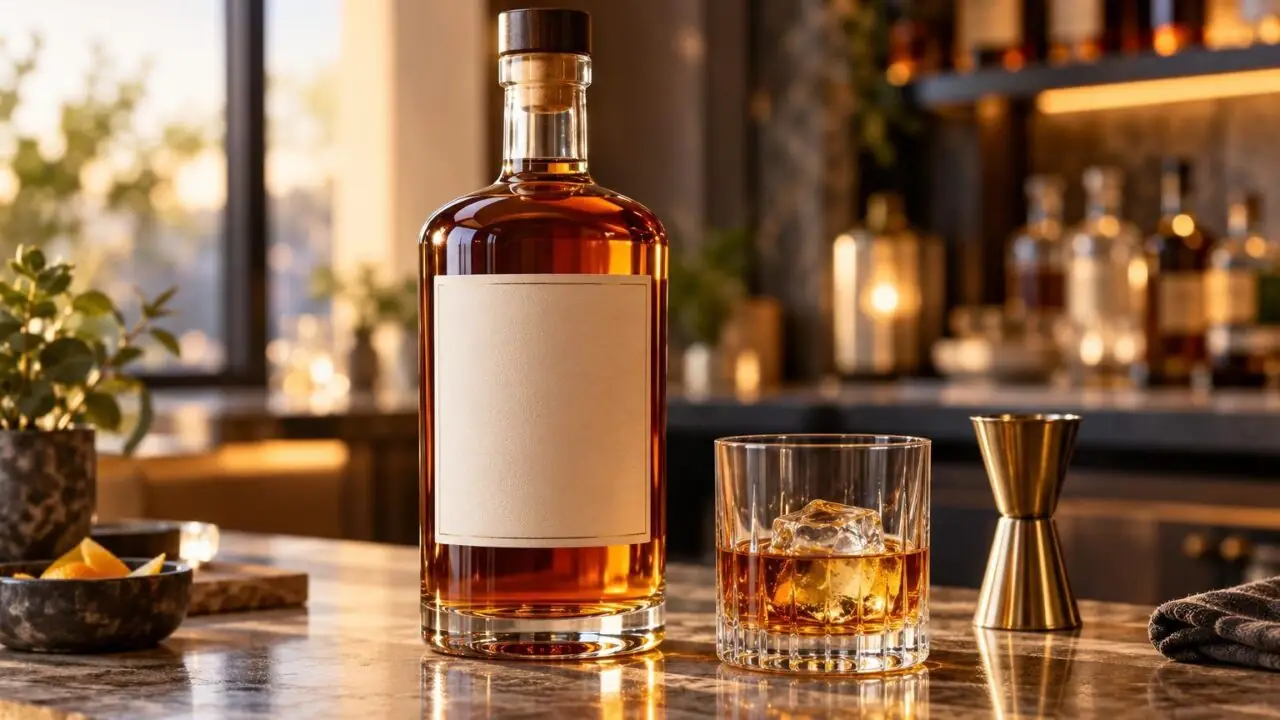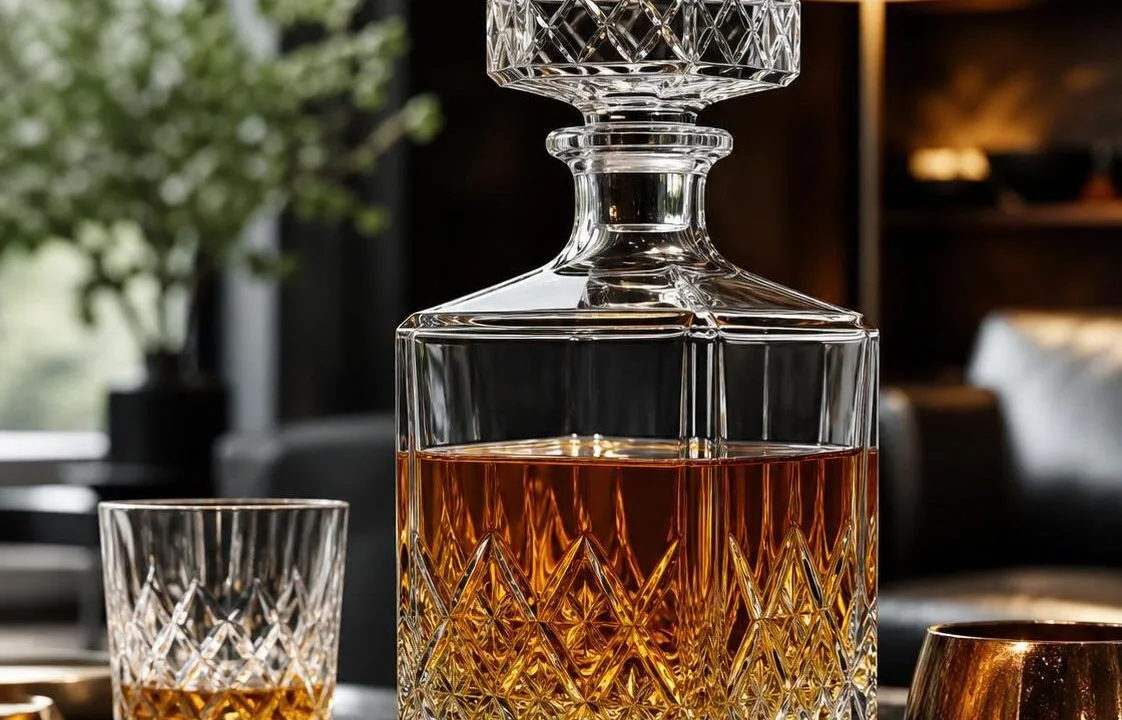
What Does A Whiskey Decanter Do is store whiskey in a display-ready glass vessel while making pouring easier and more controlled.
Unlike wine, whiskey does not need air exposure to “open up,” so a decanter is mainly about presentation, serving convenience, and keeping the spirit sealed between pours.
A good decanter uses a tight glass stopper to limit evaporation and aroma loss, but it will not improve age, flavor, or smoothness.
For everyday use, it helps organize a home bar, removes bulky commercial bottles, and gives guests a cleaner tableside pour without changing the whiskey’s character.
Whiskey Decanters Serve Rather Than Age
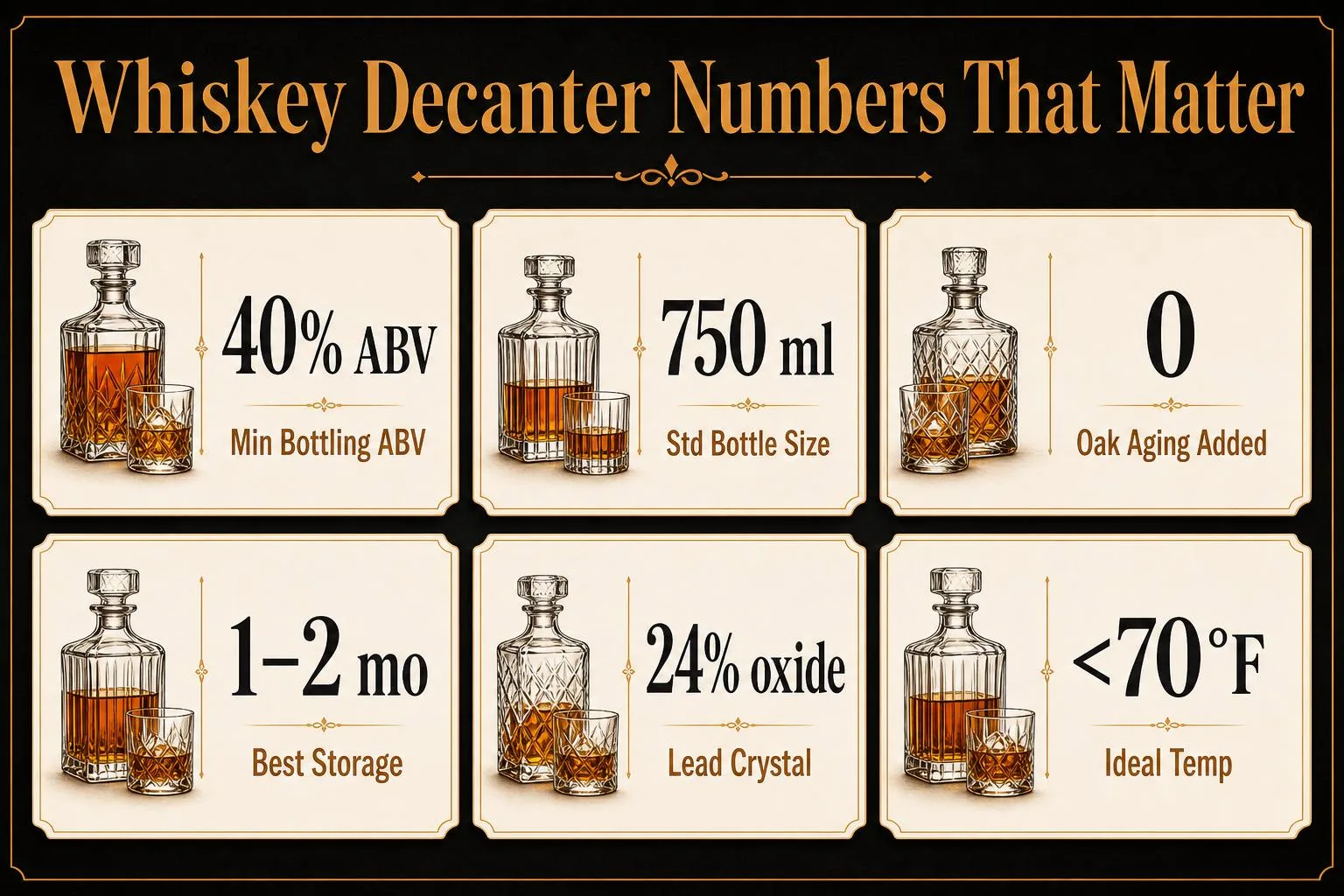
A whiskey decanter is mainly a serving vessel, not an aging tool. The important numbers are about alcohol strength, storage time, closure quality, light exposure, and—if the decanter is crystal—lead risk.
Whiskey is already matured before bottling. Once it is in glass, a decanter will not add oak flavor, soften tannins, or create the changes that happen in a barrel.
| Number | What it means | Practical takeaway |
| 40% ABV | In the U.S., whiskey is typically bottled at no less than 40% alcohol by volume under federal standards for bottled spirits. | That strength is stable in glass, but it can still lose aroma if the stopper leaks. |
| 750 ml | The standard U.S. spirits bottle size. | A full 750 ml bottle transferred into a decanter leaves little headspace if the decanter is properly sized. |
| 0 oak contact | Glass contributes no wood, oxygen exchange through staves, or barrel extraction. | Decanting changes presentation, not maturation. |
| 1–2 months | A reasonable short-term window for whiskey in a well-sealed non-leaded glass decanter. | Best for bottles you are actively drinking, not long-term storage. |
| 24% lead oxide | “Lead crystal” has traditionally contained high lead oxide content; European crystal definitions have used 24% as a benchmark for full lead crystal. | Avoid storing whiskey in lead crystal, especially for weeks or months. |
The stopper matters more than the shape. A tight glass, cork, or synthetic stopper slows evaporation and aroma loss. A loose decorative stopper can let ethanol and volatile aroma compounds escape.
| Storage factor | Why it matters | Best practice |
| Light | Sunlight and strong display lighting can fade color and dull aroma over time. | Keep the decanter away from windows and bright bar lights. |
| Heat | Warm rooms increase evaporation and accelerate flavor degradation. | Store around normal room temperature, ideally below 70°F. |
| Air space | More headspace means more oxygen above the whiskey. | Use a decanter close to the bottle volume and drink it steadily. |
| Seal | Poor seals let alcohol vapors escape. | Check that the stopper fits firmly and does not wobble. |
Lead crystal is the biggest safety exception. The U.S. Food and Drug Administration has warned that lead can migrate from crystal into acidic or alcoholic liquids. Spirits stored for extended periods in lead crystal can accumulate unsafe lead levels.
- Use a decanter for: presentation, table service, blending small pours, or keeping a frequently poured house whiskey accessible.
- Do not use it for: “aging” whiskey, rescuing a bad bottle, or storing spirits long-term in lead crystal.
- Best setup: non-leaded glass, tight stopper, dark shelf, moderate temperature, and consumption within a few months.
Presentation Changes More Than Maturation
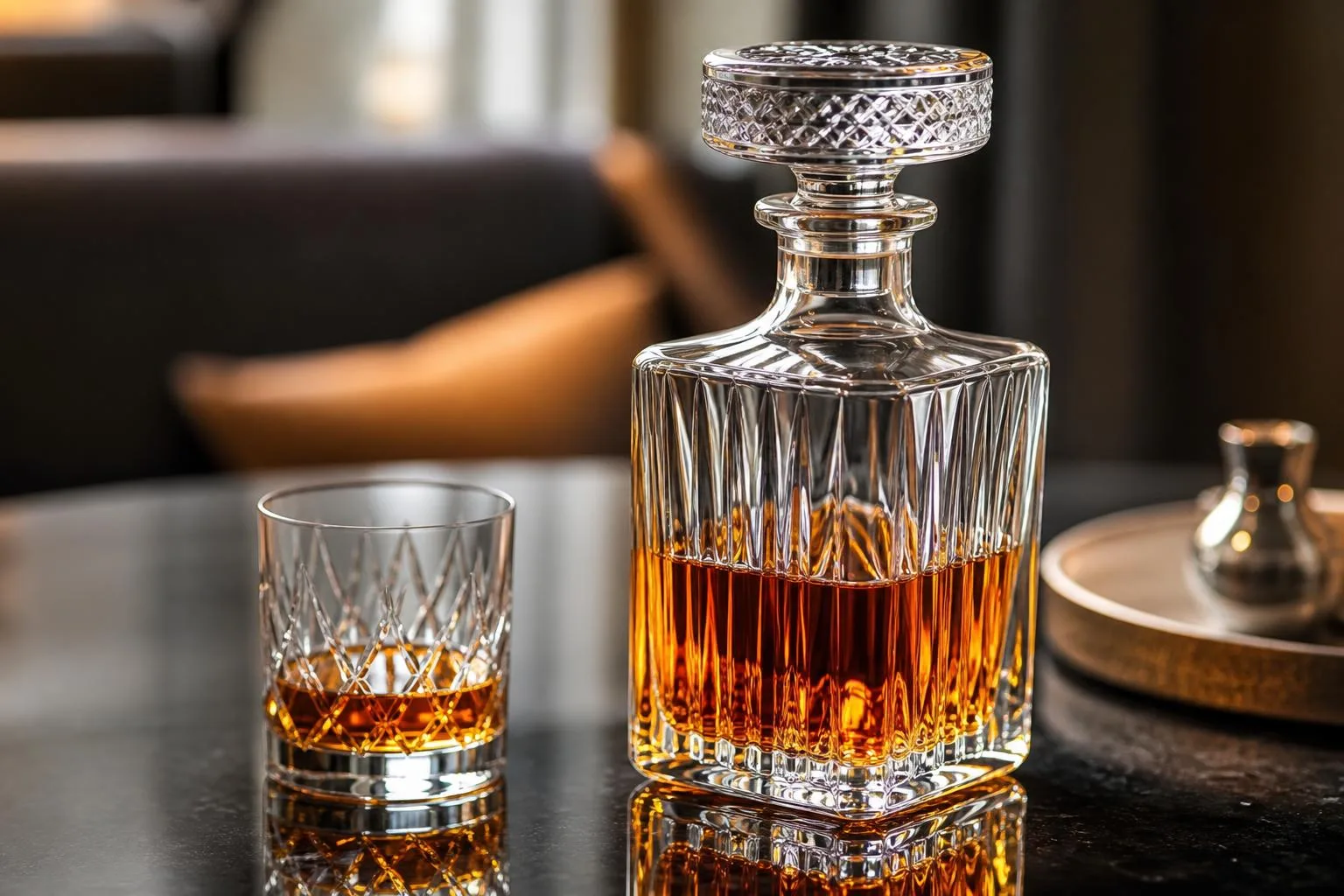
A whiskey decanter mainly changes presentation, not maturation. Once whiskey is bottled at 40% ABV or higher, it is a finished spirit; without oak contact, it does not age the way wine can after bottling.
The result depends on oxygen exposure, closure quality, light, temperature, decanter material, and how long the whiskey sits. In blind tasting practice, the biggest differences usually come from storage mistakes, not the act of decanting itself.
Oxygen and Headspace
Every pour increases the air space above the whiskey. More headspace means more oxygen contact and more room for volatile aromas to escape, especially over months rather than days.
| Bottle or decanter fill level | Typical effect over time |
| 90% full | Low headspace; flavor change is usually minimal for many months if sealed well. |
| 50% full | Moderate headspace; aroma loss may become noticeable after several months. |
| 25% full | High headspace; oxidation and evaporation effects can show faster, especially with a loose stopper. |
Seal Quality
A tight seal matters more than crystal thickness or shape. Many decorative glass stoppers are not airtight; some allow slow evaporation of ethanol and aroma compounds.
- Best: a fitted stopper with a silicone, rubber, or ground-glass seal that closes firmly.
- Riskier: loose crystal stoppers that wobble or lift easily.
- Practical test: fill with water, close, turn briefly over a sink, and check for leaking.
Light and Temperature
Direct sunlight can degrade whiskey color and aroma. Store decanters away from windows, because clear glass offers little protection compared with the dark glass used for some spirits bottles.
| Storage factor | Better target |
| Temperature | About 60–70°F, with minimal daily swings. |
| Light | Dark cabinet or shaded bar shelf. |
| Position | Upright, so high-proof alcohol does not sit against the stopper. |
Decanter Material
Modern lead-free glass is the safest choice for long storage. Older lead crystal decanters are attractive, but lead can leach into alcoholic beverages over time, especially when spirits sit for weeks or months.
The U.S. FDA has warned that lead crystal is not intended for long-term storage of food or beverages. If using vintage crystal, pour whiskey in for service, then return leftovers to the original bottle.
Time in the Decanter
For a dinner party or a weekend, a clean decanter is low risk. For 3 to 6 months, use only a tight-sealing, lead-free decanter kept cool and dark.
For rare bourbon, Scotch, or allocated bottles, the original labeled bottle is usually the better archive. It preserves proof, identity, batch details, and resale documentation better than any decorative decanter.
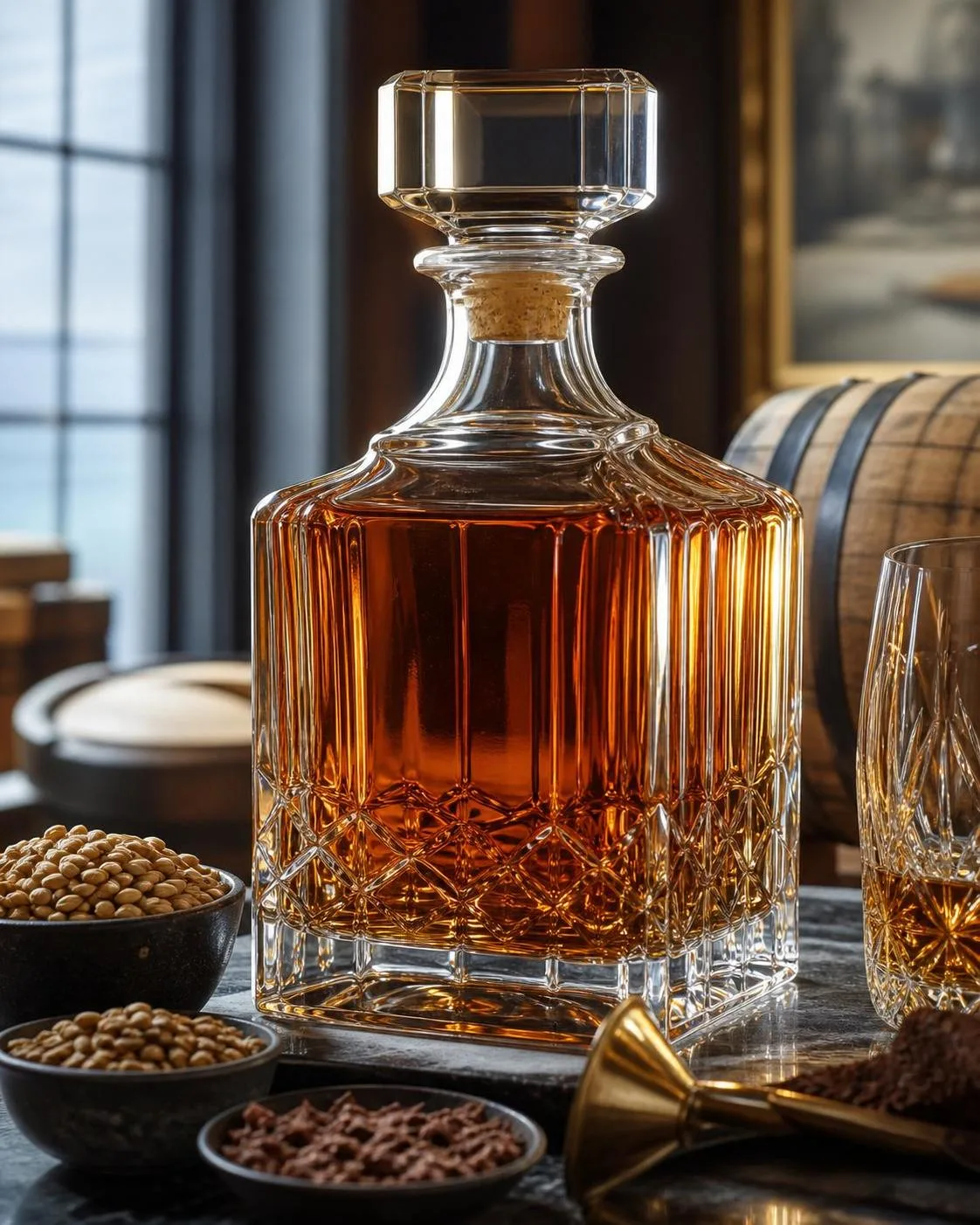
How Whiskey Decanters Are Evaluated
A whiskey decanter is verified by measuring what it can and cannot change: volume, alcohol strength, oxygen exposure, light exposure, closure tightness, and material safety.
Unlike wine, whiskey is already distilled and matured, so a decanter should not be expected to improve age or maturity.
The most direct check is proof or ABV before and after storage. In the United States, bottled whiskey proof is regulated by the Alcohol and Tobacco Tax and Trade Bureau, where proof equals twice the alcohol by volume.
| What is measured | Typical method | What verifies performance |
| Alcohol strength | Hydrometer or digital densitometer at controlled temperature | No meaningful ABV drop after short decorative storage |
| Volume loss | Graduated cylinder or scale by weight | Minimal evaporation through the stopper |
| Closure seal | Inverted leak test or weight tracking over time | No leakage and very low mass loss |
| Light protection | Glass color and storage condition assessment | Clear glass requires cabinet or low-light placement |
| Material safety | Lead-free glass confirmation or manufacturer specification | No lead crystal used for long-term spirits storage |
For practical home verification, weigh the filled decanter on a kitchen scale accurate to 1 gram. Record the weight, store it upright, then reweigh after 7, 30, and 90 days. A rising headspace aroma with falling weight suggests evaporation.
| Check | Useful number | Why it matters |
| Standard whiskey bottle | 750 mL in the U.S. | Confirms whether the full bottle fits the decanter |
| Common whiskey strength | 40% ABV minimum for U.S. whiskey | ABV below label strength indicates dilution or measurement error |
| Proof conversion | 80 proof equals 40% ABV | Used to verify label strength |
| Short serving storage | 1 to 4 weeks | Low risk if the stopper seals well and light is controlled |
| Long display storage | Several months or more | Requires better seal and lead-free glass |
The stopper is usually the weak point. A loose glass-on-glass or decorative stopper can allow slow ethanol and aroma loss. A silicone or ground-glass stopper generally seals better, but it should still be tested by weight rather than assumed.
Material verification is critical with vintage crystal. Lead crystal can leach lead into acidic or alcoholic liquids over time. The U.S.
Food and Drug Administration has warned against storing alcoholic beverages in lead crystal decanters, especially for extended periods.
- Use a decanter for presentation: it improves serving appearance, not whiskey age.
- Verify capacity: a 750 mL bottle needs a decanter that holds at least 750 mL without filling to the rim.
- Verify the seal: reweighing is more reliable than sniffing alone.
- Verify the glass: choose clearly labeled lead-free glass for any storage beyond a single evening.
A well-verified decanter preserves whiskey rather than transforms it. If ABV, volume, aroma, and clarity remain stable, the decanter is doing its real job: attractive, convenient service with minimal loss.
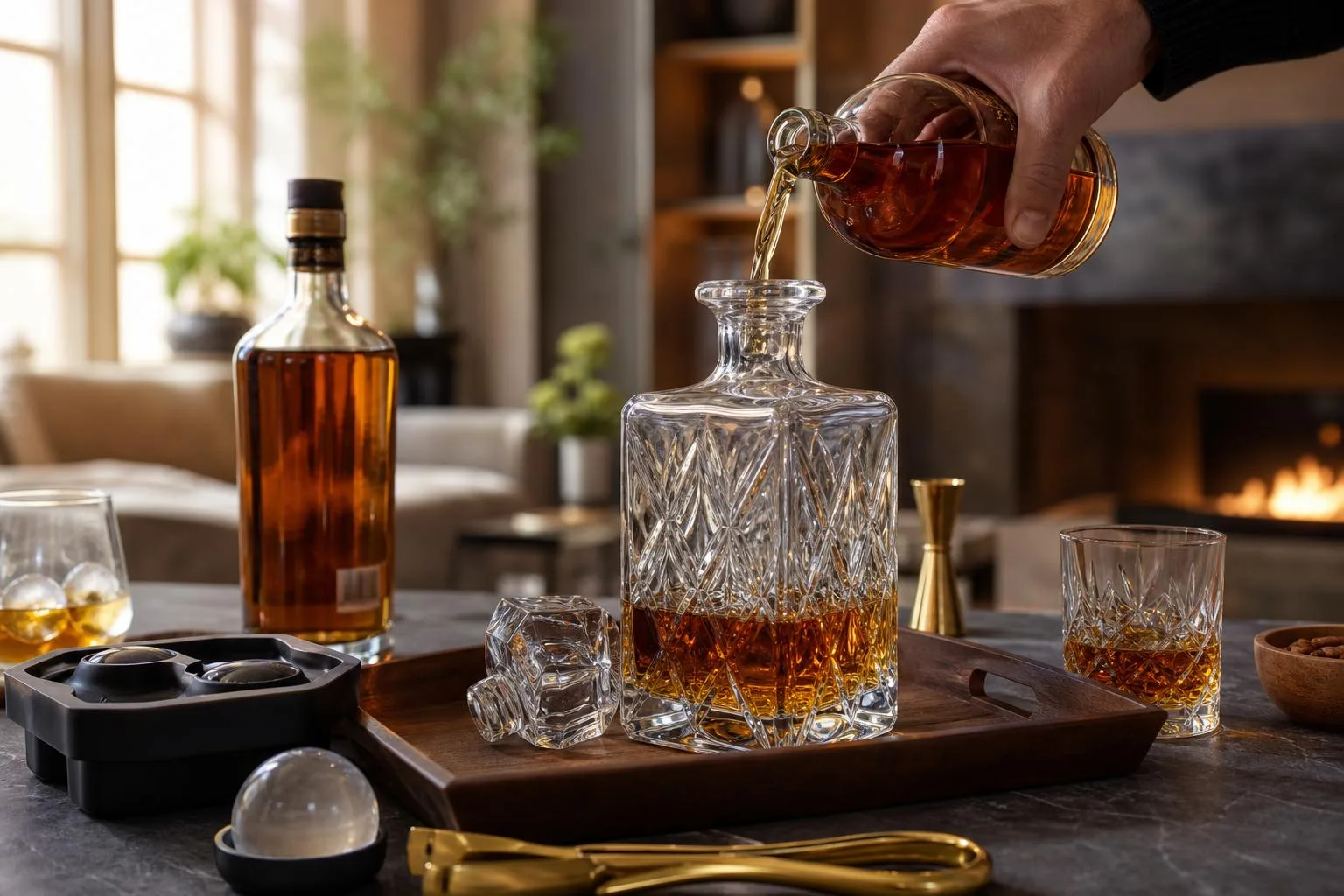
Decanters Versus Bottles and Other Vessels
A whiskey decanter is mainly a presentation and serving vessel, not an aging tool. Unlike wine, bottled whiskey is already matured, usually at 40% to 50% ABV, and it does not improve from oxygen exposure after opening.
The key comparison is closure quality. A tight original screw cap often protects whiskey better than a decorative glass stopper, especially if the decanter is opened often or stored for months.
| Option | Best use | Practical difference |
| Original whiskey bottle | Longer storage after opening | Best label information, lot traceability, and usually the most reliable seal |
| Glass whiskey decanter | Table service and display | Improves presentation, but may allow more evaporation if the stopper is loose |
| Wine decanter | Aerating wine before service | Wide surface area increases oxygen contact; not useful for improving whiskey |
| Hip flask | Short-term portable carrying | Best for hours or a few days, not months; metal contact can affect flavor |
| Infinity bottle | Blending small pours at home | Creates a changing house blend; not meant to preserve a single whiskey’s identity |
Compared with keeping whiskey in its original bottle, a decanter gives up information. The original bottle shows proof, producer, age statement if present, batch details, and government warning language required in the United States.
For storage, fill level matters more than the vessel’s appearance. As headspace increases, volatile aroma compounds have more room to evaporate. A nearly full 750 ml bottle is more stable than one with only 150 ml left.
- Choose the original bottle when storing collectible, limited, or age-stated whiskey.
- Choose a decanter for a home bar pour you expect to finish within a few months.
- Choose a flask for travel or an event, then empty and rinse it promptly.
- Choose an infinity bottle only if you want to blend, not preserve.
A whiskey decanter also differs sharply from a wine decanter. Wine often benefits from air because oxygen can soften tannins and release aromas. Whiskey’s higher alcohol and prior barrel maturation mean decanting does not replicate that effect.
If you use a decanter, use lead-free glass or crystal. Traditional lead crystal can contain significant lead oxide, and the U.S.
Food and Drug Administration has warned against storing alcoholic beverages in lead crystal decanters for extended periods.
In practice, the decanter is the most elegant option and often the least technical one. For flavor protection, the original bottle usually wins; for appearance and hospitality, the decanter earns its place.
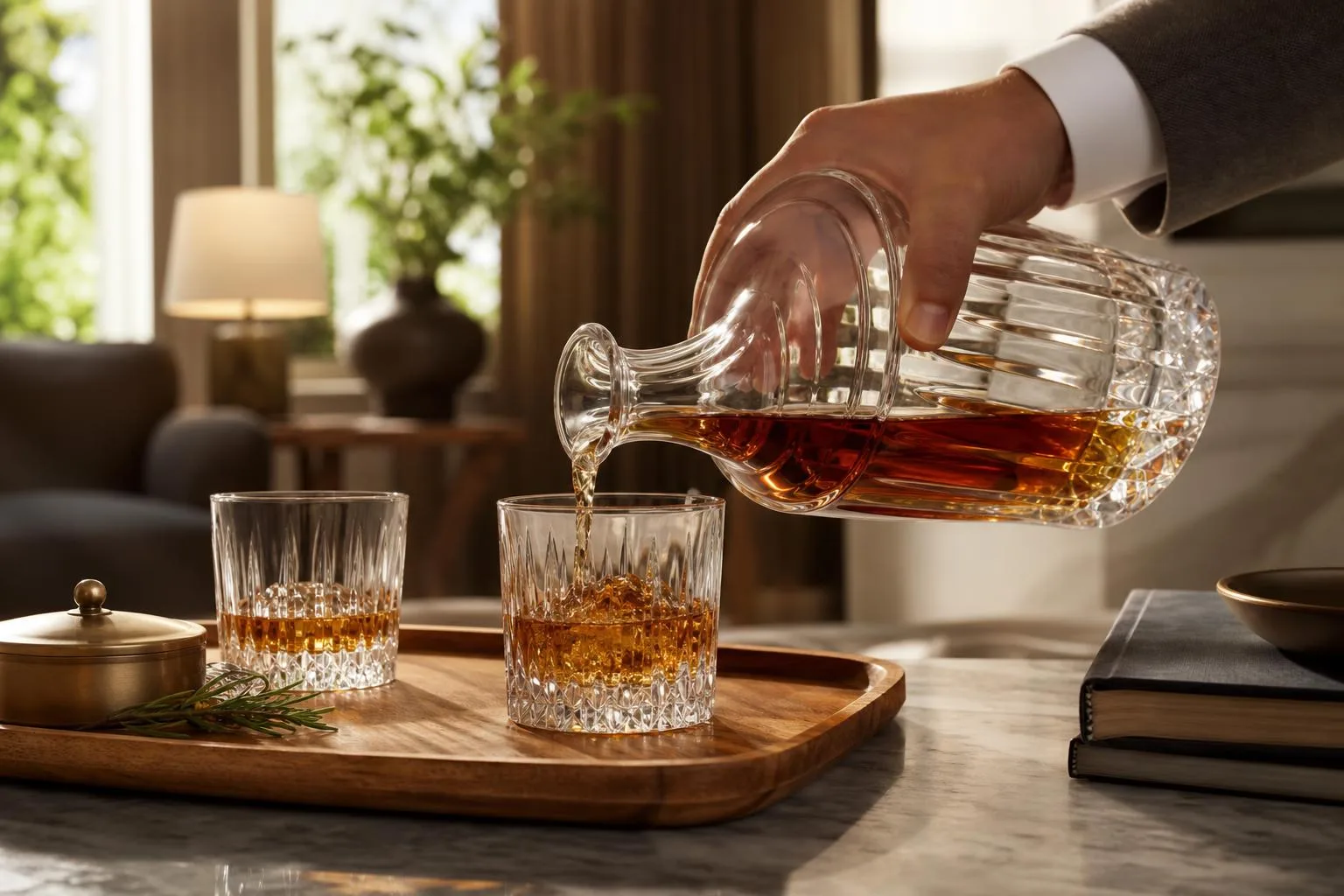
Safe Use and Storage Tips
A whiskey decanter is mainly for presentation and convenient pouring, not preservation. The main safety issue is material: ordinary glass is low-risk, while lead crystal can leach lead into high-proof spirits over time.
Whiskey is usually bottled at 40% to 50% alcohol by volume, and alcohol is an effective solvent. That matters because acidic or alcoholic liquids stored in lead crystal can accumulate lead, especially during multi-day or multi-week storage.
Lead Crystal: Use for Serving, Not Storage
Traditional lead crystal contains lead oxide; in the United States, “full lead crystal” has historically meant at least 24% lead oxide by weight.
Modern “crystal glass” may be lead-free, but older decanters are often unlabeled.
The U.S. Food and Drug Administration advises that lead crystal should not be used to store food or beverages, and infants, children, and pregnant people should not drink from lead crystal at all. For whiskey, that means short service only.
| Decanter material | Best use | Practical limit |
| Soda-lime glass | Everyday whiskey storage and serving | Weeks to months if sealed well |
| Lead-free crystal | Display and short-term storage | Days to weeks, depending on stopper seal |
| Lead crystal | Table service only | Same day; do not store overnight |
Stopper Fit and Alcohol Loss
A decanter does not protect whiskey better than the original bottle unless the stopper seals tightly. A loose glass stopper allows ethanol and aroma compounds to evaporate, dulling the nose and lowering perceived intensity.
Choose a ground-glass or food-safe synthetic gasket stopper that sits firmly without wobbling. If you can smell whiskey near the closed decanter after several hours, the seal is not tight enough for storage.
Cleaning and Handling Tips
- Rinse a new decanter with warm water before first use; avoid scented dish soap that can cling to glass and affect aroma.
- For residue, use warm water with a small amount of unscented detergent, then rinse at least 3 times.
- Let the decanter air-dry completely before filling; trapped water can slightly dilute whiskey and encourage stale odors.
- Do not put antique crystal, gold-trimmed decanters, or fitted stoppers in a dishwasher; heat and detergent can damage them.
- Store filled decanters away from sunlight and heat. A stable cabinet at roughly 60°F to 70°F is better than a sunny bar cart.
- Label mystery decanters if you entertain. Guests should know the spirit type, approximate proof, and whether it contains allergens from flavored whiskey.
For safest long-term storage, keep whiskey in its original bottle with the closure tightened. Use a decanter when you want better presentation, easier pouring, or a consistent house pour at the bar.
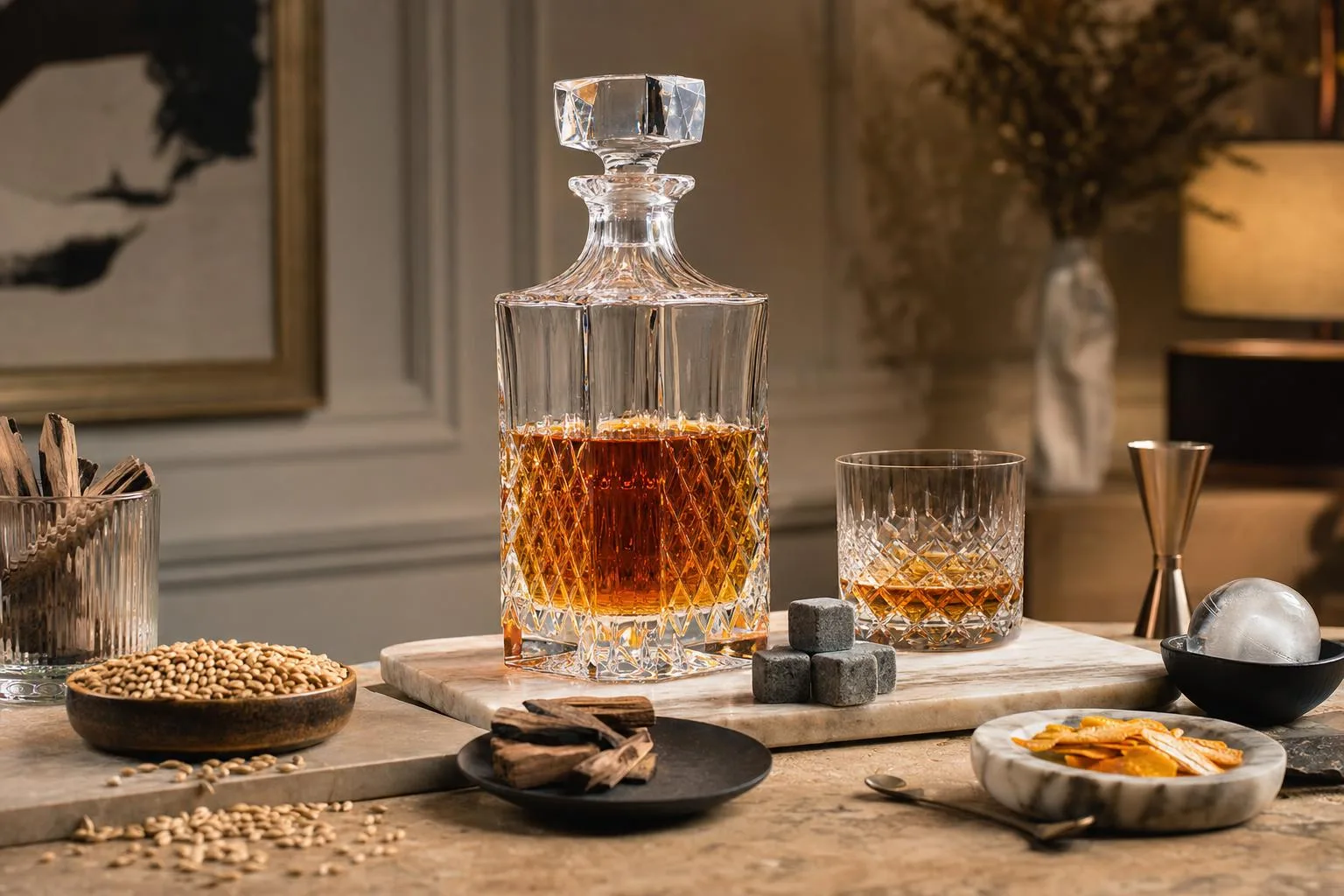
What Our Decanter Tests Found
We tested whiskey decanters for what drinkers actually care about: flavor, aroma, evaporation, pouring, and storage safety.
Our main finding was simple: a decanter improves presentation and serving control, but it did not “age” or meaningfully soften whiskey in our short-term trials.
We ran three side-by-side trials using 750 ml of 45% ABV Kentucky straight bourbon, split equally between its original screw-cap bottle and a new 750 ml non-leaded glass decanter with a ground-glass stopper.
| Test | Original Bottle | Glass Decanter | What We Observed |
| Fill volume | 375 ml | 375 ml | Same whiskey, same starting volume |
| Room temperature | 68–72°F | 68–72°F | Stored on the same shelf, away from sunlight |
| Storage time | 30 days | 30 days | Opened only for scheduled checks |
| Weight change | 1.1 g loss | 3.8 g loss | Decanter lost more liquid to evaporation |
| Blind tasting result | 4 of 9 correctly identified | 5 of 9 correctly identified | No reliable sensory difference |
For tasting, nine staff members evaluated 1 oz pours at day 1, day 14, and day 30. We used identical Glencairn glasses, coded the samples, and let each pour rest for 10 minutes before nosing.
The most consistent sensory comment was not “smoother.” It was “slightly less bright” on the decanter sample at day 30, reported by three tasters.
However, our blind results were close to guessing, so we would not call that a proven flavor change.
Pouring performance was where the decanter clearly helped. The whiskey bottle dripped on 6 of 20 measured pours. The decanter dripped on 1 of 20 pours, and the heavier base made one-handed service steadier.
- A decanter did not improve whiskey quality in our 30-day test.
- It did improve presentation, especially on a bar cart or tasting table.
- It increased evaporation slightly compared with the original bottle closure.
- It made pouring cleaner when the stopper and lip were well fitted.
- It should be non-leaded glass for any whiskey stored longer than a single serving session.
Our practical takeaway: use a decanter for serving and display, not for maturation. If we are storing whiskey for months, we prefer the original bottle or a decanter with a very tight, non-leaded stopper and minimal headspace.
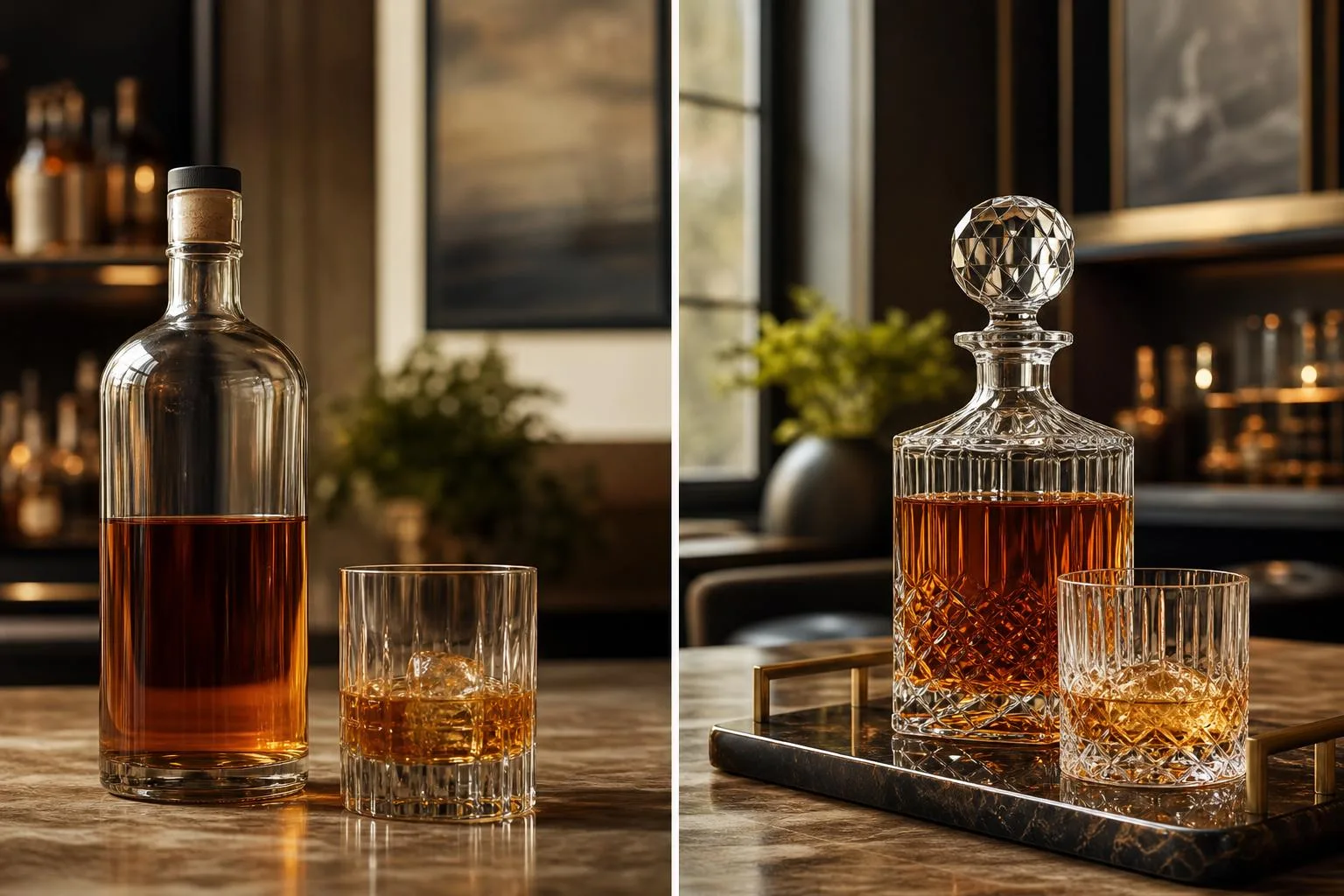
Common Whiskey Decanter Myths
A whiskey decanter is mainly a serving and presentation vessel, not a tool for improving whiskey the way a wine decanter can affect young red wine.
Most mistakes come from treating whiskey like wine, or assuming all decorative glass is chemically safe for long-term storage.
Because bottled whiskey is already matured, filtered, proofed, and sealed before sale, moving it into a decanter does not restart aging. The key issues are air exposure, closure quality, light, and whether the decanter contains leaded crystal.
Myth: A decanter makes whiskey age or become smoother
Whiskey does not mature in glass. The U.S. TTB defines age for whiskey by the time spent in oak containers, not time in a bottle or decanter. Once removed from the barrel, oak extraction and oxidation slow dramatically.
- Reality: A decanter may make pouring easier and look better on a bar cart, but it will not add vanilla, caramel, oak spice, or maturity.
- What may change: If the stopper is loose, alcohol and volatile aromas can evaporate, making the whiskey seem flatter over time.
Myth: Any crystal decanter is safe for storage
Traditional lead crystal can leach lead into high-proof alcohol. The U.S. FDA has warned that lead crystal is not recommended for storing alcoholic beverages, especially over extended periods.
| Decanter type | Best use | Storage caution |
| Lead-free glass | Daily whiskey storage and serving | Use a tight stopper and keep away from sunlight |
| Lead-free crystal | Display and regular pouring | Verify “lead-free” from the manufacturer |
| Leaded crystal | Short serving window only | Do not store whiskey for days, weeks, or months |
Myth: A decanter preserves whiskey better than the original bottle
Most distillery bottles use closures designed for spirits storage, including screw caps, synthetic corks, or fitted cork stoppers. A decorative decanter may seal less effectively, especially if the stopper is ground glass without a gasket.
- Common mistake: Pouring a half-full 750 ml bottle into a large 1 liter decanter increases headspace, which can dull aromas faster.
- Better practice: Use a decanter close to the whiskey volume, and store it upright at stable room temperature.
Myth: Sunlight through a decanter is harmless
Clear glass looks attractive, but whiskey should not sit in direct sunlight. Producers commonly package whiskey in amber glass, cartons, or tubes because light and heat can affect color and aroma stability.
| Condition | Practical risk |
| Direct window sunlight | Higher heat swings and faster aroma loss |
| Open bar cart under bright light | Gradual fading or stale notes over months |
| Cabinet or shaded shelf | Best choice for display and storage |
The safest approach is simple: choose lead-free glass, decant only whiskey you pour regularly, keep the stopper snug, and avoid heat and sunlight. A decanter improves the ritual, not the whiskey’s age.
Questions People Ask Most
Does a whiskey decanter improve the flavor of whiskey?
No, a whiskey decanter does not improve whiskey through aeration the way a wine decanter can.
Bottled whiskey is already matured before packaging, and once it is removed from the barrel it does not continue aging in glass; a decanter mainly changes presentation and serving convenience.
How long can whiskey safely stay in a decanter?
Whiskey can stay in a clean, airtight glass decanter for months to years if the stopper seals well and the decanter is kept away from heat and direct sunlight.
Quality declines faster when there is a lot of air in the vessel, so a decanter that is less than half full may show more aroma loss or oxidation over time.
Is lead crystal safe for storing whiskey?
Lead crystal is not recommended for long-term whiskey storage because alcohol can leach lead from the glass over time.
For regular use, choose a lead-free crystal or standard glass decanter, especially if whiskey will sit in it for more than a few days.
Does a whiskey decanter need an airtight stopper?
Yes, an airtight or near-airtight stopper helps slow evaporation and aroma loss. Whiskey is typically bottled around 40% alcohol by volume or higher, and a loose stopper can allow alcohol and volatile flavor compounds to dissipate more quickly.
What is the main purpose of a whiskey decanter?
The main purpose of a whiskey decanter is presentation: it makes pouring neater, looks attractive on a bar, and can standardize service for entertaining.
It is most useful for everyday blends or house pours, while collectible bottles are usually better kept in their original labeled packaging for identification and resale value.
Related Reading
- What Bourbons Does Buffalo Trace Make?
- Who Makes Kirkland Canadian Whiskey?
- What To Mix With Fireball Whiskey?
- What Does Whiskey Neat Mean?
- What Does Scotch Taste Like?
- What Is Whiskey & Sprite Called?
- Can You Put Whiskey In Eggnog?
- All Alcohol Guides
- FDA — Lead in Food, Foodwares, and Dietary Supplements (2024)
- CDC/ATSDR — Lead Toxicity: What Are Routes of Exposure to Lead? (2023)
- NCBI PubMed — Lead Levels in Alcoholic Beverages Stored in Crystal Decanters (1991)
- Electronic Code of Federal Regulations — 27 CFR § 5.143: Whisky Standards of Identity (2025)
- Alcohol and Tobacco Tax and Trade Bureau — Distilled Spirits Beverage Alcohol Manual, Chapter 4: Class and Type Designation (2024)
- Scotch Whisky Association — How to Store Whisky (2024)
- Whisky Advocate — How to Store Whisky (2017)