How Many Carbs Does Whiskey Have? is answered simply: 0 grams of carbs in a standard 1.5-ounce shot of straight whiskey.
Distillation leaves sugars and starches behind, so bourbon, rye, Scotch, Irish whiskey, and Tennessee whiskey contain no carbohydrates when served neat.
Calories still count: that same 80-proof pour has about 97 calories, all from alcohol. Carb totals change when whiskey meets cola, sour mix, flavored liqueurs, honey, or sweet vermouth, which can turn a zero-carb drink into a high-sugar cocktail.
This guide breaks down straight whiskey, proof differences, flavored whiskey, common mixed drinks, and label-reading tips so you can estimate carbs accurately before ordering or pouring.
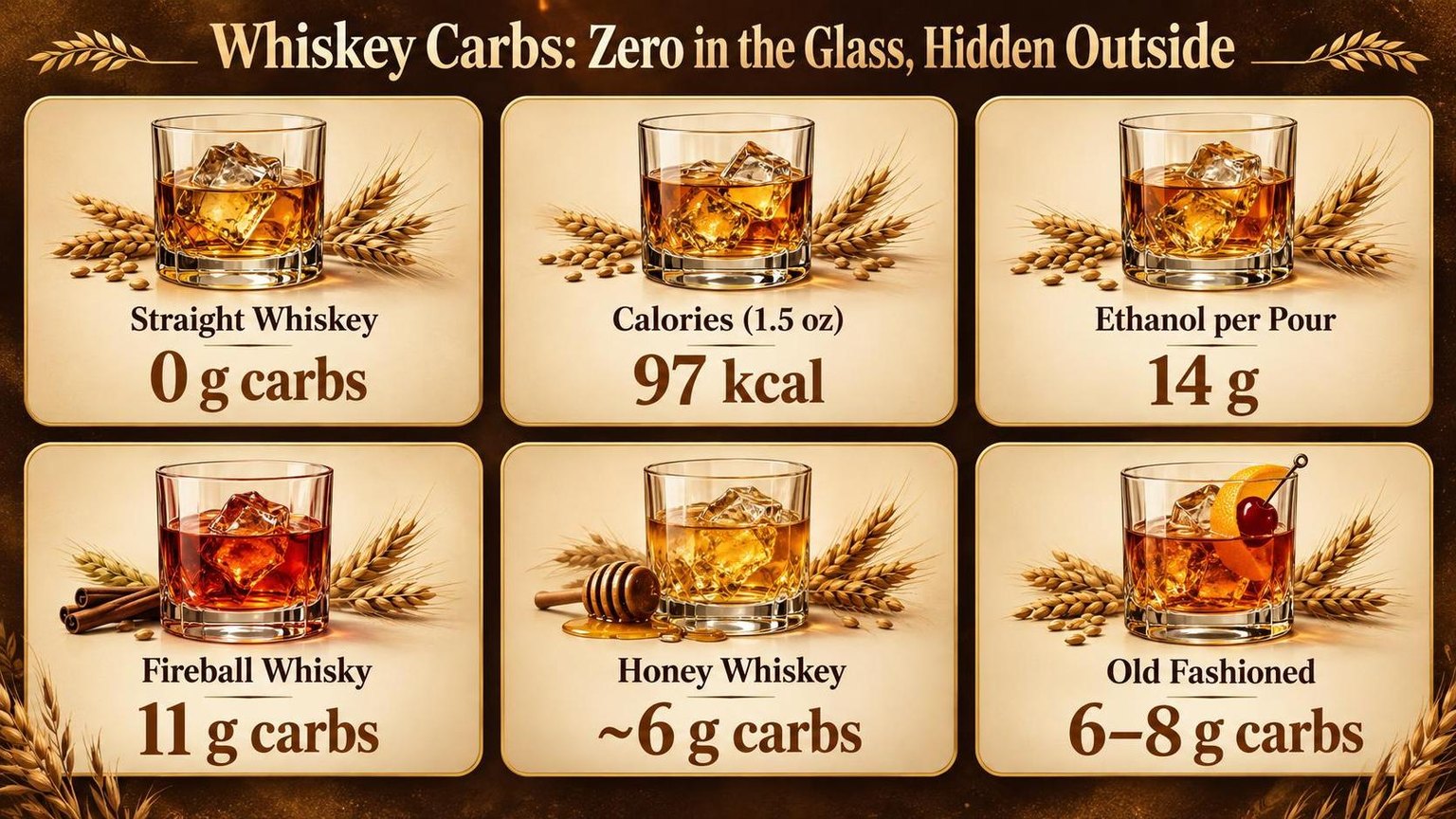
Whiskey Carbs Per Standard Pour
A standard pour of whiskey—1.5 oz (44 ml)—contains zero grams of carbohydrates. This applies to straight bourbon, rye, Scotch, and Irish whiskey at 80 proof.
The distillation process eliminates all sugars originally present in the grain mash.

The USDA FoodData Central database confirms that distilled spirits, including whiskey, register 0 g of carbohydrates, 0 g of sugar, 0 g of fat, and 0 g of protein per serving.
Calorie and Carb Breakdown by Pour Size
Calories in whiskey come exclusively from ethanol, which delivers 7 calories per gram. Carbs contribute nothing to the total.
| Pour Size | Carbs (g) | Calories | Alcohol (g) |
| 1 oz (30 ml) — short pour | 0 | ~64 | ~9.3 |
| 1.5 oz (44 ml) — standard | 0 | ~97 | ~14 |
| 2 oz (60 ml) — double | 0 | ~128 | ~18.6 |
| 3 oz (90 ml) — generous double | 0 | ~193 | ~27.9 |
Higher Proof Changes Calories, Not Carbs
Increasing proof raises alcohol content and therefore calories. Carbohydrates remain at zero regardless of proof.
| Proof (ABV) | Carbs per 1.5 oz | Calories per 1.5 oz |
| 80 proof (40% ABV) | 0 g | ~97 |
| 90 proof (45% ABV) | 0 g | ~110 |
| 100 proof (50% ABV) | 0 g | ~124 |
| 114 proof (57% ABV) — cask strength | 0 g | ~141 |
Where Carbs Sneak In
Straight whiskey is carb-free, but additions change the equation quickly. Watch for these common sources:
- Flavored whiskeys — Fireball Cinnamon Whisky contains 11 g of carbs per 1.5 oz serving, sourced from added sugars.
- Honey whiskeys — Jack Daniel’s Tennessee Honey has roughly 6 g of carbs per 1.5 oz.
- Whiskey cocktails — An Old Fashioned adds 6–8 g of carbs from the sugar cube and bitters. A Whiskey Sour with fresh sour mix adds 10–15 g.
- Cream liqueurs — Baileys Irish Cream contains approximately 11 g of carbs per 1.5 oz.
For anyone tracking macros on keto or low-carb diets, unflavored straight whiskey at any proof is a zero-carb option. The only metabolic cost is the caloric load from alcohol itself.
Why Whiskey Has Zero Carbs
Distillation eliminates all carbohydrates from whiskey. The grain mash starts with substantial starch and sugar content, but the distillation process separates ethanol from everything else—including carbs, proteins, and fats.
The science is straightforward. Ethanol has a boiling point of 78.37 °C (173.1 °F), while sugars and starches cannot vaporize at those temperatures. When the fermented wash is heated, only water and alcohol rise as vapor.
Carbohydrates remain behind in the still’s pot residue, called “stillage.”.
According to the USDA FoodData Central database (NDB #14551), 1.5 oz (44 ml) of 80-proof whiskey contains the following macronutrients:
| Nutrient | Amount per 1.5 oz (44 ml) |
| Calories | 97 kcal |
| Carbohydrates | 0 g |
| Protein | 0 g |
| Fat | 0 g |
| Sugar | 0 g |
| Ethanol | 14 g |
Every calorie in straight whiskey comes exclusively from ethanol, which provides 7 calories per gram. At 14 g of alcohol per standard pour, that yields roughly 97 kcal—none from carbohydrates.
What About the Grain Source?
Bourbon mash bills require at least 51% corn. Rye whiskey requires at least 51% rye grain. Scotch malt whisky uses 100% malted barley. All three grains are carbohydrate-dense:
| Grain | Carbs per 100 g (raw) |
| Corn | 74 g |
| Rye | 76 g |
| Malted barley | 78 g |
During fermentation, yeast converts these grain sugars into ethanol and CO₂. Distillation then strips away any residual sugars. The grain’s original carbohydrate load becomes irrelevant to the final spirit.
When Whiskey Might Contain Trace Carbs
Flavored whiskeys are the exception. Products like Fireball Cinnamon Whisky contain added sugars—approximately 11 g of carbs per 1.5 oz serving. Honey-infused whiskeys similarly add 5–6 g of carbs per serving.
- Straight whiskey (unflavored): 0 g carbs
- Flavored or liqueur-style whiskey: 5–11 g carbs per serving
- Whiskey cocktails with mixers: 15–40 g carbs depending on mixer
Check the label. If it says “straight bourbon,” “single malt,” or “straight rye” with no flavoring additives, the carbohydrate count is zero.
Carbs In Flavored Whiskey
Flavored whiskeys break the zero-carb rule that applies to straight spirits. Added sugars, honey, and artificial flavorings introduce significant carbohydrates — often 3 to 11 grams per 1.5-oz serving, depending on the brand and flavor profile.
Manufacturers are not required to display nutrition labels on distilled spirits in the United States, so exact carb counts vary by source.
The following table compiles widely reported values for popular flavored whiskeys per standard 1.5-oz (44 ml) serving.
| Brand & Flavor | Carbs (g) | Calories |
| Fireball Cinnamon Whisky | 11 | 108 |
| Crown Royal Peach | 9 | 100 |
| Jack Daniel’s Tennessee Honey | 6 | 108 |
| Jim Beam Red Stag (Black Cherry) | 6 | 103 |
| Crown Royal Vanilla | 4 | 96 |
| Jack Daniel’s Tennessee Fire | 5 | 108 |
| Wild Turkey American Honey | 6 | 106 |
| Skrewball Peanut Butter Whiskey | 8 | 104 |
Compare those numbers to standard bourbon or rye, which contain 0 grams of carbs per serving. The gap is entirely due to post-distillation additives.
Why Flavored Whiskeys Contain Carbs
Distillation removes sugars from the base liquid. Flavored whiskeys reintroduce carbohydrates through added sweeteners — cane sugar, high-fructose corn syrup, or honey — blended in after distillation.
Many flavored whiskeys also carry a lower ABV. Fireball sits at 33% ABV (66 proof) versus the standard 40% ABV (80 proof) for unflavored whiskey, leaving more room in the formulation for sugar-laden flavoring agents.
What This Means For Low-Carb Diets
- A single Fireball shot delivers 11 g of carbs — roughly equivalent to eating three sugar cubes.
- Two servings of Crown Royal Peach add 18 g of carbs, potentially enough to disrupt ketosis for strict keto dieters limiting intake to 20 g daily.
- Unflavored bourbon, Scotch, or rye remains the zero-carb alternative.
Read the brand’s product page or contact the manufacturer directly for the most current nutritional data, since formulations change without notice.
Whiskey Versus Other Alcohol Carbs
Whiskey contains zero carbohydrates per standard 1.5-oz serving, placing it among the lowest-carb alcoholic options available. Comparing it against beer, wine, and cocktails reveals dramatic differences that matter for carb-conscious drinkers.
Carb Comparison by Drink Type
| Drink | Serving Size | Carbs (g) | Calories |
| Whiskey (80 proof) | 1.5 oz | 0 | 97 |
| Vodka (80 proof) | 1.5 oz | 0 | 97 |
| Gin (80 proof) | 1.5 oz | 0 | 97 |
| Rum (80 proof) | 1.5 oz | 0 | 97 |
| Dry red wine | 5 oz | 3.8 | 125 |
| Dry white wine | 5 oz | 3.2 | 121 |
| Regular beer | 12 oz | 12.6 | 153 |
| Light beer | 12 oz | 5.9 | 103 |
| Margarita | 8 oz | 36 | 274 |
| Piña colada | 9 oz | 61 | 490 |
All unflavored distilled spirits—whiskey, vodka, gin, rum, tequila—register zero carbs. The distillation process strips out sugars entirely, regardless of the grain or fruit used as the base.
Where the Carb Gap Widens
A single regular beer delivers 12.6 g of carbs. Drinking three beers adds nearly 38 g of carbohydrates—equivalent to roughly two slices of white bread.
Cocktails present the steepest carb load. A standard margarita packs around 36 g, while a piña colada reaches 61 g per serving. These numbers come almost entirely from added mixers, syrups, and fruit juices.
Wine occupies the middle ground. A 5-oz glass of dry red wine contributes about 3.8 g of carbs, making it moderate but not zero like straight whiskey.
Keeping Whiskey Low-Carb
- Drink it neat, on the rocks, or with soda water to maintain zero carbs.
- Avoid cola mixers—a 12-oz can of Coca-Cola adds 39 g of carbs.
- Skip flavored whiskeys; Fireball Cinnamon Whisky contains roughly 11 g of sugar per 1.5-oz shot.
- Choose diet ginger ale (0 g carbs) over regular ginger ale (32 g per 12 oz) as a mixer.
Whiskey’s zero-carb profile holds only when consumed without sugary additions. The moment a mixer enters the glass, carb counts can rival those of beer or sweetened cocktails.

Calories Without Carbs In Whiskey
A standard 1.5-oz shot of 80-proof whiskey contains approximately 97 calories yet zero grams of carbohydrates. Those calories come entirely from ethanol, which the body metabolizes differently than carbs, protein, or fat.
Ethanol delivers 7 calories per gram—nearly double the 4 calories per gram from carbohydrates or protein. During distillation, sugars from the fermented grain mash are left behind. Only alcohol and water pass through the still.
Calorie Counts by Proof
Higher proof means more ethanol per volume, which directly increases calorie content. The USDA National Nutrient Database provides these figures for a 1.5-oz (44 ml) serving:
| Proof | ABV | Calories | Carbs (g) |
| 80 | 40% | 97 | 0 |
| 86 | 43% | 105 | 0 |
| 90 | 45% | 110 | 0 |
| 94 | 47% | 116 | 0 |
| 100 | 50% | 124 | 0 |
Every 10-point increase in proof adds roughly 13–14 calories per shot. Barrel-strength bourbons at 120–130 proof can reach 150–165 calories per 1.5-oz pour.
How the Body Processes Alcohol Calories
The liver prioritizes ethanol metabolism over all other macronutrients. Alcohol is converted to acetaldehyde by the enzyme alcohol dehydrogenase, then to acetate. This process generates energy but cannot be stored as glycogen.
Because the body treats ethanol as a toxin, it halts fat oxidation while clearing alcohol. Research published in The American Journal of Clinical Nutrition found that fat metabolism decreased by approximately 73% after ethanol consumption.
Why Zero Carbs Can Be Misleading
- Zero carbs does not mean zero metabolic impact—ethanol still triggers insulin responses.
- Mixers are the hidden culprit: a whiskey sour adds 15–20 g of carbs from simple syrup and citrus.
- Flavored whiskeys (e.g., Fireball at 33% ABV) contain added sugar, contributing roughly 11 g of carbs per 1.5-oz serving.
- Cream-based whiskey liqueurs like Baileys carry about 7.4 g of carbs per 1-oz pour.
Straight, unflavored whiskey remains one of the lowest-carb alcoholic options available. The calorie load, however, scales directly with alcohol content—not with carbohydrates.
Keto And Diabetes Whiskey Considerations
Whiskey contains zero carbohydrates and zero sugar per standard 1.5-oz serving, making it one of the most keto-compatible alcoholic beverages available.
However, both keto dieters and people with diabetes must account for alcohol’s metabolic effects beyond simple carb counts.
Whiskey On A Ketogenic Diet
A standard shot of whiskey provides roughly 97 calories entirely from ethanol, with 0 g carbs, 0 g fat, and 0 g protein. This fits well within the typical keto limit of 20–50 g net carbs per day.
The critical issue: your liver prioritizes metabolizing alcohol over burning fat. Ketone production temporarily stalls until all ethanol is cleared, which takes approximately one hour per standard drink.
| Drink (1.5 oz / 44 ml) | Carbs (g) | Calories | Keto-Friendly |
| Straight whiskey | 0 | 97 | Yes |
| Whiskey + diet cola | 0 | ~99 | Yes |
| Whiskey sour (classic) | 8–14 | 165–220 | No |
| Whiskey + ginger ale | 16–24 | 160–195 | No |
| Honey whiskey liqueur | 6–11 | 106–140 | No |
Whiskey And Blood Sugar Management
Whiskey does not raise blood glucose directly because it lacks carbohydrates. The real danger for people with diabetes, particularly those on insulin or sulfonylureas, is alcohol-induced hypoglycemia.
The liver normally releases stored glucose (glycogenolysis) to maintain blood sugar between meals.
Alcohol blocks this process for up to 12 hours after consumption, increasing the risk of dangerously low blood sugar—sometimes well into the next morning.
- Never drink whiskey on an empty stomach. Pair it with a meal containing protein and complex carbohydrates to buffer blood sugar drops.
- Monitor blood glucose before, during, and after drinking. The American Diabetes Association recommends checking levels before bed after any alcohol consumption.
- Limit intake to one drink per day for women and two for men, consistent with CDC moderate-drinking guidelines.
- Avoid flavored whiskeys and sugary mixers. Fireball Cinnamon Whisky, for example, contains approximately 11 g of sugar per 1.5-oz pour.
Consult your endocrinologist or primary care physician before adding whiskey to a diabetes management plan, especially if you take medications that lower blood glucose.
Lowest Carb Ways To Drink Whiskey
Straight whiskey contains zero carbohydrates per 1.5 oz serving, making it one of the most keto-friendly spirits available. The carb count climbs only when you add mixers, sweeteners, or flavored syrups.
The following table compares common whiskey drinks by their approximate carbohydrate content per standard serving.
| Drink | Serving Size | Carbs (g) |
| Whiskey neat or on the rocks | 1.5 oz | 0 |
| Whiskey + soda water | 1.5 oz + 4 oz | 0 |
| Whiskey + diet cola | 1.5 oz + 6 oz | 0–1 |
| Whiskey + regular cola | 1.5 oz + 6 oz | 20–26 |
| Whiskey sour (classic recipe) | ~4 oz | 8–14 |
| Old Fashioned | ~3.5 oz | 5–8 |
| Mint Julep | ~4 oz | 11–15 |
| Honey whiskey (flavored, e.g., Jim Beam Honey) | 1.5 oz | 6–8 |
Best Zero-Carb Strategies
Drink whiskey neat, on the rocks, or with a splash of water. These methods add nothing to the 0 g carb baseline of distilled spirits.
Soda water is the ideal mixer. It contains zero calories, zero carbs, and zero sugar while adding volume and effervescence to your drink.
Diet sodas and sugar-free tonic waters keep carbs at or near 0 g. Check labels carefully — some “zero sugar” tonics still contain 1–2 g of carbs per serving from residual ingredients.
Mixers and Additions To Avoid
- Regular cola: approximately 26 g of carbs per 8 oz serving, almost entirely from high-fructose corn syrup.
- Ginger ale: around 22 g of carbs per 8 oz, comparable to most sodas.
- Simple syrup: 12.6 g of carbs per tablespoon — a single Old Fashioned typically uses 0.5–1 tablespoon.
- Flavored whiskeys: brands like Fireball (11 g per 1.5 oz) and Jack Daniel’s Tennessee Honey (6 g per 1.5 oz) contain added sugars that raise carb counts significantly.
A squeeze of fresh lemon or lime adds under 1 g of carbs while contributing flavor. Muddled herbs like mint add negligible carbohydrates — well under 0.5 g per sprig.
Bitters also remain low-impact: a standard 2–3 dash addition of Angostura contributes roughly 0.5 g of carbs per drink.
Frequently Asked Questions
Does straight whiskey contain any carbohydrates?
Straight whiskey—bourbon, scotch, rye, or Irish—contains 0 grams of carbohydrates per 1.5 oz (44 ml) serving according to the USDA FoodData Central database.
The distillation process eliminates all sugars and starches originally present in the grain mash. This makes unflavored whiskey one of the lowest-carb alcoholic options available.
Why does whiskey have zero carbs if it’s made from grains?
Grains like corn, barley, and rye are high in carbohydrates, but fermentation converts those sugars into alcohol, and distillation then separates the alcohol as vapor, leaving behind all residual sugars, proteins, and fiber.
Only ethanol and water (plus trace congeners responsible for flavor) carry over into the final spirit.
The result is a drink with calories exclusively from alcohol—roughly 97 calories per 1.5 oz pour—but zero grams of carbs, fat, or protein.
Do flavored whiskeys have more carbs than regular whiskey?
Yes, significantly. Flavored whiskeys such as Fireball Cinnamon Whisky or Crown Royal Peach contain added sugars that push carbohydrate counts to roughly 11–16 g per 1.5 oz serving.
Honey-infused varieties like Jack Daniel’s Tennessee Honey carry approximately 6 g of carbs per serving.
Always check the label or brand website, because these products are technically liqueurs and not bound by the same zero-sugar profile as straight whiskey.
Is whiskey a good choice for keto or low-carb diets?
Plain whiskey is keto-compatible from a carbohydrate standpoint since it contributes 0 g of carbs and will not trigger an insulin response from sugar.
However, each 1.5 oz serving still delivers about 97 calories purely from alcohol (at 7 calories per gram), and the body prioritizes metabolizing alcohol over fat, temporarily pausing ketosis.
Mixers are the real risk—a whiskey and cola adds roughly 26 g of carbs, so pairing with soda water or drinking it neat preserves the zero-carb advantage.
How do whiskey’s carbs compare to beer and wine?
A 12 oz regular beer averages 13 g of carbs, a 5 oz glass of dry red wine contains about 3–4 g, and a 1.5 oz pour of straight whiskey contains 0 g—making whiskey the clear winner for carb-conscious drinkers when consumed without sugary mixers.
Even light beers, often marketed as low-carb, still carry 3–6 g per 12 oz can.
The trade-off is that whiskey’s alcohol concentration is higher at 40% ABV versus beer’s 4–5%, so responsible portion control matters more per sip.
Related Guides
- What To Mix With Baileys?
- Can You Put Whiskey In Eggnog?
- What Is the Difference Between Vodka and Whiskey?
- Crown Royal Pineapple Flavor – Find Out Now
- Jack Daniels Alcohol Percentage – Deepest Knowledge
- How Many Drinks in a Bottle of Whiskey?
- All Alcohol Guides
- USDA FoodData Central (2024)
- National Institutes of Health – Rethinking Drinking (2024)
- Dietary Guidelines for Americans 2020–2025, USDA & HHS (2020)
- TTB – Alcohol and Tobacco Tax and Trade Bureau, Labeling Rules (2024)
- Harvard T.H. Chan School of Public Health – Alcohol: Balancing Risks and Benefits (2024)
- American Diabetes Association – Alcohol & Diabetes (2023)
- MedlinePlus, U.S. National Library of Medicine – Carbohydrates (2024)
- Mayo Clinic – Alcohol Use: Weighing Risks and Benefits (2023)
- PubMed Central – Caloric and Macronutrient Content of Alcoholic Beverages (2019)
- Cleveland Clinic – How Many Calories Are in Alcohol? (2023)