Opened whiskey does go bad — not by spoiling like milk, but by oxidizing, which dulls its aroma and flattens its flavor over months.
A half-empty bottle exposed to air noticeably deteriorates within 6–12 months, even when stored upright at room temperature.
The ethanol in whiskey (typically 40–50% ABV) prevents bacterial growth, so it won’t make you sick. The real enemy is oxygen in the headspace above the liquid. Each pour increases that headspace, accelerating oxidation.
This article covers exactly how opened whiskey changes, what speeds degradation, and how to preserve every bottle longer.
Can Opened Whiskey Go Bad
Opened whiskey does not spoil in a way that makes it unsafe to drink, but it absolutely degrades in quality. Oxidation and evaporation progressively strip away aroma compounds, flatten flavor complexity, and dull the finish.
Ethanol’s high alcohol content—typically 40–60% ABV—prevents bacterial growth and pathogen development. No mold or fermentation will occur under normal storage conditions.
The real enemy is oxygen. Each time you open the bottle, fresh air enters the headspace. Volatile esters and phenols—the compounds responsible for fruity, smoky, and spicy notes—react with oxygen and dissipate.
Degradation Timeline After Opening
| Bottle Fill Level | Estimated Quality Window | Key Risk |
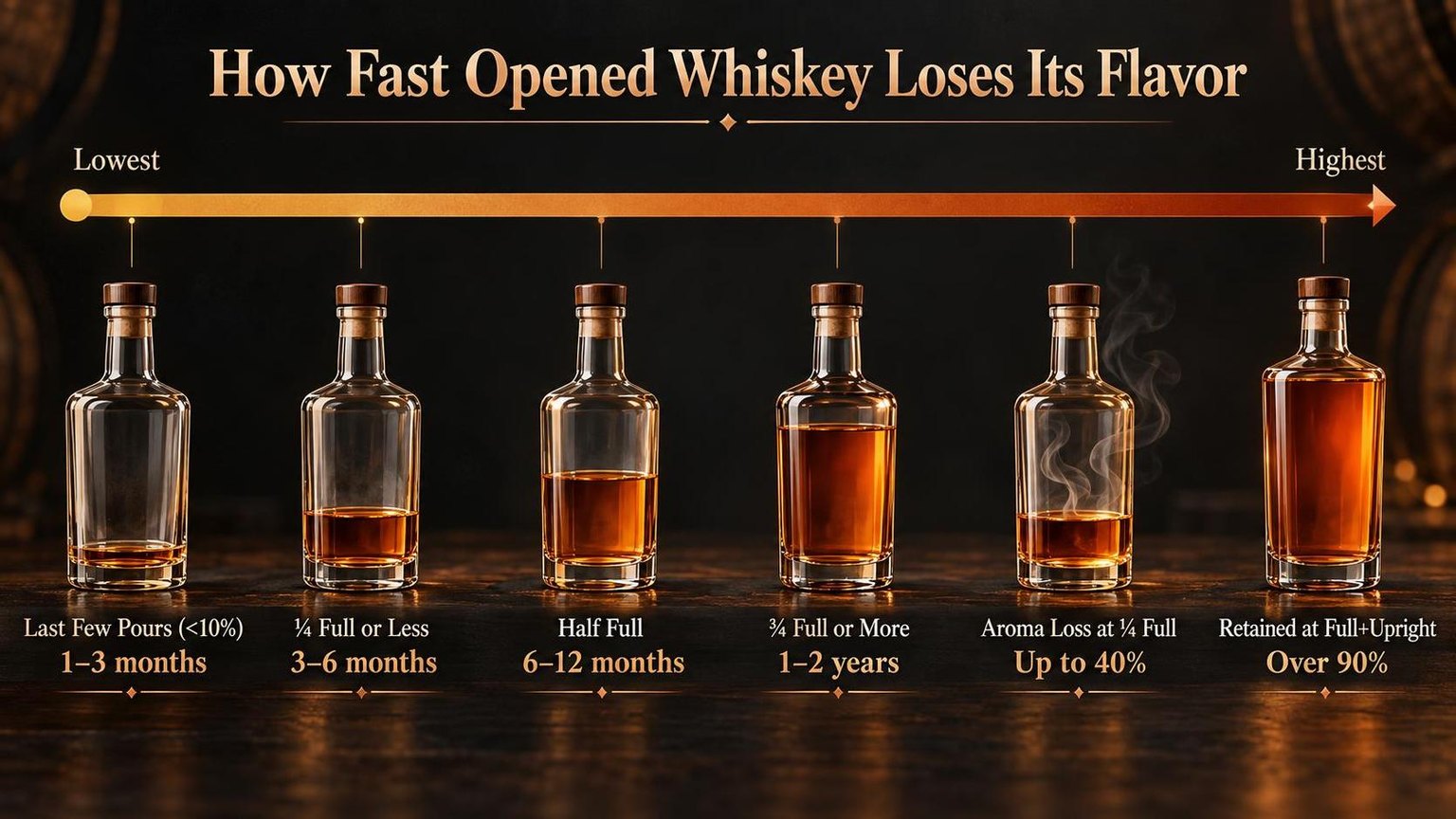
| ¾ full or more | Up to 1–2 years | Minimal oxidation; slow flavor shift |
| ½ full | 6–12 months | Noticeable aroma loss; muted mid-palate |
| ¼ full or less | 3–6 months | Significant flattening; cardboard or stale notes |
| Last few pours (under 10%) | 1–3 months | Rapid degradation; pronounced off-flavors |
The ratio of air to liquid determines the oxidation rate. A nearly empty bottle exposes whiskey to far more oxygen per milliliter than a full one.
Signs Your Opened Whiskey Has Degraded
- Muted nose: Aromas that once jumped from the glass become faint or absent
- Flat palate: Complexity collapses into a one-dimensional, alcohol-forward taste
- Off-notes: Cardboard, wet paper, or overly sharp solvent-like qualities appear
- Color change: Slight fading can occur with prolonged light exposure alongside oxidation
Temperature swings accelerate these reactions. Storing an open bottle near a stove or in direct sunlight speeds evaporation of ethanol and aromatic volatiles measurably.
A 2019 analysis by the Scotch Whisky Research Institute confirmed that bottles stored upright with minimal headspace retained over 90% of their original volatile compound profile after 12 months.
Bottles stored one-quarter full lost up to 40% of key aromatic esters in the same period.
Opened whiskey won’t harm you, but it won’t deliver the experience the distiller intended once oxidation takes hold.
How Long Opened Whiskey Lasts
Opened whiskey doesn’t spoil like milk or wine, but it does degrade. Oxidation and evaporation progressively alter flavor, aroma, and alcohol content once the seal is broken.
The rate of degradation depends primarily on how much liquid remains in the bottle. More air in the headspace accelerates oxidation.
| Bottle Fill Level | Estimated Shelf Life (Opened) | Flavor Impact |
| ¾ full or more | Up to 1–2 years | Minimal change; subtle softening |
| ½ full | 6–12 months | Noticeable muting of top notes |
| ¼ full or less | 3–6 months | Significant flattening; possible off-notes |
| Last 1–2 oz (a “heel”) | 1–3 months | Marked deterioration; stale, cardboard-like quality |
These estimates assume storage at room temperature (60–70 °F / 15–21 °C), upright, and away from direct sunlight.
What Actually Happens Inside the Bottle
Ethanol reacts with oxygen to form acetaldehyde, which at low concentrations adds fruity notes but at higher levels creates a sharp, solvent-like taste.
Volatile aromatic compounds — responsible for a whiskey’s nose — evaporate first because they have lower boiling points than ethanol itself.
A nearly empty 750 ml bottle contains roughly 600 ml of air. That volume of oxygen can meaningfully shift the chemical profile within weeks, not months.
Key Factors That Shorten or Extend Shelf Life
- Temperature swings: Repeated cycling between warm and cool conditions pumps air in and out of the bottle, accelerating oxidation.
- Alcohol proof: Higher-proof whiskeys (cask strength, typically 50–65% ABV) resist degradation slightly longer than 40% ABV bottlings because ethanol acts as a preservative.
- Cork vs. screw cap: Natural cork allows trace oxygen exchange even when sealed; screw caps provide a tighter barrier.
- Light exposure: UV radiation breaks down flavor-active congeners such as vanillin and lignin derivatives absorbed during barrel aging.
Whiskey never becomes unsafe to drink after opening. The 40%+ ABV prevents bacterial or mold growth. The concern is purely qualitative — a $60 bourbon left at one-quarter full for a year won’t taste like the bottle you first opened.
For bottles you plan to nurse slowly, decanting into a smaller container minimizes headspace and preserves character significantly longer.
Why Oxygen Changes Whiskey Flavor
Oxidation is the primary chemical reaction that alters opened whiskey. Ethanol and congeners react with dissolved oxygen, producing aldehydes and carboxylic acids that shift aroma and taste.
This process accelerates as the bottle empties and the headspace ratio increases.
The Chemistry Behind Oxidation
Ethanol (C₂H₅OH) oxidizes first into acetaldehyde, then into acetic acid. Both compounds carry sharp, vinegar-like notes that mask the softer vanilla and caramel flavors originally extracted from charred oak during barrel aging.
Volatile phenols—responsible for smoky and spicy character in peated Scotch or high-rye bourbon—are particularly susceptible. They degrade into less aromatic compounds within months of consistent air exposure.
Headspace Ratio and Degradation Speed
The volume of air trapped above the liquid (headspace) directly controls oxidation rate. A nearly full bottle degrades slowly; a quarter-full bottle deteriorates noticeably within 6–12 months.
| Bottle Fill Level | Approximate Headspace | Noticeable Flavor Change |
| Full (sealed, just opened) | ~5% | Minimal over 1–2 years |
| Three-quarters full | ~25% | Subtle shifts in 12–18 months |
| Half full | ~50% | Detectable in 6–12 months |
| Quarter full or less | ~75%+ | Significant in 2–6 months |
Other Contributing Factors
- Temperature fluctuations: Heat above 25 °C (77 °F) accelerates molecular movement and reaction rates, roughly doubling oxidation speed for every 10 °C increase.
- Light exposure: UV radiation breaks down terpenes and esters, causing “light-struck” off-flavors—particularly in bottles stored near windows.
- Proof level: Higher-ABV whiskeys (cask strength, 50–65% ABV) resist microbial spoilage but still undergo oxidation at comparable rates to standard 40% ABV expressions.
Whiskey never becomes unsafe to drink after opening. The 40%+ alcohol content prevents pathogen growth. The concern is strictly flavor degradation—loss of complexity, muted aromatics, and emerging sharpness.
Transferring remaining whiskey into a smaller glass bottle minimizes headspace. This single step is the most effective way to slow oxidation after opening.
Does Whiskey Expire After Opening
Whiskey does not expire in the sense that it becomes unsafe to drink, but it absolutely degrades in quality after opening. Oxidation begins the moment air enters the bottle, altering flavor compounds over weeks and months.
Unlike wine, whiskey’s high alcohol content (typically 40–65% ABV) prevents bacterial growth or spoilage that would make it dangerous. The concern is flavor deterioration, not food safety.
How Oxidation Changes Whiskey
Oxygen reacts with volatile flavor compounds—esters, aldehydes, and phenols—that define a whiskey’s character. These reactions accelerate as the bottle empties and the air-to-liquid ratio increases.
A bottle that is three-quarters full retains its profile for roughly 12 months. A bottle one-quarter full or less can noticeably change within 3–4 months.
| Fill Level | Approximate Quality Window | Primary Risk |
| 75–100% full | 12–18 months | Minimal oxidation |
| 50–75% full | 6–12 months | Gradual flavor flattening |
| 25–50% full | 3–6 months | Noticeable loss of complexity |
| Below 25% full | 1–3 months | Significant flavor degradation |
Other Factors That Accelerate Decline
- Heat exposure: Temperatures above 25°C (77°F) speed up evaporation and chemical reactions, hastening flavor loss.
- Direct sunlight: UV rays break down tannins and congeners, causing stale, cardboard-like off-notes.
- Loose or damaged cork: A poor seal allows continuous air exchange, compounding oxidation far beyond normal levels.
- Frequent opening: Each uncorking introduces fresh oxygen; bottles opened daily degrade faster than those accessed monthly.
What Degraded Whiskey Tastes Like
Oxidized whiskey typically loses its top notes first—fruity esters and floral aromas fade. What remains is a flat, overly woody, or slightly bitter profile with muted complexity.
Peated Scotch whiskies can lose their signature smokiness within 6 months at low fill levels. High-proof bourbons (50%+ ABV) tend to resist oxidation slightly longer due to their elevated alcohol concentration.
The bottom line: an opened bottle is a ticking clock. Drink it within a reasonable window or transfer the remaining liquid to a smaller container to minimize headspace.
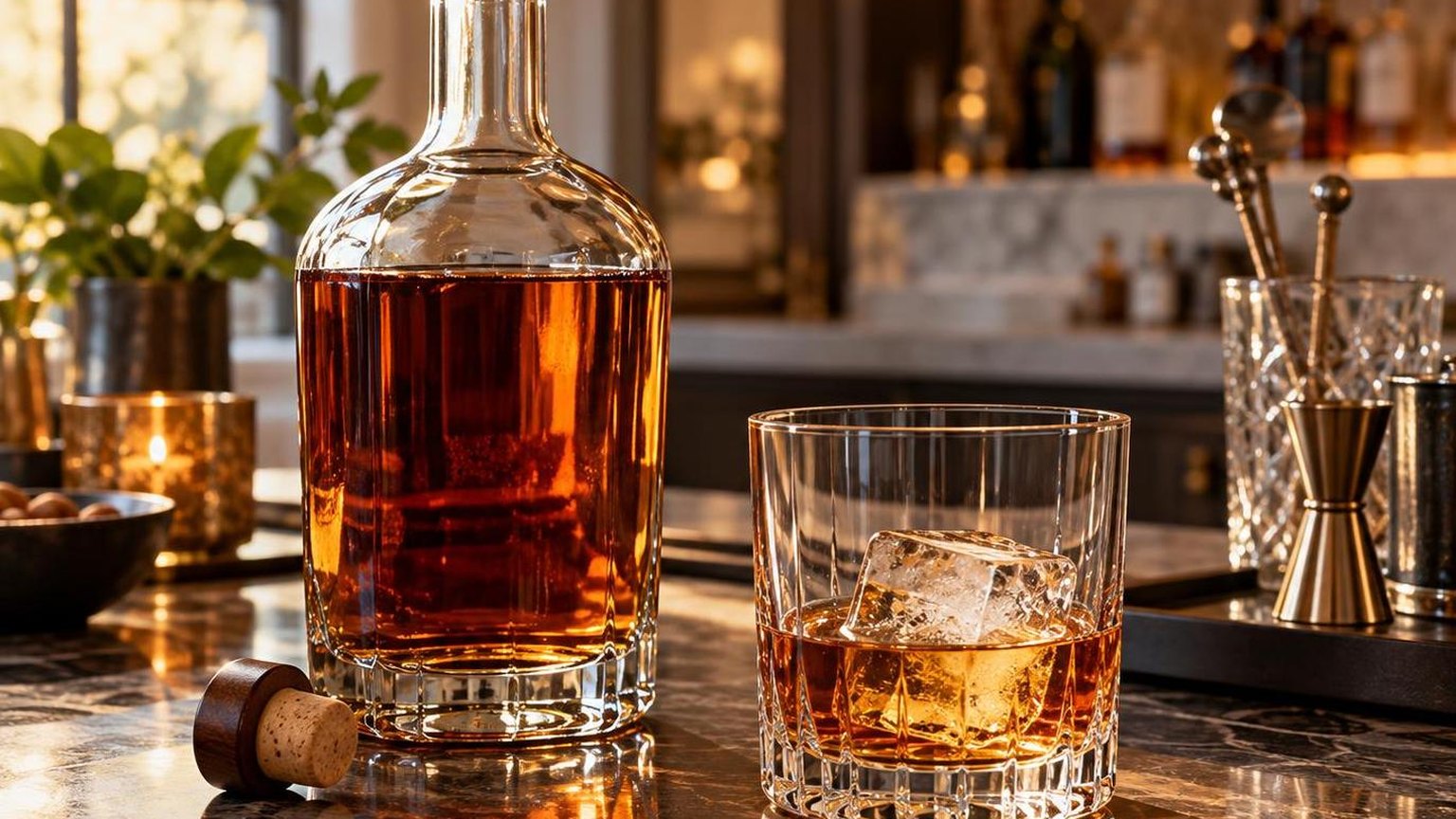
Signs Opened Whiskey Has Degraded
Opened whiskey doesn’t spoil like milk or meat, but it does degrade. Oxidation alters flavor compounds over months, and evaporation—the so-called “angel’s share”—concentrates or diminishes what remains.
Recognizing degradation early prevents serving a subpar pour.
Aroma Changes
A freshly opened bourbon or Scotch delivers defined nose notes: vanilla, caramel, smoke, fruit. Degraded whiskey loses those top notes first because volatile esters and aldehydes oxidize rapidly once exposed to air.
- Flat or cardboard-like smell — indicates oxidation of aromatic esters
- Nail-polish or solvent sharpness — signals ethyl acetate concentration shift
- Musty or damp cork odor — suggests cork taint from 2,4,6-trichloroanisole (TCA)
Flavor Degradation
Taste follows aroma. Whiskey stored one-quarter full for 6–12 months often develops noticeable flavor loss. The higher the oxygen-to-liquid ratio, the faster compounds break down.
| Bottle Fill Level | Estimated Degradation Timeline |
| 75–100% full | 12–24 months before noticeable change |
| 50–75% full | 6–12 months |
| 25–50% full | 3–6 months |
| Below 25% full | 1–3 months |
These timelines assume room-temperature storage away from direct sunlight. Heat and UV light accelerate degradation significantly.
Visual Indicators
Color shifts are subtle but real. Prolonged UV exposure breaks down tannins and lignin-derived compounds, causing lighter-colored whiskeys to fade. Darker whiskeys may develop a slightly duller hue over time.
- Floating particles or sediment — rare but possible if cork has deteriorated
- Oily film on surface — can indicate contamination from a degraded seal or stopper
- Lowered fill level without consumption — evaporation through a loose closure, losing both ethanol and water at roughly 2–4% volume per year in poorly sealed bottles
The Safety Bottom Line
Degraded whiskey at 40% ABV remains safe to drink. Alcohol at that concentration inhibits bacterial and mold growth. The issue is quality, not safety—flat whiskey won’t harm you, but it won’t deliver the experience you paid for.
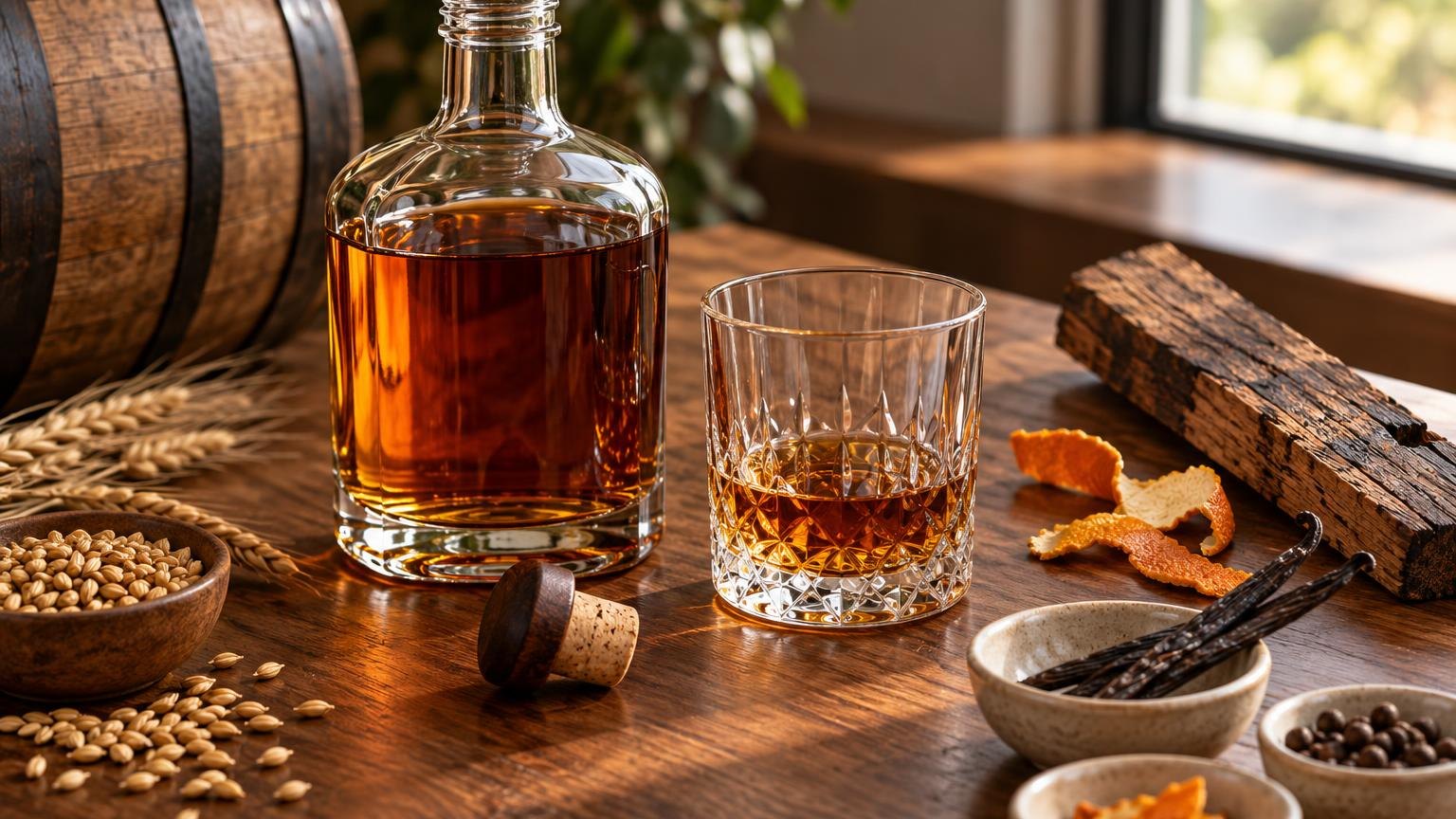
Proper Storage for Opened Whiskey
Opened whiskey doesn’t spoil like milk, but oxidation steadily degrades its flavor profile. Controlling exposure to air, light, and temperature fluctuations is the most effective way to preserve quality after breaking the seal.
Key Storage Conditions
| Factor | Ideal Condition | Why It Matters |
| Temperature | 15–20°C (59–68°F) | Heat accelerates oxidation and ethanol evaporation |
| Light exposure | Zero direct sunlight | UV rays break down terpenes and congeners that create flavor |
| Bottle orientation | Upright only | High-proof alcohol (40%+ ABV) degrades natural cork on contact |
| Headspace (air in bottle) | Minimize | More air means faster oxidation; a bottle one-quarter full deteriorates noticeably within 1–2 months |
Practical Techniques
- Transfer to a smaller bottle. When a 750 ml bottle drops below one-third full (~250 ml remaining), decant into a clean 200 ml or 375 ml glass bottle. This reduces the oxygen-to-whiskey ratio dramatically.
- Use inert gas sprays. Products like Private Preserve inject argon and nitrogen—heavier-than-air, non-reactive gases—to create a protective blanket above the liquid. One 2-second spray per session is sufficient.
- Reseal tightly after every pour. A loose cap allows continuous micro-oxidation. Parafilm wrap around the closure adds an extra barrier.
- Avoid the kitchen. Stovetop heat and humidity fluctuations make kitchens the worst room for spirits storage. A hallway closet or interior cabinet maintains steadier conditions.
How Long Opened Whiskey Lasts
| Fill Level | Expected Quality Window |
| 75–100% full | Up to 2 years |
| 50–75% full | Approximately 6–12 months |
| 25–50% full | 3–6 months |
| Below 25% full | 1–2 months |
These timelines assume proper upright storage at stable, moderate temperatures away from sunlight. Poor conditions shorten each window significantly.
Whiskey at 40% ABV or higher won’t harbor bacteria or become unsafe. The concern is strictly flavor loss—flattened aroma, diminished complexity, and a harsher finish as volatile compounds escape and oxidation products accumulate.
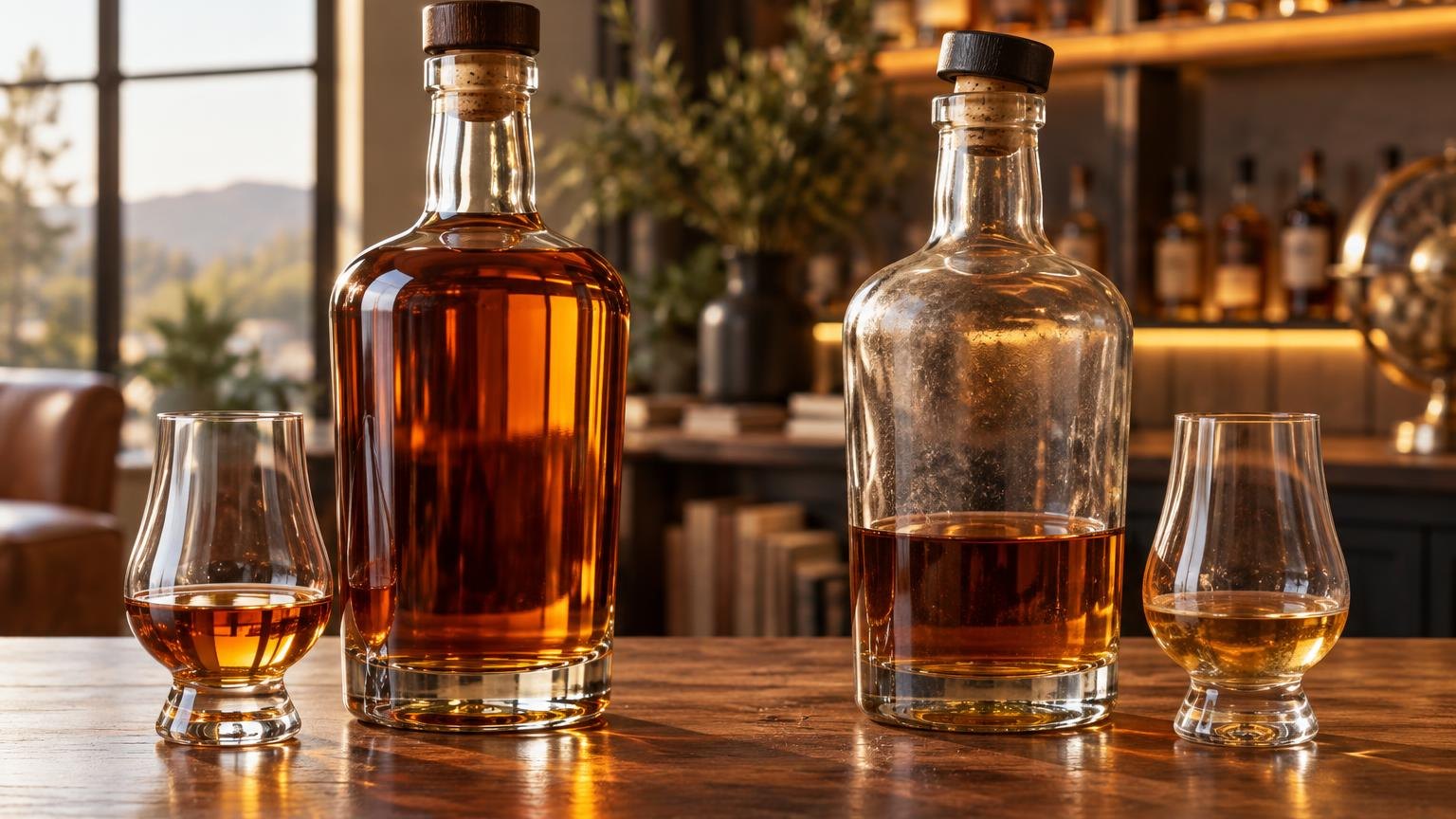
When to Keep or Discard It
Not every opened bottle deserves a spot on your shelf. Knowing when whiskey remains enjoyable versus when it has deteriorated saves you from serving subpar pours to guests—or yourself.
Quick Reference: Keep vs. Discard
| Condition | Action | Reasoning |
| Opened < 6 months, stored upright, 50%+ full | Keep | Minimal oxidation; flavor profile largely intact |
| Opened 6–12 months, ¼ to ½ full | Taste-test first | Noticeable oxidation likely; may taste flat or muted |
| Opened 1–2 years, less than ¼ full | Discard or cook with | Significant air exposure degrades volatile aroma compounds |
| Opened 2+ years, any fill level | Discard | Flavor loss is substantial; ethanol evaporation accelerates |
| Any age, visible particles or off smell | Discard immediately | Contamination risk from improper sealing or storage |
Signs It’s Still Good
- Aroma retains characteristic notes—vanilla, caramel, oak, or smoke depending on the expression.
- Color remains consistent with what you remember when first opened.
- Taste delivers the expected warmth and complexity without harsh chemical or cardboard-like flavors.
Signs It Has Turned
- Flat, dull nose with little detectable aroma—volatile compounds like ethyl acetate and isoamyl alcohol have evaporated.
- Noticeably lighter color, indicating prolonged light exposure or oxidation of congeners.
- Taste is thin, papery, or overtly harsh without the balancing sweetness and depth.
- Musty or paint-like off-notes, which can develop when a compromised cork contaminates the spirit.
The Fill-Level Rule
Air-to-liquid ratio is the single biggest factor. A bottle that is 75% full contains roughly 187 mL of air in a standard 750 mL bottle. At 25% full, that jumps to approximately 562 mL—tripling oxidation surface contact.
Transfer whiskey below the one-third mark into a smaller 200 mL or 375 mL bottle. This reduces headspace dramatically and can extend drinkable life by several additional months.
Whiskey won’t make you sick after opening—the 40%+ ABV prevents bacterial growth. The question is always quality, not safety. When it no longer brings pleasure, it has served its purpose.
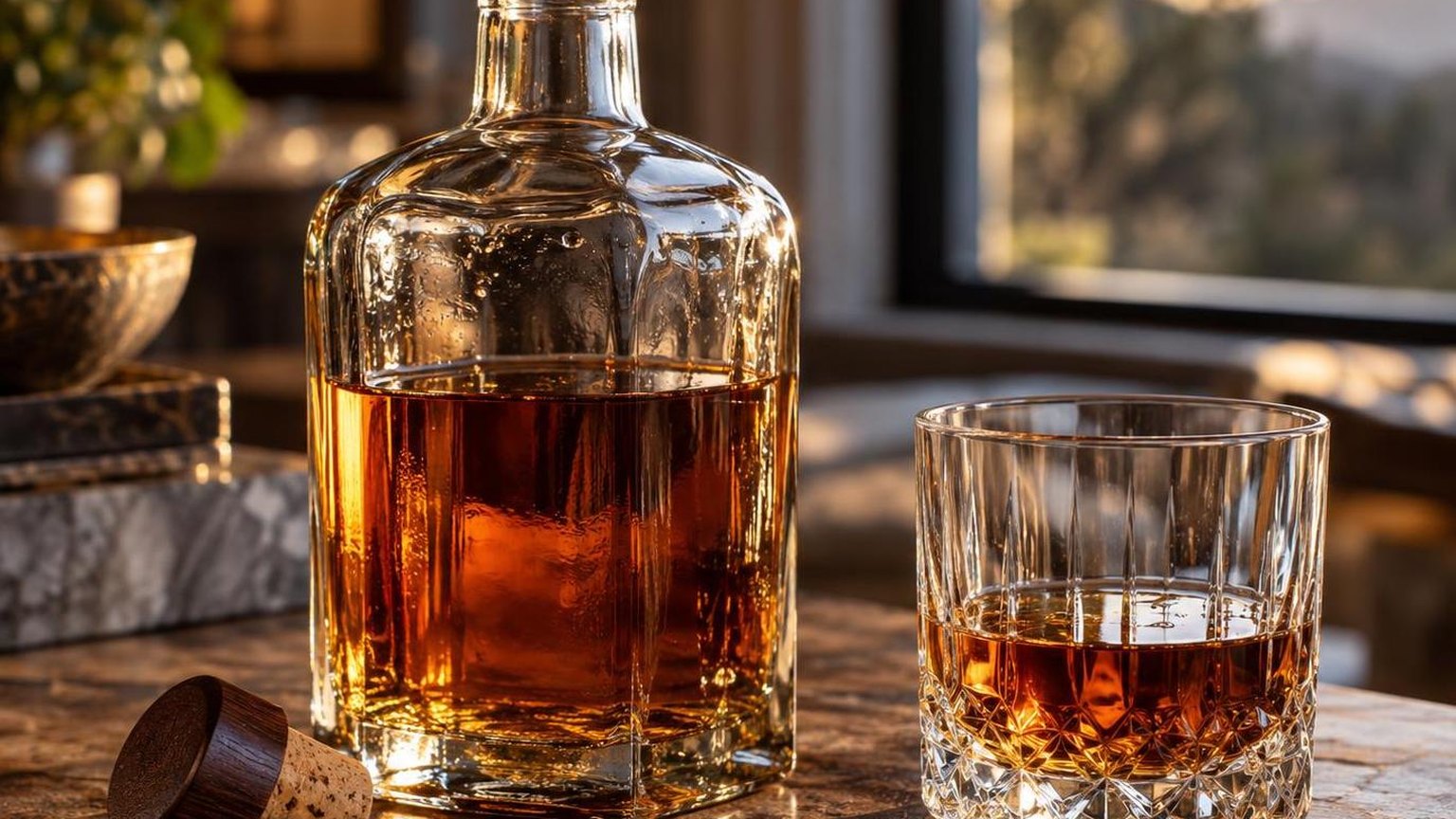
Frequently Asked Questions
Does opened whiskey expire or go bad?
Opened whiskey does not expire in the way perishable food does, but it degrades.
Oxidation alters flavor compounds once air enters the bottle, and most distillers note noticeable quality decline within 1–2 years of opening if stored at room temperature with the bottle less than half full.
How long does an opened bottle of whiskey last?
A bottle that is more than two-thirds full retains its intended flavor profile for roughly 1 year.
Once the fill drops below the halfway mark, the increased air-to-liquid ratio accelerates oxidation, and quality typically holds for only 3–6 months before flat, cardboard-like off-notes develop.
Can opened whiskey make you sick?
No. Whiskey’s 40%+ ABV prevents pathogenic bacterial growth, so an opened bottle will not become unsafe to drink.
The risk is strictly sensory—oxidized whiskey tastes duller and may develop bitter or stale notes, but it poses no food-safety hazard.
What causes opened whiskey to lose flavor?
The primary culprit is oxidation: oxygen reacts with volatile congeners—esters, aldehydes, and phenols—that define a whiskey’s aroma and taste.
Ethanol also evaporates slowly through an imperfect seal, concentrating heavier, less pleasant flavor compounds over time. UV light further degrades terpenes and color molecules if the bottle sits in direct sunlight.
Does the type of whiskey affect how fast it deteriorates after opening?
Yes. Higher-proof whiskeys (cask strength, 50–65% ABV) resist oxidation longer than standard 40% ABV bottlings because the elevated alcohol acts as a stronger solvent shield.
Peated Scotch whiskies, such as Laphroaig or Ardbeg, tend to show oxidation changes faster because their delicate smoky phenol compounds are particularly volatile and oxygen-sensitive.
Should I store opened whiskey upright or on its side?
Always upright. Unlike wine, whiskey’s high alcohol content degrades natural cork on prolonged contact, causing the seal to crumble and potentially introducing cork taint.
Storing upright minimizes the liquid-cork surface area while keeping the cork moist enough from vapor exposure to maintain a reasonable seal.
Will transferring whiskey to a smaller bottle slow deterioration?
Yes—this is one of the most effective preservation methods. Decanting the remaining whiskey into a smaller glass bottle with a tight seal reduces the headspace (air volume), which directly slows oxidation.
Aim to keep less than 1 inch of air above the liquid. Some collectors use inert gas sprays (private-preserve argon/nitrogen blends) to displace oxygen in the headspace for further protection.
Does refrigerating or freezing opened whiskey help preserve it?
Refrigeration slows oxidation marginally by reducing reaction kinetics, but it also mutes aromatic volatiles, making the whiskey harder to evaluate when cold.
Freezing is unnecessary—whiskey above 40% ABV won’t freeze in a standard home freezer (–18 °C), and temperature cycling between freezer and room temperature can stress the seal.
The better strategy is a cool (15–20 °C), dark cabinet with minimal headspace in the bottle.
Related Reading
- What To Mix With Baileys Irish Cream?
- Who Owns Howler Head Whiskey?
- How Is Scotch Made?
- What Is A Whiskey Sommelier? Facts To Know
- What Is A Jameson And Coke Called? Get the Answer
- All Alcohol Guides
- TTB – Alcohol and Tobacco Tax and Trade Bureau, U.S. Department of the Treasury (2023)
- FDA – CPG Sec 510.400 Dealcoholized Wine and Malt Beverages (2005)
- CDC – Alcohol and Public Health FAQs (2024)
- PubMed – "Changes in Whisky Composition During Maturation: Volatile Congeners" in Journal of the Institute of Brewing (2014)
- MasterClass – How to Store Whiskey: 4 Tips for Storing Whiskey (2021)
- Whisky Advocate – Does Whisky Go Bad Once You Open It? (2019)
- University of California Davis – Department of Viticulture and Enology: Oxidation in Alcoholic Beverages (2020)
- USDA FoodKeeper App – Distilled Spirits Storage Guidelines (2023)